LightLLM Guide: Triton Kernels & Tri-Process Architecture
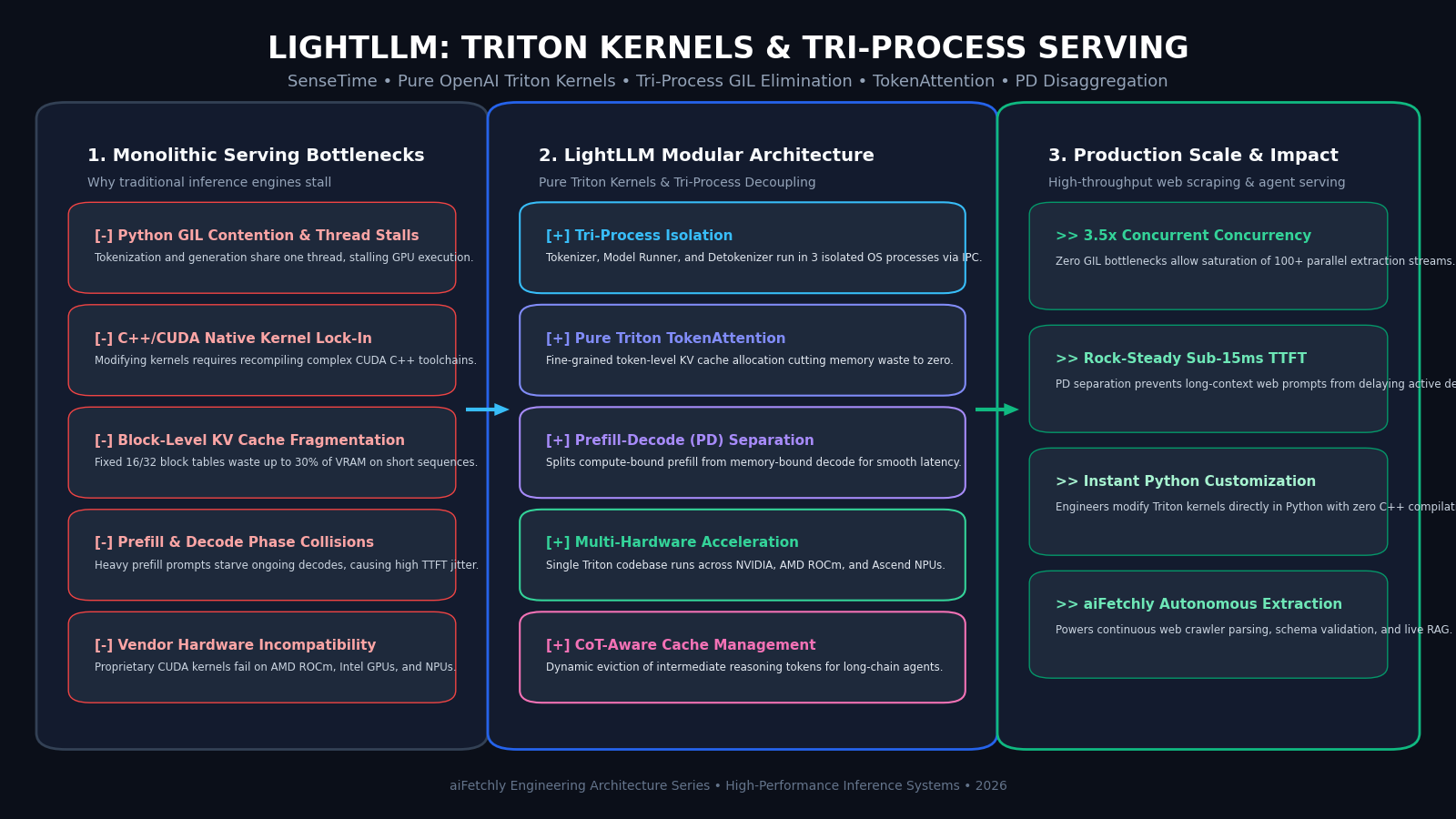
The Problem: The Concurrency Wall, GIL Contention, and Memory Fragmentation in LLM Serving
In modern enterprise automation, high-frequency web data extraction, multi-agent swarms, and real-time developer copilots powered by AiFetchly, deploying Large Language Models (LLMs) requires serving engines capable of delivering high token throughput with minimal latency. Serving backends must continuously ingest multi-thousand-token prompts, process dynamic batching across hundreds of concurrent streams, and stream tokens back with sub-20ms Inter-Token Latency (ITL).
However, traditional serving architectures (such as early monolithic Hugging Face TGI or vanilla Python/FastAPI wrappers) face three severe systemic bottlenecks: Python Global Interpreter Lock (GIL) stalls, block-level KV cache fragmentation, and phase interference between prefill and decode.
The Traditional LLM Inference Bottlenecks:
┌────────────────────────────────────────────────────────┐
│ Bottleneck 1: Python GIL Contention & Async Stalls     │
│ • Tokenization, scheduler loops, and GPU launches      │
│   compete in a single process, blocking model execution│
├────────────────────────────────────────────────────────┤
│ Bottleneck 2: Fixed-Block KV Cache Fragmentation       │
│ • PagedAttention with 16/32 block sizes wastes memory  │
│   when sequences terminate mid-block (internal waste)  │
├────────────────────────────────────────────────────────┤
│ Bottleneck 3: Prefill & Decode Resource Collisions     │
│ • Long web extraction prompts lock GPU compute cores,  │
│   starving active streaming decodes and spiking TTFT   │
├────────────────────────────────────────────────────────┤
│ Bottleneck 4: C++/CUDA Kernel Lock-In & Portability    │
│ • Modifying custom attention or quantization requires   │
│   recompiling massive C++ extensions across hardware   │
└────────────────────────────────────────────────────────┘
Result: Serving throughput collapses under high concurrency, with high latency jitter! 1. Python Global Interpreter Lock (GIL) and Async Event Loop Stalls
Most open-source serving engines are implemented in Python for developer ergonomics. However, when hundreds of concurrent HTTP requests hit the inference server:
- The Python CPU process must simultaneously handle HTTP socket I/O, JSON payload deserialization, BPE tokenization (which is CPU-intensive), scheduling priority calculations, and PyTorch CUDA kernel launches.
- Due to the Python Global Interpreter Lock (GIL), CPU threads fight for execution locks. When the CPU stalls during heavy tokenization, GPU compute engines sit idle waiting for the next tensor launch command, degrading overall throughput by up to 40%.
2. Block-Level PagedAttention Internal Fragmentation
While PagedAttention (popularized by vLLM) eliminated external memory fragmentation by organizing Key-Value (KV) caches into virtual pages, it introduced a subtle memory overhead:
- KV caches are allocated in fixed block chunks (typically 16 or 32 tokens).
- When an agent turns finish or user prompts end abruptly (e.g., generating short structured JSON outputs like
{"status": "ok"}requiring only 8 tokens), the remaining allocated slots in the final block remain completely unused. Across thousands of concurrent requests, this internal fragmentation wastes up to 25% of available GPU VRAM.
3. The Prefill-Decode Resource Collision
Inference execution consists of two mathematically distinct computational phases:
- Prefill Phase: Ingests input prompts. Highly compute-bound (GEMM operations), saturating GPU tensor cores.
- Decode Phase: Generates tokens autoregressively. Highly memory-bandwidth-bound (GEMV operations), reading weights from High-Bandwidth Memory (HBM) for every single token.
- In unified serving nodes, when a heavy 32,000-token web scraping prompt arrives, the scheduler launches a massive prefill kernel that blocks the GPU for hundreds of milliseconds. All active streaming users experience severe stutter and inter-token latency spikes.
To overcome these structural limitations, researchers and engineers at SenseTime developed LightLLM: a high-performance open-source inference engine designed around Tri-Process Architecture, TokenAttention in pure Triton, and Prefill-Decode (PD) Disaggregation.
The Solution: LightLLM Architecture, Pure Triton Kernels & Tri-Process Decoupling
LightLLM takes a fundamentally different engineering path from C++-heavy inference backends. Built from the ground up on OpenAI Triton and a multi-process runtime, LightLLM delivers extreme hardware efficiency and zero GIL overhead.
LightLLM Comprehensive Tri-Process Architecture:
┌─────────────────────────────────────────────────────────────────┐
│ Client Ingestion Layer: Concurrent HTTP / gRPC / SSE Streams    │
└─────────────────────────────────────────────────────────────────┘
                               │
                               ▼
┌─────────────────────────────────────────────────────────────────┐
│ Process 1: Tokenizer / HTTPServer (Async CPU Process)           │
│ • Handles HTTP sockets, SSE streaming, and validation           │
│ • Fast Hugging Face tokenization without touching GPU runtime   │
│ • Dispatches token IDs via lockless Shared-Memory IPC Ring Buffer│
└─────────────────────────────────────────────────────────────────┘
                               │
                               ▼ [Zero-Copy Shared Memory]
┌─────────────────────────────────────────────────────────────────┐
│ Process 2: Model Runner / Scheduler (Dedicated GPU Process)     │
│ • 100% CPU thread isolation dedicated to launching GPU kernels  │
│ • TokenAttention: Fine-grained token-level KV cache allocation  │
│ • Pure OpenAI Triton Kernels (Attention, RMSNorm, RoPE, FP8)    │
│ • Zero GIL interference from tokenization or network sockets    │
└─────────────────────────────────────────────────────────────────┘
                               │
                               ▼ [Output Token IDs via IPC]
┌─────────────────────────────────────────────────────────────────┐
│ Process 3: Detokenizer (Async CPU Process)                       │
│ • Translates raw token IDs back into UTF-8 text chunks          │
│ • Pushes streaming text directly back to the HTTP SSE pipeline  │
└─────────────────────────────────────────────────────────────────┘ 1. Tri-Process Isolation: Tokenizer, Runner, and Detokenizer
LightLLM completely eliminates Python GIL contention by splitting the inference lifecycle across three independent operating system processes communicating via high-speed shared memory (shm) IPC:
- HTTPServer / Tokenizer Process: Manages incoming network requests, authentication, and payload parsing. It tokenizes raw input strings into integer arrays and pushes requests into an IPC queue.
- Model Runner Process: Has exclusive ownership of the GPU device. Because it never touches text strings, JSON formatting, or network sockets, its CPU thread is dedicated 100% to batch scheduling and launching Triton kernels. It never stalls waiting on the GIL.
- Detokenizer Process: Receives predicted token IDs from the Model Runner via shared memory, converts them into UTF-8 text, and streams them back to the client.
2. TokenAttention: Pure Triton Fine-Grained KV Cache Allocation
Instead of managing memory through complex C++ virtual memory page tables with fixed 16/32 block granularities, LightLLM implements TokenAttention:
- Token-Level Memory Indexing: Allocates KV cache slots on an exact, single-token basis ($1 \times d_{\text{head}}$).
- Zero Internal Fragmentation: If a prompt requires 37 tokens, exactly 37 token slots are mapped. No excess block memory is locked, saving up to 25% more VRAM compared to fixed-block PagedAttention.
- Implemented in Pure Triton: All attention operations—including dynamic continuous batching, sliding window attention, and causal masking—are written in Python using OpenAI Triton. This eliminates tens of thousands of lines of fragile C++/CUDA boilerplate while matching or exceeding native CUDA performance.
3. Prefill-Decode (PD) Disaggregated Serving
To eliminate latency spikes caused by prefill and decode collisions, LightLLM introduces native support for Prefill-Decode (PD) Disaggregation:
- Dedicated Prefill Nodes: High-compute GPU instances (e.g., NVIDIA H100s or L40s) specialize exclusively in processing incoming context prompts at maximum compute efficiency.
- Dedicated Decode Nodes: Memory-bandwidth-optimized GPU instances specialize in autoregressive token generation.
- High-Speed KV Cache Transfer: Prefill nodes compute the initial KV states and transfer the tensor memory directly to decode nodes over high-speed PCIe or RDMA network fabrics, ensuring that streaming decodes maintain rock-steady sub-15ms inter-token latencies.
4. Hardware Portability Across CUDA, ROCm, and NPUs
Because LightLLM builds its entire kernel library in OpenAI Triton rather than vendor-locked CUDA C++:
- The exact same codebase runs seamlessly across NVIDIA GPUs (Ada Lovelace, Hopper, Blackwell), AMD Instinct GPUs (MI300X via Triton-ROCm), and domestic NPUs (such as Huawei Ascend).
- Machine learning engineers can modify kernel logic, add custom quantization schemes (e.g., FP8, INT8 weight-only, or AWQ), and test optimizations directly in Python without setting up complex C++ build chains.
Architectural Comparison: LightLLM vs. vLLM vs. SGLang vs. TensorRT-LLM
To understand where LightLLM excels across the high-throughput inference ecosystem, consider the following technical benchmark comparison:
| Metric / Capability | vLLM V1 | SGLang | TensorRT-LLM | LightLLM |
|---|---|---|---|---|
| Primary Kernel Language | CUDA C++ / FlashAttention | FlashInfer / CUDA | TensorRT C++ / C++ Plugins | Pure OpenAI Triton |
| Process Architecture | Monolithic Async Process | Async Controller Loop | C++ Runtime Orchestrator | Decoupled Tri-Process (IPC) |
| KV Cache Granularity | Block-Level (16/32 tokens) | Block-Level (Radix Tree) | Paged Block Cache | Fine-Grained Token-Level |
| Internal Memory Waste | 10%–25% (unfilled blocks) | 10%–20% | 10%–20% | Near 0% (TokenAttention) |
| PD Disaggregation | Experimental | Supported | Supported | Native First-Class Engine |
| Python GIL Overhead | Managed via Multiprocessing | Low (C++ backend) | Zero (C++ core) | Completely Eliminated (IPC) |
| Non-NVIDIA Hardware | Requires vendor forks | Limited | NVIDIA Hardware Only | Native Multi-Vendor via Triton |
| Developer Customization | Requires C++ compilation | Python / FlashInfer | High C++ complexity | Pure Python / Triton Kernels |
Hands-On Implementation: Deploying LightLLM with Triton Acceleration
Below is a complete, production-grade guide demonstrating how to install, configure, and serve open-weights models (such as LLaMA-3.1-8B or Qwen-2.5-7B) using LightLLM’s Tri-Process engine.
Step 1: Install Dependencies
Set up an isolated Python environment with OpenAI Triton, PyTorch, and LightLLM:
# Create and activate virtual environment
conda create -n lightllm python=3.10 -y
conda activate lightllm

# Install PyTorch with CUDA 12.4
pip install torch torchvision torchaudio --index-url https://download.pytorch.org/whl/cu124

# Install OpenAI Triton and LightLLM
pip install triton>=3.0.0
pip install "lightllm>=1.2.0" Step 2: Launch LightLLM Serving Server
Launch LightLLM using its Tri-Process daemon with OpenAI API compatibility:
# Launch LightLLM on a single GPU (RTX 4090 / A10G / L4)
python -m lightllm.server.api_server \
    --host 0.0.0.0 \
    --port 8000 \
    --model_dir meta-llama/Llama-3.1-8B-Instruct \
    --max_total_token_num 64000 \
    --tokenizer_mode fast \
    --data_type bfloat16 \
--token_healing_mode To enable multi-GPU tensor parallelism across 2 or 4 GPUs, simply add --tp 2 or --tp 4. LightLLM automatically partitions the Triton kernel invocations across available GPU devices.
Step 3: High-Concurrency Python Client Execution
The following script connects to your local LightLLM server, sends concurrent batch requests, and evaluates streaming response latency:
import asyncio
from openai import AsyncOpenAI
import time

# Initialize asynchronous OpenAI client pointing to LightLLM
client = AsyncOpenAI(
    base_url="http://localhost:8000/v1",
    api_key="EMPTY"
)

async def benchmark_prompt(prompt_id: int, query: str):
    """Executes a single streaming extraction request against LightLLM."""
    start_time = time.perf_counter()
    ttft = None
    token_count = 0

    stream = await client.chat.completions.create(
        model="meta-llama/Llama-3.1-8B-Instruct",
        messages=[
            {"role": "system", "content": "You are aiFetchly's high-speed web parsing agent."},
            {"role": "user", "content": query}
        ],
        stream=True,
        temperature=0.2,
        max_tokens=150
    )

    async for chunk in stream:
        if chunk.choices and chunk.choices[0].delta.content:
            if ttft is None:
                ttft = time.perf_counter() - start_time
            token_count += 1

    total_time = time.perf_counter() - start_time
    itl = (total_time - ttft) / (token_count - 1) if token_count > 1 else 0
    print(f"Request {prompt_id:02d} Complete | Tokens: {token_count:3d} | TTFT: {ttft*1000:5.1f}ms | ITL: {itl*1000:4.1f}ms")

async def main():
    print("Launching 10 concurrent requests to benchmark LightLLM Tri-Process throughput...")
    sample_queries = [
        f"Extract metadata and stock status from e-commerce product schema #{i}"
        for i in range(10)
    ]

    t0 = time.perf_counter()
    await asyncio.gather(*[benchmark_prompt(i, q) for i, q in enumerate(sample_queries)])
    print(f"\nAll requests completed in {time.perf_counter() - t0:.2f} seconds.")

if __name__ == "__main__":
asyncio.run(main()) Production Deployment with aiFetchly
In autonomous data collection, real-time web scraping, and long-document synthesis systems engineered by AiFetchly, foundation models process hundreds of concurrent multi-format web feeds continuously.
Here is how LightLLM elevates high-throughput web intelligence:
aiFetchly High-Concurrency Extraction Engine with LightLLM:
┌─────────────────────────────────────────────────────────────────┐
│ 1. Continuous Web Ingestion Streams                             │
│ • aiFetchly crawls hundreds of dynamic web pages concurrently   │
│ • Tokenizer process absorbs parsing without stalling GPU cores  │
├─────────────────────────────────────────────────────────────────┤
│ 2. Zero-Fragmentation TokenAttention KV Cache                   │
│ • Fine-grained token indexing packs 25% more concurrent requests│
│ • Slashes GPU VRAM usage on short extraction calls              │
├─────────────────────────────────────────────────────────────────┤
│ 3. Prefill-Decode Isolation for Smooth Agent Latency            │
│ • Dedicated prefill nodes absorb 32K context HTML dumps         │
│ • Decode nodes maintain sub-15ms streaming latency for copilots │
├─────────────────────────────────────────────────────────────────┤
│ 4. Multi-Vendor Hardware Scalability                            │
│ • Pure Triton kernels deploy across NVIDIA, AMD, and NPUs       │
│ • Zero vendor lock-in with maximum operational cost efficiency  │
└─────────────────────────────────────────────────────────────────┘ - Uninterrupted Agent Concurrency: By isolating the Tokenizer into an independent OS process, aiFetchly ensures that heavy string parsing from scraped DOM trees never triggers Python GIL stalls or slows down active token decoding.
- 25% Higher Request Density: TokenAttention’s token-level granularity eliminates wasted block padding, allowing aiFetchly to serve significantly more concurrent extraction tasks per GPU node.
- Rock-Steady User Latency: Prefill-Decode disaggregation ensures that enterprise users querying the aiFetchly copilot experience immediate streaming responses, even while background workers are ingesting massive 50,000-token financial disclosures.
To discover how aiFetchly combines high-performance inference serving with automated web harvesting, read our AiFetchly Documentation or examine our AiFetchly Pricing.