LeRobot Guide: Open-Source AI for Real-World Robotics
The Problem: The Cost, Data, and Hardware Barriers in Physical Robotics
In recent years, artificial intelligence has fundamentally revolutionized digital software tasks. Foundational vision-language models, reasoning architectures, and autonomous agent loops like AiFetchly can analyze dense documents, refactor complex multi-file codebases, and automate web workflows. However, extending artificial intelligence beyond pixels and text into the physical world—enabling neural networks to manipulate physical objects, sort items, handle laboratory test tubes, or plug in cables—has long remained locked behind three massive systemic roadblocks:
The Traditional Robotics Bottleneck:
Goal: "Train a robotic arm to pick up an item, reorient it, and place it inside a box."
  │
  ▼
┌────────────────────────────────────────────────────────┐
│ Barrier 1: The $50,000+ Hardware Moat                  │
│ • Research arms (Franka Emika, UR5) cost $30k–$80k     │
│ • Complex industrial buses & specialized safety cages  │
│ ❌ Only elite university labs and tech giants can play │
└────────────────────────────────────────────────────────┘
  │
  ▼
┌────────────────────────────────────────────────────────┐
│ Barrier 2: The Compounding Error Trajectory Drift      │
│ • Classic behavioral cloning predicts 1 step at a time │
│ • State t ──► Action a_t ──► Execution                 │
│ ❌ Tiny error at step 5 causes drift at step 6; by     │
│    step 20, the arm is far off target and freezes!     │
└────────────────────────────────────────────────────────┘
  │
  ▼
┌────────────────────────────────────────────────────────┐
│ Barrier 3: The Data Silo and Fragmented Tooling Wall   │
│ • ROS / C++ drivers are notoriously complex to wire    │
│ • No universal dataset format or public pretrained hub │
│ ❌ Every lab reinvents teleoperation and training code  │
└────────────────────────────────────────────────────────┘ 1. The $50,000 Hardware Moat and Fragile Research Robots
Historically, executing robotics research required purchasing industrial collaborative robots (such as Franka Emika Panda or Universal Robots UR5) costing between $30,000 and $80,000 per manipulator. These systems require specialized high-voltage three-phase power, heavy steel mounting tables, proprietary real-time operating system (RTOS) kernels, and complex safety perimeters. As a result, software developers, startups, and student researchers were priced out of physical embodiment.
2. The Compounding Error Crisis in Single-Step Imitation Learning
When training neural networks to mimic human demonstrations, traditional behavioral cloning trains a policy $\pi_\theta(a_t \mid o_t)$ to predict a single instantaneous motor action $a_t$ (such as joint angle deltas) from the current visual observation $o_t$:
- Markovian Compounding Drift: In real physical execution, mechanical friction, camera frame drops, and motor backlash introduce subtle discrepancies between expected and actual positions.
- Out-of-Distribution Collapse: Because the model was trained only on successful human paths, once a small error nudges the arm slightly off-trajectory, the visual observation enters an unfamiliar state. The single-step policy makes an even worse decision, triggering an exponential cascade of compounding errors that causes the robot arm to stutter, collide with tables, or freeze.
3. The Lack of a Unified Dataset and Model Hub for Robotics
In Natural Language Processing and Computer Vision, the rapid acceleration of AI was catalyzed by standardized repositories like the Hugging Face Hub—allowing any developer to download a dataset, fine-tune a model with three lines of Python, and share weights globally. In robotics, however:
- Teleoperated trajectories were recorded in proprietary binary formats or custom ROS bags with bespoke coordinate frame conventions.
- There was no standardized open repository where researchers could share multi-view camera datasets, pre-trained visuomotor policies, and benchmark evaluation suites.
The Solution: Hugging Face LeRobot Platform Architecture
To solve these foundational hurdles and democratize physical robotics just as Transformers democratized NLP and Diffusers democratized generative vision, Hugging Face created LeRobot.
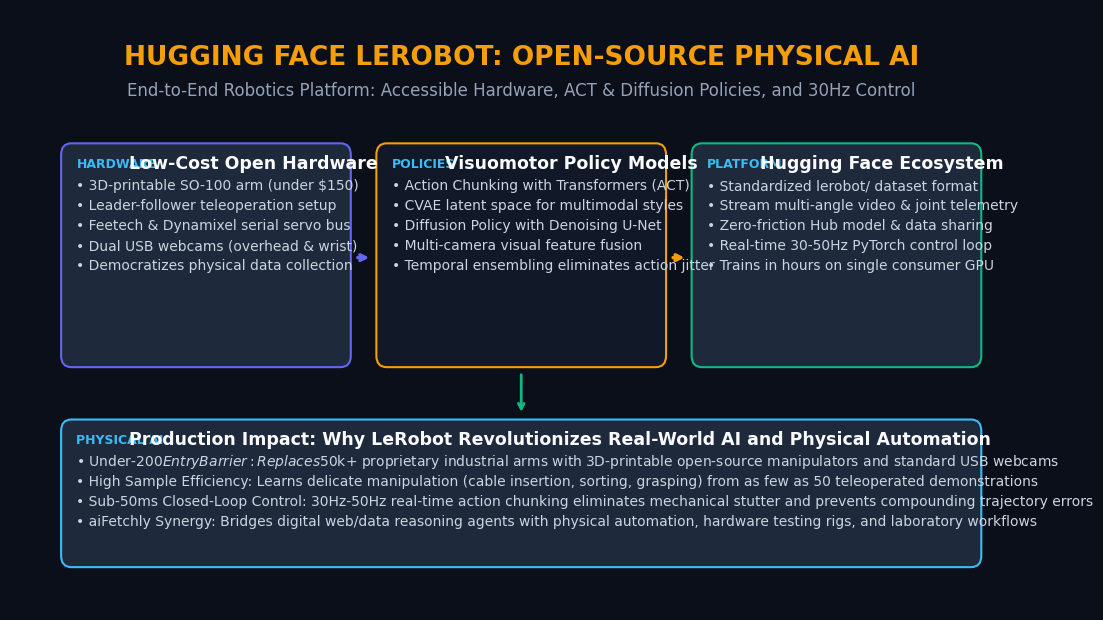
LeRobot is an open-source, end-to-end physical AI platform that bridges low-cost accessible hardware, high-performance imitation learning models, and the collaborative Hugging Face Hub ecosystem.
LeRobot System Architecture:
┌────────────────────────────────────────────────────────────────────────┐
│ 1. Accessible Physical Hardware (SO-100 / Koch / Aloha)                │
│ • Leader-Follower Teleoperation Setup (Under $150 per arm)             │
│ • Low-Latency Serial Bus (Feetech STS3215 / Dynamixel Bus)             │
│ • Dual Multi-View Webcams (Overhead Scene Camera + Wrist Gripper View) │
└───────────────────────────────────┬────────────────────────────────────┘
                                    │ Teleoperation Data Collection (30Hz)
                                    ▼
┌────────────────────────────────────────────────────────────────────────┐
│ 2. Standardized Hugging Face Hub Robotics Datasets (lerobot/ format)   │
│ • Synchronized multi-camera MP4/H.264 video streams                    │
│ • Timestamped joint angles, velocities, and torque telemetry in Parquet│
│ • One-click push/pull to Hugging Face Hub for collaborative training   │
└───────────────────────────────────┬────────────────────────────────────┘
                                    │ Batch DataLoader
                                    ▼
┌────────────────────────────────────────────────────────────────────────┐
│ 3. Visuomotor Policy Architectures (PyTorch Core)                      │
│ • Action Chunking with Transformers (ACT) + CVAE Latent Variable       │
│ • Diffusion Policy with Denoising Score-Matching U-Net                 │
│ • Multi-Camera ResNet / ViT Visual Feature Fusion                      │
│ • Temporal Ensembling: Predicts future chunks (e.g. k=100 actions)     │
└───────────────────────────────────┬────────────────────────────────────┘
                                    │ 30Hz-50Hz Closed-Loop Control Loop
                                    ▼
┌────────────────────────────────────────────────────────────────────────┐
│ 4. Autonomous Physical Execution                                       │
│ Smooth, jitter-free manipulation across cables, sorting, and grasping │
└────────────────────────────────────────────────────────────────────────┘ 1. Ultra-Low-Cost Open Hardware: The SO-100 3D-Printable Ecosystem
LeRobot is hardware-agnostic but pioneers ultra-accessible physical setups:
- The SO-100 Arm: Designed by The Robot Studio and Hugging Face, the SO-100 is an open-source 6-Degree-of-Freedom (6-DoF) robotic manipulator that can be 3D-printed on a standard desktop printer (such as a Bambu Lab P1S) for under $150 in total materials.
- Leader-Follower Teleoperation: Rather than requiring expensive VR headsets or industrial haptic pendants, the user holds a lightweight 3D-printed “leader” arm. Moving the leader physically mirrors motion to the “follower” arm while recording exact servo angles and multi-camera video at 30Hz.
- Accessible Actuators: Utilizes low-cost smart bus servos (like Feetech STS3215) that provide magnetic absolute encoders, temperature monitoring, and high-frequency serial feedback over standard USB.
2. State-of-the-Art Policy Architectures: ACT and Diffusion Policy
LeRobot natively implements modern visuomotor imitation learning algorithms:
- Action Chunking with Transformers (ACT): Replaces single-step action prediction with trajectory chunks (e.g., predicting the next 50 to 100 timesteps simultaneously) using a Conditional Variational Autoencoder (CVAE) and a transformer encoder-decoder backbone.
- Diffusion Policy: Formulates robot control as a continuous conditional denoising diffusion process, modeling complex multimodal action distributions (such as choosing whether to bypass an obstacle from the left or right).
3. The Standardized LeRobot Dataset and Hugging Face Hub Pipeline
LeRobot defines an open, standardized dataset format optimized for high-bandwidth robotics:
- Stores video streams as compressed H.264/MP4 files to prevent disk exhaustion.
- Stores numerical joint states, effort torques, and metadata in Apache Parquet files.
- Directly interfaces with the Hugging Face Hub via
lerobot.common.datasets.LeRobotDataset, enabling instant sharing, streaming, and version control across global research teams.
Deep Dive: Action Chunking with Transformers (ACT) vs. Diffusion Policy
Understanding how LeRobot eliminates compounding trajectory errors requires examining the mathematical mechanics of Action Chunking with Transformers (ACT) and Diffusion Policy.
Action Chunking with Transformers (ACT) Internal Pipeline:
Input: Multi-Camera Images (Overhead + Wrist) + Current Joint Angles q_t
  │
  ├─► [ResNet / ViT Vision Backbone] ──► Visual Tokens z_img
  └─► [Linear Joint Projection]      ──► Proprioception Token z_q
                                              │
  ┌───────────────────────────────────────────┴───────────────────────────┐
  │ CVAE Encoder (Training Only): Encodes human demonstration trajectory │
  │ Action Chunk A_t = [a_t, a_t+1, ..., a_t+k] ──► Latent style z ~ N(μ, σ)│
  └───────────────────────────────────────────┬───────────────────────────┘
                                              │
  ▼ [Transformer Decoder with Latent Variable z + Visual Tokens]
Generates Entire Action Chunk A_t = [a_t, a_t+1, ..., a_t+k] (k = 50-100 steps)
  │
  ▼ [Temporal Ensembling Overlap]
Weighted exponential averaging across overlapping predicted chunks
  │
  ▼
Smooth, high-frequency, jitter-free motor control signals sent to servos! 1. Action Chunking with Transformers (ACT) and CVAE Latent Modeling
Introduced by Tony Z. Zhao et al. (Stanford University), Action Chunking with Transformers (ACT) tackles the compounding error problem through two key innovations:
- Action Chunking ($k$-Step Horizon): Instead of generating single actions at each timestep, ACT predicts an entire chunk of future actions: $$A_t = [a_t, a_t+1, \dots, a_{t+k-1}] \in \mathbb{R}^{k \times d_a}$$ By grouping actions into contiguous chunks, the policy models temporal dependencies explicitly, effectively converting a non-Markovian process into a sequence modeling problem.
- Conditional Variational Autoencoder (CVAE): Human demonstrations exhibit multimodality (e.g., reaching for a cup at different speeds or approach angles). Training standard mean squared error (MSE) loss on multimodal data causes the model to output the blurry “average” of two paths, colliding with obstacles. ACT trains a CVAE encoder to map human trajectories into a low-dimensional Gaussian latent variable $z \sim \mathcal{N}(\mu, \Sigma)$. During inference, $z$ is set to the prior mean, conditioning the transformer decoder to generate a sharp, coherent trajectory.
2. Temporal Ensembling: Eliminating Trajectory Jitter and Discontinuities
If a robot executes an entire chunk of 50 actions open-loop without querying new visual feedback, it cannot react to dynamic changes (such as an object slipping). Conversely, if it restarts a new chunk at every step, motor commands may disagree at chunk boundaries, causing violent mechanical vibration.
LeRobot solves this via Temporal Ensembling:
- At every single timestep $t$, the policy queries the camera and predicts a fresh chunk of $k$ actions.
- At timestep $t$, the robot has multiple overlapping predictions from previous timesteps ($t-1, t-2, \dots, t-k$).
- LeRobot computes the executed action $a_t$ as an exponentially weighted average of all overlapping predictions: $$a_t = \frac{\sum_{i=0}^{m} w_i , a_{t \mid t-i}}{\sum_{i=0}^{m} w_i}, \quad w_i = \exp(-m \cdot i)$$
- This produces liquid-smooth physical motions while maintaining a closed-loop visual feedback rate of 30Hz to 50Hz.
3. Diffusion Policy: Multimodal Distribution Modeling with Denoising U-Net
Originating from Cheng Chi et al. (Columbia University / TRI), Diffusion Policy frames robot action generation as a conditional diffusion process:
- Rather than outputting actions directly through a deterministic feed-forward network, the model starts with random Gaussian noise $A^{(K)} \sim \mathcal{N}(0, I)$ and iteratively denoises it over $K$ steps using a 1D Temporal Convolutional Network (CNN) or Denoising U-Net conditioned on visual features.
- Diffusion Policy excels at complex contact-rich tasks (such as pushing T-shaped blocks or opening doors) where multiple valid continuous action trajectories exist simultaneously.
Technical Comparison: LeRobot Policy Models vs. Traditional Robotics Approaches
To evaluate where LeRobot fits across data efficiency, hardware costs, and real-time execution compared to legacy frameworks, consider this architectural breakdown:
| Metric / Feature | Classical Motion Planning (MoveIt / OMPL) | Traditional Behavioral Cloning (MLP / LSTM) | OpenVLA (7B Vision-Language-Action) | Hugging Face LeRobot (ACT / Diffusion) |
|---|---|---|---|---|
| Hardware Barrier | Requires precise $30k+ arms with exact CAD models | Custom setups, variable costs | High-end GPU servers (8x H100 or 4-bit edge) | Open 3D-printed arms (<$150 SO-100) |
| Visual Adaptability | Zero (relies on rigid geometric point clouds) | Low (fragile to lighting shifts & distractors) | High (web-scale zero-shot visual concepts) | High (multi-camera feature fusion) |
| Demonstrations Needed | N/A (analytic inverse kinematics) | 500–2,000+ demonstrations | Pretrained on 970k robot trajectories | 30–50 teleoperated demonstrations |
| Action Generation | Deterministic trajectory interpolation | Single-step $a_t$ (prone to compounding drift) | Discrete token generation (7 action tokens) | Continuous chunked trajectories ($k=50-100$) |
| Control Frequency | 100Hz–1000Hz (low-level motor joints) | 10Hz–20Hz (stutters under load) | 10Hz–15Hz (bounded by LLM token decoding) | 30Hz–50Hz (real-time closed loop) |
| Inference Hardware | Standard CPU | Standard CPU / Small GPU | 16 GB to 32 GB VRAM | Single consumer GPU (e.g. RTX 3060/4090) |
| Ecosystem & Sharing | Fragmented C++ / ROS packages | Ad-hoc Python repositories | Hugging Face Hub model weights | Unified Hub datasets, policies & telemetry |
Practical Implementation: Recording Data, Training, and Evaluating with LeRobot
Let us walk through the complete end-to-end workflow: installing LeRobot, calibrating leader-follower arms, recording a demonstration dataset, training an ACT policy, and running real-time autonomous inference.
Step 1: Installing LeRobot and Calibrating the SO-100 Hardware
Clone the official repository and install LeRobot with PyTorch and hardware driver support:
# Clone the LeRobot repository
git clone https://github.com/huggingface/lerobot.git
cd lerobot

# Create virtual environment and install dependencies
python -m venv .venv
source .venv/bin/activate
pip install -e ".[feetech]" Calibrate the motor limits for both leader and follower arms over the USB serial port:
# Calibrate follower arm (the manipulator that interacts with objects)
python lerobot/scripts/control_robot.py calibrate \
    --robot-type so_100 \
    --arm-type follower \
    --port /dev/ttyUSB0

# Calibrate leader arm (the manual controller held by the human)
python lerobot/scripts/control_robot.py calibrate \
    --robot-type so_100 \
    --arm-type leader \
--port /dev/ttyUSB1 Step 2: Teleoperating and Recording Demonstration Datasets
Connect two USB webcams (one for the wide workspace view, one attached to the follower wrist) and record 50 teleoperated episodes of a grasping task:
python lerobot/scripts/control_robot.py record \
    --robot-type so_100 \
    --fps 30 \
    --repo-id my-org/so100-pick-place-sponge \
    --num-episodes 50 \
    --run-compute-stats 1 \
--push-to-hub 1 During recording:
- Move the leader arm; the follower arm mimics the exact trajectory in real time.
- Press the right arrow key to start an episode.
- Successfully grasp the sponge, move it into the target container, and release the gripper.
- Press right arrow again to conclude and save the episode. LeRobot automatically compresses video streams, formats joint positions, and uploads the dataset to the Hugging Face Hub.
Step 3: Training an ACT Policy on a Single GPU
Train an Action Chunking with Transformers (ACT) policy using PyTorch and LeRobot’s modular training runner:
python lerobot/scripts/train.py \
    --policy.type act \
    --dataset.repo_id my-org/so100-pick-place-sponge \
    --env.type so_100_real \
    --output_dir outputs/train/act_so100_sponge \
    --training.batch_size 16 \
    --training.lr 1e-4 \
    --training.steps 100000 \
    --training.save_freq 10000 \
--device cuda On a consumer GPU (such as an NVIDIA RTX 4080 or 4090), 100,000 steps of ACT training complete in approximately 3 to 4 hours.
Step 4: Deploying Autonomous Real-Time Closed-Loop Control
Once training concludes, evaluate the trained policy on the physical SO-100 robot arm:
python lerobot/scripts/control_robot.py evaluate \
    --robot-type so_100 \
    --policy.path outputs/train/act_so100_sponge/checkpoints/last/pretrained_model \
--fps 30 The robot arm will autonomously stream live camera feeds into the ACT neural network, generate overlapping action chunks, apply temporal ensembling, and execute smooth closed-loop grasping in the real physical environment.
Production Best Practices: Bridging Digital Agents with Physical Robotics in aiFetchly
When architecting AI automation pipelines that bridge digital data extraction in AiFetchly with physical world execution, apply these core engineering principles:
1. Multimodal Camera Positioning and Latency Calibration
Visual feedback is the primary sensor for physical AI:
- Always configure at least two complementary camera angles: an overhead static camera to maintain global spatial context, and a wrist-mounted camera on the gripper to resolve micro-occlusions during fine contact.
- Verify USB bus bandwidth: running multiple high-resolution webcams on a single shared USB hub causes frame drops that desynchronize video frames from motor timestamps. Distribute cameras across independent USB host controllers.
2. Domain Randomization and Environmental Perturbation Testing
Real-world physical environments change continuously:
- During data collection and data augmentation, vary table textures, lighting intensity, and background distractor objects.
- Ensure the policy is evaluated under physical perturbations (e.g., lightly bumping the sponge while the robot approaches). Action chunking combined with 30Hz closed-loop visual updates enables the policy to recover autonomously if an object shifts.
3. Synergizing Digital Cognitive Agents with Physical Visuomotor Policies
A complete autonomous agent architecture operates across two complementary tiers:
- High-Level Cognitive Reasoning (System 2): Foundation models (like DeepSeek-V3 or Claude) and agent engines like aiFetchly perform high-level planning, inspect digital task queues, parse order forms, and emit structured sub-goals (e.g., “Locate component X on conveyor belt, verify serial number, and transfer to testing cradle”).
- Low-Level Visuomotor Control (System 1): Specialized visuomotor policies trained via LeRobot (ACT / Diffusion Policy) handle high-frequency (30Hz–50Hz) sensorimotor coordination, joint kinematics, and delicate physical contact without relying on slow internet APIs.
- This decoupled hierarchy delivers both broad intellectual reasoning and fast, reliable real-world manipulation.