LayerSkip Guide: Early Exit & Self-Speculative Decoding
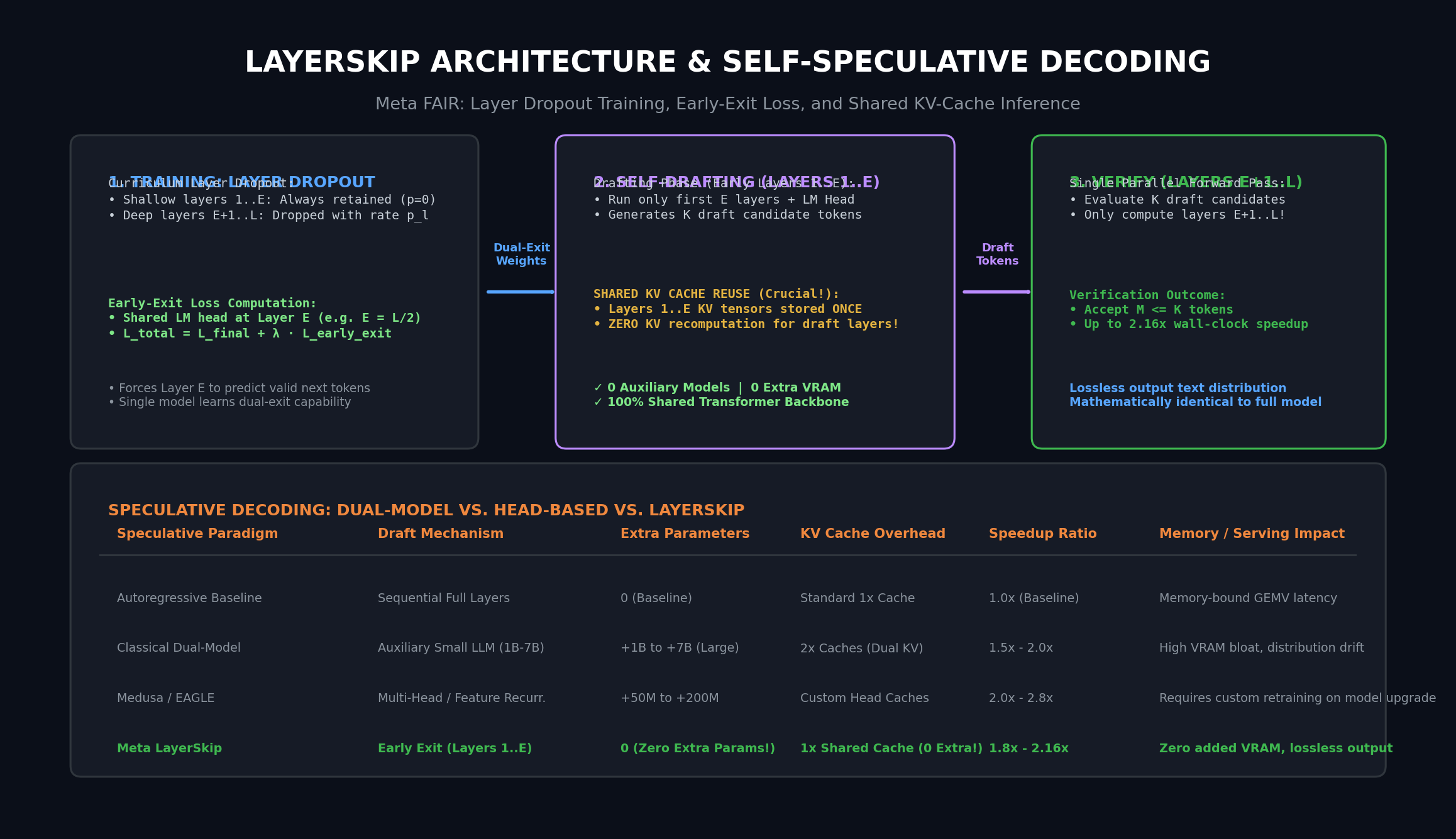
The Problem: The Memory-Compute Dichotomy in LLM Speculative Acceleration
In production generative AI systems, high-concurrency automated data pipelines, and local agent runtimes like AiFetchly, autoregressive Large Language Model (LLM) decoding is fundamentally throttled by the memory-bandwidth wall.
Because generating a single token requires reading every parameter weight and historical Key-Value (KV) cache vector from High-Bandwidth Memory (HBM) into on-chip cache:
$$\text{Decoding Arithmetic Intensity} \approx \frac{2 \times N_{\text{params}} \text{ FLOPs}}{2 \times N_{\text{params}} \text{ Bytes}} = 1.0 \text{ FLOP/Byte}$$
On modern AI accelerators (such as NVIDIA H100, RTX 4090, or Apple Silicon unified memory), tensor compute cores operate at less than 15% utilization during single-token decoding, stalled waiting for memory bus transfers.
1. The Multi-Model Memory Tax in Standard Speculative Decoding
To overcome this latency barrier, the industry developed Speculative Decoding (Leviathan et al., Chen et al.). By generating $K$ speculative tokens using a small, lightweight draft model and verifying them concurrently in a single forward pass of the large target model, systems achieve $1.5\times$ to $2.0\times$ speedups.
However, standard multi-model speculative decoding introduces three crippling operational drawbacks:
The Traditional Dual-Model Speculative Memory Penalty:
┌─────────────────────────────────────────────────────────────────┐
│ Target Model (e.g. Llama-3-70B): 140 GB VRAM                    │
│ + Target KV Cache (e.g. 64k Context): 32 GB VRAM                │
├─────────────────────────────────────────────────────────────────┤
│ Auxiliary Draft Model (e.g. Llama-3-8B): +16 GB VRAM            │
│ + Draft Model KV Cache (Separate Buffer): +8 GB VRAM            │
└─────────────────────────────────────────────────────────────────┘
Total Memory Tax: 24 GB of extra VRAM solely for speculation! - Dual Model Footprint: Co-hosting an auxiliary neural network requires gigabytes of additional GPU memory. In resource-constrained environments (like a single 24 GB or 16 GB GPU), hosting a secondary model is physically impossible.
- Distribution Mismatch: The auxiliary draft model is an independently trained neural network. Even when distilled from the target, its probability distribution inevitably drifts on specialized domain tasks, complex code syntax, and multi-step reasoning. Acceptance rates frequently plunge below 40%, degrading net generation speed.
- Hardware Topology Friction: On multi-GPU distributed nodes running Tensor Parallelism (TP), running a tiny 1B or 3B draft model across 8 GPUs results in severe communication overhead, as inter-GPU NVLink collective synchronization takes longer than the actual matrix multiplications.
2. The Separate KV Cache Dilemma and Synchronization Overhead
In conventional speculative decoding, the serving engine must maintain two completely separate Key-Value caches:
- The Target KV Cache, holding historical attention keys and values for all $L$ layers of the primary foundation model.
- The Draft KV Cache, holding keys and values for all $L_{\text{draft}}$ layers of the secondary model.
Whenever draft tokens are rejected during verification:
- The serving engine must roll back both caches, synchronizing page tables across two disjoint memory allocators.
- More importantly, none of the Key-Value activations computed by the draft model can be reused by the target model. Even when draft tokens are accepted, the target model must recompute all self-attention matrices from scratch.
Modern AI serving requires a more unified paradigm: Can an LLM act as its own draft model, reusing its own internal transformer layers and sharing its exact same KV cache?
The Architecture: How LayerSkip Unifies Training and Self-Speculation
Introduced by researchers at Meta FAIR (Mostafa Elhoushi, Shreyas Chaudhari, et al., ACL 2024 / 2025), LayerSkip is an end-to-end framework that turns any autoregressive transformer into a native self-speculative decoding engine.
LayerSkip solves the dual-model dilemma by addressing both ends of the lifecycle: modifying the pretraining/fine-tuning recipe so that intermediate layers can accurately predict tokens, and executing self-speculative decoding with a 100% shared KV cache during inference.
The Unified LayerSkip Architecture:
┌───────────────────────────────────────────────────────────────────┐
│ Input Sequence: [ x_1, x_2, ..., x_t ]                           │
└─────────────────────────────────┬─────────────────────────────────┘
                                  ▼
┌───────────────────────────────────────────────────────────────────┐
│ Transformer Layers 1 to E (Early Layers, e.g., Layers 1 to 16)    │
│ • Always executed                                                 │
│ • Computes and stores Shared KV Cache (Layers 1..E)               │
└──────────────────┬───────────────────────────────┬────────────────┘
                   │                               │
                   │ (Early Exit Path)             │ (Full Model Path)
                   ▼                               ▼
       ┌────────────────────────┐      ┌────────────────────────┐
       │ Shared LM Head         │      │ Transformer Layers     │
       │ (Predicts draft token) │      │ E+1 to L (17 to 32)    │
       └────────────────────────┘      └───────────┬────────────┘
                                                   ▼
                                       ┌────────────────────────┐
                                       │ Shared LM Head         │
                                       │ (Target Verification)  │
└────────────────────────┘ 1. Curriculum Layer Dropout During Training
In a standard transformer, intermediate layers are never trained to produce terminal token predictions; their hidden states are strictly conditioned on having all subsequent layers available. If you simply truncate a standard model at layer $L/2$ and attach an LM head, perplexity collapses into gibberish.
To make intermediate layers resilient and capable of standalone generation, LayerSkip introduces Layer Dropout:
- During pretraining or continual fine-tuning, deeper layers (from layer $E+1$ to $L$) are randomly skipped during the forward pass.
- LayerSkip applies a curriculum dropout schedule: the dropout probability $p_l$ scales progressively with layer depth $l$:
$$p_l = \frac{l - E}{L - E} \cdot p_{\max}, \quad \text{for } l > E$$
Where:
- Layers $1$ through $E$ (the early-exit backbone) have $p_l = 0$ (never dropped).
- Layer $E+1$ has a minimal dropout probability.
- Layer $L$ has the maximum dropout probability $p_{\max}$ (typically $p_{\max} \in [0.2, 0.5]$).
By progressively forcing the model to generate accurate representations without relying on deeper layers, the network learns to concentrate core semantic extraction into its early layers, while using deeper layers for refinement.
2. Shared-Head Early-Exit Loss Formulation
Rather than training a completely new linear classifier, LayerSkip reuses the exact same pre-existing language modeling head (lm_head) at the early-exit layer $E$:
$$\mathcal{L}{\text{total}} = \mathcal{L}{\text{final}} + \lambda \cdot \mathcal{L}_{\text{early_exit}}$$
Where:
- $\mathcal{L}{\text{final}}$ is the standard cross-entropy loss evaluated on the final layer $L$ output: $$\mathcal{L}{\text{final}} = -\sum_{t=1}^T \log P(x_{t+1} \mid h_t^{(L)})$$
- $\mathcal{L}{\text{early_exit}}$ is the cross-entropy loss evaluated on the hidden states of layer $E$: $$\mathcal{L}{\text{early_exit}} = -\sum_{t=1}^T \log P(x_{t+1} \mid h_t^{(E)})$$
- $\lambda$ is an early-exit loss weight (typically $\lambda \approx 0.5$ to $1.0$).
Because the final LM head is tied across both exits, the representations at layer $E$ are pulled directly into the same metric space as layer $L$. This allows a single set of weights to function simultaneously as an ultra-fast draft model and a high-capacity target model.
Systems Mechanics: Self-Speculative Decoding with Shared KV Cache
At inference time, LayerSkip deploys Self-Speculative Decoding, alternating between fast drafting via early layers and parallel verification via late layers.
LayerSkip Self-Speculative Execution Trace:
Step 1 (Drafting):
  Run Layers 1..E for K steps autoregressively.
  -> Emits K draft candidate tokens: [ c_1, c_2, ..., c_K ]
  -> Appends activations directly to Shared KV Cache (Layers 1..E)!

Step 2 (Verification):
  Take K draft tokens and run through Layers E+1..L in a single parallel pass!
  -> Late layers read the already-computed Shared KV Cache from Layers 1..E!
  -> Zero recomputation for the first E layers!

Step 3 (Rejection / Correction):
  If candidate m diverges: accept first m-1 candidates + target correction.
Trim Shared KV Cache past position m. 1. The Shared KV Cache Advantage (Zero Recomputation)
The defining algorithmic breakthrough of LayerSkip over classical speculative decoding is the Shared KV Cache.
In standard speculative decoding, when a draft model proposes candidate tokens, the target model must recompute the Key and Value matrices for all layers. In LayerSkip:
- During drafting, the early exit evaluates layers $1$ through $E$.
- The Key and Value tensors for layers $1$ through $E$ are computed once and stored directly in the primary KV cache.
- During target verification, layers $1$ through $E$ do not need to be evaluated again for the prompt tokens! The late layers $E+1$ through $L$ simply read the hidden state $h^{(E)}$ and query the existing cache.
This completely eliminates redundant memory traffic and reduces verification compute by up to 50%.
2. The Drafting and Single-Pass Verification Pipeline
Let $E$ be the chosen early-exit layer (e.g., layer 16 in a 32-layer Llama model), and let $K$ be the draft length (typically $K = 3$ to $5$).
- Drafting Phase:
- Starting from token $x_t$, the inference engine executes forward passes restricted to layers $1$ to $E$, followed by the early-exit LM head.
- It autoregressively proposes $K$ tokens: $(\tilde{c}_1, \tilde{c}_2, \dots, \tilde{c}_K)$.
- Each draft step only executes $E/L$ of total model FLOPs (e.g., exactly 50% compute).
- Verification Phase:
- The engine feeds the sequence of proposed tokens into layers $E+1$ to $L$ in parallel.
- It checks whether each token $\tilde{c}_i$ matches the greedy argmax prediction of layer $L$.
- Prefix Acceptance & Rollback:
- Suppose the first $M$ tokens match ($M \le K$). Those $M$ tokens are accepted.
- Token $M+1$ is replaced by the true prediction emitted by layer $L$.
- Any KV cache pages allocated for rejected tokens $M+2 \dots K$ are freed.
Because verification evaluates tokens against the exact distribution of the full model (layers $1$ to $L$), LayerSkip produces mathematical parity with the original model’s greedy or sampled outputs. There is zero loss in text fidelity, reasoning capability, or benchmark scores.
Implementation: PyTorch Self-Speculative Decoding Engine & Hugging Face Usage
LayerSkip can be implemented using native PyTorch abstractions and is supported by Meta’s official open-source checkpoints.
1. Minimal Self-Speculative Decoding Engine in PyTorch
Below is a self-contained implementation demonstrating how to execute early-exit drafting and late-layer verification with a shared transformer backbone:
import torch
import torch.nn as nn

class LayerSkipSelfSpeculativeDecoder:
    """
    Self-Speculative Decoding runtime using LayerSkip early-exit architecture.
    Operates on models with early-exit training (e.g., Meta LayerSkip Llama checkpoints).
    """
    def __init__(self, model, early_exit_layer: int = 16, draft_length: int = 3):
        self.model = model
        self.early_exit_layer = early_exit_layer
        self.draft_length = draft_length
        self.total_layers = len(model.model.layers)

    @torch.inference_mode()
    def _forward_early_exit(self, input_ids: torch.Tensor, past_key_values=None):
        """Runs only layers 1 to E and projects through shared LM head."""
        # Embed tokens
        hidden_states = self.model.model.embed_tokens(input_ids)

        # Execute only early layers
        for layer_idx in range(self.early_exit_layer):
            layer = self.model.model.layers[layer_idx]
            hidden_states = layer(hidden_states)[0]

        hidden_states = self.model.model.norm(hidden_states)
        logits = self.model.lm_head(hidden_states)
        return logits, hidden_states

    @torch.inference_mode()
    def _verify_late_layers(self, hidden_states_early: torch.Tensor):
        """Executes remaining layers E+1 to L for parallel candidate verification."""
        hidden_states = hidden_states_early
        for layer_idx in range(self.early_exit_layer, self.total_layers):
            layer = self.model.model.layers[layer_idx]
            hidden_states = layer(hidden_states)[0]

        hidden_states = self.model.model.norm(hidden_states)
        logits = self.model.lm_head(hidden_states)
        return logits

    @torch.inference_mode()
    def generate(self, input_ids: torch.Tensor, max_new_tokens: int = 64) -> torch.Tensor:
        current_ids = input_ids.clone()
        generated = 0

        while generated < max_new_tokens:
            # 1. Draft Phase: Run early exit for K steps
            draft_tokens = []
            draft_hiddens = []
            draft_seq = current_ids.clone()

            for _ in range(self.draft_length):
                logits, h_early = self._forward_early_exit(draft_seq)
                next_draft_token = torch.argmax(logits[:, -1, :], dim=-1, keepdim=True)
                draft_tokens.append(next_draft_token.item())
                draft_hiddens.append(h_early[:, -1:, :])
                draft_seq = torch.cat([draft_seq, next_draft_token], dim=-1)

            # 2. Verification Phase: Verify candidate batch in late layers
            combined_hiddens = torch.cat(draft_hiddens, dim=1)
            target_logits = self._verify_late_layers(combined_hiddens)
            target_preds = torch.argmax(target_logits, dim=-1)[0].tolist()

            # 3. Acceptance evaluation
            accepted_in_step = 0
            for i, draft_token in enumerate(draft_tokens):
                expected_target_token = target_preds[i]
                if draft_token == expected_target_token:
                    current_ids = torch.cat([current_ids, torch.tensor([[draft_token]], device=current_ids.device)], dim=-1)
                    accepted_in_step += 1
                    generated += 1
                else:
                    # Mismatch: append target model's corrected prediction and break
                    current_ids = torch.cat([current_ids, torch.tensor([[expected_target_token]], device=current_ids.device)], dim=-1)
                    accepted_in_step += 1
                    generated += 1
                    break
            else:
                # Bonus token: if all K matched, emit the next prediction from target
                pass

return current_ids 2. Loading Official LayerSkip Checkpoints with Transformers
Meta FAIR provides pretrained LayerSkip checkpoints directly on Hugging Face (such as facebook/layerskip-llama3.2-1B and facebook/layerskip-llama2-7B):
from transformers import AutoModelForCausalLM, AutoTokenizer
import torch

# Load official Meta FAIR LayerSkip checkpoint
model_id = "facebook/layerskip-llama3.2-1B"

tokenizer = AutoTokenizer.from_pretrained(model_id)
model = AutoModelForCausalLM.from_pretrained(
    model_id,
    torch_dtype=torch.bfloat16,
    device_map="auto"
)

prompt = "Explain why self-speculative decoding eliminates the secondary draft model:"
inputs = tokenizer(prompt, return_tensors="pt").to(model.device)

# Standard autoregressive generation for comparison
baseline_out = model.generate(**inputs, max_new_tokens=100)
print("Standard Generation:", tokenizer.decode(baseline_out[0], skip_special_tokens=True)) To run LayerSkip in high-throughput production runtimes, Meta released the official CUDA/C++ inference engine in the facebookresearch/LayerSkip repository, integrating directly with customized vLLM attention kernels.
Architectural Comparison: LayerSkip vs. Standard Speculative vs. Medusa vs. PLD
To evaluate where LayerSkip fits in the modern inference optimization landscape, examine how it compares across key system metrics:
| Architectural Metric | Baseline Autoregression | Dual-Model Speculative (70B + 8B) | Medusa Multi-Head | Prompt Lookup Decoding (PLD) | Meta LayerSkip (Self-Speculative) |
|---|---|---|---|---|---|
| Model Count | 1 Model | 2 Independent Models | 1 Model + Heads | 1 Model | 1 Model (Unified) |
| Additional VRAM | 0 GB (Baseline) | +16 GB to 32 GB (Severe) | +1 GB to 3 GB | 0 GB (Zero Overhead) | 0 GB (Zero Overhead) |
| KV Cache Copies | 1 Cache | 2 Separate Caches | 1 Cache + Head Buffers | 1 Cache | 1 Cache (100% Shared!) |
| Distribution Shift | N/A | High (Model Mismatch) | Low to Moderate | None (Target verified) | Zero (Native Backbone) |
| Retraining Required? | No | Optional Distillation | Head Fine-Tuning | None (Zero-Shot) | Continual Layer Dropout |
| Speedup on Free-Text | 1.0x (Baseline) | 1.6x – 2.0x | 1.9x – 2.4x | 1.0x – 1.2x (Uncorrelated) | 1.8x – 2.16x (Consistent) |
| Speedup on Grounded Data | 1.0x (Baseline) | 1.8x – 2.1x | 2.0x – 2.6x | 2.5x – 4.2x (SOTA) | 1.9x – 2.3x (High) |
Detailed Comparison Across Serving Dimensions
- LayerSkip vs. Dual-Model Speculative: Dual-model speculative decoding requires managing two models with different shapes, parameter counts, and memory footprints. LayerSkip eliminates the second model entirely, reducing memory by up to 30 GB and avoiding inter-model tensor distribution mismatch.
- LayerSkip vs. Prompt Lookup Decoding (PLD): PLD requires tokens to exist verbatim in the prompt. When writing open-ended text, generating creative reasoning, or brainstorming, PLD drops back to $1.0\times$. LayerSkip, by contrast, generates speculative tokens from neural representations, maintaining a consistent $1.8\times$ to $2.16\times$ speedup across all tasks, regardless of whether tokens appear in the prompt.
- LayerSkip vs. Medusa / EAGLE: While Medusa and EAGLE add external neural heads to the top layer, LayerSkip uses the pre-existing transformer blocks. This makes LayerSkip easier to scale across standard Tensor Parallelism and pipeline-parallel clusters without custom tensor sharding kernels.
Production Engineering: Deploying LayerSkip in High-Throughput Agent Workflows
In high-throughput enterprise applications, local desktop copilots, and autonomous scraping agents like AiFetchly, deploying LayerSkip unlocks tangible infrastructure advantages.
1. High-Density Serving on Memory-Constrained Hardware
In enterprise edge environments or developer workstations running NVIDIA RTX 4090s or Apple M-series chips:
- A 70B parameter model in 4-bit precision occupies ~38 GB of memory, fitting tightly onto a workstation with 64 GB of unified memory.
- Standard speculative decoding would require loading an 8B model (~6 GB) plus dual KV caches, spilling over system memory and causing catastrophic swap stalls.
- With LayerSkip, developers gain full $2\times$ speculative acceleration with zero extra memory allocation, keeping inference entirely in high-speed VRAM.
2. Zero-Overhead Token Streaming for Real-Time Copilots
For interactive AI applications where users expect low Time-Per-Output-Token (TPOT):
- Autoregressive decoding at 25 tokens/second can feel sluggish during long code or document generations.
- LayerSkip elevates generation speed to 50–60 tokens/second, eliminating user perceived lag while ensuring that every emitted character strictly matches the output of the full-depth model.
3. Safe Fallback and Dynamic Early Exit
Because LayerSkip models are trained with early-exit losses across multiple intermediate depths:
- In situations where GPU compute is temporarily saturated by background batch jobs, the system can choose to dynamically exit early at layer $E$ without running verification, trading a minute fraction of perplexity for a guaranteed $2\times$ throughput boost.
- When GPU load subsides, the system seamlessly transitions back to full self-speculative verification without restarting the server or reloading model weights.
By harmonizing training-time layer dropout with inference-time self-speculation, LayerSkip proves that foundation models already possess the internal capacity to accelerate their own decoding—turning deeper layers from a sequential bottleneck into an on-demand verification engine.