LangGraph Architecture: Cyclical Multi-Agent State Machines
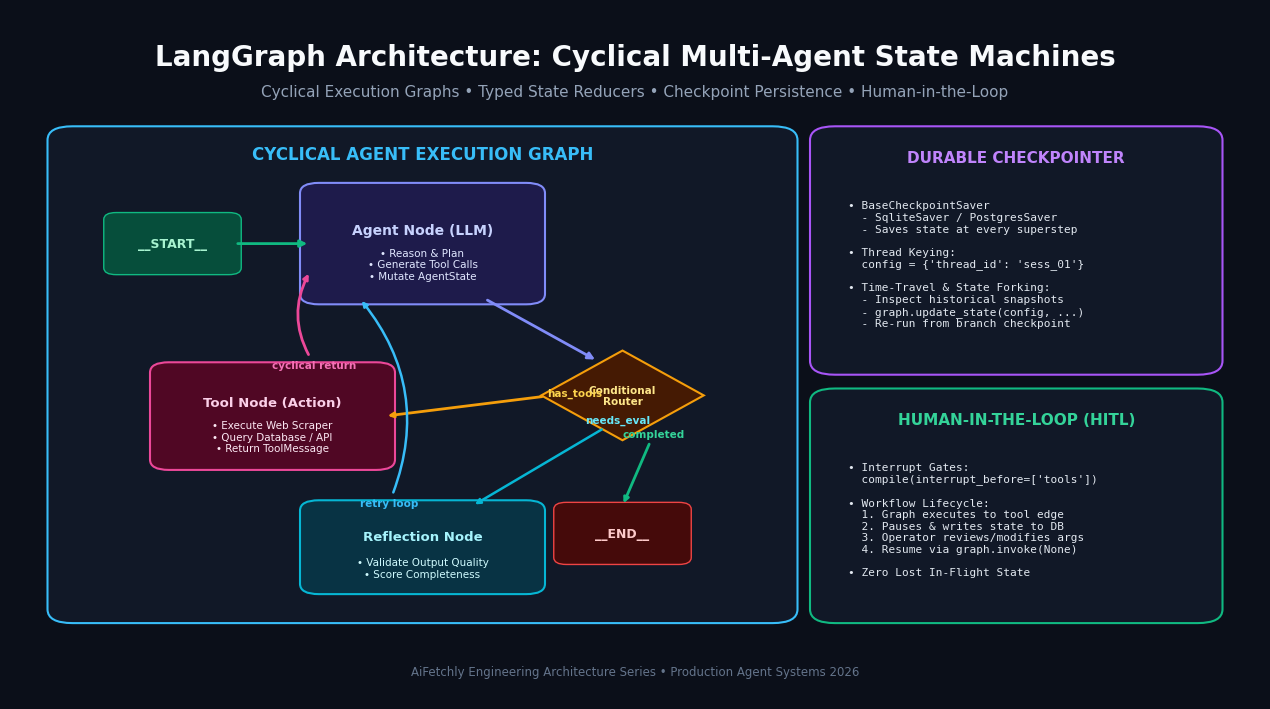
The Problem: The Fragility and Rigidity of DAGs in Autonomous Systems
In modern enterprise AI systems, high-concurrency data extraction platforms, and autonomous desktop intelligence tools like AiFetchly, developer teams have increasingly recognized that simple chain-of-thought prompting is insufficient for non-trivial tasks. Real-world autonomous execution requires reasoning, querying external APIs, parsing unstructured documents, evaluating results against validation schemas, and correcting intermediate mistakes.
Historically, generative AI frameworks—such as classic LangChain (Chains and LCEL), LlamaIndex workflows, and pipeline abstractions—modeled multi-step execution as Directed Acyclic Graphs (DAGs). In a DAG, data flows strictly forward: Node A produces an output, which passes into Node B, which triggers Node C, culminating in a final response.
While the DAG paradigm works reliably for deterministic extract-transform-load (ETL) pipelines and basic retrieval-augmented generation (RAG), deploying autonomous agents inside linear, acyclic pipelines introduces three fatal architectural failure modes:
1. The Impossibility of Native Cyclical Self-Correction
Real human cognitive problem-solving is fundamentally non-linear and iterative:
- When a software engineer encounters a compilation error, they do not terminate the project; they read the traceback, edit the code, and re-run the compiler.
- When an intelligent web agent encounters an unexpected authentication modal, a dynamic CAPTCHA, or an incomplete DOM subtree, it must adjust its extraction strategy, switch proxies, or query an alternative endpoint.
In a strict DAG, cycles are illegal by definition. To simulate loops in acyclic frameworks, developers were forced to wrap entire chains in external Python while loops or recursion wrappers. These ad-hoc loops lack formal termination guarantees, fail to track state transitions across iterations, and risk infinite execution loops that exhaust API rate limits and burn thousands of dollars in cloud tokens.
2. Ephemeral In-Memory State and Crash Vulnerability
Traditional LLM chains treat execution state as transient memory living on the runtime thread stack:
- If an agent workflow involves an 8-step extraction process (navigating pages, filtering items, extracting table schemas, reconciling pricing entities), an unhandled exception or network timeout at step 7 crashes the entire process.
- All intermediate reasoning steps, retrieved documents, and tool outputs are instantly vaporized.
- Resuming the job requires restarting from step 1, re-billing the user for duplicated LLM calls and re-hitting rate-limited upstream endpoints.
3. The Human-in-the-Loop (HITL) Execution Chasm
Production enterprise agents cannot operate in complete autonomy when executing destructive or high-liability operations:
- Consider an agent tasked with updating customer records in a CRM, issuing refund transactions, or deploying web scrapers across sensitive enterprise targets.
- Engineering teams must insert approval gates: the agent must plan an action, pause execution, present the proposed parameters to a human operator, and wait for explicit confirmation or parameter editing.
In a linear pipeline, pausing an in-flight process for hours or days while waiting for human input requires keeping the worker thread alive (blocking server memory) or building brittle custom serialization layers to dump memory to Redis and manually reconstruct execution flow upon webhook receipt.
The Solution: The LangGraph State Machine Architecture
To resolve the structural limitations of DAGs, LangChain created LangGraph. Inspired by distributed actor systems and Google’s Pregel graph-processing framework, LangGraph reconceptualizes LLM agents not as chains of prompts, but as state machines governed by cyclical graphs.
Under the LangGraph paradigm, an autonomous agent system is defined by three mathematical components: a centralized State Schema, a collection of executable Nodes, and directed Edges that govern control flow transitions.
1. The State Schema: Centralized, Typed Memory
In LangGraph, state is not scattered across object instances or hidden within closure scopes. Instead, every graph defines a unified, typed data structure—typically inheriting from Python’s TypedDict or Pydantic’s BaseModel:
from typing import Annotated, TypedDict
from langchain_core.messages import BaseMessage
from langgraph.graph.message import add_messages

class AgentState(TypedDict):
    # The add_messages reducer appends new messages or updates existing ones by ID
    messages: Annotated[list[BaseMessage], add_messages]
    extraction_target: str
    retry_count: int
validation_passed: bool State Channels and Reducer Functions: The defining innovation of LangGraph state management is the concept of Reducers. When a node finishes executing, it does not overwrite the entire state object. Instead, it returns a partial dictionary containing only the keys it modified.
By annotating state fields with reducer functions (such as add_messages or custom mathematical operators), developers define exactly how new updates merge with historical state:
- Default Replacement: Unannotated fields overwrite the previous value.
- Append / Deduplicate (
add_messages): If a node returns{"messages": [AIMessage(content="Extracted 42 items")]}, the reducer appends the message to the list. If a message contains an ID matching an existing entry, it upserts the message in place. - Custom Reducers: Developers can implement custom merge logic, such as unioning sets, averaging numeric scores, or maintaining rolling context windows.
2. Nodes: Functional Units of Computation
Nodes represent the functional workers of the graph. In LangGraph, a node is simply a Python callable (function, async coroutine, or runnable class) that takes the current AgentState as its input and returns a dictionary of state updates:
async def scraper_node(state: AgentState) -> dict:
    url = state["extraction_target"]
    # Perform resilient extraction logic
    raw_html = await fetch_page(url)
    clean_data = parse_dom_tree(raw_html)
    return {
        "messages": [AIMessage(content=f"Successfully extracted {len(clean_data)} records.")],
        "retry_count": state["retry_count"] + 1
} Because nodes communicate strictly through explicit state reads and partial dictionary writes, they remain completely decoupled, easily unit-testable, and reusable across multiple agent topologies.
3. Edges: Fixed and Conditional Control Flow
Edges define the directed pathways connecting nodes. LangGraph provides two fundamental edge primitives:
Fixed (Normal) Edges: A deterministic, unconditional transition:
builder.add_edge("scraper_node", "validator_node") Whenever scraper_node completes, execution unconditionally routes to validator_node.
Conditional Edges: Dynamic routing driven by runtime evaluation of the current state:
def route_after_validation(state: AgentState) -> str:
    if state["validation_passed"]:
        return "formatter_node"
    if state["retry_count"] < 3:
        return "scraper_node"  # CYCLICAL LOOP!
    return "human_escalation_node"

builder.add_conditional_edges(
    "validator_node",
    route_after_validation,
    {
        "formatter_node": "formatter_node",
        "scraper_node": "scraper_node",
        "human_escalation_node": "human_escalation_node"
    }
) Conditional edges allow LangGraph to implement arbitrarily complex state machines: multi-turn loops, retry backoffs, fallback switches, and termination conditions without breaking the architectural boundary of the graph.
The Persistence Engine: Checkpointers and Time-Travel
While cyclical control flow provides cognitive flexibility, LangGraph’s enterprise superpower is its Durable Persistence Layer.
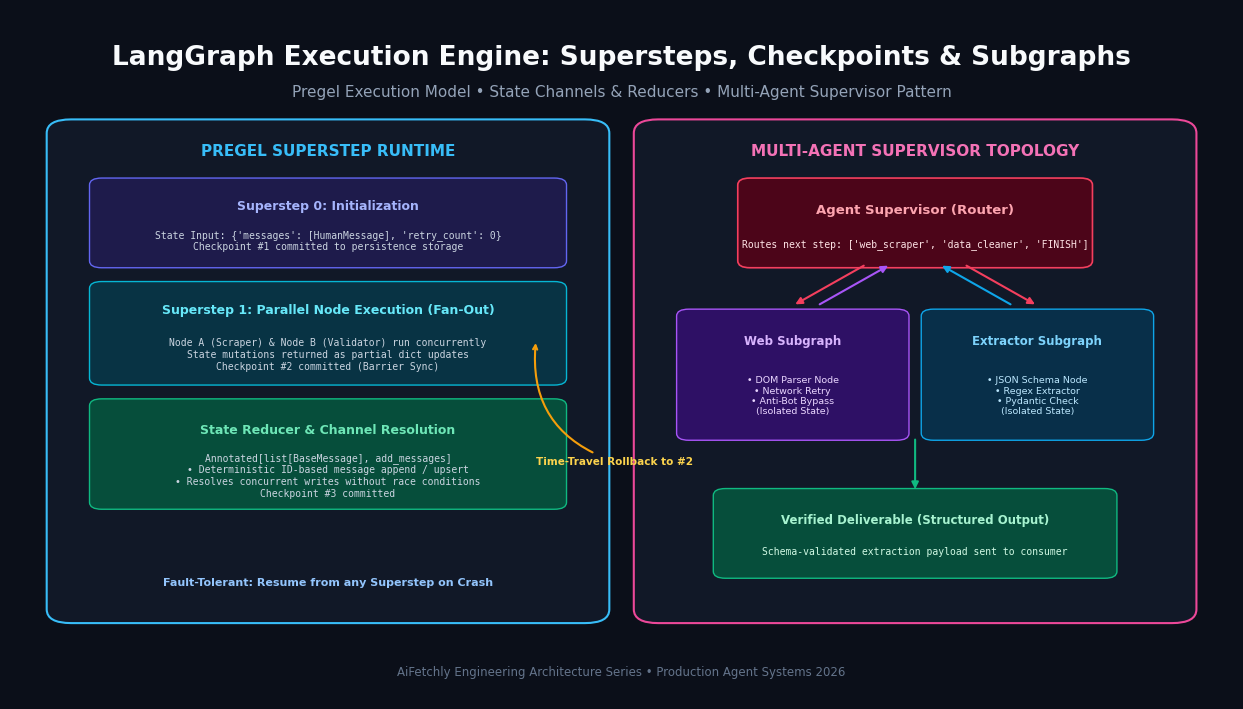
LangGraph builds upon an atomic execution model called Supersteps (derived from the Pregel computational model):
- In each superstep, all currently eligible nodes execute in parallel (fan-out).
- The graph runtime waits for all parallel nodes in the step to complete (barrier synchronization).
- Returned state updates are processed through their respective reducer functions.
- The resulting state snapshot is atomically written to a checkpointer before the next superstep begins.
Checkpoint Storage Backends
LangGraph provides native checkpointing adapters via BaseCheckpointSaver:
MemorySaver: In-memory key-value dictionary, ideal for local unit testing and quick experimentation.SqliteSaver: Lightweight, disk-backed ACID persistence for single-instance desktop apps and CLI tools.PostgresSaver: Enterprise-grade distributed persistence supporting high-throughput connection pooling, JSONB storage, and horizontal worker scaling.
Every checkpoint is keyed by a configuration tuple containing a thread_id:
config = {"configurable": {"thread_id": "session_extract_9842"}} By isolating sessions via thread_id, a single LangGraph deployment can manage millions of concurrent user sessions without crosstalk.
Human-in-the-Loop: Dynamic Interrupts
Because state is persisted at every superstep boundary, LangGraph makes human-in-the-loop workflows trivial to configure using the interrupt_before and interrupt_after compile flags:
# Compile graph with a safety gate before sensitive tool execution
app = builder.compile(
    checkpointer=checkpointer,
    interrupt_before=["database_write_node"]
) The Interrupt Lifecycle:
- The graph executes autonomously until execution reaches the inbound edge of
database_write_node. - The runtime halts execution, serializes the current state to PostgreSQL, and returns control to the caller.
- The host application displays the proposed database write payload to a human supervisor in a web dashboard or CLI.
- If approved, the application calls:
# Resume execution from the paused checkpoint await app.ainvoke(None, config=config) - If the operator needs to correct the data before approving, they invoke
app.update_state():# Mutate state as if an authorized node updated it await app.update_state( config=config, values={"approved_payload": {"status": "verified"}}, as_node="supervisor_approval" ) await app.ainvoke(None, config=config)
Time-Travel Debugging and State Forking
In production software, diagnosing why an autonomous agent took an erroneous action 15 steps into a task is notoriously difficult. With LangGraph’s checkpointer, developers gain native Time-Travel:
- History Inspection:
app.get_state_history(config)returns a chronological stream of every state snapshot across all supersteps. - Deterministic Replay: Developers can inspect the exact LLM prompt, tool outputs, and memory state at step 4.
- Forking Branches: By providing an older
checkpoint_idin the execution config, developers can edit the state at step 4 and resume execution along an alternate branch—allowing instant debugging without re-running earlier steps.
Implementation: Building a Resilient Extraction Agent
To see LangGraph in action, let us build a production-grade, cyclical web data extraction agent equipped with automated schema validation, dynamic retry loops, and durable SQLite checkpointing.
import asyncio
from typing import Annotated, Literal, TypedDict
from langchain_core.messages import AIMessage, BaseMessage, HumanMessage, ToolMessage
from langgraph.checkpoint.sqlite.aio import AsyncSqliteSaver
from langgraph.graph import END, START, StateGraph
from langgraph.graph.message import add_messages

# 1. Define the Structured Graph State
class ExtractionAgentState(TypedDict):
    messages: Annotated[list[BaseMessage], add_messages]
    target_url: str
    extracted_items: list[dict]
    validation_errors: list[str]
    iteration_count: int

# 2. Define Worker Nodes
async def agent_reasoning_node(state: ExtractionAgentState) -> dict:
    """Simulates LLM deciding whether to inspect DOM or extract records."""
    iteration = state.get("iteration_count", 0)
    messages = state["messages"]

    # In production, this would call ChatOpenAI or ChatAnthropic with tool bindings
    if iteration == 0:
        thought = "Analyzing target page layout. Initiating DOM extraction."
    else:
        thought = f"Addressing validation errors: {state['validation_errors']}. Retrying with strict schema."

    return {
        "messages": [AIMessage(content=thought)],
        "iteration_count": iteration + 1
    }

async def tool_extraction_node(state: ExtractionAgentState) -> dict:
    """Simulates external web extraction tool execution."""
    iteration = state["iteration_count"]

    # Simulate a partial failure on iteration 1, resolving on iteration 2
    if iteration == 1:
        raw_records = [{"title": "Enterprise Cloud Scanner", "price": "Invalid_String"}]
    else:
        raw_records = [{"title": "Enterprise Cloud Scanner", "price": 499.00}]

    return {
        "messages": [ToolMessage(content=f"Extracted {len(raw_records)} raw entities.", tool_call_id="call_01")],
        "extracted_items": raw_records
    }

async def validation_node(state: ExtractionAgentState) -> dict:
    """Validates extracted records against strict type constraints."""
    records = state.get("extracted_items", [])
    errors = []

    for item in records:
        if not isinstance(item.get("price"), (int, float)):
            errors.append(f"Field 'price' must be numeric. Found: {item.get('price')}")

    return {
        "validation_errors": errors
    }

# 3. Define Conditional Routing Logic
def route_next_step(state: ExtractionAgentState) -> Literal["agent_reasoning", "human_review", "__end__"]:
    errors = state.get("validation_errors", [])
    iterations = state.get("iteration_count", 0)

    if not errors and state.get("extracted_items"):
        return "__end__"

    if iterations < 3:
        return "agent_reasoning"  # Self-correcting cycle!

    return "human_review"  # Escalate to human operator

async def human_review_node(state: ExtractionAgentState) -> dict:
    """Safety gate when automated self-correction exceeds retry threshold."""
    return {
        "messages": [AIMessage(content="Escalating extraction to operator review due to persistent schema errors.")]
    }

# 4. Assemble and Compile the Graph
def build_extraction_graph():
    builder = StateGraph(ExtractionAgentState)

    # Register Nodes
    builder.add_node("agent_reasoning", agent_reasoning_node)
    builder.add_node("tool_extraction", tool_extraction_node)
    builder.add_node("validator", validation_node)
    builder.add_node("human_review", human_review_node)

    # Establish Edges
    builder.add_edge(START, "agent_reasoning")
    builder.add_edge("agent_reasoning", "tool_extraction")
    builder.add_edge("tool_extraction", "validator")

    # Conditional Edge from Validator
    builder.add_conditional_edges(
        "validator",
        route_next_step,
        {
            "agent_reasoning": "agent_reasoning",
            "human_review": "human_review",
            "__end__": END
        }
    )
    builder.add_edge("human_review", END)

    return builder

# 5. Execution with Async Checkpointing
async def main():
    builder = build_extraction_graph()

    async with AsyncSqliteSaver.from_conn_string(":memory:") as checkpointer:
        app = builder.compile(checkpointer=checkpointer)

        config = {"configurable": {"thread_id": "tenant_crawl_402"}}
        initial_input = {
            "messages": [HumanMessage(content="Extract pricing table from SaaS portal.")],
            "target_url": "https://example.com/pricing",
            "extracted_items": [],
            "validation_errors": [],
            "iteration_count": 0
        }

        print("--- Initiating Cyclical Agent Graph ---")
        async for event in app.astream(initial_input, config=config, stream_mode="values"):
            latest_msg = event["messages"][-1]
            print(f"[{latest_msg.__class__.__name__}]: {latest_msg.content}")
            if event.get("validation_errors"):
                print(f"  Validation Errors: {event['validation_errors']}")

if __name__ == "__main__":
asyncio.run(main()) Architectural Comparison: Agent Frameworks in 2026
To understand where LangGraph fits into the AI engineering stack, consider how it compares to alternative multi-agent frameworks:
| Feature Dimension | LangChain (LCEL / Chains) | AutoGen (Microsoft) | CrewAI | LangGraph (LangChain) |
|---|---|---|---|---|
| Primary Abstraction | Linear Pipelines / DAGs | Conversational Group Chat | Role-Playing Crews | Cyclical State Graphs |
| Cyclical Loops | Brittle (External loops only) | Implicit (Chat turns) | Sequential / Hierarchical | Native (Conditional Edges) |
| State Management | Ephemeral Stack Variables | Chat History List | Task Outputs / Context | Typed Schemas + Custom Reducers |
| Persistence Engine | None (Third-party custom) | In-Memory Session | In-Memory / SQLite | ACID Checkpoints (Postgres/SQLite) |
| Human-in-the-Loop | Not supported out-of-the-box | Chat interrupt prompt | Delegation approvals | Native superstep interrupt gates |
| Time-Travel Debugging | Impossible | Unsupported | Unsupported | State history rewind & branch forking |
| Fault Tolerance | Zero (Restarts from step 1) | Session loss on crash | Partial task retry | Resumes exactly from last superstep |
While frameworks like CrewAI and AutoGen excel at rapid prototyping and conversational brainstorming, LangGraph provides the deterministic control, transactional durability, and fine-grained state manipulation required for mission-critical enterprise infrastructure.
Production Engineering: Multi-Agent Topologies and Best Practices
When scaling LangGraph architectures to handle millions of extraction workflows, enterprise teams should adopt four architectural patterns:
1. The Supervisor / Router Hierarchy
Rather than building a monolithic graph containing dozens of heterogeneous tools, decompose complex workflows into specialized Subgraphs governed by a top-level Supervisor Node:
- The Supervisor acts as an intelligent dispatcher: it evaluates incoming user intent and routes tasks to specialized worker graphs (
WebScraperGraph,SqlAnalysisGraph,PdfExtractorGraph). - Each subgraph maintains its own isolated private state schema, shielding the parent graph from context pollution and token bloat.
- When a worker subgraph finishes, it compiles its final deliverable into a standardized summary dictionary and returns control to the Supervisor.
2. Subgraph Composition via Graph Embedding
In LangGraph, any compiled StateGraph can be registered directly as a node inside another graph:
# Compile the specialized extraction subgraph
scraper_app = scraper_builder.compile()

# Embed into the master parent graph
parent_builder = StateGraph(MasterState)
parent_builder.add_node("web_scraper_subgraph", scraper_app) This compositional architecture enables clean separation of concerns: domain teams can independently build, test, and version their specific subgraphs before wiring them into enterprise orchestration pipelines.
3. Checkpointer Hygiene and Retention Policies
In high-concurrency production deployments:
- Writing a snapshot at every superstep can generate millions of database records per day.
- Implement an automated retention policy on your
PostgresSavertables: retain detailed superstep checkpoints for 7 days for active operational monitoring, and archive only the final completed checkpoint to long-term cold storage. - Use PostgreSQL partitioned tables keyed by
thread_idto ensure sub-millisecond checkpoint write latencies.
4. Deterministic Parallelism via Channel Isolation
When designing fan-out execution where multiple nodes run concurrently in a single superstep:
- Ensure parallel nodes never attempt to overwrite the same scalar state keys.
- Always channel parallel node outputs through designated reducer fields (such as
Annotated[list, add_messages]or custom append lists). - This guarantees that state resolution remains mathematically deterministic regardless of the asynchronous order in which parallel nodes finish computing.
By treating agentic execution as a rigorous state machine rather than an unpredictable chatroom, software engineering teams can harness foundation models to build autonomous systems that are controllable, auditable, and resilient.