Langfuse Guide: Open-Source LLM Observability & Tracing
The Problem: The Black Box Dilemma of Multi-Agent Systems & Stochastic LLMs
In enterprise automation, autonomous web intelligence, and multi-agent copilots powered by AiFetchly, generative artificial intelligence systems have transitioned from simple prompt-and-response interfaces into complex, autonomous architectures. Modern agents query vector databases, parse unstructured web pages, synthesize balance sheets, invoke external APIs, and delegate sub-tasks to specialized sub-agents across iterative reasoning loops.
However, moving from deterministic software engineering to stochastic foundation models introduces a crippling operational vulnerability: the LLM black box dilemma.
The Traditional Software vs. LLM Observability Crisis:
┌─────────────────────────────────────────────────────────────────┐
│ Traditional Deterministic Software (REST / Microservices)      │
│ • Deterministic stack traces: File X, Line Y threw Exception Z │
│ • Predictable latency: Database query took 12ms                 │
│ • Standard APMs (Datadog, New Relic) monitor HTTP status codes  │
└─────────────────────────────────────────────────────────────────┘
 ▲
 │ Incompatible Paradigms!
 ▼
┌─────────────────────────────────────────────────────────────────┐
│ Stochastic Multi-Agent LLM Systems                              │
│ ❌ Silent Hallucinations: Model emits confident, wrong answers  │
│ ❌ Unpredictable Latency: TTFT fluctuates from 200ms to 4,000ms │
│ ❌ Token Cost Explosions: Rogue agent loop burns $300 in 1 hour │
│ ❌ Nested Context Blindness: Zero visibility into tool arguments│
│ ❌ Prompt Regression: Modifying prompt breaks 15% of edge cases │
└─────────────────────────────────────────────────────────────────┘
Result: Engineering teams fly blind in production without granular LLM tracing! 1. The Inadequacy of Traditional Application Performance Monitoring (APM)
For decades, DevOps and site reliability engineers relied on classical APM tools like Datadog, New Relic, and Dynatrace:
- Traditional APMs monitor standard infrastructure metrics: CPU utilization, RAM pressure, HTTP request counts, and error status codes (
500 Internal Server Error). - An LLM that outputs a hallucinated medical dosage or returns an empty JSON payload returns an HTTP 200 OK from the cloud provider. To a traditional APM, the transaction appears flawless.
- Traditional tools have no native understanding of token economics (prompt vs. completion tokens, cached tokens), semantic prompt versions, embedding dimensions, or output relevance rubrics.
2. The Multi-Step Agentic Debugging Nightmare
When an autonomous system—such as a research agent built with LangGraph, Pydantic AI, or Agno—fails to complete a user task:
- Did the failure stem from the vector database returning irrelevant document chunks?
- Did an external tool call fail silently or return truncated HTML?
- Did the foundation model misinterpret the system prompt in step 4 of an 8-step chain?
- Without nested distributed tracing, engineers are left digging through sprawling terminal stdout dumps trying to reconstruct what happened.
3. The Prompt Deployment and Regression Trap
In production environments, prompts are living software artifacts:
- When developers hardcode prompt strings into application code, tweaking a system preamble requires a full Git pull request, code review, CI/CD test run, and container rollout.
- Worse, changing a single sentence in a prompt to fix an edge case frequently introduces regression errors into previously working user flows, with zero automated tracking or rollback capabilities.
The Solution: The Langfuse Open-Source Observability Architecture
To provide full transparency, continuous evaluation, and engineering discipline for generative AI systems, open-source engineers built Langfuse.
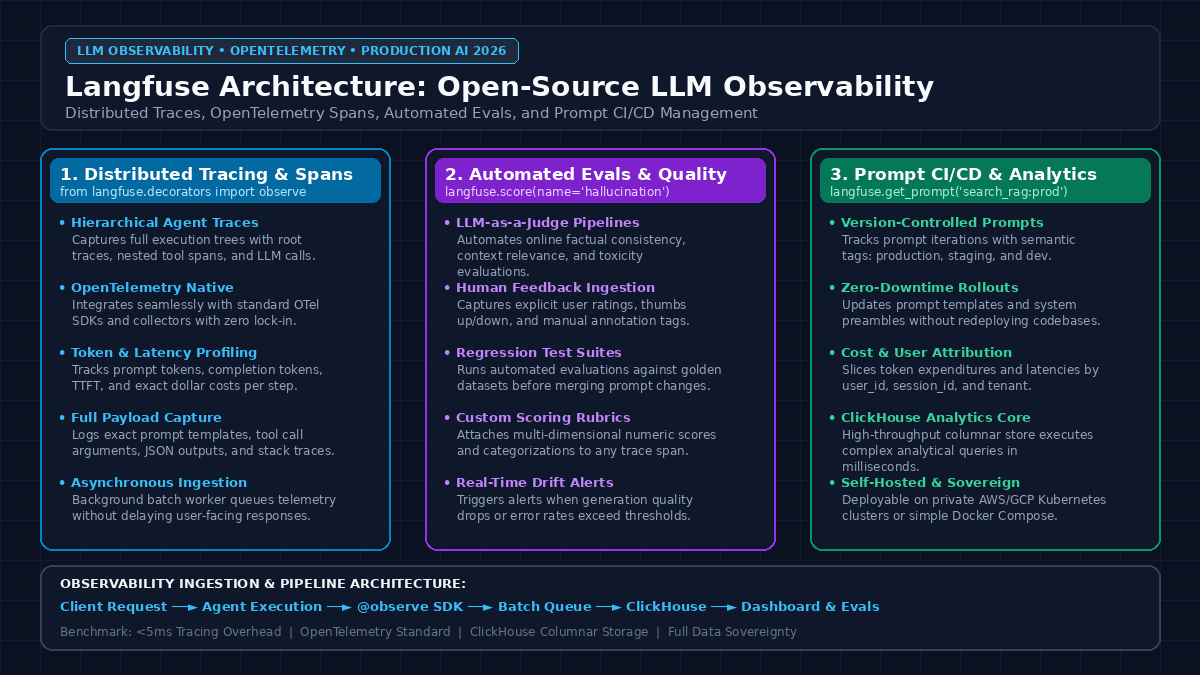
Langfuse is an open-source, enterprise-grade LLM engineering platform designed to trace, evaluate, monitor, and optimize AI applications from early prototype to planetary scale. Built natively on OpenTelemetry (OTel) standards and powered by a dual PostgreSQL + ClickHouse storage engine, Langfuse delivers sub-second analytical queries over millions of token transactions with complete data sovereignty.
Langfuse High-Level System Architecture:
┌─────────────────────────────────────────────────────────────────┐
│ aiFetchly Desktop Application / Production Multi-Agent Cloud    │
│ (LangGraph, Agno, Pydantic AI, CrewAI, Raw OpenAI / Anthropic)   │
└─────────────────────────────────────────────────────────────────┘
 │
 ▼ [@observe() Decorator / OpenTelemetry Exporter]
┌─────────────────────────────────────────────────────────────────┐
│ Langfuse Asynchronous Ingestion Engine                          │
│ • Non-blocking local batching queue (<5ms runtime overhead)    │
│ • Full payload capture: Prompts, tool arguments, completions   │
└─────────────────────────────────────────────────────────────────┘
 │
 ▼
┌─────────────────────────────────────────────────────────────────┐
│ High-Throughput Storage & Analytics Tier                        │
│ ├──► PostgreSQL: Application metadata, user RBAC, prompt trees  │
│ └──► ClickHouse: Columnar analytical engine for billions of rows│
└─────────────────────────────────────────────────────────────────┘
 │
 ▼
┌─────────────────────────────────────────────────────────────────┐
│ Observability & Engineering Suite                               │
│ ├──► Hierarchical Traces & Spans: Visual execution DAGs         │
│ ├──► Automated Evals: LLM-as-a-judge & programmatic scoring     │
│ ├──► Prompt CI/CD: Semantic tagging (prod, staging) & rollback │
│ └──► Cost & Latency Analytics: TTFT and token spend per tenant  │
└─────────────────────────────────────────────────────────────────┘ The Core Pillars of Langfuse
- Distributed Tracing & Spans: Visualizes the exact hierarchical execution DAG of agent workflows, breaking down complex multi-agent reasoning into parent traces, tool execution spans, and individual generation calls.
- Token Economics & Latency Profiling: Automatically maps token usage across 100+ model providers to exact dollar expenditures. Measures Time-to-First-Token (TTFT) and token-per-second generation speeds.
- Automated Evals & Quality Scoring: Implements online LLM-as-a-judge pipelines, custom Python heuristics, and user feedback capture (thumbs up/down) to detect hallucinations and drift in real-time.
- Prompt Management & CI/CD: Decouples prompts from application source code. Allows developers and product teams to update prompt templates, manage variables, and roll back versions via web UI or API with zero downtime.
- Data Sovereignty & Self-Hosting: Fully open-source (MIT license core) and containerized. Can be self-hosted in air-gapped VPCs via Docker Compose or Kubernetes, ensuring sensitive corporate data never leaves private networks.
Comparing LLM Observability Platforms
The table below contrasts Langfuse against traditional APM solutions and proprietary SaaS platforms:
LLM Observability Feature Matrix:
┌───────────────────────────┬───────────────────┬───────────────────┬───────────────────┐
│ Feature / Capability      │ Traditional APM   │ LangSmith (SaaS)  │ Langfuse (OSS)    │
├───────────────────────────┼───────────────────┼───────────────────┼───────────────────┤
│ Primary Focus             │ Host / CPU / HTTP │ LangChain / LLM   │ Universal LLM App │
│ Deployment Model          │ Cloud SaaS Only   │ Cloud SaaS First  │ Cloud & 100% OSS  │
│ Telemetry Standard        │ Proprietary Agent │ Custom Protocol   │ OpenTelemetry     │
│ Data Sovereignty          │ Vendor Cloud      │ Vendor Cloud      │ Self-Hostable VPC │
│ Nested Agent Tracing      │ ❌ No             │ ✅ Yes            │ ✅ Yes            │
│ Token Cost Calculation    │ ❌ No             │ ✅ Yes            │ ✅ Yes (100+ LMs) │
│ Analytical Database       │ Proprietary TimeS │ Proprietary Cloud │ ClickHouse (Fast) │
│ Prompt Versioning / CI/CD │ ❌ No             │ ✅ Yes            │ ✅ Yes            │
│ Framework Agnostic        │ ✅ Yes            │ ⚠️ LangChain bias │ ✅ Yes (Any SDK)  │
└───────────────────────────┴───────────────────┴───────────────────┴───────────────────┘ Deep Dive into Langfuse Primitives & Systems Architecture
Langfuse models AI applications using four hierarchical telemetry primitives that mirror the natural execution flow of autonomous agents.
Langfuse Hierarchical Tracing Model:
Trace (Root User Session / API Request)
 ├──► Span 1: Pre-processing & Context Assembly (Latency: 14ms)
 ├──► Generation 1: Planner LLM Call (Cost: $0.004, TTFT: 340ms)
 ├──► Span 2: Tool Execution (e.g., Vector DB Search via Qdrant)
 │     ├──► Event: Cache Hit / Miss
 │     └──► Output: 3 Retrieved Document Chunks
└──► Generation 2: Final Synthesizer LLM Call (Streaming Output) 1. The Tracing Hierarchy: Traces, Spans, Generations, and Events
- Trace: Represents the top-level container for an entire user interaction or workflow (e.g., a single user message in a chatbot, or one autonomous web scraping task in AiFetchly). A trace tracks end-to-end latency, cumulative dollar cost, user IDs, and session tags.
- Span: Represents a distinct duration of work inside a trace. Spans can be nested indefinitely, capturing operations like document chunking, API calls, or vector search queries in Qdrant.
- Generation: A specialized span specifically representing an LLM inference call. Generations log the exact model name, input prompt, completion text, token usage breakdown (prompt tokens, completion tokens, reasoning tokens), and calculated cost.
- Event: A point-in-time timestamped log within a trace or span, used for tracking discrete milestones (e.g., cache hits, guardrail triggers, or fallback switchovers).
2. The @observe() Decorator and Asynchronous Ingestion
Langfuse provides the @observe() decorator for Python and TypeScript:
- Zero Boilerplate: Wrapping a Python function with
@observe()automatically creates spans, tracks execution time, captures inputs and outputs, and links child spans to parent traces using thread-local context variables. - Non-Blocking Background Dispatch: Telemetry is written to an in-memory queue and flushed asynchronously in batches by a background worker thread. The application’s critical execution path incurs less than 5 milliseconds of overhead.
3. Automated Evals & Quality Scoring
Langfuse provides a unified evaluation interface through the Score entity:
- Programmatic Metrics: Calculate exact heuristics in Python (e.g., regex checks, latency thresholds, JSON validation status) and attach scores directly to traces.
- LLM-as-a-Judge: Deploy background evaluators that send traces to an independent evaluation model (e.g., GPT-4o-mini or Claude 3.5 Haiku) to grade factual consistency, context precision, and tone on a 0.0 to 1.0 scale.
- Human Feedback: Ingest user-facing thumbs up/down ratings from client applications to correlate subjective user satisfaction with underlying system prompts.
4. Prompt Management & Zero-Downtime CI/CD
Langfuse functions as a centralized prompt repository:
- Prompts are defined as parameterized templates with variable placeholders (e.g.,
{{query}},{{context}}). - Teams assign semantic labels such as
production,staging, anddevelopment. - Applications fetch prompts dynamically via the SDK (
langfuse.get_prompt("researcher:production")), caching them locally with configurable TTLs. Prompts can be adjusted, AB-tested, and rolled back in real-time without modifying code or restarting services.
5. High-Throughput Dual Storage: PostgreSQL + ClickHouse
To support enterprise workloads generating millions of traces daily:
- PostgreSQL: Manages transactional state, user authentication, role-based access control (RBAC), API keys, and prompt version trees.
- ClickHouse: Ingests massive event streams into columnar storage, allowing developers to execute complex analytical queries across billions of tokens (e.g., “Calculate 95th percentile TTFT and total cost grouped by model over the last 30 days”) in tens of milliseconds.
Hands-On Implementation: Building an Observable Agent with Langfuse
Let’s build a production-ready, observable multi-step research agent in Python using the Langfuse SDK and OpenAI.
1. Environment Setup
Install Langfuse and OpenAI:
pip install langfuse openai Set your environment variables:
export LANGFUSE_PUBLIC_KEY="pk-lf-..."
export LANGFUSE_SECRET_KEY="sk-lf-..."
export LANGFUSE_HOST="https://cloud.langfuse.com" # Or your self-hosted URL
export OPENAI_API_KEY="sk-..." 2. Complete Instrumented Pipeline (observable_agent.py)
import os
from langfuse.decorators import observe, langfuse_context
from langfuse import Langfuse
from openai import OpenAI

# 1. Initialize Clients
client = OpenAI()
langfuse = Langfuse()

# 2. Simulated Tool Execution with Span Tracking
@observe(as_type="generation")
def execute_vector_retrieval(query: str) -> list[str]:
    """Simulates a dense vector retrieval step."""
    # Attach custom metadata to the current span
    langfuse_context.update_current_observation(
        name="Qdrant_Vector_Search",
        metadata={"index_name": "enterprise_docs", "top_k": 2}
    )

    # Return mock retrieved chunks
    return [
        "Langfuse provides OpenTelemetry-native tracing for LLMs.",
        "ClickHouse powers high-throughput columnar analytics in Langfuse."
    ]

# 3. Model Generation with Tracing
@observe(as_type="generation")
def generate_synthesis(query: str, context: list[str]) -> str:
    """Invokes OpenAI LLM with automatic token and cost tracking."""
    formatted_context = "\n".join(context)
    prompt = f"Context:\n{formatted_context}\n\nQuestion: {query}\nAnswer:"

    response = client.chat.completions.create(
        model="gpt-4o",
        messages=[
            {"role": "system", "content": "You are a concise enterprise technical analyst."},
            {"role": "user", "content": prompt}
        ],
        temperature=0.1
    )

    output = response.choices[0].message.content
    return output

# 4. Top-Level Workflow Root Trace
@observe()
def run_research_workflow(user_id: str, session_id: str, query: str) -> str:
    """Root workflow trace orchestrating tools and LLM generation."""
    # Tag the root trace with user, session, and operational metadata
    langfuse_context.update_current_trace(
        name="Research_Agent_Pipeline",
        user_id=user_id,
        session_id=session_id,
        tags=["production", "rag", "aiFetchly-pipeline"],
        metadata={"environment": "production", "client_version": "2.4.0"}
    )

    print(f"[Trace Started] Processing query for user: {user_id}")

    # Step 1: Retrieval
    docs = execute_vector_retrieval(query)

    # Step 2: Synthesis
    answer = generate_synthesis(query, docs)

    # Step 3: Attach an Automated Programmatic Quality Score
    # For example, verifying answer is grounded in retrieved context
    grounded_score = 1.0 if "Langfuse" in answer else 0.0
    langfuse_context.score(
        name="groundedness",
        value=grounded_score,
        comment="Automated lexical check on retrieved context presence"
    )

    return answer

# 5. Application Entry Point
if __name__ == "__main__":
    test_user = "usr_enterprise_982"
    test_session = "sess_harvest_441"
    test_query = "What database does Langfuse use for fast analytics?"

    result = run_research_workflow(test_user, test_session, test_query)

    print("\n--- Final Agent Response ---")
    print(result)

    # Ensure all background telemetry batches are flushed before exit
    langfuse.flush()
print("\n[Telemetry Flushed] All spans and traces successfully sent to Langfuse!") 3. Execution and Telemetry Verification
Execute the script:
python observable_agent.py Inside the Langfuse Dashboard, navigate to Traces:
- Hierarchical Visualization: The
Research_Agent_Pipelinetrace displays two child observations:Qdrant_Vector_Searchandgenerate_synthesis. - Cost & Token Transparency: The exact input tokens, output tokens, latency (ms), and cost in USD are automatically computed and displayed.
- Score Attribution: The
groundedness: 1.0score is permanently anchored to the trace, enabling filtering across production runs.
Production Architecture & Best Practices for aiFetchly
Integrating Langfuse into high-throughput desktop copilots, automated scrapers, and agentic workflows in AiFetchly establishes a resilient, production-ready observability foundation.
aiFetchly Observability Fleet Topology:
┌─────────────────────────────────────────────────────────────────┐
│ aiFetchly Automation Platform                                   │
└─────────────────────────────────────────────────────────────────┘
 │
 ▼ (OTel Spans & Metrics)
┌─────────────────────────────────────────────────────────────────┐
│ Langfuse Ingestion Cluster (Self-Hosted on Kubernetes)          │
│ ├──► OpenTelemetry Collector Gateway (Scalable Load Balancer)   │
│ ├──► Web API & Worker Pool (Async Queue & Background Evals)     │
│ ├──► PostgreSQL (Relational Schemas, RBAC, Prompt Versioning)   │
│ └──► ClickHouse (Sub-Second Columnar Analytics on Billions)     │
└─────────────────────────────────────────────────────────────────┘
 │
 ├──► Real-Time Slack / PagerDuty Alerts on Error Spikes
└──► BI Dashboards (Cost per Customer, Latency P99, Hallucinations) 1. Tracing Across Diverse Agent Frameworks
In heterogeneous agent architectures:
- Whether orchestrating state machines with LangGraph, typed Python agents with Pydantic AI, microsecond teams with Agno, or routing gateways with LiteLLM, Langfuse’s OpenTelemetry exporter unifies all traces into a single pane of glass.
- Inter-agent handoffs and tool calls over FastMCP maintain trace context across process boundaries using standard W3C
traceparentheaders.
2. Multi-Tenant Cost Attribution & Spend Guardrails
In multi-tenant SaaS applications:
- Always tag root traces with
user_idandsession_id. - Use Langfuse analytics to track cumulative token spend per customer organization.
- Configure alerting webhooks that trigger automated circuit breakers when a specific tenant exceeds their daily token budget.
3. CI/CD Regression Testing with Golden Datasets
Before deploying an updated system prompt to production:
- Create a curated dataset of representative user queries and ground-truth answers in Langfuse.
- Run automated offline evaluation runs that benchmark the new prompt against the baseline across faithfulness, answer relevance, and JSON schema compliance.
- Only promote the prompt to the
productiontag if evaluation scores exceed predefined quality thresholds.
Summary: Moving from Blind LLM Deployment to Engineering Rigor
As artificial intelligence evolves from experimental laboratory demos into mission-critical software infrastructure, developers can no longer afford to treat language models as inscrutable black boxes.
By coupling OpenTelemetry-native distributed tracing, automated LLM-as-a-judge evaluations, centralized prompt versioning, and high-speed ClickHouse analytics, Langfuse brings traditional software engineering observability to the non-deterministic world of foundation models. For autonomous research assistants, data harvesting pipelines, and high-concurrency desktop copilots powered by AiFetchly, Langfuse delivers the operational visibility, cost control, and quality guarantees required to run production AI systems with confidence.