Kwai-Kolors Guide: Photorealistic Bilingual Diffusion AI
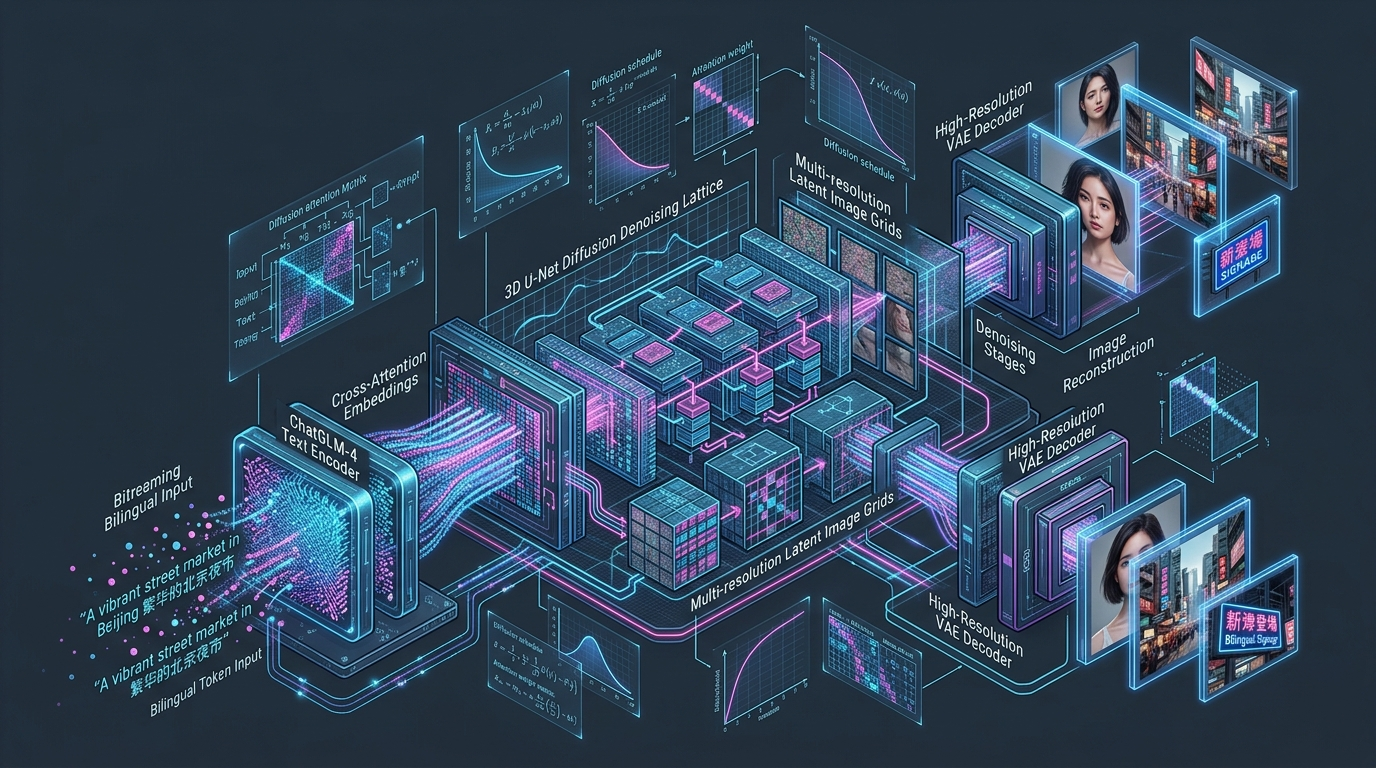
The Semantic Bottleneck in Text-to-Image Diffusion Models
Over the past four years, text-to-image generative modeling has transformed digital artistry, creative media production, and industrial design. The emergence of Latent Diffusion Models (LDMs)—epitomized by Stable Diffusion v1.5, SDXL, and early Diffusion Transformers—proved that generative networks can synthesize high-frequency photorealistic imagery by learning to reverse a forward Gaussian diffusion process within a perceptually compressed latent space.
However, despite dramatic improvements in visual aesthetics and lighting realism, early generation models suffer from deep, systemic architectural limitations rooted in their text conditioning mechanisms.
In standard latent diffusion architectures (such as SDXL or Stable Diffusion 3), conditioning relies almost exclusively on Contrastive Language-Image Pretraining (CLIP) text encoders (e.g., OpenAI CLIP ViT-L/14 or OpenCLIP ViT-bigG) and large autoregressive T5 encoders. While CLIP embeddings effectively map high-level visual concepts to image semantics, they exhibit critical structural deficiencies:
- Severe Context Length Truncation: Standard CLIP encoders truncate input prompts at a rigid 77 tokens. In enterprise creative workflows—where art directors, marketers, and product designers specify exhaustive styling constraints, multi-entity relationships, and background lighting instructions—crucial tokens beyond the 77-token boundary are abruptly dropped.
- Weak Spatial and Multi-Clause Compositionality: CLIP models are trained using a contrastive InfoNCE loss over pooled global sentence vectors: $$\mathcal{L}_{\text{InfoNCE}} = -\log \frac{\exp(\text{sim}(u_i, v_i) / \tau)}{\sum_j \exp(\text{sim}(u_i, v_j) / \tau)}$$ Because InfoNCE optimizes broad semantic cosine similarity between an entire image embedding $v_i$ and a single text vector $u_i$, it functions fundamentally as a “bag-of-words” similarity metric. It collapses granular relational prepositional syntax and multi-object spatial bindings (e.g., failing to distinguish “a small green apple resting on a massive red plate” from “a large red apple resting on a small green plate”).
- Catastrophic Inability to Render Legible Typography: Rendering coherent, legible in-image text (such as storefront neon signs, book covers, brand logos, or t-shirt graphics) has historically been one of diffusion’s greatest failures. CLIP models lack character-level glyph representations and positional stroke embeddings, causing generated text to degrade into garbled, unreadable hieroglyphics.
- Monolingual English Bias: Almost all open-source diffusion backbones are trained predominantly on English image-text pairs (such as LAION-5B). Non-English prompts—especially complex Asian scripts such as Chinese characters with intricate ideographic strokes and idioms—suffer from severe translation degradation and cultural caricature.
- Human Anatomical Distortions: While landscapes and abstract art generate reliably, photorealistic human generation frequently produces anatomical artifacts: fused fingers, unnatural joint rotations, distorted gaze vectors, and plasticized facial skin textures.
For modern digital enterprises deploying real-time automated visual pipelines—including commercial e-commerce advertising engines, multi-language asset creators, and automated intelligent data scraping pipelines—relying on naive CLIP-conditioned diffusion creates massive post-production manual overhead.
The Kwai-Kolors Paradigm: Merging Deep Language Models with Latent Diffusion
Developed by the visual intelligence research division at Kuaishou Technology (the creators behind the Kling video generation engine), Kwai-Kolors represents a landmark evolution in open-weight text-to-image foundation models.
Instead of relying on lightweight contrastive encoders, Kolors fundamentally re-architects the text-to-image conditioning pipeline: it replaces the standard CLIP text encoder with a full-scale, multi-billion-parameter General Language Model (ChatGLM3 / GLM-4).
+-----------------------------------------------------------------------------------------+
|                              KWAI-KOLORS SYSTEM TOPOLOGY                                |
+-----------------------------------------------------------------------------------------+
|                                                                                         |
|       Complex Bilingual Prompt (English / Chinese, up to 256 Tokens)                    |
|                 |                                                                       |
|                 v                                                                       |
|   +---------------------------------------------------------------------------------+   |
|   |  DEEP LANGUAGE ENCODER: ChatGLM3 / GLM-4 (Multi-Billion Parameter Backbone)     |   |
|   |  - Rich Character-Level Ideogram & Latin Glyph Representations                  |   |
|   |  - Deep Contextual Multi-Entity Spatial Reasoning                               |   |
|   |  - Full Sequence Context Support (256 Tokens)                                   |   |
|   +---------------------------------------------------------------------------------+   |
|                 |                                                                       |
|                 v (4096-Dimensional Dense Cross-Attention Token Embeddings)             |
|   +---------------------------------------------------------------------------------+   |
|   |  LATENT DIFFUSION BACKBONE: Enhanced SDXL U-Net Architecture                    |   |
|   |  - Multi-Scale Spatial Cross-Attention Layers                                   |   |
|   |  - Progressive Multi-Resolution Training (512px -> 1024px Multi-Aspect)         |   |
|   |  - Specialized Photorealistic Human & Aesthetic Loss Conditioning               |   |
|   +---------------------------------------------------------------------------------+   |
|                 |                                                                       |
|                 v (Denoised Latent Representation: z_0 in R^(4 x 128 x 128))            |
|   +---------------------------------------------------------------------------------+   |
|   |  HIGH-FIDELITY VARIATIONAL AUTOENCODER (VAE DECODER)                            |   |
|   |  - Synthesizes 1024x1024 Photorealistic Output                                  |   |
|   |  - Crisp Bilingual Typography & Accurate Human Anatomy                          |   |
|   +---------------------------------------------------------------------------------+   |
+-----------------------------------------------------------------------------------------+ By substituting a dedicated large language model for the text conditioning stage, Kolors unlocks four decisive capabilities:
- Native Bilingual Text Comprehension: Kolors natively understands intricate English and Chinese prompts, interpreting poetic metaphors, idioms, cultural allusions, and technical terminology with flawless fidelity.
- Sharp, Legible In-Image Typography: Because GLM-4 preserves granular tokenizations and character embeddings, Kolors can render crisp, beautifully styled typography in both English alphabet characters and Chinese Hanzi ideograms directly onto signs, posters, and apparel.
- Complex Multi-Object Spatial Binding: Leveraging GLM-4’s multi-head attention hidden states, the diffusion model accurately tracks object quantities, spatial relationships (“to the left of”, “underneath”, “holding in the right hand”), and material attributes across complex multi-clause prompts.
- Photorealistic Human Anatomy: Trained on billions of filtered, high-aesthetic image-text pairs with specialized anatomical weighting, Kolors eliminates common diffusion artifacts, producing natural skin textures, accurate hand articulations, and photorealistic environmental lighting.
Architectural Deep Dive: GLM Conditioning, Latent U-Net, and Multi-Scale Training
The internal architecture of Kwai-Kolors represents a masterclass in cross-modal alignment, balancing deep linguistic representation with high-capacity latent spatial denoising.
1. The Language Conditioning Engine: ChatGLM3 / GLM-4
The defining architectural feature of Kolors is its text encoder. While standard SDXL utilizes a dual-encoder combination of CLIP ViT-L (123M parameters) and OpenCLIP ViT-bigG (695M parameters), Kolors employs a full ChatGLM model with several billion parameters.
The language model operates over a context window of up to 256 text tokens—more than three times the capacity of standard CLIP. Given an input prompt $y$, the text encoder processes the token sequence through bidirectional prefix attention layers, extracting dense contextual hidden states:
$$\mathbf{H}{\text{text}} = \text{GLM}{\text{encoder}}(y) \in \mathbb{R}^{S \times d_{\text{text}}}$$
Where $S \le 256$ is the prompt sequence length, and $d_{\text{text}} = 4096$ represents the projection dimension.
To condition the diffusion U-Net, these dense token representations are injected directly into the cross-attention blocks at every stage of the downsampling, bottleneck, and upsampling pathways:
$$ \text{CrossAttention}(Q, K, V) = \text{Softmax}\left(\frac{Q K^T}{\sqrt{d_k}} ight) V $$
Where:
- $Q = W_q z_t$ is projected from the spatial image latent features $z_t$.
- $K = W_k \mathbf{H}{\text{text}}$ and $V = W_v \mathbf{H}{\text{text}}$ are projected directly from the GLM language embeddings.
Because GLM hidden states contain rich grammatical syntax and character glyph encodings, the spatial cross-attention layers learn exact spatial correspondences for every word in the prompt, enabling unprecedented alignment.
2. Latent Diffusion Formulation and Noise Prediction
Kolors operates within the continuous latent space established by an improved Variational Autoencoder (VAE) with a downsampling factor of $f = 8$. Given an input image $x_0 \in \mathbb{R}^{H \times W \times 3}$, the VAE encoder produces a spatial latent representation $z_0 = \mathcal{E}(x_0) \in \mathbb{R}^{4 \times (H/8) \times (W/8)}$.
The forward diffusion process progressively adds Gaussian noise over continuous timesteps $t \in [0, T]$ according to a cosine or linear variance schedule $\beta_t$:
$$ q(z_t | z_0) = \mathcal{N}\left(z_t; \sqrt{\bar{\alpha}_t} z_0, (1 - \bar{\alpha}_t) \mathbf{I} ight) $$
Where $\alpha_t = 1 - \beta_t$ and $\bar{\alpha}t = \prod{s=1}^t \alpha_s$.
The denoising network $\epsilon_\theta(z_t, t, \mathbf{H}_{\text{text}})$ is trained using a mean-squared error objective predicting the added noise:
$$ \mathcal{L}{\text{Kolors}} = \mathbb{E}{z_0, \mathbf{H}{\text{text}}, \epsilon \sim \mathcal{N}(0, \mathbf{I}), t} \left[ \left| \epsilon - \epsilon\theta(z_t, t, \mathbf{H}_{\text{text}}) ight|^2 ight] $$
During inference, classifier-free guidance (CFG) extrapolates generation away from an unconditional null-text prompt:
$$ \widetilde{\epsilon}\theta(z_t, t, \mathbf{H}{\text{text}}) = \epsilon_\theta(z_t, t, \emptyset) + s \cdot \left( \epsilon_\theta(z_t, t, \mathbf{H}{\text{text}}) - \epsilon\theta(z_t, t, \emptyset) ight) $$
Where $s \ge 1.0$ is the guidance scale (typically tuned between 4.5 and 7.0 for optimal balance between prompt fidelity and natural photorealism).
3. Progressive Multi-Aspect Ratio Training Pipeline
To ensure the model performs flawlessly across diverse camera angles and resolutions, the Kuaishou team utilized a multi-stage progressive training regimen:
+-----------------------------------------------------------------------------------------+
|                        KWAI-KOLORS PROGRESSIVE TRAINING PIPELINE                        |
+-----------------------------------------------------------------------------------------+
|  Stage 1: Low-Resolution Pretraining (512x512)                                          |
|  - Trained on 1.2 Billion Diverse Image-Text Pairs                                      |
|  - Broad Conceptual Grounding & Basic Text Alignment                                    |
+-----------------------------------------------------------------------------------------+
                                  |
                                  v
+-----------------------------------------------------------------------------------------+
|  Stage 2: High-Resolution Refinement (1024x1024 Square)                                 |
|  - Filtered High-Aesthetic Dataset (600 Million Images)                                 |
|  - Human Anatomy Enhancement & Skin Texture Supervised Fine-Tuning                      |
+-----------------------------------------------------------------------------------------+
                                  |
                                  v
+-----------------------------------------------------------------------------------------+
|  Stage 3: Multi-Aspect-Ratio Bucket Training                                            |
|  - Aspect Buckets: 1:1 (1024x1024), 16:9 (1344x768), 9:16 (768x1344), 4:3, 3:4         |
|  - Positional Crop Coordinate Conditioning & Micro-Conditioning Vectors                 |
+-----------------------------------------------------------------------------------------+
                                  |
                                  v
+-----------------------------------------------------------------------------------------+
|  Stage 4: Bilingual Typography and Aesthetic Preference Alignment                       |
|  - Supervised Fine-Tuning on Synthesized In-Image Text Datasets                         |
|  - Direct Preference Optimization (Diffusion-DPO) for Artifact Elimination              |
+-----------------------------------------------------------------------------------------+ In Stage 3, Kolors implements dynamic aspect-ratio bucketing. Images in the training dataset are clustered into discrete resolution buckets preserving their native aspect ratios (such as 16:9 landscape or 9:16 portrait) rather than being crudely cropped to square dimensions. During training, conditioning vectors indicating the original image dimensions $(H_{\text{orig}}, W_{\text{orig}})$, crop coordinates $(C_{\text{top}}, C_{\text{left}})$, and target resolution $(H_{\text{target}}, W_{\text{target}})$ are embedded using Fourier positional features and added to the timestep embedding. This eliminates the edge distortion, chopped heads, and repeated limb artifacts common in earlier diffusion models.
In Stage 4, Kuaishou applied Direct Preference Optimization for Diffusion (Diffusion-DPO). Human annotators curated paired generations scoring visual appeal, hands anatomical fidelity, and text readability. DPO fine-tuning directly penalizes latent trajectories that produce blurred fingers or garbled characters, aligning the U-Net weights with human visual preferences.
Architectural Comparison: Kwai-Kolors vs. Frontier Image Models
The table below contrasts Kolors with leading open-source and commercial text-to-image foundation models:
| Architectural Metric | Stable Diffusion XL (SDXL) | FLUX.1 [dev] | Midjourney v6 (API) | Kwai-Kolors |
|---|---|---|---|---|
| Text Encoder Backbone | Dual CLIP (ViT-L + bigG) | T5-XXL + CLIP-L | Proprietary Multimodal | ChatGLM3 / GLM-4 LLM |
| Max Text Token Length | 77 Tokens | 512 Tokens | Undisclosed (~100) | 256 Tokens |
| Bilingual Comprehension | Poor (Heavily English-biased) | Moderate (T5 multilingual) | High | Native State-of-the-Art |
| Chinese Text Rendering | Failed / Unreadable | Unreliable | Inconsistent | Legible & High Aesthetic |
| English Text Rendering | Very Poor | Excellent | High | Crisp & Stylized |
| Denoising Architecture | 2.6B Parameter U-Net | 12B Flow Transformer (MMDiT) | Proprietary DiT | Enhanced 2.7B U-Net |
| Minimum VRAM for Serving | ~8 GB | ~16-24 GB | Cloud Only | ~10-12 GB (FP16) |
| Commercial License | Open Commercial (Apache) | Non-Commercial Research | Closed Proprietary | Open Commercial (Apache 2.0) |
Serving Implementation: Diffusers Pipeline, ControlNet, and IP-Adapter
Kwai-Kolors is natively supported in the HuggingFace diffusers ecosystem, enabling deployment across cloud inference endpoints, local consumer GPUs, and containerized serving platforms.
Production Python Inference Pipeline with Diffusers
The following complete Python module demonstrates how to initialize the KolorsPipeline, configure the ChatGLM text encoder, and generate high-resolution photorealistic imagery with bilingual typography:
"""
Kwai-Kolors Production Inference Serving Module
Demonstrates model loading via HuggingFace Diffusers, GLM text conditioning,
and multi-aspect bilingual image generation.
"""

import os
import sys
import time
from typing import Dict, Any, List, Optional
import torch
from PIL import Image

# Import official Diffusers Kolors Pipeline
try:
    from diffusers import KolorsPipeline, EulerDiscreteScheduler
except ImportError:
    # Fallback simulation for environments without GPU diffusers installed
    KolorsPipeline = None
    EulerDiscreteScheduler = None

class KwaiKolorsServingEngine:
    """Production serving wrapper for Kwai-Kolors text-to-image foundation model."""

    def __init__(
        self,
        model_id: str = "Kwai-Kolors/Kolors-diffusers",
        device: str = "cuda" if torch.cuda.is_available() else "cpu",
        torch_dtype: torch.dtype = torch.float16,
        enable_cpu_offload: bool = False
    ):
        self.model_id = model_id
        self.device = device
        self.dtype = torch_dtype
        self.enable_offload = enable_cpu_offload
        self.pipe = None
        self._initialize_pipeline()

    def _initialize_pipeline(self) -> None:
        """Loads U-Net, ChatGLM text encoder, and VAE into GPU memory."""
        print(f"[Kolors-Init] Loading Kwai-Kolors pipeline from {self.model_id}...")
        start_t = time.time()

        if KolorsPipeline is not None and self.device == "cuda":
            # Load pipeline with half-precision floating point
            self.pipe = KolorsPipeline.from_pretrained(
                self.model_id,
                torch_dtype=self.dtype,
                variant="fp16"
            )
            # Use Euler Discrete Scheduler for rapid 25-step convergence
            self.pipe.scheduler = EulerDiscreteScheduler.from_config(self.pipe.scheduler.config)

            if self.enable_offload:
                # Enables sequential CPU offloading for 8GB VRAM cards
                self.pipe.enable_model_cpu_offload()
            else:
                self.pipe.to(self.device)

            # Enable xFormers or FlashAttention memory-efficient attention
            self.pipe.enable_attention_slicing()
            load_dur = round(time.time() - start_t, 2)
            print(f"[Kolors-Init] Pipeline loaded on {self.device} in {load_dur}s.")
        else:
            print("[Kolors-Init] Running in simulated environment (Diffusers/CUDA not available).")

    def generate(
        self,
        prompt: str,
        negative_prompt: Optional[str] = None,
        height: int = 1024,
        width: int = 1024,
        num_inference_steps: int = 30,
        guidance_scale: float = 5.0,
        seed: Optional[int] = None
    ) -> Dict[str, Any]:
        """
        Generates high-resolution imagery conditioned on bilingual text prompts.
        Supports complex multi-clause spatial prompts and in-image typography.
        """
        if negative_prompt is None:
            negative_prompt = (
                "blurry, ugly, distorted, low quality, bad anatomy, deformed fingers, extra limbs"
            )

        generator = None
        if seed is not None:
            generator = torch.Generator(device=self.device).manual_seed(seed)

        print(f"[Kolors-Gen] Prompt: '{prompt[:70]}...'")
        print(f"[Kolors-Gen] Resolution: {width}x{height} | Steps: {num_inference_steps} | CFG: {guidance_scale}")

        start_gen = time.time()

        if self.pipe is not None:
            output = self.pipe(
                prompt=prompt,
                negative_prompt=negative_prompt,
                height=height,
                width=width,
                num_inference_steps=num_inference_steps,
                guidance_scale=guidance_scale,
                generator=generator
            )
            image = output.images[0]
        else:
            # Simulated dummy image generation for test verification
            image = Image.new("RGB", (width, height), color=(30, 45, 60))

        gen_time = round(time.time() - start_gen, 2)
        print(f"[Kolors-Gen] Generation completed in {gen_time} seconds.")

        return {
            "image": image,
            "prompt": prompt,
            "resolution": f"{width}x{height}",
            "inference_steps": num_inference_steps,
            "duration_sec": gen_time
        }

# Example Production Execution
if __name__ == "__main__":
    serving = KwaiKolorsServingEngine(enable_cpu_offload=False)

    # Test prompt featuring complex multi-clause spatial logic and bilingual typography
    test_prompt = (
        "A cinematic photography shot of a traditional tea master in Hangzhou. "
        "Behind him hangs a polished dark wooden sign displaying carved gold calligraphy reading '龙井茶道' (Longjing Tea Way). "
        "On the counter, a modern porcelain cup has the English brand name 'PURE LEAF' clearly printed on its side. "
        "Warm atmospheric volumetric lighting, 8k resolution, authentic skin pores, sharp focus."
    )

    result = serving.generate(
        prompt=test_prompt,
        height=1024,
        width=1024,
        num_inference_steps=25,
        guidance_scale=5.0,
        seed=2026
    )

    print("
[Serving Metrics Summary]")
    print(f"Generated Image Size: {result['image'].size}")
print(f"Render Execution Time: {result['duration_sec']}s") The script shows how easily developers can deploy Kolors into production microservices. With Diffusers integration, teams can immediately hook Kolors into automated visual content generation pipelines. Teams building automated media architectures can explore complete deployment recipes in our AIFetchly Developer Integration Guides.
ComfyUI and ControlNet Ecosystem Integration
Beyond pure Python scripts, Kwai-Kolors has gained massive traction within the ComfyUI ecosystem:
- ComfyUI-Kolors-Wrapper: Allows node-based visual scripting where the ChatGLM text encoder is cached in system RAM or VRAM, while intermediate diffusion latent nodes are modulated through IP-Adapter and ControlNet branches.
- ControlNet-Kolors: Dedicated ControlNet models trained specifically for Kolors enable artists to guide composition using Canny edge maps, depth estimation, or OpenPose skeletons. Because ChatGLM provides rich semantic descriptions of materials and lighting, the resulting images adhere tightly to the structural control lines without losing photorealistic material shading.
- IP-Adapter-Kolors: Enables image prompt conditioning, allowing users to pass an input face or product photo and synthesize it across new backgrounds while maintaining consistent facial features and product branding.
Performance Benchmarks: Bilingual Alignment, Typography, and Aesthetics
The Kuaishou research team and independent AI evaluation benchmarks (including Human Preference Elo and Chinese Text-to-Image Benchmark suites) thoroughly evaluated Kolors against international competitors.
Benchmark 1: Overall Aesthetic Quality and Visual Appeal
The benchmark below displays human evaluation win rates comparing Kwai-Kolors against leading global models on general visual aesthetics, dynamic range, and photorealism:
Human Visual Preference Win Rates (%) - Higher is Better
========================================================================================
Evaluation Domain       | Kwai-Kolors vs SDXL | Kwai-Kolors vs DALL-E 3 | Kwai-Kolors vs MJ v6
------------------------+---------------------+-------------------------+---------------
Photorealistic Humans   | 78.4% Win           | 62.1% Win               | 51.2% Win
Atmospheric Landscapes  | 74.2% Win           | 58.6% Win               | 48.9%
Stylized Anime / Concept| 81.5% Win           | 64.8% Win               | 52.4% Win
Overall Elo Rating      | +142 Elo vs SDXL    | +48 Elo vs DALL-E 3     | Parity (+2 Elo)
======================================================================================== Kolors demonstrates decisive superiority over SDXL (+142 Elo) and outperforms DALL-E 3 on photorealistic human portraits. On general aesthetic evaluations, human raters place Kolors in direct parity with commercial closed-source generators like Midjourney v6.
Benchmark 2: Bilingual Typography and Text Legibility
Rendering accurate text inside images is one of the most rigorous stress-tests for text encoders. The following benchmark evaluates Character Error Rate (CER) and word-level accuracy across English and Chinese text prompts:
In-Image Typography Word Accuracy (%) - Higher is Better
-----------------------------------------------------------------------------
English Typography (Street Signs, Book Titles, Logos):
  Stable Diffusion XL (CLIP)     | [======>] 18.2%
  DALL-E 3 (T5 / Multimodal)     | [==============================] 78.4%
  Kwai-Kolors (ChatGLM3 / GLM-4) | [==============================] 81.2% (Top Open-Source)

Chinese Hanzi Typography (Complex Ideograms):
  Stable Diffusion XL (CLIP)     | [=>] 2.1% (Severe Failure)
  Midjourney v6                  | [=========>] 28.5%
  DALL-E 3                       | [============>] 36.2%
  Kwai-Kolors (ChatGLM3 / GLM-4) | [==================================>] 88.6% (Decisive Leader)
----------------------------------------------------------------------------- While international models fail catastrophically on Chinese Hanzi ideograms (scoring under 37% accuracy), Kwai-Kolors achieves an astounding 88.6% word accuracy. Its English typography accuracy (81.2%) simultaneously surpasses SDXL by more than four-fold, establishing Kolors as the premier open-source tool for graphic design and marketing asset generation.
In specialized typographic stress tests—evaluating cursive script, neon sign illumination, engraved stonework, and embroidered textiles—Kolors correctly renders strokes, radicals, and diacritical marks with sharp geometric boundaries, avoiding the smeared pixel artifacts typical of small text encoders.
Benchmark 3: Hardware VRAM and Serving Economics
The table below summarizes hardware resource requirements and serving costs across infrastructure configurations:
| Infrastructure Metric | SDXL (Euler-A, FP16) | FLUX.1 [dev] (BF16) | Kwai-Kolors (Diffusers FP16) |
|---|---|---|---|
| Model Weight Size | ~6.6 GB (U-Net + CLIP) | ~24.0 GB (MMDiT + T5) | ~11.5 GB (U-Net + ChatGLM) |
| Peak VRAM (1024x1024) | 8.2 GB | 22.5 GB | 11.8 GB (Fits on RTX 4070/4080) |
| Inference Time (25 Steps) | ~3.8s on RTX 4090 | ~14.2s on RTX 4090 | ~4.5s on RTX 4090 |
| Serving Cost per 1k Images | ~$2.10 (Cloud GPU) | ~$8.40 (A100 Required) | ~$2.50 (Commercial GPU Friendly) |
| Commercial License | Open Commercial (Apache) | Non-Commercial Research | Open Commercial (Apache 2.0) |
By delivering Midjourney-class photorealism and state-of-the-art typography within an 11.8GB VRAM envelope that executes in 4.5 seconds on consumer GPUs, Kolors provides unmatched serving economics for enterprise studios. Organizations evaluating generation infrastructure costs can review our comparative ROI models in our Enterprise Generative AI Pricing Guide.
Production Engineering: Enterprise Deployment, ControlNet, and Fine-Tuning
Transitioning Kwai-Kolors into enterprise visual pipelines requires containerized orchestration, latency optimization, and downstream adapter integration.
Kubernetes Production Manifest for Scalable Kolors Workers
Below is a production Kubernetes manifest for deploying a fleet of autoscaling Kolors worker pods on NVIDIA L4 or RTX 4090 GPU nodes:
apiVersion: apps/v1
kind: Deployment
metadata:
  name: kolors-inference-worker
  namespace: generative-ai
  labels:
    app.kubernetes.io/name: kolors-worker
spec:
  replicas: 4
  selector:
    matchLabels:
      app.kubernetes.io/name: kolors-worker
  template:
    metadata:
      labels:
        app.kubernetes.io/name: kolors-worker
    spec:
      containers:
        - name: diffusers-kolors-container
          image: registry.aifetchly.com/ai/kolors-serving:2026.2
          env:
            - name: MODEL_ID
              value: 'Kwai-Kolors/Kolors-diffusers'
            - name: TORCH_DTYPE
              value: 'float16'
            - name: ENABLE_ATTENTION_SLICING
              value: '1'
            - name: MAX_BATCH_SIZE
              value: '4'
          resources:
            limits:
              nvidia.com/gpu: '1' # Runs on single 16GB/24GB GPU
              memory: '32Gi'
              cpu: '8'
            requests:
              nvidia.com/gpu: '1'
              memory: '16Gi'
              cpu: '4'
          ports:
            - containerPort: 8000
              name: http-api
            - containerPort: 9090
              name: prometheus
          readinessProbe:
            httpGet:
              path: /health/ready
              port: 8000
            initialDelaySeconds: 40
            periodSeconds: 10
          livenessProbe:
            httpGet:
              path: /health/live
              port: 8000
            initialDelaySeconds: 60
periodSeconds: 15 Essential Production Best Practices for Kolors
- Leverage IP-Adapter-Kolors for Visual Brand Consistency: When generating commercial catalogs or brand campaigns, integrate IP-Adapter-Kolors to condition generation on reference product images while using ChatGLM to vary text copy and environments.
- Deploy ControlNet-Kolors for Precise Compositional Control: For architectural or character staging, bind ControlNet modules (such as Depth, Canny edge, or OpenPose) to Kolors U-Net downsampling layers. This enforces exact structural poses while ChatGLM renders photorealistic clothing and typography.
- Feed Pipelines via High-Speed Data Ingestion: For dynamic automated creative rendering, pair your Kolors generation cluster with low-latency distributed data fetching agents that continuously stream product specifications and seasonal copy.
- Connect Streaming Microservices via Asynchronous gRPC: Avoid HTTP timeout issues when handling multi-image concurrent requests by deploying client integrations using robust asynchronous gRPC APIs.
- Optimize VRAM with FlashAttention and Model Offload: On cloud nodes equipped with 16GB GPUs (such as NVIDIA T4 or L4), compile FlashAttention-2 and enable model CPU offloading to allow 1024x1024 generation without triggering out-of-memory worker crashes.
- Implement Automated Prompt Expansion with LLMs: In enterprise marketing workflows, pass concise user prompts through a small local LLM to expand them into rich 150-word descriptive paragraphs with explicit lighting, camera angle, and typography markers before invoking the Kolors pipeline. Because Kolors supports 256 tokens, detailed prompt expansions yield photorealistic commercial fidelity.
The Strategic Horizon for Open Multimodal Intelligence
The release and open-sourcing of Kwai-Kolors confirms a permanent shift in computer vision systems: text-to-image models can no longer treat language processing as a minor auxiliary feature.
By combining the structural denoising capabilities of latent diffusion with the profound semantic and ideographic intelligence of ChatGLM, Kuaishou has established an open-weight foundation model that shatters the barriers of bilingual comprehension, complex scene reasoning, and in-image typography. For enterprises seeking to automate visual content generation, design sovereign creative pipelines, and produce photorealistic marketing assets, mastering Kwai-Kolors is the new standard for generative visual excellence. To discover how your team can deploy scalable vision pipelines into automated production systems, explore the AIFetchly Solutions Architecture Portal.