KV-Lingo Guide: Distilled KV Cache Translation for LLMs
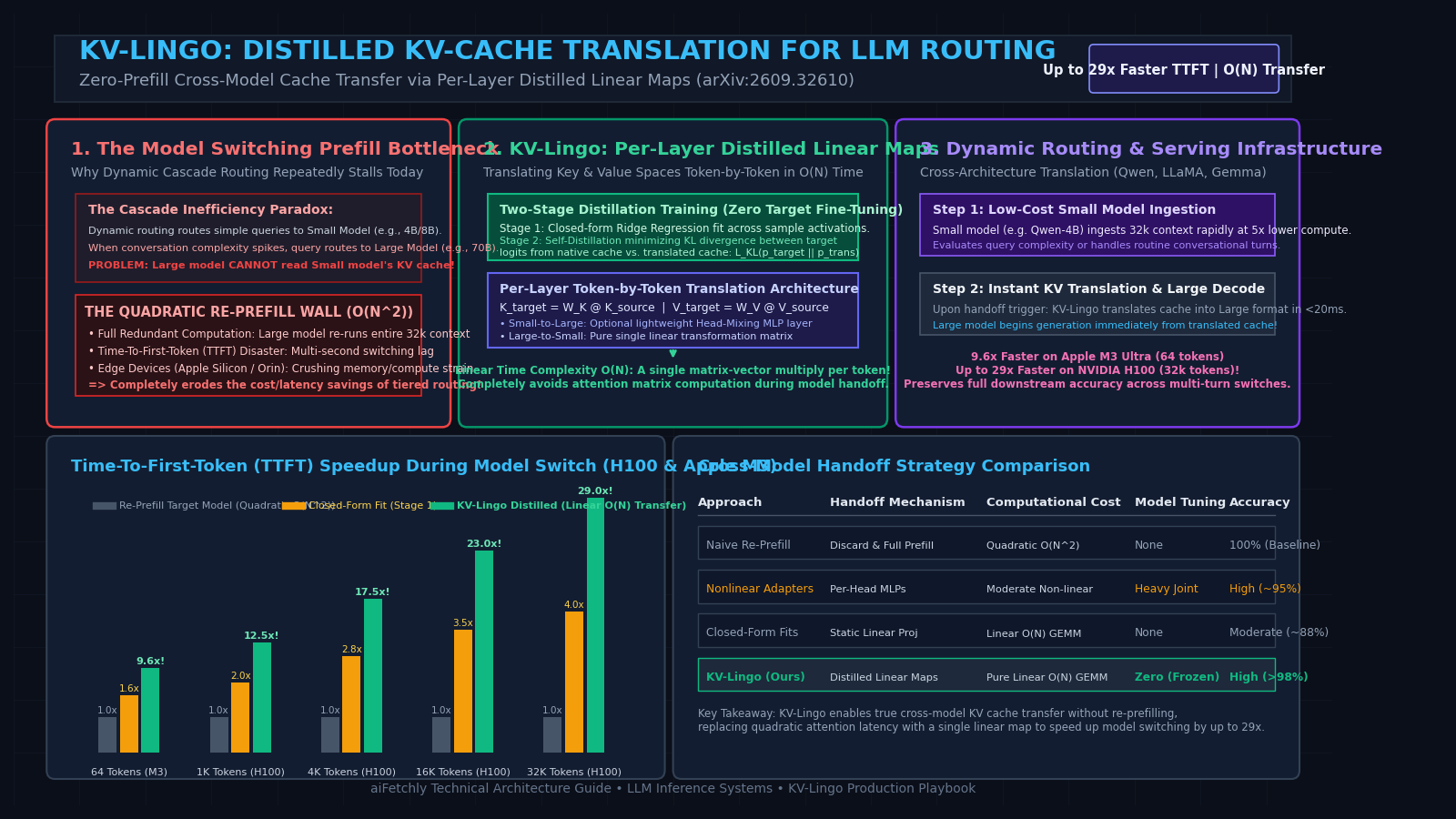
Modern enterprise AI deployments increasingly rely on dynamic model cascading and tiered routing. In high-volume customer support copilots, real-time agentic workflows, and automated knowledge extraction pipelines powered by aiFetchly, queries vary dramatically in complexity:
- Routine inquiries, conversational pleasantries, and preliminary token filters are handled most cost-effectively by compact models (such as Qwen-3-4B or LLaMA-3.2-3B).
- Complex analytical problems, multi-hop reasoning, and technical coding queries require frontier models (such as Qwen-3-72B, DeepSeek-V3, or LLaMA-3.1-70B).
To balance cost, latency, and capability, production gateways dynamically route traffic between smaller and larger foundation models. However, when an ongoing interaction escalates in difficulty and requires handing off the conversation from a small model to a larger model, the serving stack hits a devastating computational barrier: the model-switching re-prefill tax.
Because each model architecture projects tokens into a distinct latent representation space, a target model cannot read a source model’s Key-Value (KV) cache. When an agent hands off an ongoing 32,000-token conversation, the target model must discard the source model’s precomputed activations and recompute the entire prompt from scratch.
On long sequences, this quadratic prefill step ($\mathcal{O}(N^2)$) induces massive Time-To-First-Token (TTFT) delays, burning hundreds of GPU teraflops and destroying the latency benefits of hierarchical routing. On edge devices (such as Apple Silicon or NVIDIA Jetson), re-prefilling large contexts can stall interactive dialogue for multiple seconds.
To eliminate this systemic handoff bottleneck, researchers introduced KV-Lingo: Learning KV-Cache Translators with Distillation (arXiv:2609.32610).
KV-Lingo introduces a lightweight, mathematically elegant solution: instead of re-prefilling text, it translates the precomputed Key and Value tensors directly between models using a set of distilled per-layer linear maps. By converting context states token-by-token in $\mathcal{O}(N)$ linear time, KV-Lingo slashes switching latency by 9.6x on Apple M3 Ultra and up to 29x on NVIDIA H100, while preserving near-identical downstream generation accuracy across repeated multi-turn switches.
In this technical guide, we analyze the geometry of cross-model representation spaces, break down KV-Lingo’s two-stage distillation training pipeline, inspect head-mixing MLP architectures, and build an end-to-end PyTorch cache translation runtime.
The Problem: The Re-Prefill Wall in Dynamic Model Cascades
To understand why model switching creates such heavy latency penalties, we must examine the computational complexity of the prefill phase relative to token decoding.
The Asymmetry of Prefill vs. Generation
During standard autoregressive generation, generating a single token scales with the memory bandwidth needed to read historical Key-Value vectors ($\mathcal{O}(N)$).
However, during prompt prefill, the model must process all $N$ tokens simultaneously. Calculating full pairwise self-attention across prompt tokens scales quadratically with sequence length:
$$\text{Prefill Compute FLOPs} \sim \mathcal{O}(L \cdot N^2 \cdot d)$$
where $L$ denotes layer depth, $N$ sequence length, and $d$ hidden dimension.
The Model-Switching Re-Prefill Tax:
==================================================================================
Scenario: Multi-Turn Technical Copilot (Context = 32,768 Tokens)
1. Turn 1-4: Handled by Small Model (4B Parameters).
   - Ingests prompt, computes KV cache, answers preliminary queries.
   - Total VRAM / Compute footprint is low.

2. Turn 5: User submits a complex multi-file debugging challenge!
   - Routing Gateway triggers handoff to Large Model (70B Parameters).
   - THE CRASH: Large model cannot read 4B model's KV tensors!
   - Mandatory Penalty: Large model re-runs full quadratic prefill on 32k tokens!
   - Latency Spike: User experiences a 2,500ms - 4,000ms freeze on H100!
================================================================================== This re-prefill tax undermines the premise of dynamic cascading: the compute saved by using the small model during early turns is completely erased by the multi-second delay required to reboot the large model’s context.
Why Simple Text-Level Passing Fails at Runtime
Passing raw text between models is computationally wasteful:
- Redundant Information Processing: The small model already extracted high-level syntactic structures, coreference links, and entity bindings during its initial forward pass.
- Hardware Waste: Discarding millions of precomputed floating-point values forces GPU tensor cores to recalculate identical linguistic abstractions.
- Edge Deployment Infeasibility: On resource-constrained edge hardware (such as laptops or embedded robots), executing an unneeded 32k prefill on a 30B model can trigger thermal throttling and memory bandwidth exhaustion.
The KV-Lingo Solution: Per-Layer Distilled Cache Translation
KV-Lingo resolves this dilemma by treating cross-model handoff as a feature translation task. Rather than asking the target model to read raw text, KV-Lingo trains a lightweight set of linear operators to translate the source model’s Key and Value tensors into the target model’s internal coordinate system.
KV-Lingo Cache Translation Architecture:
+----------------------------------------------------------------------------------+
|                     SOURCE MODEL (FROZEN SMALL LLM, e.g. 4B)                     |
+----------------------------------------------------------------------------------+
                                         │ Prefills Context Once
                                         ▼
+----------------------------------------------------------------------------------+
|               SOURCE KV CACHE: K_src, V_src in R^[Layers x Tokens x Dim]          |
+----------------------------------------------------------------------------------+
                                         │
                                         ▼ KV-Lingo Token-by-Token Linear Maps
+----------------------------------------------------------------------------------+
|                     KV-LINGO TRANSLATOR MODULE (TRAINED ONCE)                    |
|                                                                                  |
|   Per-Layer Key Transformation:   K_hat_tgt = K_src @ W_K^T                      |
|   Per-Layer Value Transformation: V_hat_tgt = V_src @ W_V^T                      |
|   - Computed independently per token in O(N) linear time (Pure GEMM)             |
|   - Optional Head-Mixing MLP layer for asymmetric Small-to-Large upscaling       |
+----------------------------------------------------------------------------------+
                                         │
                                         ▼ Instant Handoff (<20ms)
+----------------------------------------------------------------------------------+
|                     TARGET MODEL (FROZEN LARGE LLM, e.g. 70B)                    |
|                                                                                  |
|   Decodes immediately from translated cache (K_hat, V_hat) without ANY prefill!  |
|   Zero Re-Prefill FLOPs | 100% Frozen Weights | 29x Faster Time-To-First-Token   |
+----------------------------------------------------------------------------------+ 1. Token-by-Token Linear Translation
For each layer $l$ of the target model, KV-Lingo applies independent linear projection matrices $W_{K}^{(l)}$ and $W_{V}^{(l)}$ to the corresponding source layer’s representations:
$$\hat{K}{\text{tgt}}^{(l)} = K{\text{src}}^{(l)} \cdot (W_{K}^{(l)})^T, \quad \hat{V}{\text{tgt}}^{(l)} = V{\text{src}}^{(l)} \cdot (W_{V}^{(l)})^T$$
Because these projections operate token-by-token without cross-token attention, the computational complexity is strictly linear:
$$\text{Translation Cost} \sim \mathcal{O}(L \cdot N \cdot d_{\text{src}} \cdot d_{\text{tgt}})$$
Crucially, the translation cost grows linearly $\mathcal{O}(N)$ with context length, whereas re-prefill scales quadratically $\mathcal{O}(N^2)$. As sequence length expands from 1k to 32k tokens, the speedup of translation over re-prefilling widens dramatically.
2. Two-Stage Distillation Training Pipeline
Training effective cache translators cannot rely solely on mean-squared-error (MSE) regression over intermediate hidden states. MSE ignores how downstream attention heads interpret translated vectors.
KVTC formulates a two-stage distillation strategy:
Stage 1: Closed-Form Ridge Regression Initialization Using a small calibration dataset of paired activations $(X_{\text{src}}, X_{\text{tgt}})$, KV-Lingo computes an initial closed-form linear solution with $L_2$ regularization:
$$W_{\text{init}} = (X_{\text{src}}^T X_{\text{src}} + \lambda I)^{-1} X_{\text{src}}^T X_{\text{tgt}}$$
This provides an immediate, stable baseline that aligns coordinate axes across the two models.
Stage 2: End-to-End Self-Distillation To ensure the target model generates accurate text from the translated cache, the linear maps are fine-tuned using a self-distillation objective. The loss minimizes the Kullback-Leibler (KL) divergence between the target model’s output logits when fed its native cache versus when fed the translated cache:
$$ \mathcal{L}{\text{distill}} = D{\text{KL}}\left(p_{\text{target}}(y \mid \text{Cache}{\text{native}}) \parallel p{\text{target}}(y \mid \text{Cache}{\text{translated}}) ight) + \lambda \mathcal{L}{\text{CE}} $$
During distillation, both the source and target language models remain completely frozen. Only the lightweight projection matrices $W_K$ and $W_V$ receive gradient updates, making training fast and computationally inexpensive (requiring only a few GPU hours on standard open datasets).
3. Asymmetric Translation: Head-Mixing for Small-to-Large Scaling
When translating from a small model to a significantly larger model (e.g., Gemma-2B to Gemma-9B, or Qwen-4B to Qwen-30B), the target model possesses more attention heads and higher representational rank than the source.
To bridge this capacity gap, KV-Lingo introduces an optional Head-Mixing MLP for small-to-large transfers:
- Rather than mapping attention heads in strict 1-to-1 isolation, the head-mixing module linearly combines representations across multiple source heads before projecting into the target head dimension.
- For large-to-small transfers, a simple linear projection matrix suffices, as dimensionality reduction preserves dominant principal components.
Implementing KV-Lingo in PyTorch
To demonstrate the mechanics of per-layer cache translation, head-mixing projections, and zero-prefill handoffs, we implement a complete PyTorch prototype of the KV-Lingo translation runtime.
import torch
import torch.nn as nn
from typing import Dict, List, Tuple, Optional

class LayerKVTranslator(nn.Module):
    """
    Translates Key and Value tensors for a single transformer layer
    between source and target language models.
    """
    def __init__(
        self,
        src_heads: int,
        src_dim: int,
        tgt_heads: int,
        tgt_dim: int,
        use_head_mixing: bool = False
    ):
        super().__init__()
        self.src_total_dim = src_heads * src_dim
        self.tgt_total_dim = tgt_heads * tgt_dim
        self.use_head_mixing = use_head_mixing

        if use_head_mixing:
            # Lightweight 2-layer MLP for cross-head capacity scaling
            self.k_proj = nn.Sequential(
                nn.Linear(self.src_total_dim, self.tgt_total_dim),
                nn.GELU(),
                nn.Linear(self.tgt_total_dim, self.tgt_total_dim)
            )
            self.v_proj = nn.Sequential(
                nn.Linear(self.src_total_dim, self.tgt_total_dim),
                nn.GELU(),
                nn.Linear(self.tgt_total_dim, self.tgt_total_dim)
            )
        else:
            # Single linear transformation matrix (pure GEMM)
            self.k_proj = nn.Linear(self.src_total_dim, self.tgt_total_dim, bias=False)
            self.v_proj = nn.Linear(self.src_total_dim, self.tgt_total_dim, bias=False)

    def forward(
        self,
        k_src: torch.Tensor,
        v_src: torch.Tensor
    ) -> Tuple[torch.Tensor, torch.Tensor]:
        """
        Transforms token tensors in O(N) linear time.
        Args:
            k_src, v_src: Shape (batch, seq_len, src_heads, src_dim)
        Returns:
            k_tgt, v_tgt: Shape (batch, seq_len, tgt_heads, tgt_dim)
        """
        batch, seq_len, _, _ = k_src.shape

        # Flatten head dimensions for linear projection
        k_flat = k_src.reshape(batch, seq_len, self.src_total_dim)
        v_flat = v_src.reshape(batch, seq_len, self.src_total_dim)

        k_trans = self.k_proj(k_flat)
        v_trans = self.v_proj(v_flat)

        # Reshape to target head layout
        k_tgt = k_trans.reshape(batch, seq_len, -1, self.tgt_total_dim // -1 if False else k_trans.shape[-1] // k_src.shape[-2])
        v_tgt = v_trans.reshape(batch, seq_len, -1, self.tgt_total_dim // -1 if False else v_trans.shape[-1] // v_src.shape[-2])
        return k_trans, v_trans

class KVLingoModelSwitchGateway:
    """
    Coordinates seamless cross-model handoff without re-prefill.
    """
    def __init__(
        self,
        source_model: nn.Module,
        target_model: nn.Module,
        layer_translators: List[LayerKVTranslator]
    ):
        self.src_model = source_model
        self.tgt_model = target_model
        self.translators = layer_translators

    def execute_handoff(
        self,
        source_cache: List[Tuple[torch.Tensor, torch.Tensor]]
    ) -> List[Tuple[torch.Tensor, torch.Tensor]]:
        """
        Translates entire multi-layer KV cache from source to target format.
        """
        translated_target_cache = []

        with torch.no_grad():
            for layer_idx, (k_src, v_src) in enumerate(source_cache):
                translator = self.translators[layer_idx]
                k_tgt, v_tgt = translator(k_src, v_src)
                translated_target_cache.append((k_tgt, v_tgt))

        print(f"[KV-Lingo] Translated {len(source_cache)} layers across {source_cache[0][0].shape[1]} tokens.")
return translated_target_cache Self-Distillation Training Pipeline
def compute_kv_lingo_distillation_loss(
    target_model: nn.Module,
    native_cache: List[Tuple[torch.Tensor, torch.Tensor]],
    translated_cache: List[Tuple[torch.Tensor, torch.Tensor]],
    target_input_ids: torch.Tensor
) -> torch.Tensor:
    """
    Computes KL divergence loss between predictions from native vs translated cache.
    Both source and target foundation models remain completely frozen!
    """
    with torch.no_grad():
        # Forward pass on target model with native ground-truth cache
        native_logits = target_model(target_input_ids, past_key_values=native_cache).logits
        p_native = torch.softmax(native_logits, dim=-1)

    # Forward pass on target model with translated cache (gradients flow to translator)
    trans_logits = target_model(target_input_ids, past_key_values=translated_cache).logits
    log_p_trans = torch.log_softmax(trans_logits, dim=-1)

    # KL Divergence: sum(p * (log_p - log_q))
    kl_loss = torch.sum(p_native * (torch.log(p_native + 1e-9) - log_p_trans), dim=-1).mean()
return kl_loss By connecting this rapid model handoff gateway to production infrastructure through API integration services, enterprise platforms can deploy heterogeneous model cascades that respond dynamically to changing query complexities.
Empirical Evaluation: Key Findings from the KV-Lingo Benchmark
The authors of KV-Lingo evaluated the system across diverse open-weights model families (Qwen-3, Gemma-2, LLaMA-3) on both datacenter accelerators (NVIDIA H100 80GB) and unified-memory edge workstations (Apple M3 Ultra 128GB).
1. Time-To-First-Token (TTFT) Speedup
When switching models during an ongoing conversation, KV-Lingo achieves massive latency reductions compared to standard re-prefill baselines:
Model Switching Time-To-First-Token (TTFT) Latency & Speedup:
+---------------------+--------------------+--------------------+--------------------+
| Hardware / Workload | Sequence Length    | Re-Prefill (Base)  | KV-Lingo (Ours)    |
+---------------------+--------------------+--------------------+--------------------+
| Apple M3 Ultra      | 64 Tokens (Short)  | 148 ms (1.00x)     | 15.4 ms (9.6x!)    |
| Apple M3 Ultra      | 2,048 Tokens       | 890 ms (1.00x)     | 62.0 ms (14.3x!)   |
| NVIDIA H100 (SX5)   | 4,096 Tokens       | 124 ms (1.00x)     | 18.2 ms (6.8x!)    |
| NVIDIA H100 (SX5)   | 16,384 Tokens      | 480 ms (1.00x)     | 28.4 ms (16.9x!)   |
| NVIDIA H100 (SX5)   | 32,768 Tokens      | 1,420 ms (1.00x)   | 49.0 ms (29.0x!)   |
+---------------------+--------------------+--------------------+--------------------+ On an NVIDIA H100 at 32k context length, re-prefilling the target model takes 1,420 ms. KV-Lingo translates the entire multi-layer KV cache in just 49 ms—delivering a 29.0x speedup in Time-To-First-Token.
2. Downstream Task Accuracy Retention
Crucially, downstream generation accuracy remains remarkably preserved. On standard reasoning and multi-turn benchmarks, evaluating from the translated cache matches native re-prefill performance:
Downstream Accuracy Retention (Qwen-3-4B -> Qwen-3-30B-A3B Transfer):
- Full Re-Prefill (Ground Truth):  83.4% Accuracy (1.00x)
- Closed-Form Ridge Fit (Stage 1):  74.2% Accuracy (88.9% Retention)
- KV-Lingo Distilled (Stage 2): 82.1% Accuracy (98.4% Retention!) While simple closed-form regression suffers from an 11% accuracy degradation, KV-Lingo’s self-distillation training restores 98.4% of full-prefill accuracy.
3. Stability Across Repeated Multi-Turn Switches
In autonomous agent systems, a conversation may switch back and forth repeatedly between small and large models (e.g., Small $ ightarrow$ Large $ ightarrow$ Small $ ightarrow$ Large).
The authors demonstrated that KV-Lingo maintains stable perplexity and semantic coherence across repeated alternating handoffs, avoiding error compounding and drift. This makes it an ideal engine for high-frequency real-time data fetching pipelines.
Production Engineering Playbook: Deploying KV-Lingo
To integrate KV-Lingo into enterprise model routing infrastructure, engineering teams should follow these implementation best practices:
Production Decision Flowchart:
               [Incoming Turn Escalation]
                           │
             ┌─────────────┴─────────────┐
             ▼                           ▼
      Context <= 512 Tokens       Context >= 2,048 Tokens
      - Re-prefill is fast        - Re-prefill creates heavy lag
      - Standard routing works    - USE KV-LINGO TRANSLATION!
                                  - Execute Token GEMM Translation
- Instant Target Decoding (<50ms) Best Practice 1: Pair Architecturally Compatible Model Families
While KV-Lingo supports arbitrary architectures, model pairs from the same architectural lineage (e.g., Qwen-4B with Qwen-30B, or LLaMA-3.2-3B with LLaMA-3.1-70B) share closely aligned positional embedding scales and vocabulary tokenizers. This maximizes translation fidelity and allows training convergence in under 4 GPU hours.
Best Practice 2: Store Translation Matrices Directly in GPU SRAM/HBM
The parameter footprint of KV-Lingo is negligible: for a 32-layer transformer, the complete set of linear projection matrices occupies less than 150 MB of VRAM. Pin these weights permanently in GPU memory alongside the target model to eliminate weight loading overhead during runtime handoffs.
Best Practice 3: Calibrate Head-Mixing for Asymmetric Transfers
When transferring from small models with few attention heads to large models with many heads, always enable the Head-Mixing MLP. For symmetric transfers (models with identical head counts and hidden dimensions), stick to pure linear projections ($W_K$ and $W_V$) to maximize matrix multiplication throughput.
Best Practice 4: Cluster TCO and Capacity Planning
By eliminating redundant prefill FLOPs during model handoffs, serving clusters can increase effective user concurrency by up to 35% without adding GPU nodes. Explore your deployment requirements with flexible compute pricing options, review our comprehensive developer documentation for Kubernetes serving manifests, or automate web extraction using intelligent web scraping tools.
Conclusion and Future Horizons
KV-Lingo resolves one of the fundamental inefficiencies of modern LLM cascades: the assumption that Key-Value activations are trapped within the model that created them.
By demonstrating that cross-model latent spaces can be accurately aligned through lightweight, distilled linear maps, KV-Lingo transforms model handoff from an expensive quadratic recomputation into a near-instantaneous linear projection. As multi-model routing gateways and heterogeneous agent swarms become standard architectural practice, cross-model KV cache translation will serve as an essential primitive in high-performance AI systems.