KTO Explained: Binary LLM Alignment via Prospect Theory
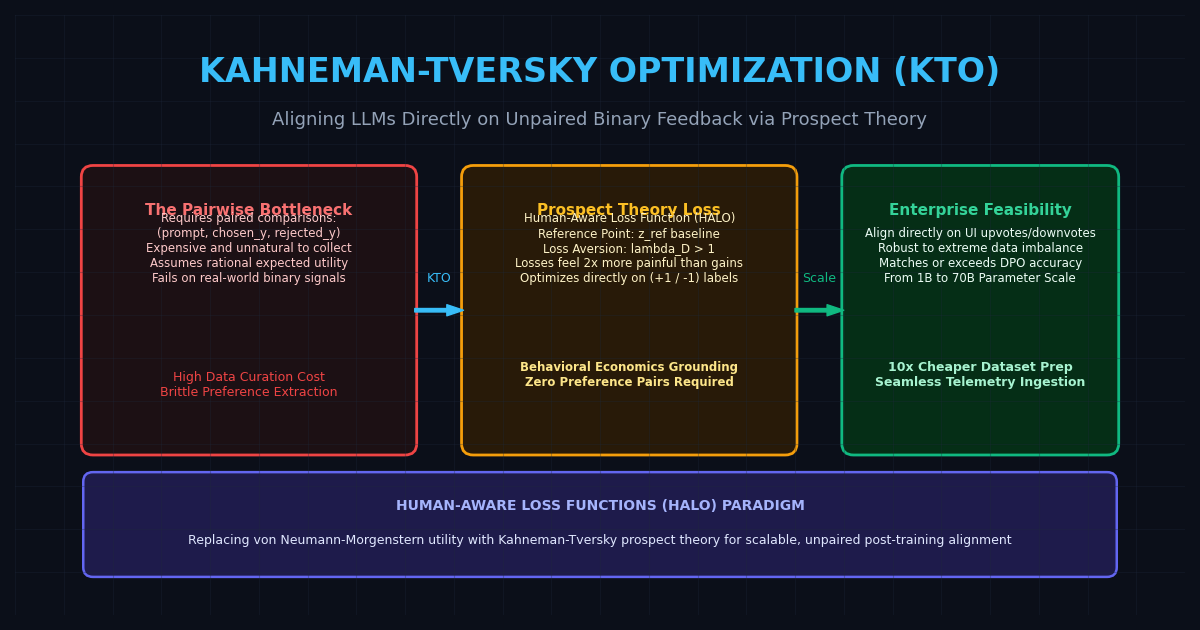
The Problem: The Pairwise Preference Bottleneck in Production Alignment
Post-training alignment has become the defining differentiator for enterprise foundation models and specialized data extraction agents like AiFetchly. Aligning a base model ensures it follows complex schemas, rejects toxic inputs, and avoids hallucinations.
However, mainstream post-training techniques—including Reinforcement Learning from Human Feedback (RLHF with PPO), Direct Preference Optimization (DPO), and Simple Preference Optimization (SimPO)—are structurally bound to pairwise preferences:
$$\mathcal{D}_{\text{pair}} = {(x, y_w, y_l)}$$
To train these models, engineering teams must present an identical prompt $x$ and pair a strictly “winning” response $y_w$ against a “losing” response $y_l$.
The Real-World Failure of Pairwise Data Collection
While pairwise datasets work inside controlled academic benchmark suites (like UltraFeedback), they present crippling bottlenecks in live production software:
- Unnatural User Telemetry: In real-world software applications, users do not generate two competing completions, read both, and submit a relative judgment. Instead, users provide unpaired binary signals: clicking a single thumbs-up icon, copying a response to their clipboard, rating a document extraction as valid, or terminating a generation midway with a thumbs-down. Forcing this data into pairwise format requires synthesizing counter-responses with separate LLMs, introducing synthetic bias and doubling inference expenses.
- Extreme Data Wastage: If an enterprise logs 100,000 positive customer interactions and 10,000 negative ones, standard DPO forces teams to discard 90,000 positive examples to construct paired triples $(x, y_w, y_l)$.
- Flawed Economic Assumptions: DPO and PPO rely on the von Neumann-Morgenstern utility theorem, which assumes humans are rational agents who evaluate choices through consistent expected utility. In reality, human psychology is profoundly non-linear and loss-averse.
To align models directly on real-world telemetry, machine learning requires a loss function rooted in how humans actually perceive value.
The Architecture: Human-Aware Loss Functions & Prospect Theory
Introduced by researchers from Stanford University and Contextual AI (Kawin Ethayarajh, Winnie Xu, Niklas Muennighoff, Dan Jurafsky, and Douwe Kiela), Kahneman-Tversky Optimization (KTO) abandons the rational utility framework.
Instead, KTO grounds language model alignment in Prospect Theory—the behavioral economics framework developed by Daniel Kahneman and Amos Tversky that won the 2002 Nobel Prize in Economics.
The Core Principles of Prospect Theory
Prospect Theory identifies three universal cognitive biases governing human decision-making under uncertainty:
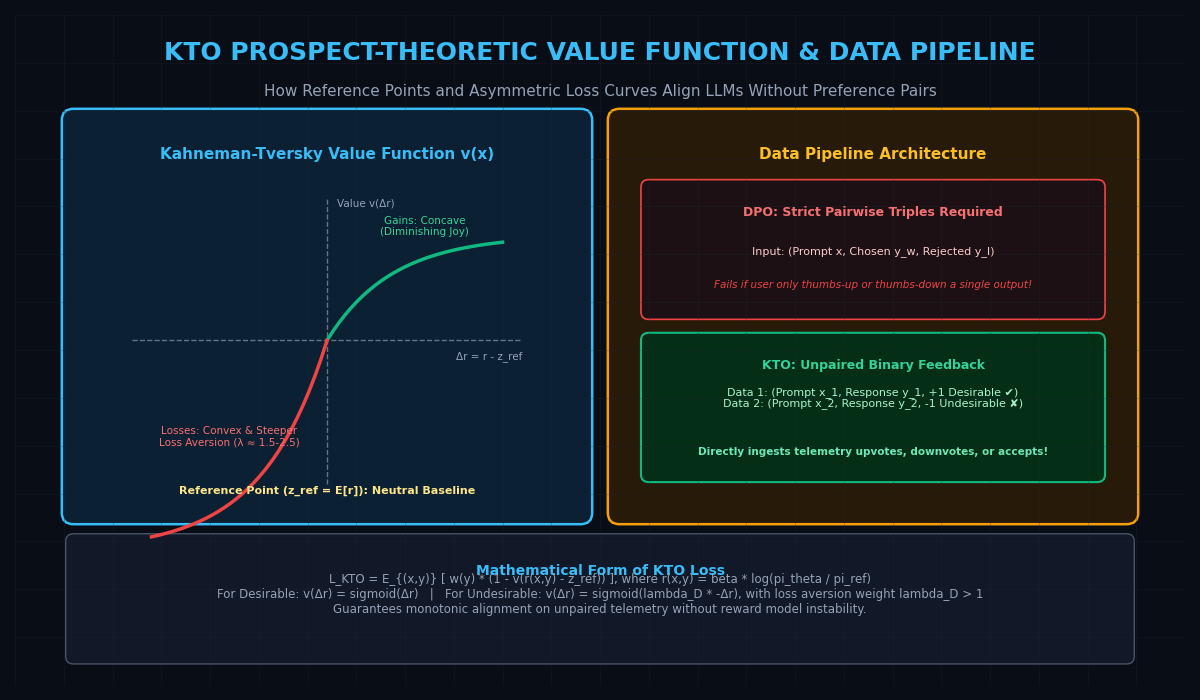
- Reference Dependence: Humans do not evaluate outcomes by absolute wealth or utility. Instead, we evaluate outcomes as gains or losses relative to a neutral reference point ($z_{\text{ref}}$).
- Loss Aversion: Humans experience the pain of a loss far more acutely than the pleasure of an equivalent gain: $$\text{Disutility of Loss} \approx \lambda \times \text{Utility of Gain} \quad (\lambda \approx 1.5 - 2.5)$$ A negative model response (such as a hallucinated financial figure or broken JSON payload) damages user trust twice as much as an accurate response builds confidence.
- Diminishing Sensitivity: Human perception exhibits an S-shaped value curve $v(x)$: concave for gains (diminishing joy for additional output length) and convex for losses (the jump from mediocre to bad feels worse than the jump from bad to terrible).
Human-Aware Loss Functions (HALOs)
KTO formalizes this behavior into the family of Human-Aware Loss Functions (HALOs). Rather than requiring pairwise relative preferences, KTO maximizes the human utility of the model’s output distribution directly from unpaired binary labels:
$$\mathcal{D}_{\text{binary}} = {(x, y, c) \mid c \in {\text{desirable}, \text{undesirable}}}$$
Key Mathematical Mechanics of KTO
In KTO, the implicit reward of an output $y$ generated from prompt $x$ is defined through the log-ratio of policy probabilities against a frozen reference model $\pi_{\text{ref}}$:
$$r_\theta(x, y) = \beta \log \frac{\pi_\theta(y \mid x)}{\pi_{\text{ref}}(y \mid x)}$$
Where $\beta$ controls the strength of the KL-divergence penalty constraint.
1. The Dynamic Reference Point ($z_{\text{ref}}$)
To implement Reference Dependence, KTO defines the neutral reference point $z_{\text{ref}}$ as the expected implicit reward of outputs under the reference distribution:
$$z_{\text{ref}} = \mathbb{E}{x’ \sim \mathcal{D}, y’ \sim \pi{\text{ref}}} \left[ \beta \log \frac{\pi_\theta(y’ \mid x’)}{\pi_{\text{ref}}(y’ \mid x’)} \right]$$
During training, $z_{\text{ref}}$ is tracked via an exponential moving average over previous batches. An output is experienced as a gain if $r_\theta(x, y) > z_{\text{ref}}$, and a loss if $r_\theta(x, y) < z_{\text{ref}}$.
2. The Asymmetric KTO Loss Function
The overall KTO objective separates into two distinct loss terms:
$$\mathcal{L}{\text{KTO}}(\pi\theta) = \mathbb{E}{(x, y) \sim \mathcal{D}{\text{desirable}}} \left[ w_D \cdot \ell_D(x, y) \right] + \mathbb{E}{(x, y) \sim \mathcal{D}{\text{undesirable}}} \left[ w_U \cdot \ell_U(x, y) \right]$$
For Desirable Responses ($y \in \mathcal{Y}_{\text{desirable}}$):
$$\ell_D(x, y) = 1 - \sigma\left(r_\theta(x, y) - z_{\text{ref}}\right)$$
As $r_\theta(x, y)$ exceeds $z_{\text{ref}}$, the sigmoid $\sigma \to 1$, driving the loss to zero.
For Undesirable Responses ($y \in \mathcal{Y}_{\text{undesirable}}$):
$$\ell_U(x, y) = 1 - \sigma\left(\lambda_D \cdot (z_{\text{ref}} - r_\theta(x, y))\right)$$
Where $\lambda_D > 1$ (typically set to $1.33$ or $1.5$) is the Loss Aversion Multiplier. If an undesirable output receives an implicit reward higher than the baseline ($r_\theta > z_{\text{ref}}$), the penalty gradient is scaled up aggressively by $\lambda_D$, ensuring the optimizer suppresses bad generations with urgent priority.
Handling Extreme Class Imbalance:
Real-world telemetry rarely features a 50/50 split between positive and negative feedback. To prevent majority-class collapse, KTO scales the weighting factors:
$$w_D = \frac{1}{N_D}, \quad w_U = \frac{\lambda_D}{N_U}$$
This ensures KTO trains effectively even when datasets consist of 90% positive and 10% negative examples (or vice-versa).
LLM Alignment Paradigm Comparison
| Dimension | PPO (RLHF) | DPO | SimPO | KTO (Prospect Theoretic) |
|---|---|---|---|---|
| Data Format | Prompts + Reward Model | Pairs $(x, y_w, y_l)$ | Pairs $(x, y_w, y_l)$ | Unpaired $(x, y, \pm 1)$ |
| Data Collection Cost | Extremely High (Reward Model) | High (Must pair identical prompts) | High (Must pair identical prompts) | Very Low (Raw UI telemetry/upvotes) |
| Theoretical Foundation | Expected Utility Theory | Bradley-Terry Model | Bradley-Terry + Margin | Kahneman-Tversky Prospect Theory |
| Loss Aversion Modeling | No | No | No | Yes (Asymmetric penalty $\lambda_D > 1$) |
| Reference Model Memory | Required in GPU | Required in GPU | None (Reference-Free) | Required in GPU |
| Imbalance Resilience | Moderate | None (Requires 1:1 pairs) | None (Requires 1:1 pairs) | High (Naturally handles 90/10 skews) |
Reference Implementation: Kahneman-Tversky Optimization in PyTorch
Below is a self-contained PyTorch implementation demonstrating sequence log-probability extraction, dynamic reference point tracking, and asymmetric loss evaluation for unpaired binary data.
import torch
import torch.nn as nn
import torch.nn.functional as F
from typing import Dict, Tuple

class KTOLoss(nn.Module):
    """
    Kahneman-Tversky Optimization (KTO) Loss Module.
    Optimizes unpaired binary feedback using Prospect Theory loss curves.
    """
    def __init__(
        self,
        beta: float = 0.1,
        desirable_weight: float = 1.0,
        undesirable_weight: float = 1.0,
        loss_aversion_lambda: float = 1.33
    ):
        super().__init__()
        self.beta = beta
        self.w_d = desirable_weight
        self.w_u = undesirable_weight
        self.lambda_d = loss_aversion_lambda

        # Running expected reward baseline (z_ref)
        self.register_buffer("z_ref", torch.tensor(0.0))
        self.decay = 0.95

    def compute_implicit_reward(
        self,
        policy_logps: torch.Tensor,    # [B] Log-probs under current policy
        ref_logps: torch.Tensor        # [B] Log-probs under frozen reference model
    ) -> torch.Tensor:
        """Computes r_theta(x, y) = beta * (log pi_theta - log pi_ref)"""
        return self.beta * (policy_logps - ref_logps)

    def forward(
        self,
        policy_logps: torch.Tensor,    # [B]
        ref_logps: torch.Tensor,       # [B]
        labels: torch.Tensor           # [B] Boolean tensor: True if desirable, False if undesirable
    ) -> Tuple[torch.Tensor, Dict[str, float]]:
        """
        Calculates asymmetric KTO loss across a mixed batch of unpaired samples.
        """
        rewards = self.compute_implicit_reward(policy_logps, ref_logps)

        # Dynamically update running baseline z_ref across training batches
        with torch.no_grad():
            batch_mean = rewards.mean()
            self.z_ref = self.decay * self.z_ref + (1.0 - self.decay) * batch_mean

        delta_r = rewards - self.z_ref

        # 1. Desirable Loss: 1 - sigmoid(r - z_ref)
        loss_desirable = 1.0 - torch.sigmoid(delta_r)

        # 2. Undesirable Loss with Loss Aversion: 1 - sigmoid(lambda_d * (z_ref - r))
        loss_undesirable = 1.0 - torch.sigmoid(self.lambda_d * (-delta_r))

        # Separate masks for desirable and undesirable examples in the batch
        mask_d = labels.float()
        mask_u = (1.0 - labels.float())

        num_d = torch.clamp(mask_d.sum(), min=1.0)
        num_u = torch.clamp(mask_u.sum(), min=1.0)

        # Weighted aggregate loss
        loss = (
            self.w_d * (loss_desirable * mask_d).sum() / num_d +
            self.w_u * (loss_undesirable * mask_u).sum() / num_u
        )

        metrics = {
            "kto_loss": loss.item(),
            "mean_reward": rewards.mean().item(),
            "z_ref": self.z_ref.item(),
            "desirable_acc": (rewards[labels] > self.z_ref).float().mean().item() if labels.any() else 0.0
        }
        return loss, metrics


# Verification and Demonstration
if __name__ == "__main__":
    torch.manual_seed(42)
    kto = KTOLoss(beta=0.1, loss_aversion_lambda=1.5)

    # Simulate batch of 4 independent samples: 3 desirable (+), 1 undesirable (-)
    # No pairwise pairing required!
    policy_logps = torch.tensor([-12.5, -8.2, -15.1, -22.4])
    ref_logps    = torch.tensor([-14.0, -9.0, -14.8, -18.0])
    labels       = torch.tensor([True, True, True, False]) # Unpaired binary flags

    loss, stats = kto(policy_logps, ref_logps, labels)

    print("--- KTO Loss Computation Successful ---")
    print(f"Calculated KTO Loss: {round(loss.item(), 4)}")
    print(f"Tracking Reference Point z_ref: {round(stats['z_ref'], 4)}")
print(f"Batch Mean Implicit Reward: {round(stats['mean_reward'], 4)}") Production Scaling and Future Outlook
Kahneman-Tversky Optimization provides a transformative upgrade for post-training engineering workflows:
1. Zero-Cost Alignment from Real-Time Telemetry
For platforms deploying automated data extraction and conversational agents like AiFetchly, acquiring paired preference datasets is a severe bottleneck.
With KTO, development teams can connect alignment pipelines directly to application event buses:
- An analyst accepts an automated web scraping table $\implies$ logged as Desirable ($c = +1$).
- An analyst manually edits a broken column regex $\implies$ initial model attempt logged as Undesirable ($c = -1$).
There is zero requirement to curate synthetic counter-responses. The continuous feedback stream flows directly into weekly post-training loops, aligning domain models on authentic user preferences at near-zero annotation expense.
2. Matching Frontier Model Quality at Scale
On standard evaluations (including AlpacaEval 2.0 and MT-Bench), models aligned with KTO match or exceed the win rates of DPO across 7B, 13B, and 70B parameter scales.
By modeling cognitive loss aversion explicitly, KTO eliminates verbose model babble and drastically reduces hallucination rates—proving that respecting the nuances of human psychology produces fundamentally more reliable artificial intelligence.