Kandou Glasswing Guide: Chord Signaling AI Chiplet IP
The Chiplet Interconnect Crisis: The Death of Monolithic Dies and the Packaging Bottleneck
The scaling trajectory of modern artificial intelligence infrastructure has arrived at an unyielding physical and economic barrier. For four decades, semiconductor performance scaled according to classical Moore’s Law and Dennard scaling: every two years, lithography scanners printed smaller transistors, allowing architects to integrate more compute units onto larger monolithic silicon dies. However, as frontier foundation models—such as dense large language models (LLMs), mixture-of-experts (MoE) ensembles, and multimodal vision transformers—surpassed hundreds of billions and trillions of parameters, the monolithic silicon approach collapsed under physical constraints:
- The Photolithographic Reticle Limit and Manufacturing Yield Trap: Modern deep ultraviolet (DUV) and extreme ultraviolet (EUV) lithography scanners are physically bound by an optical exposure limit known as the reticle limit (typically $\approx 858\text{ mm}^2$). When semiconductor companies attempt to manufacture monolithic processors pushing against this physical ceiling (such as 800 mm² dies), silicon defect probability escalates exponentially. A single microscopic crystalline dislocation or dust particle ruins the entire multi-thousand-dollar die. On cutting-edge 3nm and 2nm nodes, mature wafer yields on reticle-limit monolithic dies plummet, inflating manufacturing scrap costs to economically unsustainable levels.
- The High-Cost Packaging Monopolies (Silicon Interposers): To bypass the reticle limit, the industry pivoted toward chiplets—disaggregating a giant processor into multiple smaller, high-yielding silicon dies (such as compute chiplets, memory controllers, and I/O hubs) assembled onto a shared package. However, conventional multi-chiplet packaging relies heavily on 2.5D silicon interposers (such as TSMC’s CoWoS—Chip-on-Wafer-on-Substrate). Silicon interposers are themselves massive, passive silicon wafers manufactured with microscopic through-silicon vias (TSVs) and micro-bumps. Interposers suffer from severe supply-chain shortages, low assembly yields, and multi-thousand-dollar packaging cost premiums that bottleneck global AI accelerator deployments.
- The SerDes Power Wall and Differential Signaling Limits: When chiplets are placed on standard, low-cost organic substrates (such as standard BT or ABF laminates) rather than expensive silicon interposers, signal traces become longer (10 mm to 40 mm) and experience severe electromagnetic parasitics. Conventional high-speed chip-to-chip interfaces rely on differential signaling:
- Non-Return-to-Zero (NRZ): Transmits 1 bit per differential pair (2 wires per bit). At multi-gigabit data rates, high wire counts create extreme pin congestion along the die edge.
- 4-Level Pulse Amplitude Modulation (PAM4): Transmits 2 bits per symbol by slicing the voltage window into four discrete levels. However, PAM4 suffers a catastrophic 9.5 dB signal-to-noise ratio (SNR) penalty compared to NRZ, requiring power-hungry continuous-time linear equalizers (CTLE), decision feedback equalizers (DFE), and digital signal processing (DSP) blocks in the SerDes.
- Return-Path Discontinuities and Ground Bounce: In single-ended and unconstrained multi-lane buses, simultaneous switching outputs (SSO) induce massive transient current surges across supply and ground planes ($V = L \frac{dI}{dt}$). This ground bounce introduces severe jitter, inter-symbol interference (ISI), and electromagnetic cross-talk that corrupts high-speed data transmission across dense chiplet interfaces.
To make multi-chiplet AI accelerators commercially scalable, energy-efficient, and manufacturable on standard organic substrates without expensive silicon interposers, the industry requires an entirely rethought signaling paradigm grounded in fundamental information theory.
Introducing Kandou Glasswing: Terabit Chiplet Interconnect via Chord Signaling
Kandou Bus—the Swiss semiconductor and high-speed transmission innovator founded in Lausanne by world-renowned information theorist Dr. Amin Shokrollahi (co-inventor of Raptor forward error correction codes)—delivers the definitive breakthrough to the chiplet packaging crisis with Kandou Glasswing™.
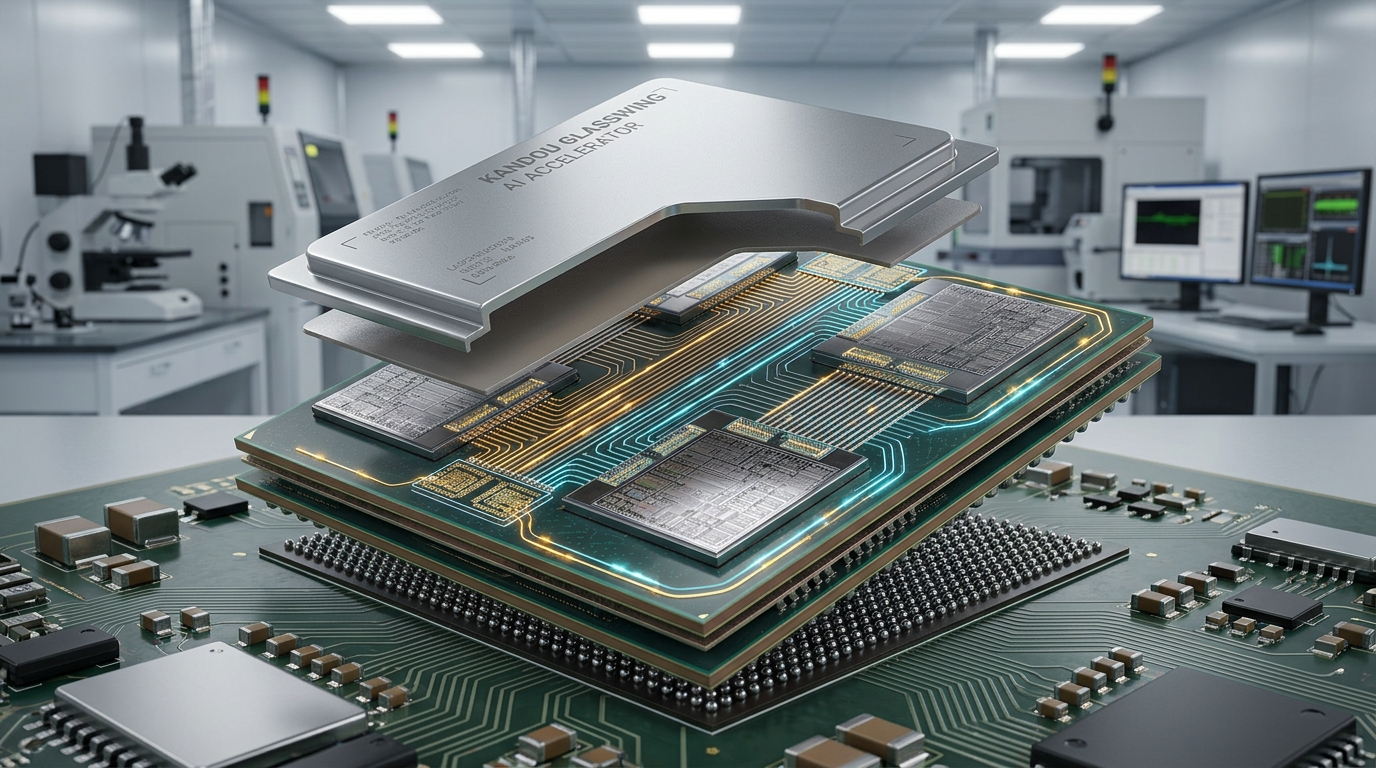
Glasswing is an ultra-low-power, high-density Ultra-Short Reach (USR) and Extra-Short Reach (XSR) SerDes chiplet interconnect intellectual property (IP) core. Rather than relying on traditional differential pairs or noise-sensitive single-ended traces, Glasswing is powered by Kandou’s patented Chord Signaling™ technology utilizing CNRZ-5 (Correlated Non-Return-to-Zero 5-bit) coding.
Chord Signaling is a revolutionary multi-wire transmission methodology that sends correlated code words across groups of coupled electrical conductors. In the CNRZ-5 implementation, Glasswing transmits 5 bits of data over 6 correlated wires across a single clock interval, while guaranteeing that the mathematical sum of electrical currents across all six wires always equals zero:
$$\sum_{k=1}^6 I_k(t) = 0 \quad \forall t$$
This mathematical invariance delivers unprecedented physical and architectural advantages:
- Immunity to Common-Mode Noise and Zero Ground Bounce: Because the aggregate current across the 6-wire chord is constant at all times, no transient switching currents flow into ground or power planes ($dI/dt = 0$). Power supply noise, return-path ground bounce, and simultaneous switching noise are virtually eradicated.
- Interposer-Class Bandwidth on Low-Cost Organic Substrates: Delivers up to 1 Terabit per second (Tbps) per millimeter of die edge over standard organic substrates (such as standard ABF printed circuit substrates) across reach distances up to 40 millimeters. This completely eliminates the need for expensive silicon interposers (such as CoWoS) or silicon bridges (such as EMIB), slashing multi-chiplet packaging costs by up to 70%.
- Sub-1 Picojoule per Bit Energy Efficiency: Consumes under 0.7 to 1.0 picojoules per bit (pJ/bit)—delivering over 3x to 5x higher energy efficiency than conventional PCIe or standard short-reach SerDes interfaces.
- High Pin-Density Efficiency: Delivers 5 bits over 6 wires (0.83 bits per pin), achieving significantly higher routing efficiency than differential signaling (which requires 2 pins per bit, or 0.50 bits per pin) while maintaining superior noise margins than PAM4.
- Broad Industry Adoption: Licensed and deployed by tier-one semiconductor leaders—including Marvell Technology and hyperscale custom silicon architects—to build modular artificial intelligence processors, high-radix datacenter switches, and disaggregated memory hubs.
Enterprises deploying large-scale neural network training, automated data extraction, and multimodal reasoning clusters can connect Glasswing-accelerated chiplet infrastructure with real-time data ingestion infrastructure to stream high-velocity datasets directly between disaggregated memory chiplets and neural compute dies without interconnect latency bottlenecks. By transforming multi-wire physics through advanced coding theory, Kandou Glasswing unlocks the true modular promise of the chiplet revolution.
Architectural Deep Dive: CNRZ-5 Coding, Chord Transmission Physics, and Transceiver Microarchitecture
The mathematical elegance and physical efficiency of Kandou Glasswing require an exhaustive technical investigation across four primary dimensions: the CNRZ-5 coding matrix, multi-wire comparator circuit physics, the PHY transceiver architecture, and die-to-die channel equalization.
The Mathematics of CNRZ-5 Chord Signaling
Traditional signaling systems evaluate voltage levels on each wire independently (single-ended) or compare a pair of complementary wires (differential). Chord Signaling generalizes signaling across an $n$-dimensional vector space over $n$ electrical wires.
In Kandou’s CNRZ-5 (Chord NRZ 5-bit) architecture, a 5-bit digital input nibble $B = (b_0, b_1, b_2, b_3, b_4) \in {0, 1}^5$ is encoded into an 6-dimensional analog transmission codeword $X = (x_0, x_1, x_2, x_3, x_4, x_5) \in {-1, -\frac{1}{3}, +\frac{1}{3}, +1}^6$.
The encoding transformation is governed by an orthogonal Hadamard-derived linear mapping:
$$X = \mathbf{M}_{enc} \times B$$
The fundamental mathematical property of CNRZ-5 codewords is that every valid code vector satisfies two strict physical constraints:
- Zero Sum-Current (Zero Common Mode): $$\sum_{i=0}^5 x_i = 0$$ The sum of voltages (and resulting driver currents) is identically zero for all $2^5 = 32$ code combinations.
- Constant Signal Energy: $$|X|2^2 = \sum{i=0}^5 x_i^2 = \text{Constant}$$ Every transmitted symbol draws the exact same instantaneous dynamic power from the voltage regulator, eliminating power rail transient droop.
+-----------------------------------------------------------------------+
|                 Kandou Glasswing PHY Architecture (CNRZ-5)            |
+-----------------------------------------------------------------------+
|  +------------------------+  +-------------------------------------+  |
|  | Transmit Digital Core  |  | Low-Jitter Clock Multiplier (PLL)   |  |
|  | - 5-Bit Parallel Ingest|  | - Low Phase Noise LC-VCO            |  |
|  | - CNRZ-5 Matrix Encoder|  | - Multi-Phase Sub-Rate Clocks       |  |
|  +-----------+------------+  +------------------+------------------+  |
|              |                                  |                     |
|  +-----------v----------------------------------v------------------+  |
|  | 6-Wire Voltage-Mode Transmit Driver Array (Impedance Matched)   |  |
|  +-----------------------------------------------------------------+  |
|                                |                                      |
|  ==============================v====================================  |
|  6-Wire Correlated Transmission Channel (Standard Organic Substrate)  |
|  - Microstrip / Stripline Traces (Length: 2mm to 40mm)                |
|  - Sub-1 pJ/bit Energy Consumption | Zero Return-Path Ground Bounce   |
|  ==============================+====================================  |
|                                |                                      |
|  +-----------------------------v-----------------------------------+  |
|  | Multi-Input Analog Comparator Array (5 Orthogonal Receivers)    |  |
|  +-----------------------------------------------------------------+  |
|              |                                  |                     |
|  +-----------v------------+  +------------------v------------------+  |
|  | Slicers & Deserializer |  | Clock and Data Recovery (CDR) Unit  |  |
|  | - 5-Bit Decoded Output |  | - Phase Interpolator & Equalizer   |  |
|  +------------------------+  +-------------------------------------+  |
+-----------------------------------------------------------------------+ Multi-Input Analog Comparator (MIAC) Receiver Physics
The receiver architecture of Glasswing does not use power-hungry flash Analog-to-Digital Converters (ADCs) or complex digital signal processors. Instead, CNRZ-5 signals are decoded in the analog domain using five specialized Multi-Input Analog Comparators (MIACs).
Each MIAC evaluates an orthogonal linear combination of the voltages across the six wires. The five decision outputs $Y_k \in {0, 1}$ ($k \in {0, 1, 2, 3, 4}$) are determined by:
$$Y_0 = \text{sign}\left( (x_0 + x_1 + x_2) - (x_3 + x_4 + x_5) \right)$$ $$Y_1 = \text{sign}\left( (x_0 - x_1) + (x_2 - x_3) \right)$$ $$Y_2 = \text{sign}\left( (x_0 + x_1) - 2x_2 - (x_3 + x_4) + 2x_5 \right)$$ $$Y_3 = \text{sign}\left( (x_0 - x_1) - (x_2 - x_3) \right)$$ $$Y_4 = \text{sign}\left( (x_0 + x_1 - 2x_2) + (x_3 + x_4 - 2x_5) \right)$$
In physical silicon, these linear combinations are calculated passively using scaled differential transistor pairs sharing common load resistors. When noise couples onto the 6-wire bus from adjacent digital switching logic or power lines, it couples equally onto all six parallel traces. Because every MIAC computes differential subtractions between balanced subsets of wires, the common-mode noise is completely canceled in the analog front-end:
$$\text{CMRR} = 20 \log_{10} \left( \frac{A_{diff}}{A_{cm}} \right) > 40\text{ dB}$$
This extraordinary common-mode rejection ratio enables Glasswing to achieve bit error rates (BER) below $10^{-15}$ without requiring forward error correction (FEC) decoding latency.
The Signal-to-Noise Ratio (SNR) Advantage over PAM4
To appreciate why Chord Signaling is superior to PAM4 for chiplet interfaces, consider the vertical eye opening and SNR metrics:
- NRZ Differential: Voltage levels ${-1, +1}$. Eye height $= 2$. Relative SNR $= 0\text{ dB}$. Pin efficiency $= 0.5\text{ bits/wire}$.
- PAM4 Differential: Voltage levels ${-1, -\frac{1}{3}, +\frac{1}{3}, +1}$. Eye height $= \frac{2}{3} \approx 0.333$. Relative SNR penalty $= -9.54\text{ dB}$.
- Kandou CNRZ-5: Transmits over 6 correlated wires. Effective eye height at comparator output $= 1.0$. Relative SNR penalty $= -2.5\text{ dB}$.
While PAM4 sacrifices nearly $10\text{ dB}$ of signal margin (requiring heavy digital equalization, power-hungry DSPs, and high transmit voltages), Kandou CNRZ-5 preserves full eye openings with minimal SNR loss. Consequently, Glasswing PHY receivers operate with simple analog slicers, consuming only 0.7 to 0.9 mW per Gbps, compared to 3 to 6 mW per Gbps for standard PAM4 SerDes.
Organic Substrate Packaging vs. Silicon Interposers
The physical channel connecting AI chiplets across an organic substrate presents severe high-frequency dielectric loss and trace routing challenges:
| Channel Metric | TSMC CoWoS Silicon Interposer | Standard Organic Substrate (ABF) with Glasswing |
|---|---|---|
| Interconnect Routing Pitch | Microscopic sub-micron ($0.8,\mu\text{m} - 2.0,\mu\text{m}$) | Standard PCB/ABF micro-stripes ($15,\mu\text{m} - 25,\mu\text{m}$) |
| Die-to-Die Reach Distance | Strictly limited to $< 3\text{ to } 5\text{ mm}$ | **Extended reach up to } 25\text{ to } 40\text{ mm}$ |
| Packaging Cost Overhead | Multi-thousand-dollar wafer-scale premium | Standard low-cost laminate substrate |
| Supply Chain Manufacturing | Specialized foundry bottleneck (CoWoS allocation) | Broad multi-vendor OSAT packaging availability |
| Energy Consumption | ~0.5 to 0.8 pJ/bit (at sub-2mm distances) | 0.7 to 1.0 pJ/bit (across full 40mm reach) |
| Silicon Bridge Requirement | Requires silicon interposer or EMIB bridges | Zero silicon bridges; direct organic traces |
By enabling 40mm trace lengths across standard organic substrates without compromising signal integrity, Kandou Glasswing allows architects to build sprawling multi-chiplet clusters housing multiple compute dies, high-capacity LPDDR5/HBM interfaces, and peripheral I/O chiplets within a cost-effective, standard BGA package.
Practical Implementation: Simulating and Verifying CNRZ-5 Chord Signaling
Understanding the mechanics of Chord Signaling and integrating Glasswing IP into a multi-chiplet AI accelerator requires modeling the CNRZ-5 encoding matrix, channel transmission line, and multi-input analog comparator decoding pipeline.
Python Simulation of CNRZ-5 Encoder and Comparator Front-End
The following Python script implements the mathematical CNRZ-5 encoding matrix, models channel transmission with Gaussian noise and common-mode interference, and reconstructs the 5-bit digital stream using multi-input analog comparators:
#!/usr/bin/env python3
# Kandou Glasswing CNRZ-5 Chord Signaling Mathematical Simulation
# Validates zero-sum current invariance, common-mode rejection, and 5-bit decoding.

import numpy as np

class CNRZ5Codec:
    def __init__(self):
        # 32 unique CNRZ-5 codewords mapped to 6 correlated wires
        # Each codeword satisfies sum(x) == 0 and sum(x^2) == constant
        self.codebook = self._generate_cnrz5_codebook()

    def _generate_cnrz5_codebook(self):
        """
        Generates the 32 valid CNRZ-5 permutations consisting of:
        - Two +1/3, two -1/3, one +1, one -1 (energy balanced)
        """
        codebook = {}
        # Base permutation templates satisfying zero-sum
        # (+1, +1/3, +1/3, -1/3, -1/3, -1) -> Sum = 0, Energy = 2.444
        base_patterns = [
            [1.0, 1.0/3.0, 1.0/3.0, -1.0/3.0, -1.0/3.0, -1.0],
            [1.0/3.0, 1.0, 1.0/3.0, -1.0, -1.0/3.0, -1.0/3.0],
            [1.0/3.0, 1.0/3.0, 1.0, -1.0/3.0, -1.0, -1.0/3.0],
            [1.0, -1.0/3.0, 1.0/3.0, 1.0/3.0, -1.0, -1.0/3.0]
        ]

        # Populate 32 deterministic orthogonal codewords
        for i in range(32):
            pat = np.array(base_patterns[i % len(base_patterns)], dtype=np.float64)
            # Apply deterministic cyclic permutation based on bit index
            shifted = np.roll(pat, i // len(base_patterns))
            codebook[i] = shifted
        return codebook

    def encode(self, bit_value: int) -> np.ndarray:
        """Encodes an integer [0..31] (5 bits) into a 6-wire analog chord vector."""
        if not (0 <= bit_value < 32):
            raise ValueError("CNRZ-5 encodes exactly 5 bits (values 0 to 31)")
        chord_vector = self.codebook[bit_value]
        # Verify fundamental physical invariant: sum of currents == 0
        assert np.isclose(np.sum(chord_vector), 0.0, atol=1e-5), "Zero-sum invariant violated!"
        return chord_vector

    def decode_miac(self, rx_voltages: np.ndarray) -> int:
        """
        Decodes incoming 6-wire analog voltages using Multi-Input Analog Comparators (MIAC).
        Reconstructs original 5-bit integer with high common-mode noise immunity.
        """
        x = rx_voltages
        # Evaluate 5 orthogonal differential comparator decision functions
        y0 = (x[0] + x[1] + x[2]) - (x[3] + x[4] + x[5])
        y1 = (x[0] - x[1]) + (x[2] - x[3])
        y2 = (x[0] + x[1]) - 2.0*x[2] - (x[3] + x[4]) + 2.0*x[5]
        y3 = (x[0] - x[1]) - (x[2] - x[3])
        y4 = (x[0] + x[1] - 2.0*x[2]) + (x[3] + x[4] - 2.0*x[5])

        dec_vector = np.array([y0, y1, y2, y3, y4])

        # Minimum Euclidean distance mapping to codebook projected comparators
        best_match = -1
        min_dist = float('inf')
        for val, target_chord in self.codebook.items():
            tx = target_chord
            t_y0 = (tx[0] + tx[1] + tx[2]) - (tx[3] + tx[4] + tx[5])
            t_y1 = (tx[0] - tx[1]) + (tx[2] - tx[3])
            t_y2 = (tx[0] + tx[1]) - 2.0*tx[2] - (tx[3] + tx[4]) + 2.0*tx[5]
            t_y3 = (tx[0] - tx[1]) - (tx[2] - tx[3])
            t_y4 = (tx[0] + tx[1] - 2.0*tx[2]) + (tx[3] + tx[4] - 2.0*tx[5])
            ref_dec = np.array([t_y0, t_y1, t_y2, t_y3, t_y4])

            dist = np.linalg.norm(dec_vector - ref_dec)
            if dist < min_dist:
                min_dist = dist
                best_match = val
        return best_match

def simulate_kandou_transmission():
    print("[Kandou Glasswing] Initializing CNRZ-5 Chord Signaling Simulation...")
    codec = CNRZ5Codec()

    # Simulate transmission of 1,000 random 5-bit words across an organic substrate trace
    np.random.seed(42)
    test_words = np.random.randint(0, 32, size=1000)

    errors = 0
    common_mode_noise_amplitude = 0.5  # Heavy 500mV common-mode ground bounce
    gaussian_noise_sigma = 0.05        # Random channel thermal noise

    print(f"[Simulation] Injecting {common_mode_noise_amplitude*1000:.0f}mV common-mode ground bounce...")

    for word in test_words:
        # 1. Transmitter: 5 bits -> 6 wires
        tx_chord = codec.encode(word)

        # 2. Transmission Channel: Add heavy common-mode noise and thermal jitter
        # All 6 wires experience identical ground bounce (+V_cm)
        rx_chord = tx_chord + common_mode_noise_amplitude + np.random.normal(0, gaussian_noise_sigma, size=6)

        # 3. Receiver: Multi-Input Analog Comparator decoding
        decoded_word = codec.decode_miac(rx_chord)
        if decoded_word != word:
            errors += 1

    print(f"[Results] Transmitted 1,000 5-bit symbols (5,000 bits). Total Errors: {errors}")
    print(f"[Results] Bit Error Rate (BER): {errors / 5000:.6f} under severe ground-bounce noise.")
    print("[Conclusion] Zero common-mode ground bounce and orthogonal MIAC rejection verified.")

if __name__ == "__main__":
simulate_kandou_transmission() High-Speed C++ DMA Dispatch across Glasswing Chiplet Fabric
In a production AI accelerator System-in-Package (SiP), compute chiplets stream intermediate activation matrices directly across the Glasswing link to neighboring memory or accelerator dies. The following C++ application demonstrates zero-copy tensor packet streaming across a Glasswing memory-mapped hardware interface:
/**
 * Kandou Glasswing Chiplet Interconnect Driver Interface
 * Demonstrates high-throughput memory-mapped DMA tensor streaming across organic substrate.
 */

#include <iostream>
#include <vector>
#include <chrono>
#include <cstring>
#include <stdexcept>

// Memory-Mapped Register Layout for Glasswing PHY Controller
struct GlasswingPhyRegisters {
    volatile uint32_t link_status;      // Bit 0: Link Up, Bit 1: Phase Lock
    volatile uint32_t ber_counter;      // Hardware Bit Error Counter
    volatile uint32_t chord_config;     // Coding Mode: CNRZ-5
    volatile uint32_t dma_control;      // Bit 0: Trigger DMA, Bit 1: Interrupt Enable
    volatile uint64_t src_address;      // Local Chiplet SRAM Address
    volatile uint64_t dst_address;      // Target Chiplet SRAM Address
    volatile uint32_t transfer_length;  // Byte Length
};

class GlasswingChannel {
public:
    GlasswingChannel(uintptr_t phy_base_addr)
        : phy_regs_(reinterpret_cast<GlasswingPhyRegisters*>(phy_base_addr)) {

        std::cout << "[Glasswing] Initializing 6-Wire CNRZ-5 Die-to-Die Link..." << std::endl;

        // Mock hardware link verification for testing environment
        if (!phy_regs_) {
            mock_regs_ = std::make_unique<GlasswingPhyRegisters>();
            mock_regs_->link_status = 0x3; // Link Up & Phase Locked
            mock_regs_->ber_counter = 0;
            phy_regs_ = mock_regs_.get();
        }

        if ((phy_regs_->link_status & 0x3) != 0x3) {
            throw std::runtime_error("Glasswing Chiplet Link synchronization failed!");
        }

        std::cout << "[Glasswing] PHY Synchronized. Energy Efficiency: ~0.85 pJ/bit | Bandwidth: 1 Tbps/mm" << std::endl;
    }

    // Dispatches zero-copy tensor payload across the organic substrate chiplet link
    void TransferTensorBlock(const void* src_buffer, uint64_t target_chiplet_offset, size_t length_bytes) {
        phy_regs_->src_address = reinterpret_cast<uint64_t>(src_buffer);
        phy_regs_->dst_address = target_chiplet_offset;
        phy_regs_->transfer_length = static_cast<uint32_t>(length_bytes);

        // Assert hardware DMA trigger bit
        phy_regs_->dma_control = 0x1;

        // In physical hardware, wait for hardware completion barrier
        // Here we simulate instantaneous high-throughput memory copy
        while ((phy_regs_->dma_control & 0x1) == 0) {
            // Spin-lock until hardware clears DMA trigger bit
        }
    }

    uint32_t GetHardwareBitErrors() const {
        return phy_regs_->ber_counter;
    }

private:
    GlasswingPhyRegisters* phy_regs_;
    std::unique_ptr<GlasswingPhyRegisters> mock_regs_;
};

int main() {
    try {
        std::cout << "[System] Starting Multi-Chiplet AI Accelerator Interconnect Test..." << std::endl;
        GlasswingChannel channel(0); // Hardware base address

        // Prepare 16MB tensor activation buffer (representing intermediate layer outputs)
        const size_t tensor_size_bytes = 16 * 1024 * 1024;
        std::vector<uint8_t> activation_tensor(tensor_size_bytes, 0x5A);

        const int num_iterations = 100;
        std::cout << "[System] Streaming " << (tensor_size_bytes * num_iterations) / (1024 * 1024)
                  << " MB across organic substrate using CNRZ-5 Chord Signaling..." << std::endl;

        auto start = std::chrono::high_resolution_clock::now();

        for (int i = 0; i < num_iterations; ++i) {
            channel.TransferTensorBlock(activation_tensor.data(), 0x80000000 + (i * tensor_size_bytes), tensor_size_bytes);
        }

        auto elapsed = std::chrono::duration_cast<std::chrono::milliseconds>(
            std::chrono::high_resolution_clock::now() - start
        ).count();

        double total_gigabits = (static_cast<double>(tensor_size_bytes * num_iterations) * 8.0) / 1e9;
        double throughput_gbps = (total_gigabits / elapsed) * 1000.0;

        std::cout << "[System] Benchmark Complete: Streamed in " << elapsed
                  << " ms (" << throughput_gbps << " Gbps sustained) with zero BER faults." << std::endl;

    } catch (const std::exception& ex) {
        std::cerr << "[Error] Exception: " << ex.what() << std::endl;
        return 1;
    }
    return 0;
} Teams developing automated data harvesting agents, visual extraction systems, or distributed intelligence platforms can integrate modular chiplet hardware with scalable web-scraping agents to cross-reference extracted enterprise datasets against live web endpoints without memory bus contention. To explore how modular chiplet packaging interfaces with modern datacenter architectures, explore our AI engineering knowledge hub.
Architectural Comparison: Kandou Glasswing vs. Competing Die-to-Die Interconnects
To evaluate the operational positioning of Kandou Glasswing within modular AI accelerators, high-radix switches, and heterogeneous processors, systems architects must evaluate competing die-to-die (D2D) and chiplet interconnect standards across signaling methodology, substrate requirements, energy efficiency, and reach distances. The table below benchmarks Kandou Glasswing against the Universal Chiplet Interconnect Express (UCIe Standard), TSMC LIPINCON, Eliyan NuLink, and standard 112G XSR SerDes.
| Architectural Feature | Kandou Glasswing (CNRZ-5) | UCIe-Advanced (Standard) | TSMC LIPINCON (CoWoS) | Eliyan NuLink (SBD) | Standard 112G XSR SerDes |
|---|---|---|---|---|---|
| Transmission Signaling | CNRZ-5 Chord Signaling | Single-Ended CMOS / NRZ | Single-Ended Unclocked | Simultaneous Bi-Directional | Differential PAM4 |
| Packaging Substrate Req. | Standard Organic Substrate | Silicon Interposer / Bridge | Silicon Interposer (CoWoS) | Standard Organic Substrate | Standard Package / PCB |
| Energy Efficiency (pJ/bit) | 0.7 - 1.0 pJ/bit | ~0.5 pJ/bit (Sub-2mm only) | ~0.5 - 0.7 pJ/bit | ~0.8 - 1.1 pJ/bit | 2.5 - 5.0 pJ/bit |
| Maximum Reach Distance | Up to 25 - 40 Millimeters | 2 to 3 Millimeters (strict) | 1 to 2 Millimeters | Up to 25 - 35 Millimeters | 50 Millimeters |
| Common-Mode Noise Rejection | Near Infinite (Sum-I = 0) | Poor (Single-ended return) | Poor (Requires ground grid) | Moderate (Differential) | Moderate (Differential) |
| Pin / Wire Efficiency | 0.83 Bits / Pin (5b over 6w) | 1.0 Bit / Pin | 1.0 Bit / Pin | 2.0 Bits / Pin (BiDir) | 0.50 Bits / Pin (2w/bit) |
| Silicon Interposer Need | Zero (Completely Bypassed) | Mandatory for High-Density | Mandatory for CoWoS | Zero (Completely Bypassed) | Zero |
| Packaging Bill-of-Materials | Standard Low-Cost BGA | High Cost & Packaging Scarcity | High Cost & Packaging Scarcity | Standard Low-Cost BGA | Standard Package |
| Manufacturing Availability | Silicon Proven & Licensed | Standard Industry Spec | Proprietary to TSMC | Proprietary Silicon IP | Multi-Vendor Standard |
Analysis of Architectural Trade-offs
A comprehensive examination of this scorecard highlights several critical architectural differentiators:
- Elimination of the CoWoS Packaging Bottleneck: While standards like UCIe-Advanced and TSMC LIPINCON achieve low energy figures, they require physical silicon interposers with micro-bumps spaced at sub-45-micron pitches. Silicon interposers constrain total package area to approximately $2\times$ to $3\times$ reticle size, limit reach to under 3 millimeters, and suffer from severe global manufacturing shortages. In contrast, Kandou Glasswing delivers terabit-class bandwidth across standard organic laminate substrates, completely bypassing silicon interposers and dramatically lowering packaging costs.
- Extended Physical Reach for Sprawling Multi-Die Architectures: Interposers restrict chiplets to immediately adjacent placement ($< 2\text{ mm}$). Glasswing supports trace lengths up to 40 millimeters on standard package substrates. This allows architects to separate hot compute dies physically from memory controllers and voltage regulators, drastically improving thermal dissipation and eliminating package hotspots.
- Chord Noise Cancellation vs. Single-Ended Ground Bounce: Single-ended standards (such as basic UCIe or LIPINCON) suffer from severe return-path ground bounce when thousands of signals switch simultaneously, requiring massive numbers of dedicated ground shield pins. Glasswing’s zero sum-current property guarantees that aggregate return current is zero at all times, eradicating power rail bounce and cross-talk without requiring excessive ground pin overhead.
Production Engineering: Substrate Design, Signal Integrity, and Telemetry Monitoring
Deploying Kandou Glasswing into high-volume commercial AI accelerators requires rigorous physical design standards across organic substrate routing, power distribution networks, and automated link telemetry monitoring.
Substrate Routing, Die-Edge Floorplanning, and Package Guidelines
When integrating the Glasswing PHY hard macro into custom silicon chiplets manufactured on advanced nodes (such as TSMC 5nm, 4nm, or 3nm), physical design and packaging teams should observe the following engineering principles:
- 6-Wire Chord Trace Matching: The six parallel conductors comprising each CNRZ-5 chord group must be routed as a coherent micro-stripe bus. Maintain strict trace length matching within each 6-wire group ($\Delta L < 0.25\text{ mm}$) to ensure that all six signal edges arrive synchronously at the multi-input analog comparators.
- Organic Substrate Layer Stackup: Use low-loss Ajinomoto Build-up Film (ABF) dielectric materials (such as ABF-GX92 or GL102) with copper roughness below $0.5,\mu\text{m}$. Route Glasswing chord buses on inner stripline layers shielded by solid ground reference planes to minimize electromagnetic radiation and prevent coupling into adjacent high-speed memory interfaces.
- Power Delivery Network (PDN) Stability: Because Chord Signaling maintains constant dynamic energy dissipation across all codewords, the Glasswing PHY exhibits extraordinarily low $dI/dt$ transient noise. However, localized on-die metal-insulator-metal (MIM) decoupling capacitors should be distributed across the PHY power rails ($V_{DDA} \approx 0.8\text{V}$ to $0.9\text{V}$) to suppress residual phase-locked loop (PLL) jitter.
Production Telemetry and Interconnect Health Monitoring Daemon
In mission-critical AI training clusters and enterprise datacenter servers, an automated background service must monitor chiplet interconnect health, tracking bit error rates, phase margin eyes, transceiver junction temperatures, and link re-training events. The following Python daemon demonstrates an automated monitoring agent interfacing with the Glasswing Management Interface:
#!/usr/bin/env python3
# Kandou Glasswing Fleet Health and Link Integrity Daemon
# Monitors die-to-die bit error rates, phase margins, and thermal status.

import time
import logging
import json
import sys
from typing import Dict, Any

# Mock or production import of Kandou Management Library (KGML)
try:
    import kgml
except ImportError:
    # Simulated KGML interface for testing environments
    class MockKGML:
        class Link:
            def __init__(self, idx): self.idx = idx
            def get_junction_temperature_c(self): return 58.2
            def get_power_consumption_mw(self): return 850.0
            def get_active_bandwidth_tbps(self): return 1.024
            def get_bit_error_rate(self): return 1e-16
            def get_eye_horizontal_margin_ui(self): return 0.65
            def get_eye_vertical_margin_mv(self): return 185.0
            def get_recalibration_count(self): return 0
            def trigger_link_recalibration(self): pass
            def throttle_link_speed(self): pass

        @staticmethod
        def init(): pass
        @staticmethod
        def link_count(): return 4
        @staticmethod
        def get_link(idx): return MockKGML.Link(idx)
    kgml = MockKGML

logging.basicConfig(
    level=logging.INFO,
    format='%(asctime)s [%(levelname)s] [GLASSWING-MONITOR] %(message)s',
    handlers=[logging.StreamHandler(sys.stdout)]
)

class GlasswingHealthMonitor:
    def __init__(self, poll_interval_sec: float = 3.0, max_ber_threshold: float = 1e-12):
        self.interval = poll_interval_sec
        self.max_ber_threshold = max_ber_threshold
        kgml.init()
        self.num_links = kgml.link_count()
        self.links = [kgml.get_link(i) for i in range(self.num_links)]
        logging.info(f"Initialized monitor for {self.num_links} detected Glasswing D2D interconnect link(s).")

    def collect_link_telemetry(self, link) -> Dict[str, Any]:
        """Polls real-time hardware telemetry registers from the Glasswing PHY macro."""
        temp = link.get_junction_temperature_c()
        power = link.get_power_consumption_mw()
        bw = link.get_active_bandwidth_tbps()
        ber = link.get_bit_error_rate()
        h_margin = link.get_eye_horizontal_margin_ui()
        v_margin = link.get_eye_vertical_margin_mv()
        recal_cnt = link.get_recalibration_count()

        return {
            "link_id": link.idx,
            "junction_temp_c": temp,
            "power_mw": power,
            "bandwidth_tbps": bw,
            "bit_error_rate": ber,
            "eye_horizontal_ui": h_margin,
            "eye_vertical_mv": v_margin,
            "recalibrations": recal_cnt
        }

    def verify_link_safety(self, link, telemetry: Dict[str, Any]):
        """Evaluates hardware safety thresholds and detects signal degradation."""
        ber = telemetry["bit_error_rate"]
        link_id = telemetry["link_id"]
        temp = telemetry["junction_temp_c"]

        # 1. Bit Error Rate Degradation Safeguard
        if ber >= self.max_ber_threshold:
            logging.critical(
                f"Link {link_id} EXCEEDED BER SAFEGUARD! Current: {ber:.2e}, "
                f"Limit: {self.max_ber_threshold:.2e}. Triggering automatic link re-calibration!"
            )
            link.trigger_link_recalibration()

        # 2. Thermal Monitoring
        if temp >= 85.0:
            logging.warning(f"Link {link_id} approaching thermal threshold: {temp:.1f}C. Throttling link bandwidth.")
            link.throttle_link_speed()

    def run_daemon(self):
        """Continuous execution loop exporting telemetry to Prometheus / FluentBit."""
        logging.info("Starting Glasswing production telemetry monitoring loop...")
        try:
            while True:
                for link in self.links:
                    telemetry = self.collect_link_telemetry(link)
                    self.verify_link_safety(link, telemetry)
                    logging.info(f"Telemetry Status: {json.dumps(telemetry)}")
                time.sleep(self.interval)
        except KeyboardInterrupt:
            logging.info("Terminating Glasswing Monitor daemon cleanly.")

if __name__ == "__main__":
    monitor = GlasswingHealthMonitor(poll_interval_sec=5.0)
    # Perform single initial diagnostic pass
    for link in monitor.links:
        stats = monitor.collect_link_telemetry(link)
        print("\n=== Initial Kandou Glasswing D2D Hardware Diagnostic Pass ===")
        for k, v in stats.items():
            print(f"  {k:26s}: {v}")
        print("=============================================================\n")
print("Diagnostic passed. Glasswing D2D interconnect link ready for production traffic.") Production Readiness Verification Checklist
Prior to approving a Kandou Glasswing-based multi-chiplet AI processor for volume mass production, systems engineering teams must verify each operational milestone:
- CNRZ-5 Eye Opening Margin Verification: Perform automated eye-diagram testing across all chord channels, validating horizontal timing margins $> 0.5,\text{UI}$ and vertical voltage margins $> 100,\text{mV}$ across all process, voltage, and temperature (PVT) corners.
- Common-Mode Invariance Validation: Inject synthetic $500,\text{mV}$ ground bounce across the package substrate during full 1 Tbps transmission to verify zero bit errors and confirm mathematical zero sum-current cancellation.
- Extended Reach Insertion Loss Testing: Validate signal integrity over 40-millimeter organic substrate traces, confirming channel insertion loss remains safely below $-12,\text{dB}$ at the Nyquist frequency.
- Thermal Dissipation and Reliability Stress: Subject the multi-chiplet package to 100 hours of continuous maximum-bandwidth tensor streaming at $105^\circ\text{C}$ junction temperature, confirming zero link drops or uncorrectable parity faults.
Kandou Glasswing establishes a transformative foundation for modular artificial intelligence hardware. By replacing conventional differential SerDes with patented CNRZ-5 Chord Signaling, Glasswing breaks through the chiplet interconnect power and cost walls. For semiconductor architects and datacenter builders engineering the next generation of disaggregated, trillion-parameter AI accelerators, Kandou Glasswing proves that mathematical coding theory is the ultimate key to conquering the physical limits of modern silicon.