Janus-Pro: Decoupled Multimodal AI Architecture Guide
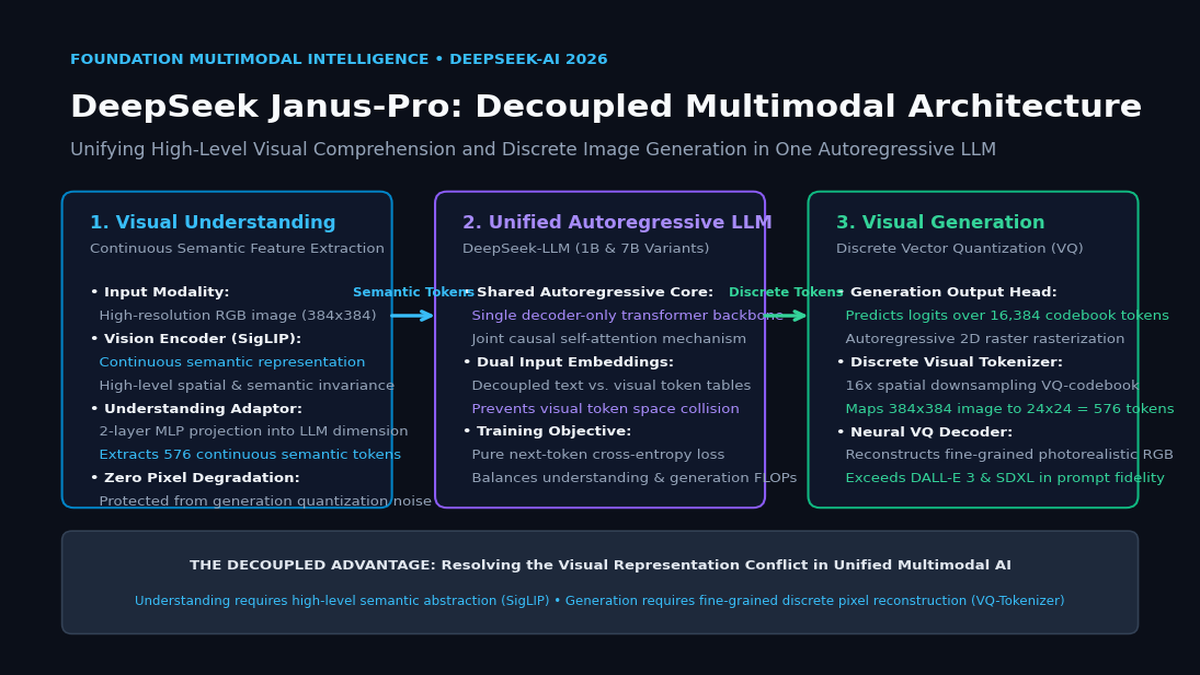
The Problem: The Visual Representation Dilemma in Unified Multimodal AI
In modern enterprise automation, automated web scraping, and autonomous agent loops powered by AiFetchly, foundation models must interact with complex visual environments: analyzing unstructured PDF tables, interpreting intricate dashboard charts, transcribing handwritten notes, and synthesizing visual user interfaces or wireframes on demand.
For years, the artificial intelligence research community sought the “Holy Grail” of multimodal AI: a single, unified foundation model capable of both visual understanding (answering questions about images, recognizing text, parsing layouts) and visual generation (creating and editing images from natural language prompts).
However, historical attempts to build unified multimodal models encountered a crippling architectural barrier known as the Visual Representation Dilemma.
The Fundamental Visual Representation Dilemma:
┌────────────────────────────────────────────────────────┐
│ Visual Understanding (VQA, OCR, Document Parsing)      │
│ • Requires High-Level Semantic Invariance              │
│ • Must discard high-frequency pixel noise and lighting │
│ • Best modeled by continuous contrastive encoders      │
│   (e.g., SigLIP, CLIP, ViT)                            │
└───────────────────────────┬────────────────────────────┘
                            │  DIAMETRICALLY OPPOSED!
                            ▼
┌────────────────────────────────────────────────────────┐
│ Visual Generation (Text-to-Image, Inpainting, Editing) │
│ • Requires High-Fidelity Pixel Reconstruction          │
│ • Must preserve exact spatial edges, textures, & colors│
│ • Best modeled by discrete tokenizers or autoencoders  │
│   (e.g., VQ-VAEs, VQ-GANs with codebooks)              │
└────────────────────────────────────────────────────────┘
Result: Forcing a single visual representation compromises BOTH tasks! 1. The High-Level Semantic Requirement of Visual Understanding
Visual understanding tasks—such as identifying a company logo on a cluttered website, reading fine text in a scanned invoice, or determining whether a button is active—require semantic abstraction:
- An effective vision encoder must be invariant to insignificant pixel fluctuations: camera angles, ambient lighting, shadows, and compression artifacts.
- Encoders like SigLIP (Sigmoid Loss for Language-Image Pre-training) map diverse photographic conditions into a shared continuous semantic vector space.
- However, continuous contrastive embeddings throw away fine-grained spatial pixel coordinates, making them incapable of reconstructing the original image pixels.
2. The Granular Spatial Requirement of Visual Generation
Conversely, visual generation requires dense spatial reconstruction:
- Generating a realistic image from text requires the model to place every single pixel, brush stroke, and texture boundary with millimeter precision.
- Autoregressive generative models achieve this by discretizing images into a 2D grid of discrete tokens using a Vector-Quantized (VQ) codebook (e.g., 24x24 = 576 tokens from a 16,384-entry codebook).
- However, discrete visual tokens are riddled with quantization noise. When passed into a language model for comprehension, the discrete quantization destroys subtle semantic gradients, causing dramatic drops in Optical Character Recognition (OCR), mathematical reasoning, and visual question answering accuracy.
3. The Failure of Prior Multimodal Paradigms
Before Janus-Pro, engineering teams were forced into one of two suboptimal compromises:
- The Single-Representation Compromise (e.g., Chameleon, early Emu): Models that forced both understanding and generation through a single discrete tokenizer suffered from severe degradation. While they could generate images, their multimodal comprehension benchmarks lagged far behind specialized vision-language models like LLaVA or Qwen-VL.
- The Cascaded Multi-System Trap (e.g., GPT-4o style wrapper + DALL-E 3): To circumvent the dilemma, production systems stitched together three or four completely separate neural networks (a CLIP vision encoder, an LLM reasoning engine, and a Latent Diffusion Model like SDXL or FLUX.1). This resulted in massive VRAM overheads (requiring multi-GPU cloud instances), eliminated cross-modal synergy, and created high-latency bottlenecks.
The Solution: DeepSeek Janus-Pro’s Decoupled Visual Architecture
To permanently resolve the visual representation dilemma without sacrificing efficiency or parameter scale, DeepSeek-AI developed Janus-Pro—an open-weights unified multimodal foundation model family available in 1B and 7B parameter variants.
Janus-Pro’s core architectural breakthrough is Decoupled Visual Encoding: instead of forcing understanding and generation into a compromised shared visual representation, Janus-Pro separates the visual encoding pathways for understanding and generation while uniting them under a single autoregressive transformer backbone.
DeepSeek Janus-Pro Architectural Blueprint:
                             ┌────────────────────────┐
                             │ Input Image (384x384)  │
                             └───────────┬────────────┘
                                         │
                    ┌────────────────────┴────────────────────┐
                    ▼                                         ▼
┌───────────────────────────────────────┐ ┌───────────────────────────────────────┐
│ Pathway 1: Visual Understanding       │ │ Pathway 2: Visual Generation          │
│ • SigLIP-Large Vision Encoder         │ │ • Discrete VQ Tokenizer (16x down)    │
│ • Continuous Semantic Representations │ │ • 16,384 Discrete Codebook Entries    │
│ • Understanding Adaptor (2-layer MLP) │ │ • Maps image to 24x24 = 576 tokens    │
└───────────────────┬───────────────────┘ └───────────────────┬───────────────────┘
                    │                                         │
                    │ (576 Semantic Embeddings)               │ (Discrete Indices)
                    ▼                                         ▼
┌─────────────────────────────────────────────────────────────────────────────────┐
│ Unified Autoregressive Transformer Backbone (DeepSeek-LLM 1B / 7B)              │
│ • Joint Causal Attention over Text, Semantic Vision & Discrete Image Tokens     │
│ • Decoupled Input Embedding Tables (Text Embeddings vs. Visual Gen Embeddings)  │
│ • Pure Next-Token Prediction Objective across all modalities                    │
└───────────────────────────────────────┬─────────────────────────────────────────┘
                                        │
                    ┌───────────────────┴───────────────────┐
                    ▼                                       ▼
┌───────────────────────────────────────┐ ┌───────────────────────────────────────┐
│ Text Output Head                      │ │ Generation Output Head                │
│ • Predicts next text tokens           │ │ • Predicts 16,384 codebook logits     │
│ • Direct Conversational Responses     │ │ • Autoregressive 2D generation        │
│ • High-Accuracy VQA & Document OCR    │ │ • Passed to Neural VQ-Decoder         │
└───────────────────────────────────────┘ └───────────────────┬───────────────────┘
                                                              ▼
                                          ┌───────────────────────────────────────┐
                                          │ Photorealistic Output Image (384x384) │
└───────────────────────────────────────┘ The Architectural Innovations of Janus-Pro
- Decoupled Visual Representation: Janus-Pro assigns specialized encoders to their natural operational domains. Visual comprehension is driven by a high-level SigLIP encoder, while visual generation is powered by a discrete VQ tokenizer. Neither task compromises the representation of the other.
- Unified Autoregressive Transformer: Both understanding tokens and generation tokens flow through the same DeepSeek-LLM backbone. The model learns cross-modal reasoning end-to-end, enabling it to interleave text, image comprehension, and image generation within a single conversational context window.
- Decoupled Input & Output Heads: To eliminate interference between natural language vocabulary and visual codebook indices, Janus-Pro separates the linear input projection tables and output prediction heads for text tokens versus visual generation tokens.
- Data and Model Scaling: Trained on over 90 million multimodal samples—including 72 million high-quality synthetic instruction pairs and 18 million curated real-world visual understanding pairs—Janus-Pro achieves remarkable generation stability without training collapse.
- Ultra-Low Memory Footprint: Unlike diffusion models that require dozens of continuous denoising steps across high-dimensional latent tensors, Janus-Pro-1B runs in under 4 GB of VRAM, and Janus-Pro-7B runs smoothly on a single RTX 3090/4090 GPU (24 GB) in full 16-bit precision.
Comparing Modern Multimodal Architectures
The table below contrasts DeepSeek Janus-Pro against competing multimodal systems:
Multimodal Architecture Paradigm Comparison:
┌───────────────────────────┬───────────────────────────────┬───────────────────────────────┬───────────────────────────────┐
│ Dimension                 │ LLaVA-1.5 + SDXL Cascade      │ Chameleon (Meta)              │ DeepSeek Janus-Pro            │
├───────────────────────────┼───────────────────────────────┼───────────────────────────────┼───────────────────────────────┤
│ Architecture Type         │ Disjointed 2-model pipeline   │ Unified single tokenizer      │ Unified decoupled autoregr.   │
│ Visual Understanding      │ SigLIP/CLIP Vision Transformer│ Quantized discrete codebook   │ Continuous SigLIP-Large (384) │
│ Visual Generation         │ Latent Diffusion Model (UNet) │ Shared discrete codebook      │ Dedicated 16x VQ-Tokenizer    │
│ Understanding Quality     │ High (Dedicated VLM)          │ Poor (Quantization loss)      │ High (Matches LLaVA/Qwen-VL)  │
│ Generation Quality        │ High (Diffusion baseline)     │ Mediocre (Artifacts)          │ High (Exceeds DALL-E 3/SDXL)  │
│ Cross-Modal Interaction   │ None (Fragmented glue code)   │ Full (Single model)           │ Full (Unified Transformer)    │
│ Serving VRAM (Inference)  │ 28 GB+ (Multiple models)      │ 16 GB (7B model)              │ 14 GB (Janus-Pro-7B FP16)     │
│ Edge / 1B Variant         │ No unified 1B equivalent      │ 7B minimum                    │ Yes (Janus-Pro-1B < 4GB VRAM) │
└───────────────────────────┴───────────────────────────────┴───────────────────────────────┴───────────────────────────────┘ Deep Dive into Janus-Pro Core Subsystems & Mathematical Foundations
To understand how Janus-Pro balances high-level semantic reasoning with low-level pixel synthesis, let’s examine the three core subsystems that constitute its architecture.
Janus-Pro Core Subsystem Breakdown:
DeepSeek Janus-Pro
 ├──► 1. Understanding Pipeline: SigLIP-Large + 2-Layer MLP Understanding Adaptor
 ├──► 2. Generation Pipeline: 16x VQ-Tokenizer (16,384 Codebook) + Neural Decoder
 ├──► 3. Unified Backbone: DeepSeek-LLM with Decoupled Word/Image Embeddings
└──► 4. Training Engine: Joint Next-Token Prediction with Modality Balancing Loss 1. The Understanding Pipeline: Continuous Semantic Invariance
When an input image $\mathbf{X}_{\text{img}} \in \mathbb{R}^{H \times W \times 3}$ is submitted for question answering, chart analysis, or web page transcription:
- SigLIP-Large-Patch16-384: The image is scaled to $384 \times 384$ pixels and partitioned into non-overlapping $16 \times 16$ patches. $$\text{Patch Count } N_{\text{patches}} = \left(\frac{384}{16}\right) \times \left(\frac{384}{16}\right) = 24 \times 24 = 576 \text{ tokens}$$
- The patch tokens pass through the multi-layer vision transformer, outputting continuous feature vectors $\mathbf{H}_{\text{siglip}} \in \mathbb{R}^{576 \times 1024}$.
- The Understanding Adaptor: A 2-layer Multi-Layer Perceptron (MLP) with GELU activation projects the 1,024-dimensional visual features into the hidden embedding dimension of the language model ($d_{\text{model}} = 2048$ for 1B; $d_{\text{model}} = 4096$ for 7B): $$\mathbf{H}_{\text{und}} = \mathbf{W}_2 \cdot \text{GELU}(\mathbf{W}1 \cdot \mathbf{H}{\text{siglip}} + \mathbf{b}_1) + \mathbf{b}_2$$
- Crucially, $\mathbf{H}_{\text{und}}$ remains continuous-valued. It is never discretized or forced into a finite codebook, preserving subtle nuances required for reading small typography, mathematical symbols, and spatial relationships.
2. The Generation Pipeline: Discrete Vector Quantization (VQ)
For image synthesis and visual manipulation:
- Janus-Pro trains an independent Vector Quantized Autoencoder (VQ-Tokenizer) with a downsampling factor of $f = 16$.
- The Discrete Codebook: The codebook $\mathcal{C} = {\mathbf{e}k}{k=1}^{K}$ contains $K = 16,384$ embedding vectors in $\mathbb{R}^{d_e}$.
- An image $\mathbf{X}$ is encoded by the VQ-encoder into spatial latent representations $\mathbf{Z} \in \mathbb{R}^{24 \times 24 \times d_e}$.
- Each spatial feature $\mathbf{z}{i, j}$ is mapped to its nearest codebook neighbor via Euclidean distance: $$q{i, j} = \arg\min_{k \in {1, \dots, K}} |\mathbf{z}_{i, j} - \mathbf{e}_k|_2$$
- This converts the continuous 2D image into a sequence of $24 \times 24 = 576$ discrete integers $q \in {1, \dots, 16384}$.
- The Neural VQ-Decoder: During image synthesis, once the LLM generates all 576 discrete tokens, they are mapped back to their codebook vectors $\mathbf{e}_q$ and passed through the convolutional neural decoder to reconstruct a crisp, artifact-free $384 \times 384$ RGB image.
3. Decoupled Token Embeddings and Output Heads
A major flaw in early unified autoregressive models was vocabulary interference: sharing the same embedding table between natural language words and visual tokens caused gradient updates from pixel generation to corrupt text embeddings.
Janus-Pro resolves this by decoupling the input and output projections:
Decoupled Embedding Architecture:
Input Sequence: [ <user> "Generate a cat" <assistant> </image_start> V_1 V_2 ... V_576 </image_end> ]
                 │                                        │
                 ▼                                        ▼
    Text Embedding Table (W_text)          Visual Generation Embeddings (W_gen)
                 │                                        │
                 └───────────────────┬────────────────────┘
                                     ▼
                     DeepSeek-LLM Transformer Backbone
                                     ▼
                 ┌───────────────────┴────────────────────┐
                 │                                        │
                 ▼                                        ▼
      Text Output Head (V_text)               Generation Output Head (V_gen)
(Predicts text tokens) (Predicts 16,384 codebook logits) - When reading text prompts, the transformer uses $\mathbf{W}{\text{text}} \in \mathbb{R}^{V{\text{text}} \times d}$.
- When predicting image tokens, the transformer routes activations through a dedicated Generation Head $\mathbf{H}_{\text{gen}} \in \mathbb{R}^{d \times 16384}$.
- This strict architectural separation guarantees that fine-grained pixel generation updates never degrade conversational fluency or reasoning abilities.
4. Joint Training Objective and Stability Tuning
Janus-Pro is trained using a multi-task next-token prediction objective: $$\mathcal{L}{\text{total}} = \lambda{\text{text}} \mathcal{L}{\text{pure_text}} + \lambda{\text{und}} \mathcal{L}{\text{und_text}} + \lambda{\text{gen}} \mathcal{L}_{\text{gen_img}}$$ Where:
- $\mathcal{L}_{\text{und_text}}$ computes cross-entropy loss exclusively on text answers conditioned on visual understanding tokens (with vision tokens masked from the loss).
- $\mathcal{L}_{\text{gen_img}}$ computes cross-entropy loss across the 576 discrete image tokens conditioned on text descriptions.
- $\lambda_{\text{gen}}$ is scaled carefully to prevent high-entropy image token loss from overpowering language modeling gradients.
Hands-On Implementation: Running Janus-Pro for VQA and Image Synthesis
Let’s walk through an end-to-end implementation of DeepSeek Janus-Pro using Python, Hugging Face Transformers, and PyTorch. We will perform both multimodal visual understanding and autoregressive image generation on a single workstation GPU.
1. Environment Setup
Install the required dependencies:
pip install -U torch torchvision transformers accelerate sentencepiece attrdict
git clone https://github.com/deepseek-ai/Janus.git
cd Janus && pip install -e . 2. Performing Multimodal Understanding (VQA & UI Analysis)
The script below loads deepseek-ai/Janus-Pro-7B (or Janus-Pro-1B for low-VRAM setups) to analyze a visual document or user interface screenshot:
import torch
from PIL import Image
from transformers import AutoModelForCausalLM
from janus.models import MultiModalityCausalLM, VLChatProcessor

# 1. Load Model & Processor
model_path = "deepseek-ai/Janus-Pro-7B"  # Or "deepseek-ai/Janus-Pro-1B"
vl_chat_processor: VLChatProcessor = VLChatProcessor.from_pretrained(model_path)
tokenizer = vl_chat_processor.tokenizer

vl_gpt: MultiModalityCausalLM = AutoModelForCausalLM.from_pretrained(
    model_path,
    trust_remote_code=True,
    torch_dtype=torch.bfloat16
).to("cuda").eval()

# 2. Formulate Conversation with an Image
image_path = "web_dashboard_screenshot.png"
raw_image = Image.open(image_path).convert("RGB")

conversation = [
    {
        "role": "<|User|>",
        "content": f"<image_placeholder>\nAnalyze this dashboard screenshot. Extract the total revenue, active user count, and identify any anomaly warnings into valid JSON.",
        "images": [raw_image],
    },
    {"role": "<|Assistant|>", "content": ""},
]

# 3. Process Input Tensors
prepare_inputs = vl_chat_processor(
    conversations=conversation,
    images=[raw_image],
    force_batchify=True
).to("cuda", dtype=torch.bfloat16)

# 4. Generate Autoregressive Response
inputs_embeds = vl_gpt.prepare_inputs_embeds(**prepare_inputs)

outputs = vl_gpt.language_model.generate(
    inputs_embeds=inputs_embeds,
    attention_mask=prepare_inputs.attention_mask,
    pad_token_id=tokenizer.eos_token_id,
    bos_token_id=tokenizer.bos_token_id,
    eos_token_id=tokenizer.eos_token_id,
    max_new_tokens=512,
    do_sample=False,  # Greedy search for deterministic factual extraction
    use_cache=True,
)

response_text = tokenizer.decode(outputs[0].cpu().tolist(), skip_special_tokens=True)
print("\n--- Janus-Pro Visual Understanding Analysis ---")
print(response_text) 3. Performing Autoregressive Image Generation
Now, let’s use the exact same model instance to generate a high-resolution image from text instructions using Classifier-Free Guidance (CFG):
import os
import torch
import numpy as np
from PIL import Image

prompt = "A futuristic autonomous robotic data-harvesting drone flying through a neon-lit cybernetic server room, volumetric lighting, photorealistic, 8k resolution, octane render"

# 1. Format Generation Prompt
messages = [
    {"role": "<|User|>", "content": prompt},
    {"role": "<|Assistant|>", "content": ""},
]
formatted_prompt = vl_chat_processor.apply_sft_template_for_multi_turn_prompts(
    conversations=messages,
    sft_format=vl_chat_processor.sft_format,
    system_prompt=""
)
formatted_prompt += vl_chat_processor.image_start_tag

# 2. Prepare Conditioned and Unconditioned Input IDs for CFG
input_ids = torch.LongTensor(tokenizer.encode(formatted_prompt))
uncond_prompt = vl_chat_processor.apply_sft_template_for_multi_turn_prompts(
    conversations=[{"role": "<|User|>", "content": ""}, {"role": "<|Assistant|>", "content": ""}],
    sft_format=vl_chat_processor.sft_format,
    system_prompt=""
) + vl_chat_processor.image_start_tag
uncond_input_ids = torch.LongTensor(tokenizer.encode(uncond_prompt))

# 3. Autoregressive Image Token Generation with CFG
print("Generating 576 discrete image tokens autoregressively...")
with torch.inference_mode():
    generated_tokens = vl_gpt.generate_image_tokens(
        input_ids=input_ids.unsqueeze(0).to("cuda"),
        uncond_input_ids=uncond_input_ids.unsqueeze(0).to("cuda"),
        temperature=1.0,
        cfg_weight=5.0,     # Classifier-Free Guidance strength
        image_token_num_per_image=576, # 24x24 grid
        top_p=0.95
    )

# 4. Decode Discrete Tokens into RGB Pixels via VQ-Decoder
print("Decoding discrete tokens through neural VQ-Decoder...")
with torch.no_grad():
    decoded_images = vl_gpt.gen_vision_model.decode_code(
        generated_tokens.to(dtype=torch.int)
    )
    # Convert tensor to PIL image
    img_np = decoded_images[0].permute(1, 2, 0).cpu().numpy()
    img_np = np.clip((img_np + 1.0) / 2.0 * 255.0, 0, 255).astype(np.uint8)
    output_image = Image.fromarray(img_np)
    output_image.save("janus_pro_generated_output.png")

print("Image successfully generated and saved to janus_pro_generated_output.png!") Production Architecture & Integration for aiFetchly
In enterprise data harvesting, document processing, and desktop intelligence systems like AiFetchly, deploying DeepSeek Janus-Pro provides an unprecedented capability: a single, self-hosted model that handles both multimodal document analysis and visual content generation.
aiFetchly Enterprise Multimodal Ingestion Topology:
┌─────────────────────────────────────────────────────────────────┐
│ aiFetchly Web Scrapers & Document Ingestion Queues             │
└─────────────────────────────────────────────────────────────────┘
 │
 ├──► Raw Scraped Artifacts (Invoices, Technical Diagrams, DOM)
 │
 ▼
┌─────────────────────────────────────────────────────────────────┐
│ DeepSeek Janus-Pro Local Serving Engine (Ollama / vLLM / Triton)│
│ • Understanding Mode: OCR, Diagram Parsing & Schema Validation  │
│ • Generation Mode: Synthesizing UI mockups & Visual Reports     │
└─────────────────────────────────────────────────────────────────┘
 │
 ├──► Vector Grounding via Qdrant / Milvus 2.5
 │
 ▼
┌─────────────────────────────────────────────────────────────────┐
│ Downstream Systems: High-Reliability JSON & Visual Verification │
│ • Validated Pydantic Schemas dispatched to databases            │
│ • Traced & Evaluated via Arize Phoenix / DeepEval               │
└─────────────────────────────────────────────────────────────────┘ 1. Vision-Driven Automated Web Scraping & DOM Grounding
Traditional text-only scrapers fail when modern web applications render data within Canvas elements, obfuscate CSS class names, or lock information behind interactive graphical charts:
- Zero DOM Dependence: Janus-Pro takes raw visual screenshots of rendered pages and directly extracts structured entity schemas without needing access to underlying HTML elements.
- Complex Table & Chart Parsing: Because SigLIP preserves spatial relationships, Janus-Pro accurately associates multi-line table headers with deeply nested numeric values, outperforming heuristic OCR pipelines.
2. Visual Synthesis for Data Quality Verification
In automated data aggregation:
- When extracting structured property listings or product catalogs, Janus-Pro can generate visual summary cards or normalized thumbnail mockups directly from the extracted JSON attributes.
- Because generation is integrated within the same transformer weights, the model possesses an intrinsic understanding of spatial aesthetics, ensuring generated visual assets perfectly align with the extracted text.
3. Local Privacy and Hardware Sizing
For enterprise security and data sovereignty:
- Janus-Pro-1B: Fits comfortably inside 4 GB of VRAM, making it ideal for client-side desktop execution inside Electron applications on standard consumer laptops.
- Janus-Pro-7B: Requires approximately 14 GB of VRAM in FP16 (or 8.5 GB using 8-bit quantization), running with blazing speed on a single NVIDIA RTX 4080/4090 or Apple M-series chip.
- Connect local Janus-Pro deployments to high-speed vector retrieval backends like Qdrant or Milvus 2.5, and monitor latency and hallucination drift with Arize Phoenix.
Summary: The New Standard for Unified Multimodal Intelligence
The long-standing conflict between visual comprehension and visual generation was never a limitation of the transformer architecture itself; it was a consequence of forcing contradictory visual representations through a shared encoder.
DeepSeek Janus-Pro resolves this architectural tension through decoupled visual encoding: pairing continuous SigLIP semantic embeddings for understanding with a dedicated 16x discrete VQ codebook for visual generation, all united under a single autoregressive language model. By delivering state-of-the-art visual question answering alongside photorealistic image generation within a compact 1B or 7B footprint, Janus-Pro sets a new benchmark for unified multimodal artificial intelligence. For desktop automation, document intelligence, and enterprise data extraction engineered with AiFetchly, Janus-Pro delivers the missing multimodal link in a private, open-weights package.