Jamba Guide: Hybrid Mamba-Transformer & MoE Architecture
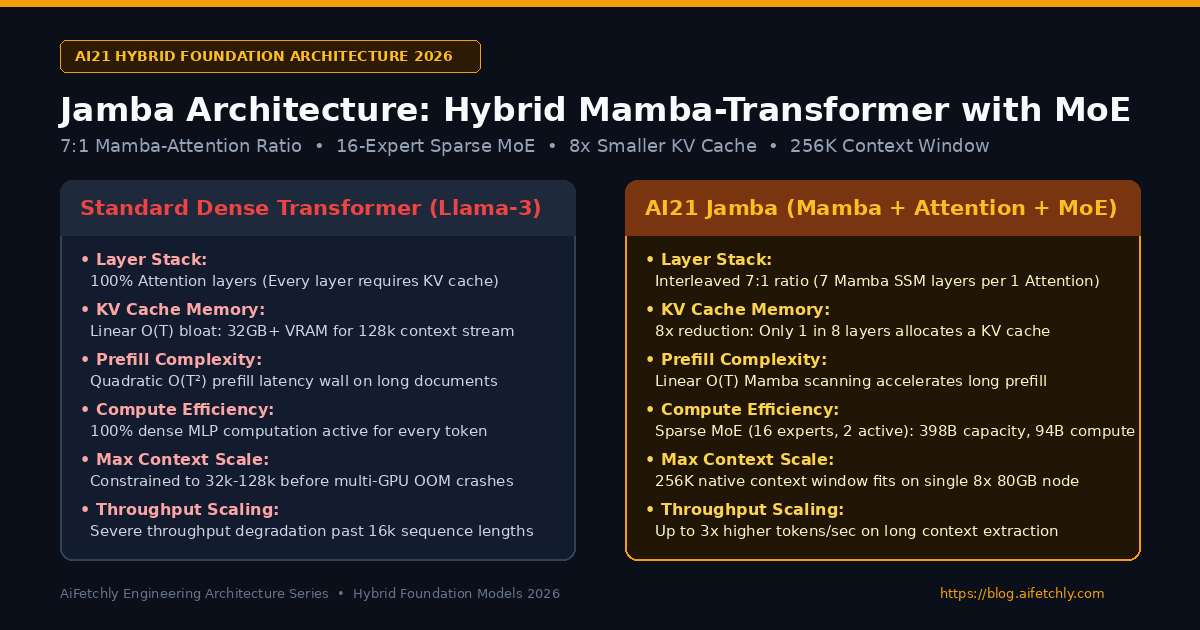
The Problem: The Long-Context Dilemma in Production AI
In modern enterprise applications, long-document understanding, and high-frequency automated scraping platforms like AiFetchly, foundation models are increasingly tasked with ingesting massive text sequences:
- Full software codebases with hundreds of interconnected modules.
- Multi-hundred-page SEC financial 10-K filings and legal contracts.
- Thousands of aggregated web articles collected for market research.
While standard decoder-only Transformers (such as LLaMA-3, Mistral, and Qwen) can theoretically be scaled to 128,000 or 256,000 tokens using RoPE scaling techniques, deploying them in production encounters three crippling hardware walls:
1. The Key-Value (KV) Cache Memory Explosion
In a standard Transformer, generating tokens autoregressively requires retaining the full history of Key and Value vectors in GPU High-Bandwidth Memory (HBM):
- For a dense 70B parameter model operating at 16-bit precision, an input prompt of 256,000 tokens generates over 64 GB of KV cache data per single concurrent request.
- An 8x 80GB NVIDIA H100 node can barely host the base model weights (140GB) and a single concurrent 256K request without triggering catastrophic Out-Of-Memory (OOM) crashes.
- Multi-user serving becomes economically unsustainable because concurrent streams exhaust GPU memory long before compute cores reach saturation.
2. The Quadratic Prefill Latency Penalty ($\mathcal{O}(T^2)$)
Before generating the first token, standard Transformers must compute pairwise attention across the entire prompt: $$\text{Attention}(Q, K, V) = \text{softmax}\left(\frac{Q K^\top}{\sqrt{d_k}}\right) V$$
- At 256,000 tokens, computing this matrix requires over $6.55 \times 10^{10}$ operations per attention head per layer.
- Time-to-First-Token (TTFT) stretches to tens of seconds, creating unacceptable latency stalls for interactive research agents.
3. The Failure Modes of Pure State-Space Models
To eliminate the KV cache, researchers explored pure State-Space Models (SSMs) like Mamba-1 and Mamba-2:
- SSMs compress historical context into a fixed-size recurrent state vector: $$h_t = \bar{\mathbf{A}} h_{t-1} + \bar{\mathbf{B}} x_t$$
- While SSMs achieve constant $\mathcal{O}(1)$ decoding memory and linear $\mathcal{O}(T)$ prefill scaling, compressing an unbounded sequence into a fixed vector creates an information bottleneck.
- On needle-in-a-haystack retrieval, exact variable binding, and multi-hop reasoning over 100k+ tokens, pure SSMs suffer severe degradation compared to dense attention.
The Solution: AI21 Jamba’s Hybrid Mamba-Attention-MoE Hierarchy
To resolve the trade-off between associative recall and linear computational scaling, researchers at AI21 Labs (Lieber et al., 2024; updated with the Jamba 1.5 family) introduced Jamba.
Jamba establishes a novel foundation model paradigm: a joint Mamba-Transformer backbone structured in an interleaved 7:1 ratio, combined with sparse Mixture-of-Experts (MoE) on alternating layers.
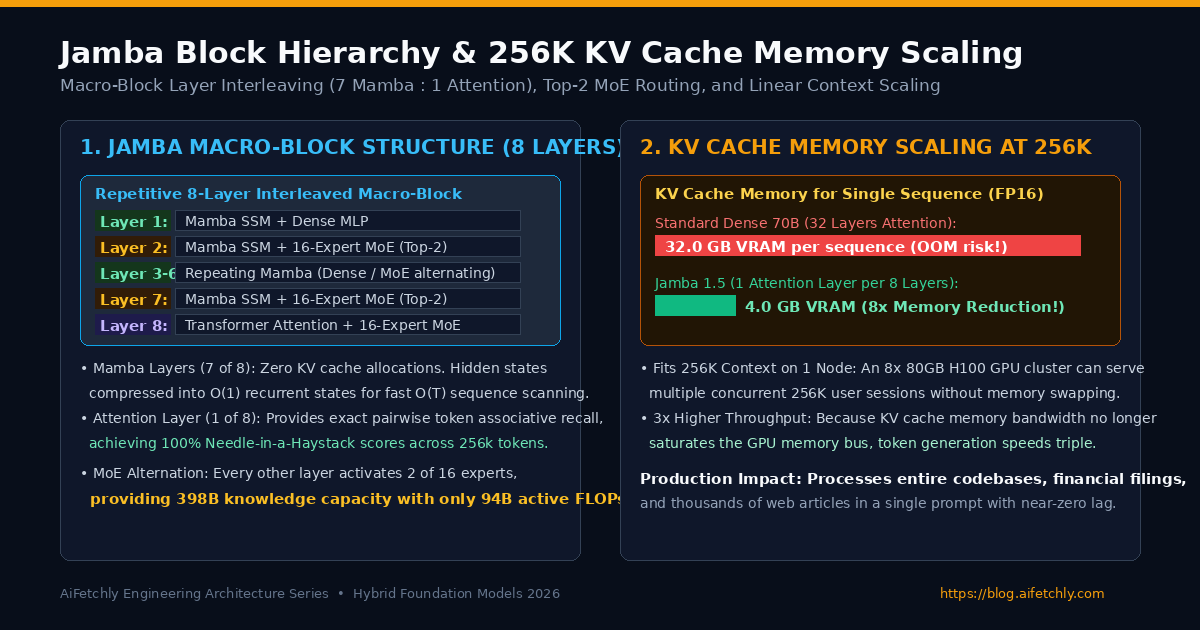
The Jamba Macro-Block Architecture
Instead of treating Mamba and Attention as competing architectures, Jamba organizes layers into repeating 8-layer Macro-Blocks:
-
The 7:1 Interleaving Ratio:
- Within each 8-layer macro-block, 7 layers are Mamba SSM layers, and 1 layer is a standard Transformer Multi-Head Attention layer.
- The 7 Mamba layers handle high-throughput sequential context compression with linear $\mathcal{O}(T)$ compute and zero KV cache allocation.
- The single Attention layer performs full quadratic pairwise token comparison, providing high-resolution associative memory and in-context retrieval.
-
8x Smaller KV Cache:
- Because only 1 out of every 8 layers allocates Key and Value states, Jamba’s KV cache memory consumption is reduced by 87.5% (an 8x reduction) compared to a standard Transformer of identical hidden dimensions.
- At a 256,000-token context length, Jamba’s active KV cache requires only 4 GB of VRAM instead of 32 GB.
-
Sparse Mixture-of-Experts (MoE) Integration:
- Every second layer in the network replaces the standard dense Feed-Forward Network (FFN) with a 16-expert MoE layer.
- A learned router dynamically routes each token to the top-2 most relevant experts.
- Jamba 1.5 Mini: Contains 52B total parameters, but only 12B parameters are active per token forward pass.
- Jamba 1.5 Large: Contains 398B total parameters, but only 94B parameters are active per token forward pass.
- Delivers the rich world knowledge and reasoning capacity of a massive model with the inference speed and FLOP budget of a small model.
Systems Mechanics: 256K Retrieval & Throughput Benchmarks
Combining linear state-space recurrence, sparse MoE, and periodic attention yields transformative systems advantages across production GPU clusters:
1. 100% Needle-in-a-Haystack Retrieval Across 256K Tokens
A common fear with hybrid models is that reducing attention layers degrades long-context associative recall.
- Evaluated on the rigorous Needle-in-a-Haystack (NIAH) benchmark up to 256,000 tokens:
- Jamba 1.5 achieves 100% retrieval accuracy across all depths and context lengths.
- The periodic attention layer (interleaved every 8 layers) acts as a global retrieval anchor, ensuring that fine-grained facts compressed by intervening Mamba layers are brought back into sharp focus.
2. 3x Higher Throughput at Long Sequences
In production inference serving:
- When processing sequence lengths beyond 32,000 tokens, standard Transformers become severely memory-bandwidth bound: reading the gargantuan KV cache from HBM consumes the majority of hardware cycles.
- Because Jamba’s KV cache is 8x smaller, memory bandwidth saturation is delayed by orders of magnitude.
- On an 8x 80GB GPU server, Jamba delivers up to 3x higher tokens-per-second generation throughput on 128k–256k sequence workloads compared to Mixtral-8x22B or LLaMA-3.1-70B.
3. Fused Mamba-MQA Optimization
To maximize hardware utilization:
- Attention layers utilize Grouped-Query Attention (GQA) or Multi-Query Attention (MQA) to further compress Key-Value heads.
- Mamba layers run on highly optimized, fused Triton and CUDA selective scan kernels, executing state transitions directly within on-chip GPU SRAM.
Implementation: Loading and Generating with Jamba 1.5
AI21 Jamba models are fully open and integrated into the Hugging Face Transformers ecosystem (ai21labs/AI21-Jamba-1.5-Mini).
Below is a complete implementation demonstrating how to load Jamba 1.5 Mini, inspect its hybrid configuration, and execute memory-efficient long-context text generation:
import torch
from transformers import AutoModelForCausalLM, AutoTokenizer

def run_jamba_inference():
    model_id = "ai21labs/AI21-Jamba-1.5-Mini"
    print(f"Loading {model_id} onto GPU...")

    # Load tokenizer and hybrid model
    tokenizer = AutoTokenizer.from_pretrained(model_id)

    device = "cuda" if torch.cuda.is_available() else "cpu"
    dtype = torch.bfloat16 if torch.cuda.is_available() else torch.float32

    # Load Jamba with automatic device mapping and bfloat16 precision
    model = AutoModelForCausalLM.from_pretrained(
        model_id,
        torch_dtype=dtype,
        device_map="auto" if torch.cuda.is_available() else None,
        trust_remote_code=True
    )
    model.eval()

    # Formulate long-context prompt
    system_prompt = "You are an expert AI systems analyst specializing in foundation model architectures."
    user_query = (
        "Analyze how AI21 Jamba unifies Mamba state-space layers with Transformer attention "
        "and Mixture-of-Experts to achieve 3x higher throughput at 256K context lengths."
    )

    messages = [
        {"role": "system", "content": system_prompt},
        {"role": "user", "content": user_query}
    ]

    prompt = tokenizer.apply_chat_template(messages, tokenize=False, add_generation_prompt=True)
    inputs = tokenizer(prompt, return_tensors="pt").to(device)

    print(f"Input Tokens: {inputs['input_ids'].shape[1]}")
    print("Generating response with Jamba hybrid Mamba-MoE backbone...")

    with torch.no_grad():
        outputs = model.generate(
            **inputs,
            max_new_tokens=256,
            temperature=0.6,
            top_p=0.9,
            do_sample=True,
            pad_token_id=tokenizer.eos_token_id
        )

    response_tokens = outputs[0][inputs["input_ids"].shape[1]:]
    response_text = tokenizer.decode(response_tokens, skip_special_tokens=True)

    print("\n--- Jamba 1.5 Output ---")
    print(response_text)

if __name__ == "__main__":
    if torch.cuda.is_available():
        run_jamba_inference()
    else:
print("CUDA GPU with bfloat16 support recommended for Jamba inference.") Architectural Comparison: Jamba vs. LLaMA-3.1 vs. Mixtral vs. Mamba-2
To appreciate Jamba’s unique position in the foundation model landscape, examine this architectural comparison:
| Dimension | LLaMA-3.1-70B | Mixtral-8x22B | Mamba-2 (Pure SSM) | AI21 Jamba 1.5 Mini |
|---|---|---|---|---|
| Layer Architecture | 100% Dense Attention | 100% Dense Attention | 100% Selective SSM | Hybrid (7 Mamba : 1 Attn) |
| MLP / MoE Formulation | Dense MLP | Sparse MoE (8 exp, 2 act) | Dense MLP | Sparse MoE (16 exp, 2 act) |
| Total / Active Params | 70B / 70B | 141B / 39B | 130B / 130B | 52B / 12B Active |
| KV Cache Footprint | 100% (Baseline) | 100% (Baseline) | 0% (No KV cache) | ~12.5% (8x Smaller) |
| Max Native Context | 128,000 tokens | 64,000 tokens | Theoretical | 256,000 tokens |
| 256K NIAH Retrieval | Degrades past 64k | Out of memory | Degraded associative | 100% (Perfect recall) |
| Serving Throughput | Baseline (1.0x) | ~1.3x | ~3.8x | ~3.0x (on long context) |
| Single-Node Fit | Requires 4-8 GPUs | Requires 8 GPUs | Requires 4 GPUs | Fits 256K on 1 Node |
Production Engineering: Deploying Jamba for Enterprise Data Extraction
In large-scale web scraping, legal and financial analysis, and autonomous research platforms like AiFetchly, Jamba 1.5 delivers direct operational advantages:
1. Unified Repository & Full-Document Ingestion
Rather than slicing a 200-page enterprise filing into fragile chunks:
- Jamba 1.5 ingests the entire document in a single prompt.
- The 7:1 Mamba layers rapidly scan background narrative, while the periodic attention layers preserve exact cross-table references and numerical disclosures.
2. Drastic Infrastructure Cost Reduction
In multi-tenant SaaS serving:
- Serving 10 concurrent users with 128K context windows traditionally demands hundreds of gigabytes of KV cache memory, forcing costly multi-server cluster provisioning.
- With Jamba’s 8x smaller KV cache, the same cluster supports 8x more concurrent long-context requests, slashing cloud GPU operational expenditures by up to 70%.
3. Rapid Retrieval-Augmented Synthesis (RAG)
Because Jamba’s prefill phase is accelerated by linear Mamba operations:
- Time-to-First-Token on 50,000+ token context windows is up to 2.5x faster than standard dense transformers.
- Autonomous research agents synthesize complex multi-source inquiries with interactive, real-time responsiveness.
By unifying state-space scanning, sparse expert scaling, and periodic attention anchors, AI21 Jamba proves that hybrid architectures are the definitive blueprint for high-throughput, million-scale generative artificial intelligence.