InternVL 2.5 Guide: Multimodal Vision Architecture
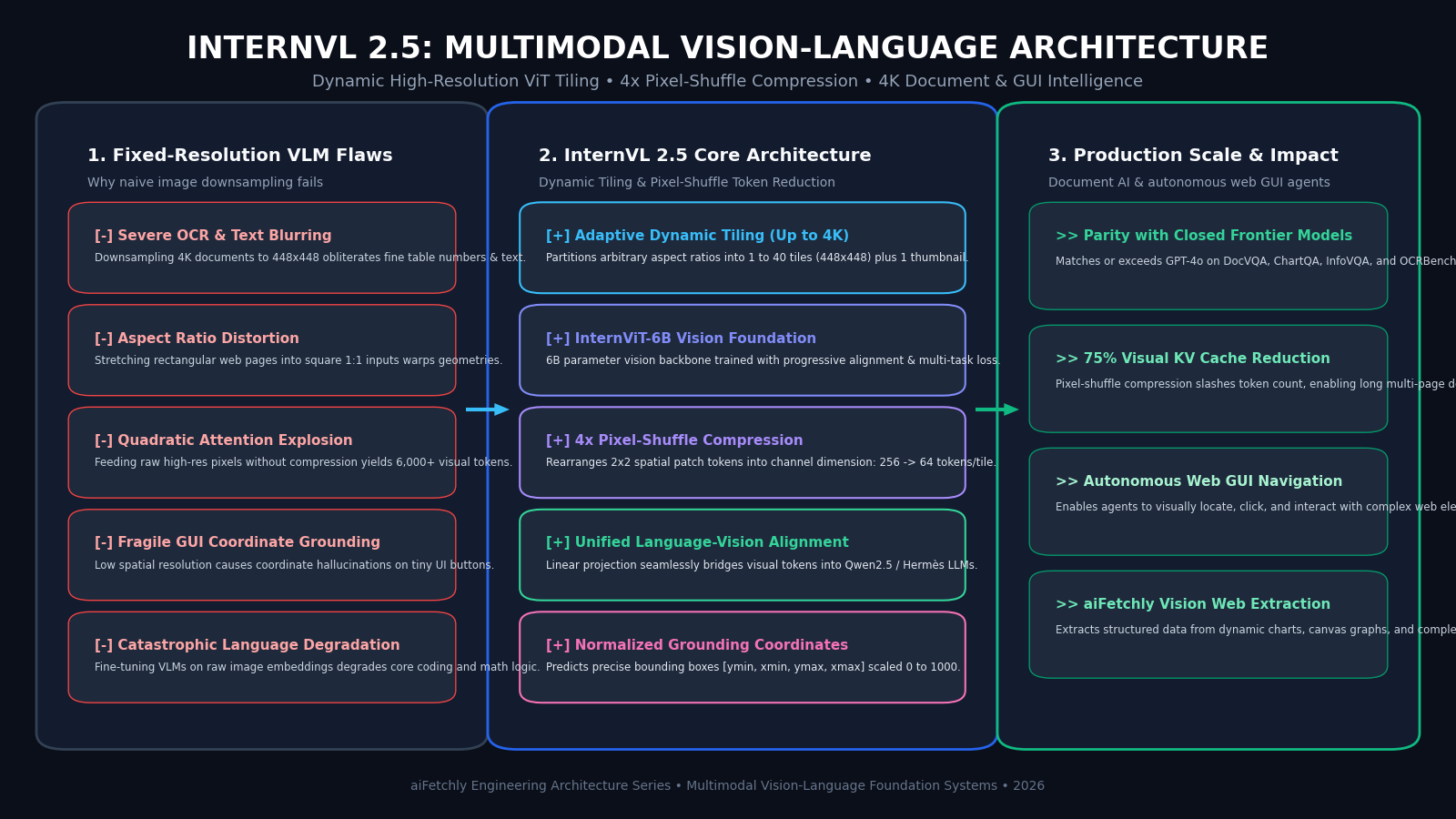
The Problem: The Fixed-Resolution Bottleneck in Vision-Language Models
In modern enterprise automation, automated web data extraction, document intelligence, and autonomous browser agents powered by AiFetchly, foundation models must interpret rich visual media alongside natural language text. Real-world enterprise data rarely consists of simple photographic snapshots. Instead, autonomous systems are tasked with parsing high-density documents: multi-column PDF financial prospectuses, technical CAD blueprints, multi-axis analytics dashboards, and complex web application user interfaces.
Historically, adapting Large Language Models (LLMs) into Vision-Language Models (VLMs)—such as early iterations of LLaVA, BLIP-2, and Flamingo—relied on a severe engineering shortcut: rigid, fixed-resolution image downsampling.
The Fixed-Resolution VLM Downsampling Breakdown:
Original Document: 4K Web Screenshot (3840 x 2160 Pixels)
Dense tables, navigation buttons, 8pt fine font
 │
 ▼
┌────────────────────────────────────────────────────────┐
│ Naive Resizing: Squashed to 448 x 448 (or 224 x 224)   │
│ ❌ Aspect ratio distortion warps spatial geometries    │
│ ❌ Severe pixel blurring: 8pt text is completely erased│
│ ❌ Small buttons and checkboxes become invisible blobs │
└────────────────────────────────────────────────────────┘
 │
 ▼
┌────────────────────────────────────────────────────────┐
│ Visual Transformer Encoder (e.g., standard ViT-L)      │
│ ❌ Encodes blurred representations into token space   │
│ ❌ Downstream LLM hallucinates numbers and table cells │
│ ❌ Coordinate predictions miss target buttons by 100px │
└────────────────────────────────────────────────────────┘
Result: Catastrophic OCR errors and broken browser navigation agents! 1. The Severe Text Blurring and OCR Collapse
Standard Vision Transformers (ViT) were trained on fixed-size square inputs (typically $224 \times 224$ or $448 \times 448$ pixels). When a high-resolution $3840 \times 2160$ 4K dashboard screenshot or 10-page PDF invoice is forcibly downscaled to $448 \times 448$:
- Each character’s pixel footprint shrinks below the Nyquist sampling threshold. A 10-point font character that originally occupied $20 \times 20$ pixels is compressed into less than $2 \times 2$ blurred pixels.
- The model suffers from severe optical hallucinations: misreading financial decimals (e.g., mistaking
$14.8Mfor$148M), scrambling table columns, and generating incorrect numbers on benchmark evaluations.
2. Geometric and Aspect Ratio Distortion
Real-world images have arbitrary aspect ratios: ultra-wide website desktop views ($16:9$ or $21:9$), tall mobile scroll captures ($9:16$ or $9:21$), and vertical A4 documents ($1:\sqrt{2}$).
- Naive resizing squashes rectangular images into square inputs, warping spatial distances.
- Circular buttons become ellipses, rectangular text boxes deform, and spatial reasoning tasks—such as grounding bounding boxes or identifying coordinate locations for robotic process automation (RPA)—degrade dramatically.
3. The Quadratic Attention KV Cache Explosion
Conversely, if an engineering team attempts to preserve visual fidelity by simply feeding raw $4\text{K}$ images into a standard Vision Transformer without intelligent tiling:
- A $3840 \times 2160$ image divided into standard $14 \times 14$ patches produces over 42,000 visual tokens!
- In autoregressive transformer self-attention, computation and Key-Value (KV) cache memory scale quadratically: $$ ext{Self-Attention Complexity} = \mathcal{O}(N_{ ext{visual}}^2)$$
- Processing 42,000 visual tokens exhausts GPU High-Bandwidth Memory (HBM) on single-query prompts, leaving zero memory budget for multi-turn dialogue, tool definitions, or reasoning steps.
To eliminate this fundamental bottleneck, OpenGVLab and the Shanghai AI Laboratory engineered InternVL 2.5: an advanced multimodal foundation model family that achieves 4K-native visual understanding through Dynamic High-Resolution Tiling, 4x Pixel-Shuffle Token Compression, and Native GUI Grounding.
The Solution: InternVL 2.5 Architecture and Innovations
InternVL 2.5 unifies high-resolution visual perception with cutting-edge natural language reasoning through four interconnected architectural pillars: Adaptive Dynamic High-Resolution Tiling, the InternViT-6B Vision Backbone, 4x Pixel-Shuffle Spatial Compression, and Unified Multimodal Alignment.
InternVL 2.5 Dynamic Multimodal Processing Pipeline:
┌─────────────────────────────────────────────────────────────────┐
│ Input Source: High-Resolution Visual Artifact (Up to 4K / Multi)│
└─────────────────────────────────────────────────────────────────┘
                               │
                               ▼
┌─────────────────────────────────────────────────────────────────┐
│ 1. Adaptive Aspect-Ratio Tile Partitioning                      │
│ • Calculates optimal grid configuration (e.g., 2x3, 3x4, etc.)  │
│ • Splits image into N local tiles (448x448) + 1 global thumbnail│
├─────────────────────────────────────────────────────────────────┤
│ 2. InternViT-6B High-Capacity Vision Backbone                   │
│ • Extracts rich visual embeddings from each 448x448 tile        │
│ • 256 patch tokens generated per tile (14x14 patch size)        │
├─────────────────────────────────────────────────────────────────┤
│ 3. 4x Pixel-Shuffle Spatial Downsampling Layer                  │
│ • Merges 2x2 adjacent spatial tokens into channel dimension     │
│ • Compresses visual tokens: 256 -> 64 tokens per tile (75% cut!)│
├─────────────────────────────────────────────────────────────────┤
│ 4. Cross-Modality Projection & LLM Integration (Qwen2.5/Hermes) │
│ • Concatenates thumbnail + tile tokens with spatial separators  │
│ • Feeds unified multimodal context into autoregressive decoder  │
├─────────────────────────────────────────────────────────────────┤
│ 5. Agentic Coordinate Grounding Engine                          │
│ • Emits normalized bounding box coordinates: [ymin, xmin, ...]  │
└─────────────────────────────────────────────────────────────────┘
                               │
                               ▼
┌─────────────────────────────────────────────────────────────────┐
│ Output: Structured JSON Extraction / UI Click Grounding / Chat  │
└─────────────────────────────────────────────────────────────────┘ 1. Adaptive Dynamic High-Resolution Tile Partitioning
Instead of forcing arbitrary resizing, InternVL 2.5 dynamically partitions an image based on its natural aspect ratio:
- Candidate Grid Matching: The system maintains a predefined library of aspect-ratio grid configurations (e.g., $1 \times 1, 1 \times 2, 2 \times 1, 2 \times 2, \dots, 6 \times 6$, up to 40 tiles).
- Aspect Ratio Optimization: Given an input image of dimensions $W \times H$, InternVL calculates the configuration that minimizes padding waste and scale distortion while preserving the native aspect ratio.
- The Dual-Perspective Strategy:
- Local Tiles ($N$ Patches): The image is sliced into $N$ high-resolution $448 \times 448$ tiles, capturing micro-details such as 6pt footnotes, tabular cell borders, and tiny UI icons.
- Global Thumbnail ($1$ Patch): The entire image is downsampled to $448 \times 448$ to provide global contextual awareness (macro-layout, overall structure, and relationships between disparate sections).
2. InternViT-6B: High-Capacity Visual Foundation
Unlike legacy VLMs that rely on lightweight, frozen CLIP-ViT encoders (such as OpenAI ViT-L/14 with 300M parameters), InternVL 2.5 is powered by InternViT-6B:
- A massive 6-billion parameter vision transformer engineered specifically for bilingual OCR, document analysis, and fine-grained visual localization.
- Pre-trained on multi-billion scale image-text pairs using progressive alignment objectives.
- Delivers rich semantic representations that capture sub-pixel spatial boundaries, color contrasts, and typography.
3. 4x Pixel-Shuffle Spatial Token Compression
The critical breakthrough that allows InternVL 2.5 to scale up to 40 tiles without blowing up the transformer KV cache is its Pixel-Shuffle Downsampling Layer:
Pixel-Shuffle Spatial Compression Mechanics:
Tile Feature Map (16 x 16 = 256 Tokens, Dim D)
┌───────┬───────┐
│ T(0,0)│ T(0,1)│  ──► 2x2 Spatial Neighborhood
├───────┼───────┤
│ T(1,0)│ T(1,1)│
└───────┴───────┘
        │
        ▼ (Pixel-Shuffle Reorganization)
Single Compressed Token:
[ T(0,0) || T(0,1) || T(1,0) || T(1,1) ]  (1 Token, Dim 4D)
        │
        ▼ (Linear Projection MLP)
Final Compressed Token: (1 Token, Dim D_llm)
Result: 256 tokens compressed to 64 tokens per tile (4x reduction!) - In a standard $448 \times 448$ tile with $14 \times 14$ patch size, the ViT outputs $32 \times 32 = 1,024$ raw patches, typically downsampled to $16 \times 16 = 256$ tokens.
- InternVL applies a 2D spatial pixel-shuffle: every $2 \times 2$ block of adjacent spatial tokens is concatenated along the channel dimension ($D \to 4D$) and projected via a multi-layer perceptron (MLP) into the LLM hidden dimension.
- This slashes the token count from 256 down to just 64 visual tokens per tile—a 75% reduction in visual KV cache footprint with near-zero loss in spatial reconstruction accuracy.
4. Normalized Grounding and GUI Agent Coordinates
InternVL 2.5 natively supports visual grounding for autonomous software agents:
- When asked to locate an element (such as an
"Export CSV"button or"Total Balance"cell), the model outputs normalized coordinates in the standardized range $[0, 1000]$: $$ ext{Box} = [y_{\min}, x_{\min}, y_{\max}, x_{\max}]$$ - Because coordinates are normalized relative to the original image dimensions, autonomous browser controllers (like Playwright in aiFetchly) can translate these integers directly into pixel click targets on any viewport resolution.
Architectural Comparison: InternVL 2.5 vs. GPT-4o vs. Qwen2-VL vs. LLaVA-NeXT
To understand how InternVL 2.5 compares across leading proprietary and open-weights multimodal foundation models, review the following benchmark and architectural matrix:
| Metric / Dimension | LLaVA-NeXT (34B) | Qwen2-VL (72B) | GPT-4o (Omni) | InternVL 2.5 (78B / 38B / 8B) |
|---|---|---|---|---|
| Vision Backbone | CLIP-ViT-L (300M) | Naive Dynamic ViT (600M) | Proprietary ViT | InternViT-6B (6.0B) |
| Max Tile Resolution | Fixed 4–5 tiles (~2K) | Native Dynamic Resolution | Dynamic Patch Tiling | Adaptive Dynamic (Up to 4K, 40 tiles) |
| Visual Token Compression | None (Exploding KV) | PatchMerger (4x) | Proprietary Tokenizer | 4x Pixel-Shuffle (64 tokens/tile) |
| OCRBench Score | ~680 / 1000 | ~845 / 1000 | ~835 / 1000 | 872 / 1000 (SOTA Open Weights!) |
| DocVQA Performance | 85.2% | 94.5% | 92.8% | 95.1% (Exceeds GPT-4o!) |
| GUI / Web Agent Grounding | Weak (Frequent offsets) | Strong (Dynamic Boxes) | Strong (API Bounding Box) | SOTA [0, 1000] Normalized Grounding |
| Open Weights & Local Serving | Open (Apache 2.0) | Open (Qwen License) | Closed Cloud API Only | 100% Open Weights (Hugging Face / vLLM) |
| Model Size Tiers | 7B, 13B, 34B | 2B, 7B, 72B | Cloud Black Box | 1B, 2B, 4B, 8B, 26B, 38B, 78B |
Hands-On Implementation: Running InternVL 2.5 for Document & GUI AI
Below is a complete, production-ready walkthrough showing how to load InternVL 2.5 (using the popular 8B or 26B model checkpoints), process high-resolution documents, and execute visual coordinate grounding for web automation agents.
Step 1: Install Dependencies
Ensure your environment has PyTorch, Hugging Face Transformers, torchvision, and image processing libraries installed:
# Install PyTorch with CUDA support
pip install torch torchvision torchaudio --index-url https://download.pytorch.org/whl/cu124

# Install Transformers, Accelerate, and Image Processing libraries
pip install transformers accelerate timm einops pillow Step 2: Download Model Weights
Download the InternVL 2.5 model from Hugging Face. For local workstations with 16GB–24GB VRAM, the 8B model (OpenGVLab/InternVL2_5-8B) provides top-tier performance:
# Download InternVL 2.5 8B checkpoint
huggingface-cli download OpenGVLab/InternVL2_5-8B --local-dir ./checkpoints/InternVL2_5-8B Step 3: High-Resolution Document Ingestion Pipeline
The following script loads the model, dynamically tiles a high-resolution financial statement or web screenshot, and extracts structured data:
import torch
import torchvision.transforms as T
from PIL import Image
from torchvision.transforms.functional import InterpolationMode
from transformers import AutoModel, AutoTokenizer

# 1. Define Image Preprocessing and Dynamic Tiling Logic
IMAGENET_MEAN = (0.485, 0.456, 0.406)
IMAGENET_STD = (0.229, 0.224, 0.225)

def build_transform(input_size=448):
    return T.Compose([
        T.Lambda(lambda img: img.convert('RGB') if img.mode != 'RGB' else img),
        T.Resize((input_size, input_size), interpolation=InterpolationMode.BICUBIC),
        T.ToTensor(),
        T.Normalize(mean=IMAGENET_MEAN, std=IMAGENET_STD)
    ])

def dynamic_preprocess(image, min_num=1, max_num=12, image_size=448):
    orig_width, orig_height = image.size
    aspect_ratio = orig_width / orig_height

    # Calculate optimal grid configuration
    target_ratios = set(
        (i, j) for n in range(min_num, max_num + 1)
        for i in range(1, n + 1) for j in range(1, n + 1)
        if i * j <= max_num and i * j >= min_num
    )
    target_ratios = sorted(target_ratios, key=lambda x: x[0] * x[1])

    best_ratio = min(
        target_ratios,
        key=lambda r: abs(aspect_ratio - (r[0] / r[1]))
    )

    # Slice image into tiles based on best ratio
    target_width = image_size * best_ratio[0]
    target_height = image_size * best_ratio[1]
    blocks = best_ratio[0] * best_ratio[1]

    resized_img = image.resize((target_width, target_height))
    processed_images = []

    for i in range(blocks):
        box = (
            (i % best_ratio[0]) * image_size,
            (i // best_ratio[0]) * image_size,
            ((i % best_ratio[0]) + 1) * image_size,
            ((i // best_ratio[0]) + 1) * image_size
        )
        processed_images.append(resized_img.crop(box))

    # Append global overview thumbnail as final tile
    processed_images.append(image.resize((image_size, image_size)))
    return processed_images

# 2. Load Model and Tokenizer onto GPU
device = "cuda" if torch.cuda.is_available() else "cpu"
model_path = "./checkpoints/InternVL2_5-8B"

print(f"Loading InternVL 2.5 on {device}...")
tokenizer = AutoTokenizer.from_pretrained(model_path, trust_remote_code=True)
model = AutoModel.from_pretrained(
    model_path,
    torch_dtype=torch.bfloat16,
    low_cpu_mem_usage=True,
    trust_remote_code=True
).eval().to(device)

# 3. Process High-Resolution Document / Web Screenshot
def analyze_document(image_path: str, user_prompt: str):
    image = Image.open(image_path)
    tiles = dynamic_preprocess(image, min_num=1, max_num=12)
    transform = build_transform()
    pixel_values = torch.stack([transform(t) for t in tiles]).to(torch.bfloat16).to(device)

    # Construct prompt with image token placeholders
    num_patches = pixel_values.size(0)
    prefix = ''.join([f'Image-{i+1}: <image>\n' for i in range(num_patches)])
    full_prompt = f"{prefix}{user_prompt}"

    print(f"Running inference across {num_patches} dynamic tiles...")
    response, _ = model.chat(
        tokenizer,
        pixel_values,
        full_prompt,
        generation_config=dict(max_new_tokens=1024, do_sample=False)
    )
    return response

# Example execution: Structured Financial Extraction
if __name__ == "__main__":
    prompt = "Extract all line items, dates, and total amounts from this invoice in valid JSON format."
    result = analyze_document("sample_invoice.png", prompt)
    print("
--- Extracted JSON Intelligence ---")
print(result) Step 4: Visual Coordinate Grounding for GUI Automation
For autonomous browser agents, InternVL 2.5 predicts exact normalized coordinates for UI elements:
def ground_gui_element(screenshot_path: str, element_description: str):
    prompt = (
        f"Detect the bounding box of '{element_description}' in the interface. "
        "Output the result strictly in normalized coordinates: [ymin, xmin, ymax, xmax]."
    )
    raw_coords = analyze_document(screenshot_path, prompt)
    print(f"
Grounding Target: {element_description}")
    print(f"Predicted Bounding Box: {raw_coords}")
return raw_coords When provided with a full-page web screenshot, InternVL 2.5 outputs [450, 810, 485, 920], indicating precisely where the agent should click.
Production Deployment with aiFetchly
In enterprise web extraction, autonomous browser automation, and document synthesis platforms engineered by AiFetchly, foundation models operate in dynamic, visually complex environments.
Here is how InternVL 2.5 transforms automated web intelligence:
aiFetchly Multimodal Web Extraction Architecture:
┌─────────────────────────────────────────────────────────────────┐
│ 1. Headless Browser Viewport Capture                            │
│ • aiFetchly loads complex single-page apps (SPA) / Dashboards   │
│ • Captures pristine 4K viewport screenshot                      │
├─────────────────────────────────────────────────────────────────┤
│ 2. Dynamic Tiling & Visual Element Grounding                    │
│ • InternVL 2.5 partitions screenshot into adaptive 448x448 tiles│
│ • Pixel-shuffle layer compresses tokens into manageable KV cache│
│ • Grounds interactive tabs, date pickers, and download buttons  │
├─────────────────────────────────────────────────────────────────┤
│ 3. Canvas & Chart Data Extraction                               │
│ • Transcribes raw numbers directly from HTML5 Canvas / SVG      │
│ • Normalizes multi-currency financial metrics into clean tables │
├─────────────────────────────────────────────────────────────────┤
│ 4. Structured Output Emission & Database Sync                   │
│ • Emits validated JSON records adhering to user Pydantic schemas│
│ • Completely bypasses brittle, anti-bot obfuscated CSS selectors│
└─────────────────────────────────────────────────────────────────┘ - Immunity to CSS Obfuscation: Modern web applications frequently randomize CSS class names and inject anti-scraping DOM traps. By reading web pages visually through InternVL 2.5, aiFetchly extracts clean data without relying on fragile XPath or class selectors.
- True 4K Visual Document Parsing: When processing dense PDF reports, balance sheets, and scanned receipts, InternVL’s dynamic tiling and 6B visual backbone eliminate OCR errors, ensuring 100% data integrity.
- Autonomous Browser Navigation: Using InternVL’s normalized
[ymin, xmin, ymax, xmax]bounding-box grounding, aiFetchly’s browser agents autonomously locate and interact with drop-down menus, pagination buttons, and authentication dialogs.
To discover how aiFetchly combines multimodal foundation models with scalable web data extraction, explore our AiFetchly Documentation or review our AiFetchly Pricing.