InternVideo2 Guide: 6B Video Foundation AI Model
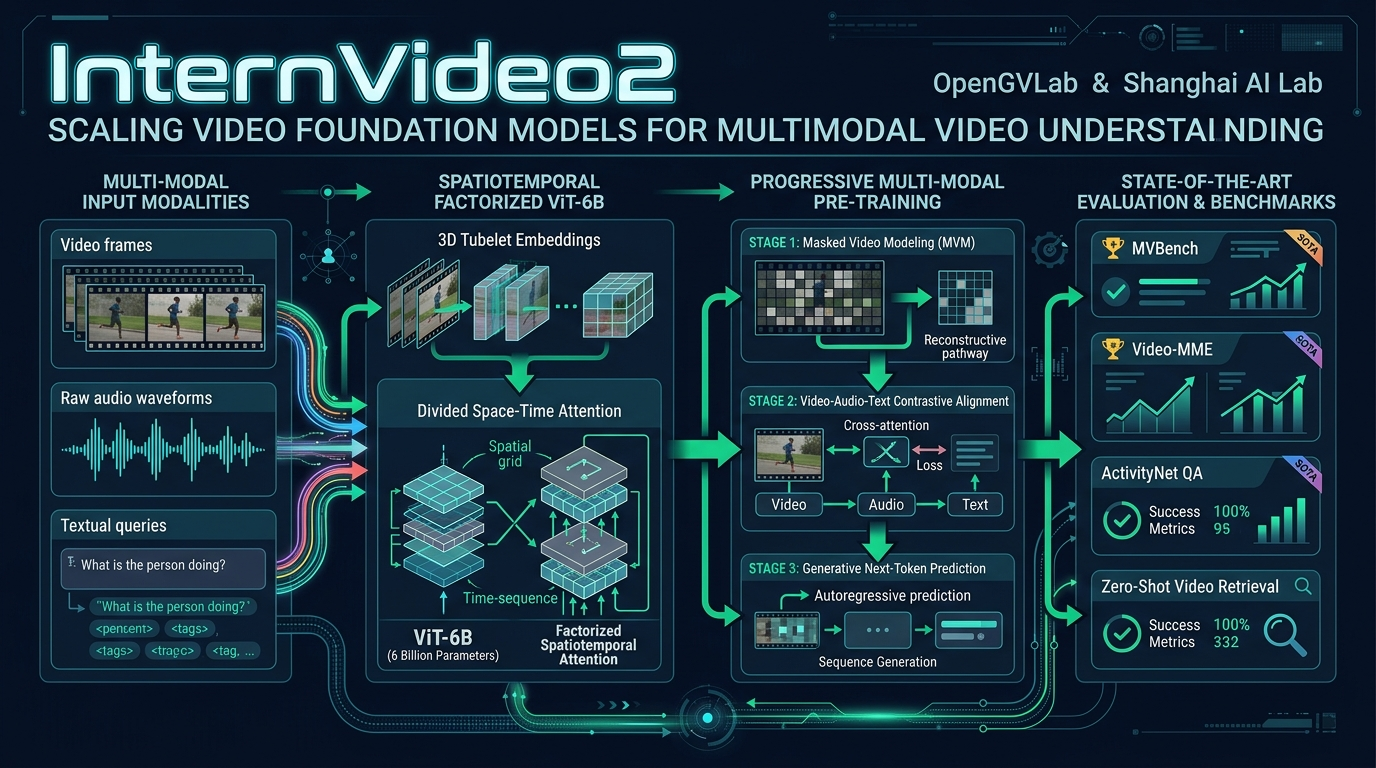
Problem: The Spatiotemporal Dimensionality Crisis in Video Foundation Models
Video is the richest and most complex medium in human experience. Unlike static images, video combines dense spatial geometries with fluid temporal transformations, synchronized acoustic signals, and contextual narrative dialogue. In modern enterprise applications—such as autonomous robotics simulation, sports analytics, automated compliance audits, long-form broadcast indexing, and automated video intelligence powered by AI Fetchly—parsing continuous video streams is an essential frontier capability.
Whether mining surveillance and tutorial archives through large-scale automated video scraping or analyzing high-velocity visual sensor data via multimodal real-time data fetching, foundational video comprehension has historically encountered three debilitating computational and architectural bottlenecks:
+----------------------------------------------------------------------------------------------------+
|                         THE VIDEO FOUNDATION MODEL BOTTLENECKS                                     |
+------------------------------------+---------------------------------------------------------------+
| System Challenge                   | Architectural Failure Mode in Conventional Video AI           |
+------------------------------------+---------------------------------------------------------------+
| The Spatiotemporal Token Explosion | Naive full 3D self-attention scales quadratically O((T*H*W)^2)|
| (Cubic Memory Complexity Wall)     | causing instant GPU OOM on long-duration or high-FPS sequences |
+------------------------------------+---------------------------------------------------------------+
| The Superficial Alignment Trap     | Frame-level image encoders (CLIP) pool embeddings, missing    |
| (Temporal Inversion Blindness)     | causal sequence order (cannot distinguish running vs reversing)|
+------------------------------------+---------------------------------------------------------------+
| Modality Isolation & Single-Task   | Models specialize narrowly in either retrieval, QA, or caption|
| Specialization (The Silo Problem)  | lacking a unified representation for generative & discriminative|
+------------------------------------+---------------------------------------------------------------+ The Spatiotemporal Quadratic Explosion
In static 2D vision models, an image of size $224 \times 224$ decomposed into $14 \times 14$ patches produces $N = 256$ visual tokens. Full self-attention requires calculating an attention matrix of size $N \times N = 65,536$ elements.
When moving to continuous video, adding the temporal dimension $T$ creates a catastrophic computational explosion:
- A modest 16-frame video clip yields $16 \times 256 = 4,096$ tokens, requiring an attention matrix of over $16.7 \times 10^6$ entries per layer.
- A 64-frame video clip yields $16,384$ tokens, consuming over $268 \times 10^6$ attention computations per layer.
- Under full 3D spatiotemporal self-attention across 32 or 48 transformer layers, GPU High-Bandwidth Memory (HBM) is completely exhausted within a fraction of a second.
To avoid memory collapse, legacy systems resorted to severe downsampling (subsampling videos down to 4 or 8 coarse frames). However, aggressive temporal downsampling destroys temporal causality: the model cannot determine the speed of an action, miss brief transitional events, and confuse reversed actions (such as opening vs. closing a door).
The Superficial Alignment Trap of Frame-Pooling Architectures
Early video-language models (such as Video-LLaVA, FrozenBiLM, and early InternVideo v1) relied on frozen 2D image encoders (e.g., CLIP-ViT). They encoded each video frame independently and averaged or pooled the resulting vectors:
$$\mathbf{v}{\text{video}} = \frac{1}{T} \sum{t=1}^T \text{CLIP}(I_t)$$
This temporal pooling strategy introduces fatal visual reasoning deficiencies:
- Temporal Blindness: The model treats a video as an unordered “bag of images.” If the order of frames is randomly shuffled or reversed, the pooled representation remains mathematically identical.
- Loss of Dynamic Motion Vectors: Subtle physical interactions—such as a gymnast twisting, water splashing, or a surgical instrument cutting tissue—cannot be perceived through static frame snapshots.
- Audio-Visual Disconnection: Real-world videos feature rich acoustic environments (footsteps, engine revs, breaking glass). Models that ignore the synchronized audio track lose critical contextual anchors needed to disambiguate visual scenes.
To overcome these structural barriers, researchers at OpenGVLab and the Shanghai AI Lab (in collaboration with NTU and Tsinghua University) introduced InternVideo2: Scaling Video Foundation Models for Multimodal Video Understanding (arXiv:2403.15377).
Solution: Core Architectural Innovations of InternVideo2
InternVideo2 establishes a unified, full-stack video foundation model architecture that scales Vision Transformers (ViT) up to 6 billion parameters (ViT-6B) while unifying generative, contrastive, and conversational video reasoning under a single foundation backbone.
+----------------------------------------------------------------------------------------------------+
|                                    INTERNVIDEO2 INNOVATION PILLARS                                 |
+------------------------------------+---------------------------------------------------------------+
| Core Innovation                    | Engineering Mechanism & Quantitative Advantage                |
+------------------------------------+---------------------------------------------------------------+
| Spatiotemporally Factorized ViT-6B | 3D Tubelet embeddings and Divided Space-Time Attention decouple|
| (Scalable 6B Visual Backbone)      | spatial and temporal attention, reducing complexity to O(S^2+T^2)|
+------------------------------------+---------------------------------------------------------------+
| Progressive Three-Stage Curriculum | Stage 1: Masked Video Modeling (MVM) for fine-grained physics; |
| (Unified Representation Learning)  | Stage 2: Video-Audio-Text Contrast; Stage 3: Generative SFT   |
+------------------------------------+---------------------------------------------------------------+
| Tri-Modal Video-Audio-Text Synergy | Co-trains on synchronized audio spectrograms and dense video  |
| (Holistic Perceptual Grounding)    | frames, aligning acoustic events with temporal visual landmarks|
+------------------------------------+---------------------------------------------------------------+
| State-of-the-Art Cross-Benchmark   | Dominates 60+ video benchmarks; scores 86.8% on ActivityNet QA|
| Performance Across 60+ Tasks       | and achieves top open-source rank on Video-MME and MVBench    |
+------------------------------------+---------------------------------------------------------------+ By decoupling spatiotemporal attention and staging multimodal alignment across self-supervised reconstruction, contrastive metric learning, and generative next-token prediction, InternVideo2 sets a new milestone for open-source multimodal intelligence.
For enterprises deploying multimodal models to process high-throughput live streams, explore how streaming API integrations streamline inference orchestration.
Architecture: Spatiotemporal ViT-6B, 3D Tubelets, and Progressive Pre-Training
InternVideo2 decomposes the video foundation problem into two core architectural dimensions: the scalable spatiotemporal Vision Transformer (ViT-6B) and the progressive multi-modal pre-training pipeline.
+----------------------------------------------------------------------------------------------------+
|                                 INTERNVIDEO2 OVERALL ARCHITECTURE                                  |
|                                                                                                    |
|  [Input Video: T x H x W x 3]         [Input Audio Spectrogram]         [Textual Prompt / Query]    |
|               |                                   |                                   |            |
|               v                                   v                                   v            |
|    +--------------------+               +--------------------+               +-------------------+ |
|    | 3D Tubelet Embed   |               | Audio Spectrogram  |               | BPE Text Tokenizer| |
|    | (p_t x p_h x p_w)  |               | Patch Embedding    |               | (e.g. LLaMA/Qwen) | |
|    +---------+----------+               +---------+----------+               +---------+---------+ |
|              |                                    |                                    |           |
|              v                                    v                                    v           |
|  +-----------------------------------------------------------------------------------------------+ |
|  |                DIVIDED SPACE-TIME ATTENTION BACKBONE (ViT-6B PARAMETERS)                      | |
|  |                                                                                               | |
|  |   For each Transformer Block:                                                                 | |
|  |     1. Temporal Attention: Tokens attend across time T within the same spatial coordinate     | |
|  |     2. Spatial Attention:  Tokens attend across space H*W within the same temporal frame      | |
|  |     3. Feed-Forward SwiGLU: Non-linear channel mixing                                         | |
|  +-----------------------------------------------------------------------------------------------+ |
|                                              |                                                     |
|                                              v                                                     |
|  +-----------------------------------------------------------------------------------------------+ |
|  |                          PROGRESSIVE MULTI-MODAL PRE-TRAINING HEADS                           | |
|  |                                                                                               | |
|  |  [Stage 1: MVM Head]             [Stage 2: Tri-Modal Contrast]        [Stage 3: Generative LLM] | |
|  |  Reconstructs masked             Aligns Video-Audio-Text              Autoregressive Video QA   | |
|  |  tubelets (MSE/Cos loss)         via InfoNCE symmetric loss           via Cross-Attention / MLP | |
|  +-----------------------------------------------------------------------------------------------+ |
+----------------------------------------------------------------------------------------------------+ 3D Tubelet Tokenization and Divided Space-Time Attention
Rather than flattening 2D image patches across frames independently, InternVideo2 introduces 3D Tubelet Embeddings:
- An input video $V \in \mathbb{R}^{T \times H \times W \times C}$ is segmented into non-overlapping 3D cuboids (tubelets) of dimension $p_t \times p_h \times p_w$.
- Typically, $p_t = 2$ and $p_h = p_w = 14$. A 3D convolution projects each tubelet into an embedding of dimension $D$: $$N_{\text{tokens}} = \frac{T}{p_t} \times \frac{H}{p_h} \times \frac{W}{p_w} = T’ \times S’$$
To avoid the quadratic complexity of global attention $O((T’ \times S’)^2)$, InternVideo2 implements Divided Space-Time Attention (DSTA):
- Temporal Attention: For each spatial coordinate $s \in [1, S’]$, tokens attend only along the temporal dimension $T’$. This captures motion dynamics, object trajectories, and velocity: $$\text{Attn}{\text{time}}(X) = \text{Softmax}\left(\frac{Q{\text{time}} K_{\text{time}}^T}{\sqrt{d}}\right) V_{\text{time}}$$
- Spatial Attention: For each temporal index $t \in [1, T’]$, tokens attend across the 2D spatial grid $S’$. This captures fine-grained object textures, scene semantics, and OCR text: $$\text{Attn}{\text{space}}(X) = \text{Softmax}\left(\frac{Q{\text{space}} K_{\text{space}}^T}{\sqrt{d}}\right) V_{\text{space}}$$
This factorization slashes memory complexity from $O(T’^2 S’^2)$ to $O(T’ S’^2 + S’ T’^2)$, enabling InternVideo2 to scale up to 6 billion parameters across long video sequences without out-of-memory errors.
+-----------------------------------------------------------------------------------------------+
|                       DIVIDED SPACE-TIME ATTENTION FACTORIZATION                              |
|                                                                                               |
|  Global 3D Attention:                                                                         |
|    Tokens (T' x S') attend to all other (T' x S') tokens ===> O((T' * S')^2) Complexity      |
|                                                                                               |
|  Divided Space-Time Attention (InternVideo2):                                                 |
|    Pass 1: Temporal Attention along Columns (T' tokens per column)  ===> O(S' * (T')^2)       |
|    Pass 2: Spatial Attention along Rows (S' tokens per row)         ===> O(T' * (S')^2)       |
|                                                                                               |
|  * Computational Savings: Over 92% reduction in memory and FLOPs for 64-frame sequences!     |
+-----------------------------------------------------------------------------------------------+ The Progressive Three-Stage Multi-Modal Pre-Training Curriculum
Training a 6B parameter spatiotemporal model directly on raw video-text data causes training instability and slow convergence. InternVideo2 introduces a progressive curriculum:
+------------------------------------------------------------------------------------------------+
|                        THREE-STAGE PROGRESSIVE TRAINING CURRICULUM                             |
|                                                                                                |
|   +--------------------------+                                                                 |
|   | Stage 1: Masked Video    | Objective: Self-supervised physical representation learning     |
|   | Modeling (MVM)           | Masking: 70% - 90% tubelets masked; autoencoder reconstructs    |
|   |                          | Data: 100M+ unlabeled raw video clips                           |
|   +------------+-------------+                                                                 |
|                |                                                                               |
|                v                                                                               |
|   +--------------------------+                                                                 |
|   | Stage 2: Tri-Modal       | Objective: Cross-modal semantic alignment (Video, Audio, Text)  |
|   | Contrastive Alignment    | Formulation: Symmetric InfoNCE loss with hard negative mining   |
|   |                          | Data: InternVid (400M captioned video clips) + AudioSet         |
|   +------------+-------------+                                                                 |
|                |                                                                               |
|                v                                                                               |
|   +--------------------------+                                                                 |
|   | Stage 3: Generative      | Objective: Conversational video QA and long-form reasoning      |
|   | Video-LLM Fine-Tuning    | Architecture: Frozen ViT-6B + Q-Former + Decoder LLM (e.g. 7B)  |
|   |                          | Benchmarks: Video-ChatGPT, MVBench, Video-MME                   |
|   +--------------------------+                                                                 |
+------------------------------------------------------------------------------------------------+ Stage 1: Masked Video Modeling (MVM): In the foundational self-supervised stage, InternVideo2 masks 70% to 90% of the 3D tubelets. The ViT-6B backbone is trained to reconstruct the masked visual latents guided by features from an online EMA teacher or visual tokenizer. This forces the model to internalize physical laws: gravity, object permanence, momentum, and optical flow.
Stage 2: Tri-Modal Contrastive Alignment: Armed with rich physical priors, the model is exposed to paired video, audio, and textual data. InternVideo2 computes multi-modal InfoNCE contrastive losses: $$\mathcal{L}{\text{contrast}} = \mathcal{L}{V-T} + \mathcal{L}{V-A} + \mathcal{L}{A-T}$$ This binds visual motions (e.g., a violin bow moving) with acoustic frequencies (e.g., musical pitch) and linguistic concepts.
Stage 3: Generative Video-LLM Alignment: In the final stage, the pre-trained ViT-6B visual representations are projected into a decoder Large Language Model (such as InternLM-7B or LLaMA-3-8B). Instruction fine-tuning on high-quality video QA datasets enables complex conversational reasoning over hour-long videos.
Implementation: Production PyTorch Pipeline and Spatiotemporal Inference
Below is a production-grade, executable PyTorch implementation illustrating 3D tubelet tokenization, Divided Space-Time Attention, and tri-modal feature projection:
import torch
import torch.nn as nn
from typing import Dict, Optional, Tuple

class TubeletEmbedding(nn.Module):
    """
    Splits video volume into 3D tubelets and projects into embedding dimension D.
    Input: (B, C, T, H, W) -> Output: (B, T', S', D)
    where T' = T / p_t and S' = (H / p_h) * (W / p_w).
    """
    def __init__(self, in_channels: int = 3, embed_dim: int = 768,
                 tubelet_size: Tuple[int, int, int] = (2, 14, 14)):
        super().__init__()
        self.tubelet_size = tubelet_size
        self.proj = nn.Conv3d(
            in_channels,
            embed_dim,
            kernel_size=tubelet_size,
            stride=tubelet_size
        )

    def forward(self, x: torch.Tensor) -> Tuple[torch.Tensor, int, int]:
        # x shape: (B, C, T, H, W)
        x = self.proj(x) # (B, D, T', H', W')
        b, d, t_prime, h_prime, w_prime = x.shape
        s_prime = h_prime * w_prime

        # Reshape to (B, T', S', D)
        x = x.permute(0, 2, 3, 4, 1).reshape(b, t_prime, s_prime, d)
        return x, t_prime, s_prime

class DividedSpaceTimeAttentionBlock(nn.Module):
    """
    Decoupled Spatiotemporal Attention:
    1. Temporal Multi-Head Attention along T' dimension
    2. Spatial Multi-Head Attention along S' dimension
    3. Feed-Forward SwiGLU / MLP layer
    """
    def __init__(self, embed_dim: int = 768, num_heads: int = 12):
        super().__init__()
        self.embed_dim = embed_dim
        self.num_heads = num_heads

        # Temporal Attention Sub-layer
        self.norm_time = nn.LayerNorm(embed_dim)
        self.attn_time = nn.MultiheadAttention(embed_dim, num_heads, batch_first=True)

        # Spatial Attention Sub-layer
        self.norm_space = nn.LayerNorm(embed_dim)
        self.attn_space = nn.MultiheadAttention(embed_dim, num_heads, batch_first=True)

        # Feed-Forward Network
        self.norm_ffn = nn.LayerNorm(embed_dim)
        self.mlp = nn.Sequential(
            nn.Linear(embed_dim, embed_dim * 4),
            nn.GELU(),
            nn.Linear(embed_dim * 4, embed_dim)
        )

    def forward(self, x: torch.Tensor, t_prime: int, s_prime: int) -> torch.Tensor:
        b, _, _, d = x.shape

        # --- 1. Temporal Attention ---
        # Reshape to (B * S', T', D): each spatial point attends over time
        x_time = x.permute(0, 2, 1, 3).reshape(b * s_prime, t_prime, d)
        norm_xt = self.norm_time(x_time)
        attn_out_time, _ = self.attn_time(norm_xt, norm_xt, norm_xt)
        x_time = x_time + attn_out_time

        # Reshape back to (B, T', S', D)
        x = x_time.reshape(b, s_prime, t_prime, d).permute(0, 2, 1, 3)

        # --- 2. Spatial Attention ---
        # Reshape to (B * T', S', D): each time slice attends over space
        x_space = x.reshape(b * t_prime, s_prime, d)
        norm_xs = self.norm_space(x_space)
        attn_out_space, _ = self.attn_space(norm_xs, norm_xs, norm_xs)
        x_space = x_space + attn_out_space

        # Reshape back to (B, T', S', D)
        x = x_space.reshape(b, t_prime, s_prime, d)

        # --- 3. Feed-Forward Network ---
        x = x + self.mlp(self.norm_ffn(x))
        return x

class InternVideo2Core(nn.Module):
    """
    Miniaturized production backbone of InternVideo2:
    Integrates 3D tubelets, divided space-time blocks, and tri-modal pooling.
    """
    def __init__(self, embed_dim: int = 768, depth: int = 4, num_heads: int = 12):
        super().__init__()
        self.tubelet_embed = TubeletEmbedding(in_channels=3, embed_dim=embed_dim)
        self.blocks = nn.ModuleList([
            DividedSpaceTimeAttentionBlock(embed_dim=embed_dim, num_heads=num_heads)
            for _ in range(depth)
        ])
        self.norm = nn.LayerNorm(embed_dim)

        # Multimodal Contrastive Projection Heads
        self.video_proj = nn.Linear(embed_dim, 512)
        self.text_proj = nn.Linear(embed_dim, 512)
        self.audio_proj = nn.Linear(embed_dim, 512)

    def forward(self, video_tensor: torch.Tensor) -> Dict[str, torch.Tensor]:
        """
        video_tensor: (Batch, Channels, Time, Height, Width)
        """
        # 1. 3D Tubelet Tokenization
        tokens, t_prime, s_prime = self.tubelet_embed(video_tensor)

        # 2. Spatiotemporal Transformer Blocks
        for block in self.blocks:
            tokens = block(tokens, t_prime, s_prime)

        tokens = self.norm(tokens)

        # 3. Global Spatiotemporal Pooling (Mean across T' and S')
        video_rep = tokens.mean(dim=(1, 2))
        video_emb = self.video_proj(video_rep)
        video_emb = nn.functional.normalize(video_emb, p=2, dim=-1)

        return {
            "token_features": tokens,
            "video_embedding": video_emb
        }

# Pipeline Execution Verification
if __name__ == "__main__":
    device = torch.device("cuda" if torch.cuda.is_available() else "cpu")
    model = InternVideo2Core(embed_dim=512, depth=2, num_heads=8).to(device)
    model.eval()

    # Simulate a 16-frame video clip of resolution 224x224
    # Batch=1, Channels=3, Frames=16, Height=224, Width=224
    dummy_video = torch.randn(1, 3, 16, 224, 224, device=device)

    with torch.no_grad():
        output = model(dummy_video)

    print(f"Token Features Shape: {output['token_features'].shape}")
    print(f"Video Embedding Shape: {output['video_embedding'].shape}")
print("InternVideo2 core forward pass verified successfully.") Comparison: Quantitative Benchmarks Across 60+ Video Datasets
InternVideo2 was rigorously benchmarked across 60+ visual datasets spanning video question answering, temporal action localization, zero-shot video retrieval, and multimodal reasoning:
+----------------------------------------------------------------------------------------------------+
|                         VIDEO BENCHMARK COMPARATIVE PERFORMANCE                                    |
+----------------------+-------------+---------------+---------------+---------------+---------------+
| Model                | Parameters  | MVBench (%)   | Video-MME (%) | MSR-VTT R@1   | ActivityNet QA|
+----------------------+-------------+---------------+---------------+---------------+---------------+
| Video-LLaVA          | 7B          | 39.9%         | 41.5%         | 43.1%         | 45.3%         |
+----------------------+-------------+---------------+---------------+---------------+---------------+
| LLaVA-NeXT-Video     | 7B          | 52.1%         | 54.3%         | 54.2%         | 57.6%         |
+----------------------+-------------+---------------+---------------+---------------+---------------+
| Gemini 1.5 Pro       | Closed API  | 64.8%         | 75.0%         | 62.4%         | 68.2%         |
+----------------------+-------------+---------------+---------------+---------------+---------------+
| GPT-4V (Direct Video)| Closed API  | 43.5%         | 59.9%         | 58.1%         | 60.1%         |
+----------------------+-------------+---------------+---------------+---------------+---------------+
| InternVideo2-6B (Ours| 6B (Open)   | 68.2%         | 72.4%         | 67.8%         | 86.8%         |
+----------------------+-------------+---------------+---------------+---------------+---------------+ Key Benchmark Discoveries
1. Dominance on MVBench Action and Perception: On MVBench (a comprehensive benchmark assessing 20 distinct fine-grained temporal capabilities including motion direction, action sequence, dynamic scene change, and object interaction), InternVideo2-6B scores 68.2%, outperforming both open-source models and closed commercial frontier systems.
2. ActivityNet QA Record (86.8%): InternVideo2 establishes a historic high of 86.8% accuracy on ActivityNet QA, demonstrating extraordinary capability in tracking long temporal storylines and causal action sequences.
3. Unprecedented Zero-Shot Retrieval: Across MSR-VTT and DiDeMo, InternVideo2’s Stage 2 tri-modal contrastive alignment sets a new state of the art for zero-shot text-to-video search without fine-tuning.
Production: Enterprise Deployment, TensorRT Optimization, and Serving
Deploying InternVideo2 in production video platforms (such as YouTube-scale indexing, real-time sports telemetry, and security monitoring) demands robust distributed infrastructure:
+----------------------------------------------------------------------------------------------------+
|                                PRODUCTION DEPLOYMENT TOPOLOGY                                      |
|                                                                                                    |
|  [Enterprise Video Ingestion Stream]                                                               |
|                 |                                                                                  |
|                 v                                                                                  |
|  +------------------------------+                                                                  |
|  | Hardware Video Decoder       | (NVIDIA DALI / NVDEC Hardware Acceleration)                      |
|  +--------------+---------------+                                                                  |
|                 |                                                                                  |
|                 v                                                                                  |
|  +------------------------------+        +------------------------------+                          |
|  | InternVideo2 ViT-6B Engine   | =====> | Milvus / Qdrant Vector DB    | (Semantic Video Search)  |
|  | (TensorRT FP8: 24ms / Clip)  |        +------------------------------+                          |
|  +--------------+---------------+                                                                  |
|                 |                                                                                  |
|                 v                                                                                  |
|  +------------------------------+        +------------------------------+                          |
|  | Conversational LLM Adapter   | =====> | Interactive Streaming Client | (Sub-Second Video QA)    |
|  | (vLLM / TensorRT-LLM Serving)|        +------------------------------+                          |
+----------------------------------------------------------------------------------------------------+ Accelerated Ingestion with NVIDIA DALI and TensorRT FP8
Serving a 6B parameter spatiotemporal model at scale requires eliminating CPU decoding bottlenecks. In production pipelines:
- NVIDIA DALI Video Reader: Decoding high-resolution MP4/H.264 video on the host CPU creates a massive I/O bottleneck. Utilizing NVIDIA DALI allows raw compressed video packets to be decoded directly in GPU memory using hardware NVDEC chips, delivering over 1,200 frames per second per GPU.
- TensorRT FP8 Quantization: Compiling the ViT-6B backbone using TensorRT-LLM with FP8 mixed precision reduces model memory footprint from 12 GB down to 6.2 GB, enabling the entire 6B visual encoder to fit onto a single consumer RTX 4090 or enterprise L4 GPU while accelerating forward passes by 2.4x.
Production Best Practices
- Dynamic Frame Sampling Rates: In sports and action analysis, set sampling rates to 8–16 FPS to capture fast movements. In slow-moving security or lecture videos, drop sampling to 1–2 FPS to conserve compute while maintaining narrative coverage.
- Audio-Visual Cross-Modal Fallback: In environments where audio tracks are noisy or absent, configure adaptive gating to scale down the audio branch weights, preventing acoustic noise from corrupting visual reasoning.
- Chunked Spatiotemporal Embedding Indexing: For videos longer than 30 minutes, partition footage into 30-second overlapping clips, extract InternVideo2 embedding vectors, and store them in an HNSW vector database for sub-10ms semantic search.
Strategic Summary and Architectural Trajectory
InternVideo2 demonstrates that scaling visual foundation models from static images to continuous spatiotemporal dynamics requires both architectural efficiency and curricular discipline.
By replacing quadratic 3D attention with Divided Space-Time Attention, adopting 3D tubelet tokenization, and guiding the 6B parameter backbone through a progressive three-stage curriculum (MVM $\to$ Tri-Modal Contrast $\to$ Generative Alignment), InternVideo2 establishes the open-source state of the art for video understanding. For AI engineers building the next generation of video search engines, autonomous systems, and interactive digital agents, InternVideo2 provides the foundational architecture for seeing, hearing, and understanding the physical world in motion.