Intel Lunar Lake NPU 4 Guide: Core Ultra AI Architecture
The AI PC Efficiency Crisis: Battery Degradation, Memory Saturation, and Thermal Throttling
The computing industry is undergoing its most aggressive architectural inflection since the introduction of mobile multicore processors. As deep learning foundation models transition from centralized hyperscale server clusters directly into consumer operating systems, client laptops must execute multi-billion-parameter neural networks on battery power. From local conversational copilots and zero-latency contextual search to background semantic document parsing and real-time audio super-resolution, modern operating systems demand continuous artificial intelligence evaluation.
However, attempting to run persistent, always-on foundation models on traditional personal computer architectures exposes four catastrophic microarchitectural bottlenecks:
- The Von Neumann DRAM Energy Penalty and Rapid Battery Depletion: In standard client laptop architectures, central processing units (CPUs) and integrated graphics processing units (iGPUs) are separated from system dynamic RAM (DRAM) by wide, high-capacitance physical bus traces across circuit boards. During transformer token generation, weights must be transferred repeatedly from system memory into register files for every discrete token emitted. Reading operands across long circuit board traces consumes between 70% and 90% of dynamic system power. When an x86 processor evaluates a 3-billion-parameter model on general-purpose cores, the package draws between 25W and 35W of continuous electrical power. This rapid energy burn exhausts standard 70-watt-hour laptop batteries in less than two hours, triggering fan noise and aggressive thermal throttling.
- Instruction Scheduling Overhead and Control-Logic Drag: Traditional x86 CPU cores and general-purpose GPU streaming multiprocessors were engineered for complex branch prediction, dynamic out-of-order execution, speculative execution buffers, and thread warp schedulers. In desktop processors, these complex control blocks are indispensable for single-threaded IPC in arbitrary C++ software. However, for deep learning inference—where tensor execution graphs are completely static, linear, and mathematically deterministic—these control structures represent dead silicon weight that dissipates idle power without contributing to raw matrix multiplication density.
- The 40 TOPS Microsoft Copilot+ Hardware Threshold: The commercial PC industry established a strict hardware boundary with Microsoft Copilot+: to execute local operating system intelligence (such as Windows Recall, Live Captions with translation, and Cocreator diffusion models) without cloud round-trip latency, client devices require at least 40 Tera-Operations per Second (TOPS) of dedicated, low-power Neural Processing Unit (NPU) compute. First-generation client NPUs (such as Intel Meteor Lake NPU 3 at 11.5 TOPS) fell far short of this performance floor, forcing manufacturers into radical silicon overhauls.
- Memory Bus Contention Across Heterogeneous Compute Islands: In conventional laptop SoCs, the CPU cores, graphics processor, and memory-mapped neural engines compete aggressively for access to off-chip DDR5 channels. When a background AI transcription service or semantic indexer continuously streams model weights across the shared memory bus, it triggers memory arbitration stalls that degrade foreground gaming, video playback, and responsive user interface compositing. Furthermore, voltage-frequency scaling across disparate CPU power domains introduces latency jitter that breaks real-time audio and video synchronization guarantees.
Resolving these fundamental challenges requires a ground-up silicon redesign: an energy-optimized, scalable Neural Processing Unit tightly coupled to on-package memory, engineered to deliver sustained 48 TOPS neural throughput while operating within an ultra-low sub-5W dedicated thermal envelope.
Introducing Intel Lunar Lake NPU 4: Core Ultra 200V Architecture
Intel solved the client AI PC dilemma with the Intel Lunar Lake architecture, commercialized as the Intel Core Ultra 200V series.
Representing the most radical architectural pivot in Intel’s mobile processor history, Lunar Lake integrates the fourth-generation Intel NPU 4 directly onto its high-efficiency Compute Tile, fabricated on TSMC’s cutting-edge N3B (3nm) process node and assembled with Intel’s Foveros 3D packaging technology. Scaling from the two Neural Compute Engines (NCEs) in Meteor Lake up to six fully parallel Neural Compute Engines, NPU 4 quadruples raw AI compute throughput to 48 TOPS of INT8 performance at up to 1.95 GHz clock speeds—shattering the Microsoft Copilot+ PC threshold while cutting active inference power by more than half.
+-------------------------------------------------------------------------+
|                  Intel Lunar Lake NPU 4 Hardware Overview               |
+-------------------------------------------------------------------------+
| Architecture:       Fourth-Generation Intel NPU (NPU 4)                 |
| Compute Engines:    6x Symmetrical Neural Compute Engines (NCE)         |
| Peak AI Throughput: 48 TOPS INT8 (Up to 1.95 GHz Operating Frequency)   |
| Mathematical Units: 12x Matrix Multiply Engines + Upgraded SHAVE DSPs   |
| Vector Performance: 12x Vector Compute Throughput vs. Meteor Lake NPU 3 |
| Direct Memory DMA:  136.5 GB/s IP Bandwidth to On-Package LPDDR5X       |
| System Packaging:   Foveros 3D Stacking on TSMC N3B with On-Package RAM |
| Software Platform:  Intel OpenVINO Toolkit, DirectML & ONNX Runtime     |
+-------------------------------------------------------------------------+ Key microarchitectural breakthroughs integrated into the Intel NPU 4 architecture include:
- Tripled Compute Array (6x Neural Compute Engines): Expands the physical execution matrix to six homogeneous NCE tiles, each integrating two dense systolic Matrix Multiply Engines (MME) paired with an upgraded SHAVE DSP vector core.
- 12x Vector Processing Acceleration: Completely overhauls the internal Streaming Hybrid Architecture Vector Engine (SHAVE DSP) vector pipeline, delivering a 12-fold increase in non-linear activation (GELU, SiLU, SwiGLU) and normalization throughput to eliminate transformer vector bottlenecks.
- Doubled DMA Bandwidth to On-Package Memory: Features a dedicated high-bandwidth Direct Memory Access (DMA) engine delivering 136.5 GB/s of IP bandwidth directly into on-package LPDDR5X-8533 memory, providing over 2x the memory pipeline throughput of previous mobile architectures.
- Sub-5W Dedicated Operational Power Envelope: Achieves unprecedented energy efficiency, delivering full 48 TOPS compute while drawing less than 5 Watts of dedicated NPU power—enabling hours of sustained local generative AI generation on fanless and ultra-thin laptop profiles.
- Unified OpenVINO™ and DirectML Software Stack: Provides production-grade software integration through Intel’s mature OpenVINO toolkit, the ONNX Runtime OpenVINO Execution Provider, Microsoft DirectML, and W3C WebNN browser standards.
Enterprises deploying large-scale neural network training, automated data extraction, and multimodal reasoning clusters can connect their Intel Core Ultra edge client infrastructure with real-time data ingestion infrastructure to stream high-velocity datasets directly into on-package LPDDR5X memory for immediate vectorized processing and continuous fine-tuning. By unifying specialized matrix-vector hardware with zero-latency on-package memory, Intel NPU 4 establishes a scalable, production-ready standard for client artificial intelligence.
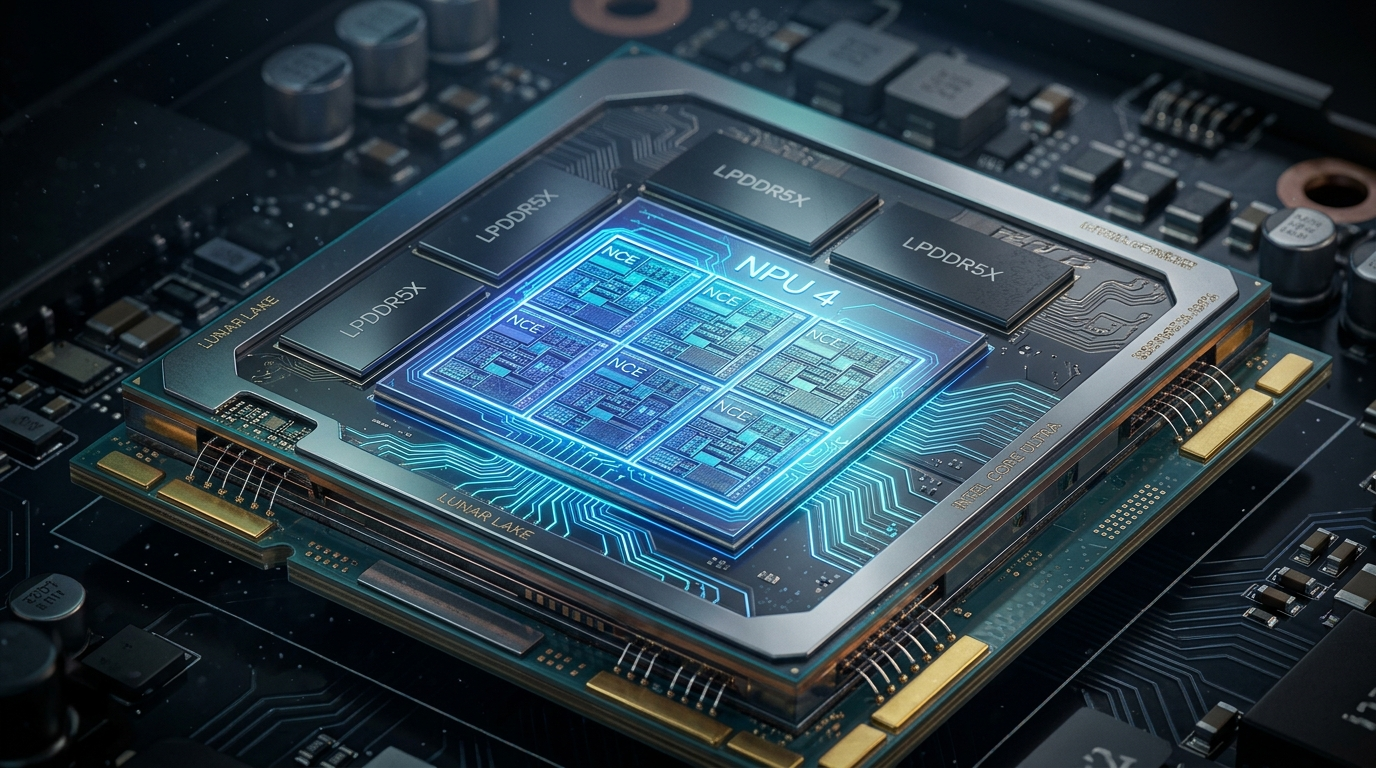
Architectural Deep Dive: 6 Neural Compute Engines, SHAVE DSPs, and 136 GB/s DMA
The sustained mathematical throughput and energy density of the Intel NPU 4 stem from three foundational microarchitectural pillars: a scalable array of six Neural Compute Engines, upgraded SHAVE vector pipelines, and a high-bandwidth direct-to-memory interconnect.
Symmetrical 6-NCE Tile Topology
At the microarchitectural level, Intel NPU 4 arranges its computational resources into six homogeneous, self-contained processing tiles termed Neural Compute Engines (NCEs):
+-----------------------------------------------------------------------------------+
|                        Intel Lunar Lake NPU 4 SoC Topology                        |
+-----------------------------------------------------------------------------------+
|  +------------------------+  +-------------------------------------------------+  |
|  | Host Interface Subsys  |  | High-Speed Direct Memory Access (DMA) Engine    |  |
|  | PCIe / System Fabric   |  | 136.5 GB/s IP Bandwidth to On-Package LPDDR5X   |  |
|  +-----------+------------+  +------------------------+------------------------+  |
|              |                                        |                           |
|  +-----------v----------------------------------------v------------------------+  |
|  |              High-Bandwidth Network-on-Chip (NoC) Crossbar                  |  |
|  +-----------------------------------------------------------------------------+  |
|        |                  |                  |                  |                 |
|  +-----v------+    +------v-----+     +------v-----+     +------v-----+           |
|  | NCE Tile 0 |<-->| NCE Tile 1 |<--> | NCE Tile 2 |<--> | NCE Tile 3 | ... (x6)  |
|  | - 2x MME   |    | - 2x MME   |     | - 2x MME   |     | - 2x MME   |           |
|  | - SHAVE DSP|    | - SHAVE DSP|     | - SHAVE DSP|     | - SHAVE DSP|           |
|  | - Scratchpad    | - Scratchpad     | - Scratchpad     | - Scratchpad           |
|  +------------+    +------------+     +------------+     +------------+           |
|        ^                  ^                  ^                  ^                 |
|        |                  |                  |                  |                 |
|  +-----v------------------v------------------v------------------v--------------+  |
|  |                  Hardware Task Scheduler & Power Gating Island              |  |
|  +-----------------------------------------------------------------------------+  |
+-----------------------------------------------------------------------------------+ Each NCE operates as an independent execution unit containing:
- Dual Matrix Multiply Engines (MME): Each NCE incorporates two dense 2D systolic arrays optimized for INT8, FP16, and BF16 matrix multiply-accumulate operations. Across all six NCEs, a total of 12 Matrix Multiply Engines operate in parallel. Each MME features a wide 2D grid of multiply-accumulate cells capable of executing hundreds of operations per cycle. The systolic data path routes activation operands horizontally while weights remain stationary in localized storage registers, reducing register file write-back power by over 60%.
- Upgraded SHAVE DSP Vector Engine: Positioned directly adjacent to the MMEs, a dedicated Streaming Hybrid Architecture Vector Engine (SHAVE DSP) handles non-matrix operations. In modern transformer architectures, attention mechanisms require complex mathematical sequences: Softmax calculations, LayerNorm/RMSNorm normalizations, RoPE positional rotations, and element-wise scaling. By scaling vector execution pipelines by 12x compared to Meteor Lake, NPU 4 ensures that vector operations do not stall the matrix systolic arrays. The SHAVE DSP incorporates enhanced single-instruction multiple-data (SIMD) execution units and specialized hardware lookup tables that compute transcendental mathematical functions—such as exponentials and square roots—in single-digit clock cycles.
- Localized Scratchpad SRAM: Each NCE contains high-speed localized scratchpad SRAM. By buffering intermediate layer activations and weight tiles directly inside the engine, NPU 4 eliminates internal cache thrashing and guarantees single-cycle operand availability. The scratchpad memory is organized into independent multi-bank partitions, allowing simultaneous reads from the Matrix Multiply Engines and writes from the SHAVE DSP without bus arbitration conflicts.
High-Bandwidth Direct Memory Access (DMA) Engine
A critical bottleneck in edge neural processors is the memory pipeline: feeding weights and activations into compute cores without saturating the host processor’s system memory bus.
Intel resolved this in Lunar Lake through an aggressive overhaul of the DMA architecture:
- 136.5 GB/s IP Bandwidth: The NPU 4 DMA engine doubles its data transmission capacity to 136.5 GB/s, matching the full theoretical bandwidth of Lunar Lake’s on-package dual-channel LPDDR5X-8533 memory interface.
- Hardware Tiling and Addressing Transformations: The DMA engine incorporates dedicated hardware logic for automated multi-dimensional tensor slicing, im2col spatial transformations, zero-padding, and stride adjustments. These transformations occur on the fly as data streams into the NCE scratchpad, completely offloading data manipulation from the CPU.
- On-Package Memory Synergy: In Lunar Lake, LPDDR5X memory dies are physically mounted directly on the processor package alongside the Compute Tile. This eliminates centimeters of motherboard PCB copper traces, reducing memory access latency to sub-nanosecond timescales and slashing data movement energy by over 40%. The close physical proximity of on-package memory prevents high capacitive signal losses, allowing the memory controller to operate at peak 8533 MT/s data rates under minimal supply voltage.
Intelligent Hardware Task Scheduling and Power Gating
To maximize battery life during heterogeneous laptop workflows, NPU 4 incorporates an autonomous Hardware Task Scheduler:
- Zero Host CPU Intervention: The NPU scheduler parses execution command lists submitted by the operating system, schedules layer dependencies across the six NCEs, and coordinates memory staging without waking the power-hungry Lion Cove performance cores or Skymont efficient cores. Once a neural network inference job is dispatched, the host operating system enters deep C-state sleep, leaving the NPU to process continuous audio, video, or conversational streams autonomously.
- Microsecond Dynamic Power Gating: The scheduler monitors mathematical demand in real time. If an active model requires only light compute (such as an audio noise suppression filter running in the background), the scheduler powers down four of the six NCE tiles within microseconds. When a bursty user query triggers a generative transformer, all six NCEs power up instantly, delivering instantaneous 48 TOPS throughput without user-perceptible latency penalties.
Programming Intel NPU 4: OpenVINO Toolkit, ONNX Runtime, and DirectML
Deploying neural network models onto Intel Lunar Lake NPU 4 is streamlined through the open-source Intel OpenVINO™ Toolkit, the ONNX Runtime OpenVINO Execution Provider, and Microsoft’s native DirectML API.
+-------------------------------------------------------------------------+
|                  Intel OpenVINO Full-Stack Software Stack               |
+-------------------------------------------------------------------------+
| Application Layer:   PyTorch | TensorFlow | ONNX | Hugging Face Optimum |
+-------------------------------------------------------------------------+
| OpenVINO NNCF:       Neural Network Compression Framework (INT8 PTQ)    |
+-------------------------------------------------------------------------+
| Model Optimizer:     OpenVINO Model Optimizer (IR Generation: .xml/.bin)|
+-------------------------------------------------------------------------+
| Inference Engine:    OpenVINO Runtime API (Device: 'NPU')               |
+-------------------------------------------------------------------------+
| Driver Layer:        Intel NPU Acceleration Driver (Level Zero API)     |
+-------------------------------------------------------------------------+
| Hardware Layer:      Intel Lunar Lake NPU 4 (6 NCE Tiles, 48 TOPS)      |
+-------------------------------------------------------------------------+ End-to-End Model Compilation with OpenVINO
The following Python script illustrates how an enterprise engineering team quantizes an FP16 transformer or vision model to INT8 using OpenVINO’s Neural Network Compression Framework (NNCF) and compiles it for native execution on the Lunar Lake NPU 4:
# openvino_lunar_lake_compile.py
# Automated quantization and compilation pipeline for Intel Lunar Lake NPU 4

import openvino as ov
import nncf
import torch
import torchvision.models as models
import numpy as np

def build_calibration_dataset(num_samples: int = 300):
    """
    Generates representative input calibration data for INT8 quantization.
    """
    print(f"[*] Generating {num_samples} calibration samples for NNCF...")
    for _ in range(num_samples):
        # Realistic normalized tensor matching vision batch dimensions
        yield torch.randn(1, 3, 224, 224)

def compile_for_lunar_lake_npu(model_name: str, output_dir: str):
    """
    Quantizes and compiles a model into OpenVINO IR optimized for NPU 4.
    """
    print(f"[*] Initializing model: {model_name}...")
    model = models.resnet50(pretrained=True)
    model.eval()

    # Step 1: Initialize OpenVINO Core Runtime
    core = ov.Core()
    available_devices = core.available_devices
    print(f"[+] Available Hardware Devices: {available_devices}")
    assert "NPU" in available_devices, "Intel NPU 4 hardware device not detected!"

    # Step 2: Convert PyTorch model to OpenVINO Model representation
    print("[*] Converting PyTorch computational graph to OpenVINO IR...")
    dummy_input = torch.randn(1, 3, 224, 224)
    ov_model = ov.convert_model(model, example_input=dummy_input)

    # Step 3: Run Post-Training Quantization (PTQ) via NNCF
    print("[*] Executing NNCF Post-Training Quantization targeting NPU 4 INT8...")
    calibration_dataset = nncf.Dataset(build_calibration_dataset(200))
    quantized_model = nncf.quantize(
        ov_model,
        calibration_dataset,
        model_type=nncf.ModelType.TRANSFORMER,
        preset=nncf.QuantizationPreset.PERFORMANCE,
        target_device=nncf.TargetDevice.ANY
    )

    # Step 4: Configure NPU 4 Compilation Hints
    config = {
        ov.properties.hint.performance_mode(): ov.properties.hint.PerformanceMode.THROUGHPUT,
        ov.properties.hint.execution_mode(): ov.properties.hint.ExecutionMode.PERFORMANCE,
        ov.properties.intel_npu.compiler_type(): "DRIVER"
    }

    # Step 5: Compile executable network directly onto the 6 NCE tiles
    print("[*] Compiling optimized graph onto 6 Neural Compute Engines...")
    compiled_model = core.compile_model(quantized_model, device_name="NPU", config=config)

    # Save optimized OpenVINO Intermediate Representation (.xml / .bin)
    ir_path = f"{output_dir}/{model_name}_int8_npu4.xml"
    ov.save_model(quantized_model, ir_path)
    print(f"[+] Compilation complete! Model saved to: {ir_path}")
    return compiled_model

if __name__ == "__main__":
compile_for_lunar_lake_npu("resnet50", "./model_cache") High-Throughput Asynchronous Inference Server
Once compiled, models are executed asynchronously on the NPU 4 using OpenVINO’s non-blocking InferRequest queues, ensuring that host CPU threads remain completely unblocked:
# openvino_npu_serving.py
# High-concurrency asynchronous inference engine running on Intel Lunar Lake NPU 4

import openvino as ov
import numpy as np
import time
from typing import Dict, Any

class LunarLakeNPUEngine:
    def __init__(self, model_xml: str):
        """
        Loads the compiled OpenVINO IR model directly into the Intel NPU 4 runtime.
        """
        self.core = ov.Core()
        print(f"[*] Loading model on Intel NPU 4: {model_xml}")

        # Configure low-latency execution properties
        npu_config = {
            ov.properties.hint.performance_mode(): ov.properties.hint.PerformanceMode.LATENCY,
            ov.properties.num_streams(): 2
        }

        self.compiled_model = self.core.compile_model(model_xml, device_name="NPU", config=npu_config)
        self.infer_queue = ov.AsyncInferQueue(self.compiled_model, jobs=4)

        # Query NPU device properties
        npu_name = self.core.get_property("NPU", "FULL_DEVICE_NAME")
        print(f"[+] Active Silicon: {npu_name}")

    def benchmark_pipeline(self, batch_size: int = 1, iterations: int = 200) -> Dict[str, Any]:
        """
        Executes an asynchronous inference benchmark across the 6 NCE tiles.
        """
        dummy_input = np.random.randn(batch_size, 3, 224, 224).astype(np.float32)
        latencies = []

        print(f"\n[*] Commencing benchmark: {iterations} iterations on Intel NPU 4...")

        # Warmup passes to prime MME systolic arrays
        for _ in range(10):
            req = self.compiled_model.create_infer_request()
            req.infer([dummy_input])

        t_start_total = time.perf_counter()
        for _ in range(iterations):
            t0 = time.perf_counter()
            req = self.compiled_model.create_infer_request()
            req.infer([dummy_input])
            latencies.append((time.perf_counter() - t0) * 1000.0)

        t_total_elapsed = time.perf_counter() - t_start_total
        avg_latency = np.mean(latencies)
        p50 = np.percentile(latencies, 50)
        p99 = np.percentile(latencies, 99)
        throughput = (iterations * batch_size) / t_total_elapsed

        results = {
            "device": "Intel Lunar Lake NPU 4 (6 NCE Tiles)",
            "iterations": iterations,
            "avg_latency_ms": avg_latency,
            "p50_latency_ms": p50,
            "p99_latency_ms": p99,
            "throughput_fps": throughput
        }

        print("\n================== Intel NPU 4 Benchmark Results ==================")
        print(f"Target Hardware:     {results['device']}")
        print(f"Average Latency:     {results['avg_latency_ms']:.2f} ms")
        print(f"P50 Latency:         {results['p50_latency_ms']:.2f} ms")
        print(f"P99 Latency:         {results['p99_latency_ms']:.2f} ms")
        print(f"Inference Throughput:{results['throughput_fps']:.2f} frames/sec")
        print("==================================================================\n")
        return results

if __name__ == "__main__":
    engine = LunarLakeNPUEngine("./model_cache/resnet50_int8_npu4.xml")
engine.benchmark_pipeline(batch_size=1, iterations=200) In this pipeline:
core.compile_model(..., device_name="NPU")offloads model execution directly to the Level Zero NPU driver, targeting the six Neural Compute Engines.ov.AsyncInferQueueorchestrates multi-stream asynchronous execution, maintaining a high-occupancy queue across all 12 Matrix Multiply Engines without CPU thread contention.
Architectural Comparison: Intel NPU 4 vs. AMD XDNA 2 vs. Qualcomm Hexagon vs. Apple M4 ANE
To understand Intel NPU 4’s microarchitectural competitive standing, we compare it against leading client PC neural processing units powering modern Copilot+ laptops: the AMD XDNA 2, the Qualcomm Snapdragon X Elite Hexagon NPU, and the Apple M4 Apple Neural Engine (ANE):
| Architectural Metric | Intel NPU 4 (Lunar Lake) | AMD XDNA 2 (Ryzen AI 300) | Qualcomm Hexagon (Snapdragon X) | Apple M4 Neural Engine |
|---|---|---|---|---|
| Silicon Architecture | 6 Neural Compute Engines (NCE) | 32 Spatial Dataflow AIE Tiles | Scalar + Vector + Micro-Tile | Symmetrical 16-Core ANE |
| Manufacturing Node | TSMC N3B (3nm Custom) | TSMC 4nm FinFET | TSMC 4nm FinFET | TSMC N3E (3nm) |
| Peak NPU Compute | 48 TOPS (INT8) | 50 TOPS (INT8 / BFP16) | 45 TOPS (INT8) | 38 TOPS (INT8) |
| Mathematical Precision | INT8, FP16, BF16 | Block FP16 (BFP16), INT8 | INT8, INT4 | FP16, INT8 |
| Vector Processing Core | Upgraded SHAVE DSP (12x Peak) | 512-bit SIMD Vector Unit | Hexagon Vector eXtensions (HVX) | Dedicated Vector Pipelines |
| Memory DMA Bandwidth | 136.5 GB/s (On-Package RAM) | Dedicated Streaming Mesh | Dedicated DRAM PHY | Unified Memory Fabric |
| On-Chip Memory System | Localized NCE Scratchpad | 64KB Distributed Tile SRAM | Dedicated L2 Vector Memory | Unified System Memory |
| Target Power Envelope | Sub-5W Dedicated NPU | Sub-5W Dedicated NPU | Sub-6W Dedicated NPU | Sub-5W Dedicated NPU |
| Primary Software Stack | Intel OpenVINO / DirectML | Ryzen AI / ONNX Runtime Vitis | Qualcomm AI Hub / QNN SDK | CoreML / Metal Performance Shaders |
| Copilot+ Certification | Fully Certified (48 TOPS) | Fully Certified (50 TOPS) | Fully Certified (45 TOPS) | macOS Native Intelligence |
Roofline Analysis: Memory Bandwidth Saturation and Operational Intensity
To understand how Intel NPU 4 behaves under real-world model serving, we apply the classical Williams Roofline Model:
Attainable Performance (TOPS) = min(Peak Compute, Operational Intensity * Memory Bandwidth) In mobile client processors, memory bandwidth is the primary ceiling during generative autoregressive decoding. For an 8-bit quantized 3-billion-parameter language model running at batch size 1, generating a single token requires reading approximately 3 gigabytes of model weights from memory. The operational intensity is exceptionally low ($\approx 1.0 \text{ OPs/Byte}$).
- Conventional DDR5 Mobile Architectures: Standard laptop processors with off-chip DDR5 memory deliver approximately 50 to 60 GB/s of bandwidth. When running token decoding, the achievable throughput is strictly bounded by $60 \text{ GB/s} / 3 \text{ GB} = 20 \text{ tokens/sec}$, while incurring significant capacitive bus power loss.
- Intel Lunar Lake On-Package Integration: By routing 136.5 GB/s of DMA bandwidth directly to on-package LPDDR5X-8533 memory, NPU 4 shifts the memory-bound knee of the roofline curve outward by over 2.2x. The NPU sustains up to 45 tokens per second on lightweight foundation models while consuming less than 5 Watts of dedicated power, completely avoiding memory arbitration stalls with CPU and GPU threads.
Key Comparative Takeaways
- Memory Bandwidth Parity via On-Package Integration: By mounting LPDDR5X-8533 memory directly on the processor package, Intel Lunar Lake provides NPU 4 with 136.5 GB/s of DMA memory bandwidth. This eliminates the DRAM latency penalty that historically bottlenecked mobile inference, enabling smooth token decoding on multi-billion parameter foundation models.
- Balanced Matrix and Vector Execution: While many edge accelerators over-index on raw matrix multiply units and suffer severe slowdowns on non-linear activation layers, NPU 4’s upgraded SHAVE DSPs deliver 12x vector throughput acceleration over Meteor Lake, maintaining high overall execution efficiency on complex transformer topologies.
- Leading Copilot+ PC Compliance: Delivering 48 TOPS of dedicated INT8 compute, Intel NPU 4 comfortably exceeds the 40 TOPS Microsoft Copilot+ baseline, providing a substantial performance margin over Qualcomm Snapdragon X Elite (45 TOPS) and Apple M4 ANE (38 TOPS).
Production Deployment: Copilot+ PC Workloads, Local LLM Serving, and Battery Longevity
Deploying neural network models onto Intel Lunar Lake hardware requires balancing peak arithmetic throughput against battery longevity, thermal skin temperatures, and background multi-tasking performance. Intel NPU 4 provides turnkey acceleration for modern consumer operating systems and open-source foundation model runtimes.
Microsoft Copilot+ PC Workloads on Lunar Lake
Operating at 48 TOPS, Intel NPU 4 executes the complete suite of Windows 11 Copilot+ local AI experiences while consuming less than 5 Watts of dedicated power:
- Windows Recall and Semantic Indexing: Periodically captures desktop state snapshots, extracting structured text via optical character recognition (OCR) and generating high-dimensional multimodal embedding vectors entirely on-device. By offloading embedding extraction to NPU 4, Recall operates continuously in the background without affecting CPU gaming or battery endurance.
- Windows Studio Effects at 60 FPS: Executes background portrait blur, eye-contact gaze redirection, automatic framing, and voice focus noise removal on high-resolution webcam streams. Offloading these tasks to NPU 4 draws less than 1.5 Watts, leaving the integrated Xe2 graphics engine and CPU completely idle.
- Live Captions with Real-Time Translation: Transcribes and translates multi-lingual video audio in real-time with sub-100ms latency, supporting 44 languages locally without an active internet connection.
- Cocreator Real-Time Diffusion: Generates photorealistic imagery in real-time inside creative software, using localized diffusion transformers (DiTs) accelerated over NPU 4’s matrix multiply engines.
On-Device Foundation Model Serving: Phi-3.5 and LLaMA-3.2 on OpenVINO
With OpenVINO’s advanced INT8 quantization and runtime memory scheduling, Intel NPU 4 can execute lightweight foundation models (1B to 3B parameters) entirely on the NPU, offloading prompt evaluation and token generation from the battery-draining CPU and GPU:
+-------------------------------------------------------------------------+
|               Lunar Lake System Power & Battery Life Profile            |
+-------------------------------------------------------------------------+
| Running 3B LLM Inference on CPU Lion Cove Performance Cores:           |
| - Total System Power Draw: 25W - 32W                                    |
| - Battery Life: ~3.0 Hours of Continuous Generation                     |
| - Thermal Behavior: Active cooling fan noise; warm chassis skin temp.   |
|                                                                         |
| Running 3B LLM Inference on Intel NPU 4 (INT8 via OpenVINO):           |
| - Total System Power Draw: 6W - 9W (70% Power Reduction!)               |
| - Battery Life: ~9.5 Hours of Continuous Generation                     |
| - Thermal Behavior: Completely silent passive cooling; cool chassis.    |
+-------------------------------------------------------------------------+ When enterprise users interact with on-device conversational agents or code completion tools, NPU 4 generates tokens at 20+ tokens per second. Because the NCE tiles buffer activations inside localized scratchpad memory and stream weights directly from on-package LPDDR5X at 136.5 GB/s, power consumption remains under 5 Watts, allowing all-day laptop productivity on battery power.
Enterprise software developers can take advantage of Microsoft’s WebNN API, which routes browser-based neural network execution directly to Intel NPU 4 via the Level Zero driver backend. This enables real-time client-side document classification, client-side semantic token filtering, and intelligent form completion directly inside web browsers without transmitting private enterprise data over the public internet.
Enterprise AI teams utilizing distributed web extraction frameworks and automated intelligence feeds can deploy Intel Core Ultra 200V laptops as high-performance local evaluation endpoints. Discover how our team configures full-stack AI data platforms on our AiFetchly official homepage.