Intel Gaudi 3 Guide: Architecture, RoCEv2 & vLLM Serving
The Interconnect Monopolies and Enterprise AI Cost Wall
In modern enterprise foundation model serving, high-concurrency reasoning agents, and autonomous data intelligence pipelines powered by AI Fetchly, computational infrastructure is bound by severe networking bottlenecks and hardware monopolization. Whether deploying distributed inference clusters, executing large-scale web document extractions with automated web scraping, or orchestrating enterprise data feeds via real-time data ingestion, scaling modern neural networks demands massive inter-accelerator communication bandwidth.
Over the past decade, general-purpose graphics processing units (GPUs) became the dominant foundation for deep learning. However, as foundation models scaled past hundreds of billions of parameters (such as LLaMA-3.1 70B and 405B), model execution evolved from a compute-bound challenge into an inter-chip communication challenge.
To scale beyond a single node, conventional commercial GPU clusters rely on proprietary, closed-source networking fabrics. This approach introduces three critical systemic failures into datacenter operations:
1. Proprietary Interconnect Lock-In and High Capital Expenditure
Traditional GPU clusters require proprietary scale-up and scale-out networking technologies:
- Proprietary Switch Tax: Scaling within a node requires proprietary high-speed switches (such as NVSwitch), while multi-node clusters demand expensive InfiniBand directors and host channel adapters.
- Prohibitive Infrastructure Costs: A multi-thousand-accelerator cluster frequently allocates up to 30% of its capital budget purely to networking switches, optical transceivers, and specialized cabling, locking enterprises into a single vendor’s closed ecosystem.
- Supply Chain Brittleness: Proprietary networking silicon experiences severe manufacturing lead times, stalling datacenter buildouts even when server racks are physically installed.
Proprietary GPU Cluster vs. Intel Gaudi 3 Open Ethernet Architecture:
+------------------------------------------------------------------------------------+
| CONVENTIONAL GPU CLUSTER: Proprietary Interconnects & External PCIe NICs           |
+------------------------------------------------------------------------------------+
| [GPU] <--- NVLink ---> [NVSwitch] <--- PCIe Bus ---> [PCIe InfiniBand NIC]         |
|                         |                                  |                       |
|                         v                                  v                       |
|                Proprietary Fabric                 InfiniBand Leaf/Spine Switch     |
| - Prohibitive proprietary licensing fees and vendor-locked optical transceivers   |
| - Multi-hop latency: Memory -> GPU Core -> PCIe Bus -> NIC -> Optical Switch      |
+------------------------------------------------------------------------------------+
| INTEL GAUDI 3 ARCHITECTURE: Native On-Chip Standard 200GbE RoCEv2 Networking       |
+------------------------------------------------------------------------------------+
| [Gaudi 3 Silicon Die] ===> 24x Integrated 200GbE RoCEv2 Ports Directly On-Chip    |
| - Scale-up (node mesh) and scale-out (cluster fabric) on standard datacenter optics|
| - Zero PCIe host bottlenecks; packets stream directly from HBM to Ethernet wires  |
| - 4.8 Tbps aggregate bandwidth per accelerator using open-standard RoCEv2          |
+------------------------------------------------------------------------------------+ 2. Multi-Hop PCIe Latency and NIC Bottlenecks
In standard GPU server architectures, inter-node communication is physically partitioned from the computing silicon:
- Data must travel from high-bandwidth GPU memory across the PCIe bus to reach an external network interface card (NIC).
- When thousands of GPUs execute synchronized collective operations (such as all-reduce or all-gather during pipeline and tensor parallelism), PCIe bus contention creates microsecond-level latency spikes.
- Packet drops on congested links trigger expensive retransmissions, leading to catastrophic pipeline bubbles that leave matrix multiplication engines idling for data.
3. The Generative AI Serving Cost Barrier
Operating large language models in enterprise production is financially grueling:
- High-demand commercial GPUs cost between $30,000 and $40,000 per accelerator, translating to steep cloud rental rates.
- Enterprise software engineering teams building customer copilots, code generation tools, and RAG pipelines face high operating expenditures that erode product gross margins.
- Industry sustainability requires silicon diversity: high-performance, cost-effective alternatives built on open datacenter standards that deliver competitive floating-point density without proprietary networking premiums.
The Habana Labs Innovation: Intel Gaudi 3
To dismantle the proprietary GPU monopoly and deliver an open, Ethernet-native computing platform for generative AI, Intel and its subsidiary Habana Labs engineered the Intel Gaudi 3 AI accelerator.
Originally founded in Israel and acquired by Intel in 2019, Habana Labs designed the Gaudi architecture from a clean slate specifically for deep learning acceleration. Unlike GPUs that adapted graphics pipelines for tensor compute, Gaudi 3 is an uncompromising neural processor: pairing Very Long Instruction Word (VLIW) SIMD cores with dedicated Matrix Math Engines (MMEs) and native on-chip 200GbE RoCEv2 networking.
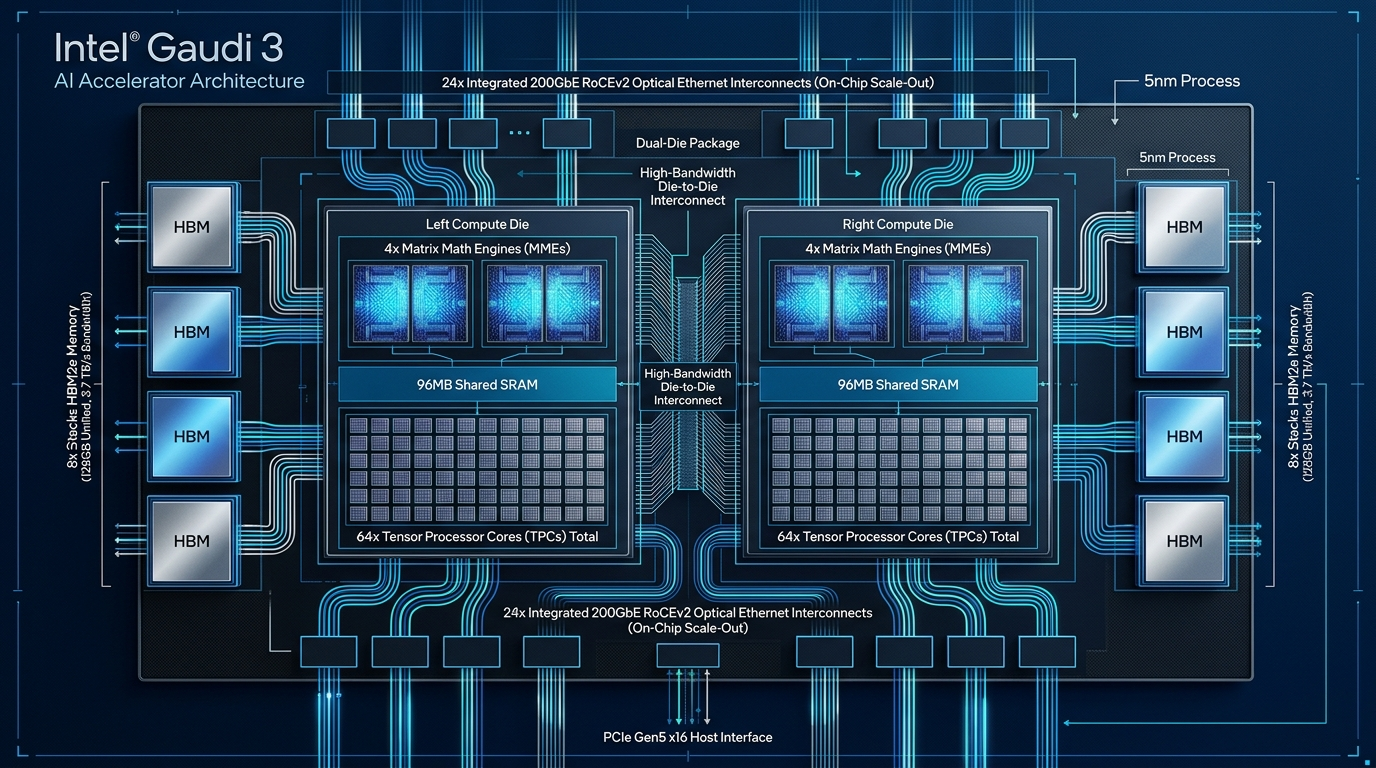
Intel Gaudi 3 Silicon Architecture Blueprint:
+------------------------------------------------------------------------------------+
| INTEL GAUDI 3 ACCELERATOR (TSMC 5nm Dual-Die Package, Up to 900W OAM)              |
+------------------------------------------------------------------------------------+
|                                                                                    |
|  +-------------------------------------+  +-------------------------------------+  |
|  | LEFT COMPUTE DIE (TSMC 5nm)         |  | RIGHT COMPUTE DIE (TSMC 5nm)        |  |
|  | - 4x Matrix Math Engines (MMEs)     |  | - 4x Matrix Math Engines (MMEs)     |  |
|  | - 32x VLIW SIMD Tensor Cores (TPCs) |  | - 32x VLIW SIMD Tensor Cores (TPCs) |  |
|  | - 48 MB Shared On-Chip SRAM Cache   |  | - 48 MB Shared On-Chip SRAM Cache   |  |
|  | - 12x 200GbE RoCEv2 Integrated NICs |  | - 12x 200GbE RoCEv2 Integrated NICs |  |
|  +-------------------------------------+  +-------------------------------------+  |
|                   ||                                         ||                    |
|  ================================================================================  |
|  High-Bandwidth Die-to-Die Interconnect (Seamless Unified Computing Substrate)     |
|  ================================================================================  |
|                   ||                                         ||                    |
|  +-------------------------------------+  +-------------------------------------+  |
|  | EIGHT HBM2e MEMORY STACKS - 128 GB TOTAL CAPACITY (3.7 TB/s PEAK BANDWIDTH)     |  |
|  +---------------------------------------------------------------------------------+  |
|                                                                                    |
|  +------------------------------------------------------------------------------+  |
|  | 24x INTEGRATED 200GbE RoCEv2 PORTS (4.8 Tbps TOTAL BIDIRECTIONAL BANDWIDTH)   |  |
|  | - 21 Links: All-to-All Scale-Up Mesh within 8-Accelerator Server Chassis     |  |
|  | - 3 Links: Direct Scale-Out to Standard Top-of-Rack Datacenter Ethernet       |  |
|  +------------------------------------------------------------------------------+  |
+------------------------------------------------------------------------------------+ 1. Dual-Die Packaging with 128 GB HBM2e
Manufactured on TSMC’s 5nm process node, Gaudi 3 unites two symmetric compute dies into a single high-performance package:
- Unified Compute Fabric: The two compute dies communicate across an ultra-high-bandwidth die-to-die interconnect, presenting a single coherent accelerator memory space to software runtimes.
- 128 GB HBM2e Memory: Integrates eight 16 GB HBM2e memory stacks providing 3.7 TB/s of peak memory bandwidth, doubling the capacity and bandwidth of Gaudi 2.
- 96 MB On-Die SRAM: Distributed across both dies (48 MB per die), this low-latency scratchpad memory delivers tens of terabytes per second of local bandwidth, caching intermediate activation tensors and keeping the arithmetic units saturated.
2. Native On-Chip Standard Ethernet (24x 200GbE RoCEv2)
The most transformative engineering feature of Gaudi 3 is its integrated networking:
- Each Gaudi 3 accelerator integrates 24 dedicated 200 Gigabit Ethernet (200GbE) RDMA-over-Converged-Ethernet (RoCEv2) ports directly onto the silicon die.
- 4.8 Terabits per Second (Tbps): Delivers 4.8 Tbps of aggregate bidirectional networking throughput per chip, completely eliminating external PCIe network interface cards.
- Open Datacenter Optics: Networking scales out using standard, cost-effective Ethernet switches (from Arista, Cisco, and Juniper) and standard QSFP-DD/OSFP optical transceivers, freeing datacenter operators from proprietary interconnect monopolies.
3. Up to 40% Better Price-Performance
By eliminating proprietary interconnect licensing fees and optimizing silicon area for deep learning primitives, Gaudi 3 delivers compelling economics:
- Delivers up to 1,835 TFLOPS of FP8 matrix compute and 918 TFLOPS of BF16 compute per accelerator.
- Demonstrates up to 40% better price-performance compared to NVIDIA H100 clusters across popular foundation model workloads, including LLaMA-2/3 70B and Falcon 180B training and inference.
Deep Dive: TPC, MME, and Integrated RoCEv2 Networking
To appreciate how Gaudi 3 achieves its high computational throughput and linear scaling efficiency, we examine the microarchitecture of its two compute engines and its networking topology.
1. Dual Compute Engines: TPCs and MMEs
Gaudi 3 decouples dense linear algebra from non-linear operations by implementing two specialized computing engines:
Gaudi 3 Compute Unit Dual-Engine Organization:
+------------------------------------------------------------------------------------+
| GAUDI 3 COMPUTE ENGINE TOPOLOGY (64 TPCs + 8 MMEs TOTAL)                           |
+------------------------------------------------------------------------------------+
|                                                                                    |
|  +------------------------------------------------------------------------------+  |
|  | 8x MATRIX MATH ENGINES (MMEs) - 4 MMEs PER DIE                               |  |
|  | - Massive 256x256 Matrix Multiplication Systolic Arrays                      |  |
|  | - Native Hardware Support: FP8 (E4M3 & E5M2), BFLOAT16, FP16, INT8, TF32    |  |
|  | - Computes Dense GEMMs, Projections, and Fully-Connected Layers              |  |
|  +------------------------------------------------------------------------------+  |
|                                        ^                                           |
|                                        | Ultra-Fast 96MB Shared On-Chip SRAM       |
|                                        v                                           |
|  +------------------------------------------------------------------------------+  |
|  | 64x TENSOR PROCESSOR CORES (TPCs) - 32 TPCs PER DIE                          |  |
|  | - Fully Programmable Very Long Instruction Word (VLIW) SIMD Processors      |  |
|  | - 2048-bit Vector Registers & Wide ALU Execution Units                      |  |
|  | - Specialized Transcendental Functions: GELU, SiLU, Softmax, LayerNorm, RoPE|  |
|  +------------------------------------------------------------------------------+  |
|                                                                                    |
+------------------------------------------------------------------------------------+ - Matrix Math Engines (MMEs): 8 massive hardware matrix accelerators (4 per die) dedicated exclusively to outer-product matrix multiply-accumulate operations. The MMEs execute large-scale 256x256 GEMMs in hardware, delivering up to 1,835 TFLOPS in FP8 precision.
- Tensor Processor Cores (TPCs): 64 fully programmable VLIW SIMD processors (32 per die). Each TPC features a 2048-bit vector datapath capable of executing non-GEMM operations concurrently: activation functions, normalization layers, softmax reductions, and rotary embeddings. Because TPCs are fully programmable in C++, custom operators can be written directly without waiting for microcode updates.
2. Supported Numerical Precision Formats
Gaudi 3 supports all modern floating-point and integer formats used across foundation model training and inference pipelines:
| Precision Format | Dedicated Compute Engine | Peak Compute Throughput | Primary Workload Target |
|---|---|---|---|
| FP8 (E4M3 & E5M2) | Matrix Math Engine (MME) | 1,835 TFLOPS (1.84 PFLOPS) | High-Throughput Serving & Low-Cost Training |
| BFLOAT16 / FP16 | Matrix Math Engine (MME) | 918 TFLOPS | Standard LLM Pre-training & Fine-tuning |
| TF32 (TensorFloat) | Matrix Math Engine (MME) | 459 TFLOPS | High-Precision Deep Learning Without Code Tuning |
| INT8 Integer | Matrix Math Engine (MME) | 1,835 TOPS | Quantized Embedding Lookups & Vision Models |
| FP32 Vector | Tensor Processor Core (TPC) | 115 TFLOPS | LayerNorm, Softmax, RoPE Positional Encoding |
4. Microarchitecture of the VLIW SIMD Tensor Processor Core (TPC)
Each of the 64 Tensor Processor Cores (TPCs) on Gaudi 3 is a custom, fully programmable Very Long Instruction Word (VLIW) SIMD processor. Unlike standard GPU streaming multiprocessors that rely on complex hardware warp schedulers and scoreboard logic to execute single-instruction multiple-thread (SIMT) code, the TPC shifts scheduling complexity to the SynapseAI static compiler:
- 2048-Bit Vector Datapath: Each TPC features a massive 2048-bit wide vector datapath, operating on 128 parallel 16-bit elements (BFLOAT16 or FP16) or 256 parallel 8-bit elements (FP8 or INT8) in a single clock cycle.
- VLIW Instruction Bundling: In every clock cycle, the TPC issues a wide instruction bundle containing multiple concurrent operations: a vector ALU operation, a scalar arithmetic instruction, an address calculation, a vector load, and a vector store. Because the compiler bundles instructions statically, the execution pipeline achieves peak functional unit utilization with zero dynamic branch hazard penalties.
- Specialized Activation Units: The TPC contains dedicated hardware functional units for computing mathematical approximations of transcendental functions: hyperbolic tangent (
tanh), exponential (exp), reciprocal square root (rsqrt), and error functions (erf). These allow Gaudi 3 to execute activation functions like GELU and SwiGLU at full vector throughput without precision loss. - Programmability and C++ Kernel Authoring: Developers are not restricted to vendor-supplied closed libraries. Using the TPC C Language, developers can implement novel custom operations—such as custom speculative decoding verification masks, selective state-space scans, or proprietary quantization scales—and compile them directly into native TPC machine code.
3. Integrated Scale-Up and Scale-Out Networking Topology
Traditional multi-accelerator nodes use different technologies for inter-GPU communication (scale-up) versus inter-server communication (scale-out). Gaudi 3 unifies both under standard 200GbE RoCEv2:
8-Accelerator Gaudi 3 Baseboard (HLB-325) Interconnect Topology:
┌────────────────────────────────────────────────────────────────────────┐
│ HLB-325 UNIVERSAL BASEBOARD: 8x INTEL GAUDI 3 ACCELERATORS             │
│                                                                        │
│   Each Gaudi 3 features 24x 200GbE on-chip links:                      │
│   - 21 Links: Dedicated internal all-to-all mesh (3 links to each peer)│
│   - 3 Links: Routed directly to external OSFP/QSFP-DD bracket ports    │
│                                                                        │
│        [Gaudi 3 #0] <======= 600 Gbps xGMI =======> [Gaudi 3 #1]       │
│             ||                                           ||            │
│       600 Gbps All-to-All Full Internal Mesh Mesh (21 links/chip)      │
│             ||                                           ||            │
│        [Gaudi 3 #6] <======= 600 Gbps xGMI =======> [Gaudi 3 #7]       │
│             |                                             |            │
│             +--------------> 24x 200GbE Ports <-----------+            │
│                                    |                                   │
│                                    v                                   │
│                  Direct to Standard Ethernet Spine Switch              │
│               (Scales to tens of thousands of chips seamlessly)        │
└────────────────────────────────────────────────────────────────────────┘ - Scale-Up (Within Node): Within an 8-accelerator baseboard (HLB-325), 21 of the 24 RoCEv2 links on each chip connect in a non-blocking all-to-all mesh to the other 7 accelerators (3 dedicated 200GbE links per peer pair, delivering 600 Gbps bidirectional bandwidth between any two chips).
- Scale-Out (Across Nodes): The remaining 3 links per chip (totaling 24x 200GbE ports per 8-accelerator server) route directly to external OSFP or QSFP-DD connectors on the server chassis.
- Switchless Sub-Clusters: Clusters can scale directly across server chassis using standard, off-the-shelf Ethernet switches, completely bypassing expensive proprietary InfiniBand directors.
Production Implementation: PyTorch, SynapseAI & vLLM on Intel Gaudi 3
Software on Intel Gaudi 3 is orchestrated through Intel Habana SynapseAI, an enterprise-grade compiler and runtime suite designed to integrate natively with PyTorch, Hugging Face Optimum Habana, and vLLM.
Intel Habana SynapseAI Software Stack:
+-----------------------------------------------------------------------------------+
| APPLICATION LAYER: Hugging Face, PyTorch, vLLM, DeepSpeed, Ray                    |
+-----------------------------------------------------------------------------------+
                                         |
+-----------------------------------------------------------------------------------+
| OPTIMUM HABANA: Hugging Face Native Accelerations for Gaudi Hardware              |
| - Pre-optimized pipelines for LLaMA-3, Mistral, Qwen, Stable Diffusion            |
+-----------------------------------------------------------------------------------+
                                         |
+-----------------------------------------------------------------------------------+
| HABANA PYTORCH PLUGIN (`habana_frameworks.torch`): Graph Tracing & Lazy Mode      |
| - PyTorch C++ bindings, memory allocators, and collective communication (HCCL)    |
+-----------------------------------------------------------------------------------+
                                         |
+-----------------------------------------------------------------------------------+
| SYNAPSEAI GRAPH COMPILER: Whole-Graph Optimization, Kernel Fusion & TPC Codegen   |
| - Automatic MME tile scheduling, SRAM layout planning, and DMA pipelining        |
+-----------------------------------------------------------------------------------+
                                         |
+-----------------------------------------------------------------------------------+
| HARDWARE SILICON: Intel Gaudi 3 OAM / PCIe Accelerators (TSMC 5nm)                |
+-----------------------------------------------------------------------------------+ 1. Launching the Production vLLM Container
Intel and the open-source community maintain official vLLM containers optimized specifically for Gaudi 3 hardware:
# ============================================================================
# Script: launch_gaudi3_vllm_service.sh
# Description: Initialize SynapseAI runtime and deploy vLLM on Intel Gaudi 3
# ============================================================================

docker run -d --name gaudi3-vllm-service --network host --ipc=host --device=/dev/hl0 --device=/dev/hl_control --cap-add=SYS_PTRACE --security-opt seccomp=unconfined -v /data/models:/root/.cache/huggingface -v /data/logs:/workspace/logs -e HABANA_VISIBLE_DEVICES=all -e VLLM_PROMPT_SEQ_BUCKET_STEP=16384 -e VLLM_ENGINE_ITERATION_TIMEOUT_S=120 vault.habana.ai/gaudi-docker/1.18.0/ubuntu22.04/habanalabs/pytorch-installer-2.4.0:latest vllm serve meta-llama/Llama-3.1-70B-Instruct --host 0.0.0.0 --port 8000 --tensor-parallel-size 8 --dtype bfloat16 --max-model-len 32768 --block-size 32 --enable-chunked-prefill 2. Native Distributed PyTorch Training on Gaudi 3
Training on Gaudi 3 uses standard PyTorch APIs combined with the habana_frameworks.torch plugin, executing distributed data-parallel and FSDP models:
# ============================================================================
# File: train_llama_gaudi3.py
# Description: Distributed Training Loop with PyTorch on Intel Gaudi 3
# ============================================================================

import os
import torch
import torch.nn as nn
import habana_frameworks.torch.core as htcore
import habana_frameworks.torch.distributed.hccl as hccl

def train_gaudi3_distributed():
    # 1. Initialize Habana Collective Communication Library (HCCL)
    hccl.initialize_distributed_hpu()
    device = torch.device("hpu")
    rank = int(os.environ.get("RANK", 0))
    world_size = int(os.environ.get("WORLD_SIZE", 1))

    print(f"[Rank {rank}/{world_size}] Initialized Gaudi 3 on HPU device: {device}")

    # 2. Build Model Architecture
    model = nn.Sequential(
        nn.Linear(8192, 16384, bias=False),
        nn.GELU(),
        nn.Linear(16384, 8192, bias=False)
    ).to(device)

    # Wrap model with DistributedDataParallel for HPU
    model = torch.nn.parallel.DistributedDataParallel(model)

    optimizer = torch.optim.AdamW(model.parameters(), lr=1e-4)
    loss_fn = nn.CrossEntropyLoss()

    # 3. Training Loop with SynapseAI Graph Compilation
    for step in range(5):
        optimizer.zero_grad()

        # Input tensors reside in 128GB HBM2e memory
        inputs = torch.randn(64, 8192, device=device, dtype=torch.bfloat16)
        targets = torch.randint(0, 8192, (64,), device=device)

        outputs = model(inputs)
        loss = loss_fn(outputs, targets)
        loss.backward()

        # htcore.mark_step demarcates execution boundaries in SynapseAI lazy mode,
        # triggering fused MME matrix execution and 200GbE RoCEv2 gradient all-reduce
        htcore.mark_step()
        optimizer.step()
        htcore.mark_step()

        if rank == 0:
            print(f"Step {step + 1} completed | Loss: {loss.item():.4f}")

if __name__ == "__main__":
train_gaudi3_distributed() 4. Hugging Face Optimum Habana and Native Transformer Acceleration
For enterprise teams deploying open-weights models from the Hugging Face Hub, Intel and Hugging Face co-develop Optimum Habana (optimum-habana):
- Zero-Code-Change Model Migration: Optimum Habana provides drop-in replacements for standard Hugging Face classes (
GaudiTrainer,GaudiSeq2SeqTrainer, andGaudiConfig), enabling models like LLaMA-3, Mistral, and Qwen to execute on Gaudi 3 with minimal code adjustments. - Fused Attention and KV Caching: Optimum Habana injects pre-compiled SynapseAI operators for FlashAttention-2, rotary positional embeddings (RoPE), and fused RMSNorm directly into model forward passes, eliminating Python overhead.
- Automated FP8 Quantization via AutoFP8: Integrates with Intel Neural Compressor to automatically calibrate and quantize model weights and activations into native FP8 (E4M3/E5M2) representations, doubling inference throughput while preserving perplexity scores within 0.1% of baseline BF16 accuracy.
3. Writing Custom Kernels with the TPC C Language
For performance engineers developing proprietary operators, Habana provides the TPC C Language—a specialized C/C++ dialect that compiles directly to VLIW vector instructions:
// ============================================================================
// File: tpc_gelu_kernel.c
// Description: Custom Vector GELU Activation Kernel for Gaudi 3 TPC Engines
// ============================================================================

#include <tpc_intrinsics.h>

void main(tensor input, tensor output) {
    // 2048-bit wide vector datapath (holds 128 BFLOAT16 elements per vector lane)
    int512 coords = get_node_coords();
    bfloat128 in_vec = v_bfloat128_mov_ld_tnsr(coords, input);

    // Constant scalar coefficients for polynomial approximation
    bfloat128 half_vec = 0.5f;
    bfloat128 sqrt_2_rpi = 0.79788456f; // sqrt(2/pi)
    bfloat128 coeff = 0.044715f;

    // Fused vector arithmetic executed on TPC vector ALU
    bfloat128 x_cube = v_bfloat128_mul_b(in_vec, v_bfloat128_mul_b(in_vec, in_vec));
    bfloat128 inner = v_bfloat128_add_b(in_vec, v_bfloat128_mul_b(coeff, x_cube));
    bfloat128 tanh_arg = v_bfloat128_mul_b(sqrt_2_rpi, inner);
    bfloat128 tanh_out = v_bfloat128_tanh_b(tanh_arg);
    bfloat128 gelu_out = v_bfloat128_mul_b(v_bfloat128_mul_b(half_vec, in_vec),
                                           v_bfloat128_add_b(1.0f, tanh_out));

    // Store result directly into destination tensor in on-die SRAM
    v_bfloat128_mov_st_tnsr(coords, output, gelu_out);
} Architectural Comparison: Intel Gaudi 3 vs. NVIDIA H100 SXM5
To evaluate where Intel Gaudi 3 stands in the enterprise datacenter, we compare its key hardware metrics against the NVIDIA H100 SXM5:
+----------------------------------------------------------------------------------------------------+
| DATACENTER ACCELERATOR HEAD-TO-HEAD COMPARISON (SINGLE ACCELERATOR MODULE)                         |
+----------------------------------------------------------------------------------------------------+
| Feature Dimension             | NVIDIA H100 SXM5       | Intel Gaudi 3 (HL-325L OAM)               |
+-------------------------------+------------------------+-------------------------------------------+
| Compute Architecture          | Hopper (4N TSMC)       | Gaudi 3 (Dual-Die 5nm TSMC)               |
| Arithmetic Units              | 132 SMs (528 TensorC)  | 64 VLIW TPCs + 8 Matrix Engines (MMEs)    |
| Dense FP8 Matrix Compute      | 1,979 TFLOPS           | 1,835 TFLOPS                              |
| Dense BF16 / FP16 Compute     | 989.5 TFLOPS           | 918 TFLOPS                                |
| On-Die SRAM Cache             | 50 MB L2 Cache         | 96 MB Shared SRAM                         |
| High-Bandwidth Memory (HBM)   | 80 GB HBM3             | 128 GB HBM2e (1.6x Capacity Advantage)    |
| Peak Memory Bandwidth         | 3.35 TB/s              | 3.7 TB/s (10% Higher Bandwidth)           |
| Integrated Scale-Out Network  | None (Requires PCIe NIC| 24x 200GbE RoCEv2 Direct On-Chip (4.8 Tbps)|
| Multi-Node Networking Fabric  | InfiniBand / RoCE NICs | Standard Datacenter Ethernet Switches     |
| Thermal Power Envelope (TDP)  | 700 W                  | 750 W Air / Up to 900 W Liquid            |
| Price-Performance Advantage   | Proprietary Baseline   | Up to 40% Better Price-Performance        |
+----------------------------------------------------------------------------------------------------+ 2. Total Cost of Ownership and Datacenter Economics
Beyond raw chip-to-chip benchmarks, the financial advantage of Intel Gaudi 3 emerges at the cluster infrastructure level:
- The Ethernet Cost Advantage: Proprietary GPU clusters require specialized InfiniBand host channel adapters (HCAs), proprietary multi-tier optical director switches, and vendor-locked optical transceivers that cost up to $1,500 to $2,000 per port. Gaudi 3 integrates 24x 200GbE ports directly onto the silicon die, connecting to standard enterprise Ethernet switches (such as 400G or 800G Arista and Cisco platforms) using commodity optical modules.
- Network Capex Reduction: In a cluster of 8,192 accelerators, eliminating proprietary external NICs and InfiniBand directors slashes total cluster networking capital expenditure by up to 60% to 70%, representing tens of millions of dollars in direct capital savings.
- Unified Fabric Management: Datacenter network engineering teams manage Gaudi 3 clusters using standard Ethernet telemetry, BGP routing, and RoCEv2 priority flow control (PFC) protocols, avoiding the need for specialized proprietary fabric administrators.
1. Key Architectural Takeaways
3. Memory Capacity and Bandwidth Advantages
- 128 GB vs. 80 GB: Gaudi 3 provides 60% more high-bandwidth memory than an 80 GB H100. This capacity allows hosting larger model checkpoints, expanding context lengths from 8k to 32k tokens, and fitting deeper batch queues before running out of memory.
- 3.7 TB/s vs. 3.35 TB/s: Gaudi 3 delivers 10% higher raw memory bandwidth, providing higher sustained token generation speeds during memory-bound autoregressive decoding.
4. The Open Ethernet Superpower
- While NVIDIA clusters require proprietary NVLink switches for scale-up and expensive InfiniBand adapters for scale-out, Gaudi 3 uses standard 200GbE RoCEv2 everywhere.
- Networking is integrated directly onto the compute die: 21 links handle non-blocking intra-node communication, while 3 links per chip route directly to standard Ethernet switches. This eliminates the multi-million-dollar proprietary switch tax in large datacenter clusters.
5. Floating-Point Density Parity
- Gaudi 3 delivers 1,835 TFLOPS in FP8 and 918 TFLOPS in BF16, sitting within 7% of H100 floating-point density while selling at a significantly lower hardware price point.
Production Deployment & Enterprise Scaling
Deploying Intel Gaudi 3 in enterprise production environments requires understanding server baseboards, cluster topologies, power standards, and telemetry monitoring.
1. The HLB-325 8-Accelerator Server Chassis
The standard enterprise deployment unit for Gaudi 3 is the HLB-325 Universal Baseboard (UBB):
- Integrates 8 Intel Gaudi 3 OAM accelerators (HL-325L) delivering 1.024 Terabytes of HBM2e memory and 29.6 TB/s of aggregate memory bandwidth.
- Delivers up to 14.6 Petaflops of FP8 compute and 7.3 Petaflops of BF16 compute in a single server chassis.
- Features 24 OSFP scale-out ports directly on the server bracket, providing 4.8 Tbps of standard Ethernet networking to the datacenter spine.
Intel Gaudi 3 Cluster Scaling Topology:
┌────────────────────────────────────────────────────────────────────────┐
│ 1. Accelerator Tier: Intel Gaudi 3 OAM (128 GB HBM2e, 24x 200GbE)      │
├────────────────────────────────────────────────────────────────────────┤
│ 2. Server Node Tier: HLB-325 8-OAM Chassis (1.024 TB HBM2e, 14.6 PFLOPS)│
│ - 8 Accelerators connected via 21 RoCEv2 links in all-to-all mesh      │
│ - 24 external 200GbE ports routed directly to datacenter switches      │
├────────────────────────────────────────────────────────────────────────┤
│ 3. Supercomputing Cluster Tier: Megawatt Pods (1,024 to 8,192 Chips)   │
│ - Pure standard Ethernet spine-leaf topology; zero InfiniBand switches │
│ - Delivering enterprise AI training at up to 40% lower TCO             │
└────────────────────────────────────────────────────────────────────────┘ 2. Facilities Planning: Power Delivery and Cooling
Operating Gaudi 3 clusters requires planning for power distribution and cooling:
- Air Cooling (750W TDP): Standard enterprise datacenters can deploy air-cooled 8-OAM servers in standard 4U chassis with high-static-pressure fans, avoiding facility liquid plumbing overhauls.
- Liquid Cooling (900W TDP): Hyperscale datacenters utilizing facility water loops can deploy liquid cold-plate configurations, unlocking sustained higher clock frequencies and maximum arithmetic density.
3. Monitoring Health and Telemetry with hl-smi
Managing Gaudi 3 clusters in production uses the Habana System Management Interface (hl-smi):
- Monitor real-time telemetry:
# Check GPU utilization, temperatures, and power draw hl-smi --query-aip=index,name,utilization.aip,temperature.aip,power.draw --format=csv - Prometheus and Grafana exporters capture:
- MME & TPC Engine Utilization: Ensure matrix engines maintain $>75%$ duty cycles during prefill and decoding phases.
- RoCEv2 Port Counters: Monitor packet throughput and detect pause frame storms on 200GbE interfaces.
- HBM2e Allocation: Track PagedAttention KV cache block consumption to optimize concurrent batch sizes.
4. Summary and Strategic Roadmap
Intel Gaudi 3 is a formidable, cost-effective alternative to commercial GPU monopolies. By integrating 64 VLIW TPC vector cores, 8 Matrix Math Engines, 128 GB of HBM2e, and 24 on-chip 200GbE RoCEv2 networking ports, Habana Labs has proved that standard Ethernet can power the largest AI clusters in the world. Furthermore, by eliminating the need for separate host network interface cards and specialized optical directors, Gaudi 3 establishes a streamlined datacenter architecture that dramatically reduces cabling complexity, lowers maintenance failure surfaces, and provides predictable, deterministic network scaling across tens of thousands of compute nodes.
For enterprise software engineering organizations, foundation model builders, and datacenter architects seeking to slash training expenditures, avoid proprietary networking lock-in, and deploy high-throughput generative AI with vLLM, Intel Gaudi 3 delivers the computational density, open standards, and production maturity required for modern artificial intelligence infrastructure.