Inside aiFetchly Workspace Memory: Auto-Dream Architecture
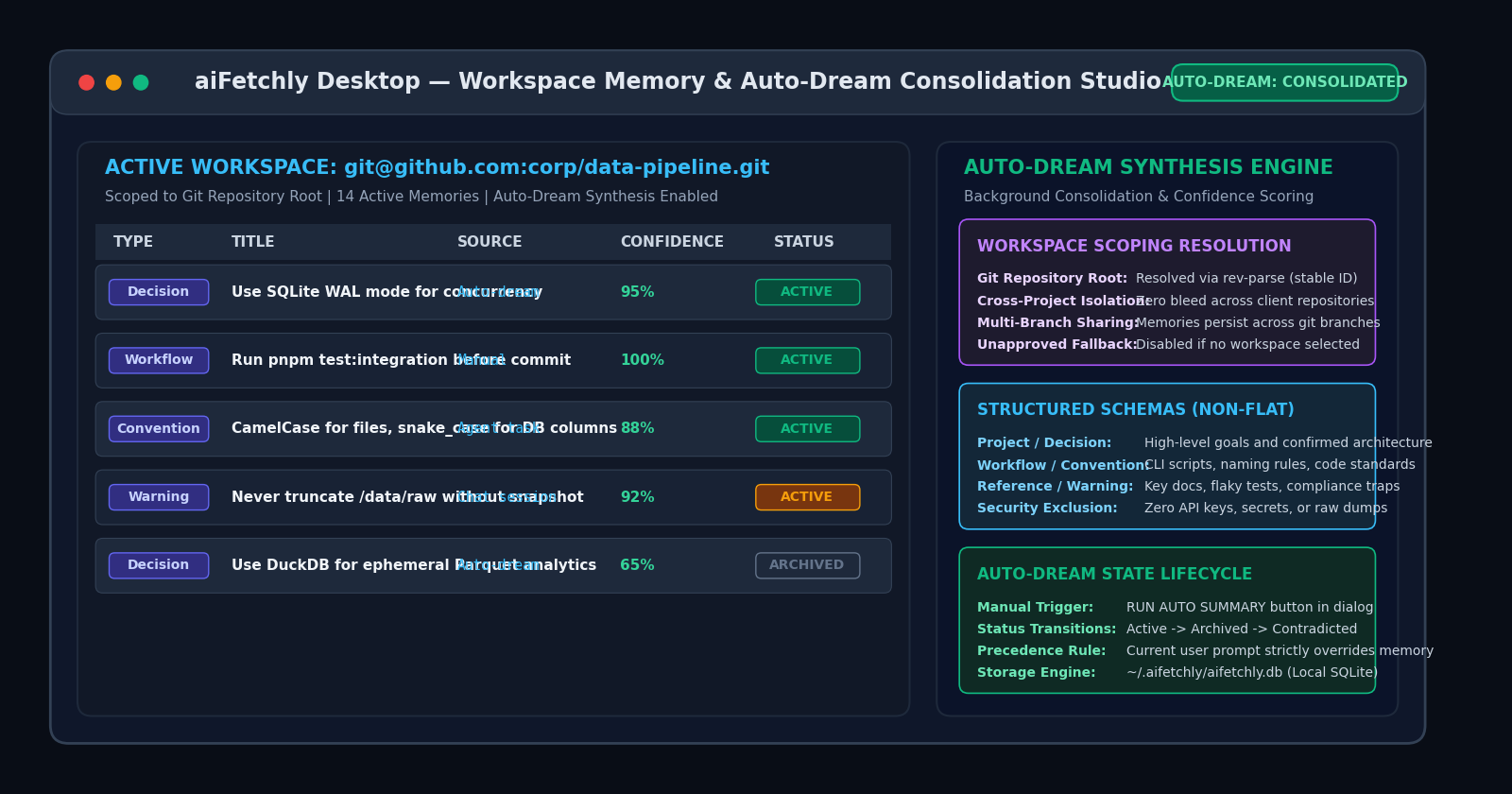
Beyond Ephemeral Chat: The Need for Structured Project Memory
Developers deploying autonomous AI agents on complex engineering codebases face a persistent memory challenge. Standard LLM sessions are inherently stateless: every fresh chat requires re-explaining architectural boundaries, custom CLI test runners, naming conventions, and compliance rules.
Conversely, naive global memory models introduce severe risks: instructions from one client repository bleed into another, while flat text notes rapidly accumulate contradictory guidelines that degrade model reasoning.
AI Fetchly resolves this context dilemma with native Workspace Memory. By anchoring durable project context to local repository roots and automating state synthesis through Workspace Auto-Summary (internally designated as Auto-Dream), aiFetchly delivers persistent, project-isolated intelligence across sessions.
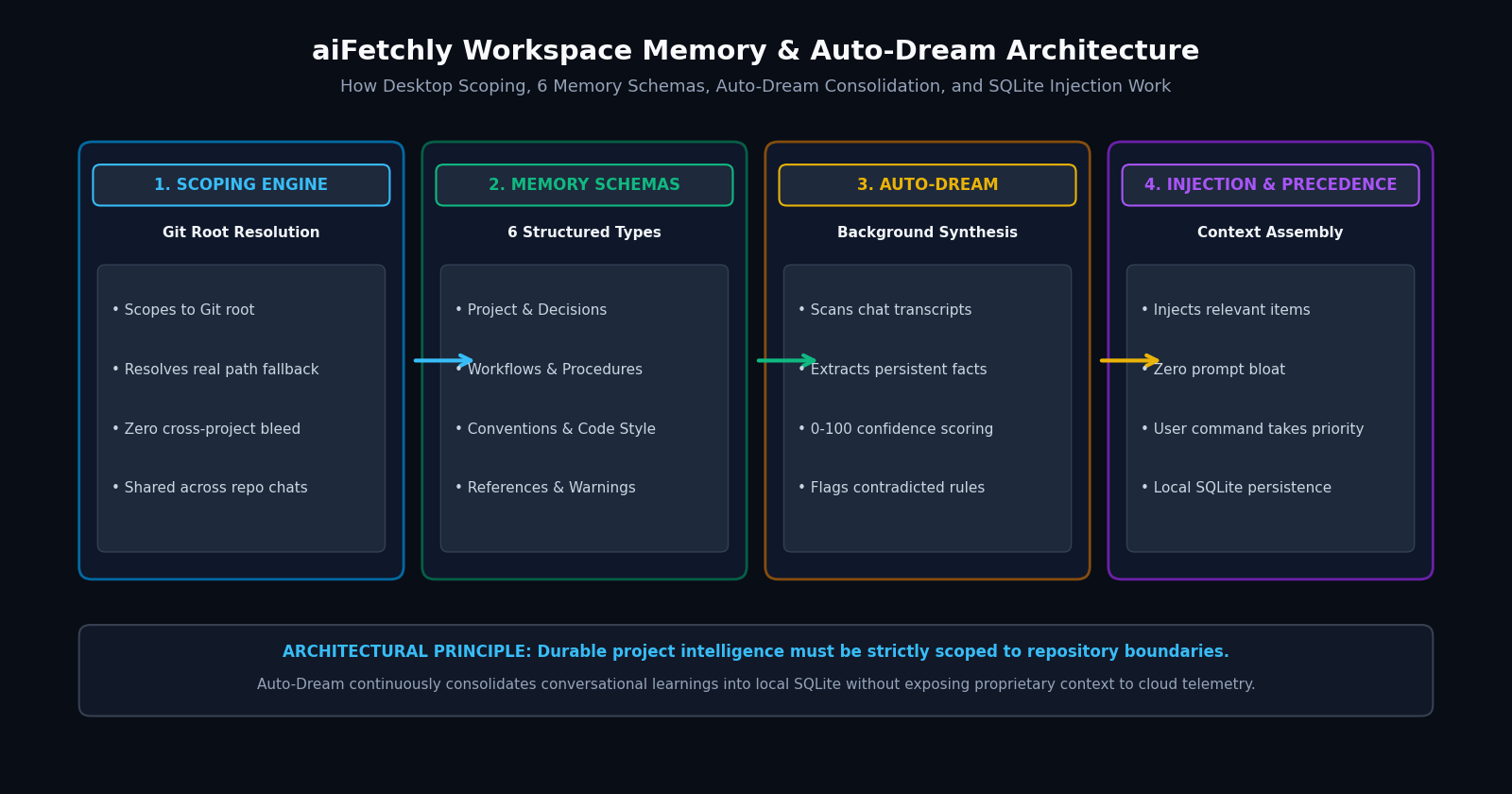
1. Deterministic Scoping via Git Root Resolution
Workspace Memory operates strictly within an approved project directory. When you bind a workspace above the composer, aiFetchly resolves the directory path against the local filesystem:
- Git Repository Scoping: If the selected folder resides inside a Git tree, memory automatically binds to the repository root. This ensures that subdirectories, feature branches, and separate terminal tabs within the same repository share a unified memory pool.
- Strict Boundary Isolation: Memory records associated with
repo-aare never injected intorepo-b, completely eliminating cross-client context leakage. - Zero-Unapproved Fallback: If no workspace is selected, the memory subsystem remains dormant, ensuring unvetted scripts cannot query persistent stores.
2. Six Structured Schemas: Non-Flat Memory Types
Rather than dumping unstructured conversation strings into model prompts, Workspace Memory categorizes intelligence into six specialized types:
- Project: High-level milestones and product context not obvious from source files.
- Decision: Explicitly approved technical choices (e.g., “Use SQLite in WAL mode for scraping concurrency”).
- Workflow: Verified CLI commands, build targets, and testing sequences.
- Convention: Naming standards, linting guidelines, and code style rules.
- Reference: Pointers to local specs, design docs, or external documentation endpoints.
- Warning: Critical traps, restricted operations, and flaky test flags.
To protect security, the memory store strictly bans sensitive credentials, API keys, raw file dumps, and private lead data.
3. Inside Auto-Dream: Autonomous State Consolidation
While developers can manually create memories, the core innovation lies in Workspace Auto-Summary (Auto-Dream). Running in the background or triggered manually via RUN AUTO SUMMARY, the engine reviews recent conversation turns and agent task logs:
- Fact Synthesis: Distills lengthy debugging trajectories into concise, durable guidelines.
- Confidence Scoring (0–100): Evaluates statement permanence; verified user confirmations receive higher confidence than speculative model deductions.
- Lifecycle Transitions: Automatically flags superseded guidelines as Contradicted or Archived, keeping the active memory pool lean.
4. Context Injection and Precedence Hierarchy
Stored memories commit to local SQLite (~/.aifetchly/aifetchly.db). During interactive sessions, aiFetchly dynamically injects relevant active memories into the system prompt. Crucially, your live user prompt always takes strict precedence: if current instructions conflict with historical memory, the agent respects real-time direction.
By pairing repository scoping with autonomous Auto-Dream consolidation, aiFetchly ensures AI assistants grow smarter with every commit.
Explore memory configuration settings in the AI Fetchly Docs.
Visual Generation Prompts
Hero Image Prompt:Modern dark-mode SaaS developer dashboard showing the aiFetchly Workspace Memory Studio, displaying an active Git repository scope badge, a structured memory table with Type badges (Decision, Workflow, Warning), 0-100% confidence scores, and a glowing green ‘Auto-Dream: Consolidated’ status pill, sleek isometric 3D perspective, slate-900 background with cyan and emerald neon accents.Body Image Prompt:High-resolution technical pipeline flowchart illustrating the aiFetchly Workspace Memory Architecture: Git Root Scoping (rev-parse resolution), 6 Structured Schemas (Project, Decision, Workflow, Convention, Reference, Warning), Auto-Dream Synthesis Engine (background transcript analysis and confidence scoring), and Local SQLite Injection with User Precedence gating, clean dark vector blueprint styling.