Inside aiFetchly Knowledge Library: Local Vector RAG Guide
Grounding Autonomous AI in Proprietary Facts
Generic generative AI models frequently stumble when answering queries regarding company-specific pricing structures, technical API specifications, or contractual nuances. Because large models are trained on generalized web corpora, prompting them about proprietary workflows often produces believable hallucinations or bland platitudes.
Cloud-based vector databases solve retrieval but introduce steep privacy risks: enterprise teams are understandably hesitant to upload unredacted contracts, pitch decks, and internal proposals to third-party cloud vector stores.
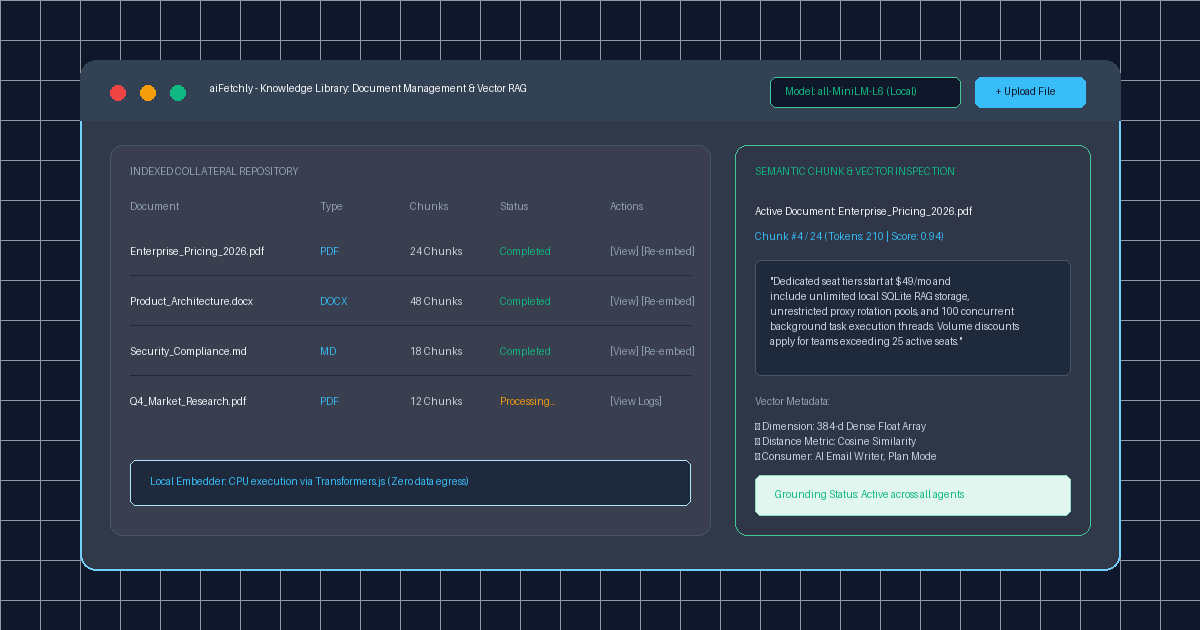
AI Fetchly resolves this architectural tension through its native Knowledge Library. Operating as a local-first Retrieval-Augmented Generation (RAG) engine, it ingests multi-format enterprise collateral, generates vector embeddings directly on your machine’s CPU, and indexes semantic chunks in an encrypted local database.
Multi-Format Ingestion and Four-Stage Processing
The Knowledge Library natively supports the primary formats used in corporate documentation:
| Format Category | Supported Extensions | Optimal Document Types |
|---|---|---|
| Adobe PDF | .pdf | Whitepapers, audited reports, brochures |
| Microsoft Word | .doc, .docx | Sales proposals, SLA contracts, product briefs |
| Markdown | .md | Technical READMEs, API guides, engineering notes |
| Plain Text | .txt | Meeting logs, prompt templates, raw notes |
| Web Content | .html, .htm | Downloaded articles, partner documentation |
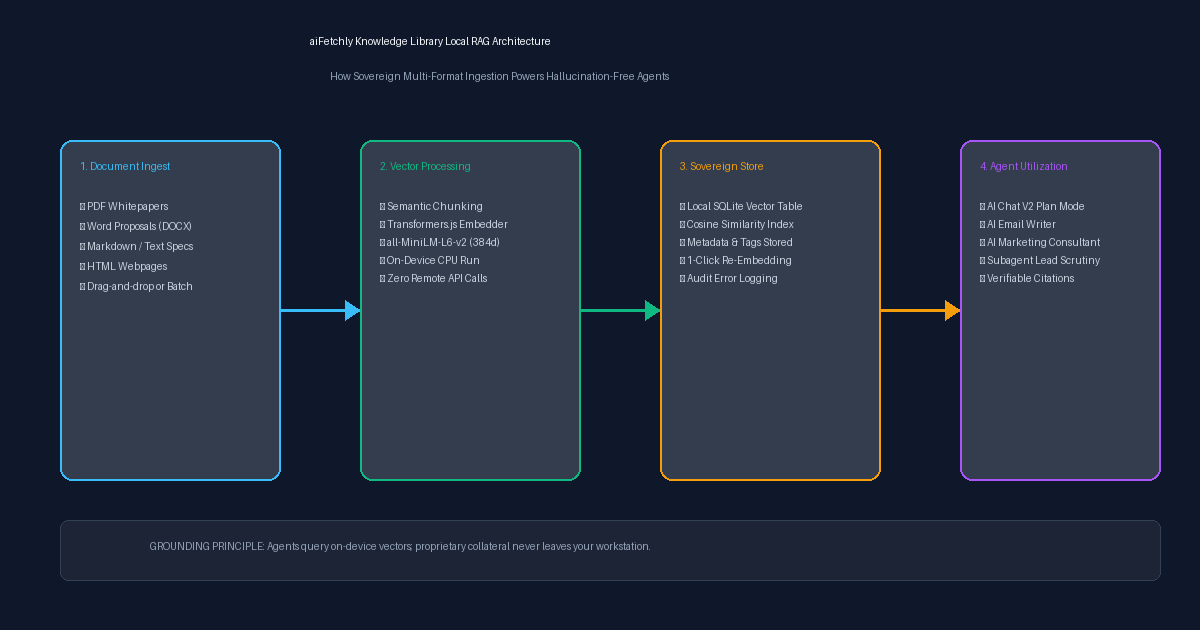
When a file is uploaded via drag-and-drop, it advances through an automated four-stage pipeline:
- Saving: File content is parsed and registered in local SQLite storage.
- Semantic Chunking: Text is split into optimal semantic segments (balancing context completeness against token density).
- Vector Embedding: High-dimensional mathematical representations are generated to capture semantic intent.
- Completed: Status transitions to green, immediately enabling the document across all desktop agent surfaces.
Sovereign Embeddings: On-Device CPU Vectorization
A standout architectural advantage of aiFetchly is its support for Local Embedding Models.
Rather than transmitting proprietary documents over HTTP to external embedding APIs, aiFetchly runs Xenova/all-MiniLM-L6-v2 directly on your workstation CPU using Transformers.js:
- Zero Data Egress: Text never leaves your device during chunk vectorization.
- Cost-Free Indexing: Generate millions of vector representations without incurring third-party API token fees.
- Offline Reliability: Fully functional in air-gapped environments once the local model weights are cached.
For teams requiring multilingual retrieval across diverse international markets, users can alternate with 1024-dimensional remote models in settings and invoke Re-embed with one click.
Cross-Agent RAG Utilization
Once indexed in the Knowledge Library, documents automatically inform the entire aiFetchly ecosystem:
- AI Chat V2: Cites verifiable document sources with similarity scores during interactive Plan Mode.
- AI Email Writer: Weaves verified case study metrics into cold outreach sequences.
- Autonomous Subagents: Grounds specialized lead research agents in corporate compliance guidelines.
Absolute Document Privacy with Enterprise RAG
By pairing flexible file ingestion with on-device vector processing, aiFetchly empowers power users to ground autonomous agents in company truth without sacrificing data security.
Explore supported file types and embedding configurations in the AI Fetchly Docs.
Visual Generation Prompts
Hero Image Prompt:Modern dark-mode application window of the aiFetchly Knowledge Library, showing a clean data table of indexed documents (Enterprise_Pricing.pdf, Architecture_Spec.docx) with green ‘Completed’ status chips, a local all-MiniLM-L6 embedding model badge, and a right drawer inspecting a 384-dimensional semantic chunk, sleek 3D perspective, cyan and emerald glow.Body Image Prompt:High-resolution technical pipeline flowchart illustrating the aiFetchly Knowledge Library architecture: multi-format ingestion (PDF, Word, Markdown, HTML), on-device CPU semantic chunking via Transformers.js, local SQLite vector indexing with cosine similarity, and multi-agent RAG consumption in AI Chat and Email Writer, clean vector schematic style on dark slate background.