IBM Granite 3.0 Guide: Open Enterprise AI & Guardian
The Problem: The Enterprise Deployment & Governance Trilemma
In modern enterprise automation, automated data extraction engines, and autonomous desktop platforms like AiFetchly, deploying generative artificial intelligence into production environments exposes a difficult architectural trilemma: compliance, cost, and hallucination safety.
While consumer-facing frontier models (such as GPT-4o or Claude 3.5 Sonnet) deliver strong conversational reasoning, corporate IT architectures face three systemic obstacles when deploying them across business-critical workflows:
The Enterprise AI Deployment Trilemma:
┌────────────────────────────────────────────────────────┐
│ 1. Intellectual Property & Commercial License Trap     │
│ ❌ Restrictive "Open Weights" licenses forbid training │
│ ❌ Unverified dataset lineage risks copyright lawsuits │
├────────────────────────────────────────────────────────┤
│ 2. The Cloud API Economics & Privacy Penalty           │
│ ❌ Proprietary cloud endpoints leak confidential PII   │
│ ❌ Per-token metered costs explode at scale            │
├────────────────────────────────────────────────────────┤
│ 3. Unchecked RAG Hallucinations & Security Attacks     │
│ ❌ Models hallucinate facts not in retrieved context   │
│ ❌ Vulnerable to prompt injection & jailbreak attacks  │
└────────────────────────────────────────────────────────┘
Result: Enterprise projects stall in compliance limbo or blow IT budgets! 1. The Intellectual Property & License Liability Trap
Many popular “open” foundation models are distributed under bespoke commercial licenses that include arbitrary restrictions:
- Monthly Active User (MAU) thresholds (e.g., forbidding use if applications exceed 700M users).
- Explicit bans on using model outputs to distill or train other models.
- Opaque pre-training datasets that expose enterprise adopters to copyright infringement lawsuits and regulatory fines under the EU AI Act.
- General counsels frequently block the deployment of models without guaranteed copyright indemnification.
2. The High Cost & Compute Overhead of Cloud API Black Boxes
Relying entirely on hosted third-party API endpoints introduces severe operational risks:
- Data Privacy Violations: Financial statements, proprietary source code, and customer records cannot leave corporate virtual private clouds (VPCs) or on-premises data centers.
- Latency & Metering: In high-concurrency automated data scraping and extraction, making dozens of tool-calling requests per document quickly racks up thousands of dollars in cloud bills while subjecting workflows to API rate limits and network jitter.
3. The Unchecked Hallucination & Security Vulnerability in RAG Pipelines
When enterprises build Retrieval-Augmented Generation (RAG) systems:
- Models often generate fluent, persuasive answers that contain metrics and claims completely absent from the retrieved documents (hallucinations).
- Furthermore, web documents and retrieved user content frequently contain hidden prompt injections designed to hijack model tool execution or exfiltrate private API keys.
- Generic language models lack a native, lightweight verification mechanism to confirm whether an answer is grounded in retrieved facts before returning it to the user.
The Solution: IBM Granite 3.0 Model Family & Architecture
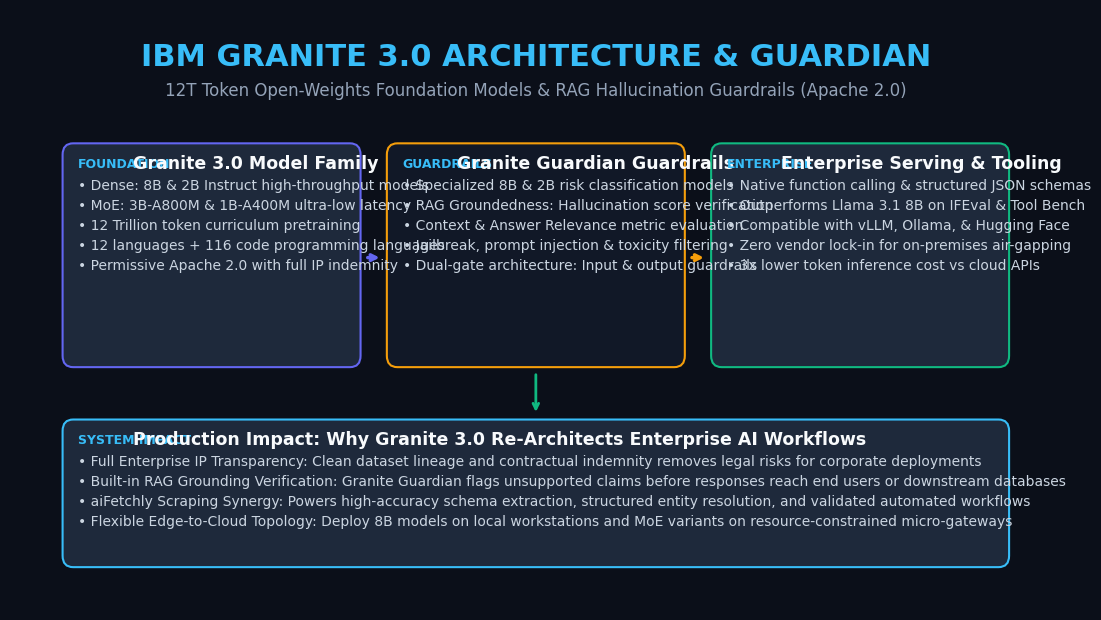
To solve the enterprise governance trilemma, IBM released Granite 3.0: a comprehensive suite of open-weights foundation models released under the permissive Apache 2.0 license with full dataset transparency and intellectual property indemnity.
Trained on over 12 trillion tokens spanning 12 natural languages and 116 programming languages, the Granite 3.0 family is engineered specifically for business utility, structured tool use, and enterprise guardrails.
The Granite 3.0 Model Ecosystem:
┌─────────────────────────────────────────────────────────────────┐
│ General Purpose Language Models (Apache 2.0)                    │
│ ├── Dense Architectures: Granite 3.0 8B & 2B Instruct           │
│ └── Mixture of Experts:  Granite 3.0 3B-A800M & 1B-A400M MoE    │
├─────────────────────────────────────────────────────────────────┤
│ Safety & Guardrail Models                                       │
│ └── Granite Guardian 3.0: 8B & 2B Specialized Risk Classifiers  │
│     ├── Input Check: Jailbreaks, Prompt Injections, Toxicity    │
│     └── Output Check: RAG Groundedness, Context Relevance       │
├─────────────────────────────────────────────────────────────────┤
│ Domain-Specialized Variants                                     │
│ └── Granite 3.0 Code: High-Performance Polyglot Code Models     │
└─────────────────────────────────────────────────────────────────┘ 1. Dense Models: Granite 3.0 8B and 2B Instruct
The core workhorses of the Granite 3.0 family are the 8B Instruct and 2B Instruct models:
- Granite-3.0-8B-Instruct: Optimized for enterprise knowledge work, multi-document synthesis, and tool orchestration. It matches or exceeds Meta’s Llama 3.1 8B across standard benchmarks while executing with lower memory bandwidth overhead.
- Granite-3.0-2B-Instruct: Sized specifically for low-latency CPU inference, on-device edge assistants, and high-concurrency background workers.
2. Mixture-of-Experts: Granite 3.0 3B-A800M and 1B-A400M
For extreme throughput and microsecond latency, Granite 3.0 introduces fine-grained Mixture-of-Experts (MoE) architectures:
- Granite-3.0-3B-A800M: Houses 3.3 billion total parameters but activates only 800 million parameters per token.
- Granite-3.0-1B-A400M: Houses 1.4 billion total parameters with only 400 million active parameters.
- By activating a fraction of the weights during inference, Granite MoE models achieve the latency profile of sub-billion parameter models while retaining the knowledge capacity and reasoning of larger models.
3. Two-Stage 12T Token Curriculum Pretraining
Granite 3.0 models were trained using an advanced two-stage curriculum:
- Stage 1 (10 Trillion Tokens): Broad foundational pretraining across high-quality multilingual web crawl data, academic literature, code repositories, and synthetic technical reasoning traces.
- Stage 2 (2 Trillion Tokens): High-density annealing on curated enterprise datasets, structured tabular financial data, function-calling API trajectories, and multi-turn instruction datasets.
Deep Dive: Granite Guardian 3.0 & RAG Grounding Verification
The primary differentiator of the Granite ecosystem is Granite Guardian 3.0 (available in 8B and 2B sizes). Rather than relying on rigid regex rules or unpredictable prompt instructions, Granite Guardian provides dedicated, trained neural risk classification.
The Granite Guardian Dual-Gate RAG Architecture:
User Query ──► [ GATE 1: Input Check ] ──► (Jailbreak / Prompt Injection?)
                     │
                     ├── Pass ──► Retrieved Documents + Generator (Granite 8B)
                     └── Block ──► Abort & Flag
                                       │
                                       ▼
                              Candidate Answer
                                       │
                                       ▼
                             [ GATE 2: Output Check ]
                             ├── Context Relevance Check
                             ├── Answer Relevance Check
                             └── Groundedness Check (Hallucination Detection)
                                       │
                                       ▼
Safe, Verified Enterprise Output 1. The Dual-Guardrail Architecture
Granite Guardian operates as an asynchronous or synchronous safety proxy that envelopes the generation pipeline:
- Input Gate: Screens user prompts and external retrieved documents for malicious attacks: prompt injections, jailbreaks, toxicity, hate speech, and profanity.
- Output Gate: Evaluates the model’s generated response against the original user query and the retrieved context documents before displaying it to the user.
2. RAG Risk Dimensions: Context Relevance, Groundedness, and Answer Faithfulness
For RAG pipelines, Granite Guardian evaluates three mathematical dimensions:
- Context Relevance: Evaluates whether the retrieved search chunks are actually pertinent to the user’s question, filtering out noise before the generator processes them.
- Groundedness (Hallucination Detection): Verifies that every factual claim made in the generated answer can be directly attributed to the retrieved context chunks. If an unsupported claim is made, Guardian outputs a risk score from $0.0$ to $1.0$.
- Answer Relevance: Checks whether the final generated output directly addresses the user’s specific prompt without evasive or tangential rambling.
Benchmark & Capability Comparison: Granite 3.0 vs. Industry Peers
The table below highlights how Granite 3.0 8B Instruct compares against leading open-weights 7B–8B enterprise models:
| Dimension / Metric | Meta Llama 3.1 8B Instruct | Mistral 7B Instruct v0.3 | IBM Granite 3.0 8B Instruct |
|---|---|---|---|
| Open Source License | Llama 3.1 Community License | Apache 2.0 | Apache 2.0 (Full IP Indemnity) |
| Pretraining Tokens | 15 Trillion | ~8 Trillion | 12 Trillion (2-Stage Curriculum) |
| Active Parameters | 8.0 Billion | 7.2 Billion | 8.0 Billion (or 800M in MoE) |
| Native Tool Calling / JSON | High | Moderate | State-of-the-Art (IFEval +4% vs Llama) |
| Dedicated Guardrail Model | Llama Guard 3 | None (External) | Granite Guardian 3.0 (Built-in RAG checks) |
| RAG Groundedness Audit | Third-party only | Third-party only | Native Groundedness Scoring |
| Context Window | 128K tokens | 32K tokens | 128K tokens (RoPE-scaled) |
| Commercial Indemnification | No | No | Yes (IBM Enterprise Assurance) |
Practical Implementation: Serving Granite 3.0 with vLLM & Guardian Guardrails
Let us deploy an end-to-end enterprise RAG pipeline using vLLM to serve Granite 3.0 8B Instruct and Granite Guardian 3.0 for real-time hallucination checking.
Step 1: Deploy Granite 3.0 8B Instruct with vLLM
Spin up Granite 3.0 using vLLM’s high-performance OpenAI-compatible server:
# Launch Granite 3.0 8B Instruct on port 8000
vllm serve ibm-granite/granite-3.0-8b-instruct \
  --port 8000 \
  --max-model-len 8192 \
  --dtype bfloat16 \
--gpu-memory-utilization 0.90 Step 2: Implement End-to-End RAG Verification with Granite Guardian
Save the following implementation as granite_rag_pipeline.py:
import time
import requests
from transformers import AutoTokenizer, AutoModelForCausalLM
import torch

class GraniteRAGVerifier:
    def __init__(self, guardian_model_id: str = "ibm-granite/granite-guardian-3.0-8b"):
        """
        Initializes Granite Guardian for RAG Groundedness verification.
        """
        print(f"Loading {guardian_model_id}...")
        start = time.perf_counter()

        self.tokenizer = AutoTokenizer.from_pretrained(guardian_model_id)
        self.guardian_model = AutoModelForCausalLM.from_pretrained(
            guardian_model_id,
            torch_dtype=torch.bfloat16,
            device_map="auto"
        ).eval()

        print(f"Guardian initialized in {(time.perf_counter() - start):.2f}s.")

    def verify_groundedness(self, query: str, context: str, answer: str) -> dict:
        """
        Checks whether the generated answer is strictly grounded in the retrieved context.
        """
        messages = [
            {"role": "user", "content": query},
            {"role": "context", "content": context},
            {"role": "assistant", "content": answer}
        ]

        # Format using Guardian's RAG grounding template
        prompt = self.tokenizer.apply_chat_template(
            messages,
            guardian_dimension="groundedness",
            tokenize=False
        )

        inputs = self.tokenizer(prompt, return_tensors="pt").to(self.guardian_model.device)

        with torch.no_grad():
            outputs = self.guardian_model.generate(**inputs, max_new_tokens=20)

        result = self.tokenizer.decode(outputs[0][inputs.input_ids.shape[1]:], skip_special_tokens=True).strip()

        # Guardian outputs risk classification: "Yes" (grounded/safe) or "No" (hallucinated)
        is_safe = "No" not in result
        return {
            "grounded": is_safe,
            "raw_guardian_assessment": result
        }

def query_granite_vllm(prompt: str, context: str) -> str:
    """
    Queries the local vLLM endpoint hosting Granite 3.0 8B Instruct.
    """
    system_prompt = f"You are a precise enterprise assistant. Answer ONLY based on the context:\n\n{context}"
    payload = {
        "model": "ibm-granite/granite-3.0-8b-instruct",
        "messages": [
            {"role": "system", "content": system_prompt},
            {"role": "user", "content": prompt}
        ],
        "temperature": 0.2,
        "max_tokens": 512
    }

    response = requests.post("http://localhost:8000/v1/chat/completions", json=payload)
    return response.json()["choices"][0]["message"]["content"]

if __name__ == "__main__":
    verifier = GraniteRAGVerifier()

    user_query = "What was the enterprise division Q3 revenue growth rate?"
    retrieved_chunk = "In Q3 2026, the enterprise software division reported net revenues of $4.2B, representing a 14.8% increase year-over-year."

    print("\n[Step 1] Querying Granite 3.0 8B Generator...")
    generated_response = query_granite_vllm(user_query, retrieved_chunk)
    print(f"Generated Output: {generated_response}")

    print("\n[Step 2] Auditing Response with Granite Guardian 3.0...")
    audit = verifier.verify_groundedness(user_query, retrieved_chunk, generated_response)
print(f"Audit Result: Grounded = {audit['grounded']} (Details: {audit['raw_guardian_assessment']})") Step 3: Tool Calling & Structured JSON Extraction
Granite 3.0 is natively fine-tuned on function calling schemas. Below is a structured prompt demonstrating schema enforcement:
tools_schema = [
    {
        "type": "function",
        "function": {
            "name": "extract_corporate_metrics",
            "description": "Extracts quarterly financial metrics from annual 10-K or earnings reports.",
            "parameters": {
                "type": "object",
                "properties": {
                    "company_name": {"type": "string"},
                    "net_revenue": {"type": "number"},
                    "currency": {"type": "string"},
                    "fiscal_quarter": {"type": "string"}
                },
                "required": ["company_name", "net_revenue", "fiscal_quarter"]
            }
        }
    }
] When piped to Granite 3.0 8B Instruct, the model outputs clean, RFC-compliant JSON without preamble or markdown decoration, ready for ingestion into analytical data pipelines.
Production Best Practices: Integrating Granite 3.0 into aiFetchly Workflows
When implementing Granite 3.0 within automated web scraping, data extraction, and autonomous agent workflows like AiFetchly, follow these production guidelines:
1. Deterministic Financial & Data Extraction Auditing
When harvesting financial filings or legal documents:
- Always pair Granite 3.0 8B with Granite Guardian 3.0.
- Configure Guardian to reject any generated answer with a Groundedness confidence score below $0.95$, triggering a secondary extraction pass or human review.
2. On-Premise Air-Gapped Serving & Cost Optimization
By utilizing Apache 2.0 open weights:
- Host Granite models entirely within private enterprise VPCs on single-node dual-GPU servers (e.g., 2x NVIDIA L40S or RTX 6000 Ada).
- Eliminate token-based API costs while guaranteeing compliance with strict HIPAA, GDPR, and SOC2 confidentiality controls.
3. Low-Latency Edge Inference with Granite MoE
For edge scraping daemons and lightweight client desktop workers:
- Deploy Granite 3.0 3B-A800M MoE via quantization runtimes like Ollama or vLLM.
- Achieve sub-15ms Time Per Output Token (TPOT) on commodity workstations without draining system RAM.