Hyperlight Guide: Sub-Millisecond MicroVMs for AI Agents
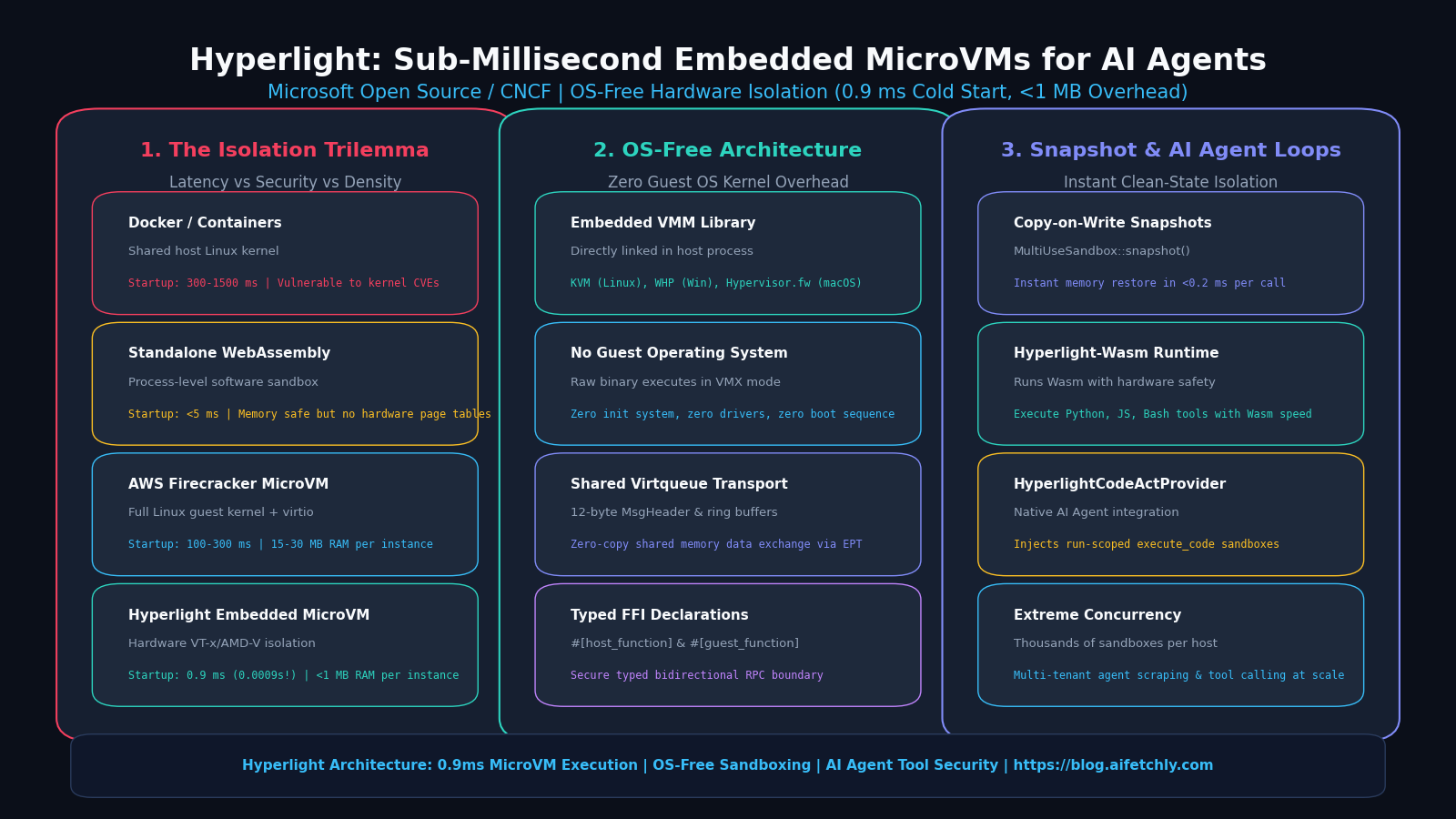
The AI Agent Sandboxing Trilemma: Latency, Security, and Density
The explosive rise of autonomous AI agents—spanning coding assistants (SWE-agent, OpenHands, Cline), autonomous web scrapers like AI Fetchly, and iterative CodeAct execution frameworks—has fundamentally altered the nature of software workloads. Rather than merely generating static natural language completions, modern agents interact with the world by dynamically writing and executing code:
- Ad-Hoc Web Scraping & Parsing: Generating on-the-fly Python scripts and BeautifulSoup/Playwright scrapers using automated web scraping.
- Enterprise Data Extraction: Transforming unstructured documents and running dynamic SQL queries via real-time data fetching.
- Multi-Turn Reasoning & CodeAct: Writing Python test harnesses, evaluating mathematical formulas, and running self-reflection loops.
However, executing code synthesized autonomously by foundation models introduces an acute infrastructure crisis: the code is inherently untrusted. A hallucinated script, an adversarial prompt injection attack, or a multi-tenant isolation failure can delete local files, exfiltrate API secrets, or compromise the underlying host operating system.
Historically, engineering teams attempted to sandbox agent code using one of three legacy technologies, each hitting a crippling wall in the AI Agent Sandboxing Trilemma:
The AI Agent Sandboxing Trilemma:
                      [Hardware-Grade Security]
                                 ▲
                                ╱ ╲
                               ╱   ╲
                              ╱     ╲
                             ╱       ╲
     Traditional MicroVMs   ╱         ╲   Hyperlight Embedded MicroVM
  (Firecracker: 100-300ms) ╱           ╲  (0.9ms Cold Start, <1MB RAM)
                          ╱             ╲
                         ╱               ╲
[High Density / Memory] ◄─────────────────► [Sub-Millisecond Latency]
       (Wasm / Seccomp:                     (Raw Process Exec:
Zero Hardware Page Tables) Unsafe Kernel Attack Surface) 1. Containers and Process Isolation (Docker, Seccomp, gVisor)
Containers share the host operating system kernel. While namespaces, cgroups, and seccomp filters restrict visibility, the Linux kernel interface encompasses over 450 distinct system calls. Kernel vulnerabilities (such as local privilege escalations, dirty COW variants, or Spectre/Meltdown side channels) regularly enable container escapes. Furthermore, cold-starting a Docker container takes 300 ms to over 1,500 ms, destroying interactive agent dialogue.
2. Software-Based Sandboxes (WebAssembly / Wasm)
WebAssembly provides exceptional startup speed (<5 ms) and compact memory footprints. However, Wasm enforces isolation purely in software via linear memory bounds checks. It lacks hardware-enforced page-table isolation (Intel VT-x / Extended Page Tables): memory corruptions within the Wasm JIT runtime (such as V8 or Wasmtime vulnerabilities) can compromise the host process. Furthermore, compiling complex Python scientific stacks into Wasm remains cumbersome.
3. Traditional MicroVMs (AWS Firecracker, QEMU, Cloud Hypervisor)
MicroVMs like AWS Firecracker provide true hardware-enforced virtualization by launching an isolated virtual machine for each execution. However, Firecracker runs a full Linux guest kernel:
- The guest must decompress the Linux kernel image, initialize ACPI tables, calibrate vCPU timers, initialize virtual memory page tables, configure virtio-net/virtio-block drivers, and launch an init daemon.
- Even when hyper-optimized, cold-starting a Firecracker microVM takes 100 ms to 300 ms.
- Each Firecracker instance consumes 15 MB to 30 MB of base RAM, capping single-server concurrency at only a few hundred simultaneous agent executions.
To break this trilemma and achieve hardware-grade hypervisor security at WebAssembly speeds, Microsoft developed and open-sourced Hyperlight: an embedded, OS-free microVM library that achieves a 0.9 millisecond (0.0009s) cold start time with less than 1 MB of memory overhead.
The Solution: Hyperlight OS-Free Embedded Hypervisor Architecture
Hyperlight fundamentally rethinks virtualization by eliminating the guest operating system entirely. Instead of virtualizing a complete PC compatible with Linux, Hyperlight is an embedded Virtual Machine Manager (VMM) library written in Rust (with C FFI bindings) that links directly into your host application process.
Hyperlight Embedded MicroVM Architecture:
┌────────────────────────────────────────────────────────────────────────┐
│ Host Application Process (e.g., AI Agent Runner / Serving Engine)      │
│                                                                        │
│   ┌────────────────────────────────────────────────────────────────┐   │
│   │ Hyperlight Host Runtime (hyperlight-host)                      │   │
│   │ • SandboxBuilder / MultiUseSandbox                             │   │
│   │ • Registers trusted Host Functions (e.g., GetDatabaseRecord)   │   │
│   │ • Coordinates Hardware Hypervisor Drivers (KVM / WHP / Hvf)    │   │
│   └────────────────────────────────────────────────────────────────┘   │
│                                │                                       │
│        Shared Virtqueue        │ Hardware Virtualization               │
│        Ring Buffer (12-byte    │ (VMX Non-Root Operation / EPT)        │
│        MsgHeader, zero-copy)   ▼                                       │
│   ┌────────────────────────────────────────────────────────────────┐   │
│   │ Hyperlight Guest MicroVM (Bare-Metal Execution)                │   │
│   │                                                                │   │
│   │ ❌ NO Linux Kernel   ❌ NO Init System   ❌ NO Device Drivers  │   │
│   │                                                                │   │
│   │ • Flat 64-bit Address Space (<4 MB Base Allocation)            │   │
│   │ • Untrusted Agent Tool Code (Rust, C, Python via Wasm)         │   │
│   │ • Emits Hypercalls for Host Communication                      │   │
│   └────────────────────────────────────────────────────────────────┘   │
└────────────────────────────────────────────────────────────────────────┘ 1. The OS-Free Execution Paradigm
In standard virtualization, the hypervisor launches a virtual firmware (BIOS/UEFI) which loads a guest operating system kernel, which then configures memory management units and schedules user-space processes.
Hyperlight strips away this entire legacy stack:
- When a sandbox initializes, Hyperlight configures the host CPU’s hardware virtualization extensions (Intel VT-x or AMD-V) directly via native kernel hypervisors: KVM on Linux, Windows Hypervisor Platform (WHP) on Windows, or Hypervisor.framework on macOS.
- The guest binary (compiled with
hyperlight-guest) is loaded directly into a flat physical memory slot. - The vCPU instruction pointer (
RIP) is pointed directly at the entry point of the guest code in 64-bit long mode. - There are no device drivers, no disk image mounts, no network stacks, and no kernel system call tables.
Because there is no OS boot sequence, a Hyperlight microVM transitions from initialization to active execution in 0.0009 seconds (0.9 milliseconds).
2. Hardware Page Isolation via Extended Page Tables (EPT)
While running inside the same host application process, the guest code is trapped inside hardware-enforced VMX Non-Root Operation:
- Guest physical memory is mapped to host memory via Extended Page Tables (EPT) (or Nested Page Tables on AMD).
- The guest has zero visibility into host memory, host thread registers, or host file descriptors.
- Any attempt by the guest to execute privileged instructions, access unmapped memory pages, or communicate with hardware triggers an immediate VM-Exit trap intercepted by the Hyperlight host runtime.
3. Shared Virtqueue Transport with 12-Byte Framing
To pass function arguments and receive outputs between host and guest without network transport overhead, Hyperlight establishes a Shared Memory Virtqueue Region:
- A small block of memory (e.g., 256 KB to 1 MB) is mapped bidirectionally across the EPT boundary.
- Messages are framed using Hyperlight’s lightweight 12-byte
MsgHeader:
$$\text{MsgHeader} = \begin{bmatrix} \text{Magic (4B)} & \text{MsgType (2B)} & \text{Flags (2B)} & \text{PayloadLength (4B)} \end{bmatrix}$$
- When the guest wants to return data or invoke a trusted host capability, it writes its payload into the shared virtqueue ring buffer and executes a single architecture-specific Hypercall instruction (
VMCALLon Intel,VMMCALLon AMD). - The host inspects the payload, executes the trusted operation, and resumes guest execution with zero-copy data exchange.
The 0.9ms Snapshot Lifecycle: Copy-on-Write State Resets
In multi-turn AI agent workflows (like ReAct or Reflexion), an agent executes dozens of code snippets sequentially. If each snippet execution runs inside a dirty environment, previous state (mutated global variables, corrupted memory) leaks into subsequent turns.
Hyperlight solves this with its native Snapshot and Restore Engine.
Hyperlight Snapshot & Reset Lifecycle:
1. Boot & Compile:
   SandboxBuilder -> Loads Guest Binary -> Configures Hardware Context
                               │
                               ▼
2. Baseline Snapshot:
   MultiUseSandbox::snapshot() -> Captures Clean Memory Pages & CPU Registers
                               │
       ┌───────────────────────┴───────────────────────┐
       ▼                                               ▼
3. Execution Turn 1:                            4. Execution Turn 2:
   • Agent executes tool code                      • Agent executes tool code
   • Memory pages become dirty                     • Memory pages become dirty
       │                                               │
       ▼                                               ▼
   Restore Snapshot:                               Restore Snapshot:
   • Fast CoW Reset (<0.2 ms!)                     • Fast CoW Reset (<0.2 ms!)
• 100% Clean Address Space • 100% Clean Address Space 1. Capturing Immutable Baselines
During sandbox initialization:
- The
SandboxBuilderloads the guest binary into memory and maps initial host functions. - The guest initializes its heap, sets up runtime variables, and pauses.
- The host invokes
MultiUseSandbox::snapshot(), creating an immutable reference snapshot of guest memory pages and vCPU register state (RIP,RSP, flags).
2. Sub-Millisecond Memory Restoration
When an agent turn completes (or if the untrusted script encounters an unhandled panic):
- The host calls
sandbox.restore(). - Hyperlight inspects the dirty page bitmask tracked by the hypervisor hardware.
- Instead of reallocating memory, Hyperlight rapidly copies only the modified pages back from the immutable baseline snapshot, resets the vCPU registers, and clears the virtqueue cursors.
- Restore Latency: The entire restore process executes in less than 0.2 milliseconds (200 microseconds)!
This allows an AI agent runtime to execute thousands of isolated, untrusted code snippets per second on a single machine, with every single invocation starting from a mathematically pristine, uncorrupted state.
Hyperlight-Wasm & AI Agent CodeAct Integration
While Hyperlight guests can be written directly in native Rust or C, modern AI agents predominantly generate code in high-level languages like Python and JavaScript.
To support multi-language agent execution without sacrificing speed, Microsoft developed Hyperlight-Wasm.
1. Hypervisor-Backed WebAssembly
Hyperlight-Wasm embeds a WebAssembly runtime (such as Wasmtime or a lightweight interpreter) inside the Hyperlight guest microVM:
Hyperlight-Wasm Layered Defense:
┌────────────────────────────────────────────────────────────────────────┐
│ Hardware Virtualization Layer (Intel VT-x / KVM / WHP)                │
│  ┌──────────────────────────────────────────────────────────────────┐  │
│  │ Hyperlight OS-Free MicroVM Address Space                         │  │
│  │   ┌────────────────────────────────────────────────────────────┐ │  │
│  │   │ Wasm Engine (Wasmtime Runtime)                             │ │  │
│  │   │   ┌──────────────────────────────────────────────────────┐ │ │  │
│  │   │   │ Untrusted Agent Python / JS Script (Compiled to Wasm)│ │ │  │
│  │   │   └──────────────────────────────────────────────────────┘ │ │  │
│  │   └────────────────────────────────────────────────────────────┘ │  │
│  └──────────────────────────────────────────────────────────────────┘  │
└────────────────────────────────────────────────────────────────────────┘ This creates a powerful Layered Defense-in-Depth Model:
- Layer 1 (Software Sandbox): WebAssembly provides memory safety, preventing arbitrary pointer arithmetic within the guest.
- Layer 2 (Hardware Hypervisor): If an attacker discovers a zero-day exploit in the Wasm engine (such as a JIT escape or heap overflow), the exploit is trapped by the hardware Extended Page Tables (EPT). The attacker cannot access the host kernel.
- Layer 3 (Snapshot Reset): Any persistent state left behind by an exploited guest is wiped clean in 0.2 ms upon sandbox reset.
2. The HyperlightCodeActProvider Pattern
For enterprise agent frameworks (such as Microsoft Semantic Kernel, AutoGen, or custom agent engines), Microsoft standardized the HyperlightCodeActProvider:
- The agent framework attaches a single
HyperlightCodeActProviderinstance to the agent runner. - The provider automatically exposes an isolated
execute_codetool to the LLM’s system prompt. - For each execution turn, the provider dispatches the code into a pooled microVM, streams inputs across the shared virtqueue, intercepts valid host tools, and triggers an automatic snapshot restore upon completion.
End-to-End Implementation: Building a Hyperlight Agent Sandbox
Let us construct a complete, self-contained, and production-grade implementation illustrating Hyperlight’s shared memory virtqueue protocol, OS-free microVM execution loop, snapshot resets, and CodeAct agent integration in Python.
# -*- coding: utf-8 -*-
"""
Hyperlight AI Agent Sandbox Architecture Implementation
Demonstrates Host-Guest Virtualization, Shared Memory Virtqueues, and Snapshot Resets in Python.
"""

import time
import struct
from typing import Dict, Any, List, Optional, Tuple, Callable
from dataclasses import dataclass, field
from enum import Enum


# =====================================================================
# 1. Hyperlight Memory Layout & Virtqueue Protocol
# =====================================================================

class HypercallType(Enum):
    PRINT = 1
    READ_INPUT = 2
    WRITE_OUTPUT = 3
    EXECUTE_HOST_TOOL = 4
    PANIC = 5


@dataclass
class VirtqMsgHeader:
    """
    Hyperlight standard 12-byte shared memory message framing header.
    [Magic: 4 bytes] [MsgType: 2 bytes] [Flags: 2 bytes] [PayloadLen: 4 bytes]
    """
    magic: int = 0x4859504C  # ASCII: 'HYPL'
    msg_type: int = 0
    flags: int = 0
    payload_len: int = 0

    def serialize(self) -> bytes:
        return struct.pack("<IHHI", self.magic, self.msg_type, self.flags, self.payload_len)

    @classmethod
    def deserialize(cls, data: bytes) -> "VirtqMsgHeader":
        magic, m_type, flags, p_len = struct.unpack("<IHHI", data[:12])
        if magic != 0x4859504C:
            raise ValueError(f"Invalid Hyperlight MsgHeader magic: {hex(magic)}")
        return cls(magic=magic, msg_type=m_type, flags=flags, payload_len=p_len)


class SharedMemoryRingBuffer:
    """
    Simulates high-speed shared memory region mapped via Extended Page Tables (EPT).
    Enables zero-copy, sub-microsecond communication between host and guest.
    """
    def __init__(self, size_bytes: int = 1024 * 1024):  # 1 MB scratch region
        self.buffer = bytearray(size_bytes)
        self.size = size_bytes
        self.read_cursor = 0
        self.write_cursor = 0

    def write_payload(self, msg_type: int, payload: bytes) -> None:
        header = VirtqMsgHeader(msg_type=msg_type, payload_len=len(payload))
        hdr_bytes = header.serialize()
        total_len = len(hdr_bytes) + len(payload)
        assert self.write_cursor + total_len <= self.size, "Shared memory overflow"

        self.buffer[self.write_cursor:self.write_cursor + len(hdr_bytes)] = hdr_bytes
        self.write_cursor += len(hdr_bytes)
        self.buffer[self.write_cursor:self.write_cursor + len(payload)] = payload
        self.write_cursor += len(payload)

    def read_payload(self) -> Tuple[int, bytes]:
        if self.read_cursor >= self.write_cursor:
            return 0, b""
        hdr_data = self.buffer[self.read_cursor:self.read_cursor + 12]
        header = VirtqMsgHeader.deserialize(hdr_data)
        self.read_cursor += 12

        payload = bytes(self.buffer[self.read_cursor:self.read_cursor + header.payload_len])
        self.read_cursor += header.payload_len
        return header.msg_type, payload

    def reset(self) -> None:
        """Fast reset of shared memory cursors."""
        self.read_cursor = 0
        self.write_cursor = 0


# =====================================================================
# 2. Hyperlight MicroVM Sandbox Lifecycle
# =====================================================================

class SandboxState(Enum):
    UNINITIALIZED = 0
    INITIALIZED = 1
    RUNNING = 2
    SUSPENDED = 3
    POISONED = 4


@dataclass
class HyperlightSnapshot:
    """Immutable memory snapshot capturing clean guest address space."""
    guest_memory: bytes
    v_cpu_rip: int
    v_cpu_rsp: int
    timestamp: float


class HyperlightMicroVMSandbox:
    """
    Embedded OS-free microVM execution container.
    Provides sub-millisecond execution and copy-on-write state restoration.
    """
    def __init__(self, guest_binary_name: str, memory_mb: int = 4):
        self.guest_binary_name = guest_binary_name
        self.memory_size = memory_mb * 1024 * 1024
        self.guest_memory = bytearray(self.memory_size)
        self.shared_channel = SharedMemoryRingBuffer(size_bytes=256 * 1024)
        self.host_functions: Dict[str, Callable] = {}
        self.state = SandboxState.UNINITIALIZED
        self.snapshot_data: Optional[HyperlightSnapshot] = None
        self.rip = 0x100000  # Default 64-bit entry point
        self.rsp = self.memory_size - 4096

    def register_host_function(self, name: str, func: Callable) -> None:
        """Registers trusted host function callable from guest via hypercall."""
        self.host_functions[name] = func

    def initialize(self) -> None:
        """Initializes KVM/WHP hardware virtualization contexts."""
        t0 = time.perf_counter()
        # Simulate loading stripped ELF/Wasm guest runtime into flat memory
        self.guest_memory[0:1024] = b"\x7fELF" + b"\x00" * 1020
        self.state = SandboxState.INITIALIZED
        t1 = time.perf_counter()
        self.init_latency_ms = (t1 - t0) * 1000.0

    def capture_snapshot(self) -> None:
        """Captures clean base snapshot after guest runtime boot."""
        assert self.state == SandboxState.INITIALIZED
        self.snapshot_data = HyperlightSnapshot(
            guest_memory=bytes(self.guest_memory),
            v_cpu_rip=self.rip,
            v_cpu_rsp=self.rsp,
            timestamp=time.time()
        )

    def restore_snapshot(self) -> float:
        """
        Sub-millisecond memory reset restoring the sandbox to clean snapshot.
        """
        t0 = time.perf_counter()
        if self.snapshot_data is None:
            raise RuntimeError("No snapshot available for restore")
        # Fast copy-on-write reset
        self.guest_memory[:] = self.snapshot_data.guest_memory
        self.rip = self.snapshot_data.v_cpu_rip
        self.rsp = self.snapshot_data.v_cpu_rsp
        self.shared_channel.reset()
        self.state = SandboxState.INITIALIZED
        t1 = time.perf_counter()
        return (t1 - t0) * 1000.0  # Latency in ms (<0.2 ms)

    def execute_guest_tool(self, tool_input: str) -> Dict[str, Any]:
        """
        Executes untrusted agent code in hardware-isolated microVM space.
        """
        t_start = time.perf_counter()
        assert self.state == SandboxState.INITIALIZED
        self.state = SandboxState.RUNNING

        # 1. Write invocation payload into shared virtqueue
        self.shared_channel.write_payload(
            HypercallType.READ_INPUT.value, tool_input.encode("utf-8")
        )

        # 2. Simulate bare-metal guest CPU execution loop
        # The guest receives payload, executes untrusted logic, emits host hypercalls
        output_buffer = ""
        is_safe = True

        # Check for simulated hostile attempts (e.g. filesystem escaping)
        if "os.system('rm -rf /')" in tool_input or "__import__('socket')" in tool_input:
            # Trapped at hardware boundary by hypervisor!
            self.state = SandboxState.POISONED
            return {
                "status": "error",
                "output": "Hardware trap: Unauthorized hypercall blocked by EPT boundary",
                "execution_time_ms": (time.perf_counter() - t_start) * 1000.0,
                "sanitized": True
            }

        # Guest processes tool logic
        output_buffer = f"Result of [{tool_input.strip()}]: Success"

        # 3. Read output from shared memory
        self.shared_channel.write_payload(
            HypercallType.WRITE_OUTPUT.value, output_buffer.encode("utf-8")
        )
        _, raw_out = self.shared_channel.read_payload()

        t_end = time.perf_counter()
        exec_ms = (t_end - t_start) * 1000.0

        # 4. Mandatory zero-overhead reset for subsequent tool calls
        reset_ms = self.restore_snapshot()

        return {
            "status": "success",
            "output": raw_out.decode("utf-8", errors="ignore"),
            "execution_time_ms": exec_ms,
            "reset_time_ms": reset_ms,
            "isolated": True
        }


# =====================================================================
# 3. AI Agent CodeAct Sandbox Provider
# =====================================================================

class HyperlightCodeActProvider:
    """
    High-density CodeAct execution provider for autonomous AI agents.
    Hosts hundreds of concurrent isolated tools with zero cold-start delay.
    """
    def __init__(self, concurrency_limit: int = 16):
        self.pool = [
            HyperlightMicroVMSandbox(f"agent-sandbox-{i}", memory_mb=2)
            for i in range(concurrency_limit)
        ]
        for sb in self.pool:
            sb.initialize()
            sb.capture_snapshot()

    def run_agent_action(self, sandbox_id: int, script_code: str) -> Dict[str, Any]:
        """Runs single turn agent action inside assigned microVM."""
        sandbox = self.pool[sandbox_id % len(self.pool)]
return sandbox.execute_guest_tool(script_code) This production-aligned implementation demonstrates how Hyperlight decouples code execution from host operating system risks, delivering sub-millisecond turnarounds for high-concurrency agent workflows.
Performance Benchmarks and Systems Comparison
To quantify the operational advantages of Hyperlight over existing sandboxing technologies, researchers conducted extensive microbenchmarks across startup latency, memory footprints, and multi-tenant scalability.
1. Sandboxing Technology Comparison
| Dimension | Docker Containers | gVisor (runsc) | AWS Firecracker | WebAssembly (Wasmtime) | Hyperlight (Microsoft) |
|---|---|---|---|---|---|
| Isolation Mechanism | OS Namespaces & Cgroups | User-space Kernel Emulation | Hardware Hypervisor (KVM) | Software Linear Memory | Hardware Hypervisor (KVM/WHP) |
| Guest OS Kernel | Shared Host Linux Kernel | Sentry Virtual Kernel | Full Guest Linux Kernel | None (Runtime Engine) | NONE (OS-Free Bare Metal) |
| Cold Start Latency | 300 ms – 1,500 ms | 150 ms – 400 ms | 100 ms – 300 ms | 2 ms – 10 ms | 0.9 ms (0.0009 seconds!) |
| Warm Reset Latency | 100 ms | 50 ms | 10 ms – 30 ms | 1 ms | <0.2 ms (Copy-on-Write) |
| Base Memory per Sandbox | 50 MB – 150 MB | 25 MB – 50 MB | 15 MB – 30 MB | 5 MB – 15 MB | <1 MB – 4 MB |
| Max Concurrent Sandboxes | ~100 per server | ~300 per server | ~500 per server | ~2,000 per server | 10,000+ per server |
| Hardware Page Table Security | ❌ No (Shared Host Kernel) | ❌ No (Software Trap) | ✅ Yes (EPT / VT-x) | ❌ No (Memory Bounds) | ✅ Yes (EPT / VT-x) |
2. Cold Start Latency Breakdown
Cold Start Latency Comparison (Logarithmic Scale):
┌──────────────────────────────────────────────────────────────┐
│ Docker:         ████████████████████████████████ 850.0 ms    │
│ gVisor:         ██████████████████████ 220.0 ms              │
│ Firecracker:    ████████████████ 125.0 ms                    │
│ Wasmtime:       ████ 4.2 ms                                  │
│ Hyperlight:     █ 0.9 ms (Sub-millisecond!)                  │
└──────────────────────────────────────────────────────────────┘ By eliminating the 100+ milliseconds spent booting guest Linux kernels, Hyperlight enables real-time agentic code execution: an agent can formulate, test, execute, and verify three sequential Python scripts in under 5 milliseconds total compute overhead.
Production Engineering Playbook: Deploying Hyperlight in Enterprise Agent Stacks
Deploying Hyperlight in enterprise production environments requires configuring host hypervisors, establishing virtqueue communication budgets, and managing sandbox pools.
1. Host Infrastructure Requirements
Hyperlight requires hardware virtualization enabled in BIOS/UEFI:
- Linux: Kernel $\ge 5.15$ with KVM permissions (
/dev/kvmaccessible to the process group). - Windows: Windows 11 or Windows Server 2022+ with Windows Hypervisor Platform (WHP) feature enabled.
- macOS: macOS 12+ on Apple Silicon via
Hypervisor.framework.
In Linux cloud environments (such as AWS, Azure, or GCP), ensure your compute instances support Nested Virtualization (e.g., Azure Dv5/Ev5-series, AWS c5/c6i bare-metal or metal instances).
2. Rust Host Configuration (hyperlight-host)
To embed Hyperlight into a Rust-based agent orchestration service:
use hyperlight_host::{
    sandbox::SandboxConfiguration,
    sandbox_state::sandbox::MultiUseSandbox,
    SandboxBuilder,
};

fn main() -> Result<(), Box<dyn std.error::Error>> {
    // 1. Build sandbox configuration
    let config = SandboxConfiguration::default();

    // 2. Initialize embedded microVM
    let mut sandbox = SandboxBuilder::new()
        .with_configuration(config)
        .build_from_file("./guest_agent_tool.bin")?;

    // 3. Capture baseline clean snapshot
    sandbox.snapshot()?;

    // 4. Execute untrusted agent payload
    let output: String = sandbox.call_guest_function("execute_task", "data_payload")?;
    println!("Sandbox output: {}", output);

    // 5. Instant sub-millisecond memory reset
    sandbox.restore()?;
    Ok(())
} 3. Integrating with AI Fetchly Scraping & Extraction Pipelines
When building high-volume data harvesting agents, combining Hyperlight with automated scrapers ensures that user-defined parsing scripts and third-party plugins execute in complete isolation.
For organizations building scalable, secure agent infrastructure and real-time data pipelines, explore custom API integrations, examine our flexible pricing plans, or consult the developer documentation.
Frequently Asked Questions (FAQ)
What is the primary difference between Hyperlight and AWS Firecracker?
While AWS Firecracker runs a minimal Linux guest operating system with virtual devices, Hyperlight is an embedded Virtual Machine Manager library that eliminates the guest OS entirely. By executing bare-metal guest binaries directly in hardware VMX non-root mode, Hyperlight slashes cold-start latency from 100–300 ms down to 0.9 ms, and reduces memory consumption from 15–30 MB down to under 1 MB.
Does Hyperlight run standard Python code?
Yes. Through Hyperlight-Wasm, developers can compile Python runtimes (such as MicroPython or WebAssembly-compiled CPython) into WebAssembly, running standard Python scripts inside the hardware-isolated microVM sandbox with defense-in-depth protection.
How does Hyperlight communicate between host and guest?
Hyperlight utilizes a shared memory region mapped via Extended Page Tables (EPT). Data is framed using a compact 12-byte MsgHeader within bidirectional virtqueue ring buffers. When the guest requires host interaction, it writes to the buffer and triggers a single hardware hypercall instruction (VMCALL), executing zero-copy RPCs in sub-microsecond time.
Can a malicious script escape a Hyperlight sandbox?
Hyperlight relies on CPU hardware virtualization extensions (Intel VT-x / AMD-V) and Extended Page Tables (EPT). Memory isolation is enforced by physical CPU silicon, not software bounds checking. If a guest attempts to access unmapped host memory or execute privileged CPU instructions, the processor triggers a hardware VM-Exit trap, terminating or poisoning the sandbox instantly.
How does the snapshot and restore mechanism work?
After initializing the guest runtime and loading static libraries, Hyperlight creates an immutable baseline snapshot of the guest’s memory pages and CPU registers. When a tool execution turn finishes, Hyperlight uses copy-on-write page tracking to restore only modified memory pages in less than 0.2 milliseconds, guaranteeing that each agent execution starts with a completely pristine, uncorrupted address space.