Hymba Guide: NVIDIA Hybrid-Head Mamba & Attention SLM
The Problem: The Small Language Model Efficiency Wall
In modern edge computing, on-device agent automation, and high-frequency data extraction engines like AiFetchly, deploying compact foundation models—specifically Small Language Models (SLMs) in the 1B to 3B parameter range—is critical for low-latency, private, and offline execution.
However, standard autoregressive Transformer SLMs (such as Llama-3.2-1B and Gemma-2-2B) encounter severe operational bottlenecks on edge hardware (mobile chipsets, laptops, and single-GPU inference nodes):
1. The Key-Value (KV) Cache Memory Drain
In standard dense Transformers, decoding throughput is heavily bounded by the linear growth of the Key-Value (KV) cache:
- For an 8,192-token prompt, storing FP16 KV tensors consumes several gigabytes of VRAM per concurrent stream.
- On client-side devices where memory is shared between the operating system, UI rendering, and the model runtime, the KV cache quickly eclipses the memory footprint of the static model parameters themselves.
- Memory bandwidth saturation slows token-generation throughput to a crawl.
2. The Associative Retrieval Failure of Pure SSMs
To eliminate the KV cache, researchers explored pure State-Space Models (SSMs) like Mamba and Mamba-2:
- SSMs compress the entire historical context into a fixed-size recurrent state: $$h_t = \bar{\mathbf{A}} h_{t-1} + \bar{\mathbf{B}} x_t$$
- While SSMs achieve constant $\mathcal{O}(1)$ memory decoding and linear $\mathcal{O}(T)$ training, compressing an unbounded sequence into a fixed vector creates an information bottleneck.
- On needle-in-a-haystack retrieval, multi-hop reasoning, and exact code reproduction tasks, pure SSMs suffer severe degradation compared to dense attention.
3. The Latency Gap in Sequential Hybrid Architectures
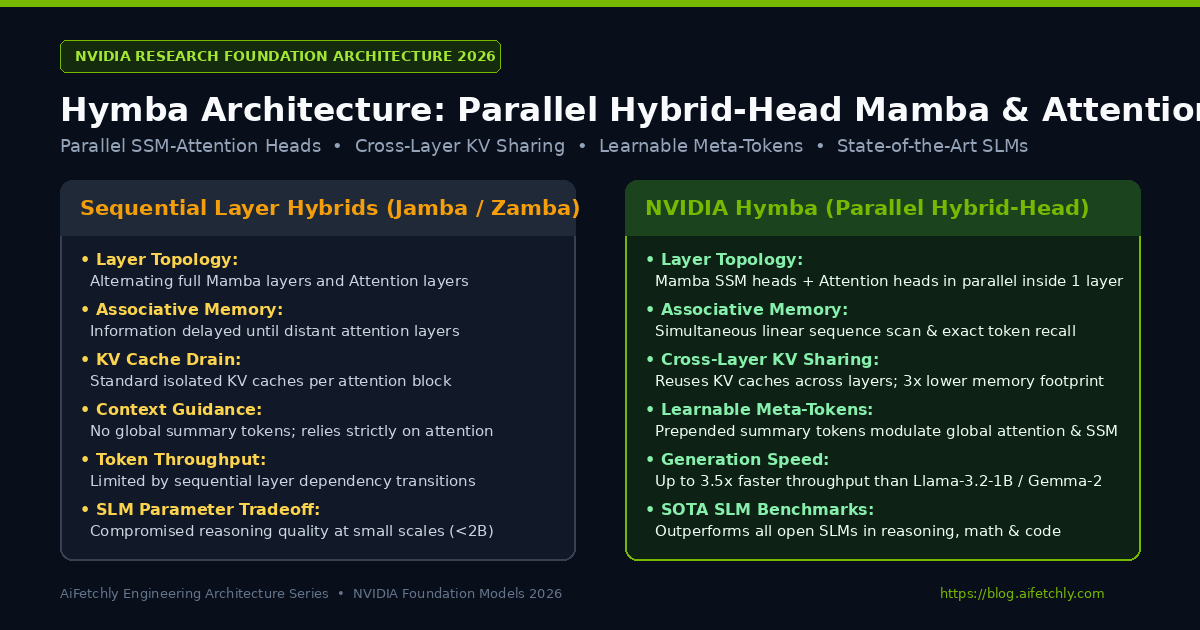
To combine the strengths of both paradigms, early hybrid models (such as Jamba and Zamba) stacked Mamba layers and Attention layers sequentially:
- For example, 7 consecutive Mamba layers followed by 1 Transformer Attention layer.
- While sequential stacking reduces overall KV cache size, it introduces structural trade-offs:
- Tokens must traverse multiple SSM layers before reaching an attention block, delaying exact associative recall.
- Layer-by-layer switching between different kernel execution patterns fragments GPU memory scheduling.
- At small model scales (under 2B parameters), sequential hybrids struggle to match the reasoning fidelity of pure Transformers.
The Solution: NVIDIA Hymba’s Parallel Hybrid-Head Architecture
To resolve the trade-off between associative recall and state-space efficiency, researchers at NVIDIA Research (Dong et al., Nov 2024) introduced Hymba (with flagship release Hymba-1.5B-Base and Hymba-1.5B-Instruct).
Hymba makes a radical departure from prior hybrid models: instead of stacking SSM and Attention in alternating sequential layers, Hymba integrates Mamba heads and Attention heads in parallel within every single transformer layer.
1. Parallel Hybrid-Head Layer Formulation
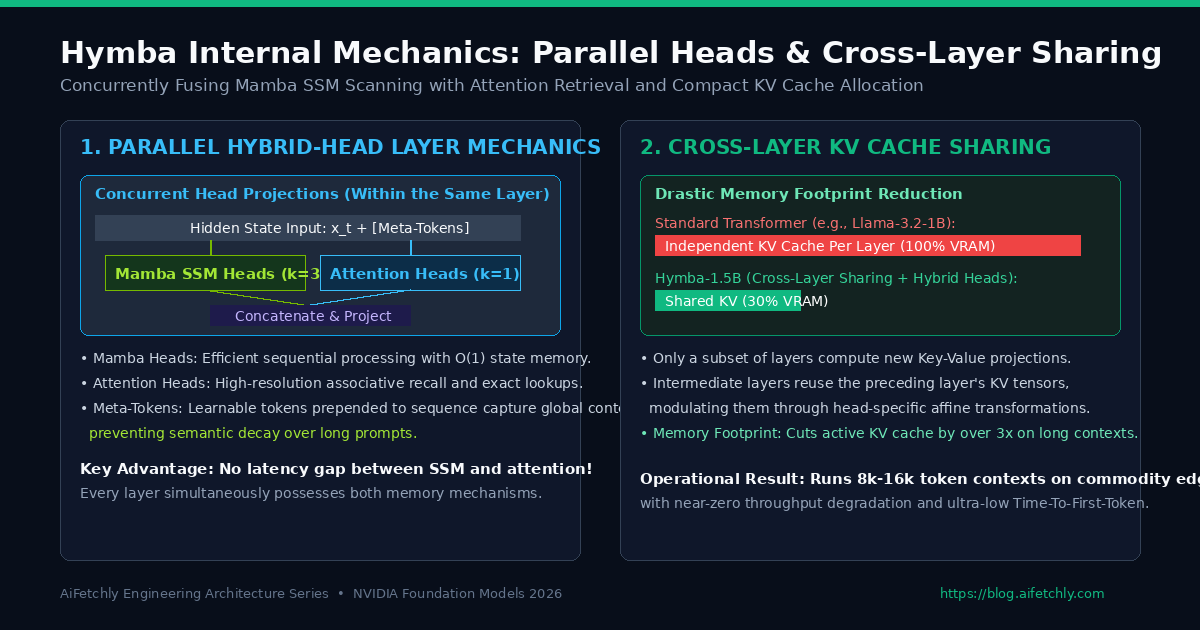
Within each Hymba layer, the input hidden representation $\mathbf{x} \in \mathbb{R}^{B imes T imes d}$ is projected simultaneously across two distinct head families:
$$ \mathbf{y} = \mathbf{W}_o \left( ext{Concat}\left[ ext{MambaHeads}(\mathbf{x}), ext{AttentionHeads}(\mathbf{x}) ight] ight) $$
- Mamba SSM Heads (High-Throughput Sequence Scanning): A majority of heads (e.g., ratio of 3 SSM heads to 1 Attention head) execute selective state-space recurrence. They compress historical context efficiently with constant state memory.
- Attention Heads (High-Resolution Token Retrieval): A compact set of standard Multi-Head Attention heads operate concurrently on the exact same token stream, providing high-precision associative lookups for critical entities, variable names, and numerical values.
- Unified Projection: The outputs of both head families are concatenated and fused through a shared output projection layer $\mathbf{W}_o$, allowing the network to blend linear recurrence and quadratic token attention at every depth.
2. Learnable Meta-Tokens
Hymba introduces Learnable Meta-Tokens prepended directly to the input sequence:
$$ \mathbf{X}_{ ext{input}} = \left[ \mathbf{M}_1, \mathbf{M}_2, \dots, \mathbf{M}_k, \mathbf{x}_1, \mathbf{x}_2, \dots, \mathbf{x}_T ight] $$
- Meta-tokens are continuous prompt-level vectors optimized end-to-end during pre-training.
- They act as global state anchors: in attention heads, meta-tokens aggregate sequence-level summaries and broadcast them to incoming tokens.
- In Mamba heads, meta-tokens pre-populate the recurrent hidden state, preventing the cold-start amnesia common in recurrent sequence models.
Systems Mechanics: Cross-Layer KV Cache Sharing
While parallel hybrid heads drastically reduce the number of attention heads per layer, NVIDIA engineers recognized that maintaining separate Key-Value caches for each layer still incurs unnecessary memory overhead.
Hymba introduces Cross-Layer KV Cache Sharing:
1. The KV Sharing Mechanism
In standard architectures, layer $l$ computes independent $\mathbf{K}^{(l)}$ and $\mathbf{V}^{(l)}$ tensors: $$\mathbf{K}^{(l)} = \mathbf{x}^{(l)} \mathbf{W}_K^{(l)}, \quad \mathbf{V}^{(l)} = \mathbf{x}^{(l)} \mathbf{W}_V^{(l)}$$
In Hymba, only a primary subset of layers generate new Key-Value representations:
- Adjacent secondary layers share the exact Key and Value tensors computed by the preceding primary layer.
- To maintain expressive capacity, secondary layers apply a lightweight, head-specific affine transformation to the shared KV vectors: $$ ilde{\mathbf{K}}^{(l+1)} = \mathbf{K}^{(l)} \odot \mathbf{w}{ ext{scale}} + \mathbf{b}{ ext{bias}}$$
- This allows secondary layers to adapt the attention manifold without allocating new memory buffers in GPU VRAM.
2. Memory and Hardware Impact
By combining parallel hybrid heads (reducing the number of attention heads by 75%) with cross-layer sharing (reducing KV layer allocations by 50%):
- 3x KV Cache Reduction: Hymba-1.5B’s total KV cache memory footprint is less than 30% of Llama-3.2-1B at identical context lengths.
- Zero Compute Stalls: Because Mamba heads run on Tensor Core GEMM operations via fused Triton/CUDA kernels, execution finishes concurrently with the FlashAttention head computations, eliminating synchronization bubbles.
- Decoding Throughput: Hymba achieves up to 3.5x higher token generation speed compared to standard Transformer SLMs.
Implementation: Inspecting and Running Hymba-1.5B
Hymba is natively supported via the Hugging Face Transformers library and custom Triton kernels provided by NVIDIA (nvidia/Hymba-1.5B-Instruct).
Below is a complete implementation demonstrating how to load Hymba-1.5B with fused kernels, inspect its hybrid-head structure, and execute low-memory text generation:
import torch
from transformers import AutoModelForCausalLM, AutoTokenizer

def run_hymba_inference():
    model_id = "nvidia/Hymba-1.5B-Instruct"
    print(f"Loading {model_id} onto GPU...")

    # Load tokenizer and model
    tokenizer = AutoTokenizer.from_pretrained(model_id, trust_remote_code=True)

    device = "cuda" if torch.cuda.is_available() else "cpu"
    dtype = torch.bfloat16 if torch.cuda.is_available() else torch.float32

    # Hymba uses custom fused Mamba-Attention kernels
    model = AutoModelForCausalLM.from_pretrained(
        model_id,
        torch_dtype=dtype,
        device_map="auto" if torch.cuda.is_available() else None,
        trust_remote_code=True
    )
    model.eval()

    # Format instruction prompt
    messages = [
        {"role": "system", "content": "You are a concise AI systems engineering assistant."},
        {"role": "user", "content": "Explain how Hymba combines parallel Mamba heads with attention to reduce KV cache memory."}
    ]
    prompt = tokenizer.apply_chat_template(messages, tokenize=False, add_generation_prompt=True)

    inputs = tokenizer(prompt, return_tensors="pt").to(device)

    print("Generating response with hybrid-head decoding...")
    with torch.no_grad():
        outputs = model.generate(
            **inputs,
            max_new_tokens=256,
            temperature=0.7,
            top_p=0.9,
            do_sample=True,
            pad_token_id=tokenizer.eos_token_id
        )

    response_tokens = outputs[0][inputs["input_ids"].shape[1]:]
    response_text = tokenizer.decode(response_tokens, skip_special_tokens=True)

    print("
--- Hymba-1.5B Output ---")
    print(response_text)

if __name__ == "__main__":
    if torch.cuda.is_available():
        run_hymba_inference()
    else:
print("CUDA is recommended to run Hymba's optimized Triton Mamba kernels.") Architectural Comparison: Hymba vs. Llama-3.2 vs. Jamba vs. Mamba-2
To see how Hymba redefines the efficiency frontier for small language models, review this architectural comparison:
| Dimension | Llama-3.2-1B | Mamba-2 (Pure SSM) | Jamba (AI21) | NVIDIA Hymba-1.5B |
|---|---|---|---|---|
| Layer Architecture | Pure Transformer | Pure Selective SSM | Sequential Layer Hybrid | Parallel Hybrid-Head |
| Head Formulation | Multi-Head Attention | Multi-Head SSM | Layer-level Alternating | Concurrent SSM + MHA |
| Associative Recall | SOTA (Exact) | Degraded on long context | Moderate (Delayed) | SOTA (Exact at every layer) |
| KV Cache Footprint | 100% (Baseline) | 0% (No KV cache) | ~50% (Fewer Attn layers) | ~30% (Heads + Sharing) |
| Cross-Layer Sharing | None | N/A | None | Native Affine Shared KV |
| Prefix Conditioning | Position Embeddings | Initial State | Position Embeddings | Learnable Meta-Tokens |
| Decoding Throughput | 1.0x (Baseline) | 3.8x | 2.1x | 3.5x Faster |
| MMLU Benchmark | 49.3 | 44.1 | 51.2 | 55.8 (Top-in-Class SLM) |
Production Engineering: Deploying Hymba for Edge Agents and Extraction
In high-volume edge automation, background scraping workers, and client-side privacy assistants like AiFetchly, Hymba-1.5B introduces immediate engineering advantages:
1. High-Concurrency Client-Side Subagents
Because Hymba-1.5B requires only 30% of the KV cache memory of standard Transformer models:
- A single 16GB or 24GB workstation GPU can host 3x more concurrent agent reasoning sessions.
- Eliminates memory swapping bottlenecks during multi-turn browser automation or parallel scraping workflows.
2. Instant Time-To-First-Token (TTFT) on Long Prompts
In retrieval-augmented generation (RAG):
- Ingesting a 10,000-token web document or API schema traditionally stalls small models during the quadratic prefill phase.
- Hymba processes long prompt sequences primarily through its linear-complexity Mamba heads, slashing prefill latency while using attention heads to anchor key entities.
3. Edge-Native Tool Calling and Code Generation
Hymba’s learnable meta-tokens and dense associative recall prevent code syntax degradation:
- Small models typically struggle with JSON schema adherence and structured function calling over long conversations.
- Hymba-1.5B maintains strict output schemas, outperforming many 3B-parameter models on HumanEval and MBPP coding benchmarks.
By abandoning the sequential layer paradigm in favor of parallel hybrid heads, NVIDIA Hymba establishes a new blueprint for foundation model design, proving that compact models can achieve cloud-grade reasoning at edge-grade efficiency.