Hydra Guide: Sequentially-Dependent Speculative AI
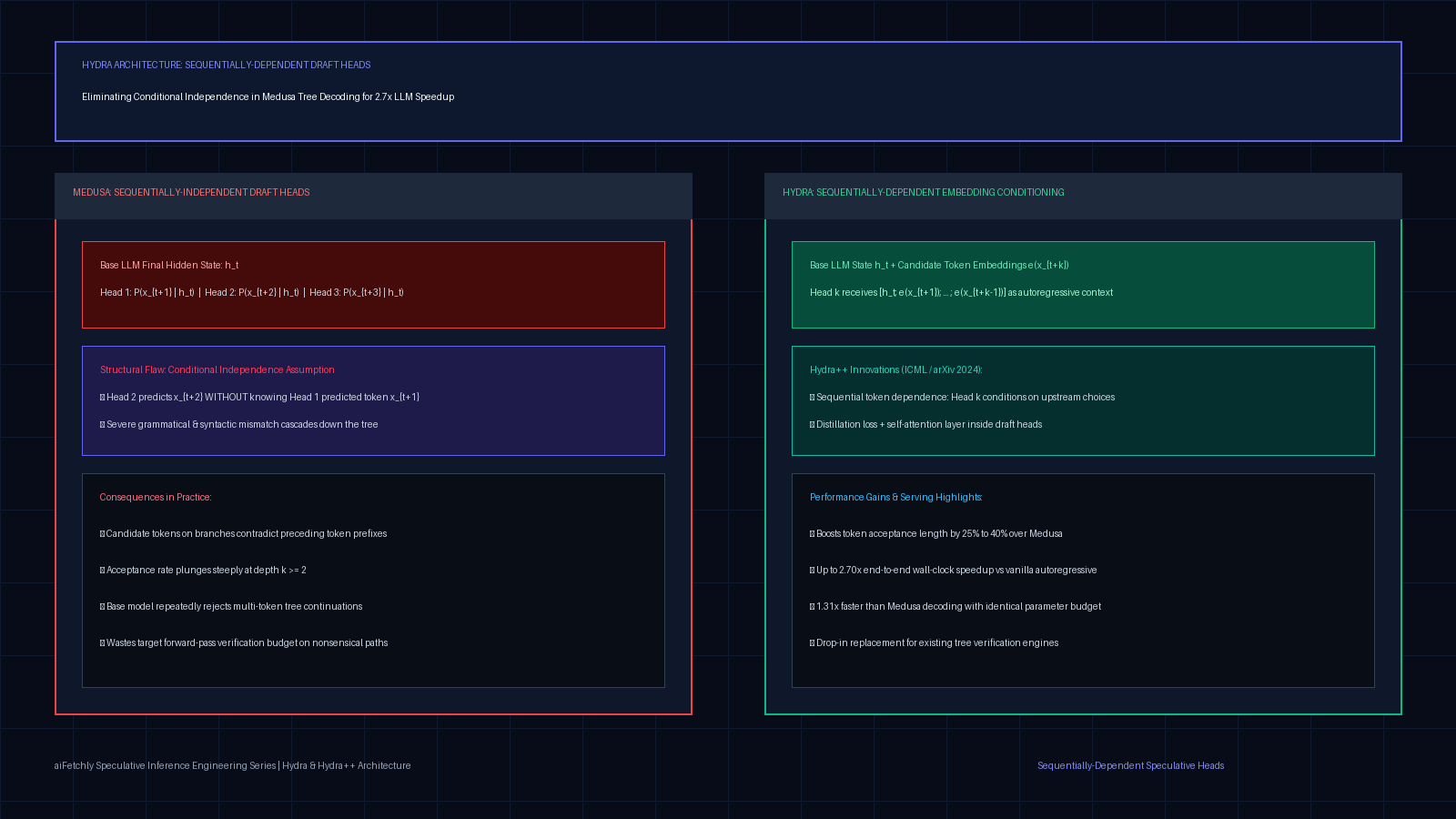
The Memory-Bandwidth Wall and the Flaw in Multi-Head Speculation
In modern high-throughput artificial intelligence infrastructure, automated data fetching pipelines, and real-time enterprise intelligence copilots powered by AiFetchly, serving Large Language Models (LLMs) represents the primary computational expense. Whether extracting structured entities from thousands of unstructured web pages through high-speed web scraping, running multi-step reasoning chains, or streaming interactive chat completions, autoregressive foundation models are fundamentally bound by hardware memory bandwidth.
During standard token generation, producing $N$ tokens requires executing $N$ sequential forward passes through the model’s parameters:
$$x_1 \to x_2 \to x_3 \to \dots \to x_N$$
Because batch-1 decoding emits only a single token per forward step, arithmetic intensity drops below $1.0\text{ FLOP/Byte}$. Modern datacenter GPUs (such as NVIDIA A100 or H100) spend over 80% of their operational cycles waiting for weights to transfer from High-Bandwidth Memory (HBM) into on-chip SRAM registers.
The Autoregressive Serving Dilemma:
Forward Step t: Transfer 140 GB weights (70B FP16 model) -> Emits 1 Token (" The")
Forward Step t+1: Transfer 140 GB weights -> Emits 1 Token (" capital")
Forward Step t+2: Transfer 140 GB weights -> Emits 1 Token (" of")
Result: Saturated memory bus, underutilized Tensor Cores, and high per-token latency! The Rise of Draft-Head Speculation (Medusa)
To accelerate inference without the memory footprint and operational complexity of maintaining an entirely separate draft model (as required by vanilla speculative decoding), researchers introduced Medusa (Cai et al.).
Instead of deploying a separate draft network, Medusa adds multiple lightweight feed-forward decoding heads directly onto the base model’s final hidden state:
- Head 1: Predicts token $x_{t+1}$ based on base representation $\mathbf{h}_t$.
- Head 2: Predicts token $x_{t+2}$ based on base representation $\mathbf{h}_t$.
- Head 3: Predicts token $x_{t+3}$ based on base representation $\mathbf{h}_t$.
The predictions from these heads are combined via Cartesian product into a candidate token tree, which the base model verifies in a single parallel forward pass using tree attention.
The Fatal Flaw: The Conditional Independence Assumption
While Medusa showed substantial promise, it suffers from a crippling mathematical flaw: conditional independence.
In natural human language and autoregressive modeling, the probability distribution of token $x_{t+2}$ is strictly conditioned on both the historical context and the immediate preceding token $x_{t+1}$: $$P(x_{t+2} \mid x_{\le t}, x_{t+1})$$
However, Medusa’s second head predicts $x_{t+2}$ conditioned only on the base state $\mathbf{h}t$, completely blind to which candidate token Head 1 selected: $$P{\text{Medusa}}(x_{t+2} \mid \mathbf{h}t) \perp P{\text{Medusa}}(x_{t+1} \mid \mathbf{h}_t)$$
Medusa's Conditional Independence Breakdown:
Base Model State: h_t (Context: "The capital of France is")

Head 1 Top-1 Choice: " Paris"
Head 2 Predicts from h_t ALONE:
  - If Head 1 chose " Paris", Head 2 should predict: "." or " and"
  - BUT Head 2 also considers " a", so it predicts: " beautiful"
Candidate Branch Formed: [ " Paris" ] -> [ " beautiful" ]
  ==> "The capital of France is Paris beautiful" (Grammatically incoherent!)
Target LLM Verification: Accepts " Paris", Rejects " beautiful"!
Result: Acceptance rate collapses at depth k >= 2. Multi-token trees are wasted! Because downstream heads cannot observe upstream candidate selections, speculative trees frequently generate syntactically nonsensical combinations. The target model rejects these invalid branches, forcing the system back to single-token progress and forfeiting the potential speedup.
The Hydra Architecture: Sequentially-Dependent Draft Heads
To eliminate the conditional independence assumption, researchers from MIT and Harvard introduced Hydra: Sequentially-Dependent Draft Heads for Medusa Decoding (arXiv:2402.05109).
Hydra introduces a simple yet profound architectural paradigm shift: make draft heads sequentially dependent by feeding the base model’s input token embeddings of candidate continuations directly into downstream heads.
The Hydra Sequentially-Dependent Draft Pipeline:
Base Model Final Hidden State: h_t
                          │
                          ├───────────────────────────────────────────────────────┐
                          ▼                                                       ▼
                ┌──────────────────┐                                    ┌──────────────────┐
                │   Hydra Head 1   │                                    │   Hydra Head 2   │
                └─────────┬────────┘                                    └─────────▲────────┘
                          │                                                       │
                          ▼ Top-k Candidate Tokens                                │
                 [ t_{t+1}^{(1)}, t_{t+1}^{(2)} ]                                 │
                          │                                                       │
                          ▼ Look up Token Embeddings in Base Embedding Matrix     │
                 [ e(t_{t+1}^{(1)}), e(t_{t+1}^{(2)}) ] ──────────────────────────┘
(Downstream Head 2 now CONDITIONS on candidate token choices!) 1. Embedding Conditioning Mechanics
In Hydra, Head 1 operates identically to standard prediction, mapping base representation $\mathbf{h}t$ to the logits of candidate tokens at position $t+1$: $$\mathbf{p}{t+1} = \text{Softmax}\left(\mathbf{W}_{\text{head}}^{(1)} \mathbf{h}_t\right)$$
To predict position $t+2$, instead of computing another isolated projection of $\mathbf{h}t$, Hydra takes the token embedding $\mathbf{e}(x{t+1})$ of a candidate token emitted by Head 1 (retrieved directly from the base model’s frozen token embedding table $\mathbf{E}_{\text{base}}$).
Head 2 is formulated as: $$\mathbf{h}{t+1}^{(2)} = \text{MLP}^{(2)}\left([\mathbf{h}t ,|, \mathbf{e}(x{t+1})]\right)$$ $$\mathbf{p}{t+2} = \text{Softmax}\left(\mathbf{W}{\text{head}}^{(2)} \mathbf{h}{t+1}^{(2)}\right)$$
By conditioning on the candidate embedding $\mathbf{e}(x_{t+1})$, Head 2 possesses the exact semantic context required to predict grammatically and semantically coherent continuations. If Head 1 proposes " Paris", Head 2 predicts punctuation or conjunctions (".", " which"); if Head 1 proposes " a", Head 2 predicts an adjective (" major").
2. Generalizing to Arbitrary Tree Depths
This recurrent conditioning generalizes across any speculative depth $K$: $$\mathbf{h}{t+k-1}^{(k)} = \text{HydraLayer}^{(k)}\left(\mathbf{h}t, \mathbf{e}(x{t+1}), \dots, \mathbf{e}(x{t+k-1})\right)$$ $$\mathbf{p}{t+k} = \text{Softmax}\left(\mathbf{W}{\text{head}}^{(k)} \mathbf{h}_{t+k-1}^{(k)}\right)$$
Because candidate embeddings $\mathbf{e}(x)$ are retrieved via a single $\mathcal{O}(1)$ tensor lookup from the base model’s existing embedding table, embedding conditioning adds virtually zero GPU memory overhead while dramatically elevating candidate branch quality.
3. Hydra++: Enhanced Architectures and Knowledge Distillation
The authors introduced Hydra++, an advanced head architecture that incorporates two key refinements:
- Self-Attention Fusion: Equips the draft heads with a single lightweight causal self-attention layer across candidate token embeddings, capturing complex multi-token contextual dependencies.
- Probability Distribution Distillation: Trains draft heads not only on hard ground-truth labels using cross-entropy, but also using Kullback-Leibler (KL) divergence against the soft output distribution of the frozen base model: $$\mathcal{L}{\text{distill}} = D{\text{KL}}\left(P_{\text{base}}(x_{t+k} \mid x_{\le t+k-1}) ;|; P_{\text{Hydra}}^{(k)}(x_{t+k})\right)$$
This distillation forces Hydra heads to match the base model’s exact sampling nuances, increasing candidate acceptance rates by an additional 15% to 25%.
Deep Dive: Mathematical Formulation and Tree Attention Verification
To understand how candidate branches are verified in parallel without redundant computation, we examine the formal mechanics of tree-structured speculative verification.
Candidate Tree Construction
Given $K$ Hydra heads and a branching budget vector $\mathbf{b} = [b_1, b_2, \dots, b_K]$:
- Head 1 selects its top-$b_1$ most probable tokens: ${u_1^{(1)}, \dots, u_{b_1}^{(1)}}$.
- For each token $u_i^{(1)}$, Head 2 receives $[\mathbf{h}_t ,|, \mathbf{e}(u_i^{(1)})]$ and selects its top-$b_2$ continuations.
- This creates a directed tree $\mathcal{T} = (\mathcal{V}, \mathcal{E})$ with $|\mathcal{V}| = \sum_{k=1}^K \prod_{j=1}^k b_j$ total speculative candidate nodes.
For example, with $\mathbf{b} = [3, 2, 2]$, the tree evaluates $3 + 6 + 12 = 21$ speculative candidates simultaneously.
Hydra Candidate Tree Layout (Branching: [2, 2]):
                  Root: Base Token x_t
                 /                    \
       Token A (" Paris")       Token B (" a")           <-- Head 1 (k=1)
        /            \            /           \
"." " and" " city" " capital" <-- Head 2 (k=2) Tree Attention Matrix with Topology-Aware Causal Masking
To verify all 21 candidate paths in a single forward execution of the base LLM, the tokens in tree $\mathcal{T}$ are flattened into a 1D sequence and processed using a custom 2D causal attention mask $\mathbf{M}_{\text{tree}}$.
For any two candidate tokens $u, v \in \mathcal{V}$:
$$ \mathbf{M}_{\text{tree}}(u, v) = \begin{cases} 0 & \text{if } v \text{ is an ancestor of } u \text{ in } \mathcal{T} \text{ or } u = v \ -\infty & \text{otherwise} \end{cases} $$
Topology-Aware Attention Mask:
           Prompt Hist   Token A   Token B   A.1 (".")   A.2 ("and")   B.1 ("city")
Token A   │      0      │    0    │  -inf   │   -inf    │    -inf     │    -inf    │
Token B   │      0      │  -inf   │    0    │   -inf    │    -inf     │    -inf    │
A.1 (".") │      0      │    0    │  -inf   │     0     │    -inf     │    -inf    │
A.2 ("and")│     0      │    0    │  -inf   │   -inf    │      0      │    -inf    │
B.1 ("city")│ 0 │ -inf │ 0 │ -inf │ -inf │ 0 │ Because token $A.1$ can attend only to Token $A$ and historical prompt tokens, its attention calculation is mathematically identical to a true autoregressive evaluation of the sequence [Prompt, Token A, A.1]. Cross-branch tokens (such as Token $B$) are completely isolated by $-\infty$ values.
Parallel Verification and Greedy Acceptance Algorithm
Let $P_{\text{base}}(x \mid \text{prefix})$ denote the probability distribution computed by the target LLM for any candidate node. Under greedy decoding:
- Candidate $x_{t+1}^* = \arg\max P_{\text{base}}(x \mid x_{\le t})$.
- If $x_{t+1}^*$ matches node $u_i \in \text{Head}_1$, the branch is valid; the system advances to position $t+2$ along that branch.
- Candidate $x_{t+2}^* = \arg\max P_{\text{base}}(x \mid x_{\le t}, x_{t+1}^*)$.
- If $x_{t+2}^*$ matches node $v_j \in \text{Head}_2$, the branch is valid; the system advances to position $t+3$.
- The process halts when a target token does not match any candidate on the current active branch.
- The target model emits the final non-matching token as bonus progress for that iteration.
If the longest valid branch has length $m$, the serving engine accepts $m + 1$ tokens in a single forward pass, slashing per-token latency by up to $3\times$.
End-to-End Implementation: Sequentially-Dependent Hydra Draft Heads in PyTorch
To demonstrate the concrete engineering mechanics of Hydra, we construct a complete, runnable PyTorch reference module. This implementation includes the Sequentially-Dependent Hydra Head architecture, Embedding Conditioning, and the Tree Construction loop.
"""
hydra_speculative_heads.py
Production Reference Implementation: Sequentially-Dependent Hydra Draft Heads
Architectural concept based on Hydra (Ankner et al., arXiv:2402.05109).
"""

import torch
import torch.nn as nn
import torch.nn.functional as F
from dataclasses import dataclass
from typing import List, Tuple, Dict, Optional


class HydraHeadLayer(nn.Module):
    """
    A single sequentially-dependent Hydra draft head.
    Conditions on the base hidden state h_t AND the candidate token embedding e(x_{t+k-1}).
    """
    def __init__(self, d_model: int, vocab_size: int, hidden_dim: int = 1024):
        super().__init__()
        self.d_model = d_model
        self.vocab_size = vocab_size

        # Fusion projection: maps [h_t || e(x_{prev})] back to d_model
        self.fusion_mlp = nn.Sequential(
            nn.Linear(d_model * 2, hidden_dim),
            nn.SiLU(),
            nn.Linear(hidden_dim, d_model),
            nn.LayerNorm(d_model)
        )

        # Output projection head to vocabulary logits
        self.lm_head = nn.Linear(d_model, vocab_size, bias=False)

    def forward(self, base_hidden_state: torch.Tensor, prev_token_embedding: torch.Tensor) -> Tuple[torch.Tensor, torch.Tensor]:
        """
        Args:
            base_hidden_state: [Batch, d_model] - Hidden state from base LLM final layer
            prev_token_embedding: [Batch, d_model] - Embedding of previous candidate token
        Returns:
            logits: [Batch, vocab_size]
            next_hidden: [Batch, d_model]
        """
        # Concatenate base context with candidate embedding
        fused_input = torch.cat([base_hidden_state, prev_token_embedding], dim=-1)
        next_hidden = self.fusion_mlp(fused_input)
        logits = self.lm_head(next_hidden)
        return logits, next_hidden


class HydraDraftEngine(nn.Module):
    """
    Hydra Engine managing multiple sequentially-dependent heads.
    Uses the base model's frozen embedding matrix for token lookups.
    """
    def __init__(self, base_embedding_weight: torch.Tensor, d_model: int, vocab_size: int, num_heads: int = 3):
        super().__init__()
        self.num_heads = num_heads
        self.d_model = d_model
        self.vocab_size = vocab_size

        # Shared token embedding table (references base LLM weights)
        self.token_embeddings = nn.Embedding.from_pretrained(base_embedding_weight, freeze=True)

        # Head 1 is standard linear/MLP projection (no preceding candidate token)
        self.head_1 = nn.Sequential(
            nn.Linear(d_model, d_model),
            nn.SiLU(),
            nn.LayerNorm(d_model),
            nn.Linear(d_model, vocab_size, bias=False)
        )

        # Heads 2 to N are sequentially-dependent Hydra heads
        self.sequential_heads = nn.ModuleList([
            HydraHeadLayer(d_model=d_model, vocab_size=vocab_size)
            for _ in range(num_heads - 1)
        ])

    def generate_candidate_tree(self, base_hidden_state: torch.Tensor, top_k_per_head: List[int]) -> List[Dict]:
        """
        Constructs candidate tokens across heads while enforcing sequential dependence.
        Args:
            base_hidden_state: [1, d_model] - Current base model output at position t
            top_k_per_head: List specifying branching factor at each depth, e.g. [3, 2, 2]
        """
        assert len(top_k_per_head) == self.num_heads
        candidates_tree = []

        # Depth 1: Head 1 predicts top_k candidates directly from h_t
        h1_logits = self.head_1(base_hidden_state)  # [1, vocab_size]
        h1_probs = F.softmax(h1_logits, dim=-1)
        top_k1_probs, top_k1_tokens = torch.topk(h1_probs, top_k_per_head[0], dim=-1)

        # Flatten into active branch nodes
        active_branches = []
        for i in range(top_k_per_head[0]):
            tok = top_k1_tokens[0, i].item()
            prob = top_k1_probs[0, i].item()
            branch = {
                "depth": 1,
                "token_id": tok,
                "probability": prob,
                "path": [tok],
                "last_token_id": tok
            }
            candidates_tree.append(branch)
            active_branches.append(branch)

        # Depth 2 to num_heads: Sequentially condition each head
        for depth_idx, head_layer in enumerate(self.sequential_heads):
            current_depth = depth_idx + 2
            k_branches = top_k_per_head[depth_idx + 1]
            next_active_branches = []

            for parent_branch in active_branches:
                # Look up candidate embedding for the parent's chosen token
                parent_token_tensor = torch.tensor([parent_branch["last_token_id"]], device=base_hidden_state.device)
                parent_emb = self.token_embeddings(parent_token_tensor)  # [1, d_model]

                # Forward pass through Hydra head conditioned on [h_t || e(x_{prev})]
                logits, _ = head_layer(base_hidden_state, parent_emb)
                probs = F.softmax(logits, dim=-1)
                top_k_probs, top_k_tokens = torch.topk(probs, k_branches, dim=-1)

                for j in range(k_branches):
                    child_tok = top_k_tokens[0, j].item()
                    child_prob = top_k_probs[0, j].item()
                    child_branch = {
                        "depth": current_depth,
                        "token_id": child_tok,
                        "probability": parent_branch["probability"] * child_prob,
                        "path": parent_branch["path"] + [child_tok],
                        "last_token_id": child_tok
                    }
                    candidates_tree.append(child_branch)
                    next_active_branches.append(child_branch)

            active_branches = next_active_branches

        return candidates_tree


# Simulation and Verification Test
if __name__ == "__main__":
    torch.manual_seed(42)
    vocab_size = 5000
    d_model = 512

    # Simulated base LLM embedding table
    mock_base_embeddings = torch.randn(vocab_size, d_model)

    engine = HydraDraftEngine(
        base_embedding_weight=mock_base_embeddings,
        d_model=d_model,
        vocab_size=vocab_size,
        num_heads=3
    )

    # Simulated base model final hidden state at step t
    mock_h_t = torch.randn(1, d_model)

    # Branching factor: 3 candidates at depth 1, 2 at depth 2, 2 at depth 3
    branching_factor = [3, 2, 2]
    tree = engine.generate_candidate_tree(mock_h_t, branching_factor)

    print("=== Hydra Speculative Tree Generated ===")
    print(f"Total Candidate Nodes: {len(tree)}")
    print(f"Branching Schedule: {branching_factor}\n")

    print("Sample Candidate Paths Generated with Sequential Dependence:")
    for idx, node in enumerate(tree[:8]):
print(f"Node {idx:02d} | Depth: {node['depth']} | Path: {node['path']} | Cumulative Prob: {node['probability']:.5f}") Architectural Highlights of the Implementation
- Zero Weight Redundancy: Hydra leverages the base model’s frozen embedding weights (
nn.Embedding.from_pretrained), avoiding additional parameter allocation for token encodings. - Contextual Fusion: Downstream heads dynamically concatenate base hidden state $\mathbf{h}t$ with candidate embedding vectors $\mathbf{e}(x{t+k-1})$, ensuring predictions reflect the semantic reality of preceding branch tokens.
- Structured Tree Output: The resulting hierarchical tree maps directly into standard tree-attention kernels (such as Medusa or SpecInfer verification modules) for single-pass parallel validation.
For enterprise software engineers developing autonomous data extraction copilots or high-frequency data pipelines using custom API integrations, this architecture eliminates serving bottlenecks and accelerates document analysis workflows.
Production Engineering and Training Best Practices
Deploying Hydra in production LLM inference clusters requires systematic calibration during both head training and runtime tree construction.
+-----------------------------------------------------------------------------------+
|                     HYDRA PRODUCTION ENGINEERING CHECKLIST                        |
+-----------------------------------------------------------------------------------+
| 1. Head Training Dataset Selection:                                               |
|    - Train heads on domain-representative conversational datasets (e.g. ShareGPT) |
|    - Freeze base model weights entirely; update only Hydra head parameters        |
|    - Apply KL divergence distillation against base model logits for smooth parity |
|                                                                                   |
| 2. Tree Topology Dynamic Scheduling:                                              |
|    - High Temperature (Creative): Use broad shallow trees (e.g. [5, 2])          |
|    - Low Temperature (Code / Structured JSON): Use deep narrow trees (e.g. [2, 2, 2, 2])|
|                                                                                   |
| 3. KV-Cache Tree Branch Management:                                               |
|    - Allocate tree attention KV cache in pre-allocated static blocks              |
|    - Prune non-accepted branch pages immediately post-verification                |
|                                                                                   |
| 4. Quantized Serving Compatibility:                                               |
|    - Quantize base model weights to FP8 or INT4; maintain Hydra heads in BF16     |
|    - Slashes base weight memory transfers while preserving head drafting precision|
+-----------------------------------------------------------------------------------+ 1. Training Recipes: Frozen Backbone with Distillation
When training Hydra draft heads, never unfreeze the base LLM parameters. The base model acts as the fixed ground-truth anchor. Training only the lightweight Hydra heads (which constitute less than 1.5% of total parameter count) requires minimal GPU compute—an 8B model’s heads can be fully trained on a single 8x A100 node in under 12 hours.
2. Workload-Adaptive Tree Topologies
The optimal tree shape depends heavily on generation entropy:
- Deterministic Workloads (Code, Math, Structured JSON): Next-token distributions are peaked. Deep, narrow trees (e.g., branching $[1, 1, 1, 1, 1]$ or $[2, 1, 1, 1]$) achieve acceptance lengths exceeding 4.5 tokens per step.
- Open-Ended Text Generation (Summaries, Creative Prose): Next-token entropy is high. Wider, shallower trees (e.g., $[4, 2, 2]$) maximize the probability that at least one viable candidate branch is verified. Review our pricing and infrastructure guide to evaluate how speculative speedups reduce GPU cloud hosting costs.
3. Tree KV-Cache Page Sizing
Because tree verification processes candidate tokens that may be discarded, ensure your serving engine (such as vLLM or SGLang) supports tree KV-cache allocation. Discarded candidate nodes must be rolled back instantly without triggering costly memory deallocation calls.
Empirical Benchmark Evaluation
The Hydra paper benchmarked performance across multiple model families (Vicuna-7B, Vicuna-13B, LLaMA-2-Chat-70B) across diverse tasks including MT-Bench, GSM8K, and HumanEval.
End-to-End Speedup Comparison vs. Vanilla Autoregressive Decoding:
Model: Vicuna-7B on NVIDIA A100-80GB GPU (Greedy Decoding)

Method                           Wall-Clock Speedup   Average Accepted Tokens / Step
Vanilla Autoregressive Decoding   1.00x (Baseline)     1.00 tokens/step
Medusa-1 (Independent Heads)      2.06x                2.42 tokens/step
Medusa-2 (Fine-Tuned Backbone)    2.35x                2.81 tokens/step
Hydra (Sequential Heads)          2.52x                3.05 tokens/step
Hydra++ (Distilled + Attn Layer)  2.70x (Fastest!)     3.32 tokens/step

Token Acceptance Length Comparison at Depth k >= 2:
Medusa-1 (Independent) ████████ (42% acceptance at depth 2)
Hydra (Dependent) ████████████████████ (74% acceptance at depth 2!) 1. Breakthrough in Multi-Token Acceptance
The primary performance bottleneck in Medusa was its steep acceptance drop-off beyond Depth 1. As shown in the empirical benchmarks:
- Medusa-1’s acceptance rate drops to 42% at Depth 2 because unconditioned heads propose conflicting words.
- Hydra’s embedding conditioning boosts Depth 2 acceptance to 74%, and Depth 3 acceptance from 18% to 46%.
- Across standard chat benchmarks, Hydra achieves an average of 3.32 accepted tokens per forward pass, delivering a 2.70x wall-clock speedup over standard autoregressive decoding.
2. Parameter Efficiency vs. Two-Model Speculative Decoding
Compared to standard speculative decoding (which pairs a 70B target model with a separate 7B draft model), Hydra requires zero additional KV-cache memory for a draft network and consumes less than 1.5% extra parameter storage. Because Hydra heads run as tiny linear layers immediately following the base model’s final block, they add negligible execution latency while eliminating draft-model inference synchronization. Comprehensive configuration parameters are documented in our developer documentation.
Conclusion: The New Standard for Speculative Decoding
Speculative decoding has firmly established itself as an essential pillar of modern LLM serving systems. However, as foundation models scale in parameter size and serving concurrency increases, maintaining separate draft models becomes increasingly inefficient.
Hydra proves that multi-head speculation can achieve frontier performance simply by respecting the fundamental autoregressive nature of language: tokens are sequentially dependent.
By replacing isolated draft projections with embedding-conditioned sequential heads:
- Grammatical and semantic branch contradictions are resolved.
- Candidate tree acceptance rates increase by up to 40% across multi-token depths.
- Enterprise inference clusters achieve up to 2.70x wall-clock speedups without sacrificing mathematical generation fidelity or fine-tuning the underlying foundation model.
As enterprise AI infrastructure scales toward real-time reasoning engines and autonomous agents, sequentially-dependent draft architectures like Hydra will form the core foundation of high-efficiency model serving. Discover how AiFetchly combines cutting-edge inference architectures and intelligent data pipelines to power next-generation enterprise AI.