HunyuanVideo Guide: 13B Open-Source DiT Video Architecture
The Problem: The Spatiotemporal and Linguistic Bottlenecks in Open Video AI
In modern generative artificial intelligence, autonomous web agents, and multimodal platforms powered by AiFetchly, foundation models have expanded from text generation and static image synthesis into dynamic video comprehension and generation. Whether producing animated product demos from scraped web catalogs, creating instructional video summaries of technical documentation, or generating cinematic visual narratives, video synthesis represents the ultimate frontier of multimodal intelligence.
However, scaling video generation models has historically encountered three severe architectural barriers: the spatiotemporal compute explosion, the prompt comprehension failure of legacy text encoders, and temporal motion instability.
The Spatiotemporal Video Generation Bottlenecks:
Goal: "Generate a 5-second 720p video (1280x720) at 24 FPS with complex narrative camera movement."
 │
 ▼
┌─────────────────────────────────────────────────────────────────┐
│ Bottleneck 1: Raw Dimensionality Explosion                     │
│ • 5s × 24 FPS = 120 frames × 1280 × 720 × 3 RGB channels        │
│ ❌ Over 330 Million raw subpixels per video!                    │
│ ❌ Quadratic self-attention O(N^2) crashes modern GPU VRAM      │
├─────────────────────────────────────────────────────────────────┤
│ Bottleneck 2: Linguistic Blindness of Frozen T5 / CLIP Encoders│
│ • Prompt: "A drone orbits a medieval castle, then zooms in"     │
│ ❌ Fails on temporal sequencing (what happens first vs. second)  │
│ ❌ Ignores camera trajectory directions and multi-object physics│
├─────────────────────────────────────────────────────────────────┤
│ Bottleneck 3: The 2D Frame-Splicing Motion Artifacts           │
│ • Legacy 2D U-Nets with temporal cross-attention layers         │
│ ❌ Severe flickering, morphing limbs, and unnatural physics     │
│ ❌ Unstable temporal drift across consecutive frames            │
└─────────────────────────────────────────────────────────────────┘
Result: Open-source video generation lagged far behind closed commercial APIs! 1. The Spatiotemporal Dimensionality Explosion
Video data is fundamentally more computationally demanding than static imagery:
- A high-resolution image ($1024 \times 1024$) contains approximately 1 million pixels.
- A 5-second cinematic video at $1280 \times 720$ resolution and 24 frames per second contains 120 consecutive frames and over 330 million subpixels.
- Calculating standard full self-attention across uncompressed spatiotemporal patches scales quadratically ($O((T \cdot H \cdot W)^2)$), immediately triggering out-of-memory (OOM) crashes even on 80GB NVIDIA H100 GPUs.
- Without massive spatial and temporal compression in a shared latent space, training large foundation models at high resolutions is mathematically intractable.
2. The Linguistic Blindness of Standard Text Encoders
Early open-source video models (such as Stable Video Diffusion or early CogVideo) relied on frozen CLIP or T5 text encoders:
- Spatial and Temporal Nuance Gap: CLIP models were trained on static image-caption pairs; they understand static objects (e.g., “a red car”) but possess zero understanding of verbs, temporal sequence, or physical dynamics (e.g., “the car accelerates, drifts around the corner, and stops”).
- Camera Movement Disconnect: When developers specify cinematic directions (e.g., “pan left”, “dolly zoom”, “aerial tracking shot”), traditional text encoders treat these camera instructions as background semantic noise, yielding stagnant, motionless scenes.
3. Temporal Drift and Morphing in 2D Cascaded Architectures
Prior video architectures attempted to retrofit 2D image diffusion models by inserting 1D temporal attention layers between frozen 2D spatial convolution blocks:
- Because the underlying backbone was not natively 3D, spatial features drifted across frames.
- Characters morphed uncontrollably, limbs multiplied or vanished, and background textures warped unnaturally during camera pans.
The Solution: Tencent HunyuanVideo’s 13B Foundation Architecture
To establish a new frontier for open-source generative video, Tencent developed and open-sourced HunyuanVideo.
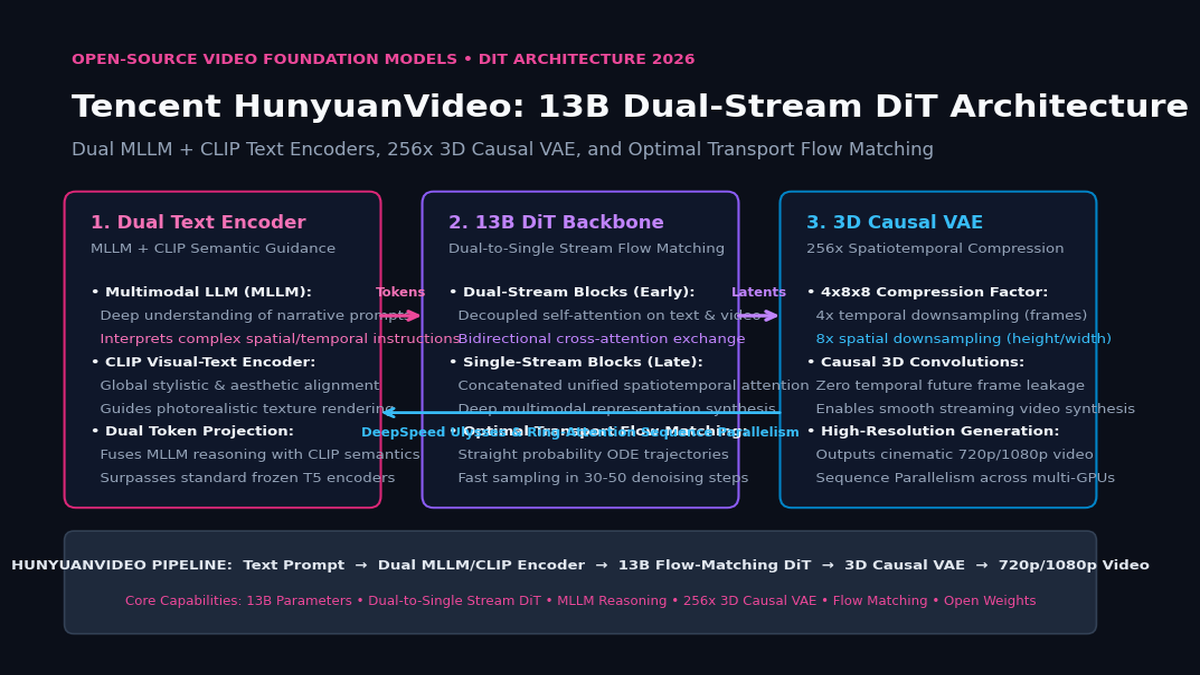
HunyuanVideo is a 13-billion-parameter text-to-video foundation model built from the ground up on a unified Diffusion Transformer (DiT) architecture. By coupling an instruction-tuned Multimodal LLM (MLLM) text encoder with a traditional CLIP encoder, a 256x 3D causal VAE, and an optimal transport Flow Matching formulation, HunyuanVideo produces high-definition 720p and 1080p cinematic video matching or surpassing closed commercial systems like Runway Gen-3 and Luma Dream Machine.
HunyuanVideo Core Architecture:
┌─────────────────────────────────────────────────────────────────┐
│ Input Prompt: "Cinematic drone shot soaring over mist-shrouded  │
│ mountains at sunrise, camera tilts down to reveal an ancient temple"│
└─────────────────────────────────────────────────────────────────┘
 │
 ├──► Multimodal LLM (MLLM): Deep narrative, temporal & camera motion
 └──► CLIP Text Encoder: Global aesthetic & visual style guidance
 │
 ▼ (Dual Token Embeddings Fused via Linear Projections)
┌─────────────────────────────────────────────────────────────────┐
│ 13B Diffusion Transformer (DiT) Backbone                        │
│                                                                 │
│ ┌─────────────────────────────────────────────────────────────┐ │
│ │ Early Layers: Dual-Stream Blocks                            │ │
│ │ • Decoupled self-attention on text tokens & video latents   │ │
│ │ • Bidirectional cross-attention exchange                    │ │
│ └─────────────────────────────────────────────────────────────┘ │
│                                │                                │
│                                ▼                                │
│ ┌─────────────────────────────────────────────────────────────┐ │
│ │ Late Layers: Single-Stream Blocks                           │ │
│ │ • Concatenated spatiotemporal sequence (Text + Video)       │ │
│ │ • Unified self-attention for deep cross-modal synthesis     │ │
│ └─────────────────────────────────────────────────────────────┘ │
│                                │                                │
│ ┌─────────────────────────────────────────────────────────────┐ │
│ │ 3D Rotary Position Embeddings (3D-RoPE) + Flow Matching     │ │
│ │ • Straight probability ODE trajectories (30–50 steps)       │ │
│ └─────────────────────────────────────────────────────────────┘ │
└─────────────────────────────────────────────────────────────────┘
 │
 ▼ (Denoised Spatiotemporal Latents)
┌─────────────────────────────────────────────────────────────────┐
│ 3D Causal VAE Decoder (256x Spatial & Temporal Decompression)   │
│ • 4x Temporal Up-Sampling × 8x Spatial Up-Sampling (4×8×8)     │
│ • Causal 3D convolutions eliminate temporal future leakage      │
└─────────────────────────────────────────────────────────────────┘
 │
 ▼
┌─────────────────────────────────────────────────────────────────┐
│ Output Video: High-Definition 720p/1080p, 24 FPS Cinematic Video│
└─────────────────────────────────────────────────────────────────┘ The Architectural Pillars of HunyuanVideo
- 13-Billion-Parameter DiT Backbone: Scales diffusion transformers to 13 billion parameters, unlocking emergent physical simulation capabilities (fluid motion, realistic lighting reflections, gravity, and complex cloth physics).
- Dual-Stream to Single-Stream Transformer Blocks:
- Dual-Stream (Early): Keeps text and video latents in separate computational pathways to preserve modality-specific representations while exchanging information via cross-attention.
- Single-Stream (Late): Merges text and video tokens into a unified token stream, allowing full attention heads to model intricate interactions between words and pixels.
- Dual Text Encoding Engine (MLLM + CLIP):
- An instruction-tuned Multimodal Large Language Model (MLLM) understands complex multi-sentence paragraphs, camera directives, and chronological scene descriptions.
- A standard CLIP encoder provides global aesthetic and stylistic grounding.
- 256x Spatiotemporal 3D Causal VAE: Downsamples video by 4x temporally (along frames) and 8x spatially (along height and width). Causal convolutions enforce that current latents depend only on past frames, preventing temporal bleeding and enabling streaming generation.
- Optimal Transport Flow Matching: Formulates the generative process as a straight-line probability ODE rather than curved stochastic diffusion, cutting required sampling steps from 100+ down to 30 to 50 steps.
- Multi-GPU Sequence Parallelism: Leverages DeepSpeed Ulysses and Ring-Attention to distribute spatiotemporal tokens across multi-GPU nodes (4x or 8x H100s), enabling native 720p/1080p generation without out-of-memory errors.
Comparing Open-Source Video Foundation Models
The table below contrasts HunyuanVideo against other notable open and closed video generation engines:
Video Generation Model Architectural Comparison:
┌───────────────────────────┬───────────────────────────────┬───────────────────────────────┬───────────────────────────────┐
│ Dimension                 │ Stable Video Diffusion (SVD)  │ CogVideoX (5B)                │ Tencent HunyuanVideo (13B)    │
├───────────────────────────┼───────────────────────────────┼───────────────────────────────┼───────────────────────────────┤
│ Model Architecture        │ 2D U-Net + Temporal Layers    │ 3D Diffusion Transformer (DiT)│ Dual-to-Single Stream DiT     │
│ Total Parameters          │ 1.5 Billion                   │ 5.0 Billion                   │ 13.0 Billion                  │
│ Text Encoder              │ Frozen CLIP                   │ Frozen T5-XXL                 │ Dual MLLM + CLIP Encoders     │
│ VAE Architecture          │ 2D Spatial VAE (Frame-by-frame│ 3D Causal VAE (8x8x4)         │ 3D Causal VAE (8x8x4, 256x)   │
│ Generative Formulation    │ Score-based Diffusion (EDM)   │ Standard Denoising Diffusion  │ Optimal Transport Flow Match  │
│ Native Output Resolution  │ 576p                          │ 720p                          │ 720p & 1080p Cinematic        │
│ Prompt Adherence          │ Weak (Short tags only)        │ Moderate (Sentence-level)     │ Exceptional (Paragraph MLLM)  │
│ Multi-GPU Parallelism     │ Simple Data Parallel          │ Basic Sequence Parallel       │ DeepSpeed Ulysses + Ring Attn │
│ Open Weights License      │ Open Community License        │ Apache 2.0                    │ Open Apache 2.0               │
└───────────────────────────┴───────────────────────────────┴───────────────────────────────┴───────────────────────────────┘ Deep Dive into HunyuanVideo Core Primitives & Mechanics
HunyuanVideo achieves cinematic realism through four integrated subsystems: Dual-Stream to Single-Stream DiT Blocks, Dual MLLM/CLIP Token Encoding, 3D Causal Latent Compression, and Flow Matching Trajectories.
HunyuanVideo Subsystem Breakdown:
HunyuanVideo Engine
 ├──► 1. Dual Text Encoders: MLLM (narrative/temporal reasoning) + CLIP (style/aesthetics)
 ├──► 2. Dual-to-Single DiT: Decoupled early streams transitioning to unified deep fusion
 ├──► 3. 3D-RoPE: Rotary positional encodings across temporal (T) and spatial (H, W) axes
 ├──► 4. 3D Causal VAE: 256x spatiotemporal downsampling with zero future-frame leakage
└──► 5. Flow Matching: Straight-path probability ODEs enabling 30-step high-fidelity sampling 1. The Dual-Stream to Single-Stream DiT Backbone
Inspired by modern unified architectures (such as FLUX.1), HunyuanVideo separates and fuses modalities across two distinct structural phases:
- Phase 1: Dual-Stream Blocks (Early 20 Layers):
- Text tokens and video latent patches are kept in separate feature buffers.
- Video tokens perform self-attention across spatiotemporal patches; text tokens perform self-attention across linguistic context.
- Modalities exchange information via bidirectional cross-attention projections. This preserves linguistic abstraction without allowing video noise to corrupt text representations during early denoising.
- Phase 2: Single-Stream Blocks (Late 40 Layers):
- Video and text tokens are concatenated into a single unified sequence: $$\mathbf{Z} = [\mathbf{Z}{\text{text}}, \mathbf{Z}{\text{video}}] \in \mathbb{R}^{(N_{\text{text}} + N_{\text{video}}) \times D}$$
- A single set of attention heads operates over the combined sequence, allowing fine-grained pixel regions to query individual adjectives, verbs, and camera instructions directly.
2. 3D Rotary Position Embeddings (3D-RoPE)
In video transformers, position encodings must model three continuous dimensions: time ($t$), height ($h$), and width ($w$):
- Standard 1D RoPE assigns a single scalar frequency along sequence length.
- HunyuanVideo decomposes the channel hidden dimension $D$ into three subspaces: $$D = D_t + D_h + D_w$$
- Rotary matrices are applied independently along the temporal frame index and the 2D spatial grid coordinates, ensuring translation invariance across camera pans and time intervals.
3. Dual Text Encoding: The MLLM Advantage
Traditional video generators struggle with prompts like “First, a cat jumps onto a table; second, it knocks over a glass; third, the glass shatters on the floor”:
- Standard CLIP encoders compress the whole text into a single pooled vector, ignoring chronological order.
- HunyuanVideo integrates an instruction-tuned Multimodal Large Language Model (MLLM):
- Generates token-level hidden states with rich reasoning capabilities.
- Extracts nuanced spatial layouts, lighting directions, and temporal transitions.
- Concurrently, a CLIP ViT-L/14 encoder provides dense visual-semantic tokens, ensuring photorealistic textures and stylistic fidelity.
4. 256x Spatiotemporal 3D Causal VAE
The VAE compresses raw pixel video into a compact continuous latent space:
- Spatial Downsampling ($8 \times 8$): Compresses an $8 \times 8$ pixel patch into a single vector.
- Temporal Downsampling ($4\times$): Compresses 4 temporal frames into a single latent timestep.
- Total Compression Factor: $4 \times 8 \times 8 = 256\times$.
- Causal Convolutions: By enforcing that convolution filters only attend to $t’ \le t$, the VAE avoids looking into future frames. This design prevents temporal artifacts and enables streaming video extension.
5. Optimal Transport Flow Matching Formulation
Standard diffusion models train neural networks to estimate score functions along curved stochastic trajectories (SDEs), requiring 50 to 100 discretization steps:
- HunyuanVideo adopts Flow Matching: $$x_t = (1 - t) x_0 + t x_1, \quad t \in [0, 1]$$ Where $x_0$ is pure Gaussian noise and $x_1$ is the clean video latent.
- The vector field velocity $v_t = x_1 - x_0$ is completely linear.
- Sampling follows a straight-line Ordinary Differential Equation (ODE), allowing Euler or Midpoint solvers to generate photorealistic video in just 30 to 50 denoising steps.
Hands-On Implementation: Running HunyuanVideo Inference with Sequence Parallelism
Let’s walk through the practical setup and execution of HunyuanVideo inference using PyTorch and Hugging Face Diffusers, including multi-GPU sequence parallelism.
1. Environment & Hardware Requirements
Generating 720p video with a 13B parameter model requires substantial GPU memory:
- Minimum Single GPU: 1x NVIDIA RTX 4090 or A100 (with FP8 quantization and CPU offloading).
- Recommended Production Cluster: 4x or 8x NVIDIA H100 / A100 GPUs with NVLink for native FP16 execution via DeepSpeed Ulysses.
Install dependencies:
pip install torch torchvision torchaudio --index-url https://download.pytorch.org/whl/cu124
pip install diffusers transformers accelerate sentencepiece
pip install flash-attn --no-build-isolation 2. Basic Text-to-Video Inference via Diffusers
Generate a cinematic video using the high-level HunyuanVideoPipeline:
import torch
from diffusers import HunyuanVideoPipeline, HunyuanVideoTransformer3DModel
from diffusers.utils import export_to_video

# 1. Load the 13B HunyuanVideo pipeline in bfloat16 precision
model_id = "tencent/HunyuanVideo"

pipeline = HunyuanVideoPipeline.from_pretrained(
    model_id,
    torch_dtype=torch.bfloat16
)

# 2. Enable FlashAttention-2 and CPU offloading to optimize VRAM
pipeline.transformer.enable_flash_attention()
pipeline.enable_model_cpu_offload()

# 3. Define a complex cinematic prompt with narrative camera movement
prompt = (
    "A majestic snow leopard strides across a rugged Himalayan ridge at twilight. "
    "A slow cinematic drone pan circles the leopard as snowflakes drift across the lens. "
    "Photorealistic textures, 8k resolution, cinematic lighting, 24 FPS."
)

negative_prompt = "cartoon, low quality, blurry, distorted anatomy, jittery motion, watermark"

# 4. Generate video latents using 30 Flow Matching steps
print("Executing HunyuanVideo generation pipeline...")
output = pipeline(
    prompt=prompt,
    negative_prompt=negative_prompt,
    num_frames=85,            # ~3.5 seconds at 24 FPS
    height=720,
    width=1280,
    num_inference_steps=35,   # Flow matching straight-line sampling
    guidance_scale=6.0,
    generator=torch.Generator(device="cuda").manual_seed(42)
).frames[0]

# 5. Export to MP4
export_to_video(output, "himalayan_snow_leopard.mp4", fps=24)
print("Video saved to himalayan_snow_leopard.mp4") 3. Multi-GPU Distributed Inference with DeepSpeed Ulysses
For multi-GPU clusters, distribute the spatiotemporal token sequence across GPUs using sequence parallelism:
# Launch distributed inference across 4 GPUs
torchrun --nproc_per_node=4 sample_video.py \
    --model_path tencent/HunyuanVideo \
    --prompt "A vintage steam locomotive accelerates through a snow-covered pine forest, thick white steam billowing into the winter sky" \
    --video_size 720 1280 \
    --video_length 129 \
    --infer_steps 40 \
    --ulysses_degree 4 \
--output_path ./output_steam_train.mp4 In DeepSpeed Ulysses mode, the spatiotemporal latent sequence is sliced evenly along the sequence dimension across all 4 GPUs. Before self-attention, an All-to-All collective communication transpose reorganizes tokens across attention heads, allowing each GPU to compute full spatiotemporal attention with zero sequence truncation.
Production Architecture & Integration for aiFetchly
Integrating HunyuanVideo into automated web extraction, media generation pipelines, and desktop intelligence systems like AiFetchly establishes a dynamic visual generation tier.
aiFetchly Multimodal Video Generation Topology:
┌─────────────────────────────────────────────────────────────────┐
│ aiFetchly Web Extraction & Document Harvester                   │
└─────────────────────────────────────────────────────────────────┘
 │
 ▼ (Extracted Text, Product Catalogs, Real-Time Market Intelligence)
┌─────────────────────────────────────────────────────────────────┐
│ Automated Narrative Storyboard Agent                            │
│ • Synthesizes extracted facts into sequential visual prompts    │
│ • Injects explicit camera direction (pan, tilt, dolly, zoom)    │
└─────────────────────────────────────────────────────────────────┘
 │
 ▼
┌─────────────────────────────────────────────────────────────────┐
│ HunyuanVideo Distributed Cluster (4x–8x H100 with NVLink)       │
│ • Dual Text Encoders (MLLM + CLIP) parse complex storyboards    │
│ • 13B DiT Flow Matching generates 720p/1080p video sequences   │
│ • 256x 3D Causal VAE decodes photorealistic MP4 media streams   │
└─────────────────────────────────────────────────────────────────┘
 │
 ├──► Real-Time Video Preview Delivered to Desktop App
 │
 ▼
┌─────────────────────────────────────────────────────────────────┐
│ Observability & Latency Monitoring (Arize Phoenix / OpenTelemetry)│
│ • Tracks step-by-step sampling latency, TTFT, and GPU HBM usage │
└─────────────────────────────────────────────────────────────────┘ 1. Automated Video Summarization of Scraped Web Data
When AiFetchly scrapes complex web content (such as e-commerce product catalogs, architectural designs, or real estate listings):
- An autonomous LLM agent processes the raw extracted text into an optimized cinematic visual prompt.
- HunyuanVideo synthesizes a photorealistic 5-second video showcasing the product in dynamic lighting with cinematic camera movement, delivering rich interactive media assets automatically.
2. Multi-Model Pipeline Synergy
Pair HunyuanVideo with other core open-source infrastructure:
- Store generated video metadata and multimodal embeddings in Weaviate or ChromaDB using multi-tenant vector shards.
- Run script and prompt generation on fast local inference servers like Ollama or enterprise serving engines like TensorRT-LLM.
- Monitor generation latency, step times, and GPU memory saturation using Arize Phoenix with OpenTelemetry distributed tracing.
Summary: Democratizing Frontier Video Generation with Open-Source DiTs
Video generation is no longer confined to closed proprietary APIs with metered pricing and restrictive content barriers.
By integrating a 13-billion-parameter dual-stream to single-stream Diffusion Transformer, a dual MLLM and CLIP text encoding engine, a 256x spatiotemporal 3D causal VAE, and optimal transport Flow Matching, Tencent HunyuanVideo brings frontier-grade cinematic video synthesis to the open-source community. For automated media generation, rich web content synthesis, and desktop intelligence platforms engineered with AiFetchly, HunyuanVideo provides the scalable architectural foundation necessary to create photorealistic, physics-grounded video at scale.