Hugging Face TRL: Full-Stack SFT, DPO & GRPO Guide
The Problem: The Fractured and Fragile Post-Training Toolchain
In modern artificial intelligence engineering, automated web data extraction, and autonomous agent platforms like AiFetchly, foundation models are rarely deployed directly out of pre-training. A raw pre-trained base model simply predicts the next token across billions of web documents; it cannot follow instructions reliably, refuses to admit ignorance, and frequently hallucinates invalid schemas.
Transforming a raw base model into a reliable, instruction-following reasoning agent requires post-training: Supervised Fine-Tuning (SFT), preference alignment (RLHF / DPO), and reinforcement learning for verifiable reasoning (GRPO).
However, until recently, executing post-training was an operational minefield characterized by fragile toolchains, astronomical multi-model VRAM overheads, and sluggish rollout bottlenecks.
The Traditional Post-Training Infrastructure Dilemma:
┌─────────────────────────────────────────────────────────────────┐
│ Stage 1: Supervised Fine-Tuning (Naive Padding & Waste)         │
│ • Padding variable-length prompts with `<pad>` tokens           │
│ ❌ 60%+ of GPU compute wasted calculating padding loss!          │
│ ❌ Fragile custom collators fail to mask user prompts!          │
├─────────────────────────────────────────────────────────────────┤
│ Stage 2: Traditional RLHF with PPO (The 4-Model VRAM Tax)       │
│ • Requires 4 models simultaneously in GPU memory:               │
│   1. Actor (Policy Model being trained)                         │
│   2. Critic (Value Model estimating expected future reward)     │
│   3. Reference Model (Frozen policy for KL divergence penalty)   │
│   4. Reward Model (Frozen neural network scoring completions)   │
│ ❌ Demands 8x NVIDIA H100s ($300k+ cluster) just to train a 7B! │
│ ❌ Critic network training is notoriously unstable and drifts!  │
├─────────────────────────────────────────────────────────────────┤
│ Stage 3: The Generation Rollout Bottleneck                      │
│ • Standard PyTorch autoregressive loops generate training data  │
│ ❌ GPU Tensor Cores sit idle for 80% of training time!          │
└─────────────────────────────────────────────────────────────────┘
Result: Post-training was restricted to elite labs with massive compute budgets! 1. The Compute Waste of Naive Batch Padding in SFT
In standard Supervised Fine-Tuning, datasets contain instruction prompts of wildly varying lengths (from 50-token questions to 4,000-token web documents):
- To construct rectangular tensor batches, shorter sequences must be zero-padded to match the longest sequence.
- Over 60% of GPU Tensor Core cycles are wasted computing forward and backward passes over padding tokens.
- Furthermore, naive cross-entropy loss calculates gradients across the entire prompt. If the model is penalized for failing to predict the user’s input phrasing, instruction-following capabilities degrade.
2. The 4-Model Memory Tax of Traditional PPO
Standard Reinforcement Learning from Human Feedback (RLHF) via Proximal Policy Optimization (PPO) requires four distinct neural networks running concurrently:
- The Actor (Policy): The generative model being updated.
- The Critic (Value Network): A secondary model predicting expected cumulative reward.
- The Reference Model: A frozen snapshot of the SFT model used to calculate KL divergence.
- The Reward Model: A frozen classifier scoring model outputs.
Even with parameter-efficient fine-tuning (LoRA), fitting four 8B or 70B parameter models into GPU memory causes severe out-of-memory (OOM) crashes, requiring complex model offloading that slows training down by 10x. Moreover, the Critic network is notoriously difficult to stabilize; if the critic’s value estimates diverge, the actor policy collapses into gibberish.
3. The Generation Bottleneck in Online Reinforcement Learning
Unlike supervised pre-training where training tokens are known ahead of time, reinforcement learning is an online exploration loop:
- The model must generate rollouts (sample completions) dynamically at every training step before evaluating rewards and computing policy gradients.
- Standard PyTorch generation loops in training scripts lack paged KV caching, continuous batching, and CUDA kernel fusion, spending 80% of wall-clock time waiting on sluggish single-token decoding.
The Solution: Hugging Face TRL’s Unified Post-Training Stack
To democratize post-training and unite every phase of model alignment into a cohesive, high-performance Python framework, Hugging Face developed TRL (Transformer Reinforcement Learning).
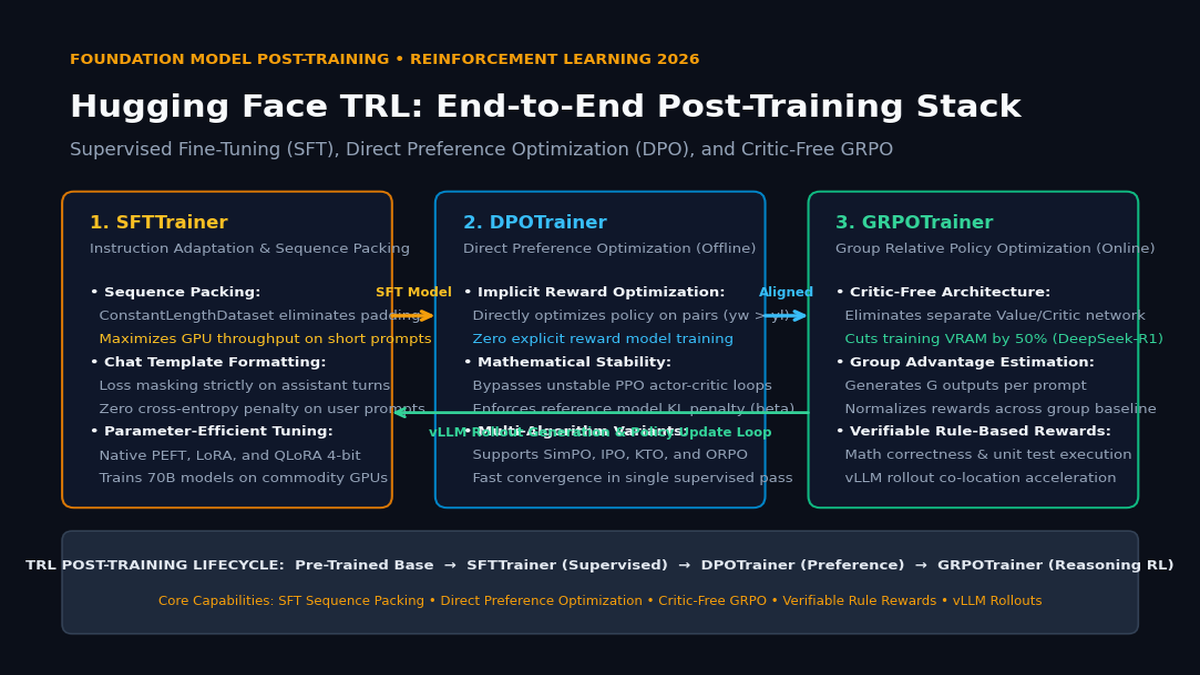
TRL is a comprehensive, open-source library engineered to guide foundation models through the entire post-training lifecycle. Built on top of PyTorch, Transformers, Accelerate, and PEFT, TRL unifies constant-length sequence packing in SFT, offline direct preference optimization (DPO), and critic-free Group Relative Policy Optimization (GRPO) with vLLM-accelerated rollout co-location.
Hugging Face TRL End-to-End Post-Training Architecture:
┌─────────────────────────────────────────────────────────────────┐
│ Raw Pre-Trained Foundation Base Model (LLaMA-3, Qwen-2.5, etc.) │
└─────────────────────────────────────────────────────────────────┘
 │
 ▼
┌─────────────────────────────────────────────────────────────────┐
│ Phase 1: SFTTrainer (Supervised Fine-Tuning)                    │
│ • Sequence Packing (`ConstantLengthDataset` eliminates padding) │
│ • Auto Chat Templates & Masking (`DataCollatorForCompletionOnly`)│
│ • Native PEFT, LoRA, and QLoRA 4-bit integration                │
└─────────────────────────────────────────────────────────────────┘
 │
 ▼ (Instruction-Following Base Model)
┌─────────────────────────────────────────────────────────────────┐
│ Phase 2: DPOTrainer (Direct Preference Optimization - Offline)  │
│ • Implicit Reward Optimization from pairwise preferences (yw>yl)│
│ • Eliminates explicit reward models and unstable PPO loops      │
│ • Reference model KL penalty constraint (beta parameter)        │
└─────────────────────────────────────────────────────────────────┘
 │
 ▼ (Preference-Aligned Conversational Model)
┌─────────────────────────────────────────────────────────────────┐
│ Phase 3: GRPOTrainer (Group Relative Policy Optimization - RL)  │
│ • DeepSeek-R1 reasoning alignment without Critic/Value model   │
│ • Generates G outputs per prompt; computes relative advantage   │
│ • Verifiable Rule-Based Rewards: Math proofs & unit tests       │
│ • High-Speed Rollout Generation via vLLM co-location            │
└─────────────────────────────────────────────────────────────────┘
 │
 ▼
┌─────────────────────────────────────────────────────────────────┐
│ Production-Ready High-Reasoning Foundation Model                │
└─────────────────────────────────────────────────────────────────┘ The Architectural Pillars of Hugging Face TRL
SFTTrainerwith Constant-Length Sequence Packing: Packs multiple conversational turns into fixed-length contiguous token windows (e.g., 4,096 tokens), driving GPU hardware utilization above 90% and cutting training time in half. Automatically masks user prompts so loss is computed exclusively on assistant completions.DPOTrainer(Direct Preference Optimization): Replaces complex actor-critic RLHF loops with a closed-form supervised objective derived directly from pairwise preference datasets (chosenvs.rejected), optimizing the implicit reward function without training a separate reward model.GRPOTrainer(Group Relative Policy Optimization): Brings DeepSeek-R1-style reasoning alignment to every developer. By evaluating candidate responses as a group against a relative mathematical baseline, GRPO completely discards the Critic network, cutting VRAM overhead by 50%.- Verifiable Rule-Based Reward Functions: Allows training reasoning models using programmatic Python validators (e.g., executing unit tests, evaluating sympy mathematical proofs, and verifying JSON syntax) rather than relying on noisy neural reward models.
- vLLM Rollout Co-Location: Integrates the high-throughput vLLM serving engine directly into the RL training loop, accelerating rollout generation by 10x to 15x compared to vanilla PyTorch decoding.
Comparing LLM Post-Training Frameworks
The table below contrasts Hugging Face TRL against alternative post-training approaches:
Post-Training Framework Architectural Comparison:
┌───────────────────────────┬───────────────────────────────┬───────────────────────────────┬───────────────────────────────┐
│ Dimension                 │ Raw PyTorch Scripts           │ DeepSpeed-Chat                │ Hugging Face TRL              │
├───────────────────────────┼───────────────────────────────┼───────────────────────────────┼───────────────────────────────┤
│ Unified Workflow          │ Fragmented custom glue code   │ Multi-stage shell scripts     │ Unified Python Trainer API    │
│ SFT Sequence Packing      │ Manual tensor manipulation    │ Basic padding                 │ Built-in ConstantLengthDataset│
│ Preference Optimization   │ Custom loss implementation    │ Standard PPO                  │ DPO, SimPO, IPO, KTO, ORPO    │
│ Reasoning RL (GRPO)       │ Complex custom distributed code│ No native GRPO                │ Native GRPOTrainer (Built-in) │
│ Critic Model Required     │ Yes (for standard PPO)        │ Yes (for PPO)                 │ No (Critic-free in GRPO)      │
│ Rollout Engine            │ Vanilla PyTorch generate()    │ DeepSpeed inference           │ Native vLLM co-location       │
│ PEFT & QLoRA Support      │ Manual gradient hooks         │ Partial LoRA support          │ First-class native integration│
│ Distributed Scaling       │ Manual torch.distributed      │ DeepSpeed ZeRO-1/2/3          │ Accelerate, FSDP2, DeepSpeed  │
└───────────────────────────┴───────────────────────────────┴───────────────────────────────┴───────────────────────────────┘ Deep Dive into TRL Core Primitives & Trainers
TRL structures modern post-training across three standardized abstractions: SFTTrainer, DPOTrainer, and GRPOTrainer.
TRL Core Subsystem Breakdown:
Hugging Face TRL
 ├──► 1. SFTTrainer: Sequence packing, chat templates, and completion-only loss masking
 ├──► 2. DPOTrainer: Implicit reward optimization with KL regularization (beta)
 ├──► 3. GRPOTrainer: Critic-free group advantage estimation for reasoning models
 ├──► 4. Verifiable Rewards: Rule-based math, code, and regex execution functions
└──► 5. vLLM Engine: In-memory rollout generation with paged KV cache acceleration 1. SFTTrainer: Sequence Packing and Completion Masking
In conversational fine-tuning, training efficiency depends on eliminating padding and properly attributing loss:
ConstantLengthDataset: Instead of creating batches where 50-token prompts are padded to 4,096 tokens, TRL concatenates multiple independent conversations end-to-end, separated by end-of-sequence (<eos>) tokens, up to the exact context limit. Attention masks are adjusted to prevent cross-document attention leakage.DataCollatorForCompletionOnlyLM: Masking prompt tokens is critical. TRL uses response template delimiters (e.g.,<|start_header_id|>assistant<|end_header_id|>\n\n) to find where the user prompt ends and sets the label indices of all preceding tokens to-100, ensuring the loss function evaluates only the model’s generated responses.
2. DPOTrainer: Direct Preference Optimization
DPO derives an exact mathematical equivalence between the optimal policy in RLHF and the probability ratio of preferred completions:
- Given a dataset of triples $(x, y_w, y_l)$ where $y_w$ is the winning response and $y_l$ is the losing response: $$\mathcal{L}{\text{DPO}}(\theta; \pi{\text{ref}}) = -\mathbb{E}{(x, y_w, y_l)} \left[ \log \sigma \left( \beta \log \frac{\pi\theta(y_w|x)}{\pi_{\text{ref}}(y_w|x)} - \beta \log \frac{\pi_\theta(y_l|x)}{\pi_{\text{ref}}(y_l|x)} \right) \right]$$
- The Role of $\beta$: Controls the strength of the KL divergence penalty relative to the reference policy $\pi_{\text{ref}}$ (typically set between $0.05$ and $0.2$). Higher values prevent the model from drifting too far from its original conversational distribution.
- SimPO Variant: TRL also supports SimPO (Simple Preference Optimization), which eliminates the reference model entirely by using length-normalized average log probabilities, cutting training VRAM by an additional 30%.
3. GRPOTrainer: Group Relative Policy Optimization
Made famous by DeepSeek-R1, Group Relative Policy Optimization (GRPO) is designed for training reasoning models on verifiable tasks:
- The Critic Bottleneck Eliminated: Traditional PPO trains a Value Network $V_\phi(s)$ with millions or billions of parameters solely to estimate the baseline advantage $A_t = R_t - V_\phi(s_t)$.
- Group Advantage Estimation: For each input prompt $q$, GRPOTrainer samples a group of $G$ candidate outputs ${o_1, o_2, \dots, o_G}$ from the old policy $\pi_{\theta_{\text{old}}}$.
- Each completion is scored by reward functions $r_i = r(q, o_i)$.
- The advantage $A_i$ of each candidate completion is normalized using the group’s mean and standard deviation: $$A_i = \frac{r_i - \text{mean}({r_1, \dots, r_G})}{\text{std}({r_1, \dots, r_G}) + \epsilon}$$
- Completions that outperform the group average receive positive reinforcement; completions that underperform receive negative updates.
- Outcome: Zero Critic network required, cutting training memory by 50% while stabilizing policy gradient steps.
4. High-Throughput Rollout Acceleration via vLLM Co-Location
During online RL with GRPO, generating $G = 8$ or $G = 16$ rollouts per prompt across thousands of training batches is the primary computational bottleneck:
- TRL integrates with vLLM:
- The model weights are shared or synchronized between the training process (PyTorch/DeepSpeed) and a background vLLM inference engine.
- vLLM utilizes PagedAttention, continuous in-flight batching, and custom CUDA kernels to generate candidate rollouts up to 15x faster than native PyTorch decoding.
Hands-On Implementation: Post-Training a Reasoning Model with GRPOTrainer
Let’s walk through an end-to-end implementation of reasoning alignment using TRL’s GRPOTrainer and verifiable rule-based reward functions.
1. Installation & Environment Prerequisites
Install TRL with PEFT and vLLM support:
pip install -U trl peft vllm accelerate transformers datasets 2. Defining Verifiable Rule-Based Reward Functions
Instead of training a subjective neural reward model, define programmatic Python validators for mathematical correctness and format adherence:
import re

def accuracy_reward_func(prompts, completions, answer, **kwargs) -> list[float]:
    """Scores 1.0 if the final boxed answer matches ground truth, else 0.0."""
    rewards = []
    for completion, target in zip(completions, answer):
        # Extract content inside \boxed{...} or <answer>...</answer>
        match = re.search(r"\\boxed\{([^}]+)\}", completion)
        if match:
            pred = match.group(1).strip()
            rewards.append(1.0 if pred == str(target).strip() else 0.0)
        else:
            rewards.append(0.0)
    return rewards

def format_reward_func(prompts, completions, **kwargs) -> list[float]:
    """Enforces chain-of-thought structure: <think>...</think> followed by \boxed{...}."""
    rewards = []
    pattern = r"^<think>.*?</think>\s*.*?\\boxed\{[^}]+\}"
    for completion in completions:
        if re.search(pattern, completion, re.DOTALL):
            rewards.append(0.5)  # Reward proper reasoning formatting
        else:
            rewards.append(0.0)
return rewards 3. Configuring GRPOTrainer with LoRA and vLLM Acceleration
Set up GRPOConfig and launch training on an instruction base model (e.g., Qwen2.5-7B):
import torch
from datasets import load_dataset
from peft import LoraConfig
from trl import GRPOTrainer, GRPOConfig

# 1. Load GSM8K math dataset
dataset = load_dataset("openai/gsm8k", "main", split="train")

def format_dataset(example):
    return {
        "prompt": f"Solve this math problem step by step. Put your reasoning in <think> tags and final answer in \\boxed{{}}:\n\n{example['question']}",
        "answer": example['answer'].split("####")[-1].strip()
    }

dataset = dataset.map(format_dataset)

# 2. Configure GRPO Hyperparameters
training_args = GRPOConfig(
    output_dir="./grpo_reasoning_model",
    learning_rate=5e-6,
    per_device_train_batch_size=2,
    gradient_accumulation_steps=4,
    num_generations=8,           # Group size G: samples 8 rollouts per prompt
    max_prompt_length=512,
    max_completion_length=1024,
    temperature=0.7,             # Higher temperature encourages diverse reasoning paths
    use_vllm=True,               # Accelerate rollouts with vLLM!
    vllm_device="cuda:0",
    logging_steps=10,
    save_strategy="steps",
    save_steps=100,
    fp16=False,
    bf16=True
)

# 3. Configure Parameter-Efficient LoRA
peft_config = LoraConfig(
    r=16,
    lora_alpha=32,
    target_modules=["q_proj", "k_proj", "v_proj", "o_proj", "gate_proj", "up_proj", "down_proj"],
    lora_dropout=0.05,
    bias="none",
    task_type="CAUSAL_LM"
)

# 4. Initialize GRPOTrainer
trainer = GRPOTrainer(
    model="Qwen/Qwen2.5-7B",
    reward_funcs=[accuracy_reward_func, format_reward_func],
    args=training_args,
    train_dataset=dataset,
    peft_config=peft_config
)

# 5. Execute Training Loop
print("Starting GRPO reasoning alignment loop...")
trainer.train()
trainer.save_model("./grpo_reasoning_model_final")
print("Post-training completed successfully!") Production Architecture & Integration for aiFetchly
Integrating models aligned with Hugging Face TRL into automated web extraction, schema generation, and desktop copilots like AiFetchly establishes a high-precision, domain-specialized intelligence tier.
aiFetchly Domain Alignment & Serving Topology:
┌─────────────────────────────────────────────────────────────────┐
│ aiFetchly Web Scrapers & Document Ingestion Queues             │
└─────────────────────────────────────────────────────────────────┘
 │
 ▼ (Curated Extraction Traces & User Corrections)
┌─────────────────────────────────────────────────────────────────┐
│ TRL Post-Training Pipeline (Cloud / On-Premise GPU Cluster)     │
│ • SFTTrainer: Adapts base model to complex JSON schema formats  │
│ • DPOTrainer: Aligns extraction preferences on human audits     │
│ • GRPOTrainer: Enforces verifiable JSON syntax & Pydantic tests │
└─────────────────────────────────────────────────────────────────┘
 │
 ▼ (Merged Aligned Checkpoint)
┌─────────────────────────────────────────────────────────────────┐
│ High-Throughput Production Serving Engine                       │
│ • High-Concurrency Clusters: TensorRT-LLM (FP8 H100s)           │
│ • Local Desktop Workstations: Ollama / LM Studio (Quantized)   │
└─────────────────────────────────────────────────────────────────┘
 │
 ├──► Real-Time Vector Retrieval via Milvus 2.5 / Weaviate
 │
 ▼
┌─────────────────────────────────────────────────────────────────┐
│ Full-Stack Observability & Evaluation (Arize Phoenix / DeepEval)│
│ • Monitors extraction accuracy, schema validity, and latency    │
└─────────────────────────────────────────────────────────────────┘ 1. Training Verifiable JSON Extraction Models
In automated data harvesting:
- General-purpose base models frequently leak markdown boilerplate or generate unparseable JSON schemas.
- Using TRL’s
GRPOTrainer, engineers can train models with a rule-based Pydantic Validation Reward Function:- Sample 8 candidate extractions per document.
- Test each candidate against a strict Pydantic model (
MySchema.model_validate_json(...)). - Award $+1.0$ for valid JSON that passes schema validation, and $0.0$ for syntax errors.
- Within a few hundred steps, the model converges on 100% syntactically valid structured extraction.
2. Full-Stack Model Lifecycle Integration
Connect post-trained checkpoints directly to your serving and retrieval infrastructure:
- Export aligned LoRA weights and compile them with TensorRT-LLM for sub-millisecond GPU serving, or package as GGUF for local Ollama execution.
- Ground models with enterprise hybrid search using Milvus 2.5 or Weaviate.
- Monitor production accuracy and trace regressions using OpenTelemetry via Arize Phoenix.
Summary: Democratizing Post-Training and Reasoning Alignment
Foundation model pre-training provides raw linguistic capacity, but post-training imparts reasoning, safety, and operational precision.
By unifying constant-length sequence packing in SFTTrainer, offline preference alignment in DPOTrainer, and critic-free reinforcement learning in GRPOTrainer with high-throughput vLLM rollout acceleration, Hugging Face TRL provides an industrial-grade post-training stack for modern generative AI. For automated web harvesting, intelligent document extraction, and desktop copilots engineered with AiFetchly, TRL delivers the architectural tools necessary to align custom foundation models into reliable, high-reasoning autonomous agents.