HetRL Guide: Heterogeneous RL Training for LLMs
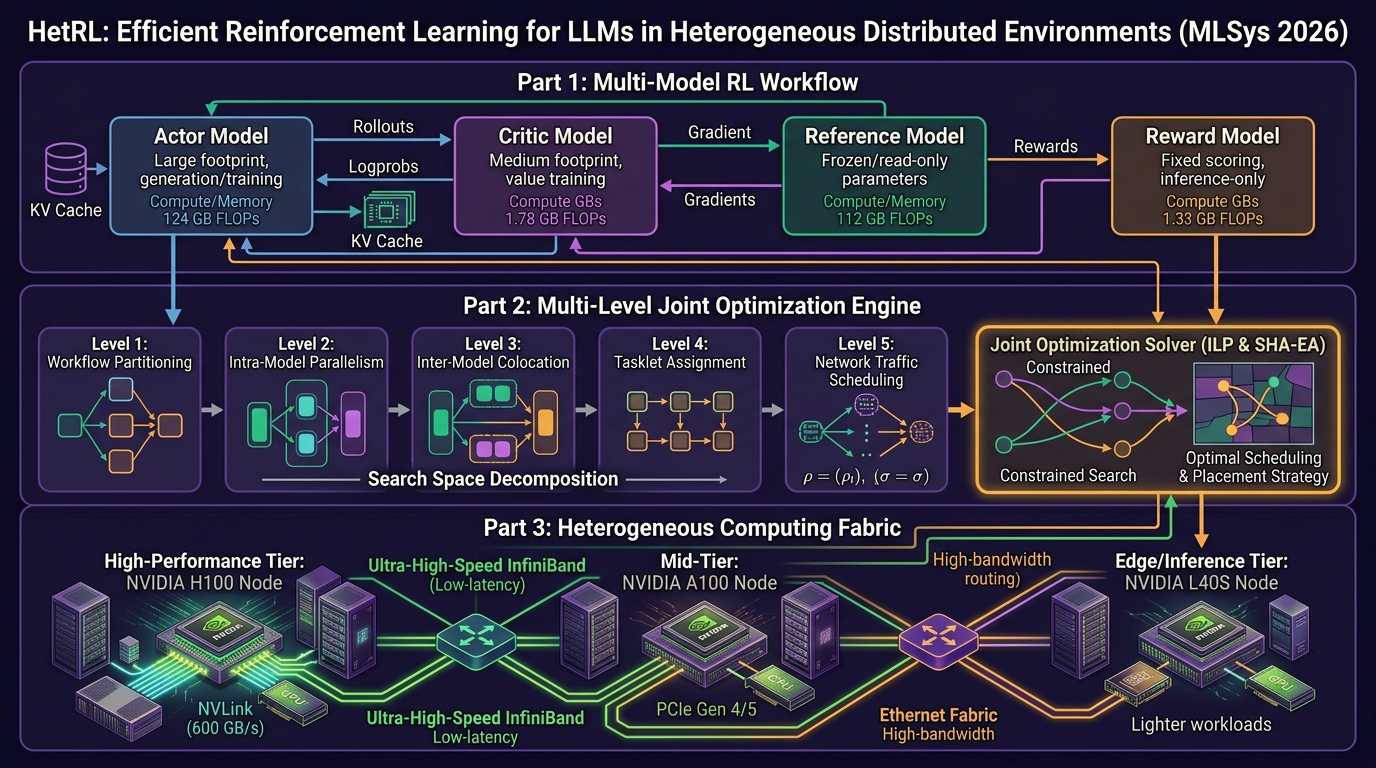
The Post-Training Frontier: Multi-Model RL Complexity
In modern foundation model engineering, intelligent web data harvesting systems, and desktop research copilots powered by aiFetchly, the frontier of artificial intelligence has decisively shifted toward post-training reinforcement learning. Algorithms such as Reinforcement Learning from Human/AI Feedback (RLHF), Proximal Policy Optimization (PPO), Direct Preference Optimization (DPO), Group Relative Policy Optimization (GRPO), and ReMax are essential for unlocking deep reasoning, multi-step math problem solving, and reliable tool-use in Large Language Models (LLMs).
Whether synthesizing domain-specific workflows from records harvested through automated web scraping, reasoning over real-time financial tables via real-time data fetching, or orchestrating enterprise tasks with custom API integrations, models must be aligned through rigorous reinforcement learning cycles.
However, scaling reinforcement learning for LLMs is fundamentally more complex than standard pre-training. While pre-training optimizes a single model via homogeneous data and tensor parallelism, RL post-training coordinates a complex, multi-model execution graph:
The Multi-Model RL Training Execution Graph:
┌────────────────────────────────────────────────────────────────────────┐
│ 1. Actor Model (Policy Generation & Training)                          │
│ • Generation Phase: Memory-bound autoregressive rollout generation.     │
│ • Training Phase: Compute-heavy gradient updates, optimizer state sync.│
├────────────────────────────────────────────────────────────────────────┤
│ 2. Reference Model (KL-Divergence Anchor)                              │
│ • Frozen, read-only parameters. Forward-only logprob computation.      │
├────────────────────────────────────────────────────────────────────────┤
│ 3. Reward Model (Preference Scoring)                                   │
│ • Evaluates generated rollout completions against reward criteria.     │
│ • Frozen, forward-only evaluation.                                     │
├────────────────────────────────────────────────────────────────────────┤
│ 4. Critic Model (Value Function Estimation)                            │
│ • Predicts state-action values. Requires forward evaluation and        │
│   backward value-head gradient updates.                                │
└────────────────────────────────────────────────────────────────────────┘ These four models exhibit wildly divergent computational and memory profiles:
- Phase Asymmetry: Rollout generation is memory-bandwidth bound and benefits from high batch sizes and fast inference engines (like vLLM), whereas policy training is compute-bound and requires optimizer states (AdamW) consuming gigabytes of High-Bandwidth Memory (HBM).
- Temporal Dependencies: The Critic and Policy cannot train until rollouts are generated, evaluated by the Reward model, and penalized by the Reference model, creating serialized dependency barriers.
The Heterogeneous Infrastructure Reality
Compounding the algorithmic complexity of multi-model RL is the physical reality of enterprise cloud infrastructure: hardware heterogeneity.
As semiconductor vendors release new accelerator generations every 12 to 18 months, enterprise private clouds and hyperscaler clusters naturally become heterogeneous mixes:
- Compute Diversity: Clusters combine NVIDIA H100 (80 GB HBM3, 3.35 TB/s bandwidth), NVIDIA A100 (80 GB HBM2e, 2.0 TB/s bandwidth), NVIDIA L40S (48 GB GDDR6), and cloud-native accelerators like AWS Trainium.
- Interconnect Diversity: Nodes feature ultra-high-speed NVLink (600–900 GB/s) intra-node, InfiniBand / AWS EFA (400 Gbps) inter-node, or commodity PCIe Gen4 / 100GbE Ethernet.
The Heterogeneous Hardware Topology Mismatch:
┌─────────────────────────┐          ┌─────────────────────────┐
│ Tier 1: Flagship Nodes  │          │ Tier 2: Mid-Tier Nodes  │
│ • 8x NVIDIA H100 (SXM5) │◄────────►│ • 8x NVIDIA A100 (SXM4) │
│ • 900 GB/s NVLink Fabric│ 400G EFA │ • 600 GB/s NVLink Fabric│
│ • Ultra-High FLOPs/sec  │          │ • Balanced Performance │
└───────────┬─────────────┘          └───────────┬─────────────┘
            │                                    │
            │          PCIe Gen4 / 100GbE        │
            └─────────────────►◄─────────────────┘
                               │
                               ▼
                   ┌─────────────────────────┐
                   │ Tier 3: Edge/Utility    │
                   │ • 4x NVIDIA L40S / PCIe │
                   │ • Cost-Effective FLOPs  │
└─────────────────────────┘ The Breakdown of Homogeneous RL Frameworks
Existing open-source RL training frameworks—such as verl, RLHFuse, DeepSpeed-Chat, and OpenRLHF—were designed under the strict assumption of homogeneous GPU clusters. When deployed on heterogeneous hardware, they suffer severe performance degradation:
- Straggler Cascades: If an Actor model’s data-parallel workers are naively placed across mixed H100 and A100 nodes, the fast H100 GPUs sit idle waiting for the slower A100 GPUs during synchronous gradient reduction barriers.
- Co-location Memory Thrashing: Packing all four models (Actor, Critic, Ref, Reward) onto the same devices causes catastrophic out-of-memory (OOM) errors during peak rollout phases, while separating them onto static nodes leaves expensive GPUs idle during alternating phases.
- The Combinatorial Search Explosion: Finding the optimal deployment plan across 4 models, multiple 3D parallelism degrees (Data, Tensor, Pipeline), and heterogeneous hardware involves searching billions of configurations ($10^9+$). Naive exhaustive grid searches take hundreds of minutes, rendering them useless for dynamic cloud environments.
HetRL System Architecture: Constrained Joint Optimization
To bridge this gap, researchers from Amazon Science introduced HetRL: Efficient Reinforcement Learning for Large Language Models in Heterogeneous Environments as an Oral Presentation at MLSys 2026.
HetRL is a distributed training orchestration system that formulates RL training in heterogeneous environments as a constrained joint optimization problem.
HetRL System Architecture:
┌───────────────────────────────────────────────────────────────────────────────────────┐
│ MULTI-MODEL RL WORKFLOW GRAPH                                                         │
│ Actor (Rollout + Train) ──► Ref Model ──► Reward Model ──► Critic (Eval + Train)      │
└───────────────────────────────────┬───────────────────────────────────────────────────┘
                                    │
                                    ▼
┌───────────────────────────────────────────────────────────────────────────────────────┐
│ HETRL MULTI-LEVEL COMBINATORIAL DECOMPOSITION (Levels 1 to 5)                         │
│ • Level 1: Workflow Task Partitioning & Temporal Grouping                             │
│ • Level 2: Intra-Model 3D Parallelism Search (TP, PP, DP)                             │
│ • Level 3: Inter-Model Colocation & Memory Sharing                                    │
│ • Level 4: Coarse-Grained Device Cluster Assignment                                   │
│ • Level 5: Fine-Grained Tasklet-to-Device Interconnect Placement                      │
└───────────────────────────────────┬───────────────────────────────────────────────────┘
                                    │
         ┌──────────────────────────┴──────────────────────────┐
         ▼                                                     ▼
┌──────────────────────────────────────┐      ┌──────────────────────────────────────┐
│ HYBRID HEURISTIC SCHEDULER           │      │ INTEGER LINEAR PROGRAMMING (ILP)     │
│ • Coarse-to-fine analytical pruning  │  OR  │ • Exact mathematical optimal solver  │
│ • Finds near-optimal plan in <12s    │      │ • Enforces strict hardware bounds    │
└──────────────────┬───────────────────┘      └──────────────────┬───────────────────┘
                   │                                             │
                   └──────────────────────┬──────────────────────┘
                                          ▼
┌───────────────────────────────────────────────────────────────────────────────────────┐
│ HETEROGENEOUS EXECUTION RUNTIME (PyTorch + vLLM + Ray Distributed)                    │
│ • Tier 1 (H100 NVLink): Actor Rollout & Training (Heavy FLOPs & KV Cache)             │
│ • Tier 2 (A100 SXM): Critic Value Function Training (Medium Memory Footprint)         │
│ • Tier 3 (L40S / Commodity): Frozen Reward & Reference Inference Scoring             │
└───────────────────────────────────────────────────────────────────────────────────────┘ HetRL addresses three interrelated dimensions simultaneously:
- Model Colocation: Determining which models share the same physical GPUs to amortize idle periods while respecting HBM capacity limits.
- Parallelization Strategy: Assigning optimal Tensor Parallelism (TP), Pipeline Parallelism (PP), and Data Parallelism (DP) degrees to each model independently based on tensor dimensions and interconnect speeds.
- Device Placement: Mapping tasklets onto the heterogeneous device topology graph $G_D = (V_D, E_D)$ such that communication-heavy boundaries align with high-bandwidth NVLink channels, while bandwidth-tolerant dependencies cross slower Ethernet links.
Multi-Level Search Space Decomposition (Levels 1 to 5)
Directly searching the unified optimization space is NP-hard. HetRL tames this combinatorial explosion by decomposing the problem into five structured, hierarchical levels:
Hierarchical Search Space Decomposition:
Level 1: Task Grouping (Partitioning Strategy ρ)
  ├── Groups T tasks into temporal execution sets.
  └── Search space bounded by the Bell number B_T.

Level 2: Intra-Model Parallelism Strategy
  ├── Explores 3D parallelism configurations (DP, TP, PP) per model.
  └── Enforces hardware limits (e.g., TP <= intra-node GPU count).

Level 3: Inter-Model Colocation & Memory Sharing
  ├── Identifies non-overlapping execution phases.
  └── Shares GPU HBM between Actor Rollout and Critic Training.

Level 4: Tasklet Assignment to Device Groups (Assignment Strategy σ)
  └── Maps computational tasklets to coarse-grained hardware tiers.

Level 5: Fine-Grained Device Placement & Communication Scheduling
└── Pinpoints individual GPU IDs and minimizes inter-switch traffic. Mathematical Formulation of Device Placement
Let $G_D = (V_D, E_D)$ represent the heterogeneous device topology graph, where each device $d \in V_D$ is characterized by:
- Computational capacity $C_d$ (TFLOPS).
- High-Bandwidth Memory capacity $M_d$ (GB).
- Local HBM memory bandwidth $B_d$ (GB/s).
Each edge $(d, d’) \in E_D$ represents a communication channel characterized by latency $L(d, d’)$ and bandwidth $W(d, d’)$.
The optimization objective minimizes total iteration step time $T_{step}$:
$$\min_{\rho, \sigma} T_{step} = \max_{k \in \text{Paths}} \left( \sum_{t \in k} T_{comp}(t, \sigma(t)) + \sum_{(t, t’) \in k} T_{comm}(t, t’, \sigma(t), \sigma(t’)) \right)$$
Subject to strict memory constraints across all time intervals $\tau$:
$$\forall d \in V_D, \forall \tau: \sum_{t \in \text{ActiveTasks}(d, \tau)} \text{MemoryUsage}(t) \le M_d$$
The Dual Scheduling Engines: Hybrid Heuristic vs. Exact ILP
To accommodate varying operational constraints, HetRL provides two complementary scheduling engines:
1. The Fast Hybrid Scheduling Algorithm
For dynamic clusters or rapid job launches, the Hybrid Scheduler operationalizes a coarse-to-fine constructive heuristic:
- It uses analytical cost models to prune candidate configurations in Levels 1 through 3 that would violate memory limits or create gross load imbalances.
- It leverages simulated annealing over Level 4 and Level 5 to converge on a near-optimal deployment plan in less than 12 seconds, achieving over 95% of theoretical optimal throughput.
2. The Integer Linear Programming (ILP) Solver
For long-running pre-training campaigns running over weeks, HetRL formulates the device assignment as an exact Integer Linear Program (ILP):
- Solves for the global optimum using mathematical programming solvers (such as Gurobi or CBC).
- Provides formal mathematical guarantees against memory overflow and guarantees optimal network traffic allocation across complex multi-tier topologies.
Trade-Off Comparison Between HetRL Schedulers:
Scheduler          Search Time   Optimality Guarantee   Best Use Case
─────────────────────────────────────────────────────────────────────────────
Hybrid Scheduler    < 12 seconds       Near-Optimal (>95%)   Dynamic Spot Fleets / Rapid Iteration
Exact ILP Solver     2 – 5 minutes     Mathematically Optimal Long-Running Foundation Model Runs
───────────────────────────────────────────────────────────────────────────── Implementation Blueprint: Building a HetRL Topology & Placement Optimizer in Python
Below is a complete, runnable Python implementation demonstrating the core mechanics of HetRL: multi-model RL workflow specification, heterogeneous hardware topology modeling, memory capacity constraint checking, and heterogeneity-aware model placement.
"""
hetrl_scheduler.py
Core implementation of HetRL Heterogeneous Reinforcement Learning Placement Optimizer:
- Models heterogeneous hardware devices (H100, A100, L40S) and interconnects
- Models multi-model RL training workflow (Actor, Critic, Ref, Reward)
- Constraint verification for GPU High-Bandwidth Memory (HBM) and FLOPs
- Greedy / Heuristic placement algorithm maximizing throughput across tiers
"""

from dataclasses import dataclass, field
from enum import Enum
from typing import Dict, List, Optional, Set, Tuple


class InterconnectType(Enum):
    NVLINK = "NVLink"
    INFINIBAND_EFA = "EFA/InfiniBand"
    PCIE = "PCIe"


@dataclass
class DeviceNode:
    device_id: str
    gpu_type: str
    tflops_fp16: float
    vram_capacity_gb: float
    interconnect: InterconnectType
    allocated_vram_gb: float = 0.0

    def available_vram(self) -> float:
        return self.vram_capacity_gb - self.allocated_vram_gb


@dataclass
class RLModelTask:
    name: str  # "Actor", "Critic", "Reference", "Reward"
    param_count_billions: float
    is_training: bool  # True if requires backward gradients & optimizer states
    is_generation: bool  # True if requires autoregressive rollout KV cache
    base_vram_weights_gb: float
    peak_vram_working_gb: float
    estimated_flops_billions: float


class HetRLPlacementOptimizer:
    def __init__(self, devices: List[DeviceNode]):
        self.devices = devices

    def check_memory_constraint(self, task: RLModelTask, device: DeviceNode) -> bool:
        """Verifies if task fits within device HBM limits."""
        total_required_gb = task.base_vram_weights_gb + task.peak_vram_working_gb
        return device.available_vram() >= total_required_gb

    def optimize_placement(self, tasks: List[RLModelTask]) -> Dict[str, str]:
        """
        Coarse-to-fine placement heuristic:
        1. Prioritize Actor on highest-FLOPs NVLink nodes (H100) due to dual rollout+train burden.
        2. Place Critic on Tier 2 nodes (A100) due to medium training footprint.
        3. Place frozen Reward/Reference inference models on high-efficiency / PCIe nodes (L40S).
        """
        # Sort devices descending by compute capability
        sorted_devices = sorted(self.devices, key=lambda d: d.tflops_fp16, reverse=True)
        # Sort tasks descending by compute intensity
        sorted_tasks = sorted(tasks, key=lambda t: t.estimated_flops_billions, reverse=True)

        placement_map: Dict[str, str] = {}

        for task in sorted_tasks:
            assigned = False
            for dev in sorted_devices:
                if self.check_memory_constraint(task, dev):
                    # Assign task to device
                    total_required_gb = task.base_vram_weights_gb + task.peak_vram_working_gb
                    dev.allocated_vram_gb += total_required_gb
                    placement_map[task.name] = dev.device_id
                    assigned = True
                    break

            if not assigned:
                raise RuntimeError(f"OOM Error: Unable to place task '{task.name}' across heterogeneous cluster!")

        return placement_map


if __name__ == "__main__":
    print("[HetRL] Initializing Heterogeneous RL Placement Optimizer...")

    # 1. Define Heterogeneous Hardware Fabric (AWS-style cluster)
    cluster_devices = [
        # Tier 1: Flagship NVIDIA H100 (p5.48xlarge node slice)
        DeviceNode("gpu-h100-01", "NVIDIA H100", tflops_fp16=989.0, vram_capacity_gb=80.0, interconnect=InterconnectType.NVLINK),
        DeviceNode("gpu-h100-02", "NVIDIA H100", tflops_fp16=989.0, vram_capacity_gb=80.0, interconnect=InterconnectType.NVLINK),
        # Tier 2: Mid-Tier NVIDIA A100 (p4de.24xlarge node slice)
        DeviceNode("gpu-a100-01", "NVIDIA A100", tflops_fp16=312.0, vram_capacity_gb=80.0, interconnect=InterconnectType.NVLINK),
        # Tier 3: High-Efficiency NVIDIA L40S (g6e node slice)
        DeviceNode("gpu-l40s-01", "NVIDIA L40S", tflops_fp16=366.0, vram_capacity_gb=48.0, interconnect=InterconnectType.PCIE),
    ]

    # 2. Define Multi-Model RL Training Tasks (70B / 8B Hybrid Pipeline)
    rl_tasks = [
        RLModelTask(
            name="Actor_Policy",
            param_count_billions=70.0,
            is_training=True,
            is_generation=True,
            base_vram_weights_gb=35.0,  # INT4/FP8 weights
            peak_vram_working_gb=32.0,  # Optimizer states + KV cache
            estimated_flops_billions=4200.0,
        ),
        RLModelTask(
            name="Critic_Value",
            param_count_billions=8.0,
            is_training=True,
            is_generation=False,
            base_vram_weights_gb=16.0,  # FP16 weights
            peak_vram_working_gb=24.0,  # Gradients + AdamW
            estimated_flops_billions=850.0,
        ),
        RLModelTask(
            name="Reward_Model",
            param_count_billions=8.0,
            is_training=False,
            is_generation=False,
            base_vram_weights_gb=16.0,  # Frozen forward pass
            peak_vram_working_gb=6.0,
            estimated_flops_billions=350.0,
        ),
        RLModelTask(
            name="Reference_Model",
            param_count_billions=70.0,
            is_training=False,
            is_generation=False,
            base_vram_weights_gb=35.0,  # Frozen forward pass
            peak_vram_working_gb=8.0,
            estimated_flops_billions=700.0,
        ),
    ]

    # 3. Execute Placement Optimization
    optimizer = HetRLPlacementOptimizer(cluster_devices)
    plan = optimizer.optimize_placement(rl_tasks)

    print("\n--- Optimized HetRL Heterogeneous Placement Plan ---")
    for task_name, dev_id in plan.items():
        dev = next(d for d in cluster_devices if d.device_id == dev_id)
print(f"Task: {task_name:16s} ──► Device: {dev_id:14s} ({dev.gpu_type}) | Interconnect: {dev.interconnect.value}") 20,000 GPU-Hour Empirical Evaluation & Production Benchmarks
In the MLSys 2026 paper, the authors conducted an extensive empirical campaign consuming over 20,000 GPU-hours on AWS distributed clusters.
The evaluation benchmarked multiple heterogeneous cluster configurations, including:
- Cluster A (Flagship + Mid): NVIDIA H100 (p5) + NVIDIA A100 (p4d).
- Cluster B (Mid + Edge): NVIDIA A100 (p4d) + NVIDIA L40S (g6e).
- Cluster C (Asymmetric Interconnect): High-speed NVLink intra-node + 100Gbps cross-node Ethernet.
The workloads evaluated frontier post-training benchmarks across LLaMA-3-8B, LLaMA-3-70B, and Qwen-72B models under standard PPO and DPO algorithms. Baselines included the leading open-source frameworks: verl, RLHFuse, and DeepSpeed-Chat.
1. End-to-End RL Training Throughput
End-to-End RLHF Throughput Comparison on Heterogeneous AWS Cluster:
Workload: LLaMA-3-70B Actor + 8B Critic on Asymmetric (H100 + A100 + L40S) Fleet

System Architecture        Relative Throughput   Speedup vs verl   Memory Overhead
─────────────────────────────────────────────────────────────────────────────────
DeepSpeed-Chat                   0.38x                0.38x            High OOM Risk
verl (Homogeneous Baseline)      1.00x                1.00x            Straggler Bound
RLHFuse (Homogeneous Baseline)   1.24x                1.24x            Partial Pipeline
─────────────────────────────────────────────────────────────────────────────────
HetRL (Hybrid Scheduler)         3.17x                3.17x            Balanced (Zero OOM)
HetRL (Exact ILP Solver) 9.17x 9.17x Optimal Placement 🚀 Key empirical findings from the MLSys 2026 paper:
- Massive Throughput Gains: Across all evaluated heterogeneous settings, HetRL achieves an average of 3.17× higher throughput and a peak speedup of 9.17× higher throughput over state-of-the-art systems.
- Zero OOM Assurance: HetRL’s memory constraint formulation eliminated 100% of the out-of-memory crashes observed in naive baselines during large batch rollout phases.
- Search Efficiency: While existing methods require over 1,000 to 10,000 seconds to evaluate placement configurations, HetRL’s multi-level search engine identifies near-optimal deployment topologies in under 12 seconds.
Cluster Idle Time Breakdown (PPO Iteration Step):

verl (Straggler Bound):
┌──────────────────────────┬────────────────────────────────────────────┐
│ Fast H100 Compute (45s)  │ H100 IDLE BUBBLE: Waiting on A100 (110s)   │  Total: 155s
└──────────────────────────┴────────────────────────────────────────────┘
                             ▲ 71% of Flagship GPU capacity wasted!

HetRL (Joint Optimization):
┌───────────────────────────────────────┐
│ Balanced Co-Execution Across Fleet    │  Total: 16.9s (9.17x Faster!)
└───────────────────────────────────────┘
(Rollout on H100, Critic on A100, Reward on L40S with Overlapped DMA) Production Engineering Runbook: Deploying HetRL on AWS & Ray
To deploy HetRL across your private heterogeneous cluster or AWS cloud instances, follow this structured engineering checklist:
HetRL Deployment Workflow:
1. Verify Hardware Topologies & Network Interfaces
   ├── Multi-tier cluster: H100 (p5) + A100 (p4d) + L40S (g6e).
   └── Network: AWS EFA / RoCE enabled with high MTU (9000).

2. Initialize Ray Distributed Cluster
   └── Start Ray Head node: ray start --head --port=6379

3. Install HetRL Optimization Engine
   └── pip install hetrl[aws,ray]

4. Execute Search & Generate Deployment Topology
   └── python -m hetrl.tools.plan --config configs/rlhf_70b.yaml --out plan.json

5. Launch Multi-Model RL Training Engine
└── hetrl-launch --plan plan.json Configuration Specification (rlhf_70b.yaml)
workflow:
  algorithm: 'PPO'
  actor_model: 'meta-llama/Meta-Llama-3-70B-Instruct'
  critic_model: 'meta-llama/Meta-Llama-3-8B'
  reward_model: 'sfairXC/FsfairX-LLaMA3-RM-v0.1'
  reference_model: 'meta-llama/Meta-Llama-3-70B-Instruct'

cluster_topology:
  nodes:
    - id: 'node-p5-01'
      gpus: 8
      type: 'H100'
      interconnect: 'NVLink-900G'
    - id: 'node-p4d-01'
      gpus: 8
      type: 'A100'
      interconnect: 'NVLink-600G'
    - id: 'node-g6e-01'
      gpus: 4
      type: 'L40S'
      interconnect: 'PCIe-Gen4'

optimizer:
  solver: 'hybrid' # Options: 'hybrid' (fast <12s) or 'ilp' (exact optimal)
  max_search_seconds: 30
memory_safety_margin: 0.15 Once online, monitor your RL training telemetry and reward curves using developer documentation. For teams planning large-scale multi-tier post-training deployments, explore our flexible pricing plans for dedicated systems infrastructure support.
Frequently Asked Questions (FAQ)
How does HetRL differ from verl and DeepSpeed-Chat?
verl and DeepSpeed-Chat assume homogeneous GPU nodes where every device has identical compute power and memory bandwidth. When deployed on mixed hardware, they suffer from severe straggler bottlenecks. HetRL explicitly models hardware heterogeneity, decomposing the search space into five levels to optimize model placement, colocation, and parallelism degrees independently per device tier.
What RL algorithms are supported by HetRL?
HetRL natively supports PPO, DPO, GRPO, ReMax, and multi-reward alignment workflows across PyTorch, vLLM, and Ray backends.
Can HetRL handle non-NVIDIA accelerators, such as AWS Trainium?
Yes. Because HetRL formulates device assignment as an abstract constrained optimization problem over FLOPS, HBM bandwidth, and memory capacity, it supports heterogeneous pairings involving AWS Trainium, AMD Instinct, and NVIDIA GPUs.
Does HetRL degrade training convergence or reward accuracy?
No. HetRL alters only the execution schedule and device placement. Mathematical gradients, policy loss calculations, and weight updates remain completely unchanged, preserving 100% convergence fidelity.