Haystack Guide: Composable RAG Pipeline Architecture
The Problem: The Hidden Chains and Implicit State Chaos in Legacy RAG
In modern enterprise automation, automated data extraction platforms, and autonomous intelligence workflows powered by AiFetchly, Retrieval-Augmented Generation (RAG) is the primary bridge connecting foundation models to proprietary knowledge bases. RAG pipelines must parse multi-format documents, generate dense vector embeddings, query high-scale vector indices, rerank candidate passages, format dynamic prompt contexts, and stream verified responses to end users.
However, as generative AI moved from quick notebook demonstrations to mission-critical enterprise systems, engineering teams discovered that early RAG libraries (such as early LangChain and monolithic chain wrappers) introduced severe architectural liabilities:
The Legacy RAG Chain Vulnerability:
┌─────────────────────────────────────────────────────────────────┐
│ 1. Opaque "Black-Box" Abstractions                             │
│ • Hidden data transformations buried inside monolithic classes  │
│ ❌ Developers cannot inspect intermediate data without hacks    │
├─────────────────────────────────────────────────────────────────┤
│ 2. Implicit Dictionary Passing & Typeless Sockets               │
│ • Components pass unvalidated dicts: {'input': x, 'docs': y}   │
│ ❌ Silent runtime KeyError crashes in production at 3:00 AM     │
├─────────────────────────────────────────────────────────────────┤
│ 3. Linear Rigidity (No Native Cycles or Parallelism)            │
│ • Forcing multi-stage retrieval into linear sequential chains    │
│ ❌ Cannot execute parallel hybrid search or cyclic agent loops  │
├─────────────────────────────────────────────────────────────────┤
│ 4. Tight Vendor Coupling & Zero Serialization                   │
│ • Proprietary wrapper objects bound directly to code logic     │
│ ❌ Impossible to serialize, audit, or hot-swap pipelines        │
└─────────────────────────────────────────────────────────────────┘
Result: Production RAG pipelines become brittle, untestable, and impossible to debug! 1. The Opaque “Black-Box” Chain Fallacy
Early generative AI frameworks popularized linear “chains” (e.g., RetrievalQA.from_chain_type):
- These monolithic abstractions encapsulated text splitting, embedding generation, vector search, prompt assembly, and LLM inference into a single opaque function call.
- When an LLM produced a hallucinated answer or suffered high latency, developers could not determine whether the failure was caused by the vector search retriever, the prompt formatting template, or the model generation step without injecting monkey-patches into the library’s internal source code.
2. The Fragility of Implicit Dictionary State
In untyped chain architectures:
- Components communicate by mutating a shared, untyped dictionary (
dict[str, Any]). - A prompt template expects a key named
"context", but an upstream retriever emits"documents". The framework provides no static validation: the code compiles and initializes cleanly, only to crash with a fatal runtimeKeyErrorhours later under user traffic. - Refactoring prompts or upgrading dependencies becomes an error-prone guessing game.
3. Linear Rigidity vs. Real-World RAG Complexity
Real-world enterprise search rarely follows a single linear path:
- High-precision RAG requires parallel branch execution: simultaneously querying a dense vector index in Qdrant and a sparse BM25 index, then merging results with a reciprocal rank fusion reranker.
- Autonomous agents require cyclic graph execution: generating a hypothesis, calling a tool, evaluating the observation, and looping back until a confidence threshold is satisfied.
- Chained frameworks were fundamentally incapable of modeling cycles or complex branches without unwieldy external graph orchestrators.
The Solution: Haystack 2.0’s Composable Graph Architecture
To bring true software engineering rigor, transparency, and modularity to retrieval and generative AI applications, deepset completely redesigned their flagship framework from the ground up to create Haystack 2.0 (and its modern 3.x evolutions).
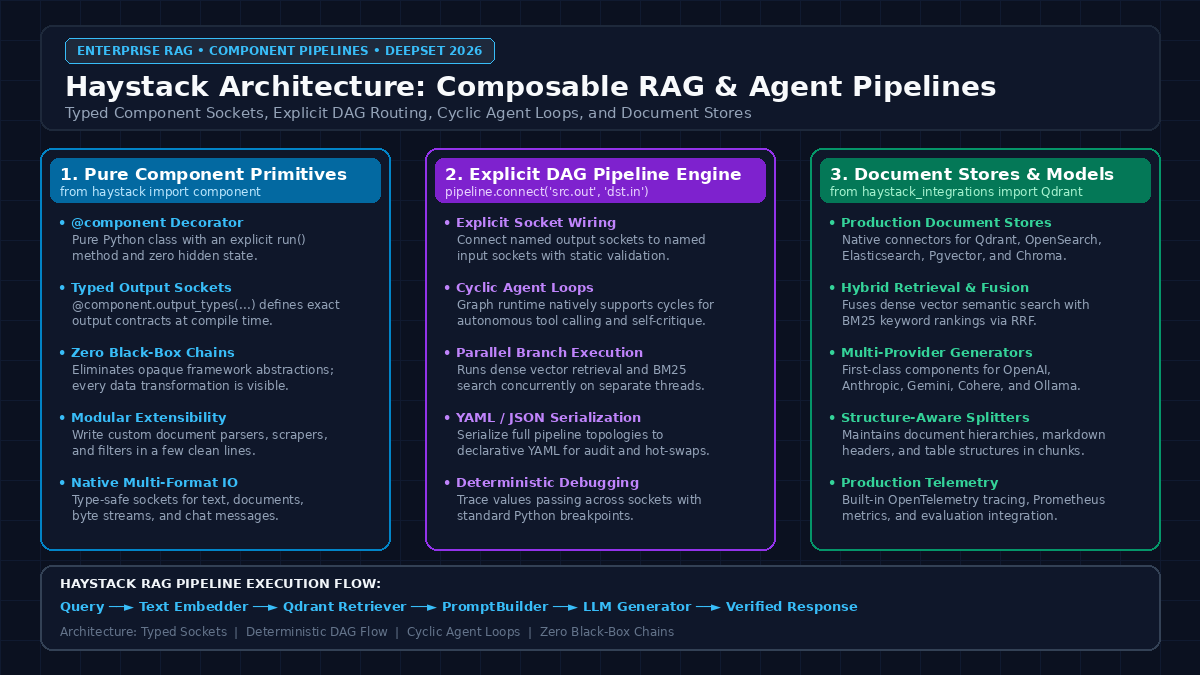
Haystack is an open-source, Apache 2.0 Python framework designed specifically for production search, RAG, and agentic systems. Rather than hiding complexity behind magic chains, Haystack enforces an explicit Component and Pipeline architecture:
Haystack Composable Pipeline Topology:
┌─────────────────────────────────────────────────────────────────┐
│ User Query Ingestion (Text String)                              │
└─────────────────────────────────────────────────────────────────┘
 │
 ├──► Component 1: OpenAITextEmbedder
 │     └── Sockets: text (in) ──► embedding: list[float] (out)
 │                                │
 │ ┌──────────────────────────────┘
 │ ▼
 ├──► Component 2: QdrantEmbeddingRetriever
 │     └── Sockets: query_embedding (in) ──► documents: list[Document] (out)
 │                                            │
 │ ┌──────────────────────────────────────────┘
 │ ▼
 ├──► Component 3: PromptBuilder (Template: "Context: {{ documents }}...")
 │     └── Sockets: documents (in), query (in) ──► prompt: str (out)
 │                                                  │
 │ ┌────────────────────────────────────────────────┘
 │ ▼
 └──► Component 4: OpenAIChatGenerator
└── Sockets: messages / prompt (in) ──► replies: list[ChatMessage] (out) The Architectural Pillars of Haystack 2.0
- Pure Component Abstraction (
@component): Every building block in Haystack is an isolated Python class decorated with@component. A component defines its inputs and outputs via strict type annotations, receives data only through itsrun()method, and maintains zero hidden global state. - Explicit Directed Graph (
Pipeline.connect): Pipelines are directed graphs of components. Developers explicitly wire named output sockets of one component into named input sockets of another (e.g.,pipeline.connect("retriever.documents", "prompt_builder.documents")). - Compile-Time Socket Type Validation: When
pipeline.connect()is called, Haystack statically inspects the input and output types. If a developer attempts to connect alist[Document]socket to an integer parameter, Haystack raises a clear validation error immediately at pipeline build time—long before processing a single user query. - Native Cyclic Agent Loops: The pipeline execution engine natively supports directed cycles, allowing autonomous agents to loop between reasoning steps, tool calling, and self-reflection without requiring a separate state-machine framework.
- Declarative Pipeline Serialization: Pipelines can be serialized to and deserialized from standard YAML or JSON. Teams can version-control full RAG architectures as infrastructure-as-code, audit pipeline topologies, and hot-swap prompt templates in production without redeploying code.
Comparing RAG Orchestration Paradigms
The table below contrasts Haystack 2.0 against other popular LLM application frameworks:
RAG Framework Architectural Comparison:
┌───────────────────────────┬───────────────────────────────┬───────────────────────────────┬───────────────────────────────┐
│ Feature / Dimension       │ LangChain (LCEL)              │ LlamaIndex Workflows          │ Haystack 2.0 (deepset)        │
├───────────────────────────┼───────────────────────────────┼───────────────────────────────┼───────────────────────────────┤
│ Core Abstraction          │ Runnable / Pipe `|` Operator  │ Event-driven step functions   │ Pure `@component` & `Pipeline`│
│ Socket Wiring             │ Implicit dictionary piping    │ Event dispatchers / listeners │ Explicit `pipeline.connect()` │
│ Type Safety & Validation  │ Runtime Pydantic validation   │ Type hints on event classes   │ Static socket type validation │
│ Pipeline Inspectability   │ Difficult (nested chains)     │ Step-by-step event logs       │ Native graph DAG visualizer   │
│ Cyclic Execution (Agents) │ Requires LangGraph add-on     │ Native event loops            │ Native pipeline graph cycles  │
│ Configuration / Export    │ Python code only              │ Python code only              │ Declarative YAML / JSON       │
│ Document Store Focus      │ Broad community wrappers      │ Data index abstractions       │ Production enterprise search  │
│ Native Observability      │ LangSmith (Proprietary SaaS)  │ LlamaTrace                    │ OpenTelemetry / Langfuse native│
└───────────────────────────┴───────────────────────────────┴───────────────────────────────┴───────────────────────────────┘ Deep Dive into Haystack Primitives & Systems Architecture
Haystack structures all information processing through three decoupled primitives: Components, Pipelines, and Document Stores.
Haystack Core Systems Hierarchy:
Haystack Architecture
 ├──► 1. Components (@component): Isolated execution units with typed input/output sockets
 ├──► 2. Pipeline: Directed graph coordinating execution order, validation, and cycles
 ├──► 3. Document Stores: Storage engines abstracting vector, BM25, and metadata indexing
 ├──► 4. Serialization Engine: Dumps and loads entire pipelines to declarative YAML
└──► 5. Telemetry Bridge: OpenTelemetry tracing tracking spans across all pipeline nodes 1. The @component Decorator & Output Types Contract
In Haystack 2.0, creating a component requires no subclassing of heavyweight framework base classes. Any Python class can become a component:
from typing import List
from haystack import component, Document

@component
class KeywordFilter:
    """Filters candidate documents containing banned or irrelevant terms."""

    @component.output_types(passed_documents=List[Document], filtered_count=int)
    def run(self, documents: List[Document], banned_keywords: List[str]):
        passed = [
            doc for doc in documents
            if not any(k.lower() in doc.content.lower() for k in banned_keywords)
        ]
        return {
            "passed_documents": passed,
            "filtered_count": len(documents) - len(passed)
} - Output Socket Declaration: The
@component.output_typesdecorator defines the exact dictionary keys and types returned by the component. - Pure Execution: The
run()method is a standard synchronous or asynchronous Python method. It receives arguments explicitly and returns a dictionary matching its declared output types. - Zero Framework Leakage: Testing a component requires zero mocks: simply instantiate the class and call
run()with standard Python objects.
2. The Directed Graph Pipeline Engine
The Pipeline is responsible for graph assembly, validation, and execution scheduling:
- Component Registration: Components are added via
pipeline.add_component(name, instance). - Explicit Connection: Components are connected via
pipeline.connect("sender_component.output_socket", "receiver_component.input_socket"). - Execution Order Determination: Haystack analyzes socket dependencies and executes nodes in topological order. When multiple components are ready to execute (e.g., in a hybrid search pipeline), Haystack can run them concurrently in worker threads.
3. Native Cyclic Execution for Autonomous Agents
Unlike classical DAG engines (like Apache Airflow) which strictly forbid cycles, Haystack’s pipeline engine natively supports directed cyclic graphs:
- A component can pass data back to an earlier component in the pipeline.
- This enables autonomous agent patterns: an LLM generates a tool call, a tool executor runs the action, and the result loops back into the LLM’s input socket until the agent emits a final completion token.
- Haystack provides built-in safety controls (such as
max_loops_allowed) to prevent infinite recursion bugs.
4. Pluggable Enterprise Document Stores
Haystack treats data storage as a first-class citizen through its DocumentStore protocol:
- Supports native high-performance vector databases such as Qdrant (
qdrant-haystack), OpenSearch, Elasticsearch, PostgreSQL (Pgvector), and Chroma. - Completely decouples document storage from embedding models: documents are indexed with rich metadata payloads, enabling precise filtering by tenant, category, or timestamp.
Hands-On Implementation: Building an Enterprise RAG Pipeline in Haystack 2.0
Let’s build a complete, production-ready Retrieval-Augmented Generation pipeline using Haystack 2.0, Qdrant as the in-memory vector store, and OpenAI for embedding generation and answer synthesis.
1. Environment & Package Installation
Install Haystack, the Qdrant integration, and OpenAI dependencies:
pip install haystack-ai qdrant-haystack Set your OpenAI API key:
export OPENAI_API_KEY="sk-..." 2. Complete Code Implementation (haystack_rag_pipeline.py)
import os
from haystack import Document, Pipeline
from haystack.components.builders import PromptBuilder
from haystack.components.embedders import OpenAITextEmbedder, OpenAIDocumentEmbedder
from haystack.components.generators import OpenAIChatGenerator
from haystack.dataclasses import ChatMessage
from haystack_integrations.document_stores.qdrant import QdrantDocumentStore
from haystack_integrations.components.retrievers.qdrant import QdrantEmbeddingRetriever

# 1. Verify API Key
if not os.getenv("OPENAI_API_KEY"):
    raise ValueError("OPENAI_API_KEY environment variable is required.")

print("Initializing Enterprise Document Store (Qdrant)...")

# 2. Initialize In-Memory Qdrant Document Store
document_store = QdrantDocumentStore(
    ":memory:",
    recreate_index=True,
    embedding_dim=1536  # Matches text-embedding-3-small
)

# 3. Populate Document Store with Enterprise Technical Docs
sample_docs = [
    Document(
        content="aiFetchly is an autonomous desktop platform for web intelligence, automated scraping, and local AI agent execution.",
        meta={"source": "overview", "product": "aiFetchly"}
    ),
    Document(
        content="Haystack 2.0 uses explicit typed component sockets and directed graph pipelines for deterministic enterprise RAG.",
        meta={"source": "architecture", "framework": "Haystack"}
    ),
    Document(
        content="Qdrant provides Rust-native vector search with in-graph payload filtering and binary quantization for sub-millisecond retrieval.",
        meta={"source": "infrastructure", "engine": "Qdrant"}
    )
]

# 4. Generate Embeddings and Index Documents
doc_embedder = OpenAIDocumentEmbedder(model="text-embedding-3-small")
indexed_docs = doc_embedder.run(documents=sample_docs)["documents"]
document_store.write_documents(indexed_docs)
print(f"Indexed {len(indexed_docs)} documents into Qdrant successfully.")

# 5. Define Custom Prompt Template with Jinja2 Syntax
template = """
You are a senior technical analyst. Use the provided context documents to answer the user inquiry accurately.

Context:
{% for doc in documents %}
- [Source: {{ doc.meta.source }}]: {{ doc.content }}
{% endfor %}

User Inquiry: {{ query }}

Provide a clear, grounded technical response.
"""

# 6. Instantiate Pipeline Components
query_embedder = OpenAITextEmbedder(model="text-embedding-3-small")
retriever = QdrantEmbeddingRetriever(document_store=document_store, top_k=2)
prompt_builder = PromptBuilder(template=template)
generator = OpenAIChatGenerator(model="gpt-4o")

# 7. Assemble the Explicit Directed Graph Pipeline
rag_pipeline = Pipeline()

# Add components to the pipeline
rag_pipeline.add_component("text_embedder", query_embedder)
rag_pipeline.add_component("retriever", retriever)
rag_pipeline.add_component("prompt_builder", prompt_builder)
rag_pipeline.add_component("llm", generator)

# Explicitly wire typed sockets
# text_embedder.embedding -> retriever.query_embedding
rag_pipeline.connect("text_embedder.embedding", "retriever.query_embedding")

# retriever.documents -> prompt_builder.documents
rag_pipeline.connect("retriever.documents", "prompt_builder.documents")

# prompt_builder.prompt -> llm.messages
# Haystack automatically converts string prompts into user ChatMessages if needed
rag_pipeline.connect("prompt_builder.prompt", "llm.messages")

print("Pipeline assembled and static socket types validated successfully.")

# 8. Execute the Pipeline
if __name__ == "__main__":
    user_query = "How does Haystack 2.0 ensure deterministic dataflow in RAG pipelines?"
    print(f"\nUser Query: '{user_query}'")

    # Run the pipeline: inputs are passed to specific component sockets
    response = rag_pipeline.run({
        "text_embedder": {"text": user_query},
        "prompt_builder": {"query": user_query}
    })

    # Extract output from the generator component
    replies = response["llm"]["replies"]

    print("\n--- Synthesized Answer ---")
    for reply in replies:
print(reply.text) 3. Execution Output and Pipeline Inspection
Run the script:
python haystack_rag_pipeline.py - Static Verification: During
pipeline.connect(), Haystack verifies thattext_embedder.embeddingoutputslist[float], exactly matchingretriever.query_embedding’s expected input type. - Isolated Debugging: The
responsedictionary contains the exact outputs of every component in the graph (response["retriever"]["documents"],response["prompt_builder"]["prompt"]), making it trivial to audit retrieved chunks and verify prompt formatting without complex logging tools.
Production Architecture & Best Practices for aiFetchly
Integrating Haystack 2.0 into high-throughput desktop copilots, automated web harvesting engines, and document intelligence pipelines in AiFetchly establishes a scalable, production-ready architecture.
aiFetchly Enterprise Haystack RAG Architecture:
┌─────────────────────────────────────────────────────────────────┐
│ aiFetchly Web Intelligence & Data Extraction Pipeline           │
└─────────────────────────────────────────────────────────────────┘
 │
 ▼
┌─────────────────────────────────────────────────────────────────┐
│ Haystack Ingestion & Indexing Pipeline                          │
│ ├──► Document Converters (HTML / PDF / Markdown Extractors)     │
│ ├──► Structure-Aware Chunker (Preserves Tables & Headers)       │
│ └──► Batch Document Embedder (OpenAI / FastEmbed)               │
└─────────────────────────────────────────────────────────────────┘
 │
 ▼ (Parallel Dense & Sparse Indexing)
┌─────────────────────────────────────────────────────────────────┐
│ Qdrant Vector Engine & PostgreSQL Metadata Store                │
│ • Dense vector index + In-graph payload filtering               │
└─────────────────────────────────────────────────────────────────┘
 │
 ▼
┌─────────────────────────────────────────────────────────────────┐
│ Haystack Query & Reasoning Pipeline                             │
│ ├──► Query Embedder ──► Qdrant Retriever                        │
│ ├──► Cross-Encoder Reranker (Filters Semantic Distractors)      │
│ ├──► FastMCP Tool Bridge (Dispatches Actions to Local Tools)    │
│ └──► OpenTelemetry Exporter (Sends Traces to Langfuse)          │
└─────────────────────────────────────────────────────────────────┘ 1. Hybrid Search with Reciprocal Rank Fusion (RRF)
For high-precision technical documentation search:
- Use Haystack’s branching pipeline capabilities to execute dense vector search and BM25 sparse keyword search in parallel.
- Connect both retriever outputs into a
DocumentJoinercomponent using Reciprocal Rank Fusion (RRF). - This ensures rare technical identifiers (e.g., error codes, function signatures) match via BM25, while broad conceptual inquiries match via dense embeddings.
2. Full-Lifecycle Observability with Langfuse
To monitor RAG quality and token expenditures in production:
- Enable Haystack’s native OpenTelemetry tracer.
- Route telemetry to an open-source observability platform like Langfuse.
- Every component execution in the Haystack pipeline appears as a discrete span within the parent trace, providing instant visibility into retriever latency, token costs, and LLM Time-to-First-Token.
3. Declarative YAML Pipeline Deployments
To ensure continuous deployment without code regressions:
- Serialize validated Haystack pipelines into YAML files:
with open("production_rag_pipeline.yaml", "w") as f: rag_pipeline.dump(f) - Load pipelines dynamically in production services using
Pipeline.load(f). - This decouples search pipeline definitions from application code, allowing prompt engineers and data scientists to optimize prompt templates and retrieval hyperparameters without redeploying the core application binary.
Summary: Engineering Clarity in the Age of Generative AI
As generative AI applications transition from experimental prototypes to mission-critical enterprise systems, the software engineering practices surrounding LLM orchestration must evolve.
By replacing opaque chains and implicit state dictionaries with pure @component primitives, explicit typed socket connections, native cyclic agent loops, and declarative YAML serialization, deepset’s Haystack 2.0 brings clarity and determinism to RAG architectures. For autonomous research copilots, complex document intelligence systems, and high-throughput data extraction platforms powered by AiFetchly, Haystack establishes the architectural standard for composable, production-ready AI engineering.