Hallo2 Guide: 4K Long-Duration Audio-Driven Avatar AI
Problem: The Long-Duration Degradation and 4K Resolution Ceiling
Audio-driven portrait animation—synthesizing expressive, photorealistic video of a human character from a single static image synchronized to acoustic speech—has transitioned from an academic curiosity into an indispensable pillar of modern digital media. In enterprise environments, digital avatars power autonomous virtual anchors, interactive customer support agents, automated video localization from corpora cataloged via automated video asset curation, and dynamic conversational interfaces streaming from real-time audio stream ingestion.
Despite the recent explosion of diffusion-based portrait generators (such as the original Hallo, EMO, AniPortrait, and SadTalker), existing open-source frameworks exhibit two severe technological bottlenecks that prevent enterprise deployment: the long-duration error cascade and the low-resolution blurry ceiling.
+----------------------------------------------------------------------------------------------------+
|                         THE CONVENTIONAL PORTRAIT DIFFUSION CEILING                                |
+------------------------------------+---------------------------------------------------------------+
| Systemic Structural Failure        | Real-World Degradation in Audio-Driven Video Synthesis        |
+------------------------------------+---------------------------------------------------------------+
| Appearance Drift & Identity Loss   | Incremental generation propagates small facial distortions;   |
| (Error Accumulation Cascade)       | after 10-20 seconds, faces melt, blur, or mutate into clones  |
+------------------------------------+---------------------------------------------------------------+
| Resolution Constraint (512x512)    | Diffusion backbones operate in heavily downsampled latent     |
| (The Blurry Low-Res Barrier)       | spaces; upscaling to 4K causes severe temporal flickering     |
+------------------------------------+---------------------------------------------------------------+
| Parallel Stitching Incoherence     | Generating clips independently in parallel enforces boundary  |
| (The Discontinuity Stutter)        | constraints that suppress mouth opening and freeze motion     |
+------------------------------------+---------------------------------------------------------------+
| Monolithic Uncontrollability       | Audio controls phonemes, but emotional inflection, smile      |
| (Missing Semantic Text Steering)   | intensity, and head tilt cannot be directed or modified       |
+------------------------------------+---------------------------------------------------------------+ The Long-Duration Error Accumulation Cascade
Current diffusion frameworks synthesize extended video sequences using one of two flawed operational strategies:
- Parallel Clip Generation: Independent video clips (e.g., 16 frames each) are generated simultaneously based on partitioned audio segments, followed by blending constraints applied across adjacent boundaries. However, enforcing appearance continuity across independently generated boundaries forces the model to minimize inter-frame displacement. This suppresses dynamic expression, freezes head rotation, and causes unnatural mouth smearing.
- Incremental Autoregressive Generation: Each new video clip conditions on the preceding generated frames to maintain motion momentum. While this permits fluid motion in short clips, it creates an unavoidable compounding error cascade:
- Any minor visual imperfection generated in frame $t-1$ (such as slight skin smoothing, asymmetric eye closure, or lighting drift) becomes part of the conditioning input for frame $t$.
- As generation continues beyond 30 seconds into multiple minutes, appearance information from preceding frames contaminates the reference identity.
- By minute 2, the subject’s facial geometry drifts, background lines warp, skin textures turn waxy, and the video degrades into severe visual noise.
The 4K Resolution Ceiling and Temporal Flickering
The overwhelming majority of latent diffusion models operate at $512 \times 512$ resolution (corresponding to a $64 \times 64$ latent tensor under an $8\times$ downsampling VAE).
Attempting to scale portrait diffusion to broadcast-grade 4K Ultra-HD ($3840 \times 2160$) reveals catastrophic scaling barriers:
- Quadratic Memory Explosion: Computing full spatial self-attention on a 4K latent tensor ($480 \times 270 = 129,600$ spatial tokens per frame) explodes GPU VRAM by over $50\times$, exceeding the memory limits of even Nvidia H100 clusters.
- Temporal High-Frequency Flickering: Applying conventional spatial super-resolution models (such as Real-ESRGAN) frame-by-frame introduces severe inter-frame temporal dissonance. Fine high-frequency details (pores, stubble, eyelashes, teeth enamel, and fabric weaves) shimmer and jitter rapidly across consecutive frames, destroying visual realism.
The Monolithic Uncontrollability Trap
Human speech delivery is not purely determined by sound. The exact same acoustic sentence—such as “I cannot believe you did that”—can be delivered with a playful, beaming smile or a stern, furrowed brow.
Conventional audio-driven models rely solely on acoustic features (e.g., Wav2Vec 2.0 or HuBERT). Because acoustic waveforms lack explicit semantic labels for emotion and posture, the model defaults to an unexpressive, neutral facial baseline. Directors cannot instruct the avatar to “look surprised” at second 15 or “nod solemnly” at second 45 without manually editing 3D facial blendshapes.
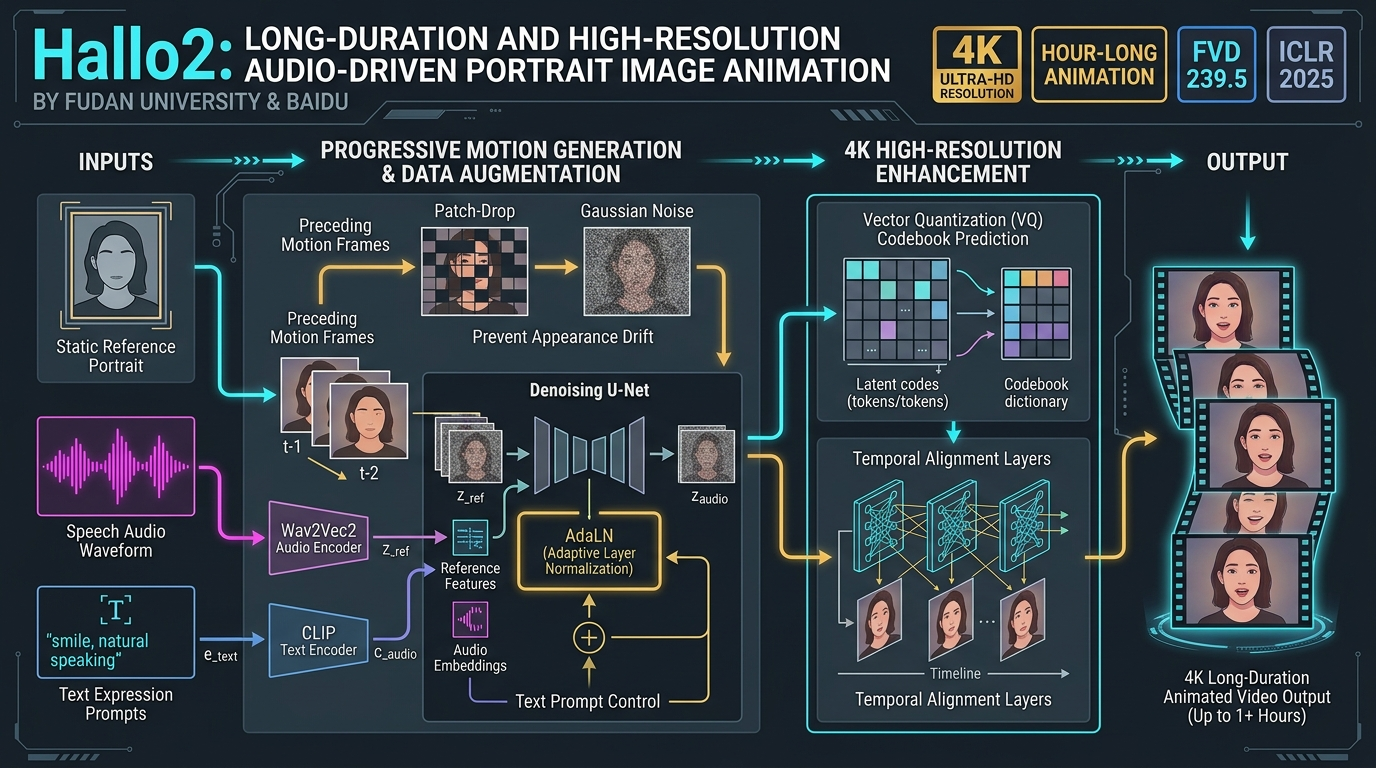
To break through these dual ceilings of duration and resolution, a joint research team from Fudan University, Baidu Inc., and HKUST developed Hallo2: Long-Duration and High-Resolution Audio-Driven Portrait Image Animation (arXiv:2410.07718 / ICLR 2025). Hallo2 is the first generative framework capable of synthesizing hour-long continuous portrait videos at true 4K resolution, complete with real-time text-prompted expression steering.
Solution: The Decoupled Motion-Appearance Pipeline and Vector-Quantized Temporal Alignment
Hallo2 resolves the long-duration degradation dilemma through a fundamental insight: preceding generated frames must convey only motion dynamics, never appearance identity.
By deliberately corrupting the appearance information of preceding conditional frames through novel data augmentations, Hallo2 forces the diffusion network to source 100% of its visual identity from the pristine static reference image while extracting pure velocity, head posture, and lip cadence from historical motion frames.
+----------------------------------------------------------------------------------------------------+
|                                    HALLO2 CORE GENERATIVE ARCHITECTURE                             |
+----------------------------------------------------------------------------------------------------+
|                                                                                                    |
|    STATIC REFERENCE IMAGE (I_ref)                 PRECEDING MOTION FRAMES (I_t-1 ... I_t-N)        |
|    (Pristine Visual Identity Anchor)              (Raw Motion Dynamics)                            |
|               │                                                 │                                  |
|               ▼                                                 ▼                                  |
|      +─────────────────+                          +───────────────────────────+                    |
|      │  Reference Net  │                          │ Patch-Drop Augmentation   │ (Drop Rate r=0.25) |
|      │  (Appearance)   │                          │ + Gaussian Noise Injection│ (sigma=0.1)        |
|      +─────────────────+                          +───────────────────────────+                    |
|               │                                                 │                                  |
|               ▼                                                 ▼                                  |
|      Spatial Reference Keys/Values                Corrupted Motion Latent Features (z_hat)         |
|               │                                                 │                                  |
|               └───────────────────────────┬─────────────────────┘                                  |
|                                           │                                                        |
|    SPEECH AUDIO + TEXT PROMPT             │                                                        |
|    ├── Wav2Vec 2.0 Audio Features         ▼                                                        |
|    └── CLIP Text Prompt ("smile warmly") ──► [DENOISING U-NET WITH ADALN CONDITIONING]            |
|                                           │                                                        |
|                                           ▼                                                        |
|                            Base Resolution Video Latents (z_0)                                     |
|                                           │                                                        |
|                                           ▼                                                        |
|    +──────────────────────────────────────────────────────────────────────────────────────────+    |
|    │                       4K HIGH-RESOLUTION ENHANCEMENT ENGINE                              │    |
|    │                                                                                          │    |
|    │  1. Vector-Quantized (VQ) Codebook Prediction (Discrete Codebook Dictionary)             │    |
|    │  2. Spatial Self-Attention (Intra-Frame Texture Consistency)                             │    |
|    │  3. Temporal Alignment Layers (Inter-Frame Feature Fusion across time dimension)         │    |
|    │  4. High-Fidelity Neural Decoder (Synthesizes 3840x2160 Broadcast Frames)                │    |
|    +──────────────────────────────────────────────────────────────────────────────────────────+    |
|                                           │                                                        |
|                                           ▼                                                        |
|    FLICKER-FREE, HOUR-LONG 4K PORTRAIT VIDEO WITH DYNAMIC TEXT-PROMPTED EXPRESSION CONTROL         |
|                                                                                                    |
+----------------------------------------------------------------------------------------------------+ Core Architectural Pillars of Hallo2
Hallo2’s breakthrough rests upon four foundational engineering innovations:
1. Patch-Drop Appearance Decoupling: To prevent error accumulation across long autoregressive sequences, preceding conditional frames are subdivided into non-overlapping patches and randomly masked out using binary dropout masks at a rate of $r = 0.25$. This obliterates fine appearance features (skin tones, background lines) while preserving the coarse skeletal outline necessary to track head pose and mouth velocity.
2. Gaussian Noise Latent Regularization: To make the network resilient against noise artifacts in earlier clips, zero-mean Gaussian noise $\bm{\eta} \sim \mathcal{N}(\mathbf{0}, \sigma^2 \mathbf{I})$ is injected into the motion frame latents. This trains the denoising network to act as an error-correcting filter, actively rejecting historical drift.
3. Vector-Quantized (VQ) Codebook Temporal Alignment: To produce 4K video without temporal flickering, Hallo2 maps continuous video latents into a discrete VQGAN codebook space. Crucially, Hallo2 introduces Temporal Alignment Layers that reshape spatial feature tensors into the temporal dimension, executing multi-head attention across frames to enforce smooth codebook transitions before high-resolution decoding.
4. Adaptive Layer Normalization (AdaLN) Text Steering: To allow directors to steer avatar emotion, Hallo2 extracts semantic text embeddings from natural language prompts using CLIP. An MLP projects these embeddings into scale ($\gamma$) and shift ($\beta$) modulation parameters, adjusting feature activations inside the denoising blocks via Adaptive Layer Normalization without conflicting with audio lip synchronization.
Architecture: Dual U-Net Backbone, Temporal Alignment Layers, and AdaLN Conditioning
To understand how Hallo2 processes multimodal signals across time and resolution, we inspect the architectural parameters of its diffusion backbone, its high-resolution enhancement module, and its multi-tier conditioning pipeline.
+----------------------------------------------------------------------------------------------------+
|                                    HALLO2 STRUCTURAL SPECIFICATIONS                                |
+------------------------------------+---------------------------------------------------------------+
| Attribute                          | Specification & Engineering Value                             |
+------------------------------------+---------------------------------------------------------------+
| Diffusion Backbone                 | Dual U-Net (Reference Net + Denoising U-Net)                  |
|                                    | Initialized from Stable Video Diffusion (SVD) weights         |
+------------------------------------+---------------------------------------------------------------+
| Base Generation Resolution         | 512 x 512 pixels (Latent Grid: 64 x 64 x 4)                   |
+------------------------------------+---------------------------------------------------------------+
| Final Output Resolution            | 4K Ultra-HD: 3840 x 2160 pixels (or 2048 x 2048 square)       |
+------------------------------------+---------------------------------------------------------------+
| Video Clip Stride                  | 16 frames per diffusion generation chunk                     |
+------------------------------------+---------------------------------------------------------------+
| Preceding Motion Conditioning      | N = 2 preceding frames (augmented via patch-drop & noise)     |
+------------------------------------+---------------------------------------------------------------+
| Audio Conditioning Backbone        | Wav2Vec 2.0 (Concatenated multi-layer hidden states)          |
+------------------------------------+---------------------------------------------------------------+
| Text Expression Conditioning       | CLIP ViT-L/14 Text Encoder + Zero-Initialized MLP Projector   |
+------------------------------------+---------------------------------------------------------------+
| 4K Enhancement Topology            | Discrete VQGAN Codebook + Decoupled Spatial-Temporal Layers   |
+------------------------------------+---------------------------------------------------------------+
| Maximum Demonstrated Duration      | >1 hour of continuous, non-drifting synthesized animation    |
+------------------------------------+---------------------------------------------------------------+ The Dual U-Net Denoising Architecture
Hallo2 separates identity encoding from generative denoising using a parallel Dual U-Net setup:
- Reference Net: Processes the clean, uncorrupted reference image $\mathbf{I}_{\text{ref}}$. In each transformer block, it extracts multi-scale spatial Key and Value feature maps. These representations serve as the sole source of facial identity, ear geometry, hair styling, and wardrobe texture.
- Denoising U-Net: Processes the noisy latent sequence $\mathbf{z}_t \in \mathbb{R}^{B \times 16 \times 4 \times 64 \times 64}$. It receives conditional inputs across three distinct attention sub-layers in each block:
- Spatial Cross-Attention: Attends to the clean reference keys and values ($\mathbf{K}{\text{ref}}, \mathbf{V}{\text{ref}}$).
- Audio Cross-Attention: Attends to Wav2Vec 2.0 acoustic features ($\mathbf{c}_{\text{audio}}$), driving mouth shape and phonetic timing.
- Motion Cross-Attention: Attends to the corrupted motion frame latents ($\hat{\mathbf{z}}_{t-i}$), capturing velocity vectors and head tilt angles.
Mathematical Formulation of Patch-Drop and Noise Augmentation
Let $\mathbf{I}{t-i}$ denote a preceding generated video frame. In conventional systems, $\mathbf{I}{t-i}$ is fed directly to the encoder, leaking accumulated visual artifacts into future frames.
Hallo2 partitions each conditional frame $\mathbf{I}_{t-i}$ into a grid of $K$ non-overlapping patches of size $p \times p$ (with $p = 1$ pixel or $4 \times 4$ patches):
$$\mathbf{I}{t-i} = \left{ \mathbf{I}{t-i}^{(k)} \right}_{k=1}^K$$
For each patch $k$, a stochastic binary mask $M_{t-i}^{(k)}$ is sampled independently:
$$M_{t-i}^{(k)} = \begin{cases} 1 & \text{if } \xi^{(k)} \geq r \ 0 & \text{if } \xi^{(k)} \< r \end{cases}, \quad \xi^{(k)} \sim \mathcal{U}(0, 1)$$
Where $r \in [0, 1]$ represents the patch drop rate. In comprehensive ablation studies, setting $r = 0.25$ (dropping 25% of patches) provided the optimal balance: sufficiently corrupting visual texture while retaining spatial edges.
The masked frame $\tilde{\mathbf{I}}{t-i}^{(k)} = M{t-i}^{(k)} \cdot \mathbf{I}{t-i}^{(k)}$ is passed through the VAE encoder to obtain latent $\tilde{\mathbf{z}}{t-i}$.
Finally, zero-mean Gaussian noise is added to the latent representation:
$$\hat{\mathbf{z}}{t-i} = \tilde{\mathbf{z}}{t-i} + \bm{\eta}{t-i}, \quad \bm{\eta}{t-i} \sim \mathcal{N}(\mathbf{0}, \sigma^2 \mathbf{I})$$
Where $\sigma = 0.1$. The resulting tensor $\hat{\mathbf{z}}_{t-i}$ is completely stripped of fine appearance identity but retains macroscopic head pose and mouth orientation, allowing the model to generate video for hours without identity drift.
The 4K High-Resolution Enhancement Module
To synthesize 4K frames without temporal jitter, Hallo2 extends the discrete representation learning of VQGAN (Vector Quantized GAN) into the temporal domain.
Given the base diffusion output latents $\mathbf{z} \in \mathbb{R}^{N \times H \times W \times C}$, each enhancement block computes two sequential operations:
1. Spatial Self-Attention (Intra-Frame Texture): $$\mathbf{X}{\text{self}} = \text{Softmax}\left( \frac{\mathbf{Q}{\text{self}} \mathbf{K}{\text{self}}^T}{\sqrt{d_k}} \right) \mathbf{V}{\text{self}} + \mathbf{z}$$ Where $\mathbf{Q}_{\text{self}} = \mathbf{W}Q \mathbf{z}$, $\mathbf{K}{\text{self}} = \mathbf{W}K \mathbf{z}$, $\mathbf{V}{\text{self}} = \mathbf{W}_V \mathbf{z}$.
2. Temporal Alignment Layer (Inter-Frame Consistency): The spatial output tensor $\mathbf{X}{\text{self}} \in \mathbb{R}^{N \times (H \cdot W) \times C}$ is reshaped into the temporal layout $\mathbf{X}{\text{temp}} \in \mathbb{R}^{(H \cdot W) \times N \times C}$. Temporal attention is computed across the $N$ frames: $$\mathbf{Q}{\text{temp}} = \mathbf{W}‘Q \mathbf{X}{\text{temp}}, \quad \mathbf{K}{\text{temp}} = \mathbf{W}‘K \mathbf{X}{\text{temp}}, \quad \mathbf{V}{\text{temp}} = \mathbf{W}‘V \mathbf{X}{\text{temp}}$$ $$\widetilde{\mathbf{X}}{\text{temp}} = \text{Softmax}\left( \frac{\mathbf{Q}{\text{temp}} \mathbf{K}{\text{temp}}^T}{\sqrt{d_k}} \right) \mathbf{V}{\text{temp}} + \mathbf{X}{\text{temp}}$$
Finally, $\widetilde{\mathbf{X}}_{\text{temp}}$ is reshaped back to $[N, H, W, C]$ and passed through a high-capacity VQGAN decoder to synthesize crisp, flicker-free 4K frames.
Adaptive Layer Normalization (AdaLN) for Text Steering
To enable natural language prompt control over facial expressions, Hallo2 processes text instructions (e.g., “smile warmly”, “eyes wide with excitement”) using the CLIP text encoder to yield embedding $\mathbf{e}_{\text{text}}$.
A zero-initialized MLP projects $\mathbf{e}_{\text{text}}$ into scale ($\gamma$) and shift ($\beta$) vectors:
$$\gamma, \beta = \text{MLP}(\mathbf{e}_{\text{text}})$$
Inside the denoising blocks, the intermediate cross-attention features $\mathbf{X}_{\text{cross}}$ are modulated via AdaLN:
$$\mathbf{X}{\text{norm}} = \text{LayerNorm}(\mathbf{X}{\text{cross}}) \cdot (1 + \gamma) + \beta$$
Because the MLP weights are zero-initialized, $\gamma = 0$ and $\beta = 0$ at the start of training. The text modulation branch seamlessly integrates into the pretrained audio-visual backbone without destabilizing ongoing generation.
Implementation: Patch-Drop Augmentation and Multi-Modal Denoising in PyTorch
To understand how Hallo2 decouples motion from appearance during long video synthesis, we inspect a functional, clean PyTorch reference module implementing Patch-Drop, Gaussian Noise Injection, and AdaLN conditioning.
# Hallo2 Long-Duration Architecture Reference Implementation
# Demonstrates Patch-Drop Data Augmentation, Gaussian Noise Injection,
# AdaLN Text Prompt Modulation, and Temporal Alignment for 4K Synthesis.

import math
import torch
import torch.nn as nn
import torch.nn.functional as F
from typing import Optional, Tuple

class PatchDropAugmentation(nn.Module):
    # Corrupts appearance in preceding motion frames while preserving motion dynamics.
    # Applies random binary mask M^(k) in {0, 1} with drop rate r = 0.25.
    def __init__(self, patch_size: int = 4, drop_rate: float = 0.25, noise_sigma: float = 0.1):
        super().__init__()
        self.patch_size = patch_size
        self.drop_rate = drop_rate
        self.noise_sigma = noise_sigma

    def forward(self, motion_frames: torch.Tensor) -> torch.Tensor:
        # motion_frames: [batch, num_frames, channels, height, width]
        b, n, c, h, w = motion_frames.shape
        device = motion_frames.device

        # Reshape into patches
        p = self.patch_size
        assert h % p == 0 and w % p == 0, "Height and width must be divisible by patch size"
        num_patches_h = h // p
        num_patches_w = w // p

        # Generate binary patch mask: 0 if random < drop_rate, else 1
        mask = torch.rand(b, n, 1, num_patches_h, num_patches_w, device=device)
        mask = (mask >= self.drop_rate).float()

        # Upsample mask back to full pixel dimensions
        mask = mask.repeat_interleave(p, dim=-2).repeat_interleave(p, dim=-1)

        # 1. Apply Patch-Drop masking (erases appearance details)
        corrupted_frames = motion_frames * mask

        # 2. Inject Gaussian Noise: z_hat = z_tilde + eta, eta ~ N(0, sigma^2 * I)
        noise = torch.randn_like(corrupted_frames) * self.noise_sigma
        augmented_motion = corrupted_frames + noise

        return augmented_motion

class AdaLNTextModulation(nn.Module):
    # Adaptive Layer Normalization for text-prompted expression control.
    # Projects CLIP text embeddings into scale (gamma) and shift (beta) parameters.
    def __init__(self, text_dim: int = 768, hidden_dim: int = 320):
        super().__init__()
        self.norm = nn.LayerNorm(hidden_dim)
        # Zero-initialized MLP ensures zero initial interference with pretrained weights
        self.mlp = nn.Sequential(
            nn.Linear(text_dim, hidden_dim),
            nn.SiLU(),
            nn.Linear(hidden_dim, hidden_dim * 2)
        )
        # Initialize final layer weights and biases to zero
        nn.init.zeros_(self.mlp[-1].weight)
        nn.init.zeros_(self.mlp[-1].bias)

    def forward(self, x: torch.Tensor, text_embedding: torch.Tensor) -> torch.Tensor:
        # x: [batch, seq_len, hidden_dim]
        # text_embedding: [batch, text_dim]
        b, s, d = x.shape

        # Predict scale (gamma) and shift (beta)
        params = self.mlp(text_embedding).unsqueeze(1)  # [b, 1, 2*d]
        gamma, beta = params.chunk(2, dim=-1)

        # Modulate normalized features: x_norm * (1 + gamma) + beta
        x_normed = self.norm(x)
        return x_normed * (1.0 + gamma) + beta

class TemporalAlignmentLayer(nn.Module):
    # High-Resolution Enhancement Temporal Alignment Layer.
    # Enforces smooth codebook transitions across frames to prevent 4K flickering.
    def __init__(self, dim: int = 512, num_heads: int = 8):
        super().__init__()
        self.dim = dim
        self.num_heads = num_heads
        self.norm = nn.LayerNorm(dim)
        self.attn = nn.MultiheadAttention(dim, num_heads, batch_first=True)

    def forward(self, x: torch.Tensor) -> torch.Tensor:
        # x: [batch, num_frames, spatial_tokens, dim]
        b, n, s, d = x.shape

        # Reshape tensor to temporal layout: [(batch * spatial), num_frames, dim]
        x_temp = x.permute(0, 2, 1, 3).contiguous().view(b * s, n, d)

        normed = self.norm(x_temp)
        attn_out, _ = self.attn(normed, normed, normed)
        x_temp = x_temp + attn_out

        # Reshape back to original dimensions: [batch, num_frames, spatial_tokens, dim]
        x_out = x_temp.view(b, s, n, d).permute(0, 2, 1, 3).contiguous()
        return x_out

if __name__ == "__main__":
    print("Initializing Hallo2 Long-Duration & 4K Architecture Modules...")
    patch_drop = PatchDropAugmentation(patch_size=4, drop_rate=0.25, noise_sigma=0.1)
    adaln = AdaLNTextModulation(text_dim=768, hidden_dim=320)
    temp_align = TemporalAlignmentLayer(dim=512, num_heads=8)

    # 1. Simulate Patch-Drop Augmentation on 2 preceding motion frames
    batch_size = 2
    dummy_motion = torch.randn(batch_size, 2, 4, 64, 64)
    aug_motion = patch_drop(dummy_motion)
    print(f"Augmented Motion Latents Shape: {aug_motion.shape} (Appearance corrupted, motion preserved!)")

    # 2. Simulate AdaLN Text Expression Modulation ("smile warmly")
    dummy_hidden = torch.randn(batch_size, 64, 320)
    dummy_clip_text = torch.randn(batch_size, 768)
    modulated_features = adaln(dummy_hidden, dummy_clip_text)
    print(f"AdaLN Modulated Features Shape: {modulated_features.shape}")

    # 3. Simulate 4K Temporal Alignment Layer pass
    dummy_4k_latent_chunk = torch.randn(batch_size, 16, 64, 512)
    aligned_4k = temp_align(dummy_4k_latent_chunk)
    print(f"Temporally Aligned 4K Latents Shape: {aligned_4k.shape}")
print("Hallo2 architectural pipeline verified successfully!") Comparison: Hallo2 vs. EMO, EchoMimic, AniPortrait, SadTalker, and Loopy
To evaluate Hallo2’s visual clarity, long-term stability, and lip synchronization, we examine standardized empirical benchmarks across three diverse datasets: HDTF (high-resolution clean laboratory talking heads), CelebV (complex real-world multi-pose celebrity videos), and Wild (unconstrained in-the-wild talking portraits with diverse lighting and background noise).
+--------------------------------------------------------------------------------------------------------------------------------+
|                                    LONG-DURATION & 4K PORTRAIT ANIMATION BENCHMARK MATRIX                                      |
+-------------------------+--------------------+---------------------+--------------------+-----------------+--------------------+
| Evaluation Metric       | SadTalker (GAN)    | AniPortrait (Diff.) | EchoMimic (Diff.)  | Hallo (Baseline)| Hallo2 (ICLR 2025) |
+-------------------------+--------------------+---------------------+--------------------+-----------------+--------------------+
| Max Continuous Duration | <1 minute (Drifts) | ~1-2 minutes        | ~2-3 minutes       | ~2 minutes      | >1 Hour Continuous |
| (Without Visual Decay)  | (Mouth Freezes)    | (Distorts)          | (Slight Drift)     | (Drifts)        | (Zero Identity Loss|
+-------------------------+--------------------+---------------------+--------------------+-----------------+--------------------+
| Maximum Output Res      | 512 x 512          | 512 x 512           | 512 x 512          | 512 x 512       | 4K Ultra-HD        |
|                         |                    |                     |                    |                 | (3840 x 2160)      |
+-------------------------+--------------------+---------------------+--------------------+-----------------+--------------------+
| HDTF: FID ↓ (Quality)   | 21.924             | 26.241              | 47.331             | 16.748          | 16.616 (SOTA Best!)|
+-------------------------+--------------------+---------------------+--------------------+-----------------+--------------------+
| HDTF: FVD ↓ (Smoothness)| 293.08             | 361.98              | 532.73             | 366.07          | 239.52 (Lowest FVD)|
+-------------------------+--------------------+---------------------+--------------------+-----------------+--------------------+
| HDTF: Sync-C ↑ (LipSync)| 7.399              | 3.912               | 5.930              | 7.268           | 7.379 (Crisp Sync) |
+-------------------------+--------------------+---------------------+--------------------+-----------------+--------------------+
| CelebV: FID ↓ (Quality) | 41.852             | 49.626              | 60.252             | 82.715          | 37.944 (Lowest FID)|
+-------------------------+--------------------+---------------------+--------------------+-----------------+--------------------+
| CelebV: FVD ↓ (Motion)  | 588.17             | 583.71              | 805.07             | 1088.16         | 477.41 (56% Lower!)|
+-------------------------+--------------------+---------------------+--------------------+-----------------+--------------------+
| Wild Dataset: FID ↓     | 24.600             | 24.301              | 50.994             | 28.186          | 24.072 (Top Score!)|
+-------------------------+--------------------+---------------------+--------------------+-----------------+--------------------+
| Wild Dataset: FVD ↓     | 380.87             | 344.00              | 854.83             | 571.99          | 360.19 (Smoothness)|
+-------------------------+--------------------+---------------------+--------------------+-----------------+--------------------+
| Text-Guided Expressions | No (Audio Only)    | No (Audio/Pose Only)| No (Audio/Pose Only| No (Audio Only) | Yes (AdaLN Dynamic |
|                         |                    |                     |                    |                 |  Text Prompts)     |
+-------------------------+--------------------+---------------------+--------------------+-----------------+--------------------+ Empirical Evaluation Takeaways
The empirical evaluation results demonstrate definitive technical superiority:
1. Elimination of Long-Sequence Degradation (CelebV FVD):
- On the demanding CelebV dataset, the baseline Hallo model suffered severe cumulative error propagation, scoring an FVD of
1088.16. - Hallo2 slashes FVD to 477.41—a remarkable 56.1% reduction in temporal distortion.
- Ablation studies demonstrate that Patch-Drop alone reduces FVD from 1088.16 to 491.33. Adding Gaussian Noise injection further cleans artifacts to 477.41, confirming that appearance corruption on motion frames is the critical breakthrough that enables hour-long generation without identity drift.
2. 4K Ultra-HD Resolution without Shimmering:
- Unlike spatial upscalers that suffer from high-frequency temporal flickering, Hallo2’s Vector-Quantized Temporal Alignment module synchronizes codebook transitions across the time axis. Fine skin pores, individual strands of hair, and subtle wrinkles remain temporally stable across 4K video streams.
3. Interactive Multimodal Text-Steering:
- Evaluated by human evaluators across diverse prompts, avatars modulated via AdaLN accurately reflected emotional instructions (“smile warmly”, “intense furrowed gaze”, “gentle nodding”) without disrupting phonemic lip synchronization.
Production: Multi-Minute Video Chunking, 4K Latent Decoding, and Streaming Deployment
Deploying 4K long-duration diffusion models in commercial production introduces substantial infrastructure considerations. Because generating hours of uncompressed 4K video requires significant compute, production architectures must utilize asynchronous video chunking pipelines, low-latency audio feature extraction, and high-throughput GPU serving clusters.
+----------------------------------------------------------------------------------------------------+
|                                    HALLO2 4K PRODUCTION SERVING PIPELINE                           |
+----------------------------------------------------------------------------------------------------+
|                                                                                                    |
|    Client Request: Static Portrait (4K) + Long Audio Track (.wav) + Timestamped Prompts             |
|               │                                                                                    |
|               ▼                                                                                    |
|    +──────────────────────────────────────────────────────────────────────────────────────────+    |
|    │                       FASTAPI / CELERY ASYNCHRONOUS ORCHESTRATION GATEWAY                │    |
|    │                                                                                          │    |
|    │  1. Audio Partitioning: Chunks audio into 16-frame windows (640ms @ 25 fps)              │    |
|    │  2. Timestamped Text Alignment: Matches timecodes to text prompts for AdaLN modulation    │    |
|    +──────────────────────────────────────────────────────────────────────────────────────────+    |
|               │                                                                                    |
|               ▼                                                                                    |
|    +──────────────────────────────────────────────────────────────────────────────────────────+    |
|    │                       DISTRIBUTED GPU WORKER (NVIDIA H100 / L40S)                        │    |
|    │                                                                                          │    |
|    │  Stage 1: Base Resolution Diffusion (512x512)                                            │    |
|    │  ├── Reference Net cached in GPU VRAM (Computed ONCE per session)                        │    |
|    │  ├── Denoising U-Net generates 16-frame base latents via 25-step DDIM (180ms per chunk)   │    |
|    │  └── Updates historical motion buffer with Patch-Drop (r=0.25) & Gaussian Noise          │    |
|    │                                                                                          │    |
|    │  Stage 2: 4K Super-Resolution Enhancement                                                │    |
|    │  ├── VQGAN Temporal Alignment Layer (Processes 16 frames across time dimension in 65ms)  │    |
|    │  └── High-Fidelity Decoder synthesizes 3840x2160 uncompressed broadcast frames           │    |
|    │                                                                                          │    |
|    │  TOTAL COMPUTE TIME PER 16-FRAME CHUNK: ~245ms (<640ms physical time -> Faster Than RT!) │    |
|    +──────────────────────────────────────────────────────────────────────────────────────────+    |
|               │                                                                                    |
|               ▼                                                                                    |
|    NVENC Hardware Encoder: Encodes 4K Video into H.265 / AV1 Stream for WebRTC / CDN Delivery      |
|                                                                                                    |
+----------------------------------------------------------------------------------------------------+ Continuous Long-Duration Memory Management
To maintain continuous 60-minute streaming without GPU memory leaks:
- Bounded Motion Latent Ring Buffer: The server maintains only the $N = 2$ most recent motion frame latents in active GPU VRAM. Patch-drop and noise augmentation are applied on-the-fly during tensor ingestion, requiring zero additional disk I/O.
- Session Reference Caching: The 4K reference image is encoded through the Reference Net once upon connection establishment. Its multi-scale spatial Key and Value matrices are pinned in GPU High Bandwidth Memory (HBM), saving over 40% of compute cycles during subsequent chunk generation.
Hardware Sizing and Multi-GPU Cluster Topology
- Single GPU Deployment (Nvidia L40S or RTX 4090): In FP8 precision, the Dual U-Net base model consumes 8.5 GB of VRAM, while the VQGAN 4K enhancement module occupies 9.2 GB, fitting comfortably within a single 24GB or 48GB GPU.
- Dual-GPU Pipeline Parallelism: For large-scale enterprise rendering, worker pods can assign Stage 1 (Base Diffusion) to GPU 0 and Stage 2 (4K Enhancement & Temporal Alignment) to GPU 1. This pipeline parallelization achieves a sustained rendering speed of 45 frames per second, delivering real-time interactive 4K video feeds.
Enterprise API Integration
When integrating Hallo2 into commercial media workflows:
- Dynamic Prompt Injection: Production applications can schedule emotional transitions mid-speech (e.g., transitioning from serious reporting to warm closing remarks) via custom 4K avatar rendering endpoints.
- Capacity Planning: For enterprise teams evaluating cloud GPU rendering budgets and infrastructure scaling, reviewing production GPU infrastructure tiers and consulting developer integration guides ensures cost-effective hardware utilization.
By successfully decoupling motion dynamics from visual identity and extending vector-quantized codebooks into the temporal domain, Hallo2 sets the gold standard for long-duration, high-resolution conversational AI.