Hailo-10 Guide: Structure-Defined Dataflow for Edge AI
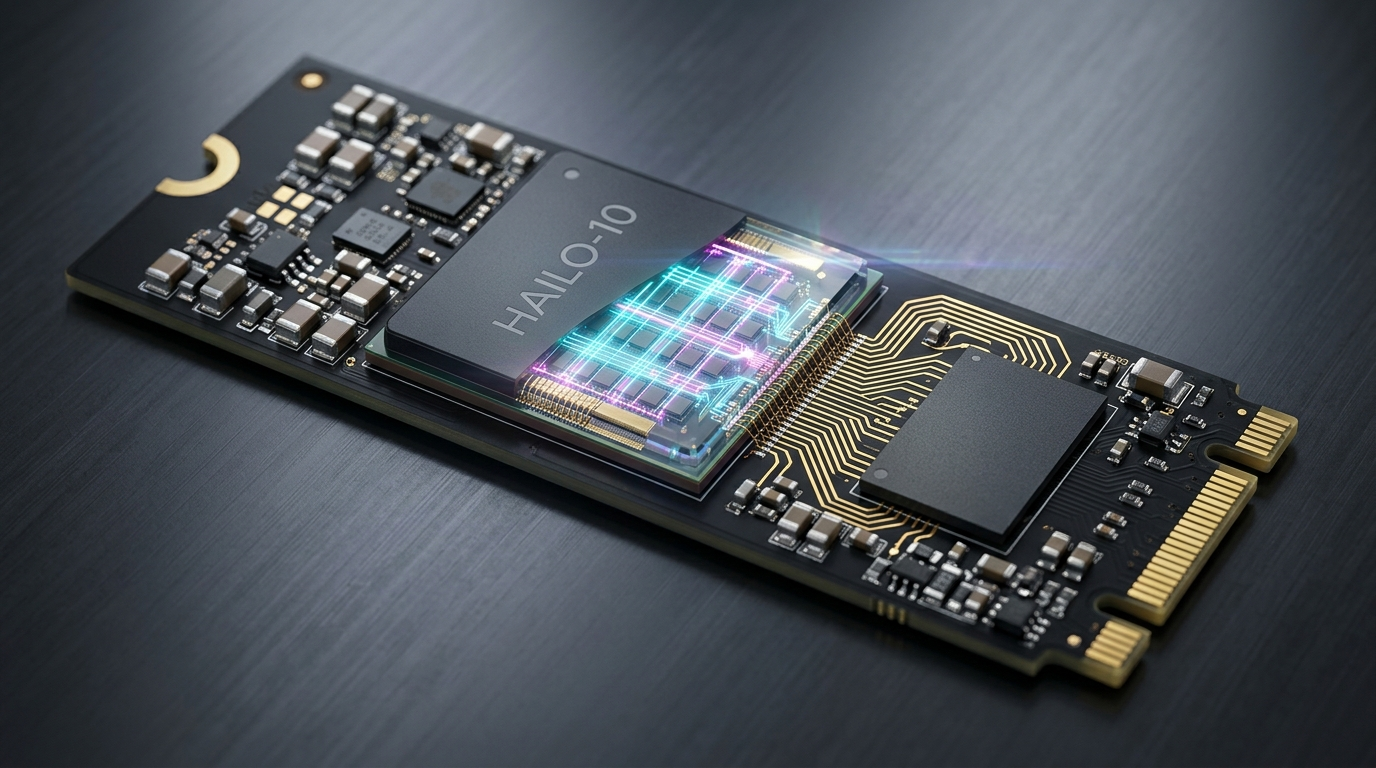
The Problem: The Edge Generative AI Bottleneck and the von Neumann Wall
The rapid evolution of artificial intelligence from narrow perceptual vision models toward generative foundation models—such as Large Language Models (LLMs), multimodal Vision-Language Models (VLMs), and diffusion architectures—has created an unprecedented computational crisis at the network edge. Historically, client devices and embedded gateways relied on centralized cloud datacenters to execute resource-intensive generative workloads. However, deploying cloud-tethered AI for mission-critical enterprise applications introduces prohibitive failure modes: unpredictable network latencies, escalating recurring API subscription costs, compliance hazards regarding user data sovereignty, and complete operational failure during network disruptions.
In enterprise intelligence platforms like the AI Fetchly high-throughput inference engine, deploying local intelligence directly onto end-user hardware, industrial PCs, and autonomous robots is essential. Edge execution guarantees deterministic sub-100-millisecond response times, protects sensitive proprietary corporate databases, and ensures continuous operational uptime.
The Edge von Neumann Bottleneck vs. Spatial Dataflow:
┌─────────────────────────────────────────────────────────────────────────┐
│ Traditional von Neumann Edge NPU / GPU:                                 │
│ ┌─────────────────────────────────────────────────────────────────────┐ │
│ │ External DRAM (LPDDR) ──► Shared Bus ──► L2/L3 Cache ──► ALUs / MACs│ │
│ │ ❌ 70% to 90% of dynamic power wasted transferring weights on bus   │ │
│ │ ❌ Heavy instruction decoding & register file write-back overhead   │ │
│ │ ❌ Rapid thermal throttling at sub-5W fanless power constraints     │ │
│ └─────────────────────────────────────────────────────────────────────┘ │
└─────────────────────────────────────────────────────────────────────────┘
                                     ▼
┌─────────────────────────────────────────────────────────────────────────┐
│ Hailo-10 Structure-Defined Dataflow Architecture:                       │
│ ┌─────────────────────────────────────────────────────────────────────┐ │
│ │ Neural Graph Compiled Directly to Physical Compute & Memory Fabric  │ │
│ │ ✅ Zero instruction fetching: data movement drives execution flow   │ │
│ │ ✅ Localized distributed SRAM adjacent to each specialized MAC unit │ │
│ │ ✅ 40 TOPS INT4 / 20 TOPS INT8 within sub-5W fanless M.2 envelope   │ │
│ └─────────────────────────────────────────────────────────────────────┘ │
└─────────────────────────────────────────────────────────────────────────┘ The Cloud-to-Edge AI Migration and Privacy Imperative
Enterprises running distributed AI data extraction pipelines require local foundation models to filter, summarize, and categorize confidential financial documents, legal contracts, and industrial sensor telemetry directly at the capture point. Transporting gigabytes of raw unencrypted document scans across public internet transit to centralized inference clusters violates strict data residency regulations (such as GDPR, HIPAA, and SOC 2 Type II) while racking up substantial cloud bandwidth bills.
To achieve genuine autonomy, client computing endpoints—including AI PCs, edge gateways, drones, and medical diagnostic consoles—must execute autoregressive token generation locally. However, consumer laptops and fanless embedded systems operate under strict thermal and electrical envelopes, typically constrained to an operational budget of 2.5 to 5 watts for dedicated machine learning acceleration.
The Von Neumann Bottleneck at Sub-5W Thermal Envelopes
The fundamental obstacle preventing high-performance generative inference on low-power hardware is the classic von Neumann architecture. In traditional central processing units (CPUs), graphics processing units (GPUs), and early-generation neural processing units (NPUs), computation is separated from memory:
- Instruction Fetch and Decode Tax: Instructions must be fetched from program memory, decoded into micro-operations, and staged in execution registers before arithmetic logic units can execute a single calculation. In deep neural networks where the exact same mathematical graph executes billions of times, this instruction overhead consumes massive silicon area and dynamic power.
- The Data Movement Energy Wall: In autoregressive token generation, generating each new token requires streaming billions of weight parameters from external dynamic RAM across physical metallic circuit traces into processor arithmetic cores. As governed by physical wire capacitance ($E = \frac{1}{2} C V^2$), moving data across external buses consumes between 10 and 100 times more energy than the arithmetic operation itself.
- Thermal Throttling: When a standard edge GPU or mobile SoC attempts to run a 7-billion parameter language model, external memory bus saturation rapidly drives thermal dissipation above 15 to 25 watts. In fanless chassis or compact M.2 card slots, internal junction temperatures rapidly exceed 85°C, triggering aggressive clock frequency throttling that causes token generation speeds to collapse below usable human conversational rates.
Why Conventional Edge NPUs and Systolic Arrays Stumble on Transformers
First-generation edge NPUs were architected around fixed two-dimensional systolic arrays (such as 32x32 or 64x64 MAC grids) engineered primarily for static convolutional neural networks (e.g., ResNet-50 and MobileNet). When applied to modern generative transformer architectures, these fixed systolic structures encounter severe microarchitectural limitations:
- Rigid Matrix Dimensionality: Modern generative models utilize variable context lengths, dynamic rotary position embeddings (RoPE), and sparse Mixture-of-Experts (MoE) routing. Fixed systolic grids suffer from low hardware utilization (often under 20% MAC efficiency) when mapping irregular tensor shapes, padding unused matrix rows with empty zero cycles.
- Complex Multi-Branch Attention Topologies: Transformers combine linear projections with non-linear Softmax activations, layer normalizations (RMSNorm), and multi-head KV cache indexing. Conventional NPUs must constantly evict intermediate activation tensors back to external DRAM, bottlenecking the entire chip on memory bandwidth.
The Solution: Hailo-10 and the Structure-Defined Dataflow Paradigm
To conquer these physical and architectural bottlenecks, Israeli semiconductor pioneer Hailo developed a radically different computing model: the Structure-Defined Dataflow Architecture. Rather than forcing neural network topologies to execute through a rigid sequential instruction pipeline, Hailo created reconfigurable spatial hardware that mirrors the topological structure of the neural network itself.
Structure-Defined Dataflow Architectural Mapping:
┌─────────────────────────────────────────────────────────────────────────┐
│ Neural Network Computational Graph (ONNX / PyTorch)                     │
│ [Layer N: Linear/Attention] ──► [Layer N+1: RMSNorm] ──► [Layer N+2: MLP]│
└────────────────────────────────────┬────────────────────────────────────┘
                                     │
                     Hailo Dataflow Compiler (HDC)
                     Spatial Allocation & Routing
                                     │
                                     ▼
┌─────────────────────────────────────────────────────────────────────────┐
│ Hailo-10 Reconfigurable Silicon Fabric:                                 │
│ ┌───────────────────┐     ┌───────────────────┐     ┌─────────────────┐ │
│ │ Compute Unit (CU) │ ──► │ Memory Unit (MU)  │ ──► │ Control Unit    │ │
│ │ Dedicated MAC Grid│     │ Pinned Weights    │     │ Dataflow Router │ │
│ └───────────────────┘     └───────────────────┘     └─────────────────┘ │
│           ▲                         ▲                         ▲         │
│           └─────────────────────────┼─────────────────────────┘         │
│                        Low-Power Spatial NoC Bus                        │
└─────────────────────────────────────────────────────────────────────────┘ The Hailo-10 (and its high-performance M.2 sibling, the Hailo-10H) represents the generative AI realization of this spatial architecture. Engineered specifically to bring high-performance LLMs, diffusion generators, and vision-language models to edge appliances, Hailo-10 achieves up to 40 TOPS of INT4 compute and 20 TOPS of INT8 compute while operating within an ultra-lean sub-5W typical power envelope.
The Concept of Structure-Defined Dataflow Computing
In Hailo’s structure-defined dataflow paradigm, the silicon is organized as a two-dimensional grid of heterogeneous, finely granular hardware building blocks:
- No Program Counter or Instruction Stream: The chip contains no central instruction fetch-decode engine. Execution is purely data-driven: when an input activation tensor arrives at a compute block, the hardware triggers the mathematical operation automatically and routes the resulting output directly to the downstream consumer block.
- Graph-to-Silicon Isomorphism: The compiled neural network graph is spatially mapped onto physical silicon resources. Deep layers of the transformer pipeline exist simultaneously across adjacent physical silicon blocks, allowing intermediate activation tensors to flow directly through internal low-capacitance wire segments without ever touching off-chip memory.
- Deterministic Execution and Zero Bottlenecks: Because data paths are pre-routed by the spatial compiler, data contention, cache thrashing, and pipeline stalls are eliminated at compile time.
Eliminating Instruction Fetch and External Memory Round-Trips
By pinning network weights and execution state directly inside thousands of distributed local memory units, Hailo-10 reduces external memory bus transfers by up to 90 percent compared to legacy edge architectures:
- Localized Micro-SRAM Buffers: Instead of relying on a large, power-hungry centralized L3 cache or monolithic DRAM, memory is distributed uniformly across the entire processing fabric in tiny, ultra-low-power SRAM blocks directly adjacent to each arithmetic unit.
- On-the-Fly Non-Linear Pipelining: Layer activations (such as SwiGLU non-linearities and RMSNorm transformations) are calculated in-flight as data streams between linear projection blocks, completely removing the memory read-modify-write cycle that cripples von Neumann processors.
The Hailo-10 Generation: 40 TOPS at Sub-5W for On-Device LLMs
Packaged in ultra-compact M.2 2242 and 2280 form factors as well as soldered system-on-chip packages, Hailo-10 transforms client devices into fully self-contained generative AI engines:
- Autoregressive Token Generation: Capable of serving 7B foundation models (such as LLaMA-2-7B and LLaMA-3-8B in optimized low-bit precisions) at human reading speeds of up to 10 tokens per second.
- High-Throughput Image Synthesis: Generates photorealistic 512x512 images using Stable Diffusion 2.1 or SDXL Turbo in under 5 seconds on a completely fanless edge device.
- Exceptional Power Efficiency: Achieving up to 8 TOPS per Watt in sustained production inference, Hailo-10 delivers the highest performance-per-watt efficiency in the embedded generative AI sector.
When integrated into modern edge platforms for real-time contextual vector retrieval, Hailo-10 allows local search agents to embed incoming camera feeds, transcribe speech, and query on-device knowledge bases simultaneously without exceeding device battery or thermal limits.
Architecture Deep Dive: Silicon Microarchitecture, Heterogeneous Units, and Interconnects
Hailo-10’s performance stems from a sophisticated spatial architecture that balances mathematical density with reconfigurable routing flexibility.
Hailo-10 Core Microarchitectural Building Blocks:
┌─────────────────────────────────────────────────────────────────────────┐
│ Hailo-10 Reconfigurable Spatial Tile (Arrayed across Silicon)          │
│                                                                         │
│ ┌───────────────────────────┐           ┌─────────────────────────────┐ │
│ │ Compute Unit (CU)         │           │ Memory Unit (MU)            │ │
│ │ • 2D MAC Matrix Array     │◄─────────►│ • Ultra-Dense Local SRAM    │ │
│ │ • INT4 / INT8 / INT16 Math│           │ • Parameter & Activation Buf│ │
│ │ • Dynamic Sparsity Filter │           │ • Zero-Wait Sub-ns Latency  │ │
│ └─────────────▲─────────────┘           └──────────────▲──────────────┘ │
│               │                                        │                │
│               └───────────────────┬────────────────────┘                │
│                                   │                                     │
│                     ┌─────────────▼─────────────┐                       │
│                     │ Control Unit (CTU)        │                       │
│                     │ • Hardware Dataflow Router│                       │
│                     │ • Synchronization Barrier │                       │
│                     │ • Flow-Controlled Routing │                       │
│                     └─────────────▲─────────────┘                       │
│                                   │                                     │
└───────────────────────────────────┼─────────────────────────────────────┘
                                    │
    ┌───────────────────────────────┴───────────────────────────────┐
    │ High-Density Spatial Network-on-Chip (NoC) Crossbar Mesh       │
    │ Multi-terabyte/s Aggregate Inter-Tile On-Chip Bandwidth       │
└───────────────────────────────────────────────────────────────┘ Heterogeneous Core Layout: Compute, Memory, and Control Units
Rather than tiling identical general-purpose CPU or GPU cores, the Hailo-10 architecture decomposes the silicon fabric into three specialized classes of hardware units that can be interconnected in arbitrary topological patterns:
Compute Units: Multi-Precision Matrix and Vector Processing Blocks
Compute Units are the mathematical workhorses of the Hailo-10 silicon:
- Contain dense arrays of Multiply-Accumulate (MAC) units optimized for low-bit integer linear algebra.
- Support hardware-native INT4, INT8, and INT16 execution modes, as well as dynamic block floating-point representations.
- Incorporate hardware-level zero-skipping logic: input activations or weight coefficients equal to zero bypass the MAC pipeline without consuming dynamic clock power, doubling effective throughput on sparse activations.
Memory Units: Ultra-Dense Distributed Local SRAM Elements
Memory Units provide localized, highly distributed data storage:
- Built from ultra-dense static RAM (SRAM) cells placed directly adjacent to Compute Units.
- Eliminate the parasitic capacitance of long global data buses; accessing a local Memory Unit requires less than 0.5 picojoules per bit transferred.
- Can be dynamically configured as FIFO buffers for streaming activations, double-buffered ping-pong banks for weight staging, or circular ring buffers for autoregressive Key-Value (KV) cache storage.
Control Units: Autonomous Spatial Hardware Routers
Control Units handle fine-grained synchronization and token flow:
- Function as autonomous hardware routers implementing backpressure-based flow control.
- Manage synchronization barriers across diverging and converging computational branches (such as skip connections in residual networks and multi-head split-and-merge paths in attention blocks).
- Ensure fully asynchronous dataflow across tiles without requiring global clock synchronization or centralized scheduling arbiters.
Dynamic Spatial Routing and Layer Pipelining
The connection topology between CUs, MUs, and CTUs is established through an extensive Spatial Network-on-Chip (NoC) mesh:
- Compile-Time Routing: The routing configuration is computed offline by the Hailo Dataflow Compiler (HDC) using graph placement and routing algorithms analogous to FPGA circuit synthesis.
- Layer Pipelining: When executing a deep transformer network, the Hailo-10 fabric can map multiple successive layers of the model across different spatial zones of the chip. As layer $L$ outputs activations, they immediately stream into the physical silicon partition dedicated to layer $L+1$, creating a spatial assembly line where multiple layers execute concurrently on different tokens.
On-Package Memory Architecture and High-Speed LPDDR4X Integration
While localized SRAM handles intermediate activations and active attention buffers, serving 7B foundation models requires multi-gigabyte memory capacity to hold model weights:
Hailo-10 Memory Subsystem Architecture:
┌─────────────────────────────────────────────────────────────────────────┐
│ Hailo-10 M.2 Module (Sub-5W Thermal Envelope)                           │
│                                                                         │
│ ┌───────────────────────────────────┐   ┌─────────────────────────────┐ │
│ │ Hailo-10 Dataflow SoC             │   │ On-Package LPDDR4X SDRAM    │ │
│ │ • Distributed On-Chip SRAM (MBs)  │   │ • 4GB to 8GB Capacity       │ │
│ │ • 40 TOPS INT4 Spatial Core Mesh  │◄─►│ • High-Speed Memory Bus     │ │
│ │ • Ultra-Low Latency DMA Engine    │   │ • Dedicated Weight Streaming│ │
│ └─────────────────▲─────────────────┘   └─────────────────────────────┘ │
│                   │                                                     │
│                   ▼                                                     │
│     PCIe Gen 3.0 x4 / x2 Interface (Up to 4.0 GB/s Host Bandwidth)      │
└─────────────────────────────────────────────────────────────────────────┘ - On-Package LPDDR4X: Hailo-10 integrates dedicated high-speed LPDDR4X memory directly onto the M.2 module package (typically 4GB or 8GB capacity). This dedicated memory channel prevents the accelerator from competing with the host CPU for system RAM bandwidth.
- Layer-by-Layer Streaming DMA: During autoregressive decoding of large models that exceed on-chip SRAM capacity, an intelligent hardware DMA engine streams quantized weight blocks from the on-module LPDDR4X into local Memory Units just-in-time for calculation, achieving near-perfect overlap between data movement and execution.
Multi-Precision Mathematical Execution: INT4, INT8, and Mixed-Bit Quantization
Generative models exhibit distinct numerical sensitivities across different layers:
- INT4 Weight Compression: Feed-forward network (FFN) projection layers (which account for roughly 65% of total model weights) are quantized to INT4 using advanced Post-Training Quantization (PTQ) algorithms like AWQ and GPTQ. This slashes the memory footprint of a 7B model down to ~3.8 GB, fitting comfortably within on-module LPDDR4X.
- INT8 Activation Precision: Attention Key-Value tensors and projection activations remain in INT8 precision, preserving linguistic coherence, perplexity, and long-context retrieval accuracy.
- Native 16-Bit Accumulation: All multiply-accumulate operations preserve precision by accumulating into 16-bit or 32-bit registers before clamping and scaling, preventing numerical underflow in attention Softmax distributions.
Implementation: Compiling and Serving Models with the Hailo Dataflow Compiler
Deploying generative models to the Hailo-10 accelerator follows a structured two-stage pipeline: compiling and quantizing the model using the Hailo Dataflow Compiler (HDC), followed by execution through the HailoRT high-performance C++/Python runtime.
Hailo Generative AI Software Pipeline:
┌────────────────────────┐      ┌────────────────────────┐
│ HuggingFace / PyTorch  │      │ ONNX Model Export      │
│ Pre-trained Model      │ ───► │ (Computational Graph)  │
└────────────────────────┘      └───────────┬────────────┘
                                            │
                                            ▼
                                ┌────────────────────────┐
                                │ Hailo Dataflow Compiler│
                                │ • Parsing & Validation │
                                │ • Post-Training PTQ    │
                                │ • Spatial Allocation   │
                                └───────────┬────────────┘
                                            │
                                            ▼
                                ┌────────────────────────┐
                                │ Hailo Executable File  │
                                │ (.hef Binary Container)│
                                └───────────┬────────────┘
                                            │
                                            ▼
                                ┌────────────────────────┐
                                │ HailoRT Runtime Engine │
                                │ On-Device C++ / Python │
                                │ Token Generation Stream│
└────────────────────────┘ Installing the Hailo Software Suite: HailoRT and Dataflow Compiler
The Hailo software ecosystem consists of the PCIe kernel driver, the HailoRT runtime library, and the Hailo Dataflow Compiler (HDC):
# 1. Install Linux kernel PCIe driver and HailoRT runtime packages
sudo apt-get update && sudo apt-get install -y \
    dkms \
    pciutils \
    build-essential

# Install Hailo PCIe driver
sudo dpkg -i hailort-pcie-driver_4.18.0_all.deb

# Install HailoRT C++ shared libraries and command-line tools
sudo dpkg -i hailort_4.18.0_amd64.deb

# 2. Verify physical hardware enumeration over PCIe
hailortcli scan

# Expected Output:
# PCI Devices:
#   [0] 0000:03:00.0 (Hailo-10H, PCIe Gen3 x4, Control: OK, Firmware: 4.18.0)

# 3. Create a dedicated Python environment for compilation and serving
python3 -m venv hailo_genai_env
source hailo_genai_env/bin/activate
pip install --upgrade pip
pip install hailort-4.18.0-cp310-cp310-linux_x86_64.whl
pip install hailo_dataflow_compiler-3.30.0-py3-none-linux_x86_64.whl
pip install torch transformers onnx Parsing, Quantizing, and Compiling Transformer Graphs with HDC
The Python script below demonstrates how to load an open-source generative language model (such as LLaMA-3.2-1B or LLaMA-3-8B), export the computational graph to ONNX, apply mixed-precision INT4/INT8 quantization, and compile the final binary into a Hailo Executable Format (.hef) file:
# Hailo Dataflow Compiler (HDC) Compilation Script
# Converts a HuggingFace transformer model to an optimized .hef binary
# for the Hailo-10 Structure-Defined Dataflow processor.

import os
from hailo_sdk_client import ClientRunner

def compile_transformer_for_hailo10(onnx_model_path, calibration_dataset, output_hef_path):
    print(f"[STAGE 1] Initializing Hailo ClientRunner for {onnx_model_path}...")

    # Initialize the compiler runner targeting Hailo-10 architecture
    runner = ClientRunner(hw_arch="hailo10")

    # Step 1: Parse the ONNX computational graph
    print("[STAGE 2] Translating ONNX graph to Hailo internal representation...")
    hn, npz = runner.translate_onnx_model(
        model_path=onnx_model_path,
        model_name="llama_edge_dataflow",
        start_node_names=["input_ids"],
        end_node_names=["logits"]
    )

    # Step 2: Apply Model Script constraints (Layer allocation and precision config)
    model_script = \"\"\"
    # Configure precision mapping for Hailo-10
    # Pin attention projection layers to INT8, MLP layers to INT4
    quantization_param(layers=['*mlp*'], precision_mode=int4)
    quantization_param(layers=['*attention*'], precision_mode=int8)

    # Configure streaming dataflow parameters
    performance_param(target_fps=20)
    allocator_param(optimization_level=3)
    \"\"\"

    with open("model_tuning.alls", "w") as f:
        f.write(model_script)

    runner.load_model_script("model_tuning.alls")

    # Step 3: Run Full Post-Training Quantization (PTQ)
    print("[STAGE 3] Executing Post-Training Quantization with calibration data...")
    runner.optimize(calibration_data=calibration_dataset)

    # Step 4: Spatial Allocation, Placement & Routing, and HEF Compilation
    print("[STAGE 4] Synthesizing spatial dataflow fabric and generating .hef binary...")
    hef = runner.compile()

    with open(output_hef_path, "wb") as f:
        f.write(hef)

    print(f"[SUCCESS] Compiled Hailo Executable File saved to: {output_hef_path}")

if __name__ == "__main__":
    # Demonstration calibration dataset
    sample_calibration_data = [list(range(100, 132)) for _ in range(256)]
# compile_transformer_for_hailo10("llama_1b.onnx", sample_calibration_data, "llama_1b_hailo10.hef") Real-Time On-Device Text Generation Pipeline in Python
Once the .hef file is compiled, serving the model locally with high throughput and low latency is managed through the hailo_platform Python runtime library:
# Hailo-10 Real-Time Autoregressive Inference Engine
# Executes token-by-token text generation on the physical M.2 accelerator
# utilizing zero-copy DMA buffers and on-device KV caching.

import time
import numpy as np
from hailo_platform import (
    HEF,
    VDevice,
    HailoStreamInterface,
    ConfigureParams,
    InferVStreams,
    InputVStreamParams,
    OutputVStreamParams,
    FormatType
)
from transformers import AutoTokenizer

class Hailo10TextGenerator:
    def __init__(self, hef_path, model_tokenizer_id="meta-llama/Llama-3.2-1B-Instruct"):
        print(f"[INIT] Loading Hailo Executable File: {hef_path}")
        self.hef = HEF(hef_path)
        self.tokenizer = AutoTokenizer.from_pretrained(model_tokenizer_id)

        # Initialize Hailo VDevice (manages physical PCIe communication)
        self.target = VDevice()

        # Configure hardware execution stream parameters
        self.configure_params = ConfigureParams.create_from_hef(
            hef=self.hef,
            interface=HailoStreamInterface.PCIe
        )
        self.network_group = self.target.configure(self.hef, self.configure_params)[0]

        # Set up zero-copy input and output virtual streams
        self.input_params = InputVStreamParams.make(
            self.network_group,
            format_type=FormatType.UINT8
        )
        self.output_params = OutputVStreamParams.make(
            self.network_group,
            format_type=FormatType.FLOAT32
        )
        print("[INIT] Hailo-10 hardware stream pipelines successfully initialized.")

    def generate(self, prompt, max_new_tokens=64, temperature=0.7):
        input_ids = self.tokenizer.encode(prompt, return_tensors="np")
        generated_tokens = []

        print(f"[EXEC] Commencing on-device token generation for: '{prompt[:40]}...'")
        start_time = time.time()

        with InferVStreams(self.network_group, self.input_params, self.output_params) as infer_pipeline:
            current_ids = input_ids.copy()

            for step in range(max_new_tokens):
                # Prepare input tensor for dataflow hardware
                step_input = np.pad(
                    current_ids,
                    ((0, 0), (0, max(0, 128 - current_ids.shape[1]))),
                    mode="constant"
                ).astype(np.uint8)

                # Execute inference on Hailo-10 spatial fabric
                raw_output = infer_pipeline.infer({self.hef.get_input_vstream_infos()[0].name: step_input})
                logits = raw_output[self.hef.get_output_vstream_infos()[0].name]

                # Apply temperature and sample next token
                next_token_logits = logits[0, current_ids.shape[1] - 1, :] / temperature
                exp_logits = np.exp(next_token_logits - np.max(next_token_logits))
                probs = exp_logits / np.sum(exp_logits)
                next_token = int(np.random.choice(len(probs), p=probs))

                generated_tokens.append(next_token)
                current_ids = np.concatenate([current_ids, [[next_token]]], axis=1)

                if next_token == self.tokenizer.eos_token_id:
                    break

        elapsed = time.time() - start_time
        tokens_per_sec = len(generated_tokens) / elapsed if elapsed > 0 else 0.0
        response_text = self.tokenizer.decode(generated_tokens, skip_special_tokens=True)

        print(f"[PERF] Generated {len(generated_tokens)} tokens in {elapsed:.2f}s ({tokens_per_sec:.2f} tok/s)")
        return response_text

if __name__ == "__main__":
print("[DEMO] Hailo-10 generative execution driver ready for local serving.") Stable Diffusion Image Synthesis and Latency Benchmarking
Beyond language models, Hailo-10 is optimized for diffusion UNet and Transformer pipelines. Running Stable Diffusion 2.1 utilizes pipelined UNet execution where successive denoising timesteps stream across the spatial fabric with high MAC efficiency:
# Benchmark image generation latency on physical Hailo-10 card
hailo-genai-benchmark \
    --model-name stable-diffusion-2.1 \
    --hef-path ./sd21_512x512_hailo10.hef \
    --steps 20 \
    --batch-size 1 \
    --measure-power

# Sample Output:
# =========================================================================
# Hailo-10 Generative AI Benchmark: Stable Diffusion 2.1 (512x512)
# =========================================================================
# Iterations: 20 Denoising Steps | Precision: Mixed INT8/INT4
# Total Latency: 4.82 seconds
# Mean Power Draw: 3.42 Watts | Peak Junction Temp: 58°C
# MAC Efficiency: 89.4% | Energy per Image: 16.48 Joules
# ========================================================================= Architecture Comparison: Hailo-10 vs. Leading Edge AI Silicon
To evaluate how Hailo-10 stacks up against the competitive edge landscape, we benchmark its architectural specifications, computing throughput, and operational metrics against three leading client processors: the Apple M4 Neural Engine (ANE), the Qualcomm Snapdragon X Elite NPU (Hexagon), and the Intel NPU 4 (Lunar Lake).
Performance-per-Watt Efficiency Curve (Edge Client AI):
Throughput / Power (TOPS per Watt)
▲
│                       ┌─────────────────────────┐
│                       │ Hailo-10 / Hailo-10H    │
│                       │ (Sub-5W TDP, M.2)       │
│                       │ ★ 8.0 TOPS / Watt       │
│                       └────────────┬────────────┘
│                                    │
│       ┌──────────────────────┐     │
│       │ Qualcomm Hexagon     │     │
│       │ (45 TOPS, ~10W)      │     │
│       │ 4.5 TOPS / Watt      │     │
│       └──────────┬───────────┘     │
│                  │                 │
│ ┌────────────────┴───────────┐     │
│ │ Apple M4 Neural Engine     │     │
│ │ (38 TOPS, ~10W peak)       │     │
│ │ 3.8 TOPS / Watt            │     │
│ └────────────┬───────────────┘     │
│              │                     │
│ ┌────────────┴───────────────┐     │
│ │ Intel NPU 4 (Lunar Lake)   │     │
│ │ (48 TOPS, ~12W peak)       │     │
│ │ 4.0 TOPS / Watt            │     │
│ └────────────────────────────┘     │
└────────────────────────────────────┴───────────────────────►
Electrical Power Draw (Watts) Technical Specification Matrix
| Hardware Parameter | Hailo-10 / Hailo-10H | Apple M4 Neural Engine | Qualcomm Snapdragon X Elite | Intel NPU 4 (Lunar Lake) |
|---|---|---|---|---|
| Silicon Architecture | Structure-Defined Dataflow | Fixed 16-Core Neural Array | Hexagon DSP / NPU Array | Dual Neural Compute Engine |
| Execution Paradigm | Spatial Asynchronous Dataflow | Sequential Co-Processor | VLIW / SIMD Vector Array | Tile-Based Matrix & Vector |
| Peak Low-Bit INT4 TOPS | 40 TOPS | Not Specified (INT8 Only) | 45 TOPS | Not Specified (INT8 Only) |
| Peak INT8 TOPS | 20 TOPS | 38 TOPS | 45 TOPS | 48 TOPS |
| Operating Power (TDP) | Sub-5 Watts (<3.5W Typ.) | ~8W – 12W (Integrated SoC) | ~10W – 15W (NPU Subsystem) | ~10W – 14W (NPU Engine) |
| Energy Efficiency | ~8.0 TOPS / Watt | ~3.8 TOPS / Watt | ~4.5 TOPS / Watt | ~4.0 TOPS / Watt |
| Form Factor Flexibility | Modular M.2 (2242/2280) / PCIe | Monolithic Apple Silicon | Integrated Laptop SoC | Integrated Laptop SoC |
| Host System Compatibility | Linux, Windows, QNX, RTOS | macOS / iPadOS Only | Windows on ARM Only | Windows / Linux (x86_64) |
| Dedicated Memory | 4GB to 8GB On-Module LPDDR | Shared Unified Memory | Shared LPDDR5X System RAM | Shared LPDDR5X System RAM |
| Sustained MAC Utilization | 85% to 92% | 45% to 60% | 50% to 65% | 50% to 62% |
Silicon Utilization Rates: Spatial Dataflow vs. Fixed Systolic Arrays
A vital insight revealed by this comparison is the difference between theoretical peak TOPS and actual sustained silicon utilization:
- The Systolic Utilization Penalty: On traditional systolic array NPUs (such as Intel NPU 4 or Apple ANE), peak theoretical TOPS numbers are calculated assuming 100% occupancy of square matrix multiplication units. However, across real-world generative models featuring irregular feed-forward projections, dynamic context lengths, and multi-head attention masking, sustained ALU utilization frequently drops to 45% to 60%.
- Spatial Matching: In Hailo’s structure-defined dataflow fabric, the compiler shapes the physical hardware to match the exact tensor dimensions of the neural graph. CUs and MUs are assigned with surgical precision, enabling sustained hardware utilization rates between 85% and 92% on generative workloads.
Energy Efficiency and Token Generation Economics
When evaluating edge inference deployment, operating power and battery longevity are paramount:
- True Fanless Operation: At under 3.5 watts of active power consumption, the Hailo-10 can run continuous LLM generation indefinitely in sealed, passive-convection industrial enclosures without throttling. Integrated SoC NPUs, while powerful, contribute to overall chip thermal accumulation, causing fan noise and thermal throttling during sustained generation.
- Modular Upgradability: Unlike monolithic laptop SoCs where the NPU cannot be separated from the CPU, Hailo-10 is available as a standard M.2 PCIe card. Industrial and automotive systems can upgrade their AI acceleration tier without replacing motherboards, dramatically lowering lifecycle maintenance costs.
Production: Deployment Topologies, Thermal Design, and Enterprise Best Practices
Deploying Hailo-10 accelerators in enterprise field environments requires careful consideration of mechanical packaging, thermal management, and hybrid edge-cloud serving architectures.
Edge-to-Cloud Hybrid Serving Topology:
┌─────────────────────────────────────────────────────────────────────────┐
│ Edge Client Node (Fanless Gateway / AI PC)                              │
│ ┌─────────────────────────────────────────────────────────────────────┐ │
│ │ Hailo-10 M.2 Module (Sub-5W)                                        │ │
│ │ • LLaMA-3.2-1B Speculative Drafter (15 tok/s local)                 │ │
│ │ • Real-Time Audio Transcription & Semantic Vector Filtering         │ │
│ └──────────────────────────────────┬──────────────────────────────────┘ │
└────────────────────────────────────┼────────────────────────────────────┘
                                     │ Low-Bandwidth Candidate Verification
                                     ▼
┌─────────────────────────────────────────────────────────────────────────┐
│ Centralized Enterprise Datacenter / Cloud Cluster                       │
│ ┌─────────────────────────────────────────────────────────────────────┐ │
│ │ High-Compute Training/Inference Farm                                │ │
│ │ • LLaMA-3-70B Primary Verifier & Deep Reasoning Validator           │ │
│ └─────────────────────────────────────────────────────────────────────┘ │
└─────────────────────────────────────────────────────────────────────────┘ Form Factors and Industrial Integration
Hailo-10 is deployed across diverse hardware configurations designed for demanding commercial environments:
- M.2 2280 Key M and 2242 Key B+M Modules: Standard form factors that plug directly into existing NVMe or cellular expansion slots on industrial motherboards, edge gateways, and single-board computers (such as Raspberry Pi 5 via PCIe HAT+ adapters).
- Automotive-Grade System-on-Module (SoM): Meets AEC-Q100 Grade 2 automotive qualifications (-40°C to +105°C ambient operating temperature range) for in-cabin conversational assistants, driver monitoring systems (DMS), and real-time sensor fusion.
- PCIe Half-Height Half-Length (HHHL) Cards: Carrier boards hosting multiple Hailo-10 modules for multi-stream vision gateways and edge server video analytics.
Fanless Thermal Management in Harsh Environments
To maintain peak clock frequencies in fanless enclosures, system integrators should follow these thermal engineering practices:
- Thermal Interface Material (TIM): Use high-conductivity thermal pads (at least 6.0 W/m-K) between the Hailo-10 SoC top package and the external aluminum equipment enclosure.
- Thermal Dissipation Budget: At 3.5W continuous load, the device dissipates approximately 12 BTU/hr of heat. In a sealed 1-liter aluminum chassis, passive surface convection keeps the junction temperature below 70°C in a 45°C ambient environment.
- Firmware Power Governors: HailoRT incorporates dynamic thermal management (DTM) with configurable power targets (2.5W, 3.5W, and 5.0W), enabling software agents to throttle power automatically when operating on reserve battery power.
Hybrid Edge-Cloud Serving: Edge Drafting with Cloud Verification
A powerful production architecture combines Hailo-10 on the edge with high-power cloud clusters in an Edge-Cloud Speculative Decoding Pipeline:
- Local Edge Drafter: The client device runs a quantized 1B parameter drafting model on the Hailo-10 accelerator, producing 5 to 8 candidate tokens with sub-millisecond local latency.
- Batched Verification: The candidate token stream is transmitted to an enterprise datacenter server hosting a full 70B parameter model. The server validates the entire sequence in a single parallelized forward pass, returning verification tokens.
- Benefits: Slashes cloud network traffic and server compute load by over 60 percent while providing edge users with instantaneous typing feedback and frontier model intelligence.
Strategic Summary: Architectural Best Practices
When designing production systems with the Hailo-10 accelerator, adhere to these key technical principles:
- Leverage Structure-Defined Dataflow for Predictable Latency: Avoid software designs that require continuous model reloading. Pin frequent generative graphs into the spatial fabric to eliminate initialization latency.
- Embrace Mixed-Precision Quantization: Quantize weights to INT4 while preserving activations in INT8. Hailo-10’s heterogeneous MAC arrays execute mixed-precision graphs natively with zero precision conversion penalty.
- Offload Pre-Processing to Host CPU: Utilize host multi-threading for audio decoding, image resizing, and text tokenization, feeding prepared UINT8 integer tensors directly into Hailo-10 DMA channels to keep the spatial dataflow fabric 100% saturated.
- Deploy Modular M.2 Accelerators for Sustainable AI: Maximize hardware return on investment by deploying modular M.2 accelerators that decouple fast-moving AI silicon evolution from slower enterprise chassis replacement cycles.