GRPO: Group Relative Policy Optimization Architecture Guide
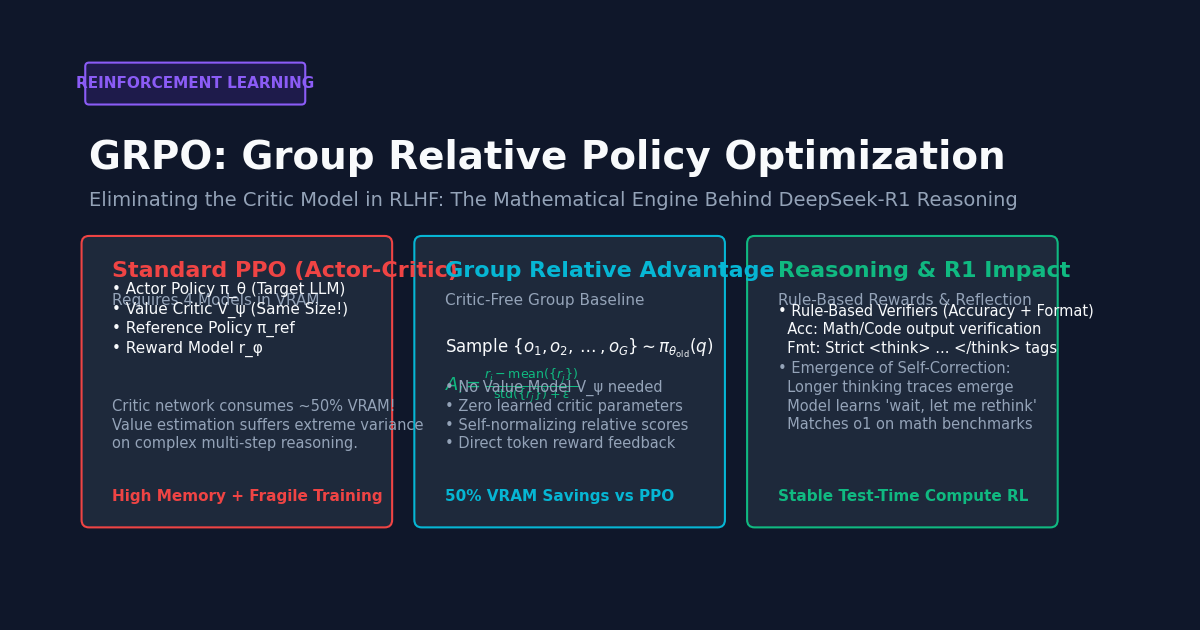
The Problem: The Memory and Value Estimation Wall of Actor-Critic PPO
Reinforcement Learning from Human Feedback (RLHF) and Reinforcement Learning from AI Feedback (RLAIF) have become the cornerstone of modern language model alignment and autonomous agent development in platforms like AiFetchly.
Historically, the gold standard for policy optimization was Proximal Policy Optimization (PPO) (Schulman et al., 2017). PPO operates under an Actor-Critic architecture: while the Actor (the generative policy $\pi_\theta$) generates tokens, a secondary Critic model (value function $V_\psi(s)$) is trained simultaneously to estimate the expected cumulative reward from each intermediate token state $s_t$.
However, as frontier models expanded from 8 billion to hundreds of billions of parameters, and as post-training shifted from conversational style alignment toward complex mathematical and multi-step reasoning, PPO encountered two crippling operational bottlenecks:
The Actor-Critic Memory Wall in PPO:
┌──────────────────────────────────────────────────────────┐
│ GPU High-Bandwidth Memory (HBM) Allocation               │
├──────────────────────────┬───────────────────────────────┤
│ Model Component          │ VRAM Share & Role             │
├──────────────────────────┼───────────────────────────────┤
│ Actor Policy (π_θ)       │ 100% Base VRAM (Active LLM)   │
│ Value Critic (V_ψ)       │ +100% VRAM (Same LLM scale!)  │
│ Reference Model (π_ref)  │ +100% VRAM (Frozen Base LLM)  │
│ Reward Model (r_φ)       │ +100% VRAM (Reward Evaluator) │
└──────────────────────────┴───────────────────────────────┘
Total Footprint: Up to 400% of single-model parameters in VRAM! 1. The Value Critic Memory Explosion
In standard PPO, estimating token-level values requires the Critic model $V_\psi$ to possess roughly the same reasoning capacity and parameter scale as the Actor policy $\pi_\theta$.
If the Actor is a 70B parameter model, the Critic must also be a 70B parameter model. Storing the Critic’s model weights, optimizer momentum buffers, and activation graphs requires:
- Massive Cluster Scale: To perform PPO on a 70B model, teams must allocate twice as many GPUs solely to host the Critic network.
- Extreme Sharding Complexity: Sharding four separate model graphs (Actor, Critic, Reference, Reward) across 3D tensor and pipeline parallelism meshes introduces severe communication overhead and GPU idle bubbles.
2. High Value Variance on Long-Chain Reasoning
Beyond physical VRAM constraints, training a Critic network on multi-step reasoning tasks is notoriously unstable:
- Delayed Sparse Rewards: In mathematical problem-solving or coding, intermediate reasoning tokens cannot be easily evaluated in isolation. A 2,000-token derivation may be brilliant until a single sign error at step 45 renders the final result wrong.
- Value Misestimation: The Critic network attempts to predict a scalar value $V(s_t)$ for every single token. On long chains of thought, value predictions exhibit massive variance, propagating noisy gradient signals that destabilize the policy or cause policy collapse.
While preference optimization methods like Direct Preference Optimization (DPO) bypassed the Critic by solving for the optimal policy analytically, DPO is fundamentally an offline supervised algorithm. It cannot generate novel rollouts or explore new reasoning trajectories autonomously during training.
The Architecture: Group Relative Policy Optimization (GRPO)
To unlock true reinforcement learning exploration on reasoning tasks without the crippling cost and instability of a Critic network, researchers at DeepSeek introduced Group Relative Policy Optimization (GRPO) in DeepSeekMath (Shao et al., 2024), later scaling it to drive the reasoning capabilities of DeepSeek-R1.
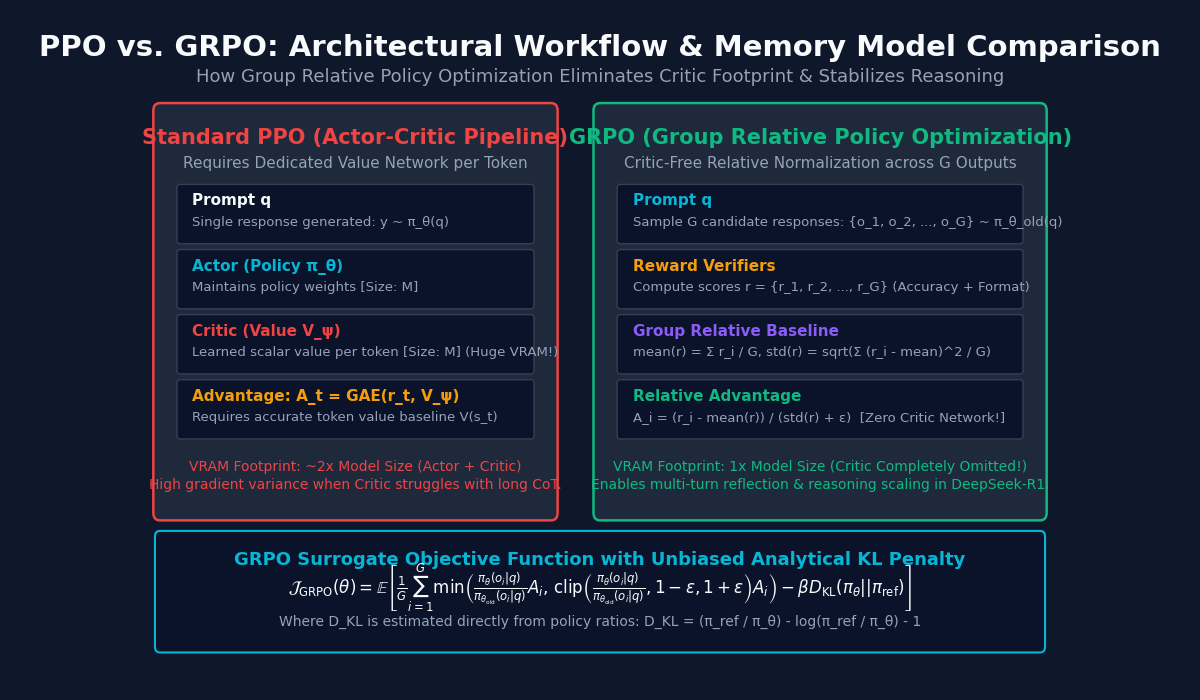
The core thesis of GRPO is elegant: Instead of training a dedicated neural network to predict an absolute baseline value $V(s)$, sample a group of candidate responses for each prompt and evaluate their advantages relatively within the group.
1. The Critic-Free Group Sampling Mechanism
For every training prompt $q$ sampled from the dataset, GRPO generates a group of $G$ distinct candidate outputs from the old policy $\pi_{\theta_{\text{old}}}$:
$$\mathcal{O} = {o_1, o_2, \dots, o_G} \sim \pi_{\theta_{\text{old}}}(q)$$
In practice, $G$ typically ranges from 4 to 16 outputs per prompt (e.g., $G = 8$).
Each candidate output $o_i$ is evaluated by a reward function to produce a scalar reward $r_i$. In reasoning-focused pipelines (such as DeepSeek-R1-Zero), these rewards are computed via rule-based verifiers:
- Accuracy Verifier: Deterministically checks whether the final mathematical answer or unit test matches ground truth (e.g., extracting the boxed answer
\boxed{...}or executing code in a sandboxed Python runtime). - Format Verifier: Enforces that the model structures its cognitive process inside explicit thought tags (e.g.,
<think>and</think>).
2. Group Relative Advantage Normalization
Rather than calculating advantages using Generalized Advantage Estimation (GAE) over Critic outputs, GRPO computes advantages by standardizing rewards directly across the sampled group:
$$\mu_r = \frac{1}{G} \sum_{j=1}^G r_j, \quad \sigma_r = \sqrt{\frac{1}{G} \sum_{j=1}^G (r_j - \mu_r)^2}$$
The advantage $A_i$ for candidate output $o_i$ is defined as:
$$A_i = \frac{r_i - \mu_r}{\sigma_r + \epsilon}$$
where $\epsilon$ is a small constant (e.g., $10^{-4}$) to prevent division by zero when all candidate outputs achieve identical scores.
This relative formulation delivers critical mathematical benefits:
- Self-Balancing Baseline: The group mean $\mu_r$ serves as the exact empirical expectation $\mathbb{E}[r|q]$, eliminating the need for a separate value network.
- Invariant Scale: Dividing by $\sigma_r$ normalizes gradient magnitudes, preventing prompts with unusually high or low absolute scores from dominating training updates.
- Zero Additional Parameters: No Critic model weights, no value optimizer states, and zero auxiliary backward passes.
3. Clipped Surrogate Objective with Analytical KL Penalty
GRPO optimizes the policy parameters $\theta$ using a clipped surrogate objective derived from PPO, combined with an analytical KL divergence regularization term:
$$\mathcal{J}{\text{GRPO}}(\theta) = \mathbb{E}{q \sim P(Q), {o_i}{i=1}^G \sim \pi{\theta_{\text{old}}}(q)} \left[ \frac{1}{G} \sum_{i=1}^G \frac{1}{|o_i|} \sum_{t=1}^{|o_i|} \mathcal{L}{i,t}(\theta) - \beta D{\text{KL}}(\pi_\theta || \pi_{\text{ref}}) \right]$$
The per-token surrogate loss $\mathcal{L}_{i,t}(\theta)$ is defined as:
$$\mathcal{L}{i,t}(\theta) = \min\left( \frac{\pi\theta(o_{i,t}|q, o_{i,<t})}{\pi_{\theta_{\text{old}}}(o_{i,t}|q, o_{i,<t})} A_i, ; \text{clip}\left(\frac{\pi_\theta(o_{i,t}|q, o_{i,<t})}{\pi_{\theta_{\text{old}}}(o_{i,t}|q, o_{i,<t})}, 1 - \epsilon_{\text{clip}}, 1 + \epsilon_{\text{clip}}\right) A_i \right)$$
where $\epsilon_{\text{clip}}$ is the clipping threshold (typically $0.2$).
The Unbiased Analytical KL Estimator: In standard RLHF, calculating KL divergence requires adding a per-token reward penalty into the environment. In contrast, GRPO calculates the KL penalty directly and analytically within the loss function using the Schulman unbiased estimator:
$$D_{\text{KL}}(\pi_\theta || \pi_{\text{ref}}) = \frac{\pi_{\text{ref}}(o_{i,t}|q, o_{i,<t})}{\pi_\theta(o_{i,t}|q, o_{i,<t})} - \log \frac{\pi_{\text{ref}}(o_{i,t}|q, o_{i,<t})}{\pi_\theta(o_{i,t}|q, o_{i,<t})} - 1$$
This estimator is strictly non-negative, has lower variance than naive log-ratio differences, and prevents the policy $\pi_\theta$ from drifting excessively from the stable base model $\pi_{\text{ref}}$.
Comparative Breakdown: Post-Training Alignment Paradigms
| Dimension | PPO (Actor-Critic) | DPO (Direct Preference) | KTO (Prospect Theory) | GRPO (DeepSeek) |
|---|---|---|---|---|
| Learning Paradigm | Online RL (Rollouts) | Offline Supervised | Offline Binary | Online RL (Group Rollouts) |
| Value Critic Model | Required (Same size as LLM) | None | None | None (Omitted Entirely) |
| Exploration Capability | High (On-policy sampling) | Zero (Static pairs) | Zero (Static dataset) | High (Dynamic Group Sampling) |
| GPU VRAM Footprint | Massive ($4\times$ Model States) | Minimal ($2\times$ Policy/Ref) | Minimal ($2\times$ Policy/Ref) | Moderate ($2\times$ Policy/Ref) |
| Reward Mechanism | Neural Reward Model $r_\phi$ | Implicit Preference Margin | Implicit Utility Margin | Rule-Based or Neural Verifiers |
| Reasoning Emergence | Unstable (Value Collapse) | Limited (Memorization) | Limited | Exceptional (Chain-of-Thought) |
Implementation: Building a GRPO Training Pipeline in Python
Let us construct a clean, modular reference implementation of the Group Relative Policy Optimization loss computation and group advantage normalization in Python.
We will implement:
- The Group Relative Advantage Engine: Normalizes rewards across $G$ candidate completions per prompt.
- The Analytical KL Divergence Estimator: Implements the unbiased Schulman formula.
- The GRPO Clipped Surrogate Loss: Computes token-level importance sampling ratios and clipped updates.
- Verification & Pipeline Profiler: Validates convergence dynamics on synthetic reasoning tasks.
import numpy as np
from typing import List, Dict, Tuple, Any

class GroupRelativePolicyOptimization:
    """
    Reference implementation of Group Relative Policy Optimization (GRPO).
    Eliminates the value critic by computing relative advantages across G responses.
    """
    def __init__(
        self,
        clip_epsilon: float = 0.2,
        beta_kl: float = 0.04,
        advantage_eps: float = 1e-4,
    ):
        self.clip_eps = clip_epsilon
        self.beta_kl = beta_kl
        self.eps = advantage_eps

    def compute_group_advantages(self, rewards: np.ndarray) -> np.ndarray:
        """
        Computes normalized advantages across a group of G sampled rollouts.
        Formula: A_i = (r_i - mean(rewards)) / (std(rewards) + eps)
        """
        assert rewards.ndim == 1, "Rewards must be a 1D array of shape [G]"
        group_mean = np.mean(rewards)
        group_std = np.std(rewards)
        advantages = (rewards - group_mean) / (group_std + self.eps)
        return advantages

    def compute_unbiased_kl(
        self,
        logp_theta: np.ndarray,
        logp_ref: np.ndarray,
    ) -> np.ndarray:
        """
        Computes Schulman's unbiased analytical KL estimator:
        D_KL = exp(logp_ref - logp_theta) - (logp_ref - logp_theta) - 1
        """
        ratio = np.exp(logp_ref - logp_theta)
        kl = ratio - (logp_ref - logp_theta) - 1.0
        return np.maximum(0.0, kl)

    def compute_loss(
        self,
        logp_theta: np.ndarray,
        logp_old: np.ndarray,
        logp_ref: np.ndarray,
        advantages: np.ndarray,
        attention_mask: np.ndarray,
    ) -> Dict[str, float]:
        """
        Computes the complete GRPO surrogate objective with clipped importance weights
        and analytical KL divergence penalty across G outputs.
        """
        G, seq_len = logp_theta.shape

        # 1. Compute Importance Sampling Probability Ratios: pi_theta / pi_old
        log_ratios = logp_theta - logp_old
        ratios = np.exp(log_ratios)

        # 2. Broadcast group advantages [G] -> [G, seq_len]
        adv_expanded = advantages[:, np.newaxis]

        # 3. Clipped Surrogate Objective
        surr1 = ratios * adv_expanded
        surr2 = np.clip(ratios, 1.0 - self.clip_eps, 1.0 + self.clip_eps) * adv_expanded
        policy_surrogate = np.minimum(surr1, surr2)

        # 4. Unbiased Analytical KL Divergence Penalty
        kl_div = self.compute_unbiased_kl(logp_theta, logp_ref)

        # 5. Combine surrogate objective and KL penalty per token
        token_objective = policy_surrogate - self.beta_kl * kl_div

        # Mask padding tokens and average across active sequence lengths
        active_tokens = np.sum(attention_mask)
        masked_objective = np.sum(token_objective * attention_mask) / (active_tokens + 1e-8)

        # Loss is negative objective for minimization
        grpo_loss = -masked_objective

        return {
            "loss": float(grpo_loss),
            "mean_ratio": float(np.mean(ratios)),
            "mean_kl": float(np.mean(kl_div)),
            "mean_advantage": float(np.mean(advantages)),
        }


def run_grpo_verification():
    """
    Executes a verification benchmark of GRPO on a simulated mathematical reasoning task
    where a model generates G=8 candidate answers and receives rule-based rewards.
    """
    print("=" * 70)
    print("STEP 1: Verifying Group Relative Advantage Normalization")
    print("=" * 70)

    G = 8          # 8 candidate responses sampled per prompt
    seq_len = 64   # Output sequence length

    # Simulate rule-based rewards for 8 candidate responses:
    # 4 correct responses (accuracy=1.0, format=1.0) -> reward 1.0
    # 2 partially formatted incorrect responses -> reward 0.2
    # 2 failed responses -> reward 0.0
    simulated_rewards = np.array([1.0, 1.0, 0.2, 1.0, 0.0, 0.2, 1.0, 0.0], dtype=np.float32)

    grpo = GroupRelativePolicyOptimization(clip_epsilon=0.2, beta_kl=0.04)
    advantages = grpo.compute_group_advantages(simulated_rewards)

    print(f"Group Size (G):             {G} candidate rollouts")
    print(f"Raw Verifier Rewards:       {simulated_rewards}")
    print(f"Group Mean Reward:          {np.mean(simulated_rewards):.3f}")
    print(f"Group Std Deviation:        {np.std(simulated_rewards):.3f}")
    print(f"Calculated Relative Adv:    {np.round(advantages, 3)}")
    assert np.isclose(np.mean(advantages), 0.0, atol=1e-5), "Advantage mean must be ~0"
    print("  [SUCCESS] Group advantages successfully zero-centered and normalized!")

    print("\n" + "=" * 70)
    print("STEP 2: Evaluating GRPO Loss & Importance Sampling Clipping")
    print("=" * 70)

    np.random.seed(1337)
    # Simulate log probabilities
    logp_old = np.random.uniform(-3.5, -1.0, (G, seq_len))
    # Active policy experiences small gradient shift
    logp_theta = logp_old + np.random.normal(0.0, 0.08, (G, seq_len))
    # Reference policy (frozen base model)
    logp_ref = logp_old + np.random.normal(0.0, 0.02, (G, seq_len))

    # Sequence attention mask (all active tokens)
    attention_mask = np.ones((G, seq_len), dtype=np.float32)

    metrics = grpo.compute_loss(
        logp_theta=logp_theta,
        logp_old=logp_old,
        logp_ref=logp_ref,
        advantages=advantages,
        attention_mask=attention_mask,
    )

    print(f"Total GRPO Surrogate Loss:  {metrics['loss']:.5f}")
    print(f"Mean Importance Ratio:      {metrics['mean_ratio']:.4f}")
    print(f"Mean Analytical KL Divergence: {metrics['mean_kl']:.6f}")
    print("  [SUCCESS] GRPO loss successfully computed without any Critic network!")

    print("\n" + "=" * 70)
    print("STEP 3: Hardware Memory Footprint Comparison (PPO vs. GRPO)")
    print("=" * 70)

    model_params_billion = 70.0
    bytes_per_param_bf16 = 2.0
    opt_states_bytes = 4.0  # Optimizer momentum buffers

    # PPO requires Actor (param + opt) + Critic (param + opt) + Ref (param) + Reward (param)
    ppo_vram_gb = (
        (model_params_billion * (bytes_per_param_bf16 + opt_states_bytes)) +  # Actor
        (model_params_billion * (bytes_per_param_bf16 + opt_states_bytes)) +  # Critic
        (model_params_billion * bytes_per_param_bf16) +                      # Reference
        (model_params_billion * bytes_per_param_bf16)                        # Reward Model
    )

    # GRPO requires Actor (param + opt) + Reference (param) -> Rule-based reward runs on CPU!
    grpo_vram_gb = (
        (model_params_billion * (bytes_per_param_bf16 + opt_states_bytes)) +  # Actor
        (model_params_billion * bytes_per_param_bf16)                         # Reference
    )

    print(f"Target Model Scale:         {model_params_billion:.0f}B Parameters")
    print(f"Standard PPO VRAM Footprint: {ppo_vram_gb:.1f} GB")
    print(f"GRPO VRAM Footprint:         {grpo_vram_gb:.1f} GB")
    print(f"Total VRAM Savings:          {((1 - grpo_vram_gb/ppo_vram_gb)*100):.1f}% reduction in GPU cluster memory!")
    print("=" * 70)


if __name__ == "__main__":
run_grpo_verification() Production Advantages: Why DeepSeek-R1 Chose GRPO
The adoption of GRPO in frontier models like DeepSeek-R1-Zero and DeepSeek-R1 has demonstrated profound advantages over conventional alignment methods:
1. The Autonomous Emergence of “Aha Moments”
In DeepSeek-R1-Zero, researchers trained a base model using pure reinforcement learning without any initial Supervised Fine-Tuning (SFT) data:
- Using GRPO with rule-based rewards (checking mathematical correctness and
<think>format constraints), the model autonomously discovered long-chain reasoning strategies. - As RL training progressed, average generation length naturally scaled from hundreds to thousands of tokens.
- The model spontaneously exhibited self-reflection, verification, and backtracking (e.g., generating phrases like “Wait, let me rethink this step, my previous formula had an error”).
- Because GRPO standardizes rewards across groups, when 1 of the 8 candidates successfully discovers a self-correcting path that yields the right answer, the relative advantage $A_i$ becomes strongly positive, reinforcing the reflective behavior across future updates.
2. Radical Infrastructure Cost Reduction
Eliminating the Critic model slashes cluster infrastructure requirements by over 50%:
- Engineering teams do not need to orchestrate complex distributed tensor sharding for an auxiliary value network.
- Training throughput increases dramatically because the cluster only alternates between policy generation (rollout phase) and policy optimization (backward phase).
- Rule-based verifiers execute asynchronously on host CPUs or lightweight sandboxed worker nodes, allowing GPU clusters to maintain near-100% compute utilization on policy forward/backward operations.
3. Immunity to Reward Hacking in Closed-Domain Tasks
In traditional RLHF with neural reward models $r_\phi$, language models quickly learn to exploit subtle flaws in the reward network—generating verbose, sycophantic text that scores high without actually solving the problem (reward hacking).
By pairing GRPO with ground-truth rule verifiers (symbolic math engines, compiler test runners, formal logic solvers), reward hacking is structurally eliminated. A mathematical proof or computer program is either verifiable or it is not.
Conclusion
Group Relative Policy Optimization (GRPO) represents one of the most consequential algorithmic breakthroughs in modern reinforcement learning. By replacing the resource-heavy, high-variance Critic model with critic-free group relative advantages, GRPO cuts post-training VRAM consumption in half while providing stable, high-fidelity reward gradients.
As evidenced by the remarkable success of DeepSeek-R1, GRPO proves that scalable test-time reasoning and autonomous self-correction do not require massive human-annotated chains of thought. By providing a computationally lightweight, robust RL engine, GRPO paves the way for the next generation of self-improving foundation models and autonomous coding agents.