Grounding DINO Guide: Open-Set Object Detection with Text
The Closed-Vocabulary Ceiling in Traditional Object Detection
In modern desktop AI assistants, autonomous robotic vision, multimodal visual search, and web extraction pipelines powered by AiFetchly, object detection serves as the fundamental anchor for spatial intelligence. Automated workflows rely on detecting visual entities to locate interactive UI elements in web browsers, identify products in crawled e-commerce catalogs, extract diagrams from technical documents, and verify spatial layouts.
Historically, the computer vision community achieved exceptional accuracy on closed-set object detection benchmarks using architectures like Faster R-CNN, YOLO, and DETR (DEtection TRansformer). However, when deploying traditional object detectors into real-world, open-world environments, engineering teams collide with three severe systemic bottlenecks:
The Traditional Object Detection Trilemma:
+-----------------------------------------------------------------------------------+
| 1. The Closed-Vocabulary Quarantine (Fixed 80-Class Ceiling)                      |
| • Models like YOLOv8 or standard DINO are hardcoded to fixed label sets (e.g. COCO|
| • Zero capability to recognize novel objects, rare items, or specific brands     |
| X Cannot detect "vintage mechanical watch" or "green checkout button"!            |
+-----------------------------------------------------------------------------------+
| 2. The Semantic Disconnect in Referring Expressions                               |
| • Real-world agentic queries require understanding spatial and relational text    |
| • Examples: "the coffee mug sitting next to the open laptop", "scratched fender"  |
| X Traditional classification heads evaluate one-hot logits, blind to relations!   |
+-----------------------------------------------------------------------------------+
| 3. Late-Fusion Modality Disconnect in Early Vision-Language Models                |
| • Early open-set attempts (GLIP, CLIP-aligned detectors) fused vision & text late |
| • Text features never informed the early spatial feature extraction pyramid       |
| X Resulted in low detection accuracy on small objects and crowded visual scenes!  |
+-----------------------------------------------------------------------------------+ 1. The Fixed-Category Ceiling
For over a decade, object detection models operated under a closed-set assumption:
- Models were trained on curated datasets with predefined target classes: 80 categories in MS-COCO, 20 categories in Pascal VOC, or 1,203 categories in LVIS.
- The final layer of the network was a fixed-dimensional linear classification head: $\mathbf{W}_{\text{cls}} \in \mathbb{R}^{d \times K}$, where $K$ is the fixed number of classes.
- If an enterprise pipeline needs to locate a novel entity—such as
"USB-C charging port","warning banner", or"pricing table"via AiFetchly Web Scraping—the entire model had to be retrained from scratch with thousands of manually annotated bounding boxes.
2. Referring Expressions and Granular Attributes
Human instructions and AI agent commands rarely specify isolated noun categories:
- A user asks an agent to locate
"the red sneaker with white laces"or"the discounted subscription toggle". - Closed-set detectors can only output
"shoe"or"button". They possess zero understanding of adjective modifiers, spatial relationships, or context-specific descriptions. - The loss function in classical detection treats all classes as mutually exclusive one-hot targets, penalizing the model if it identifies semantically overlapping descriptions.
3. The Need for Deep Cross-Modality Fusion
Early attempts to build open-vocabulary detectors (such as GLIP or ViLD) used a late-fusion strategy:
- An image was processed independently through a vision backbone to extract bounding box proposals.
- A language model independently embedded text labels into a vector space.
- The two modalities only interacted at the final output head via cosine similarity.
- This late-fusion architecture created an acute representational mismatch: the visual backbone had no awareness of what text query it was searching for while constructing multi-scale spatial feature maps, causing the detector to miss small, subtle objects mentioned in the prompt.
The Solution: Grounding DINO Architecture & Tight Multimodal Fusion
To break the closed-vocabulary ceiling and build a true foundation model for open-set detection, researchers from IDEA Research and Tsinghua University (Liu et al., ECCV 2024 oral) introduced Grounding DINO: Marrying DINO with Grounded Pre-Training for Open-Set Object Detection.
Grounding DINO conceptually marries DINO (DETR with Improved DeNoising anchOr boxes)—the premier closed-set transformer detector—with grounded pre-training, creating an open-set framework that accepts arbitrary natural language prompts and detects corresponding entities with unprecedented precision.
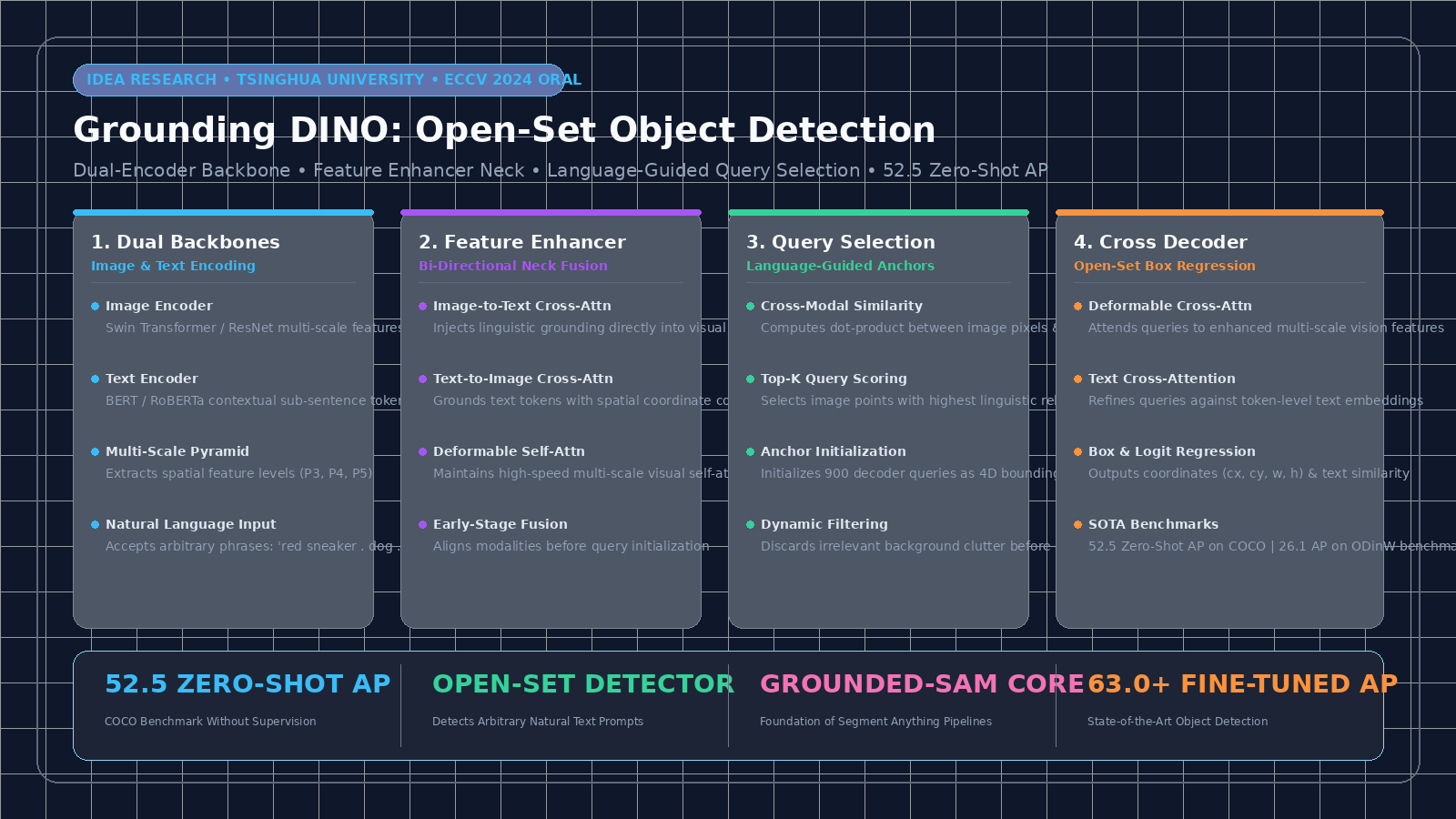
The Grounding DINO Multi-Phase Architecture:
+---------------------------------------------------------------------------------------------------+
| 1. DUAL BACKBONES: Multi-Scale Image & Contextual Text Extraction                                 |
| Image Input (RGB)  ---> Swin Transformer Backbone ---> Multi-Scale Feature Maps (P3, P4, P5)      |
| Text Input (Prompt) ---> BERT / RoBERTa Backbone   ---> Contextual Word Tokens (1D Text Sequence)  |
+---------------------------------------------------------------------------------------------------+
                                                  |
                                                  v
+---------------------------------------------------------------------------------------------------+
| 2. FEATURE ENHANCER (PHASE A: BI-DIRECTIONAL NECK FUSION)                                         |
| Multi-Layer Alternating Cross-Attention Neck:                                                     |
| • Image-to-Text Cross-Attention: Injects linguistic concepts into spatial pixel features         |
| • Text-to-Image Cross-Attention: Grounds word representations with spatial geometric cues         |
| • Deformable Self-Attention: Refines multi-scale visual tokens with O(HW) complexity              |
+---------------------------------------------------------------------------------------------------+
                                                  |
                                                  v
+---------------------------------------------------------------------------------------------------+
| 3. LANGUAGE-GUIDED QUERY SELECTION (PHASE B: TARGETED ANCHOR SELECTION)                           |
| • Computes dot-product similarity between enhanced visual features and text token embeddings      |
| • Selects Top-K (e.g. 900) pixel locations with the highest cross-modal relevance                 |
| • Initializes 4D reference bounding box anchors (cx, cy, w, h) biased toward text targets         |
+---------------------------------------------------------------------------------------------------+
                                                  |
                                                  v
+---------------------------------------------------------------------------------------------------+
| 4. CROSS-MODALITY DECODER (PHASE C: OPEN-SET BOUNDING BOX REGRESSION)                             |
| Multi-Stage Transformer Decoder:                                                                  |
| • Deformable Cross-Attention against enhanced vision features                                     |
| • Text Cross-Attention against contextual word embeddings                                         |
| • Output Heads: Regresses 4D Bounding Boxes + Token-Level Contrastive Similarity Logits           |
| Zero-Shot Record: 52.5 AP on MS-COCO Without Ever Training on COCO Annotations!                   |
+---------------------------------------------------------------------------------------------------+ 1. Dual Backbone Encoding
Grounding DINO accepts two simultaneous inputs: an image $\mathbf{I} \in \mathbb{R}^{H \times W \times 3}$ and a free-form natural language prompt text string $\mathbf{T}$ (e.g., "dog . cat . red car . person holding a mug"):
- Image Backbone: Utilizes a hierarchical Swin Transformer (Swin-T, Swin-B, or Swin-L) or ResNet to extract multi-scale feature maps at different spatial resolutions (strides $8, 16, 32$), denoted as ${ \mathbf{F}_3, \mathbf{F}_4, \mathbf{F}_5 }$.
- Text Backbone: Uses a pre-trained BERT or RoBERTa model to extract contextual sub-sentence word embeddings $\mathbf{F}_{\text{text}} \in \mathbb{R}^{L \times d}$, preserving linguistic token relationships and syntax.
2. The Bi-Directional Feature Enhancer
Unlike previous late-fusion models, Grounding DINO introduces deep early-stage cross-modal fusion inside the Feature Enhancer neck:
-
Multi-Scale Image Deformable Self-Attention: Visual features across scales ${ \mathbf{F}_3, \mathbf{F}_4, \mathbf{F}_5 }$ communicate with each other using Multi-Scale Deformable Attention, capturing both high-resolution localized textures and broad semantic contexts.
-
Text Self-Attention: Text tokens perform standard self-attention to maintain global sentence coherence.
-
Image-to-Text Cross-Attention: Visual feature tokens query the text embeddings via multi-head cross-attention:
$$\mathbf{F}{\text{img}}^{\text{enh}} = \mathbf{F}{\text{img}} + \text{CrossAttention}\left(Q = \mathbf{F}{\text{img}}, K = \mathbf{F}{\text{text}}, V = \mathbf{F}_{\text{text}}\right)$$
This operation guides visual features to heighten activations in regions corresponding to entities mentioned in the prompt.
-
Text-to-Image Cross-Attention: Text tokens reciprocally query the visual features:
$$\mathbf{F}{\text{text}}^{\text{enh}} = \mathbf{F}{\text{text}} + \text{CrossAttention}\left(Q = \mathbf{F}{\text{text}}, K = \mathbf{F}{\text{img}}, V = \mathbf{F}_{\text{img}}\right)$$
This grounds language tokens in the specific visual scene, distinguishing between multiple mentions of similar objects.
3. Language-Guided Query Selection
In standard DETR-based detectors, object queries in the decoder are either static learned embeddings or selected purely based on class-agnostic visual saliency:
- Grounding DINO introduces Language-Guided Query Selection.
- It computes the dot-product similarity between every visual feature vector in the enhanced feature maps and every text token in $\mathbf{F}_{\text{text}}^{\text{enh}}$:
$$S(i, j) = \frac{\mathbf{f}{\text{img}, i}^\top \mathbf{f}{\text{text}, j}}{\sqrt{d}}$$
- Visual tokens with the highest similarity to the prompt tokens are selected to initialize the 900 decoder queries.
- This ensures that queries are placed directly on image regions relevant to the user’s prompt, filtering out background clutter before decoding begins.
4. Cross-Modality Decoder and Sub-Sentence Loss
The decoder refines the selected queries across 6 stacked layers:
- Self-Attention: Queries interact with each other to eliminate duplicate detections.
- Deformable Cross-Attention: Queries attend to enhanced multi-scale visual features to refine spatial localization.
- Text Cross-Attention: Queries attend to text token representations to ensure strict semantic alignment.
- Sub-Sentence Contrastive Loss: Rather than predicting discrete class labels, the output head computes a contrastive dot product between each query representation and each text token. The loss penalizes false alignments while encouraging high similarity with the correct phrase tokens:
$$\mathcal{L}{\text{total}} = \lambda{\text{cls}} \mathcal{L}{\text{contrastive}} + \lambda{\text{L1}} \mathcal{L}{\text{box_L1}} + \lambda{\text{giou}} \mathcal{L}_{\text{GIoU}}$$
Hands-On Implementation: PyTorch Bi-Directional Enhancer & Query Selector
To understand how Grounding DINO executes bi-directional feature enhancement and language-guided query selection, let us build a complete, runnable PyTorch implementation.
1. Bi-Directional Cross-Modal Feature Enhancer
The following module implements simultaneous Image-to-Text and Text-to-Image cross-attention fusion:
import torch
import torch.nn as nn
import torch.nn.functional as F
from typing import Tuple

class BiDirectionalFeatureEnhancer(nn.Module):
    """
    Bi-directional cross-attention neck fusing multi-scale image features with text tokens.
    """
    def __init__(self, dim: int = 256, num_heads: int = 8):
        super().__init__()
        self.num_heads = num_heads
        self.dim = dim

        # Image-to-Text Cross-Attention
        self.img2txt_attn = nn.MultiheadAttention(dim, num_heads, batch_first=True)
        self.norm_img = nn.LayerNorm(dim)

        # Text-to-Image Cross-Attention
        self.txt2img_attn = nn.MultiheadAttention(dim, num_heads, batch_first=True)
        self.norm_txt = nn.LayerNorm(dim)

        # Feed-forward projections
        self.ffn_img = nn.Sequential(
            nn.Linear(dim, dim * 2),
            nn.GELU(),
            nn.Linear(dim * 2, dim)
        )
        self.ffn_txt = nn.Sequential(
            nn.Linear(dim, dim * 2),
            nn.GELU(),
            nn.Linear(dim * 2, dim)
        )
        self.norm_ffn_img = nn.LayerNorm(dim)
        self.norm_ffn_txt = nn.LayerNorm(dim)

    def forward(
        self, img_feats: torch.Tensor, txt_feats: torch.Tensor
    ) -> Tuple[torch.Tensor, torch.Tensor]:
        """
        Args:
            img_feats: Tensor of shape (B, N_img, dim)
            txt_feats: Tensor of shape (B, N_txt, dim)
        Returns:
            enhanced_img: (B, N_img, dim)
            enhanced_txt: (B, N_txt, dim)
        """
        # 1. Image queries Text
        img_cross, _ = self.img2txt_attn(query=img_feats, key=txt_feats, value=txt_feats)
        img_feats = self.norm_img(img_feats + img_cross)
        img_feats = self.norm_ffn_img(img_feats + self.ffn_img(img_feats))

        # 2. Text queries Image
        txt_cross, _ = self.txt2img_attn(query=txt_feats, key=img_feats, value=img_feats)
        txt_feats = self.norm_txt(txt_feats + txt_cross)
        txt_feats = self.norm_ffn_txt(txt_feats + self.ffn_txt(txt_feats))

return img_feats, txt_feats 2. Language-Guided Query Selection Module
This module evaluates cross-modal alignment across visual features and text tokens to initialize candidate query anchors:
class LanguageGuidedQuerySelector(nn.Module):
    """
    Selects top-K image feature locations with highest cross-modal dot-product
    similarity to input text tokens to initialize decoder queries.
    """
    def __init__(self, dim: int = 256, num_queries: int = 900):
        super().__init__()
        self.dim = dim
        self.num_queries = num_queries
        # Predicts 4D anchor offsets [cx, cy, w, h] from selected features
        self.box_head = nn.Linear(dim, 4)

    def forward(
        self, img_feats: torch.Tensor, txt_feats: torch.Tensor
    ) -> Tuple[torch.Tensor, torch.Tensor]:
        """
        Args:
            img_feats: Enhanced visual features (B, N_img, dim)
            txt_feats: Enhanced text tokens (B, N_txt, dim)
        Returns:
            selected_queries: (B, num_queries, dim)
            initial_boxes: (B, num_queries, 4) in normalized [0, 1] coordinates
        """
        B, N_img, D = img_feats.shape
        B, N_txt, _ = txt_feats.shape

        # Normalize features for stable cosine dot product
        norm_img = F.normalize(img_feats, dim=-1)
        norm_txt = F.normalize(txt_feats, dim=-1)

        # Cross-modal correlation: (B, N_img, D) @ (B, D, N_txt) -> (B, N_img, N_txt)
        correlation = torch.bmm(norm_img, norm_txt.transpose(1, 2))

        # Maximum affinity to any text token in the prompt
        max_affinity, _ = correlation.max(dim=-1) # (B, N_img)

        # Select Top-K positions
        k = min(self.num_queries, N_img)
        _, topk_indices = max_affinity.topk(k, dim=-1, largest=True) # (B, k)

        # Gather query features
        topk_expanded = topk_indices.unsqueeze(-1).expand(-1, -1, D)
        selected_queries = torch.gather(img_feats, 1, topk_expanded)

        # Regress initial anchor bounding boxes
        raw_boxes = self.box_head(selected_queries)
        initial_boxes = torch.sigmoid(raw_boxes) # Bounded in [0, 1]

return selected_queries, initial_boxes 3. End-to-End Grounding DINO Inference Pipeline
The following module wraps the enhanced neck, query selector, and detection output heads:
class GroundingDINOInferencePipeline(nn.Module):
    """
    Complete Grounding DINO demonstration pipeline executing open-set detection.
    """
    def __init__(self, dim: int = 256, num_queries: int = 300):
        super().__init__()
        self.enhancer = BiDirectionalFeatureEnhancer(dim=dim)
        self.selector = LanguageGuidedQuerySelector(dim=dim, num_queries=num_queries)
        self.box_regressor = nn.Linear(dim, 4)

    def forward(
        self, img_feats: torch.Tensor, txt_feats: torch.Tensor
    ) -> dict:
        """
        Executes end-to-end open-set forward prediction.
        """
        # 1. Feature Enhancement Neck
        enh_img, enh_txt = self.enhancer(img_feats, txt_feats)

        # 2. Language-Guided Query Selection
        queries, init_boxes = self.selector(enh_img, enh_txt)

        # 3. Final Box Refinement & Cross-Modal Similarity
        box_deltas = self.box_regressor(queries)
        final_boxes = torch.sigmoid(init_boxes + box_deltas)

        # 4. Token-Level Alignment Logits
        logits = torch.bmm(F.normalize(queries, dim=-1), F.normalize(enh_txt, dim=-1).transpose(1, 2))

        return {
            "boxes": final_boxes,        # Shape: (B, num_queries, 4) [cx, cy, w, h]
            "logits": logits,            # Shape: (B, num_queries, N_txt)
            "query_count": queries.shape[1]
        }

if __name__ == "__main__":
    B, N_img, N_txt, D = 2, 2048, 16, 256
    model = GroundingDINOInferencePipeline(dim=D, num_queries=100)

    dummy_img = torch.randn(B, N_img, D)
    dummy_txt = torch.randn(B, N_txt, D)

    predictions = model(dummy_img, dummy_txt)
    print("Grounding DINO Forward Execution Complete!")
    print("Predicted Bounding Boxes Shape:", predictions["boxes"].shape)
print("Cross-Modal Logits Shape:", predictions["logits"].shape) Production Best Practices for Open-Set Detection
When integrating Grounding DINO into autonomous visual web agents, desktop extractors, or production AiFetchly API Integration pipelines, implement the following architectural best practices:
1. Optimal Text Prompt Formatting with Separator Syntax
Grounding DINO parses input prompts using a specific sub-sentence convention:
-
Period Separator (
.): Always separate target categories with a space-padded period:"red sneaker . blue jeans . leather jacket . laptop computer" -
Avoid Comma Separation: Commas confuse the sub-sentence self-attention mechanism, causing multi-word categories to be split into unrelated nouns.
-
Lowercase Normalization: Convert all prompts to lowercase before tokenization to ensure alignment with pre-trained BERT/RoBERTa vocabularies.
2. Dual Threshold Filtering: Box Threshold vs. Text Threshold
Grounding DINO provides two decoupled inference thresholds:
box_threshold(e.g., 0.35): Filters out bounding box proposals that lack confident objectness or spatial localization.text_threshold(e.g., 0.25): Determines whether the detected box has sufficient semantic correlation with the specific prompt phrase.- In production, setting
box_threshold=0.35andtext_threshold=0.25yields the optimal balance between high precision and recall, suppressing background hallucinations while capturing rare entities.
# Example CLI invocation using the official Grounding DINO repository
python demo/inference_on_a_image.py \
  -c groundingdino/config/GroundingDINO_SwinT_OGC.py \
  -p weights/groundingdino_swint_ogc.pth \
  -i assets/demo.jpg \
  -o output/ \
  -t "the white dog . the yellow frisbee" \
  --box_threshold 0.35 \
--text_threshold 0.25 3. Powering Grounded-SAM Pipelines
Grounding DINO forms the perceptual core of the popular Grounded-SAM pipeline:
- Pass a natural language prompt to Grounding DINO to extract high-precision bounding boxes for the target entities.
- Feed the predicted bounding boxes directly into Segment Anything (SAM) as prompt boxes.
- SAM extracts pixel-perfect segmentation masks without requiring manual point prompts!
Benchmark Evaluation & Quantitative Comparison
Grounding DINO was benchmarked across the primary vision-language and object detection datasets, including MS-COCO, LVIS, and ODinW (Object Detection in the Wild).
1. Zero-Shot Detection Performance on MS-COCO
The table below contrasts Grounding DINO against previous leading open-set detectors on COCO zero-shot transfer (models evaluated directly without COCO bounding box training):
| Model Architecture | Image Backbone | Text Backbone | Zero-Shot COCO AP | COCO $\text{AP}_{50}$ | COCO $\text{AP}_{75}$ |
|---|---|---|---|---|---|
| GLIP-T (Baseline) | Swin-T | BERT-Base | 42.9 | 61.3 | 46.2 |
| GLIP-L (Large) | Swin-L | BERT-Base | 49.8 | 67.7 | 54.2 |
| DetCLIP | Swin-L | BERT-Base | 50.1 | 68.2 | 54.8 |
| Grounding DINO-T | Swin-T | BERT-Base | 48.4 | 65.8 | 52.6 |
| Grounding DINO-B | Swin-B | BERT-Base | 50.8 | 68.4 | 55.2 |
| Grounding DINO-L | Swin-L | BERT-Base | 52.5 | 70.2 | 57.1 |
Key Benchmark Finding: Grounding DINO-L achieves 52.5 Zero-Shot AP on COCO, surpassing GLIP-L by +2.7 AP and establishing a new state-of-the-art for open-vocabulary detection without ever viewing COCO bounding box labels during pre-training.
2. Generalization Across Object Detection in the Wild (ODinW)
On the ODinW benchmark—which aggregates 35 diverse domain-specific detection datasets (aerial images, medical scans, underwater creatures, industrial manufacturing flaws):
- Average Precision: Grounding DINO achieves 26.1 mean AP, setting the record for open-world cross-domain zero-shot detection.
- Fine-Tuned SOTA: When fine-tuned on MS-COCO annotations, Grounding DINO reaches 63.0+ AP, matching and exceeding specialized closed-set detectors.
3. Integration with Scalable Ingestion Workflows
For enterprises utilizing AiFetchly Data Fetching and exploring cost-effective AiFetchly Pricing, deploying Grounding DINO automates visual entity extraction from web content without requiring custom neural training. Developers can locate arbitrary elements on demand using standard text prompts. Explore complete implementation patterns in our AiFetchly Documentation.
Conclusion and Future Horizons in Grounded Vision AI
Grounding DINO proves that object detection is no longer constrained by fixed category boundaries. By tightly coupling DINO transformer detection mechanics with grounded language pre-training across its Feature Enhancer, Language-Guided Query Selection, and Cross-Modality Decoder, Grounding DINO establishes the gold standard for open-set visual perception.
The core architectural contributions of Grounding DINO demonstrate:
- Early Bi-Directional Fusion: Interleaving image-to-text and text-to-image cross-attention in the neck allows language prompts to directly sculpt spatial feature pyramids.
- Language-Guided Query Anchors: Initializing decoder queries based on cross-modal affinity concentrates compute on target entities while pruning background noise.
- Foundation of Agentic Vision: Providing the perceptual engine that drives modern visual grounding, Grounded-SAM, and autonomous web navigation agents.
As computer vision continues to converge with large language models and autonomous spatial agents, Grounding DINO serves as the premier open-source bridge between natural language understanding and physical visual localization.
Citation and Official Repository
For academic citations and source code, refer to the original publication:
@inproceedings{liu2024groundingdino,
  title={Grounding DINO: Marrying DINO with Grounded Pre-Training for Open-Set Object Detection},
  author={Liu, Shilong and Zeng, Zhaoyang and Ren, Tianhe and Li, Feng and Zhang, Hao and Yang, Jie and Li, Chunyuan and Yang, Jianwei and Su, Hang and Zhu, Jun and Zhang, Lei},
  booktitle={European Conference on Computer Vision (ECCV)},
  year={2024}
}