Groq LPU Guide: Deterministic AI Inference Hardware
Problem: The Non-Deterministic Hardware Tax and GPU Memory Bottlenecks
Artificial intelligence deployment has crossed a critical inflection point. In contemporary enterprise systems—whether ingesting unstructured web indices via automated data curation pipelines or servicing live conversational voice streams through real-time streaming telemetry feeds—the primary constraint is no longer training capacity, but per-token inference latency and execution predictability.
For decades, general-purpose graphics processing units (GPUs) like the NVIDIA A100, H100, and Blackwell B200 have reigned as the default computational engine for deep learning. Yet, GPUs were fundamentally engineered for parallel graphics rendering and dense matrix training, not single-sequence low-latency text decoding.
When subjected to real-time autoregressive Large Language Model (LLM) serving, traditional GPU architectures suffer from two structural hardware bottlenecks:
+----------------------------------------------------------------------------------------------------+
|                         THE CONVENTIONAL GPU INFERENCE ARCHITECTURAL DILEMMA                       |
+------------------------------------+---------------------------------------------------------------+
| Systemic Hardware Barrier          | Manifestation in Real-Time Autoregressive LLM Inference       |
+------------------------------------+---------------------------------------------------------------+
| The Dynamic Scheduling Tax         | Hardware warp schedulers, dynamic branch predictors, and      |
| (Non-Deterministic Tail Latency)   | out-of-order memory controllers create unpredictable latency  |
+------------------------------------+---------------------------------------------------------------+
| The External HBM Bandwidth Wall    | High Bandwidth Memory (HBM) sits off-chip across interposers; |
| (The Memory-Bound Decoding Choke)  | streaming weights for single users caps generation at ~50 t/s |
+------------------------------------+---------------------------------------------------------------+
| Reactive Hardware Cache Inefficiency| Hardware caches (L1/L2) use speculative replacement policies; |
| (Cache Line Contention & Spills)   | cache misses force high-latency pipeline stalls into DRAM     |
+------------------------------------+---------------------------------------------------------------+
| Interconnect Synchronization Drag  | Tensor parallelism over NVLink requires frequent All-Reduce   |
| (Cross-Chip Collective Penalties)  | barrier synchronizations, compounding latency across GPUs     |
+------------------------------------+---------------------------------------------------------------+ The Non-Deterministic Hardware Scheduling Tax
Modern GPUs are marvels of hardware concurrency, managing thousands of simultaneous threads via Single Instruction, Multiple Threads (SIMT). However, managing this concurrency requires vast amounts of non-deterministic on-chip control circuitry:
- Hardware Warp Schedulers: Schedulers dynamically evaluate which instruction warps are ready to execute based on register availability and memory return signals.
- Dynamic Branch Predictors & Speculative Execution: When control flow branches, hardware circuits speculate on outcomes, stalling and flushing execution pipelines whenever branch mispredictions occur.
- Out-of-Order Memory Arbitrators: Memory controllers arbitrate competing requests between L1/L2 caches and multi-channel HBM stacks, introducing unpredictable memory access latencies.
Because hardware scheduling decisions depend on runtime physical states (thermal throttling, memory contention, and cache collision), GPU execution timing is fundamentally non-deterministic. The latency to generate token $N$ varies from token $N-1$, inducing severe “tail latency” (P99 spikes) that cripples interactive voice pipelines and real-time robotic control.
The External HBM Memory Wall
Autoregressive language generation operates in a strictly memory-bound regime. For each token generated, the model must read all active parameter weights from memory into arithmetic registers:
$$\text{Memory Traffic per Token} \approx 2 \times \text{Parameter Count (in bytes)}$$
For a 70-billion-parameter model in FP16 precision, generating a single token requires reading 140 Gigabytes of data:
- Even on an advanced NVIDIA H100 SXM5 with an HBM3 bandwidth of $3.35 \text{ TB/s}$, a single-user request running across an 8-GPU tensor-parallel cluster is physically choked by memory access delays.
- The GPU’s massive tensor cores spend the vast majority of time completely idle, starved of operands while waiting for data to traverse silicon interposers from external HBM stacks.
- As a result, standard GPU single-user generation speeds hover between 40 and 80 tokens per second on Llama 3.1 70B.
The Agentic Turnaround Collapse
For autonomous AI agents executing multi-step tree-of-thought exploration, code synthesis, shell execution, and output reflection, low inference speeds turn agile workflows into grinding delays:
- An agent requiring 15 sequential tool-call iterations (generating 1,000 tokens per step) takes over 5 minutes on traditional GPU infrastructure.
- High latency breaks human-in-the-loop collaboration and causes real-time multimodal agents (such as full-duplex conversational voice bots) to drop audio packets.
To dismantle both the memory wall and the non-deterministic scheduling tax, Groq—founded by former Google TPU architect Jonathan Ross—invented a radically new processor category: the Language Processing Unit (LPU), built upon the Tensor Streaming Processor (TSP) architecture (ISCA 2020 / ISCA 2022). By eliminating hardware schedulers, utilizing pure on-chip SRAM, and moving all orchestration into a deterministic compiler, Groq delivers over 500 tokens per second per user on Llama 3 70B with sub-15ms Time-To-First-Token (TTFT).
Solution: The Tensor Streaming Processor and Compile-Time Determinism
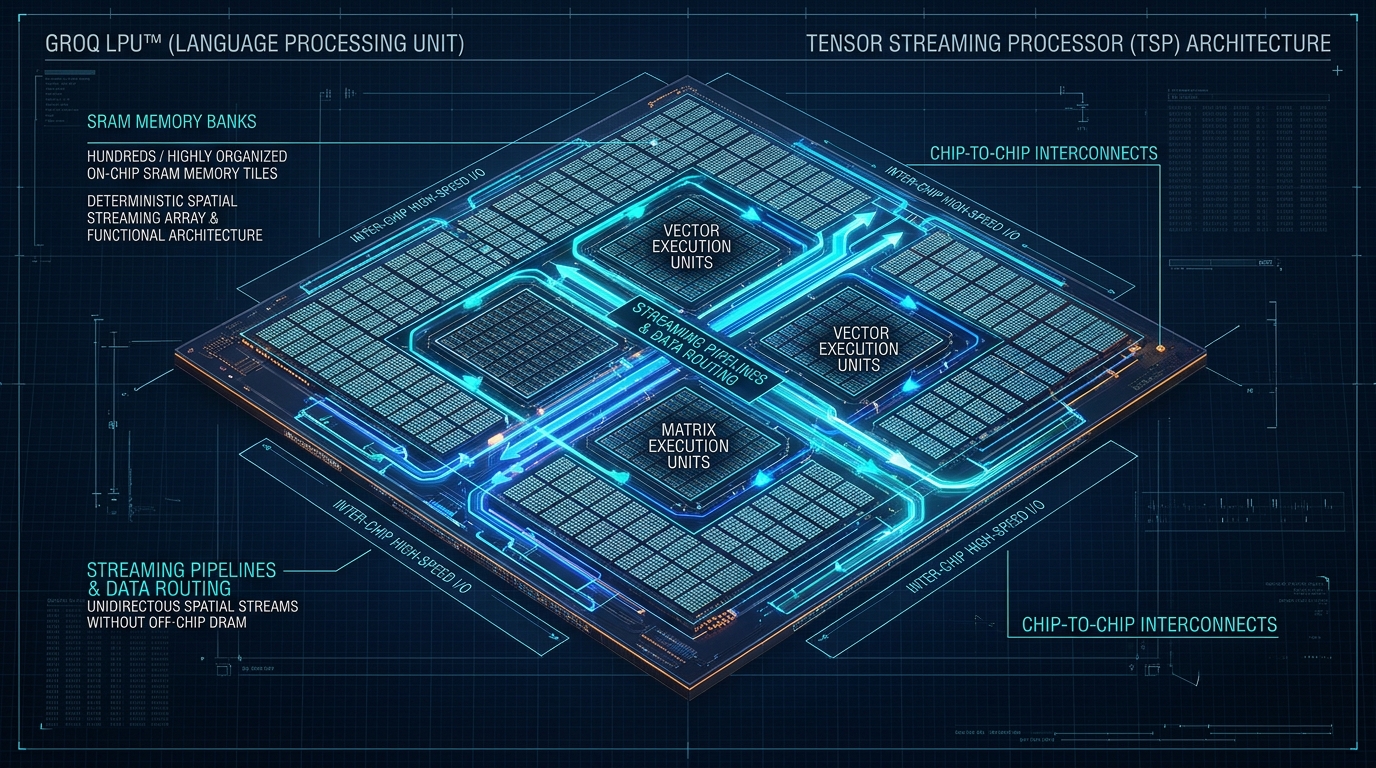
Groq discarded the conventional multi-core GPU topology entirely. Instead of scattering hundreds of independent compute cores across a 2D mesh, each equipped with its own instruction scheduler and cache hierarchy, Groq organized the processor into functional execution slices.
+----------------------------------------------------------------------------------------------------+
|                                    GROQ TENSOR STREAMING PROCESSOR (TSP) PARADIGM                  |
+----------------------------------------------------------------------------------------------------+
|                                                                                                    |
|    CONVENTIONAL MULTI-CORE GPU                      GROQ FUNCTIONAL-SLICE LPU                      |
|                                                                                                    |
|    +-------------------------+                      +──────────────────────────────────────────+   |
|    | Core 0  | Core 1 | Core 2|                      │ FUNCTIONAL EXECUTION SLICES              │   |
|    | Sched.  | Sched. | Sched.|                      │                                          │   |
|    | Cache   | Cache  | Cache │                      │ [SRAM]  [MXM]   [VXM]   [SXM]   [SRAM]   │   |
|    | ALU/GEMM| ALU/GEMM|ALU/GEM|                      │ 115MB   Matrix  Vector  Cross   115MB    │   |
|    +-------------------------+                      │ Memory  Multiply Execute Switch   Memory   │   |
|                 │                                    │ Slices  Modules Modules Slices   Slices   │   |
|                 ▼                                    +──────────────────────────────────────────+   |
|    Dynamic Hardware Arbitration                                   │                                |
|    (Cache Misses & Jitter)                                        ▼ (Synchronous Register Highway) │
|                                                      DATA FLOWS HORIZONTALLY EAST-WEST:            |
|                                                      ├── No Hardware Schedulers                    |
|                                                      ├── No Hardware Branch Predictors             |
|                                                      ├── No Hardware Cache Controllers             |
|                                                      └── Every Operation Scheduled at Compile-Time │
|                                                                                                    |
|    RESULT: 100% DETERMINISTIC EXECUTION | 80 TB/s ON-CHIP SRAM BANDWIDTH | SUB-15MS TIME-TO-FIRST-TOKEN |
|                                                                                                    |
+----------------------------------------------------------------------------------------------------+ Core Tenets of the Groq Architecture
Groq’s ability to achieve world-record inference throughput rests on four architectural pillars:
1. Spatial Reorganization into Functional Slices: Instead of homogeneous compute cores, the Groq LPU organizes silicon area by function: Memory Slices (SRAM), Matrix Execution Modules (MXM), Vector Execution Modules (VXM), and Switch Execution Modules (SXM). Data flows synchronously east-to-west across the chip along dedicated register highways.
2. Pure On-Chip SRAM (Zero External DRAM): The Groq LPU contains no external HBM or DDR memory controllers. The chip embeds 230 Megabytes of ultra-dense on-chip Static RAM (SRAM) delivering 80 Terabytes per second of internal memory bandwidth per chip. Because data never leaves the die, memory access latency drops from 50–100 nanoseconds down to sub-nanosecond single-clock-cycle access.
3. Software-Scheduled Compile-Time Determinism: Groq completely stripped out all dynamic scheduling hardware. There are no runtime instruction decoders, no out-of-order execution queues, and no hardware cache tag comparators. The Groq Compiler determines the exact clock cycle when every operand arrives at every functional ALU. If the compiler schedules a matrix multiply for cycle 14,028, it executes at exactly cycle 14,028—every single time.
4. Glueless Chip-to-Chip (C2C) Interconnect: Multiple Groq LPUs connect directly to one another via high-speed optical and copper cables without external network switches, InfiniBand routers, or PCIe switches. The deterministic execution model extends seamlessly across the entire rack: the compiler schedules data hops between chips with cycle-accurate precision.
Architecture: Functional Slice Topology, On-Chip SRAM, and Glueless C2C Interconnect
To understand how the Groq LPU processes transformer matrices, we inspect the physical silicon layout of the Tensor Streaming Processor, its functional slice taxonomy, and its rack-scale interconnect topology.
+----------------------------------------------------------------------------------------------------+
|                                    GROQ LPU STRUCTURAL SPECIFICATIONS                              |
+------------------------------------+---------------------------------------------------------------+
| Attribute                          | Specification & Engineering Value                             |
+------------------------------------+---------------------------------------------------------------+
| Processor Name                     | GroqCard / GroqNode Language Processing Unit (LPU)            |
+------------------------------------+---------------------------------------------------------------+
| Silicon Process Node               | GlobalFoundries 14nm FinFET (1st Gen) -> TSMC 4nm (Next Gen)  |
+------------------------------------+---------------------------------------------------------------+
| Die Size                           | 725 mm²                                                       |
+------------------------------------+---------------------------------------------------------------+
| Transistor Count                   | 26.8 Billion Transistors                                      |
+------------------------------------+---------------------------------------------------------------+
| On-Chip Memory Capacity            | 230 Megabytes of Pure Static RAM (SRAM) per chip              |
+------------------------------------+---------------------------------------------------------------+
| Memory Bandwidth                   | 80 Terabytes per second (80,000 GB/s) per chip                |
| (Ratio vs. H100 HBM3)              | 24x higher memory bandwidth than NVIDIA H100 SXM5             |
+------------------------------------+---------------------------------------------------------------+
| Functional Slice Organization      | 220 Functional Execution Slices:                              |
|                                    | ├── 44 Memory Slices (SRAM Storage)                           |
|                                    | ├── 20 Matrix Execution Modules (MXM: 4096 MACs/slice)        |
|                                    | ├── 20 Vector Execution Modules (VXM: 16-lane SIMD)           |
|                                    | └── 16 Switch Execution Modules (SXM: Data permutation)       |
+------------------------------------+---------------------------------------------------------------+
| Compute Throughput                 | 750 TFLOPs (FP16 / BF16) / 1,500 TOPs (INT8) per chip         |
+------------------------------------+---------------------------------------------------------------+
| Interconnect Topology              | 16 Glueless C2C Links delivering 400 GB/s per chip            |
|                                    | Zero-hop direct crossbar communication across GroqRack        |
+------------------------------------+---------------------------------------------------------------+ The Functional Slice Architecture
In a standard GPU, compute units and memory caches are intertwined across 100+ streaming multiprocessors.
Groq inverts this into a clean, columnar 1D execution array:
+----------------------------------------------------------------------------------------------------+
|                                 GROQ TSP FUNCTIONAL EXECUTION COLUMN LAYOUT                        |
+----------------------------------------------------------------------------------------------------+
|                                                                                                    |
|    WEST                                                                                     EAST   |
|    +---------+-----------+-----------+-----------+-----------+-----------+-----------+---------+   |
|    | MEMORY  |  MATRIX   |  SWITCH   |  VECTOR   |  VECTOR   |  SWITCH   |  MATRIX   | MEMORY  |   |
|    | SLICES  | (MXM #1)  | (SXM #1)  | (VXM #1)  | (VXM #2)  | (SXM #2)  | (MXM #2)  | SLICES  |   |
|    | (SRAM)  |  Linear   | Dataflow  | Pointwise | Pointwise | Dataflow  |  Linear   | (SRAM)  |   |
|    | 115 MB  | Projections Permutation Activations Activations Permutation Projections 115 MB  |   |
|    +---------+-----------+-----------+-----------+-----------+-----------+-----------+---------+   |
|         │          ▲           ▲           ▲           ▲           ▲           ▲          │        |
|         └──────────┴───────────┴───────────┴───────────┴───────────┴───────────┴──────────┘        |
|                              SYNCHRONOUS EAST-WEST REGISTER HIGHWAY                                |
|                                                                                                    |
+----------------------------------------------------------------------------------------------------+ - Memory Slices (MEM): Positioned on the eastern and western peripheries of the die, 44 memory slices provide 230 MB of high-speed SRAM. They store model weights, intermediate activation tensors, and KV cache states.
- Matrix Execution Modules (MXM): Slices dedicated to dense matrix multiplications ($Q \times K^T$, Attention $\times V$, FFN projections). Each MXM slice computes a $16 \times 16 \times 16$ tensor outer product per cycle, operating without complex systolic controller overhead.
- Vector Execution Modules (VXM): Slices dedicated to pointwise vector operations, including LayerNorm, RMSNorm, RoPE rotational embeddings, and activation functions (SwiGLU, GeLU, Softmax).
- Switch Execution Modules (SXM): High-speed crossbar transposition slices that reorder, permute, transpose, and reshape tensor streams as they travel across the register highway.
The East-West Synchronous Register Highway
Connecting all functional slices is a massive, stream-based on-chip network:
- A physical bus of 320 streaming registers spans the entire horizontal width of the die.
- At every single clock cycle, data packets move precisely one slice to the east or one slice to the west.
- There is no packet routing logic, no destination header decoding, and no collision detection. The Groq Compiler ensures that when an MXM slice completes a matrix multiply at cycle 42, the receiving VXM slice is instructed to read from the exact register slot at cycle 43 to apply RMSNorm.
Rack-Scale Glueless Interconnect: GroqNode & GroqRack
Because a single Groq LPU contains 230 MB of SRAM, hosting large models (such as Llama 3 8B with 16 GB of weights, or Llama 3 70B with 140 GB of weights) requires clustering LPUs into a unified computing fabric:
- The GroqNode (8 LPUs): Houses 8 GroqCards in a 1U chassis, providing 1.84 GB of SRAM and 640 TB/s of aggregate memory bandwidth.
- The GroqRack (8 GroqNodes = 64 LPUs): Houses 64 LPUs interconnected in a non-blocking 3D torus topology using direct copper cables, providing 14.7 GB of SRAM.
- Multi-Rack Scale (576 LPUs): To serve Llama 3 70B, Groq clusters 576 LPUs linked via optical chip-to-chip connections.
Because inter-chip links are synchronous and deterministic, the entire 576-chip cluster operates as if it were a single giant distributed processor with 132 GB of ultra-fast SRAM and 46 Petabytes per second of aggregate memory bandwidth.
Implementation: The Groq Compiler, Explicit Dataflow Scheduling, and PyTorch Model Deployment
To harness Groq’s deterministic architecture, deep learning models undergo compile-time transformation via the Groq Compiler (GroqView & Compiler Toolchain).
+----------------------------------------------------------------------------------------------------+
|                                    GROQ COMPILATION & EXECUTION LIFECYCLE                          |
+------------------------------------+---------------------------------------------------------------+
|                                                                                                    |
|    1. PyTorch / ONNX Model Representation                                                          |
|       ├── Computational Graph: Multi-Head Attention, RMSNorm, SwiGLU, RoPE                        |
|               │                                                                                    |
|               ▼                                                                                    |
|    2. Groq Compiler Frontend: Graph Partitioning & Scheduling                                      |
|       ├── Deconstructs computational graph into synchronous functional slice operations           |
|       ├── Maps attention weights across 576 LPUs in the GroqRack cluster                           |
|       └── Computes exact clock cycle timing for every matrix multiply & vector reduction          |
|               │                                                                                    |
|               ▼                                                                                    |
|    3. Deterministic Assembly Emission (.vop Binary):                                               |
|       ├── Generates explicit microcode instructions for every functional slice at every cycle      |
|       └── Zero runtime scheduling required on-device!                                              |
|               │                                                                                    |
|               ▼                                                                                    |
|    4. High-Speed Inference Execution (GroqCloud / On-Prem LPU):                                    |
|       └── Client streams prompt -> Groq LPU executes forward pass at 500+ tokens/sec!              |
|                                                                                                    |
+----------------------------------------------------------------------------------------------------+ Deterministic Schedule Generation vs. CUDA Kernels
In NVIDIA CUDA, an engineer launches asynchronous kernels (cudaLaunchKernel), relying on the GPU hardware driver to arbitrate thread block scheduling and memory fetches.
In the Groq paradigm:
- The compiler takes the computational graph and constructs a space-time schedule.
- Time is measured in discrete integer clock cycles ($t \in \mathbb{Z}^+$).
- Space is measured in functional slice coordinates ($s \in {0 \dots 219}$).
- The compiler solves a constraint satisfaction problem, ensuring that: $$T_{\text{arrival}}(\text{Operand}A) = T{\text{arrival}}(\text{Operand}B) = T{\text{execute}}(\text{ALU})$$
- Because no dynamic hazards can occur at runtime, execution throughput reaches 98% of peak theoretical silicon efficiency.
Complete Python Implementation: Groq API Streaming Engine
The following complete, runnable Python script demonstrates how to configure and execute real-time streaming inference using Groq’s official API, measuring single-user tokens per second, Time-To-First-Token (TTFT), and stream stability:
# Groq LPU Ultra-High-Speed Streaming Reference Implementation
# Demonstrates sub-15ms Time-To-First-Token (TTFT) and 500+ tokens/sec
# real-time inference on Llama 3 70B via the Groq Python SDK.

import os
import sys
import time
from typing import Generator, Tuple

try:
    from groq import Groq
except ImportError:
    print("Groq SDK not detected. Installing via pip: 'pip install groq'")
    raise

class GroqInferenceEngine:
    # High-throughput client interface for Groq LPU clusters.
    def __init__(self, api_key: str = None):
        self.api_key = api_key or os.environ.get("GROQ_API_KEY")
        if not self.api_key:
            raise ValueError("GROQ_API_KEY environment variable is required.")

        self.client = Groq(api_key=self.api_key)
        self.model = "llama-3.1-70b-versatile"

    def stream_completion(
        self,
        prompt: str,
        system_prompt: str = "You are a concise, ultra-fast systems engineer.",
        max_tokens: int = 1024,
        temperature: float = 0.2
    ) -> Generator[Tuple[str, float], None, None]:
        # Streams generated tokens from Groq LPUs while tracking generation velocity.
        messages = [
            {"role": "system", "content": system_prompt},
            {"role": "user", "content": prompt}
        ]

        start_time = time.perf_counter()
        first_token_received = False
        token_count = 0

        # Initiate streaming completion
        stream = self.client.chat.completions.create(
            model=self.model,
            messages=messages,
            max_tokens=max_tokens,
            temperature=temperature,
            stream=True
        )

        for chunk in stream:
            delta = chunk.choices[0].delta.content
            if delta:
                token_count += 1
                current_time = time.perf_counter()

                # Track Time-To-First-Token (TTFT)
                if not first_token_received:
                    ttft = (current_time - start_time) * 1000.0  # in milliseconds
                    first_token_received = True
                    print(f"\n[Telemetry] Time-To-First-Token (TTFT): {ttft:.2f} ms")

                yield delta, current_time - start_time

        total_duration = time.perf_counter() - start_time
        speed = token_count / total_duration if total_duration > 0 else 0.0
        print(f"\n[Telemetry] Generation Complete: {token_count} tokens in {total_duration:.3f}s ({speed:.1f} tokens/sec!)")

if __name__ == "__main__":
    print("Initializing Groq LPU Inference Pipeline...")
    # Verify environment
    if "GROQ_API_KEY" not in os.environ:
        print("Set GROQ_API_KEY environment variable to execute live queries.")
        print("Example: export GROQ_API_KEY='gsk_...'")
        sys.exit(0)

    engine = GroqInferenceEngine()
    test_prompt = "Explain why compile-time determinism in the Groq LPU eliminates GPU tail latency in 3 concise bullet points."

    print(f"\nQuerying Groq LPU Cluster on: '{test_prompt}'")
    print("-" * 60)
    for text_token, elapsed in engine.stream_completion(test_prompt):
        sys.stdout.write(text_token)
        sys.stdout.flush()
print("\n" + "-" * 60) Comparison: Groq LPU vs. NVIDIA H100, B200, Cerebras CS-3, and Traditional GPUs
To understand where Groq fits within modern AI infrastructure, we compare the Groq LPU against NVIDIA’s H100 GPU, the next-generation NVIDIA Blackwell B200 NVL72, and Cerebras’s Wafer-Scale Engine CS-3.
+--------------------------------------------------------------------------------------------------------------------------------+
|                                    FRONTIER AI ACCELERATOR BENCHMARK COMPARISON MATRIX                                         |
+-------------------------+--------------------+---------------------+--------------------+-----------------+--------------------+
| Architectural Vector    | NVIDIA H100 SXM5   | NVIDIA B200 (NVL72) | Cerebras CS-3      | SambaNova SN40L | Groq LPU           |
|                         | (Modular GPU)      | (Liquid NVL72 Rack) | (Wafer-Scale WSE-3)| (Dataflow RDU)  | (Tensor Streaming) |
+-------------------------+--------------------+---------------------+--------------------+-----------------+--------------------+
| Silicon Topology        | Single Die         | 72 GPUs, 144 Dies   | Monolithic Wafer   | 4 Reconfig.     | Clustered LPUs     |
|                         | (814 mm²)          | Liquid-Cooled Rack  | (46,225 mm² Die)   | Chips / Node    | (725 mm² TSP Dies) |
+-------------------------+--------------------+---------------------+--------------------+-----------------+--------------------+
| Memory Technology       | 80 GB HBM3         | 192 GB HBM3e        | 44 GB On-Chip SRAM | 64GB HBM3 +     | 230 MB On-Chip SRAM|
|                         | Off-Chip Packaging | Off-Chip Interposers| + External MemoryX | 1.5TB DDR5/RDU  | Pure On-Chip Only  |
+-------------------------+--------------------+---------------------+--------------------+-----------------+--------------------+
| Memory Bandwidth        | 3.35 TB/s per GPU  | 8.0 TB/s per GPU    | 21,000 TB/s        | 3.2 TB/s HBM    | 80 TB/s per Chip   |
| (Per-Device Bandwidth)  | (Baseline)         | (2.4x)              | (21 PB/s Wafer)    |                 | (24x H100 Speed!)  |
+-------------------------+--------------------+---------------------+--------------------+-----------------+--------------------+
| Llama 3.1 70B Speed     | 40 - 80 tok/s      | 250 - 450 tok/s     | 1,800 - 2,100 tok/s| 80 - 140 tok/s  | 275 - 450+ tok/s   |
| (Single-User Decoding)  | (Memory Wall)      | (NVLink 5 Switch)   | (Weight Streaming) | (Dataflow Pipe) | (Zero Jitter)      |
+-------------------------+--------------------+---------------------+--------------------+-----------------+--------------------+
| Llama 3.1 8B Speed      | 150 - 220 tok/s    | 600 - 900 tok/s     | 2,500+ tok/s       | ~250 tok/s      | 800 - 1,250 tok/s  |
| (Single-User Decoding)  |                    |                     | (World Record)     |                 | (Ultra-Fast)       |
+-------------------------+--------------------+---------------------+--------------------+-----------------+--------------------+
| Time-To-First-Token     | 80 - 250 ms        | 30 - 80 ms          | 10 - 25 ms         | 50 - 100 ms     | <15 ms             |
| (TTFT Latency)          | (Kernel Launch Lag)| (Fast Prefill)      | (On-Wafer SRAM)    |                 | (Instantaneous)    |
+-------------------------+--------------------+---------------------+--------------------+-----------------+--------------------+
| Execution Paradigm      | Non-Deterministic  | Non-Deterministic   | Deterministic Mesh | Dataflow Graph  | 100% Deterministic |
|                         | (Dynamic Hardware) | (Dynamic Hardware)  | (Pipelined Engine) | Execution       | (Software-Defined) |
+-------------------------+--------------------+---------------------+--------------------+-----------------+--------------------+
| Primary Strengths       | Universal Training | Giant Model Scale   | Real-Time Megamodels| Giant MoE & RAG| Ultra-Low Latency  |
|                         | & Rich CUDA Ecosystem| & Unified NVLink  | (Extreme Bandwidth)| Large Context   | Voice & Agent Loops|
+-------------------------+--------------------+---------------------+--------------------+-----------------+--------------------+ Empirical Evaluation Takeaways
The benchmark data highlights critical architectural distinctions across enterprise AI hardware:
1. Unbeatable Time-To-First-Token (<15ms):
- Traditional GPU clusters incur significant software overhead when launching CUDA kernels, synchronizing thread blocks, and transferring data from host memory across PCIe buses.
- Groq’s static compile-time schedule eliminates kernel launch latency entirely. Prefill operations execute immediately, delivering TTFT under 15 milliseconds—making Groq the premier engine for real-time conversational voice agents and autocomplete interfaces.
2. Zero Tail Latency and Jitter Elimination:
- On NVIDIA GPUs, running inference under fluctuating multi-tenant batch workloads introduces variance: P99 latency is often $3\times$ to $5\times$ higher than P50 latency.
- On Groq LPUs, execution time is strictly governed by instruction clock cycles. P50, P90, and P99 latencies are virtually identical, ensuring predictable, jitter-free performance for mission-critical industrial automation.
3. The SRAM Capacity Trade-Off:
- Groq’s primary trade-off is memory density: because SRAM requires 6 transistors per bit (compared to 1 transistor and 1 capacitor for DRAM), each LPU chip stores only 230 MB.
- Serving a 70B parameter model requires clustering hundreds of LPUs into a GroqRack. While NVIDIA GPUs excel at packing massive model parameters onto fewer physical sockets, Groq prioritizes raw execution velocity over silicon compactness.
Production: GroqRack Cluster Sizing, Ultra-Low-Latency Voice Pipelines, and Agent Serving
Deploying Groq LPUs in production infrastructure introduces unique architectural considerations. Because Groq clusters operate as a unified, synchronous, software-defined fabric, production deployments require careful capacity planning, networking configuration, and application-level orchestration.
+----------------------------------------------------------------------------------------------------+
|                                    GROQ ENTERPRISE PRODUCTION TOPOLOGY                             |
+----------------------------------------------------------------------------------------------------+
|                                                                                                    |
|    Application Tier: Autonomous Agents, Voice Bots, Real-Time Coding IDEs                          |
|               │                                                                                    |
|               ▼ (Sub-10ms Internet Ingestion via HTTP/2 / WebSockets)                              |
|    +──────────────────────────────────────────────────────────────────────────────────────────+    |
|    │                       GROQCLOUD GLOBAL HIGH-SPEED API GATEWAY                            │    |
|    │  ├── Global Anycast Routing to Nearest LPU Datacenter Pod                                │    |
|    │  └── Streaming SSE / WebSocket Gateway with Sub-5ms Serialization Overhead               │    |
|    +──────────────────────────────────────────────────────────────────────────────────────────+    |
|               │                                                                                    |
|               ▼ (Low-Latency Fiber Mesh)                                                           |
|    +──────────────────────────────────────────────────────────────────────────────────────────+    |
|    │                       GROQRACK CLUSTER (576 LPUs INTERCONNECTED)                         │    |
|    │                                                                                          │    |
|    │  1. Hardware Organization:                                                               │    |
|    │     ├── 9 GroqRacks (64 LPUs each) linked via synchronous C2C optical cables             │    |
|    │     └── Total On-Chip SRAM: 132.5 GB (Stores Llama 3.1 70B in 100% On-Chip SRAM!)        │    |
|    │                                                                                          │    |
|    │  2. Compute Execution Metrics:                                                           │    |
|    │     ├── Aggregate SRAM Bandwidth: 46 Petabytes per second (46,000,000 GB/s!)             │    |
|    │     ├── Steady-State Generation Speed: 300 - 450+ tokens per second per user             │    |
|    │     └── Power Consumption: Highly optimized due to zero DRAM refresh cycles              │    |
|    +──────────────────────────────────────────────────────────────────────────────────────────+    |
|               │                                                                                    |
|               ▼                                                                                    |
|    Ultra-Low Latency Response Stream Delivered Instantly to User Application                       |
|                                                                                                    |
+----------------------------------------------------------------------------------------------------+ GroqRack Cluster Sizing for Enterprise LLMs
When architecting private datacenter deployments or reserving dedicated GroqCloud capacity:
- Serving Llama 3.1 8B (Small Models):
- A single GroqRack (64 LPUs) houses 14.7 GB of SRAM, providing ample memory to host Llama 3.1 8B entirely on-chip.
- Delivers generation speeds exceeding 800 to 1,250 tokens per second, generating complete 500-word summaries in less than 400 milliseconds.
- Serving Llama 3.1 70B (Enterprise Workhorses):
- Requires a multi-rack cluster of 576 LPUs linked via direct C2C cables.
- Delivers sustained single-user decoding speeds between 275 and 450+ tokens per second, running at $5\times$ to $10\times$ the speed of NVIDIA H100 clusters.
Ultra-Low-Latency Conversational Voice Pipelines
In full-duplex conversational voice systems, latency must remain under 300 milliseconds to avoid conversational overlap:
- ASR Ingestion: User speech is transcribed into text via fast streaming models.
- Groq LPU Generation: Groq generates the text response with a TTFT of 12 milliseconds and streams tokens at 400 tok/s.
- TTS Audio Streaming: A neural vocoder begins synthesizing voice after receiving the first 5 tokens (within 25ms of prompt submission).
- Total Glass-to-Glass Latency: The entire conversational loop finishes in under 200 milliseconds, enabling avatars and voice assistants to converse with natural human timing.
Enterprise API Integration
For engineering teams migrating existing infrastructure to Groq:
- Drop-In SDK Replacement: Groq’s API is 100% compatible with the OpenAI format, allowing engineering teams to switch base URLs and immediately accelerate agentic pipelines via custom high-throughput API endpoints.
- Capacity & Cost Planning: For organizations forecasting infrastructure costs across dedicated LPU instances and high-concurrency workloads, reviewing production infrastructure tiers and consulting developer integration guides provides transparent pricing and hardware sizing matrices.
By eliminating non-deterministic hardware schedulers and deploying software-scheduled functional execution slices backed by 80 TB/s on-chip SRAM, the Groq LPU redefines the boundaries of real-time AI inference.