Grok 4.7 Guide: Architecture, Benchmarks & Agentic Loops
The Problem: The Fragility and Cost of Long-Horizon Agentic Coding
In modern automated development environments, autonomous data extraction pipelines, and agent platforms like AiFetchly, developer teams face a common set of obstacles when building production agents:
- “Why does the agent lose coherence and begin hallucinating after two hours of continuous problem solving?”
- “How do we prevent our cloud inference budget from exploding when an agent ingests hundreds of source files and DOM trees?”
- “Why do reasoning models repeat expensive chain-of-thought scratchpads on every subsequent turn of a multi-turn conversation?”
- “Why must we pay flagship premium prices for simple deterministic verification loops?”
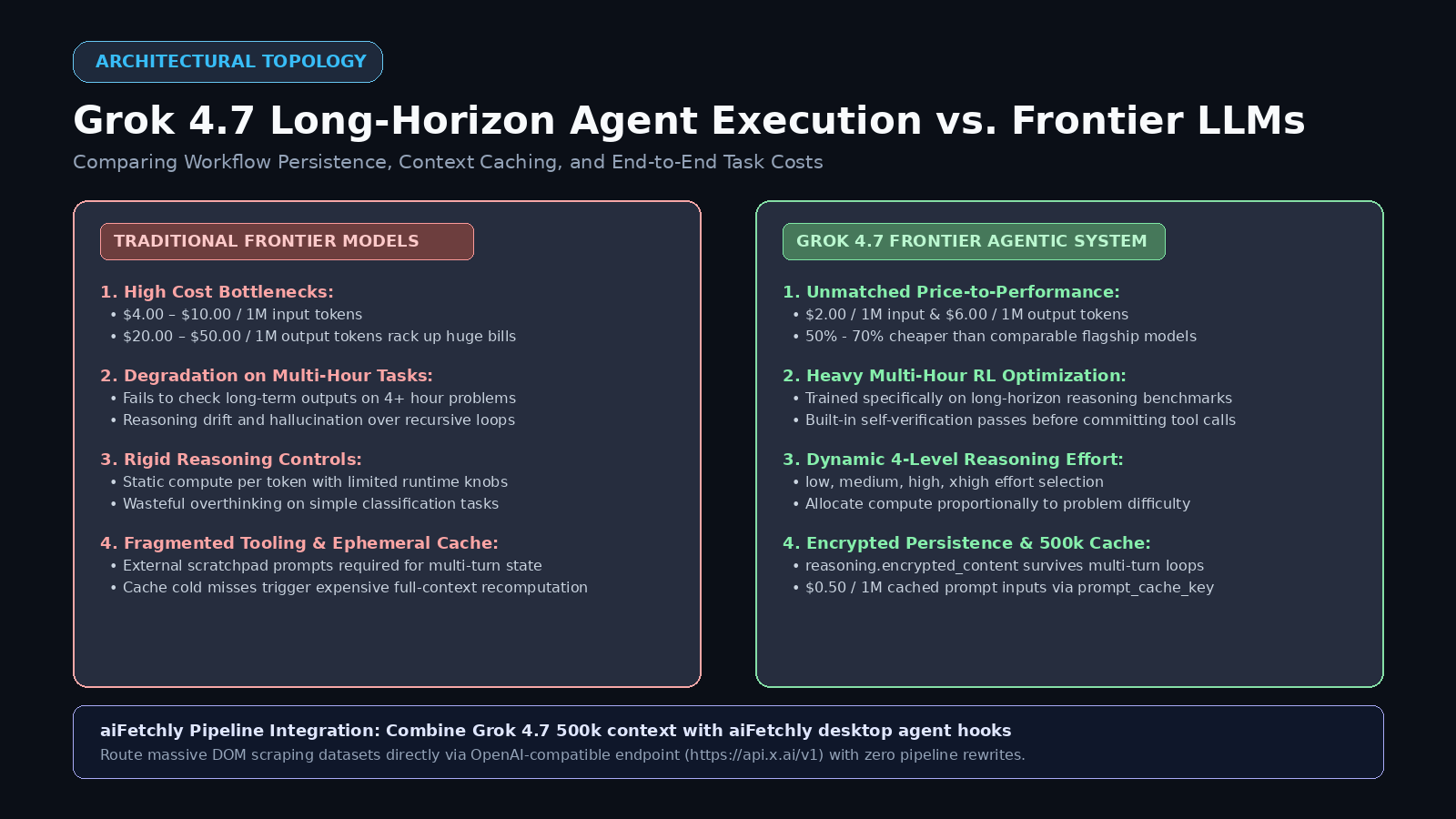
Until recently, frontier reasoning models suffered from structural trade-offs. Models either offered fast turnaround times with shallow reasoning, or deep deliberation burdened by crippling output token fees ($20.00 to $50.00+ per million tokens). More critically, on extended multi-step assignments that take hours of tool calls, shell executions, and codebase exploration, traditional models steadily drift, accumulating compounding reasoning errors.
The Breakdown of Traditional LLMs on Multi-Hour Workflows
Frontier agentic development fails across four specific failure modes:
- Reasoning Decay in Recursive Loops: Most language models are aligned on short single-turn or few-step benchmarks (like GSM8K or HumanEval). When pushed into 15-to-50-step autonomous loops, their internal state drifts, leading to repetitive tool calls and abandoned task goals.
- The Output Token Tax on Deliberation: Extended chain-of-thought reasoning generates thousands of hidden thinking tokens per step. When enterprise agents execute complex codebase migrations or multi-page AiFetchly Data Fetching, API costs escalate exponentially.
- Cache Invalidation and Cold Prefill Penalties: Large context windows (128k to 2M tokens) are ineffective if server-side prompt caching is unreliable. Without consistent routing, agents pay full prefill latency and full price on every turn.
- Over-Refusal on Dual-Use Tasks: Conventional safety guardrails frequently block benign cybersecurity research, reverse engineering, and low-level system debugging due to simplistic keyword filtering.
Building resilient, cost-effective agents requires a frontier foundation model designed from the ground up for endurance, transparent pricing, and granular reasoning control.
The Architecture: Inside Grok 4.7’s Multi-Hour Reasoning Engine
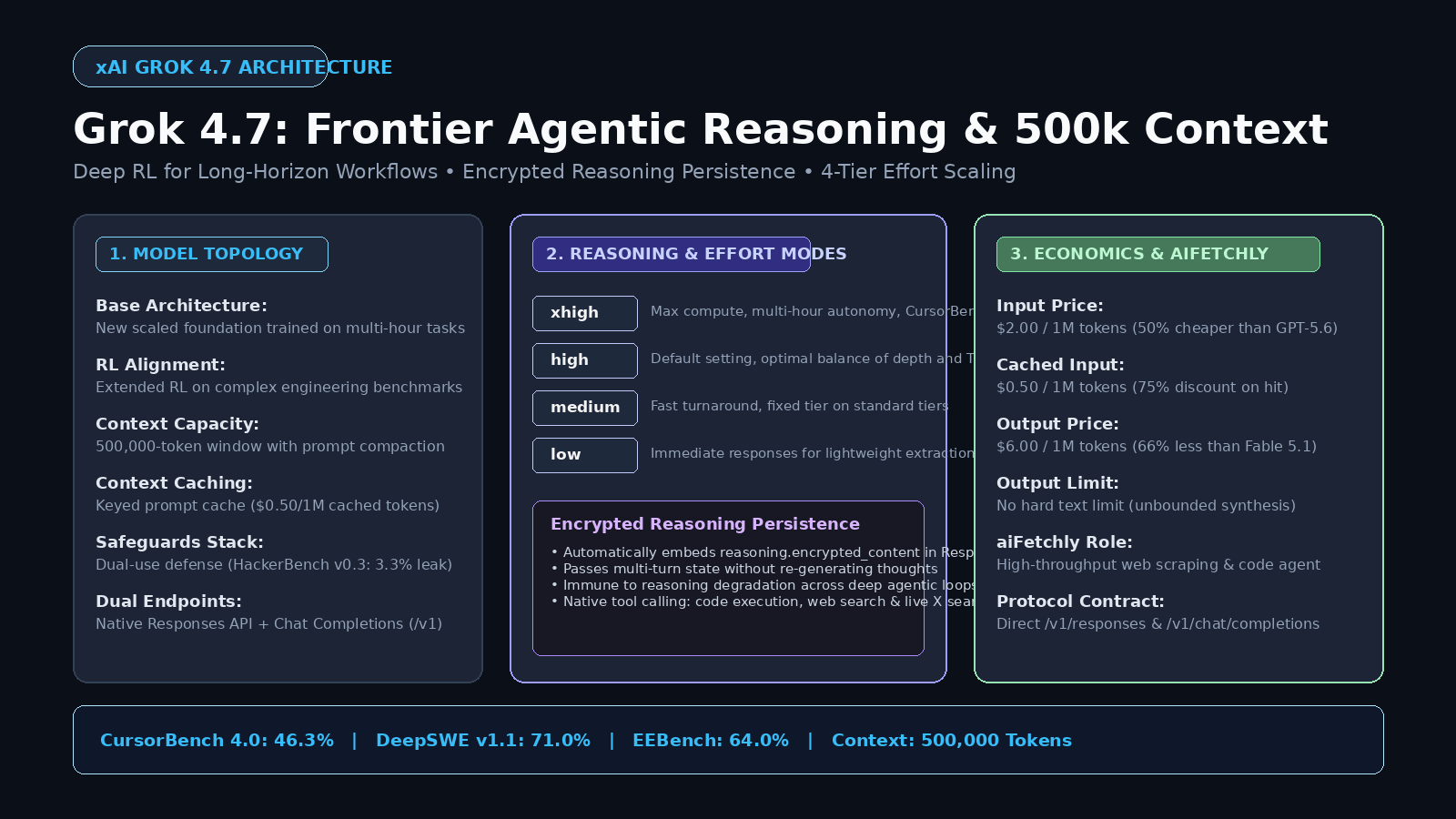
Released on September 21, 2026, Grok 4.7 introduces a newly scaled base model trained with an extended reinforcement learning (RL) regime focused on long-horizon endurance and rigorous self-verification.
1. Multi-Hour Task-Weighted Reinforcement Learning
Unlike earlier iterations trained primarily on conversational agility, Grok 4.7’s post-training dataset was explicitly weighted toward problems requiring hours of continuous compute:
- Autonomous Self-Verification: The model is incentivized to critique its intermediate conclusions before emitting tool calls or finalizing code diffs.
- Deep SWE Alignment: Rather than predicting single function bodies, training rewards multi-file refactoring, test suite execution, and root-cause analysis across messy git repositories.
- Context Compaction Resilience: The attention mechanisms maintain high needle-in-a-haystack recall across the full 500,000-token context window, preventing degradation during prolonged sessions.
2. Four-Tier Configurable Reasoning Effort
Grok 4.7 introduces discrete reasoning effort levels, giving developers direct control over token allocation and latency:
| Effort Level | Target Workload | Latency Profile | Primary Benchmarks |
|---|---|---|---|
xhigh | Complex architectural refactoring, mathematical proofs, long-running agent debugging | High (deep multi-path deliberation) | 46.3% CursorBench 4.0, 71.0% DeepSWE v1.1 |
high (Default) | Standard production coding, full-stack feature generation, data pipeline construction | Balanced (0.84s time-to-first-token) | 53 tokens/s throughput, $2.73 avg task cost |
medium | Structured data extraction, AST parsing, API schema mapping, interactive chat | Fast | Low operational overhead for daily utility |
low | Document triage, semantic routing, basic classification, lint fixing | Ultra-fast sub-second response | Minimal token expenditure for high-volume queues |
3. Encrypted Reasoning Persistence in the Responses API
A major innovation in the xAI POST /v1/responses API is native Encrypted Reasoning Content (reasoning.encrypted_content).
In standard multi-turn reasoning workflows, developers must either discard intermediate thoughts (causing the model to “forget” its analytical plan) or transmit verbose plaintext thought chains back and forth, consuming excessive bandwidth and context tokens.
Grok 4.7 returns an opaque, encrypted cryptographic representation of its reasoning state. When passed back in subsequent request payloads, the model immediately resumes its deductive chain without recomputing historical thoughts from scratch.
4. Enterprise Dual-Use Safeguard Stack
Grok 4.7 implements a modernized safety architecture that decouples dangerous capabilities from benign developer workflows:
- HackerBench v0.3: The model achieved the industry’s lowest risky leak rate (3.3%) on dual-use cyber operations while eliminating false-positive refusals on legitimate defensive auditing and vulnerability patching.
- LatchBio Biosafety: Ranked #1 on the LatchBio biosafety benchmark at 62.4% compliance.
- Developer Agency: The model complies with terminal commands, script executions, and web scraping scripts without conversational lectures or arbitrary pre-flight refusals.
Benchmark Evaluation: CursorBench, DeepSWE, and Frontier Intelligence
Independent benchmarks from Artificial Analysis and community evaluations demonstrate Grok 4.7’s competitive position among frontier engineering models:
Software Engineering and Knowledge Work Comparison
| Benchmark / Metric | Grok 4.7 (xhigh) | Grok 4.6 (high) | GPT-5.6 Sol Max | Fable 5.1 Max |
|---|---|---|---|---|
| Input Token Price (per 1M) | $2.00 | $2.00 | $4.00 | $10.00 |
| Cached Input Price (per 1M) | $0.50 | $0.50 | $1.00 | $2.50 |
| Output Token Price (per 1M) | $6.00 | $6.00 | $20.00 | $50.00 |
| CursorBench 4.0 | 46.3% | 40.4% | 41.7% | 51.8% |
| DeepSWE v1.1 | 71.0% | 65.2% | 72.7% | 70.0% |
| EEBench (Electrical Eng.) | 64.0% | 53.0% | 39.4% | 56.4% |
| AA Briefcase v1.1 (Office Work) | 1,657 | 1,546 | 1,487 | 1,678 |
| Terminal-Bench 4.0 | 38.0% | 20.3% | 37.3% | 57.9% |
| GDPval Knowledge Work (Elo) | 1,695 | 1,605 | 1,542 | 1,735 |
While specialized models like Fable 5.1 achieve slightly higher raw CursorBench scores, Grok 4.7 delivers comparable engineering capabilities at one-fifth the input cost and one-eighth the output cost, establishing an attractive price-to-performance ratio for automated agent fleets.
Implementation: Orchestrating Grok 4.7 in aiFetchly Pipelines
Because Grok 4.7 exposes both an OpenAI-compatible /v1/chat/completions endpoint and the next-generation /v1/responses API, integrating it into desktop automation tools like AiFetchly takes just minutes.
Step 1: Configuring Environment Credentials
Obtain an API key from the official developer console (console.x.ai) and configure your shell environment:
# Set your active API key
export XAI_API_KEY="xai-live-xxxxxxxxxxxxxxxxxxxxxxxx"

# Optional: Set US Regional Endpoint if data residency requires domestic routing
export XAI_BASE_URL="https://api.x.ai/v1" Step 2: Sending a Reasoning Request via TypeScript / Node.js
Using the standard @ai-sdk/xai or the OpenAI client library, configure Grok 4.7 with high reasoning effort and prompt caching keys:
import OpenAI from 'openai';

const client = new OpenAI({
  apiKey: process.env.XAI_API_KEY,
  baseURL: process.env.XAI_BASE_URL || 'https://api.x.ai/v1',
});

interface ScrapeSynthesisResult {
  extractedEntities: Array<{ name: string; value: string }>;
  qualityScore: number;
  confidence: number;
}

export async function analyzeLongContextDocument(
  documentText: string,
  analysisPrompt: string,
  conversationId: string,
): Promise<string> {
  const response = await client.chat.completions.create({
    model: 'grok-4.7',
    messages: [
      {
        role: 'system',
        content:
          'You are an expert autonomous data analyst specializing in web extraction verification.',
      },
      {
        role: 'user',
        content: `Document Payload:\n${documentText}\n\nTask: ${analysisPrompt}`,
      },
    ],
    // Custom header to ensure session affinity for prompt cache hits
    extra_headers: {
      'x-grok-conv-id': conversationId,
    },
    temperature: 0.2,
  });

  return response.choices[0]?.message?.content || '';
} Step 3: Multi-Turn Responses API with Encrypted Reasoning
For autonomous multi-step loops where the agent must retain thought trajectory across multiple tool executions, use the native responses.create API:
import os
import requests

def execute_grok_agent_turn(messages, conversation_key):
    url = "https://api.x.ai/v1/responses"
    headers = {
        "Authorization": f"Bearer {os.environ['XAI_API_KEY']}",
        "Content-Type": "application/json"
    }

    payload = {
        "model": "grok-4.7",
        "input": messages,
        "prompt_cache_key": conversation_key,
        "reasoning": {
            "effort": "xhigh"
        },
        "tools": [
            {
                "type": "function",
                "function": {
                    "name": "fetch_live_web_data",
                    "description": "Scrapes and parses real-time web content using aiFetchly engine",
                    "parameters": {
                        "type": "object",
                        "properties": {
                            "url": {"type": "string"},
                            "css_hint": {"type": "string"}
                        },
                        "required": ["url"]
                    }
                }
            }
        ]
    }

    res = requests.post(url, json=payload, headers=headers)
    res.raise_for_status()
    data = res.json()

    # Encrypted reasoning payload preserved for subsequent turns
    encrypted_reasoning = data.get("reasoning", {}).get("encrypted_content")
    output_text = data.get("output_text", "")
    tool_calls = data.get("tool_calls", [])

    return {
        "output_text": output_text,
        "tool_calls": tool_calls,
        "encrypted_reasoning": encrypted_reasoning
} Step 4: Connecting Grok 4.7 to aiFetchly’s Custom Provider
To route aiFetchly’s desktop agent requests through Grok 4.7:
- Open aiFetchly Settings and navigate to AI Providers.
- Select Custom OpenAI-Compatible Provider.
- Set Base URL to
https://api.x.ai/v1. - Enter your
XAI_API_KEY. - Enter
grok-4.7into the Model Name combobox. - Click Test Connection. aiFetchly will validate streaming, tool calling, and latency badges.
Once verified, all scraped DOM payloads, schema extractions, and synthesis tasks will execute through Grok 4.7’s 500k context engine.
Production Guidelines, Prompt Caching, and Error Handling
To maximize reliability and minimize token expenditure when running Grok 4.7 at scale, apply these production patterns:
- Always Supply a
prompt_cache_key: Grok 4.7 uses server-affinity caching. If you omit the cache key (orx-grok-conv-idon chat completions), subsequent requests may land on cold worker nodes, causing full-price cache misses. Cached input tokens enjoy a 75% discount ($0.50 vs $2.00 per million). - Match Effort to Task Complexity: Avoid leaving
xhighenabled for simple tasks. Uselowormediumfor preliminary HTML cleanup, regex generation, or schema parsing, and elevate tohighorxhighonly when handling full-codebase refactoring or debugging obscure build failures. - Pass Encrypted Reasoning Unchanged: When using the Responses API, do not attempt to strip or decode
reasoning.encrypted_content. Pass it back verbatim in subsequent turn inputs so the model retains its prior analytical context. - Manage Context Window Headroom: While the 500k window accommodates extensive documentation, keep system prompts clean and utilize structured JSON schemas to prevent context bloating across dozens of tool iterations.
- Monitor Rate Limits and Concurrency: Enterprise tiers support high concurrency, but production agent loops should implement exponential backoff with jitter on HTTP
429status codes.
Conclusion
With the release of Grok 4.7, xAI has delivered a capable model for persistent software engineering and knowledge work. By combining a 500,000-token context window, configurable reasoning effort levels, encrypted reasoning persistence, and aggressive pricing, Grok 4.7 lowers the barrier to deploying long-horizon autonomous agents. When paired with high-performance desktop extraction tools like AiFetchly, developers can build autonomous data harvesting and analysis pipelines that run reliably without excessive token costs.