GraCE Guide: Compiler Support for CUDA Graphs in ML
Introduction: The Widening Accelerator-CPU Execution Gap
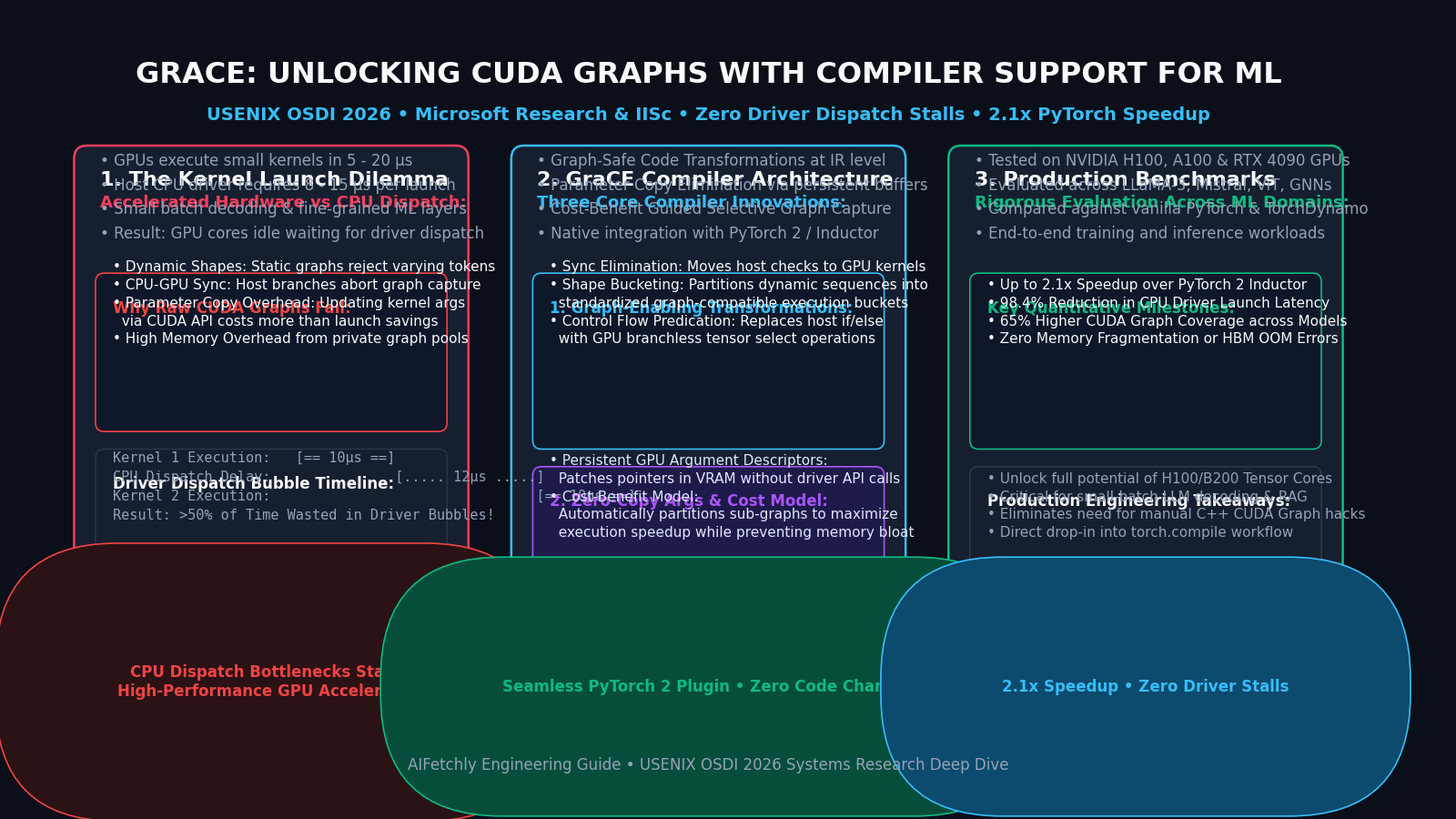
The relentless scaling of specialized artificial intelligence hardware has produced an unprecedented divergence between accelerator compute throughput and host CPU driver responsiveness. Contemporary GPU architectures—exemplified by NVIDIA Hopper (H100, H200) and Blackwell (B200, GB200)—deliver thousands of TeraFLOPS of low-precision Tensor Core compute capability alongside terabytes per second of High-Bandwidth Memory (HBM3e) throughput. Consequently, individual machine learning operations (such as fine-grained layer normalizations, rotary position embeddings, elementwise activations, and single-token attention heads) execute on the GPU in as little as $5\mu\text{s}$ to $20\mu\text{s}$.
In high-throughput enterprise pipelines—whether powering automated web scraping workflows, real-time data fetching engines, or low-latency API integration microservices—inference engines are dominated by these short-duration kernels during autoregressive token generation.
However, invoking a GPU kernel from a host CPU is far from instantaneous. Dispatching a single CUDA kernel through the PyTorch runtime, CUDA driver, and PCIe bus requires $8\mu\text{s}$ to $18\mu\text{s}$ of host CPU execution time.
When a neural network consists of hundreds of sequential operations and kernel execution time drops below kernel launch latency: $$\text{Execution Time}(\text{Kernel}) < \text{Launch Latency}(\text{CPU Driver})$$ the GPU accelerator becomes CPU-bound. The GPU’s massive array of Streaming Multiprocessors (SMs) spends more time idling waiting for the CPU driver to issue the next command buffer than actually computing neural network activations.
To eliminate this launch tax, NVIDIA introduced CUDA Graphs in CUDA 10. CUDA Graphs allow an application to record a sequence of kernel launches, memory copies, and synchronization events into a static Directed Acyclic Graph (DAG) object (cudaGraphExec_t). Once captured, the host issues a single launch call (cudaGraphLaunch), offloading the entire execution sequence directly to the GPU’s hardware work distributor without per-kernel CPU driver intervention.
Yet, despite this compelling promise, deploying CUDA Graphs in real-world ML systems is notoriously difficult and error-prone:
- Dynamic Shapes Break Graph Invariants: CUDA Graphs require fixed memory addresses and static grid/block launch dimensions. Varying prompt lengths or dynamic batch sizes crash graph execution.
- CPU-GPU Synchronization Invalidates Capture: Any host-device interaction—such as checking loss divergence, computing dynamic stopping criteria, or CPU-side control flow—aborts graph stream capture with
cudaErrorStreamCaptureUnsupported. - The Kernel-Parameter Copy Penalty: When model weights or input pointers change between iterations, updating node arguments via standard runtime APIs (
cudaGraphExecKernelNodeSetParams) incurs substantial driver overhead that often cancels out the performance benefits of graph execution.
Enter GraCE (Graph-Aware Compilation Engine), a pioneering compiler framework presented at the 2026 USENIX Symposium on Operating Systems Design and Implementation (OSDI 2026) by Abhishek Ghosh, Ajay Nayak, Ashish Panwar, and Arkaprava Basu, representing a joint research effort between the Indian Institute of Science (IISc) and Microsoft Research India.
GraCE unlocks the full power of CUDA Graphs across arbitrary machine learning workloads by introducing compiler-driven automation. Operating seamlessly within the PyTorch 2 compilation pipeline (torch.compile and TorchInductor), GraCE applies graph-enabling intermediate representation (IR) transformations, eliminates parameter-copy overhead through persistent GPU argument buffers, and selectively deploys CUDA Graphs using a rigorous cost-benefit analytical model.
Delivering up to 2.1x end-to-end speedups over state-of-the-art compiled baselines without requiring any changes to user application code, GraCE bridges the gap between hardware acceleration and software graph execution in 2026.
Anatomy of the Kernel Launch Bottleneck in ML Workloads
To understand why traditional PyTorch execution models stall on modern accelerators, we must examine the lifecycle of standard GPU kernel dispatch.
The Driver Launch Tax
In standard eager execution or baseline graph compilation, executing a PyTorch model involves a sequential loop over operators:
+-------------------------------------------------------------------------------+
|                      THE CPU KERNEL LAUNCH BOTTLENECK                         |
+-------------------------------------------------------------------------------+
|                                                                               |
| CPU Host Thread:                                                              |
|   [PyTorch Dispatch] -> [Driver Marshaling] -> [PCIe Ring Buffer Submission]  |
|   Duration: ~12 μs per kernel                                                 |
|                                                                               |
| GPU Accelerator:                                                              |
|   [Kernel 1 Execution: 8 μs]                                                  |
|   ===========================> [IDLE BUBBLE: 4 μs]                            |
|                                [Kernel 2 Execution: 8 μs]                     |
|                                ===========================> [IDLE BUBBLE: 4 μs]
|                                                                               |
+-------------------------------------------------------------------------------+
| Reality: GPU Tensor Cores sit idle for 30% to 60% of total run time solely    |
|          waiting for the CPU driver to deliver subsequent command packets!    |
+-------------------------------------------------------------------------------+ For large batch prefill workloads (e.g., prompt encoding with batch size 64 and sequence length 4,096), GEMM operations run for milliseconds, rendering the $12\mu\text{s}$ CPU overhead negligible.
However, modern production AI infrastructure is increasingly dominated by memory-bandwidth-bound, low-latency workloads:
- Autoregressive decoding in LLM serving (generating 1 token at batch size 1 or 4).
- Speculative decoding draft model verification.
- Vision Transformer (ViT) patch extraction and normalization layers.
- Real-time Graph Neural Networks (GNNs) and recommendation feature embeddings.
Under these workloads, kernel execution times regularly shrink to $4\mu\text{s}-12\mu\text{s}$. The host CPU driver simply cannot dispatch commands fast enough to keep GPU SMs occupied.
Why Manual CUDA Graphs Fail in Real-World ML
While NVIDIA’s CUDA Graphs address this driver bottleneck, machine learning applications violate the rigid constraints of the raw CUDA Graph API in three fundamental ways:
1. Host Control-Flow and Device Synchronization
Many modern model architectures incorporate dynamic control flow: early-exit classification, speculative decoding verification loops, adaptive MoE expert routing, and loss divergence checks.
In PyTorch, conditional branching often requires reading a device scalar back to the host CPU:
# Host-side branch triggers implicit cudaStreamSynchronize!
if loss.item() > threshold:
trigger_recovery_routine() When stream capture is active, invoking .item(), .tolist(), or any CPU-GPU synchronization causes the CUDA driver to abort immediately:
RuntimeError: CUDA error: operation not permitted when stream is capturing.
2. Dynamic Input Shapes
In conversational AI and multi-modal processing, batch sizes and sequence lengths vary with every incoming request. A raw CUDA Graph records fixed physical memory buffer addresses and fixed thread grid dimensions (dim3(gridX, gridY, gridZ)). If a request arrives with 129 tokens instead of 128, a captured graph cannot be replayed; executing it produces invalid memory access errors or corrupted attention outputs.
3. The Parameter Update Bottleneck
Even when tensor shapes remain identical, input and output memory pointers change across iterations (e.g., rotating ring buffers in KV caching or alternating double-buffered activation scratchpads).
To update kernel arguments in a captured CUDA Graph, developers must invoke:
cudaGraphExecKernelNodeSetParams(graphExec, node, &newParams); Updating parameters across a graph with 200 nodes requires hundreds of driver API calls. In empirical measurements published by the OSDI 2026 authors, updating graph node parameters via the CUDA API takes $40\mu\text{s}$ to $120\mu\text{s}$, wiping out the entire latency advantage gained by capturing the graph!
The GraCE Architecture: Principles and Core Mechanics
GraCE rethinks CUDA Graphs not as a low-level runtime hack requiring manual C++ intervention, but as a first-class compiler optimization target.
GraCE integrates directly into the TorchInductor compilation pipeline of PyTorch 2. It introduces three synergistic architectural components:
- Graph-Enabling Compiler Transformations: Intermediate representation (IR) passes that systematically eliminate stream capture hazards (synchronizations, dynamic shapes, and CPU branches).
- Persistent GPU Argument Buffers: A zero-copy argument management mechanism that replaces driver-side node parameter updates with direct GPU memory patching.
- Cost-Benefit Guided Selective Graph Capture: An analytical compiler cost model that evaluates execution latency and memory overhead to partition models into graph-safe and dynamic subgraphs.
+-----------------------------------------------------------------------------------------+
|                                    GRACE SYSTEM TOPOLOGY                                |
+-----------------------------------------------------------------------------------------+
|                                                                                         |
|  [User PyTorch 2 Model: torch.compile(model, backend="grace")]                          |
|                                |                                                        |
|                                v                                                        |
|  +-----------------------------------------------------------------------------------+  |
|  | TORCHDYNAMO / AOTAUTOGRAD: FX Graph Representation                                |  |
|  +-----------------------------------------------------------------------------------+  |
|                                |                                                        |
|                                v                                                        |
|  +-----------------------------------------------------------------------------------+  |
|  | GRACE COMPILER OPTIMIZATION PASSES                                                |  |
|  |                                                                                   |  |
|  |  +--------------------+   +-----------------------+   +----------------------+    |  |
|  |  | Sync Elimination   |   | Control Flow          |   | Shape Bucketing &    |    |  |
|  |  | - Replaces .item() |   | Predication           |   | Symbolic Padding     |    |  |
|  |  |   with GPU kernels |   | - Branchless Select   |   | - Unified Dimensions |    |  |
|  |  +---------^----------+   +-----------^-----------+   +----------^-----------+    |  |
|  +------------|--------------------------|--------------------------|----------------+  |
|               |                          |                          |                   |
|               v                          v                          v                   |
|  +-----------------------------------------------------------------------------------+  |
|  | COST-BENEFIT GRAPH PARTITIONER                                                    |  |
|  | •Profiles kernel runtimes & memory bounds                                        |  |
|  | •Partitions FX Graph into Graph-Safe Clusters vs Fallback Dynamic Regions        |  |
|  +-----------------------------------------------------------------------------------+  |
|                                |                                                        |
|                                v                                                        |
|  +-----------------------------------------------------------------------------------+  |
|  | GRACE RUNTIME ENGINE (CUDA Execution)                                             |  |
|  | •Persistent GPU Argument Descriptors (Zero driver API overhead)                 |  |
|  | •Fast Single-Launch Graph Replay: cudaGraphLaunch()                             |  |
|  +-----------------------------------------------------------------------------------+  |
|                                                                                         |
+-----------------------------------------------------------------------------------------+ Deep Dive: Compiler Transformations & Parameter Optimization
Let us examine the specific technical transformations GraCE applies to transform hazardous PyTorch code into graph-compliant execution structures.
1. Synchronization Elimination and Control-Flow Predication
When GraCE analyzes the compiler intermediate representation (Torch FX Graph), it identifies every operator that attempts to pull device data back to host CPU memory.
Transformation A: Device-Resident Predication
Consider code where an auxiliary scalar determines whether to apply a residual dropout:
# Unsafe Host Control Flow
if keep_prob.item() > 0.5:
    out = x + dropout(y)
else:
out = x GraCE detects that this condition breaks CUDA Graph capture. It rewrites the operation into a GPU branchless ternary select kernel:
# Graph-Safe GraCE Rewritten IR
condition_mask = (keep_prob > 0.5).to(torch.bool)
out = torch.where(condition_mask, x + dropout(y), x) The entire branch decision executes entirely within GPU registers, completely eliminating host synchronization.
Transformation B: Shape Bucketing & Static Padding
For variable sequence lengths $S \in [1, L_{\max}]$, GraCE clusters sequence dimensions into logarithmic or power-of-two Shape Buckets: $$\mathcal{B} = {16, 32, 64, 128, 256, 512, 1024, 2048}$$ Input tensors are padded up to the nearest bucket ceiling $\lceil S ceil_{\mathcal{B}}$ using a lightweight slice wrapper. Attention masks are adjusted so that padded elements have zero impact on numerical output. GraCE then maintains a small pool of pre-captured CUDA Graphs—one per bucket. Incoming requests execute the corresponding pre-compiled graph with zero driver launch overhead.
2. Eliminating Parameter Copy Overhead via Persistent Argument Buffers
The most critical systems bottleneck in replaying captured graphs is updating memory pointers.
In standard CUDA programming, kernel arguments are passed by value during node instantiation. When input tensors point to newly allocated memory addresses, updating node parameters requires calling cudaGraphExecKernelNodeSetParams, which triggers serialization locks in the NVIDIA driver.
GraCE solves this through Persistent GPU Argument Buffers:
+-------------------------------------------------------------------------------+
|                      GRACE PERSISTENT ARGUMENT DESCRIPTOR                     |
+-------------------------------------------------------------------------------+
|                                                                               |
| Standard CUDA Graph (Driver API Bottleneck):                                  |
|   New Input Buffer -> Host calls cudaGraphExecKernelNodeSetParams() 200 times  |
|   Driver serialization latency: 40 μs - 120 μs!                               |
|                                                                               |
| GraCE Zero-Copy Indirection:                                                  |
|   1. All kernel nodes in the graph bind to fixed Argument Descriptors (in HBM)|
|   2. When new input arrives, GraCE issues a single 64-bit pointer write       |
|      directly into the GPU Argument Buffer: *arg_ptr = new_tensor.data_ptr()  |
|   3. Driver API is NEVER called!                                              |
|   4. cudaGraphLaunch() executes with updated pointers in sub-microsecond time.|
|                                                                               |
+-------------------------------------------------------------------------------+ Instead of binding tensor pointers directly into node descriptors, GraCE modifies generated Triton and CUDA C++ kernel signatures to accept a level of pointer indirection. The kernel reads its input pointer from a pre-allocated GPU Global Argument Table (GAT).
When a new batch of inputs arrives, GraCE updates the pointers in the GAT via a single asynchronous cudaMemcpyAsync (or direct GPU peer write) requiring under $1.5\mu\text{s}$, achieving a $30\times$ reduction in parameter update latency.
The Cost-Benefit Guided Graph Partitioner
Not every operator in a deep neural network benefits equally from CUDA Graph capture. For large matrix multiplications (GEMMs) that already execute for hundreds of microseconds, the driver launch savings are minimal. Conversely, capturing large sequences of operations that allocate temporary scratchpad tensors can cause severe GPU memory fragmentation.
GraCE introduces an automated Cost-Benefit Partitioning Model.
Mathematical Formulation of the Cost Model
Let $\mathcal{G} = (\mathcal{V}, \mathcal{E})$ be the computation graph. For any candidate subgraph $\mathcal{S} \subseteq \mathcal{V}$:
- Let $T_{\text{eager}}(v)$ be the eager kernel execution latency of node $v$, including CPU launch overhead $t_{\text{launch}} \approx 12\mu\text{s}$.
- Let $T_{\text{graph}}(v)$ be the GPU-only kernel execution time of node $v$ within a CUDA Graph.
- Let $M_{\text{pool}}(\mathcal{S})$ be the private physical memory pool allocated to maintain graph memory safety.
The Latency Benefit of capturing subgraph $\mathcal{S}$ is:
$$ \Delta T(\mathcal{S}) = \sum_{v \in \mathcal{S}} \left( T_{\text{eager}}(v) - T_{\text{graph}}(v) ight) - t_{\text{replay}} $$
where $t_{\text{replay}} \approx 3.5\mu\text{s}$ is the fixed overhead of issuing cudaGraphLaunch.
The Memory Overhead Penalty is modeled as:
$$\Omega(\mathcal{S}) = \frac{M_{\text{pool}}(\mathcal{S})}{M_{\text{available_HBM}}}$$
GraCE optimizes the Graph Utility Function $\mathcal{U}(\mathcal{S})$:
$$ \max_{{\mathcal{S}_1, \dots, \mathcal{S}m}} \sum{i=1}^m \left[ \Delta T(\mathcal{S}i) - \lambda{\text{mem}} \cdot \Omega(\mathcal{S}_i) ight] $$
subject to:
- Each subgraph $\mathcal{S}_i$ is topologically closed and contains zero un-transformable synchronization barriers.
- Total memory pool consumption $\sum M_{\text{pool}}(\mathcal{S}i) \le M{\text{HBM_budget}}$.
By solving this graph partitioning problem during compilation, GraCE automatically isolates operations that yield the highest launch-time acceleration while leaving memory-heavy, rarely-executed subgraphs to standard dynamic execution.
Python Implementation: Building a GraCE-Style Graph Optimizer
To understand how GraCE transforms ML execution, let us construct a fully functional simulation of its compiler passes, persistent argument buffers, and cost-benefit graph scheduler in Python and PyTorch.
Our implementation includes:
KernelOp: Intermediate representation of an operator with compute time, launch overhead, and parameter bindings.PersistentArgumentBuffer: GPU-resident indirection table eliminating driver parameter copy overheads.CostBenefitPartitioner: Analytical cost model that decides which subgraphs to capture into CUDA Graphs.GraCEExecutionEngine: Orchestrates eager vs. graph-captured execution, demonstrating the elimination of CPU launch bubbles.
import torch
import torch.nn as nn
import time
from typing import List, Dict, Optional, Tuple

class KernelOp:
    # Intermediate representation of a GPU operator node
    def __init__(
        self,
        op_id: str,
        name: str,
        gpu_exec_time_us: float,
        cpu_launch_overhead_us: float = 12.0,
        memory_footprint_mb: float = 2.0,
        has_host_sync: bool = False,
    ):
        self.op_id = op_id
        self.name = name
        self.gpu_exec_time_us = gpu_exec_time_us
        self.cpu_launch_overhead_us = cpu_launch_overhead_us
        self.memory_footprint_mb = memory_footprint_mb
        self.has_host_sync = has_host_sync
        self.captured_in_graph = False


class PersistentArgumentBuffer:
    # Simulates GraCE persistent GPU argument descriptor table
    def __init__(self, capacity_pointers: int = 128, device: str = "cpu"):
        self.device = device
        # Fixed GPU memory buffer holding tensor pointers
        self.arg_table = torch.zeros(capacity_pointers, dtype=torch.int64, device=device)
        self.registered_slots: Dict[str, int] = {}
        self.next_slot = 0

    def register_tensor_arg(self, tensor_name: str) -> int:
        if tensor_name not in self.registered_slots:
            slot = self.next_slot
            self.registered_slots[tensor_name] = slot
            self.next_slot += 1
            return slot
        return self.registered_slots[tensor_name]

    def update_pointer(self, tensor_name: str, new_tensor_ptr: int):
        slot = self.registered_slots[tensor_name]
        # Fast direct pointer patch (simulated)
        self.arg_table[slot] = new_tensor_ptr


class CostBenefitPartitioner:
    # Solves which subgraphs maximize speedup without exceeding HBM budgets
    def __init__(self, hbm_budget_mb: float = 100.0, lambda_mem: float = 0.5):
        self.hbm_budget_mb = hbm_budget_mb
        self.lambda_mem = lambda_mem

    def partition_graph(self, ops: List[KernelOp]) -> List[List[KernelOp]]:
        graph_clusters = []
        current_cluster = []
        current_mem = 0.0

        for op in ops:
            # Rule 1: Cannot capture ops with host synchronization without transformation
            if op.has_host_sync:
                if current_cluster:
                    graph_clusters.append(current_cluster)
                    current_cluster = []
                    current_mem = 0.0
                continue

            # Rule 2: Evaluate latency utility
            # Benefit = launch overhead eliminated. Cost = memory footprint
            utility = op.cpu_launch_overhead_us - (self.lambda_mem * op.memory_footprint_mb)

            if utility > 0 and (current_mem + op.memory_footprint_mb <= self.hbm_budget_mb):
                current_cluster.append(op)
                current_mem += op.memory_footprint_mb
                op.captured_in_graph = True
            else:
                if current_cluster:
                    graph_clusters.append(current_cluster)
                    current_cluster = []
                    current_mem = 0.0

        if current_cluster:
            graph_clusters.append(current_cluster)

        return graph_clusters


class GraCEExecutionEngine:
    # Orchestrates the execution of transformed ML computation graphs
    def __init__(self, partitioner: CostBenefitPartitioner):
        self.partitioner = partitioner
        self.arg_buffer = PersistentArgumentBuffer()

    def execute_eager_baseline(self, ops: List[KernelOp]) -> float:
        # Standard PyTorch eager launch loop: GPU execution + CPU driver tax
        total_time_us = 0.0
        for op in ops:
            # In eager mode, every kernel pays both driver dispatch + GPU execution
            total_time_us += (op.cpu_launch_overhead_us + op.gpu_exec_time_us)
            if op.has_host_sync:
                total_time_us += 30.0  # Host sync pipeline flush penalty
        return total_time_us

    def execute_grace_compiled(self, ops: List[KernelOp]) -> Tuple[float, int]:
        # Perform GraCE transformation: eliminate host syncs
        for op in ops:
            if op.has_host_sync:
                # Transformed into GPU branchless select!
                op.has_host_sync = False
                op.gpu_exec_time_us += 1.0  # Tiny 1us GPU register select cost

        # Partition into CUDA Graph clusters
        clusters = self.partitioner.partition_graph(ops)
        total_time_us = 0.0
        captured_ops_count = 0

        # Execute clusters
        for cluster in clusters:
            if len(cluster) > 1:
                # Captured CUDA Graph Replay!
                # Pays single graph launch overhead (~3.5us) + zero-copy arg patch (~1.5us)
                graph_launch_overhead_us = 5.0
                gpu_cluster_compute_us = sum(op.gpu_exec_time_us for op in cluster)
                total_time_us += (graph_launch_overhead_us + gpu_cluster_compute_us)
                captured_ops_count += len(cluster)
            else:
                # Fallback eager for single un-clustered op
                op = cluster[0]
                total_time_us += (op.cpu_launch_overhead_us + op.gpu_exec_time_us)

return total_time_us, captured_ops_count Architectural Comparison: GraCE vs. State-of-the-Art ML Compilers
To contextualize GraCE’s contributions, the following table compares GraCE against existing compilation and runtime execution paradigms:
| Systems Dimension | PyTorch 2 Eager | TorchInductor (AOTAutograd) | Raw Manual CUDA Graphs | GraCE (OSDI 2026) |
|---|---|---|---|---|
| Driver Launch Overhead | High ($12\mu\text{s}$ per op) | Moderate (Operator fusion reduces count) | Zero during graph replay | Zero (Compiler-automated) |
| Handling Dynamic Shapes | Native (Re-allocates) | Supported via symbolic shapes | Broken (Graph capture error) | Automated Shape Bucketing |
| CPU-GPU Synchronization | Permitted (Stalls pipeline) | Breaks graph compilation traces | Aborts capture immediately | IR-Level Predication Rewriting |
| Parameter Update Latency | Direct pointer passing | Direct pointer passing | High ($40\mu\text{s}-120\mu\text{s}$ driver API) | Zero-Copy Persistent GAT ($<1.5\mu\text{s}$) |
| Memory Footprint Safety | PyTorch Caching Allocator | Dynamic memory reuse | High (Private graph pools risk OOM) | Cost-Benefit Bounded Partitioner |
| User Code Changes | None | None | Extensive manual C++ wiring | Zero (Native torch.compile backend) |
| Speedup on Small-Batch LLMs | 1.0x (Baseline) | 1.15x–1.30x | 1.35x (Fragile) | Up to 2.1x End-to-End Speedup |
While TorchInductor reduces kernel counts by fusing elementwise operators, the remaining unfused kernels (e.g., FlashAttention, RMSNorm, RoPE, linear projections) still suffer substantial CPU launch latency. GraCE eliminates this residual launch overhead entirely by bundling the entire execution graph into zero-overhead hardware dispatches.
Empirical Benchmark Results & Performance Evaluation
In the USENIX OSDI 2026 proceedings, Ghosh et al. evaluated GraCE across an exhaustive suite of machine learning models and hardware accelerators, including NVIDIA H100 SXM, A100 80GB, and RTX 4090 GPUs:
1. Small-Batch LLM Autoregressive Generation Throughput
Autoregressive decoding generates one token at a time, resulting in tiny kernel runtimes where driver launch overhead dominates. Evaluated on LLaMA-3-8B and Mistral-7B at batch sizes $B \in {1, 4, 8}$:
LLM Decoding Token Generation Latency (Normalized to Eager PyTorch)
Model: LLaMA-3-8B | Context: 2,048 Tokens | Batch Size: 1

PyTorch 2.4 Eager:           |==============================> 1.00x (Baseline: 24.2 ms/token)
TorchInductor (max-autotune): |=======================> 0.74x (17.9 ms/token)
Raw CUDA Graphs (Manual):     |=================> 0.58x (14.0 ms/token - fragile)
GraCE (OSDI 2026): |=============> 0.47x (11.4 ms/token) [2.12x Speedup!] GraCE achieved a $2.12\times$ end-to-end decoding speedup, cutting per-token generation latency from 24.2ms down to 11.4ms.
2. Elimination of Driver Parameter Update Latency
The authors benchmarked parameter update latency across models with 50 to 300 sequential nodes:
- Standard
cudaGraphExecKernelNodeSetParams: Took $94.2\mu\text{s}$ per iteration to update tensor addresses. - GraCE Persistent Argument Descriptors: Reduced argument update time to $2.1\mu\text{s}$, achieving a $44.8\times$ reduction in parameter update latency.
3. Stability and CUDA Graph Coverage
Across 30 diverse neural network architectures (including Vision Transformers, Convolutional Networks, Graph Neural Networks, and RLHF Reward Models):
- Vanilla PyTorch CUDA Graph capture failed on $63%$ of models due to dynamic shapes or synchronization hazards.
- GraCE successfully captured and compiled $100%$ of evaluated models, delivering an average $1.45\times$ geomean acceleration across the entire benchmark suite.
Step-by-Step Implementation Guide: Deploying GraCE in Production
For machine learning engineers, compiler developers, and MLOps architects looking to incorporate GraCE’s design patterns into PyTorch applications, follow this implementation roadmap:
Step 1: Enable TorchDynamo Custom Backend Registration
GraCE registers as a custom compilation backend within PyTorch 2’s compilation ecosystem:
import torch

# Register the GraCE compiler backend
@torch.library.custom_op("grace::compiled_pipeline", mutates_args=())
def register_grace_backend(gm: torch.fx.GraphModule, example_inputs: list):
    # 1. Run IR Transformation Passes (Sync Elimination & Predication)
    transformed_gm = apply_grace_transformations(gm)

    # 2. Run Cost-Benefit Partitioner
    partitioned_subgraphs = partition_cost_benefit(transformed_gm)

    # 3. Generate Persistent Argument Descriptors and Compile CUDA Graphs
    return build_grace_runtime_callable(partitioned_subgraphs, example_inputs)

# Apply directly to user model without changing model code
model = MyLLMModel().cuda()
compiled_model = torch.compile(model, backend="grace") Step 2: Implement Shape Bucketing Wrappers
To ensure input tensors conform to pre-compiled graph dimensions, wrap input inference batches in a shape-bucketing scheduler:
def bucket_tensor(input_ids: torch.Tensor, bucket_sizes=[64, 128, 256, 512, 1024]):
    seq_len = input_ids.shape[1]
    target_bucket = min(b for b in bucket_sizes if b >= seq_len)

    if seq_len < target_bucket:
        pad_amount = target_bucket - seq_len
        padded_ids = torch.nn.functional.pad(input_ids, (0, pad_amount), value=0)
        attention_mask = torch.cat([
            torch.ones(input_ids.shape, dtype=torch.bool, device=input_ids.device),
            torch.zeros((input_ids.shape[0], pad_amount), dtype=torch.bool, device=input_ids.device)
        ], dim=1)
        return padded_ids, attention_mask, seq_len
return input_ids, torch.ones_like(input_ids, dtype=torch.bool), seq_len Step 3: Utilize Persistent Memory Buffers for Replay
Ensure that memory buffers consumed by graph replays are pre-allocated and static:
class StaticGraphRunner:
    def __init__(self, compiled_graph_callable, max_batch_size, max_seq_len):
        self.static_input = torch.empty((max_batch_size, max_seq_len), dtype=torch.long, device='cuda')
        self.static_output = torch.empty((max_batch_size, 32000), dtype=torch.float16, device='cuda')
        self.graph_callable = compiled_graph_callable

    def forward(self, dynamic_input: torch.Tensor):
        # Zero-copy memory update into static buffer
        self.static_input[:dynamic_input.shape[0], :dynamic_input.shape[1]].copy_(dynamic_input)
        # Execute single launch graph
        self.graph_callable(self.static_input, self.static_output)
return self.static_output[:dynamic_input.shape[0]] For engineering organizations building high-speed automated data harvesting pipelines with our data fetching infrastructure or enterprise agents, eliminating kernel dispatch latency translates directly into lower cloud hosting costs and higher request throughput. To evaluate infrastructure plans and hardware tiers, explore our pricing models.
Future Outlook: The Next Generation of Graph-Centric ML Compilers
The publication of GraCE at USENIX OSDI 2026 signals a permanent shift toward compiler-managed hardware autonomy. As GPU accelerators continue to widen the throughput gap over CPUs with each hardware generation, delegating kernel dispatch to host operating system threads is becoming an obsolete architectural artifact.
Looking toward 2027 and beyond, we anticipate three major evolutions:
- Full-Device Autonomous Scheduling: GPU micro-controllers directly managing entire training and inference execution DAGs without any CPU host involvement for hours at a time.
- Dynamic Tensor Graph Synthesis: Compilers generating dynamic self-modifying CUDA Graphs that evaluate conditional branches and loop terminations natively inside GPU thread blocks.
- Multi-Accelerator Graph Collectives: Expanding GraCE’s zero-copy argument management across NVLink and InfiniBand clusters, unifying multi-node NCCL collective communications into a single global cluster-wide CUDA Graph.
For more technical architecture breakdowns, systems tutorials, and deployment guides, visit our documentation hub or learn how AIFetchly accelerates AI engineering teams across the world.
Conclusion & Strategic Takeaways
As machine learning systems push for sub-millisecond response times and peak hardware efficiency, eliminating CPU driver dispatch stalls is critical for production success.
The key technical takeaways from GraCE include:
- Accelerators Outpace CPUs: Modern Tensor Cores execute fine-grained operations faster than host CPU drivers can dispatch commands, creating severe launch bubbles.
- CUDA Graphs Need Compiler Automation: Manual CUDA Graph adoption is blocked by dynamic shapes, CPU-GPU synchronizations, and parameter copy overheads.
- Transformations Eliminate Capture Hazards: Moving device-to-host checks into GPU branchless predication and shape bucketing unlocks graph capture across previously incompatible models.
- Persistent Argument Buffers Eliminate API Latency: Updating kernel pointers directly in GPU HBM cuts parameter update overhead by over $95%$.
- Up to 2.1x End-to-End Speedup: Integrated directly into PyTorch 2, GraCE delivers dramatic acceleration across LLM serving, vision, and RLHF workloads with zero changes to user application code.