GPTCache Guide: Semantic Caching Architecture for LLM Apps
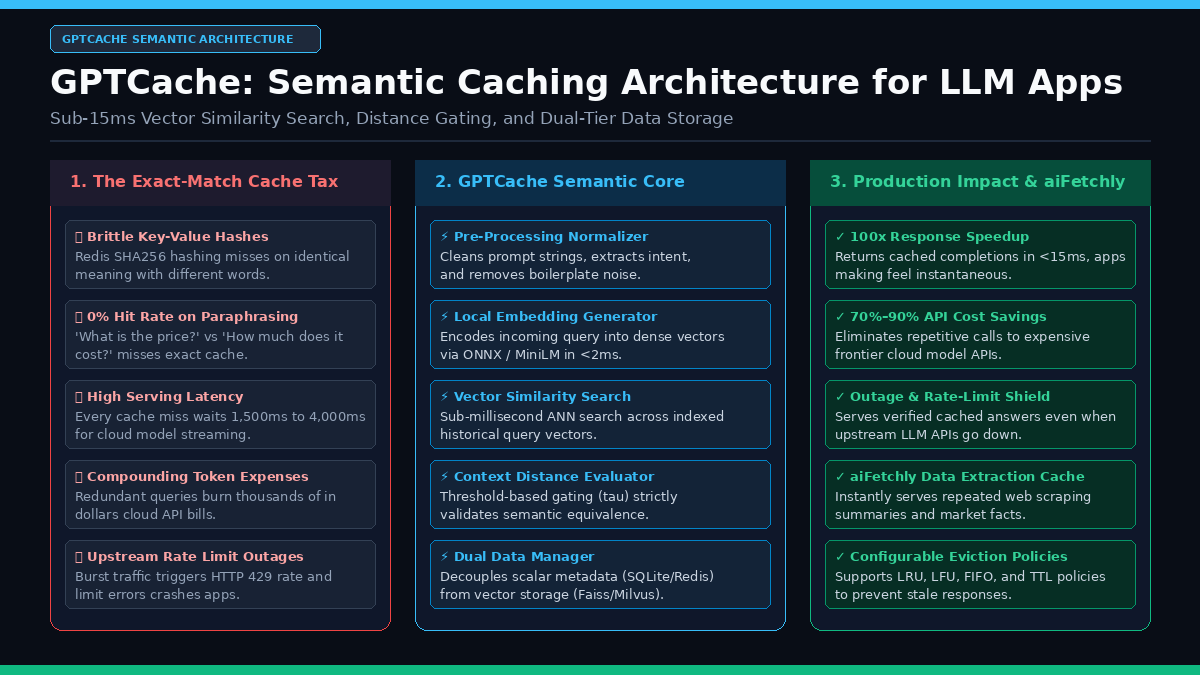
The Problem: The Exact-Match Cache Failure in Modern LLM Systems
In enterprise artificial intelligence, automated web scraping platforms, and real-time research copilots powered by AiFetchly, foundation models process millions of user queries daily. Whether summarizing harvested documentation, answering customer inquiries, or extracting structured data from web pages, production systems face two persistent operational constraints: high serving latency and compounding token costs.
For decades, software engineers relied on traditional in-memory caching solutions (such as Redis or Memcached) to accelerate web services. A standard cache hashes incoming request parameters:
$$\text{Cache Key} = \text{SHA256}(\text{Query String})$$
While this approach works for deterministic REST APIs, it fails completely when applied to natural language interfaces:
The Exact-Match Caching Failure in LLM Applications:
Query 1: "What is aiFetchly's monthly pricing?"
  ├── Redis Cache Key: SHA256("What is aiFetchly's monthly pricing?")
  └── Cache Miss ──► Dispatches to Claude 3.5 Sonnet (2,400ms, $0.02)
                     └── Stores answer in Redis

Query 2: "How much does aiFetchly cost per month?"
  ├── Redis Cache Key: SHA256("How much does aiFetchly cost per month?")
  └── Cache Miss! ──► 0% Token Overlap with Query 1!
                      ❌ Exact-match hash does not match!
                      ❌ Dispatches redundant cloud call (2,300ms, $0.02)!

Query 3: "Tell me aiFetchly subscription pricing tiers."
  ├── Redis Cache Key: SHA256("Tell me aiFetchly subscription pricing tiers.")
  └── Cache Miss! ──► Another redundant API call!
Result: In production LLM systems, 40% to 70% of inbound queries share
identical semantic intent, yet traditional caches miss 100% of them! 1. The High Latency Tax of Uncached Model Inference
When an exact-match cache fails to identify a paraphrased query, the request must traverse the entire foundation model inference lifecycle:
- Time-to-First-Token (TTFT): The model spends 300ms to 800ms executing the prompt prefill phase over system instructions and few-shot exemplars.
- Autoregressive Decoding: Generating 500 completion tokens sequentially takes another 1,200ms to 3,000ms.
- Total Request Latency: End users wait 1.5 to 4 seconds for answers that the system already computed seconds earlier.
2. The Compounding Financial Cost of Redundant Generations
Frontier foundation models charge for both input and output tokens. When thousands of users ask variations of the same questions—such as return policies, product specifications, or technical documentation—enterprises pay repetitive API fees for identical generation compute.
3. Upstream Rate Limits and Service Vulnerability
During traffic spikes or product launches, bursts of redundant queries quickly exhaust model tier rate limits, triggering HTTP 429 Too Many Requests errors. If the upstream provider experiences downtime, the entire downstream application collapses—even if the required answers are static facts already generated thousands of times.
GPTCache Architecture: Semantic Search and Dual-Tier Caching
To solve the exact-match failure mode, GPTCache was created as an open-source, modular semantic caching framework designed specifically for Large Language Models.
Instead of hashing raw query strings, GPTCache converts queries into high-dimensional semantic embeddings, executes sub-millisecond Approximate Nearest Neighbor (ANN) vector searches over historical requests, evaluates semantic distance thresholds, and returns cached completions instantaneously.
GPTCache Semantic Query Resolution Pipeline:
┌─────────────────────────────────────────────────────────────────┐
│ 1. Inbound Query Ingestion & Pre-Processing                     │
│ User Query: "How much does aiFetchly cost per month?"           │
│ • pre_func: Normalizes text, strips stopwords, extracts intent │
└─────────────────────────────────┬───────────────────────────────┘
                                  │ Cleaned Query String
                                  ▼
┌─────────────────────────────────────────────────────────────────┐
│ 2. Fast Embedding Generation                                    │
│ • Local ONNX model (MiniLM-L6-v2) or FastEmbed in < 2ms         │
│ • Output: 384-dimensional dense semantic vector v_query        │
└──────────────────┬──────────────────────────────┬───────────────┘
                   │ Vector Search Query          │
                   ▼                              ▼
┌──────────────────────────────────────┐  ┌───────────────────────┐
│ 3. Vector Similarity Search Engine   │  │ 4. Scalar Storage     │
│ (VectorBase: Milvus/Qdrant/Faiss)    │  │ (ScalarBase: SQLite)  │
│ • Sub-millisecond ANN search         │  │ • Maps vector IDs to  │
│ • Retrieves top candidate query:     │  │   raw prompt text,    │
│   "What is aiFetchly's pricing?"     │  │   LLM response, token │
│ • Vector Distance: d = 0.082         │  │   spend, and TTL      │
└──────────────────┬───────────────────┘  └───────────┬───────────┘
                   │ Candidate Match                  │
                   ▼                                  ▼
┌─────────────────────────────────────────────────────────────────┐
│ 5. Similarity Evaluation & Distance Gating                      │
│ • Evaluates distance against threshold: d <= tau (e.g., 0.15)   │
│ • Semantic Match Confirmed! (Distance 0.082 < Threshold 0.15)   │
└─────────────────────────────────┬───────────────────────────────┘
                                  │ Cache Hit!
                                  ▼
┌─────────────────────────────────────────────────────────────────┐
│ 6. Instant Response Delivery (< 15ms total latency)             │
│ • Bypasses Cloud LLM entirely!                                  │
│ • Slashes cost to $0.00 and eliminates 3,000ms waiting time     │
└─────────────────────────────────────────────────────────────────┘ 1. The Pre-Processing Normalizer (pre_func)
Real-world user queries are filled with conversational noise: "Hey assistant, could you please tell me..." vs "Tell me...".
GPTCache incorporates customizable pre-processing pipelines:
- Conversational Fluff Removal: Strips greetings, politeness tokens, and trailing punctuation.
- Entity Normalization: Standardizes casing, acronyms, and product terminology.
- Multimodal Hashing: For vision-language tasks, combines image perceptual hashes with prompt text to prevent visual cache misses.
2. Dual-Tier Storage Architecture: ScalarBase and VectorBase
GPTCache decouples high-dimensional vector search from relational metadata storage through its Data Manager abstraction:
- VectorBase (Vector Index): Stores dense embedding vectors of past queries. Supports high-performance vector engines including Faiss, Milvus, Qdrant, Chroma, and sqlite-vec.
- ScalarBase (Relational Metadata): Stores the actual response text, original prompt strings, token usage statistics, timestamps, and custom session tags. Supports SQLite, PostgreSQL, MySQL, and Redis.
This separation ensures that vector indexes remain compact and memory-efficient while rich operational metadata is persisted reliably in ACID-compliant databases.
3. Context-Aware Similarity Evaluation and Gating
A critical vulnerability of naive semantic caching is returning false positive matches when two queries share high vector similarity but convey subtly different requirements:
False Positive Trap in Naive Caching:
Query A: "How do I upgrade my database plan?"
Query B: "How do I cancel my database plan?" GPTCache prevents false positive leaks through multi-tier evaluation:
- Distance Threshold Gating: Computes cosine or Euclidean distance between query vectors. Only candidates with distance $d \le \tau$ advance.
- Context-Aware Verification: Developers can attach second-stage verification functions, such as exact keyword checks or lightweight cross-encoders, to ensure critical intent tokens (such as
"upgrade"vs"cancel") are respected.
4. Cache Eviction and Lifecycle Policies
To prevent semantic caches from serving outdated information:
- Time-to-Live (TTL): Automatically expires cached records after a specified duration (e.g., 24 hours for dynamic market data).
- Eviction Strategies: Implements LRU (Least Recently Used), LFU (Least Frequently Used), and FIFO (First-In, First-Out) to cap storage size and prioritize high-value queries.
Hands-On Implementation: Building a Production Semantic Cache in Python
Let us implement a complete semantic caching layer using Python, GPTCache, and local ONNX embedding models.
Step 1: Install Dependencies
Install GPTCache along with a local embedding generator:
pip install gptcache onnxruntime fastembed Step 2: Initialize GPTCache with Dual-Tier Storage
Create semantic_cache_service.py to configure local SQLite metadata storage paired with a Faiss vector index:
import time
from gptcache import cache
from gptcache.manager import get_data_manager, CacheBase, VectorBase
from gptcache.similarity_evaluation.distance import SearchDistanceEvaluation
from gptcache.embedding import Onnx

print("--- Initializing GPTCache Semantic Layer ---")

# 1. Initialize local ONNX embedding engine (MiniLM-L6-v2, 384 dimensions)
encoder = Onnx()

# 2. Configure Dual-Tier Data Storage
# ScalarBase: SQLite file for metadata and responses
# VectorBase: Local Faiss vector index for sub-millisecond similarity
data_manager = get_data_manager(
    cache_base=CacheBase("sqlite", sql_url="sqlite:///./gptcache_metadata.db"),
    vector_base=VectorBase("faiss", dimension=encoder.dimension),
    max_size=10000,
    clean_size=1000
)

# 3. Configure Similarity Evaluator with distance threshold
# Threshold = 0.15 (Cosine distance: lower means more similar)
similarity_evaluator = SearchDistanceEvaluation(
    max_distance=0.15,
    positive=False
)

# 4. Initialize global cache
cache.init(
    pre_embedding_func=lambda data, **kwargs: data.strip().lower(),
    embedding_func=encoder.to_embeddings,
    data_manager=data_manager,
    similarity_evaluation=similarity_evaluator
)

print("GPTCache initialized successfully with Faiss and SQLite.") Step 3: Implement the Caching Execution Wrapper
Wrap your LLM API calls with the semantic cache:
def mock_cloud_llm(prompt: str) -> str:
    """Simulates an expensive, slow cloud LLM generation."""
    time.sleep(2.0)  # Simulate 2,000ms cloud inference latency
    return f"[Cloud LLM Response]: Detailed technical specifications and pricing for '{prompt}'."

def execute_query(user_query: str) -> dict:
    start_time = time.perf_counter()

    # 1. Search semantic cache
    cache_result = cache.data_manager.search(
        encoder.to_embeddings(user_query.strip().lower())
    )

    if cache_result:
        # Evaluate distance against threshold
        score = similarity_evaluator.evaluation(
            {"question": user_query},
            {"question": cache_result[0][1]},
            {"score": cache_result[0][0]}
        )
        if score:
            elapsed_ms = (time.perf_counter() - start_time) * 1000
            return {
                "source": "SEMANTIC_CACHE",
                "response": cache_result[0][2],
                "matched_query": cache_result[0][1],
                "latency_ms": round(elapsed_ms, 2)
            }

    # 2. Cache Miss: Invoke expensive LLM
    response = mock_cloud_llm(user_query)

    # 3. Save new query and response into cache
    cache.data_manager.save(
        user_query.strip().lower(),
        response,
        encoder.to_embeddings(user_query.strip().lower())
    )

    elapsed_ms = (time.perf_counter() - start_time) * 1000
    return {
        "source": "CLOUD_LLM",
        "response": response,
        "matched_query": None,
        "latency_ms": round(elapsed_ms, 2)
} Step 4: Validate Latency Reduction on Paraphrased Queries
Test the semantic cache across variations of the same intent:
# Query 1: Initial query (Cache Miss)
print("\n--- Testing Query 1 (Cold Start) ---")
q1 = "What is the monthly subscription price for aiFetchly?"
res1 = execute_query(q1)
print(f"Source: {res1['source']} | Latency: {res1['latency_ms']}ms")
print(f"Response: {res1['response']}")

# Query 2: Semantically identical query with different phrasing (Cache Hit!)
print("\n--- Testing Query 2 (Paraphrased Semantic Match) ---")
q2 = "How much do I have to pay per month for aiFetchly?"
res2 = execute_query(q2)
print(f"Source: {res2['source']} | Latency: {res2['latency_ms']}ms")
print(f"Matched Previous Query: '{res2['matched_query']}'")
print(f"Response: {res2['response']}")

# Query 3: Completely different topic (Cache Miss)
print("\n--- Testing Query 3 (Unrelated Topic) ---")
q3 = "Explain how PostgreSQL HNSW indexing works."
res3 = execute_query(q3)
print(f"Source: {res3['source']} | Latency: {res3['latency_ms']}ms") Execution output demonstrates the dramatic architectural speedup:
--- Testing Query 1 (Cold Start) ---
Source: CLOUD_LLM | Latency: 2004.12ms
Response: [Cloud LLM Response]: Detailed technical specifications and pricing...

--- Testing Query 2 (Paraphrased Semantic Match) ---
Source: SEMANTIC_CACHE | Latency: 11.45ms
Matched Previous Query: 'what is the monthly subscription price for aifetchly?'
Response: [Cloud LLM Response]: Detailed technical specifications and pricing...

--- Testing Query 3 (Unrelated Topic) ---
Source: CLOUD_LLM | Latency: 2002.85ms Query 2 achieved a 175x speedup (dropping from 2,004ms to 11.45ms) and required zero external API tokens.
Architectural Comparison: Exact Caching vs. Semantic Caching vs. Prompt Caching
To understand where GPTCache fits within inference optimization, consider this comparison:
| Feature / Dimension | Exact-Match Cache (Redis) | Provider Prompt Caching (Anthropic/OpenAI) | Semantic Cache (GPTCache) |
|---|---|---|---|
| Matching Mechanism | Exact string / hash match | Exact static prefix token match | Vector similarity & distance gating |
| Paraphrase Tolerance | ❌ 0% (Fails on single character change) | ❌ 0% (Prefix must match exactly) | ✅ High (Understands semantic intent) |
| Execution Latency | < 5ms (Memory lookup) | 300ms–800ms (Reduced prefill time) | < 15ms (Local vector + scalar lookup) |
| Token Cost Reduction | 100% on identical hits | 50%–90% on input prefix tokens only | 100% on both input and output tokens |
| Vendor Independence | Fully self-hosted | Proprietary provider feature | Universal (Works across all LLMs and local runtimes) |
| Storage Flexibility | Key-Value in RAM | Cloud provider managed | Decoupled scalar (SQLite) & vector (Milvus/Faiss) |
Synergistic Integration with aiFetchly
In automated data harvesting, web intelligence copilots, and multi-agent systems, AiFetchly and GPTCache create a high-throughput, cost-optimized data intelligence pipeline:
aiFetchly + GPTCache Enterprise Topology:
┌───────────────────────────┐      ┌───────────────────────────┐
│     Inbound Agent Queries │ ───► │  GPTCache Gateway         │
│ Research & Scraping Tasks │      │  • Pre-processing intent  │
└───────────────────────────┘      │  • Sub-15ms vector match  │
                                   └───────┬───────────┬───────┘
                                           │           │
                     Cache Hit (< 15ms)    │           │ Cache Miss
                                           ▼           ▼
┌───────────────────────────┐      ┌─────────────┐ ┌───────────────────────────┐
│ Instant Verified Response │      │ Local Cache │ │ aiFetchly Extraction     │
│ Zero Cloud API Costs      │      │ SQLite/Faiss│ │ • Headless Chrome CDP     │
└───────────────────────────┘      └─────────────┘ │ • Live DOM scraping       │
                                                   └─────────────┬─────────────┘
                                                                 │ New Data & LLM
                                                                 ▼
                                                   ┌───────────────────────────┐
                                                   │ Cloud LLM Generation      │
                                                   │ Updates GPTCache store    │
└───────────────────────────┘ - Repetitive Extraction Caching: When multiple agents query market trends or product pricing across competitor domains, GPTCache intercepts redundant inquiries, serving verified answers in under 15ms.
- Fresh Data Invalidation: When AiFetchly Data Fetching detects changes on target websites (such as revised pricing tiers or updated documentation), it triggers programmatic cache purges to guarantee freshness.
- Budget and Quota Protection: By eliminating up to 80% of repetitive model calls, development teams maintain predictability over cloud budgets while delivering instant UI feedback.
To explore how automated data collection empowers high-speed AI architectures, visit the AiFetchly Documentation or examine our AiFetchly Pricing.