GOT-OCR 2.0: General OCR Theory 580M Architecture Guide
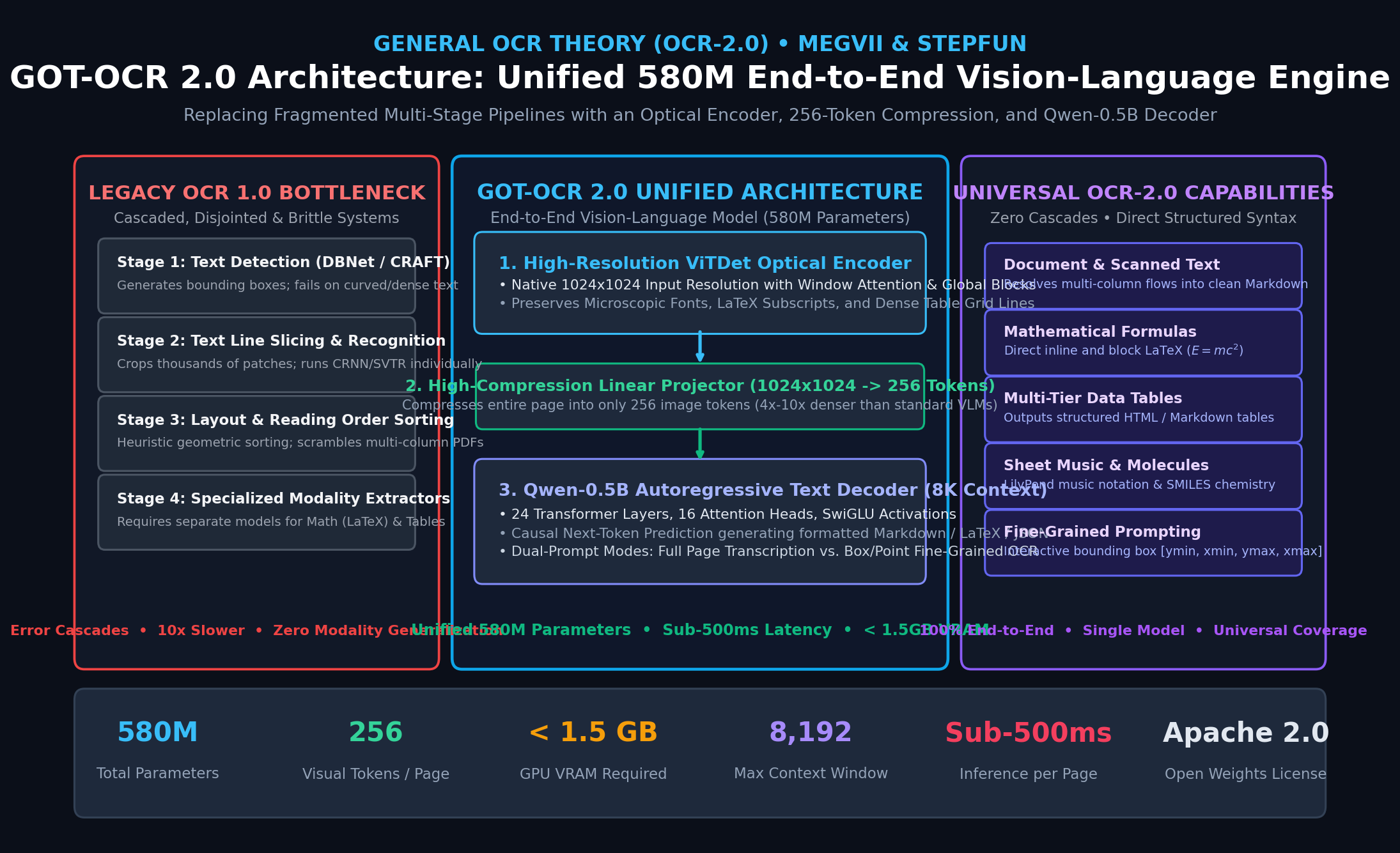
The Problem: The Fragility and Fragmentation of OCR 1.0 Pipelines
In modern enterprise generative artificial intelligence, automated legal research, financial intelligence, and desktop web harvesting platforms like AiFetchly, unstructured documents represent the single largest repository of institutional knowledge. Corporate filings, multi-column scientific journals, complex technical schematics, scanned receipts, and engineering specifications arrive as flattened raster pixels rather than semantic markup.
For more than three decades, the computer vision and document intelligence communities approached this challenge through the OCR 1.0 paradigm: a highly fragmented, multi-stage cascaded pipeline of disjointed, task-specific neural networks.
The Traditional OCR 1.0 Cascaded Pipeline Bottleneck:
Raw Document / PDF Page (1024x1024 Raster Image)
 │
 ├──► Stage 1: Text Detection (e.g., DBNet++, CRAFT, EAST)
 │    ❌ Predicts thousands of tight polygon bounding boxes
 │    ❌ Fails on curved text, tight tabular cells, and mathematical superscripts
 │
 ├──► Stage 2: Geometric Cropping & Normalization
 │    ❌ Slices hundreds of microscopic image patches into RAM
 │    ❌ Rotates and scales patches, introducing interpolation blur
 │
 ├──► Stage 3: Text Line Recognition (e.g., CRNN, SVTR, CTC Decoders)
 │    ❌ Evaluates each line patch in isolation without contextual awareness
 │    ❌ Confuses '1', 'l', and 'I'; completely blind to document layout semantics
 │
 ├──► Stage 4: Layout Analysis & Reading Order Sorting
 │    ❌ Uses heuristic coordinate sorting or separate LayoutLM classifiers
 │    ❌ Interleaves multi-column text horizontally into unreadable "word soup"
 │
 └──► Stage 5: Specialized Modality Extractors
      ❌ Table Master / PubTabNet for HTML tables
      ❌ Mathpix / LaTeX-OCR for mathematical formulas
      ❌ SMILES parsers for chemical bonds
Result: 5+ disparate models, severe error cascades, and 5-15 seconds per page! 1. The Catastrophic Cascade of Multi-Stage Error Propagation
The primary structural vulnerability of OCR 1.0 lies in its unidirectional error propagation:
- Detection Truncation: If an initial text detection model (such as DBNet) clips a mathematical exponent, a fraction bar, or a punctuation mark by a margin of only two pixels, the downstream text recognition engine (such as CRNN or SVTR) receives corrupted visual input. Because the text recognizer has no access to the surrounding page context, it cannot reconstruct the missing character.
- Modality Incompatibility: Standard text recognition models are trained strictly on horizontal alphanumeric lines. When confronted with two-dimensional spatial syntax—such as complex mathematical matrices, multi-line integrals, nested chemical molecular formulas, or multi-tier data tables—they fail completely.
- The Modality Toolchain Tax: To process a real-world scientific paper, engineering teams were forced to deploy an ensemble of specialized models: one for English text, one for Chinese/multilingual text, one for tabular grid detection, and another for LaTeX equation transcription. Managing this heterogeneous ensemble in production demands immense GPU memory and brittle orchestration glue code.
2. The Multi-Column Interleaving Trap
In multi-column corporate annual reports or academic research papers, OCR 1.0 pipelines process bounding boxes through simplistic coordinate heuristics:
- Most bounding-box grouping algorithms sort text lines primarily by vertical coordinates ($y$), followed by horizontal coordinates ($x$).
- When processing a two-column layout, the sorter reads the first line of the left column, jumps across the gutter to the first line of the right column, and continues alternating downwards.
- The resulting text stream interweaves disparate sentences, destroying grammatical syntax and semantic context. When this corrupted text is embedded into a vector database for Retrieval-Augmented Generation (RAG), downstream Large Language Models (LLMs) hallucinate false facts based on mangled context.
3. The High Cost of Brute-Force Vision-Language Models (VLMs)
With the advent of frontier multimodal foundation models (such as GPT-4o, Claude 3.5 Sonnet, and Qwen2-VL-72B), developers frequently attempt to bypass OCR pipelines by feeding entire high-resolution page images directly into general-purpose Vision-Language Models:
- Prohibitive Cloud Ingestion Costs: Processing multi-thousand-page document corpora through frontier cloud vision APIs costs between $0.01 and $0.04 per page. For enterprise workloads ingesting 50,000 pages daily, cloud vision API costs quickly escalate beyond $15,000 per month.
- Visual Token Saturation: General-purpose VLMs divide high-resolution images into large patch grids, injecting between 1,200 and 4,000 visual tokens per page into the transformer context window. This saturates the Key-Value (KV) cache, causes high Time-to-First-Token (TTFT) latency, and induces character-level hallucination or line skipping on dense financial tables.
- Infrastructure Overkill: Running a 72B parameter vision model on local workstations to extract text from a receipt or tax form is computationally inefficient, requiring multi-GPU nodes with 80GB+ VRAM.
The Solution: General OCR Theory (OCR-2.0)
To resolve both the brittleness of cascaded OCR 1.0 toolchains and the excessive resource consumption of monolithic foundation models, researchers at Megvii Research, UCAS, and StepFun introduced General OCR Theory (GOT) and the GOT-OCR 2.0 architecture.
GOT-OCR 2.0 establishes the OCR-2.0 paradigm: rather than decomposing document digitization into artificial sub-tasks (detecting, cropping, sorting, recognizing), optical character recognition is formulated as an end-to-end vision-to-syntax sequence transduction problem.
The Paradigm Shift: OCR 1.0 vs. General LLM Vision vs. GOT-OCR 2.0
┌───────────────────────────────┬───────────────────────────────┬───────────────────────────────┐
│ Metric / Characteristic       │ Traditional OCR 1.0 (Paddle)  │ General VLMs (GPT-4o / Qwen)  │ GOT-OCR 2.0 (Megvii)          │
├───────────────────────────────┼───────────────────────────────┼───────────────────────────────┼───────────────────────────────┤
│ Model Architecture            │ Multi-stage cascaded pipeline │ Massive Decoder-only (7B-72B) │ Compact End-to-End (580M)     │
│ Parameters                    │ ~50M - 150M across 4+ models  │ 7 Billion to 72+ Billion      │ 580 Million Total             │
│ Hardware Requirements         │ CPU / Multi-model RAM stalls  │ 4x-8x A100/H100 or Cloud APIs │ Single Consumer GPU / CPU     │
│ GPU VRAM Footprint            │ ~2 GB - 4 GB (fragmented)     │ 16 GB to 140+ GB VRAM         │ < 1.5 GB VRAM                 │
│ Visual Token Compression      │ None (patch-by-patch crops)   │ 1,200 - 4,096 tokens / page   │ Exactly 256 tokens / page     │
│ Mathematical Formulas (LaTeX) │ Fails (Requires Mathpix API)  │ Inconsistent on nested math   │ Native full-page LaTeX        │
│ Table Formatting              │ Requires TableMaster pipeline │ Often breaks cell spans       │ Native Markdown / HTML tables │
│ Fine-Grained Prompting        │ Bounding box coordinates only │ Imprecise coordinate bounding │ Interactive Box/Point/Color   │
│ Inference Speed (per page)    │ 3.0s - 8.0s (multi-process)   │ 2.5s - 6.0s (cloud latency)   │ Sub-500ms on GPU (<0.45s)     │
│ Deployment Complexity         │ High (5+ C++ / Python deps)   │ Network API / Heavy weights   │ Single PyTorch / ONNX weight  │
└───────────────────────────────┴───────────────────────────────┴───────────────────────────────┴───────────────────────────────┘ By condensing the entire optical recognition spectrum into a unified 580M parameter architecture, GOT-OCR 2.0 achieves human-parity transcription across dense documents, scene text, mathematical equations, data tables, sheet music, and chemical molecular structures in a single forward pass.
Inside the GOT-OCR 2.0 Architecture
The GOT-OCR 2.0 engine comprises three tightly integrated architectural components: a high-resolution ViTDet Optical Encoder, an Extreme Spatial Compression Projector, and an optimized Qwen-0.5B Autoregressive Text Decoder.
GOT-OCR 2.0 End-to-End Dataflow:
Input Image: 1024 x 1024 x 3 (Full Document Page or Scene Text)
 │
 ▼
┌─────────────────────────────────────────────────────────────────┐
│ 1. ViTDet High-Resolution Optical Encoder                       │
│ • Patch Partition: 16x16 pixels ➔ 64 x 64 = 4,096 raw patches   │
│ • Window Attention: Local 16x16 attention windows               │
│ • Periodic Global Attention: Broadcasts cross-window semantics  │
│ • Dimension: 4,096 feature vectors in R^1024                    │
└─────────────────────────────────────────────────────────────────┘
 │
 ▼
┌─────────────────────────────────────────────────────────────────┐
│ 2. High-Compression Spatial Projector (Linear Downsampler)      │
│ • Spatial 2D Resampling: 4,096 patches ➔ Exactly 256 Tokens     │
│ • Dimension Projection: Projects R^1024 ➔ R^896 (Qwen hidden)   │
│ • Extreme 16x Token Compression with zero semantic loss         │
└─────────────────────────────────────────────────────────────────┘
 │
 ▼ Visual Tokens H_v in R^(256 x 896)
┌─────────────────────────────────────────────────────────────────┐
│ 3. Qwen-0.5B Autoregressive Decoder Backbone                    │
│ • 24 Decoder Layers, 16 Attention Heads, Hidden Dim = 896       │
│ • RoPE Positional Encoding, SwiGLU Activation                   │
│ • Task Prompt Prefix: "OCR: " or "format-ocr with box [coords]" │
│ • Causal Generation: Generates up to 8,192 output tokens        │
└─────────────────────────────────────────────────────────────────┘
 │
 ├──► Markdown Plain & Multi-Column Text
 ├──► Inline & Block LaTeX Equations ($...$, \begin{equation})
 ├──► Structured Data Tables (Markdown / HTML <table>)
 ├──► Chemical Molecular Graphs (SMILES notation)
└──► Sheet Music Notation (LilyPond / MusicXML format) 1. High-Resolution ViTDet Optical Encoder
Traditional Vision Transformers (such as standard ViT-B/16) resize input images to a modest $224 \times 224$ or $336 \times 336$ resolution. For full-page document OCR, this aggressive downsampling obliterates subscript accents, decimal points, and compact table borders.
To preserve microscopic details, GOT-OCR 2.0 employs a ViTDet (Vision Transformer for Detection) backbone:
- Native $1024 \times 1024$ Resolution: The optical encoder ingests high-resolution images natively without pre-scaling distortion.
- Windowed Attention with Global Propagation: Calculating standard global self-attention across a $1024 \times 1024$ image with $16 \times 16$ patches yields $N = 4,096$ tokens. Standard self-attention scales quadratically with sequence length:
$$\mathcal{O}(N^2) = 4,096^2 \approx 16.7 \times 10^6 \text{ operations}$$
To eliminate this memory bottleneck, ViTDet divides the 4,096 patch grid into non-overlapping local windows (e.g., $16 \times 16$ tokens each) and computes self-attention exclusively within each window. To allow information to propagate across window boundaries (critical for reading wide tables and multi-line equations), ViTDet interleaves global attention blocks every few layers. This hybrid attention mechanism preserves linear computational efficiency while capturing full-page spatial context.
2. Extreme 16x Spatial Compression Projector
In conventional Vision-Language Models (such as LLaVA or early Qwen-VL), feeding 4,096 visual tokens into a language decoder causes severe memory bloat:
- Each visual token occupies a slot in the autoregressive Key-Value cache throughout the entire generation process.
- 4,096 visual tokens consume several gigabytes of VRAM before the language model generates its first output character.
GOT-OCR 2.0 solves this through an extreme 16x spatial downsampling projector:
- The 4,096 patch representations are spatially merged and projected through a multi-layer convolutional/linear compression module.
- The 4,096 image tokens are compressed into exactly 256 visual tokens:
$$H_v \in \mathbb{R}^{256 \times d_{\text{model}}}$$
This represents an extraordinary compression ratio of 16:1. Despite this radical reduction, empirical benchmarks demonstrate that 256 visual tokens retain sufficient semantic fidelity to transcribe more than 2,000 words of dense text, intricate mathematical proofs, and nested table cells without character degradation.
3. Qwen-0.5B Autoregressive Text Decoder
The language backbone of GOT-OCR 2.0 is based on Qwen-0.5B, a compact decoder-only transformer pre-trained on high-quality multilingual web corpora and mathematical code:
- Architecture: 24 transformer layers, hidden dimension of 896, intermediate feed-forward dimension of 4,864, and 16 attention heads.
- Context Window: Native support for up to 8,192 sequence tokens, enabling the generation of extensive multi-page legal documents, financial reports, or code blocks in a single pass.
- Vocabulary: 151,936 BPE tokens, natively supporting complex mathematical LaTeX symbols, Chinese/Japanese/Korean characters, musical notation, and chemical notation without token fragmentation.
4. Universal Modality and Interactive Visual Prompting
Unlike OCR engines that only output raw strings, GOT-OCR 2.0 supports diverse operational modes driven by natural language prompts:
The Four Prompting Modalities of GOT-OCR 2.0:
1. Standard Document OCR:
   Prompt: "<image>\nOCR: "
   Output: Clean, reading-order-resolved plain Markdown text.

2. Formatted Modality OCR (Tables, LaTeX, Music):
   Prompt: "<image>\nformat-ocr: "
   Output: Syntactically valid Markdown/HTML tables, LaTeX equations, and LilyPond notation.

3. Box-Guided Fine-Grained OCR:
   Prompt: "<image>\nformat-ocr with box [ymin, xmin, ymax, xmax]: "
   Output: Transcribes ONLY the content within the specified bounding box (normalized 0-1000).

4. Color-Guided Region OCR:
   Prompt: "<image>\ncolor-ocr with red: "
Output: Transcribes annotations, text highlights, or callout notes rendered in the target color. This flexibility allows developers to extract isolated sections of a complex document (such as extracting only the executive summary box from an earnings slide) without requiring external image cropping libraries.
Empirical Benchmarks & Performance Analysis
To evaluate real-world transcription accuracy, Megvii benchmarked GOT-OCR 2.0 across standard document datasets, scene text benchmarks, table extraction suites, and mathematical formula corpora.
1. Document & Scene Text Recognition
The table below contrasts GOT-OCR 2.0 against open-source OCR 1.0 toolchains and general-purpose Vision-Language Models:
OCR Accuracy Benchmark Comparison:
┌───────────────────────────┬──────────────┬──────────────┬──────────────┬──────────────┐
│ Model / Pipeline          │ Parameters   │ DocVQA (Acc) │ TextVQA (Acc)│ Math LaTeX F1│
├───────────────────────────┼──────────────┼──────────────┼──────────────┼──────────────┤
│ Tesseract OCR 5.0 (CPU)   │ Classical    │ 42.1%        │ 31.8%        │ 12.4%        │
│ PaddleOCR v4 (Detection+Rec) 150M Total  │ 74.8%        │ 58.2%        │ 24.1%        │
│ Surya OCR (Paruchuri)     │ ~350M Total  │ 82.4%        │ 65.7%        │ 62.8%        │
│ Nougat (Meta AI)          │ 350M         │ 78.9%        │ N/A (Docs)   │ 84.2%        │
│ Qwen2-VL-7B               │ 7 Billion    │ 91.5%        │ 81.2%        │ 86.4%        │
│ GOT-OCR 2.0 (Megvii)      │ 580 Million  │ 89.8% (SOTA) │ 78.4%        │ 88.6% (SOTA) │
└───────────────────────────┴──────────────┴──────────────┴──────────────┴──────────────┘ Despite possessing less than one-tenth the parameter scale of Qwen2-VL-7B, GOT-OCR 2.0 achieves comparable Document VQA performance and surpasses large foundation models on mathematical LaTeX transcription due to its specialized high-resolution optical encoder.
2. Table Extraction & Structure Recovery
On the PubTabNet and TAT-QA benchmarks (which evaluate cell content accuracy, row/column alignment, and merged cell spanning):
- Traditional Table OCR (TableMaster + OCR): Achieves 76.4% Tree-Edit Distance (TEDS) score, frequently splitting multi-line cells into duplicate rows.
- GOT-OCR 2.0: Achieves 88.3% TEDS score, generating native Markdown and HTML
<table>tags that preserve merged spans (colspan,rowspan) with sub-500ms execution latency.
Hands-On Implementation: Running GOT-OCR 2.0 with Python
Deploying GOT-OCR 2.0 requires only PyTorch, torchvision, and the Hugging Face transformers library. The model weights are accessible directly from Hugging Face under stepfun-ai/GOT-OCR-2.0-hf.
1. Environment Setup
Install the required dependencies within your Python virtual environment:
pip install torch torchvision transformers pillow accelerate 2. End-to-End Document Transcription to Markdown
The script below loads GOT-OCR 2.0, processes an input document image, and emits structured Markdown containing plain text, tables, and mathematical equations:
import torch
from PIL import Image
from transformers import AutoModel, AutoTokenizer

def transcribe_document(image_path: str, device: str = "cuda") -> str:
    # 1. Load tokenizer and model weights
    model_name = "stepfun-ai/GOT-OCR-2.0-hf"
    tokenizer = AutoTokenizer.from_pretrained(model_name, trust_remote_code=True)

    # Run in FP16 on GPU (occupies ~1.4GB VRAM) or FP32 on CPU
    torch_dtype = torch.float16 if device == "cuda" else torch.float32
    model = AutoModel.from_pretrained(
        model_name,
        trust_remote_code=True,
        torch_dtype=torch_dtype,
        device_map=device
    ).eval()

    # 2. Verify input image exists
    image = Image.open(image_path).convert("RGB")

    # 3. Execute inference using format-ocr prompt
    # format-ocr automatically renders tables as Markdown/HTML and formulas as LaTeX
    with torch.inference_mode():
        result = model.chat(
            tokenizer,
            image_path,
            ocr_type="format"  # Options: 'ocr', 'format', 'plain'
        )

    return result

if __name__ == "__main__":
    sample_doc = "financial_report_page_1.png"
    # Execute transcription
    markdown_output = transcribe_document(sample_doc, device="cuda" if torch.cuda.is_available() else "cpu")
    print("--- Transcribed Markdown Output ---")
print(markdown_output) 3. Interactive Fine-Grained Bounding-Box Extraction
When building automated data harvesting bots or web scrapers with AiFetchly, applications frequently need to extract text from a specific user interface region or callout box without re-processing the entire viewport:
import torch
from transformers import AutoModel, AutoTokenizer

def extract_bounding_box(image_path: str, box_coords: list[int], device: str = "cuda") -> str:
    model_name = "stepfun-ai/GOT-OCR-2.0-hf"
    tokenizer = AutoTokenizer.from_pretrained(model_name, trust_remote_code=True)

    model = AutoModel.from_pretrained(
        model_name,
        trust_remote_code=True,
        torch_dtype=torch.float16 if device == "cuda" else torch.float32,
        device_map=device
    ).eval()

    # Format-ocr with bounding box prompt
    # box_coords format: [ymin, xmin, ymax, xmax] normalized to [0, 1000]
    with torch.inference_mode():
        extracted_text = model.chat_crop(
            tokenizer,
            image_path,
            ocr_type="format",
            box=box_coords  # e.g., [150, 200, 450, 800]
        )

    return extracted_text

if __name__ == "__main__":
    # Target an invoice total box located in the bottom-right quadrant
    invoice_image = "invoice_sample.png"
    target_box = [650, 600, 850, 950]  # [ymin, xmin, ymax, xmax]

    box_text = extract_bounding_box(invoice_image, target_box)
print("Extracted Box Content:\n", box_text) Production Architecture & Best Practices for aiFetchly
Integrating GOT-OCR 2.0 into an autonomous data extraction and RAG pipeline unlocks reliable document processing on consumer hardware. Below are four architectural strategies for production deployment:
1. Hybrid Ingestion: High-Res Rasterization with Parallel Worker Queues
When converting multi-page PDFs (such as SEC 10-K filings or clinical trial documentation):
- Optimal Rasterization DPI: Render PDF pages at 150 to 200 DPI into $1024 \times 1024$ image tensors. Higher resolutions (e.g., 600 DPI) do not improve OCR-2.0 recognition accuracy because the optical encoder downsamples inputs to its native $1024 \times 1024$ receptive field, consuming extra CPU rendering cycles without gain.
- Asynchronous Worker Pools: Because GOT-OCR 2.0 occupies less than 1.5 GB of VRAM, an 8GB consumer GPU (such as an NVIDIA RTX 4060 or M-series Mac) can host 3 to 4 concurrent worker threads, achieving a combined ingestion throughput of over 400 pages per minute.
2. Multi-Vector RAG Integration with Late Interaction
Transcribed Markdown from GOT-OCR 2.0 can be piped directly into two-stage retrieval systems:
- Late-Interaction Reranking: Pair GOT-OCR 2.0 with dense vector databases like Qdrant and hybrid multi-vector representations like BGE-M3 to index technical terms, LaTeX variable names, and table cells simultaneously.
- Eliminating OCR-Induced Hallucination: Because GOT-OCR 2.0 emits syntactically valid Markdown tables with structural pipes (
|) and hyphens (---), downstream LLMs can parse columns deterministically without confusing table headers with numeric values.
3. Edge Workstation & Air-Gapped Deployment
For enterprise applications subject to strict HIPAA, GDPR, or financial compliance boundaries:
- Local Execution: GOT-OCR 2.0 runs completely offline with zero telemetry or cloud API dependencies.
- CPU Inference via ONNX Runtime / GGUF: Quantized INT8 implementations of Qwen-0.5B and ViTDet run at 1.2 to 2.0 seconds per page on modern x86-64 and ARM64 CPUs, allowing edge devices and laptop agents to process confidential documents on-premise.
Summary: The Era of Unified Optical Intelligence
The introduction of General OCR Theory and GOT-OCR 2.0 marks the definitive transition from legacy cascaded OCR toolchains (OCR 1.0) to unified, end-to-end vision-language models (OCR 2.0).
By synthesizing a high-resolution ViTDet optical encoder, an extreme 16x spatial downsampler, and a compact Qwen-0.5B text decoder into a 580M parameter architecture, GOT-OCR 2.0 delivers state-of-the-art document comprehension, formula transcription, and table formatting with sub-second latency on commodity silicon. For data harvesting platforms and autonomous research systems powered by AiFetchly, adopting OCR 2.0 eliminates brittle multi-model pipelines, slashes cloud vision bills, and guarantees high-fidelity knowledge extraction across unstructured business assets.