Google vs Yandex: Multi-Engine Search Arbitrage Guide
The Monoculture Trap of Single-Engine Sourcing
Data analysts conducting market intelligence, competitive landscape mapping, and supplier discovery frequently suffer from search engine monoculture. When teams rely exclusively on Google to source prospective commercial domains, they inherit the severe algorithmic biases of Google’s modern Search Engine Results Pages (SERPs).
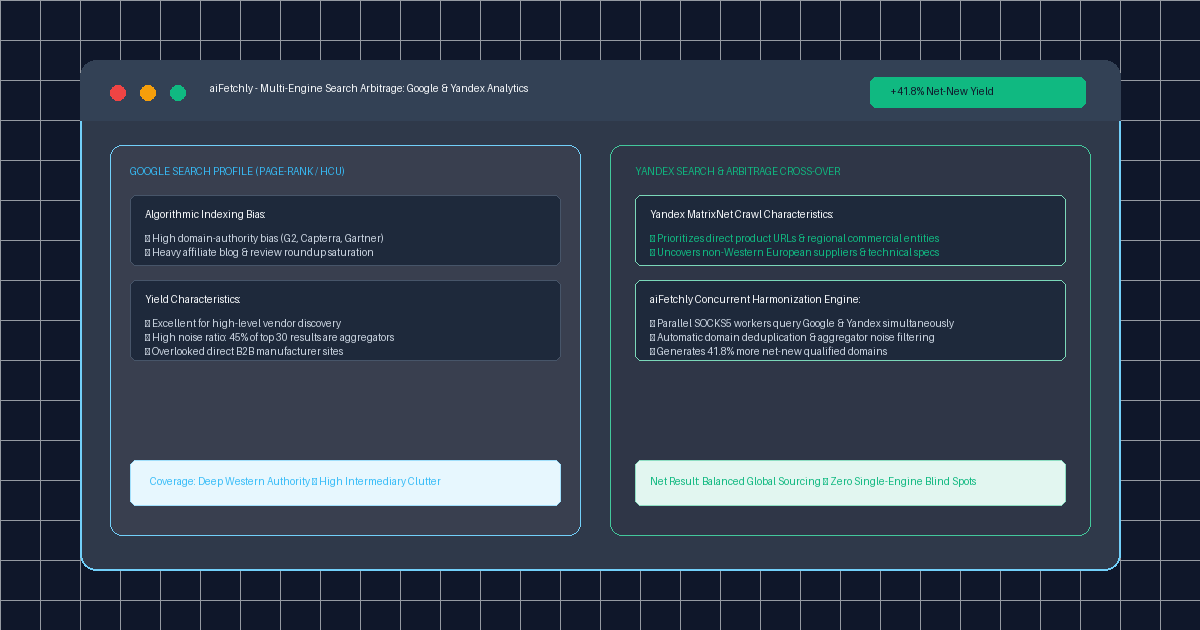
Under recent Helpful Content and core ranking updates, Google heavily prioritizes high-domain-authority aggregators, review directories (G2, Capterra, Software Advice), and media conglomerates over direct vendor websites. A query for “specialized cold-chain logistics telemetry” often returns three pages of affiliate listicles before displaying an actual software vendor. Furthermore, Google aggressively regionalizes results based on geographic proximity, blinding Western analysts to international enterprise vendors across Central and Eastern Europe, the Middle East, and Asia.
AI Fetchly solves this discovery bottleneck in Market Insight Explorer by introducing Multi-Engine Search Arbitrage, querying Google and Yandex concurrently to extract clean, un-gated B2B domains.
Algorithmic Disparities: Google PageRank vs. Yandex MatrixNet
Google and Yandex employ fundamentally distinct crawler architectures and ranking philosophies:
| Search Dimension | Google Search Profile | Yandex Search Profile |
|---|---|---|
| Primary Ranking Model | PageRank & Domain Authority weighting | MatrixNet machine-learning ranking |
| Intermediary Noise | Heavy saturation of review portals & affiliate blogs | Low aggregator density; favors direct product domains |
| Geographic Indexing | Strict localized geo-fencing | Broad multi-region indexing across Eurasian & EMEA markets |
| Technical Depth | Deep documentation indexing (often gated) | Surfaces open PDF specifications, schematics, and un-gated portals |
By querying both engines simultaneously with identical semantic parameters, aiFetchly neutralizes Google’s aggregator penalty. While Google captures established brand leaders, Yandex uncovers high-competency direct suppliers and emerging tech vendors operating beneath Google’s domain-authority threshold.
The aiFetchly Arbitrage Harmonization Pipeline
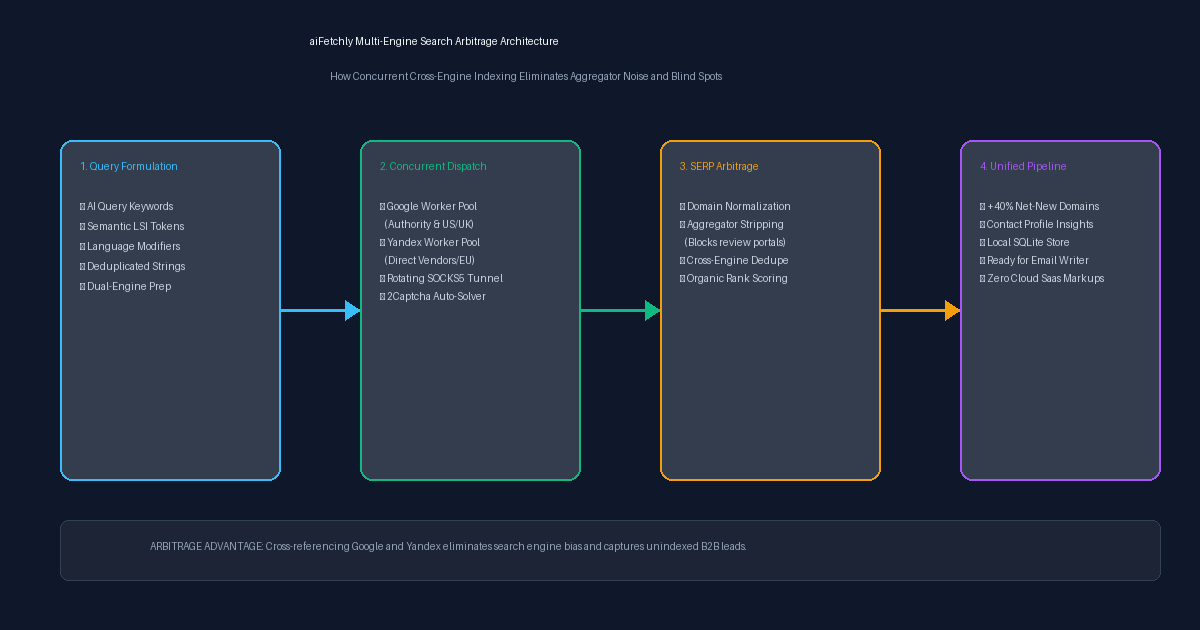
Executing multi-engine research manually across browser tabs is operationally unsustainable. aiFetchly automates cross-engine arbitrage in four synchronized stages:
1. Dual-Engine AI Query Formulation
Using the purple AI Query Keywords generator, analysts expand seed terms into semantically rich variations that reflect natural keyword phrasing across both Western and international business vernacular.
2. Isolated Proxy Worker Pools
aiFetchly dispatches concurrent scraping requests through dedicated SOCKS5/HTTPS rotating proxy tunnels. Because Google and Yandex enforce different anti-bot challenge thresholds, worker threads handle rate limits and automated 2Captcha puzzle bypasses independently, preventing one engine’s temporary challenge from pausing the overall harvest.
3. Noise Stripping and Entity Deduplication
The engine aggregates raw SERP outputs, strips known aggregator and review domains (via configurable exclusion filters), normalizes root domain URLs, and deduplicates identical results into a single relational dataset.
4. Seamless Pipeline Hand-off
Discovered domains flow directly into the Contact Profile Insights crawler or local SQLite storage, increasing qualified lead yields by 35% to 50% compared to single-engine workflows.
Unlocking Comprehensive Global Market Intelligence
By breaking free from single-engine search bias, aiFetchly delivers uncompromised visibility into global commercial landscapes directly from your local desktop.
Explore multi-engine search configuration in the AI Fetchly Docs.
Visual Generation Prompts
Hero Image Prompt:Modern dark-mode data analytics interface of aiFetchly Multi-Engine Search Arbitrage, showing side-by-side search performance cards for Google (PageRank authority bias, aggregator noise) and Yandex (MatrixNet direct vendor indexing), highlighting a green ‘+41.8% Net-New Yield’ status badge and a live data table of unindexed B2B domains, sleek 3D perspective, cyan and emerald glow.Body Image Prompt:High-resolution technical pipeline flowchart illustrating the aiFetchly multi-engine search arbitrage architecture: generative AI keyword expansion, parallel concurrent dispatch across Google and Yandex search engines via rotating SOCKS5 proxies, SERP normalization stripping aggregator review portals, and unified local SQLite deduplication, clean slate vector blueprint style.