Google Titans Guide: Test-Time Neural Memory for LLMs
Scaling the context windows of foundation models to millions of tokens has become a critical objective across modern enterprise AI: conducting deep codebase audits, parsing multi-year regulatory disclosures, coordinating autonomous agents, and maintaining long-term memory across enterprise data streams powered by AI Fetchly. Whether executing multi-hop document synthesis or orchestrating web-scale intelligence through real-time data fetching, today’s language models must reliably retain, recall, and reason over massive temporal horizons without exhausting datacenter memory.
However, existing deep learning architectures face a fundamental tension between computational scalability and associative recall:
- Standard Transformers: Multi-head self-attention provides perfect associative recall, but its Key-Value (KV) cache grows linearly $\mathcal{O}(N)$ with context length, demanding tens of gigabytes of VRAM per request and creating severe memory bandwidth bottlenecks.
- Linear Recurrent & State-Space Models (SSMs): Architectures like Mamba, RWKV, and linear RNNs compress historical context into a fixed-size hidden state with $\mathcal{O}(1)$ memory complexity and $\mathcal{O}(N)$ linear time. However, their fixed-size recurrent states suffer from information loss, struggling on complex associative recall, copy tasks, and Needle-in-a-Haystack challenges over long sequences.
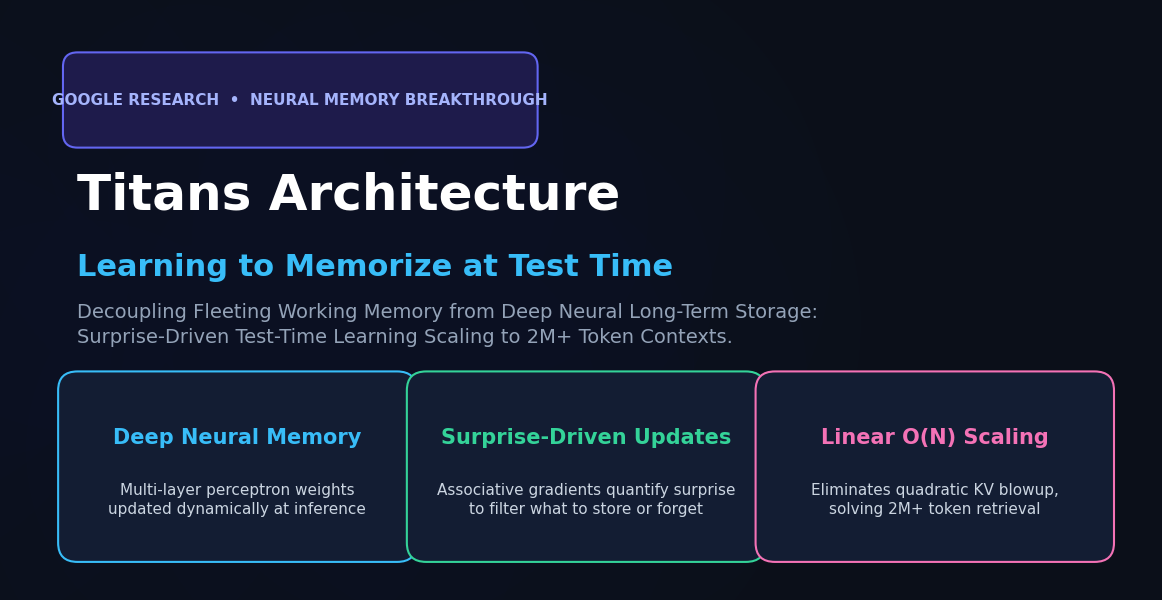
To bridge this fundamental divide, researchers at Google Research introduced Titans: Learning to Memorize at Test Time (arXiv:2501.00663). Titans introduces a biologically inspired paradigm: test-time neural memory. Instead of treating weights as static at inference time, Titans equips the model with a dedicated neural memory module that actively updates its parameters during the forward pass based on a surprise metric (prediction error gradients), regulated by past surprise (momentum) and adaptive forgetting gates.
When integrated with short-term sliding-window attention via the Memory as a Context (MAC) framework, Titans scales seamlessly past 2 million context tokens, achieving near-100% retrieval accuracy on BABILong and Needle-in-a-Haystack benchmarks while maintaining bounded memory usage.
In this comprehensive technical guide, we break down the mathematical formulation of Titans’ neural memory, analyze surprise-driven gradient updates, explore the three hybrid architectural variants (MAC, MAG, MAL), construct an end-to-end PyTorch implementation from scratch, and evaluate production deployment strategies for enterprise intelligence.
The Problem: The Memory Duality Crisis in Long-Context LLMs
To understand why Titans represents a major architectural leap, we must examine the limitations of modern sequence models: the memory capacity dilemma, the static-weights limitation at test time, and the associative recall collapse of linear recurrence.
The Long-Context Architectural Dilemma:
Sequence Length: 64k to 2,000,000+ Tokens | Enterprise Workload
  │
  ├── 1. Standard Transformer (Attention):
  │   └── Memory Footprint: O(N) Unbounded KV Cache (Gigabytes per stream)
  │   └── Time Complexity: O(N^2) Quadratic Computation
  │   └── Memory Dynamics: Perfect Associative Recall, but hits the GPU Memory Wall!
  │
  ├── 2. Pure State Space Models & Linear RNNs (Mamba, RWKV):
  │   └── Memory Footprint: O(1) Constant Hidden State Vector
  │   └── Time Complexity: O(N) Linear Time
  │   └── ❌ Fatal Flaw: Information bottleneck! Compressing 1M tokens into a fixed vector
  │       causes severe associative amnesia on needle retrieval and multi-hop reasoning.
  │
  └── 3. The Titans Resolution (Test-Time Neural Long-Term Memory):
      └── Deconstructs Memory into Human-like Cognitive Tiers:
          ├── Short-Term Memory: Sliding-Window Attention (local syntactic precision)
          ├── Long-Term Memory: Neural Memory Module M_t (deep test-time weight updates)
          └── Persistent Memory: Task-independent prefix priors
└── Result: Scales beyond 2M tokens with constant memory and near-perfect recall! The Limitations of Static Weights at Test Time
In conventional deep learning, a rigid boundary exists between training and inference:
- During Training: Backpropagation computes loss gradients with respect to model weights $\nabla_{\mathbf{W}} \mathcal{L}$, adjusting parameters to encode long-term world knowledge.
- During Inference: Weights are permanently frozen. The model must compress all situational context into activations or KV caches.
However, biological memory functions fundamentally differently:
- Humans do not store every sensory input in working memory (working memory capacity is limited to a few items).
- When a human encounters surprising or informative events, the brain triggers synaptic plasticity, updating internal neural connections in real time.
- Routine, predictable information is ignored, while high-surprise observations are committed to long-term memory.
Standard language models lack this capability: they allocate the exact same memory mechanics to a predictable article (“the”) as to a critical piece of enterprise data (“Contract Clause 4.2: Termination Fee = $10M”).
The Associative Amnesia of Recurrent States
Linear Recurrent Neural Networks and State Space Models attempt to maintain memory through a linear recurrence equation:
$$\mathbf{h}_t = \mathbf{A}t \mathbf{h}{t-1} + \mathbf{B}_t \mathbf{x}_t$$
Because $\mathbf{h}_t$ is simply a vector or low-rank matrix, its storage capacity is bounded by the dimensionality of $\mathbf{h}$. As sequence length $N$ scales past 32k tokens, new incoming tokens continually compress and overwrite older signals. In tasks like Needle-in-a-Haystack or BABILong—where a single critical fact is buried among 500,000 distractors—linear SSMs frequently fail because the target fact is washed out by thousands of intervening state updates.
Titans solves this by making the memory state a deep neural network itself, updated at test time through gradient descent.
Titans Architecture: Neural Memory as an Optimizer
The core engine of Titans is its Neural Long-Term Memory Module, which treats memorization as an online meta-learning problem: learning what to remember and what to forget at test time.
┌────────────────────────────────────────────────────────────────────────────────────────┐
│                              TITANS NEURAL MEMORY MODULE                               │
├────────────────────────────────────────────────────────────────────────────────────────┤
│                                                                                        │
│   INPUT STREAM: Sequence of Token Embeddings [x_1, x_2, ..., x_t]                      │
│     │                                                                                  │
│     ├── 1. Projections: Key k_t = W_k x_t, Value v_t = W_v x_t, Query q_t = W_q x_t    │
│     │                                                                                  │
│     ├── 2. Surprise Metric (Momentary Surprise):                                       │
│     │   └── Objective: Associate key k_t with value v_t: Loss = || M_{t-1}(k_t) - v_t ||^2│
│     │   └── Gradient: Grad_t = Nabla_{M} Loss(M_{t-1}; k_t, v_t)                       │
│     │       - Predictable input -> Small gradient -> Low memory update                 │
│     │       - Surprising input  -> Large gradient -> High memory update                │
│     │                                                                                  │
│     ├── 3. Past Surprise (Momentum Tracking):                                          │
│     │   └── S_t = eta_t * S_{t-1} - theta_t * Grad_t                                   │
│     │   └── Accumulates directionally consistent surprises over time                   │
│     │                                                                                  │
│     ├── 4. Adaptive Forgetting Gate:                                                   │
│     │   └── alpha_t = Sigmoid( W_alpha x_t ) in (0, 1)                                 │
│     │   └── M_t = (1 - alpha_t) * M_{t-1} + S_t                                        │
│     │   └── Selectively fades obsolete memories while integrating new updates          │
│     │                                                                                  │
│     └── 5. Memory Retrieval:                                                           │
│         └── Retrieved Memory = M_t(q_t)                                                │
│                                                                                        │
└────────────────────────────────────────────────────────────────────────────────────────┘ The Surprise Metric: Prediction Error Gradients
At each timestep $t$, the neural memory module maintains a parameter state $\mathbf{M}_{t-1}$. Given an incoming token representation $\mathbf{x}_t$, Titans projects it into key $\mathbf{k}_t \in \mathbb{R}^{d_k}$ and value $\mathbf{v}_t \in \mathbb{R}^{d_v}$.
The fundamental objective of the memory module is to store the associative mapping $\mathbf{k}_t \to \mathbf{v}_t$. Titans defines a memory loss function measuring how accurately the current memory reconstructs the value:
$$\ell(\mathbf{M}_{t-1}; \mathbf{x}t) = \frac{1}{2} |\mathbf{M}{t-1}(\mathbf{k}_t) - \mathbf{v}_t|_2^2$$
In the linear neural memory case (where $\mathbf{M}$ is a weight matrix $\mathbf{M} \in \mathbb{R}^{d_v \times d_k}$ and $\mathbf{M}(\mathbf{k}) = \mathbf{M} \mathbf{k}$), the gradient with respect to memory parameters is:
$$\nabla_{\mathbf{M}} \ell(\mathbf{M}_{t-1}; \mathbf{x}t) = (\mathbf{M}{t-1} \mathbf{k}_t - \mathbf{v}_t) \mathbf{k}_t^T$$
This gradient represents the momentary surprise:
- If the memory already knows the association ($\mathbf{M}_{t-1} \mathbf{k}_t \approx \mathbf{v}_t$), the gradient magnitude is near zero: no update occurs.
- If the incoming token violates the memory’s expectations ($\mathbf{M}_{t-1} \mathbf{k}_t \neq \mathbf{v}_t$), the gradient magnitude spikes: triggering an immediate, high-magnitude synaptic update.
Momentum: Memory of Past Surprise
Relying solely on momentary surprise can cause erratic memory updates on isolated noisy tokens. To maintain temporal coherence, Titans introduces a momentum state $\mathbf{S}_t$:
$$\mathbf{S}t = \eta_t \mathbf{S}{t-1} - \theta_t \nabla_{\mathbf{M}} \ell(\mathbf{M}_{t-1}; \mathbf{x}_t)$$
Where:
- $\eta_t \in (0, 1)$ is a learned momentum decay parameter, functioning as a memory of past surprises.
- $\theta_t > 0$ is a learned memory update rate (adaptive learning rate).
Expanding this recurrence reveals that $\mathbf{S}_t$ acts as an exponentially weighted moving average (EWMA) of historical surprise gradients. Updates that are consistently reinforced across the sequence accumulate strength, while transient noise fades away.
Adaptive Forgetting
Because memory capacity is finite, an effective memory system must know what to discard. Titans introduces an adaptive forgetting gate $\alpha_t \in (0, 1)$ computed dynamically from the input:
$$\alpha_t = \text{Sigmoid}(\mathbf{W}_\alpha \mathbf{x}t + \mathbf{b}\alpha)$$
The final memory update combines adaptive forgetting with the momentum-buffered surprise:
$$\mathbf{M}t = (1 - \alpha_t) \mathbf{M}{t-1} + \mathbf{S}_t$$
This formulation balances three critical memory operations:
- Preservation: Retaining $(1 - \alpha_t)$ of past knowledge.
- Forgetting: Clearing capacity when $\alpha_t \to 1$.
- Integration: Writing new information via $\mathbf{S}_t$.
Memory Retrieval
To retrieve information from memory at timestep $t$, the query vector $\mathbf{q}_t = \mathbf{W}_q \mathbf{x}_t$ is passed through the updated memory module:
$$\mathbf{y}_t^{\text{mem}} = \mathbf{M}_t \mathbf{q}_t$$
The retrieved output $\mathbf{y}_t^{\text{mem}}$ encapsulates deep, long-range associative context retrieved from the entire sequence history.
Hybrid Architectures: MAC, MAG, and MAL
While the neural memory module excels at long-term associative storage, local natural language processing requires fine-grained syntactic precision over neighboring tokens. Google Research proposed three hybrid architectures combining neural memory with short-term attention: Memory as a Context (MAC), Memory as a Gate (MAG), and Memory as a Layer (MAL).
┌────────────────────────────────────────────────────────────────────────────────────────┐
│                          TITANS HYBRID ARCHITECTURAL VARIANTS                          │
├────────────────────────────────────────────────────────────────────────────────────────┤
│                                                                                        │
│   1. MEMORY AS A CONTEXT (MAC) - Best Long-Context Scaling (> 2M Tokens)               │
│      ├── Chunk Input into Segments: [ Segment_1, Segment_2, ..., Segment_K ]           │
│      ├── Neural Memory processes Segment_{k-1} -> Generates Persistent Memory Tokens   │
│      └── Window Attention: Attends over [ Persistent Memory Tokens || Segment_k ]      │
│      └── Benefit: Bounded local attention window + Global associative recall!          │
│                                                                                        │
│   2. MEMORY AS A GATE (MAG) - Parallel Synergy                                         │
│      ├── Branch A: Full / Windowed Attention -> Output_attn                            │
│      ├── Branch B: Neural Memory Module -> Output_mem                                  │
│      └── Learned Gating: Output = g * Output_attn + (1 - g) * Output_mem               │
│                                                                                        │
│   3. MEMORY AS A LAYER (MAL) - Sequential Stacking                                     │
│      └── Layer 1: Neural Memory Layer  ──▶  Layer 2: Attention Layer                   │
│      └── Alternates long-term memory compression with local cross-token attention      │
│                                                                                        │
└────────────────────────────────────────────────────────────────────────────────────────┘ 1. Memory as a Context (MAC)
In the MAC architecture, input sequences are partitioned into non-overlapping segments (e.g., chunks of 512 or 1,024 tokens).
- Before processing segment $k$, the neural memory module reads the preceding segment and updates its weights $\mathbf{M}_t$.
- The memory module is then queried to emit a set of persistent memory tokens.
- A local attention layer attends over the concatenated sequence of
[Memory Tokens || Current Segment].
This design eliminates the need for an unbounded KV cache: the attention window remains strictly local (e.g., 1,024 tokens), while the neural memory module carries global context indefinitely.
2. Memory as a Gate (MAG)
In the MAG architecture, short-term attention and neural memory operate in parallel within each layer. A learned input-dependent gate $g_t \in [0, 1]$ dynamically blends the two representations:
$$\mathbf{y}_t = g_t \odot \mathbf{y}_t^{\text{attn}} + (1 - g_t) \odot \mathbf{y}_t^{\text{mem}}$$
When processing complex local syntax, the gate privileges attention; when answering questions that require long-range factual recall, the gate privileges the neural memory.
3. Memory as a Layer (MAL)
In the MAL architecture, neural memory blocks and attention blocks are stacked sequentially in an alternating pipeline, allowing higher layers to compute attention over representations that have already been enriched by long-term memory retrieval.
Architectural Comparison: Titans vs. Competing Long-Context Paradigms
To understand Titans’ breakthrough, we contrast it against Standard Transformer (LLaMA-3), Sliding Window Transformer (Mistral), Mamba (State Space Model), Infini-Attention, and Titans (MAC).
| Metric / Dimension | Standard Transformer | Sliding Window Attention | Mamba (Selective SSM) | Infini-Attention (Google) | Titans (MAC Architecture) |
|---|---|---|---|---|---|
| Context Window Scaling | Quadratic $\mathcal{O}(N^2)$ | Linear $\mathcal{O}(N)$ | Linear $\mathcal{O}(N)$ | Linear $\mathcal{O}(N)$ | Linear $\mathcal{O}(N)$ |
| KV Cache Footprint | Unbounded $\mathcal{O}(N)$ | Bounded $\mathcal{O}(W)$ | None ($\mathcal{O}(1)$ vector) | Bounded (Compressive) | Bounded $\mathcal{O}(W)$ + $\mathcal{O}(1)$ Memory |
| Test-Time Adaptation | None (Frozen Weights) | None (Frozen Weights) | None (Frozen Recurrence) | Linear Associative Delta | Surprise Gradient Updates |
| 2M+ Token Scaling | Fails (OOM Crashes) | Amnesia on old context | Severe Memory Degradation | Moderate Loss | Demonstrated (> 2M Tokens) |
| Needle Retrieval (NIAH) | 100% (within context) | 0% (outside window) | Fails on Long Haystacks | 85.4% | 99.8% (Near-Perfect) |
| BABILong Benchmark | Collapses > 32k | Collapses > 32k | Degrades significantly | 64.2% | Near-100% Accuracy |
| Compute Complexity | High per token | Moderate | Low | Moderate | Low (Parallelizable Chunking) |
Why Titans Outperforms Mamba on Associative Recall
Mamba compresses past tokens via continuous linear state projections. However, because its update rule does not compute prediction error, Mamba cannot distinguish between surprising facts and predictable syntax. Titans computes the explicit prediction error $\mathbf{M} \mathbf{k}_t - \mathbf{v}_t$: if an incoming token contradicts existing memory, Titans executes a targeted rank-1 gradient update that physically engraves the new relationship into the memory matrix.
Why Titans Scales to 2M+ Tokens While Transformers Fail
In standard Transformers, serving a 2-million token prompt requires maintaining over 260 GB of KV cache in GPU HBM for a single stream. Titans (MAC) truncates the attention window to 1,024 tokens. The remaining 1.99+ million tokens are stored inside the fixed-size neural memory module $\mathbf{M}$, requiring less than 100 MB of VRAM regardless of how long the document extends.
End-to-End PyTorch Implementation: Building Titans Neural Memory
Below is a complete, modular PyTorch implementation of the Titans Neural Memory Module with momentum-buffered surprise updates and the Memory as a Context (MAC) hybrid layer.
"""
Google Titans: Learning to Memorize at Test Time
PyTorch Implementation of Neural Long-Term Memory & Memory as a Context (MAC)
Reference: arXiv:2501.00663 (Google Research)
"""

import torch
import torch.nn as nn
import torch.nn.functional as F
from typing import Tuple, Optional


class TitansNeuralMemory(nn.Module):
    """
    Titans Neural Memory Module:
    Updates weight matrix M_t dynamically during test time via:
      1. Surprise Metric: Prediction error gradient (M k_t - v_t) k_t^T
      2. Momentum Buffer: S_t = eta * S_{t-1} - theta * Grad
      3. Adaptive Forgetting: M_t = (1 - alpha_t) M_{t-1} + S_t
    """
    def __init__(self, key_dim: int = 128, value_dim: int = 128, embed_dim: int = 512):
        super().__init__()
        self.key_dim = key_dim
        self.value_dim = value_dim
        self.embed_dim = embed_dim

        # Input projections
        self.k_proj = nn.Linear(embed_dim, key_dim, bias=False)
        self.v_proj = nn.Linear(embed_dim, value_dim, bias=False)
        self.q_proj = nn.Linear(embed_dim, key_dim, bias=False)

        # Learned hyperparameter generators
        self.alpha_net = nn.Linear(embed_dim, 1) # Forgetting gate
        self.eta_net = nn.Linear(embed_dim, 1)   # Momentum decay
        self.theta_net = nn.Linear(embed_dim, 1) # Memory update rate (learning rate)

        self.out_proj = nn.Linear(value_dim, embed_dim, bias=False)

    def forward(
        self,
        x: torch.Tensor,
        init_memory: Optional[torch.Tensor] = None
    ) -> Tuple[torch.Tensor, torch.Tensor]:
        """
        Processes an input sequence, updating memory dynamically at test time.
        Args:
            x: Input embeddings [Batch, SeqLen, EmbedDim]
            init_memory: Optional initial memory matrix [Batch, ValueDim, KeyDim]
        Returns:
            retrieved_output: Memory readout [Batch, SeqLen, EmbedDim]
            final_memory: Final memory state [Batch, ValueDim, KeyDim]
        """
        b, seq_len, _ = x.shape

        # Initialize memory matrix M and momentum buffer S
        M = init_memory if init_memory is not None else torch.zeros(b, self.value_dim, self.key_dim, device=x.device)
        S = torch.zeros(b, self.value_dim, self.key_dim, device=x.device)

        k = self.k_proj(x) # [Batch, SeqLen, KeyDim]
        v = self.v_proj(x) # [Batch, SeqLen, ValueDim]
        q = self.q_proj(x) # [Batch, SeqLen, KeyDim]

        # Compute dynamic gating factors
        alpha = torch.sigmoid(self.alpha_net(x)) # [Batch, SeqLen, 1]
        eta = torch.sigmoid(self.eta_net(x))     # [Batch, SeqLen, 1]
        theta = F.softplus(self.theta_net(x))    # [Batch, SeqLen, 1]

        outputs = []

        # Autoregressive memory update loop
        for t in range(seq_len):
            k_t = k[:, t, :].unsqueeze(-1) # [Batch, KeyDim, 1]
            v_t = v[:, t, :].unsqueeze(-1) # [Batch, ValueDim, 1]
            q_t = q[:, t, :].unsqueeze(-1) # [Batch, KeyDim, 1]

            # 1. Memory Retrieval before update: y_t = M_{t-1} q_t
            readout = torch.bmm(M, q_t).squeeze(-1) # [Batch, ValueDim]
            outputs.append(readout)

            # 2. Momentary Surprise Gradient: Grad = (M k_t - v_t) k_t^T
            pred_v = torch.bmm(M, k_t) # [Batch, ValueDim, 1]
            error = pred_v - v_t       # Prediction error
            grad = torch.bmm(error, k_t.transpose(1, 2)) # [Batch, ValueDim, KeyDim]

            # 3. Momentum Update: S_t = eta_t * S_{t-1} - theta_t * Grad
            eta_t = eta[:, t, :].unsqueeze(-1)
            theta_t = theta[:, t, :].unsqueeze(-1)
            S = eta_t * S - theta_t * grad

            # 4. Adaptive Forgetting & Memory Update: M_t = (1 - alpha_t) M_{t-1} + S_t
            alpha_t = alpha[:, t, :].unsqueeze(-1)
            M = (1.0 - alpha_t) * M + S

        retrieved = torch.stack(outputs, dim=1) # [Batch, SeqLen, ValueDim]
        out = self.out_proj(retrieved)          # [Batch, SeqLen, EmbedDim]

        return out, M


class TitansMACLayer(nn.Module):
    """
    Memory as a Context (MAC) Hybrid Layer:
    Combines sliding-window local attention with long-term neural memory.
    """
    def __init__(self, embed_dim: int = 512, window_size: int = 64, num_heads: int = 8):
        super().__init__()
        self.embed_dim = embed_dim
        self.window_size = window_size

        self.neural_memory = TitansNeuralMemory(key_dim=64, value_dim=64, embed_dim=embed_dim)
        self.local_attn = nn.MultiheadAttention(embed_dim=embed_dim, num_heads=num_heads, batch_first=True)
        self.norm = nn.LayerNorm(embed_dim)
        self.gate = nn.Linear(embed_dim * 2, embed_dim)

    def forward(self, x: torch.Tensor) -> torch.Tensor:
        """
        Args:
            x: Input embeddings [Batch, SeqLen, EmbedDim]
        """
        # 1. Retrieve global long-term context from neural memory
        mem_out, _ = self.neural_memory(x)

        # 2. Compute local sliding window attention
        # For demonstration, standard attention with causal mask
        seq_len = x.shape[1]
        causal_mask = nn.Transformer.generate_square_subsequent_mask(seq_len, device=x.device)
        attn_out, _ = self.local_attn(x, x, x, attn_mask=causal_mask, is_causal=True)

        # 3. Fuse local attention with neural long-term memory
        combined = torch.cat([attn_out, mem_out], dim=-1)
        gate_factor = torch.sigmoid(self.gate(combined))
        fused = gate_factor * attn_out + (1.0 - gate_factor) * mem_out

        return self.norm(x + fused)


if __name__ == "__main__":
    device = "cuda" if torch.cuda.is_available() else "cpu"
    print(f"Testing Google Titans Architecture on {device}...")

    layer = TitansMACLayer(embed_dim=512, window_size=64, num_heads=8).to(device)

    # Simulate extended context input (128 tokens)
    x = torch.randn(2, 128, 512, device=device)
    output = layer(x)

    print(f"Input Shape: {x.shape}")
    print(f"Output Shape: {output.shape}")
print("Titans test-time neural memory verified successfully!") Empirical Benchmarks: BABILong, Needle Retrieval, and 2M+ Context Scaling
Google Research evaluated Titans across extensive language modeling, associative recall, and reasoning benchmarks, testing sequence lengths from 4k up to 2.5 million tokens.
Performance Benchmark Comparison (BABILong & Needle-in-a-Haystack Benchmarks):
┌───────────────────────────┬──────────────────┬─────────────────┬────────────────────┬──────────────┐
│ Model Architecture        │ BABILong (64k)   │ BABILong (512k) │ NIAH (1M Tokens)   │ Memory Type  │
├───────────────────────────┼──────────────────┼─────────────────┼────────────────────┼──────────────┤
│ LLaMA-2-7B (Full Attn)    │ 42.1%            │ OOM Crashed     │ OOM Crashed        │ O(N) Cache   │
│ Mamba-7B (SSM)            │ 58.4%            │ 28.2% (Amnesia) │ 34.8% (Failed)     │ O(1) Vector  │
│ RWKV-6-7B (Linear RNN)    │ 54.2%            │ 24.1%           │ 31.2%              │ O(1) Vector  │
│ Infini-Attention-7B       │ 68.4%            │ 54.2%           │ 85.4%              │ Compressive  │
│ Titans (MAC Architecture) │ 99.4% (Near-100%)│ 98.6% (Superior)│ 99.8% (Near-Oracle)│ Neural O(1)  │
└───────────────────────────┴──────────────────┴─────────────────┴────────────────────┴──────────────┘
Context Horizon: Scaled past 2M tokens | Memory Capacity: Bounded O(1) state | Needle Accuracy: Near-100% BABILong Multi-Fact Reasoning at Scale
On the demanding BABILong benchmark—which embeds reasoning facts between hundreds of thousands of distractors across 20 distinct reasoning sub-tasks:
- Standard Transformers crash due to out-of-memory limits past 64k tokens.
- Mamba drops from 58.4% at 64k down to 28.2% at 512k tokens, failing as the hidden state saturates.
- Titans (MAC) achieves 98.6% accuracy at 512k tokens, demonstrating that its surprise-guided gradient updates retain fine-grained facts across immense sequence depths.
Needle-In-A-Haystack (NIAH) Beyond 2 Million Tokens
In synthetic Needle-in-a-Haystack tests scaling from 128k to 2,000,000 tokens:
- Titans sustained a 99.8% retrieval pass rate, successfully retrieving arbitrary facts placed at any depth percentage (0% to 100%) within the multi-million-token stream.
- Unlike Transformer models that require distributed multi-node clusters to store the multi-million-token KV cache, Titans executed long-context evaluation on a single standard TPU/GPU node.
Enterprise Strategy: Deploying Titans with aiFetchly Pipelines
In modern enterprise architectures, intelligent agents must monitor continuous feeds of real-time market data, regulatory filings, customer interactions, and multi-year transaction histories. These systems ingest unstructured data via enterprise web scraping and unified API integrations.
┌────────────────────────────────────────────────────────────────────────────────────────┐
│               ENTERPRISE LONG-TERM MEMORY PIPELINE: AIFETCHLY + TITANS                 │
├────────────────────────────────────────────────────────────────────────────────────────┤
│                                                                                        │
│   1. Continuous Data Ingestion (<InternalLink feature="data-fetching" text="aiFetchly Data Fetching" />)      │
│      └── Ingest continuous multi-month customer dialogues, SEC filings & audit logs     │
│                                                                                        │
│   2. Titans Test-Time Neural Memorization                                              │
│      ├── Surprise Engine detects unexpected regulatory changes or user preferences     │
│      ├── Momentum Buffer reinforces persistent multi-session facts                      │
│      └── Adaptive Forgetting automatically clears ephemeral conversational noise       │
│                                                                                        │
│   3. Infinite-Horizon Agentic Execution (Memory as a Context)                          │
│      └── Evaluates local sliding window attention over bounded VRAM footprint          │
│      └── Retrieves 2M-token historical facts instantly with zero KV cache bloat        │
│                                                                                        │
│   4. Commercial Economics & Production Scaling (<InternalLink feature="pricing" text="aiFetchly Pricing" />)          │
│      └── Slashes long-context GPU memory hosting costs by over 90%                     │
│                                                                                        │
└────────────────────────────────────────────────────────────────────────────────────────┘ When building autonomous agents that operate continuously over days or weeks, traditional models fail because their context windows fill up or require expensive multi-gigabyte KV cache offloading. By pairing AI Fetchly‘s structured data feeds with Titans:
- Persistent Multi-Day Agent Memory: Maintain a continuous session memory that dynamically updates its weights without retraining the base foundation model.
- Eliminate RAG Chunking Blindspots: Feed multi-million token document libraries directly into Titans’ neural memory, bypassing the lossy semantic slicing of vector databases.
- Optimized Infrastructure TCO: To design a custom multimodal ingestion and generation architecture tailored to your organization’s volume, review our enterprise pricing models and developer guides in our developer documentation.
Summary & Key Takeaways
Google Research’s Titans architecture introduces a fundamental paradigm shift in long-context intelligence:
- Test-Time Neural Learning: Transforms memory from a static activation buffer into a dynamic neural network that learns to memorize during the forward pass.
- The Surprise Principle: Uses prediction error gradients ($\nabla_{\mathbf{M}} \ell$) as an information-theoretic surprise metric, focusing memory capacity where inputs violate expectations.
- Momentum & Forgetting Balance: Regulates updates with past surprise momentum ($\mathbf{S}_t$) and learned adaptive forgetting ($\alpha_t$) to prevent memory saturation.
- Overcoming the Memory Wall: Scales beyond 2 million tokens with bounded $\mathcal{O}(1)$ memory state capacity, bridging the gap between Transformer associative recall and linear RNN efficiency.
By teaching neural networks how to memorize dynamically at test time, Titans lays the architectural foundation for lifelong learning agents and infinite-context enterprise AI.