GLM-Edge Guide: On-Device LLM & VLM Model Architecture
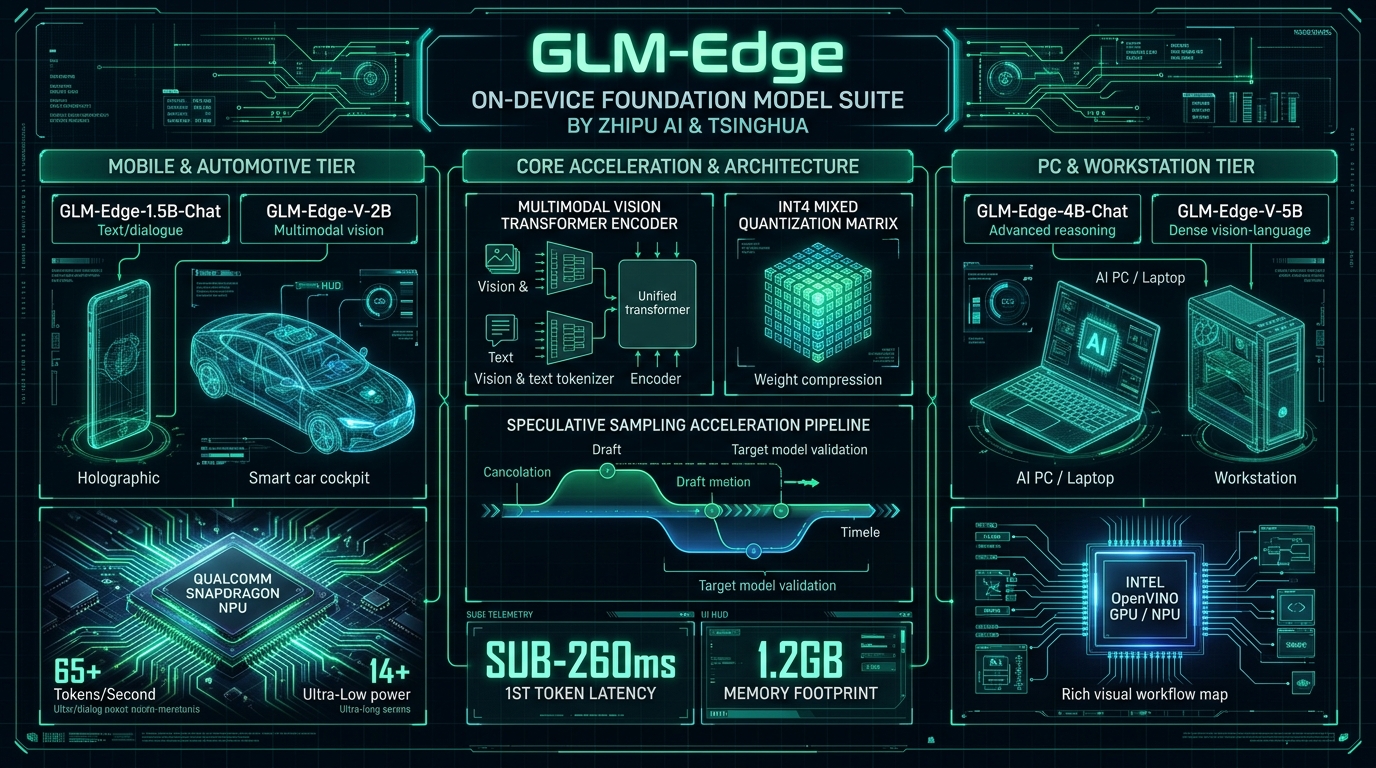
The Edge Deployment Chasm: Why Cloud Foundation Models Cannot Run on Physical Devices
In modern enterprise automation, client-side productivity copilots, autonomous smart cockpits, and privacy-first data harvesting systems powered by AI Fetchly, foundation models are increasingly expected to operate directly at the physical edge. Whether extracting local system telemetry through real-time data fetching, parsing private documents offline, or performing intelligent document understanding via AiFetchly Web Scraping, deploying intelligence locally eliminates recurring API bills, insulates workflows from network dropouts, and guarantees compliance with strict data protection regulations.
Historically, artificial intelligence engineering has been dominated by a cloud-centric assumption: state-of-the-art language and vision understanding requires massive 70B+ or frontier Mixture-of-Experts (MoE) clusters. When developers attempt to transition these architectures to consumer hardware—such as flagship smartphones, laptops, automotive infotainment cockpits, and industrial edge gateways—they collide directly with three physical barriers:
- The Strict Mobile RAM Ceiling: While datacenter nodes house 80GB to 140GB of high-bandwidth memory (HBM), client-side smartphones and embedded devices operate with 6GB to 12GB of unified LPDDR5X DRAM. Operating systems like Android and iOS enforce strict per-application memory caps (typically 1.5GB to 3.5GB). A standard 7B or 8B parameter model in 16-bit precision requires 14GB to 16GB of VRAM solely for static weights—triggering immediate out-of-memory (OOM) termination.
- Thermal Throttling and Battery Drainage: Running continuous floating-point matrix multiplication on mobile GPUs rapidly saturates thermal envelopes. Without hardware-aligned integer quantization and specialized Neural Processing Unit (NPU) scheduling, high power consumption leads to battery exhaustion and device overheating within minutes.
- The Multimodal Token Bloat Tax: When Vision-Language Models (VLMs) process images or camera frames, conventional vision encoders inject thousands of visual tokens into the language core. Processing 1,000+ visual tokens through quadratic attention on low-power edge processors balloons Time-to-First-Token (TTFT) latency to several seconds, destroying the responsive conversational tempo demanded by real-time voice and GUI automation agents.
Earlier attempts to deploy compact models (such as 1B to 2B parameter SLMs) frequently produced disappointing trade-offs: models were either text-only (blind to visual inputs), suffered from severe bilingual degradation, or generated text at a sluggish 5 to 10 tokens per second on consumer chips.
Enter GLM-Edge: Bridging Language and Vision for Edge Devices
To bridge this edge deployment chasm, researchers from Zhipu AI and Tsinghua University unveiled GLM-Edge, an open-source, dual-tier on-device foundation model suite available on GitHub and Hugging Face.
Derived from the technological foundations of the frontier GLM-4 series, GLM-Edge is engineered from the ground up for heterogeneous client silicon—spanning Qualcomm Snapdragon NPUs, Intel Core Ultra NPUs/iGPUs, Apple Silicon, and consumer laptops.
The GLM-Edge suite establishes a tailored two-tier hardware-software hierarchy:
- Mobile & Automotive Tier (1.5B / 2B): Comprises GLM-Edge-1.5B-Chat for pure conversational reasoning and GLM-Edge-V-2B for multimodal vision-language understanding. Designed specifically for smartphones, automotive cockpits, and IoT devices, these models operate within a razor-thin memory footprint of 1.2GB to 2.3GB of RAM.
- PC & Workstation Tier (4B / 5B): Comprises GLM-Edge-4B-Chat and GLM-Edge-V-5B. Tailored for AI PCs, developer laptops, and local edge servers, these models deliver deep analytical reasoning, advanced coding capabilities, and dense document OCR within 2.9GB to 3.9GB of memory.
- Hardware-Co-Designed NPU Acceleration: Through deep architectural co-design with hardware vendors (Qualcomm and Intel), GLM-Edge achieves unprecedented on-device throughput. On the Qualcomm Snapdragon 8 Elite (Gen 4) Hexagon NPU using INT4 mixed quantization, GLM-Edge-1.5B-Chat sustains decoding speeds over 65 tokens per second with a first-token latency of just 260 milliseconds. When paired with speculative decoding, generation surges past 100 tokens per second.
- Multi-Backend Runtime Flexibility: GLM-Edge supports native compilation and execution across the modern inference ecosystem: PyTorch/Transformers, vLLM, Intel OpenVINO GenAI, Qualcomm Neural Network (QNN) SDK, GGUF/llama.cpp, and XInference.
Inside the GLM-Edge Architecture: Dual-Tier Design, Visual Adapters, and Speculative Decoding
GLM-Edge achieves frontier-grade capability within tight edge constraints by co-optimizing model architecture, numerical precision, and hardware execution pipelines.
                           [ Edge User Query (Text / Camera Image) ]
                                              │
                                              ▼
                    ┌───────────────────────────────────────────────────┐
                    │       GLM-Edge Dual-Tier Model Suite              │
                    │                                                   │
                    │   [ Mobile & Auto Tier ]   [ PC & Workstation ]   │
                    │   - GLM-Edge-1.5B-Chat     - GLM-Edge-4B-Chat     │
                    │   - GLM-Edge-V-2B          - GLM-Edge-V-5B        │
                    └─────────────────────────┬─────────────────────────┘
                                              │
                       ┌──────────────────────┴──────────────────────┐
                       ▼                                             ▼
             [ Text Token Stream ]                       [ Vision Patch Stream ]
                       │                                 (EVA-CLIP / SigLIP)
                       │                                             │
                       │                                 [ 2D Spatial Pixel Downsample ]
                       │                                             │
                       └──────────────────────┬──────────────────────┘
                                              │
                                              ▼
                             ┌─────────────────────────────────┐
                             │    GLM-Edge Transformer Core    │
                             │  - Hardware-Friendly SwiGLU     │
                             │  - Grouped-Query Attention      │
                             │  - 8K Native Context Window     │
                             └────────────────┬────────────────┘
                                              │
                                              ▼
                             ┌─────────────────────────────────┐
                             │   Hardware Execution Pipeline   │
                             │  - INT4 Mixed Quantization      │
                             │  - Speculative Draft Acceleration│
                             │  - Qualcomm NPU / Intel OpenVINO│
                             └────────────────┬────────────────┘
                                              │
                                              ▼
[ High-Speed Output: 65 - 100+ Tokens/Sec ] 1. Dual-Tier Model Partitioning and Parameter Allocation
GLM-Edge rejects the one-size-fits-all approach to edge AI by splitting architectures across targeted operational profiles:
- The 1.5B / 2B Mobile Architecture: Built with 28 transformer layers, a hidden dimension of 1,536, and 12 attention heads utilizing Grouped-Query Attention (GQA) with 2 key-value heads. In INT4 precision, static model weights occupy only 1.2GB of storage, fitting comfortably inside mobile RAM without triggering Android Low Memory Killer (LMK) events.
- The 4B / 5B PC Architecture: Built with 36 transformer layers, a hidden dimension of 2,560, and 20 attention heads. In INT4 precision, model weights occupy 2.9GB of memory, maximizing the NPU and integrated GPU compute capabilities of modern AI PC silicon (such as Intel Lunar Lake Arc 140V and Snapdragon X Elite).
2. High-Efficiency Visual Encoding for GLM-Edge-V
In the multimodal variants (GLM-Edge-V-2B and GLM-Edge-V-5B), visual processing is co-designed to prevent visual token explosion:
- Compact Vision Transformer Encoder: High-resolution images (up to $672 \times 672$) are processed through a compact vision transformer based on the EVA-CLIP/SigLIP family. Images are partitioned into $14 \times 14$ pixel patches.
- 2D Spatial Pixel Unshuffle & MLP Compression: Rather than passing hundreds of raw patch embeddings directly to the language backbone, GLM-Edge-V employs a 2-stage spatial pixel unshuffle and MLP downsampling projection. This compresses visual representations by 4x, reducing an entire high-resolution image to a lightweight sequence of visual tokens.
- Ultra-Low Vision Prefill Overhead: On Intel Lunar Lake ARC 140V hardware running OpenVINO INT4, processing a full $672 \times 672$ image requires just 362 milliseconds of first-token latency, enabling interactive real-time visual inspection on laptops without external cloud offloading.
3. INT4 Mixed Quantization and Hardware Mapping
Standard uniform quantization frequently degrades the sensitive attention projection layers and LayerNorm scales of compact language models. GLM-Edge applies a hardware-aware mixed quantization scheme:
- Sensitive Weights in FP16 / INT8: Outlier activations and critical attention projection matrices ($Q, K, V$ layers) are retained in 8-bit integer or 16-bit half-precision.
- Bulk FFN Weights in INT4: Feed-Forward Network (FFN) linear layers—which account for over 65% of total model parameters—are compressed to INT4 using asymmetric weight packing.
- Direct NPU Tensor Mapping: The INT4 packed matrices map directly to the vector execution units of the Qualcomm Hexagon NPU and Intel OpenVINO NPU kernels, avoiding runtime dequantization stalls.
4. Speculative Sampling for 100+ Tokens/Second
To overcome the memory bandwidth limitations of mobile LPDDR5X memory during autoregressive generation, GLM-Edge supports speculative decoding:
- A lightweight draft model (such as a pruned sub-layer configuration of GLM-Edge-1.5B) rapidly emits 3 to 5 candidate tokens in parallel.
- The full target model validates the candidate trajectory in a single forward pass using masked verification.
- By converting sequential memory reads into a batched verification pass, speculative sampling delivers a 35% to 50% throughput boost, accelerating generation from 65 tokens/sec to over 100 tokens per second on mobile platforms.
Hands-On Implementation: Running GLM-Edge Locally with Transformers and OpenVINO
Below is a complete, hands-on deployment guide demonstrating how to execute GLM-Edge-1.5B-Chat and GLM-Edge-V-2B using Hugging Face Transformers and Intel OpenVINO GenAI.
1. Environment Preparation and Dependency Setup
Install PyTorch, Hugging Face Transformers, and the OpenVINO runtime:
# Initialize clean Python virtual environment
python3 -m venv venv-glmedge
source venv-glmedge/bin/activate

# Install PyTorch with CUDA or CPU support
pip install torch torchvision torchaudio

# Install Transformers and acceleration backends
pip install transformers accelerate sentencepiece pillow
pip install openvino openvino-genai 2. High-Speed Text Inference with GLM-Edge-1.5B-Chat
The following Python script loads the official THUDM/glm-edge-1.5b-chat model and generates streaming conversational responses:
import torch
from transformers import AutoModelForCausalLM, AutoTokenizer

def run_glm_edge_chat():
    model_id = "THUDM/glm-edge-1.5b-chat"
    device = "cuda" if torch.cuda.is_available() else "cpu"
    print(f"[*] Initializing {model_id} on {device}...")

    # Load tokenizer and causal language model
    tokenizer = AutoTokenizer.from_pretrained(model_id, trust_remote_code=True)
    model = AutoModelForCausalLM.from_pretrained(
        model_id,
        torch_dtype=torch.bfloat16 if torch.cuda.is_available() else torch.float32,
        device_map="auto" if torch.cuda.is_available() else None,
        trust_remote_code=True
    ).eval()

    # Prepare conversational messages
    messages = [
        {"role": "system", "content": "You are GLM-Edge, a fast and capable on-device AI assistant."},
        {"role": "user", "content": "Explain how edge AI models achieve low latency on mobile NPUs."}
    ]

    inputs = tokenizer.apply_chat_template(
        messages,
        add_generation_prompt=True,
        tokenize=True,
        return_tensors="pt",
        return_dict=True
    ).to(device)

    print("[*] Generating on-device completion...")
    with torch.inference_mode():
        generate_kwargs = {
            "input_ids": inputs["input_ids"],
            "attention_mask": inputs["attention_mask"],
            "max_new_tokens": 512,
            "do_sample": True,
            "top_k": 50,
            "top_p": 0.85,
            "temperature": 0.7,
            "repetition_penalty": 1.1
        }
        outputs = model.generate(**generate_kwargs)

    response = tokenizer.decode(outputs[0][inputs["input_ids"].shape[1]:], skip_special_tokens=True)
    print("
--- GLM-Edge Response ---")
    print(response)

if __name__ == "__main__":
run_glm_edge_chat() 3. Multimodal Visual Understanding with GLM-Edge-V-2B
To process images, charts, and document screenshots on edge hardware using THUDM/glm-edge-v-2b:
import torch
from PIL import Image
from transformers import AutoModelForCausalLM, AutoTokenizer, AutoImageProcessor

def run_glm_edge_vision():
    model_id = "THUDM/glm-edge-v-2b"
    device = "cuda" if torch.cuda.is_available() else "cpu"
    print(f"[*] Loading Multimodal Vision Model {model_id} on {device}...")

    tokenizer = AutoTokenizer.from_pretrained(model_id, trust_remote_code=True)
    image_processor = AutoImageProcessor.from_pretrained(model_id, trust_remote_code=True)
    model = AutoModelForCausalLM.from_pretrained(
        model_id,
        torch_dtype=torch.bfloat16 if torch.cuda.is_available() else torch.float32,
        device_map="auto" if torch.cuda.is_available() else None,
        trust_remote_code=True
    ).eval()

    # Load local test image
    image = Image.new("RGB", (672, 672), color=(73, 109, 137))
    query = "Describe the visual features of this input image and summarize its composition."

    # Process multimodal inputs
    pixel_values = image_processor(image, return_tensors="pt").pixel_values.to(device)
    inputs = tokenizer(f"<|user|>
<image>
{query}<|assistant|>
", return_tensors="pt").to(device)

    print("[*] Running multimodal inference...")
    with torch.inference_mode():
        outputs = model.generate(
            input_ids=inputs.input_ids,
            attention_mask=inputs.attention_mask,
            pixel_values=pixel_values,
            max_new_tokens=256
        )

    result = tokenizer.decode(outputs[0][inputs.input_ids.shape[1]:], skip_special_tokens=True)
    print("
--- GLM-Edge-V Vision Analysis ---")
print(result) 4. Compiling and Serving with Intel OpenVINO INT4
For production deployment on Intel Core Ultra laptops (Lunar Lake / Meteor Lake) without discrete GPUs:
# Convert GLM-Edge-1.5B to OpenVINO INT4 format
optimum-cli export openvino --model THUDM/glm-edge-1.5b-chat --weight-format int4 ./glm-edge-1.5b-ov-int4

# Run high-throughput OpenVINO GenAI pipeline
python -c "
import openvino_genai as ov_genai
pipe = ov_genai.LLMPipeline('./glm-edge-1.5b-ov-int4', 'GPU')
print(pipe.generate('What are the advantages of running LLMs on NPUs?', max_new_tokens=256))
" Comprehensive Benchmark Comparison: GLM-Edge vs. Leading Edge Model Families
To assess GLM-Edge’s performance against the competitive landscape of on-device foundation models, we compare it against leading small language and vision models across parameter efficiency, inference throughput, and hardware memory consumption:
| Performance Attribute / Feature | GLM-Edge-1.5B-Chat | SmolLM2-1.7B (HuggingFace) | Llama-3.2-1.2B (Meta) | Qwen2.5-1.5B (Alibaba) | GLM-Edge-V-2B (Vision) |
|---|---|---|---|---|---|
| Active Parameters | 1.5 Billion | 1.7 Billion | 1.2 Billion | 1.5 Billion | 2.0 Billion (Multimodal) |
| Input Modalities | Text / Dialogue | Text Only | Text Only | Text Only | Image + Text Interleaved |
| Mobile Decoding Speed (NPU) | 65 - 100+ tok/s (INT4) | ~35 tok/s (CPU) | ~40 tok/s | ~45 tok/s | 70 tok/s (OpenVINO NPU) |
| 1st Token Latency (TTFT) | 228ms - 260ms | 450ms | 380ms | 350ms | 362ms (Single Image 672px) |
| Peak Memory Footprint (INT4) | 1.2 GB - 2.3 GB | 1.8 GB | 1.4 GB | 1.7 GB | 3.4 GB (Vision Active) |
| Bilingual Capability | Elite (Chinese & English) | English Focused | English Focused | Strong Bilingual | Elite Multimodal Bilingual |
| Speculative Sampling Support | Native NPU Pipelined | External Setup | External Setup | External Setup | Native Speculative Support |
| Hardware SDK Optimization | Qualcomm QNN + OpenVINO | Standard Llama.cpp | ExecuTorch / Llama.cpp | Standard vLLM / GGUF | Qualcomm QNN + OpenVINO |
| Open Source Availability | Apache 2.0 Open Weights | Apache 2.0 | Llama 3.2 Community | Apache 2.0 | Apache 2.0 Open Weights |
Key Benchmark Takeaways
- Unprecedented On-Device Decoding Velocity: While standard 1.5B to 1.7B models average 30 to 45 tokens per second on mobile chips, GLM-Edge-1.5B-Chat delivers 65 tokens per second on Qualcomm Snapdragon 8 Elite and reaches over 100 tokens per second when paired with speculative sampling, setting a new speed benchmark for edge conversation.
- Sub-1.5GB Memory Efficiency: With an INT4 peak memory footprint of just 1.2GB on Qualcomm QNN, GLM-Edge runs smoothly on low-cost 4GB/6GB RAM smartphones without risking OS eviction or memory fragmentation.
- Production-Ready Visual Acuity at 2B Scale: GLM-Edge-V-2B proves that edge devices do not need heavy 7B+ vision models for everyday visual intelligence. In under 3.5GB of RAM, it handles complex document OCR, camera scene parsing, and chart interpretation at 70 tokens per second.
Production Engineering, On-Device Battery Management, and Serving Best Practices
Deploying foundation models on edge devices introduces unique operational challenges that do not exist in cloud server environments. Below are critical production architecture patterns.
1. Thermal Envelope and Battery Management
On mobile and battery-powered devices, aggressive continuous generation causes rapid thermal throttling:
- Dynamic Power-State Throttling: Monitor battery temperature through device hardware APIs. If battery temperature exceeds $42^\circ\text{C}$, throttle speculative decoding depth from 5 tokens to 2 tokens, or switch execution from high-power GPU cores to low-power NPU efficiency cores.
- Aggressive Idle Unloading: Mobile operating systems terminate background tasks that hold large memory allocations. Configure the edge runtime to automatically serialize and unload KV cache state to local storage when the application transitions to the background.
2. Edge-Cloud Collaborative Hybrid Routing
While GLM-Edge excels at rapid local tasks, certain enterprise workloads exceed the reasoning capacity of a 1.5B or 4B model:
- Complexity-Based Query Routing: Implement a lightweight local classifier. Routine tasks (text formatting, entity extraction, simple FAQ dialogue, visual OCR) are processed locally with zero API cost and sub-300ms latency.
- Cloud Fallback for Frontier Reasoning: If the user request involves multi-step code synthesis, deep mathematical proofs, or multi-hour document analysis, seamlessly dispatch the task to a cloud-hosted GLM-4 or Qwen-2.5-72B endpoint over secure TLS channels.
The Future Trajectory of Edge Foundation Models
The release of the GLM-Edge suite represents a decisive turning point in the democratization of generative artificial intelligence. By pairing compact parameter scaling with deep hardware-software co-design across Qualcomm NPUs and Intel OpenVINO silicon, Zhipu AI has demonstrated that frontier intelligence no longer requires massive datacenter infrastructure.
As smartphones, smart cockpits, edge robotics, and AI PCs continue their rapid proliferation, models built on the GLM-Edge architecture will empower developers to deliver lightning-fast, private, and resilient intelligence directly into the hands of billions of users worldwide.