GLM-4-Voice Guide: End-to-End Speech-to-Speech AI
Conversational artificial intelligence is undergoing a fundamental paradigm shift from text-mediated interfaces to native, real-time voice interaction. For years, voice-enabled agents relied on a disjointed, three-stage cascaded pipeline: transcribing spoken audio to text using Automatic Speech Recognition (ASR), processing textual prompts through a Large Language Model (LLM), and converting text completions back into audio via Text-to-Speech (TTS) synthesis.
While cascaded systems powered early voice bots, they introduce severe architectural limitations: crippling latency stacking, loss of non-verbal paralinguistic cues (such as intonation, laughter, hesitations, and vocal emotion), and vulnerability to compounding pipeline errors. When an ASR system mishears a domain-specific term, the LLM hallucinates an answer, and the TTS engine recites the hallucination in a sterile, monotone cadence.
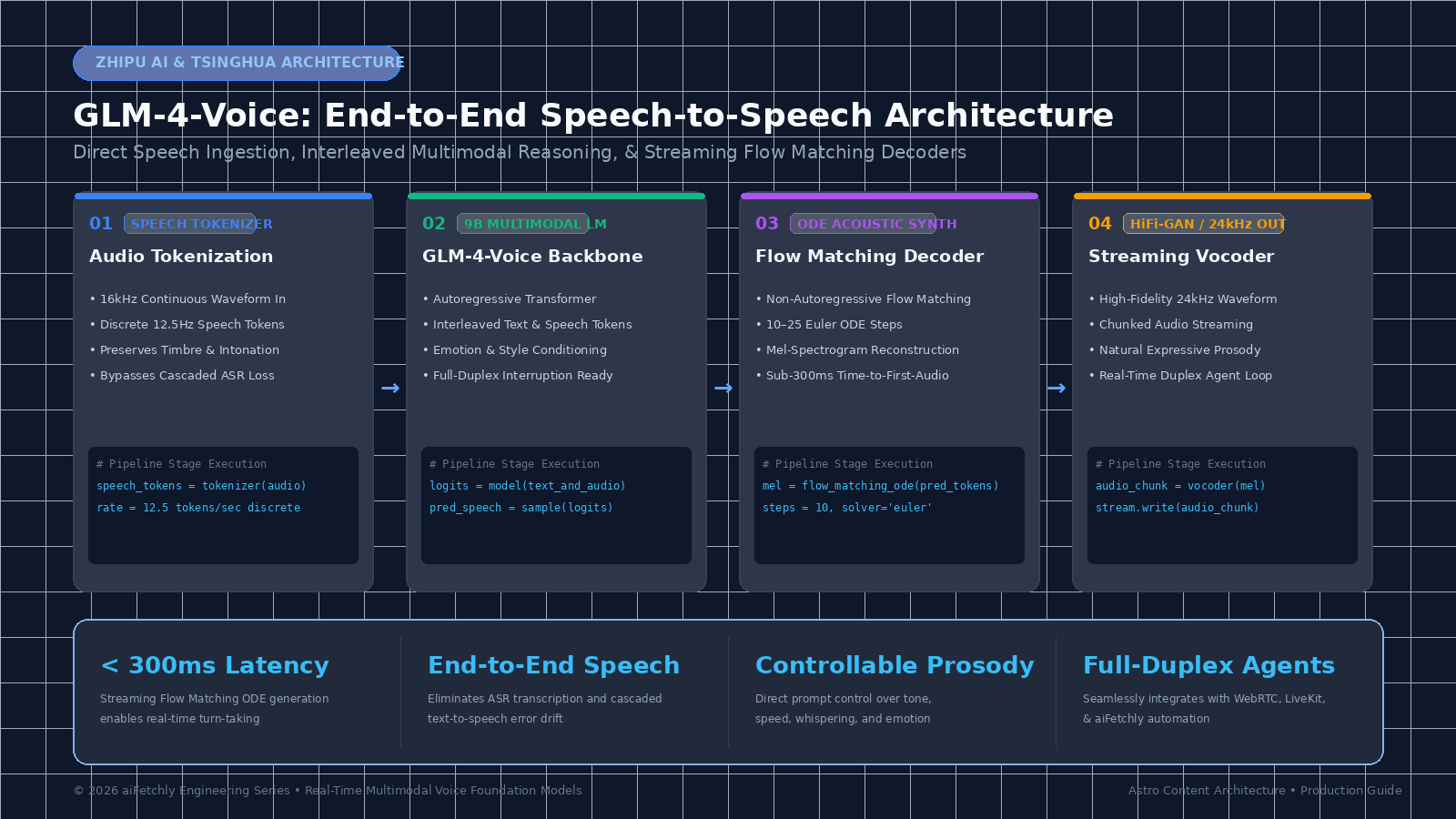
To establish genuine human-parity voice communication, researchers at Zhipu AI and Tsinghua University unveiled GLM-4-Voice (THUDM/GLM-4-Voice), an open-source, end-to-end speech-to-speech foundation model. Rather than converting speech to intermediate text strings, GLM-4-Voice directly tokenizes continuous audio into discrete acoustic representations, performs autoregressive cross-modal reasoning, and generates expressive spoken waveforms via a streaming Flow Matching acoustic decoder.
In this technical guide, we dissect the inner architecture of GLM-4-Voice, explore its discrete speech tokenization and Flow Matching diffusion pipeline, benchmark its latency against legacy cascaded voice systems, and construct an end-to-end Python implementation for deployable, low-latency voice agents.
The Latency and Expressiveness Bottleneck in Cascaded Voice AI
To understand the architectural necessity of end-to-end speech models, we must examine the compounding failure points inherent in conventional cascaded voice pipelines.
In modern automated agent systems—such as real-time customer support bots, automated telephone voice agents, or data aggregation copilots deployed with AiFetchly Web Scraping and AiFetchly API Integration—responsiveness is measured by turn-taking latency. In human conversation, natural turn transitions occur within 200 to 400 milliseconds. When conversational pauses exceed 800 milliseconds, users perceive the interaction as sluggish, mechanical, and disjointed.
Traditional Cascaded Voice Architecture (2.5s - 4.2s Latency):
+-----------------+      +-----------------+      +-----------------+
|   User Audio    | ---> |    ASR Engine   | ---> |  Text Transcript|
|  "Book a cab"   |      | (Whisper-Large) |      |   (Text Only)   |
+-----------------+      +-----------------+      +--------+--------+
                                                           |
                                                           v
+-----------------+      +-----------------+      +--------+--------+
| Synthesized Wave| <--- |    TTS Engine   | <--- |  LLM Text Reply |
| (Monotone Voice)|      | (ElevenLabs/TTS)|      |  (GPT-4/Claude) |
+-----------------+      +-----------------+      +-----------------+
  Accumulated Latency: ~1.2s ASR + ~1.5s LLM Prefill/TTFT + ~0.8s TTS Generation
Paralinguistic Data: Completely Stripped at ASR Stage! 1. Cumulative Latency Stacking
In a cascaded pipeline, each independent component enforces a hard serialization barrier:
- ASR Buffering and Transcription (800ms–1,500ms): Speech recognition models like Whisper require complete sentence chunks or Voice Activity Detection (VAD) silence timeouts before transcribing audio frames.
- LLM Prefill and Time-to-First-Token (500ms–1,200ms): The LLM must ingest the full transcribed prompt, process input token embeddings, and stream text completions.
- TTS Synthesis and Audio Buffering (600ms–1,500ms): Autoregressive neural TTS engines require multiple text tokens (often entire clauses) before computing mel-spectrogram frames and executing vocoder synthesis.
The resulting cumulative turn-around delay regularly reaches 2.5 to 4.2 seconds, rendering spontaneous, interrupted, or fluid dialogue impossible.
2. Paralinguistic Degradation (The Semantic Filter Trap)
Spoken human language conveys immense semantic information outside the literal text dictionary:
- Emotion and Tone: A whispered warning, an sarcastic quip, or an urgent plea are all reduced to identical Unicode characters (
"sure, whatever"). - Prosodic Dynamics: Pitch shifts, cadence alterations, stress emphasis, and hesitations guide mutual understanding.
- Acoustic Environment Awareness: In a noisy warehouse or an open vehicle, human speakers naturally elevate their voice and enunciate. Cascaded systems possess zero acoustic grounding; the LLM remains blind to whether the user is shouting through high wind or whispering in a library.
3. Error Propagation and Fragility
When an ASR engine transcribes an ambiguous technical keyword incorrectly (e.g., parsing "Kubernetes cluster" as "Cooper native clutters"), downstream LLMs attempt to interpret the garbled text, generating nonsensical reasoning chains. Furthermore, cascaded pipelines cannot handle user interruptions naturally: if a user speaks while the bot is reciting audio, the entire multi-service state machine must be violently purged and restarted.
The GLM-4-Voice Architecture: Unified Speech-to-Speech Foundation
GLM-4-Voice resolves the limitations of cascaded architectures by formulating speech generation as a direct, unified sequence-to-sequence problem across text and audio token spaces. Developed as a dual-track model, it pairs a 9-billion parameter multimodal autoregressive backbone with a high-fidelity Flow Matching speech decoder.
+-------------------------------------------------------------------------+
|                         RAW USER AUDIO (16kHz PCM)                      |
+------------------------------------+------------------------------------+
                                     |
                                     v
                  +--------------------------------------+
                  |         GLM-4-Voice Audio Tokenizer  |
                  |     (Discrete Audio Quantization)    |
                  +------------------+-------------------+
                                     |
                         12.5 Hz Discrete Tokens
                                     |
                                     v
+------------------------------------+------------------------------------+
|                      GLM-4-Voice-9B Backbone Model                      |
|           Autoregressive Transformer with Multimodal Pre-Training       |
|    - Accepts Interleaved Text & Discrete Speech Tokens                  |
|    - Generates Spoken Reasoning & Acoustic Codebook Sequences           |
|    - Dynamic Emotional Conditioning: <|emotion:whisper|>, <|speed:1.2|> |
+------------------------------------+------------------------------------+
                                     |
                         Target Speech Token Stream
                                     |
                                     v
                  +--------------------------------------+
                  |    Streaming Flow Matching Decoder   |
                  |   - Non-Autoregressive ODE Solver    |
                  |   - 10-25 Euler Trajectory Steps     |
                  |   - Reconstructs Mel-Spectrogram     |
                  +------------------+-------------------+
                                     |
                                     v
                  +--------------------------------------+
                  |          HiFi-GAN Neural Vocoder     |
                  |    (24kHz High-Fidelity Waveform)    |
                  +------------------+-------------------+
                                     |
                                     v
                         STREAMED BOT AUDIO OUTPUT
(Sub-300ms First-Audio Latency) Stage 1: Discrete Speech Tokenization (12.5 Hz Compression)
Continuous speech contains massive redundant high-frequency information that would overwhelm standard autoregressive sequence lengths if tokenized naively. Standard CD-quality audio (44.1kHz) or conversational speech (16kHz) generates 16,000 samples per second.
GLM-4-Voice employs a specialized speech tokenizer that compresses 16kHz continuous audio into discrete acoustic tokens at an ultra-compact rate of 12.5 tokens per second:
- Residual Vector Quantization (RVQ): Continuous acoustic feature vectors from a convolutional encoder are mapped onto a hierarchical codebook, preserving phonetic clarity and speaker identity.
- Information Bottleneck Separation: The tokenizer isolates semantic content and prosodic contours while shedding environmental noise, allowing the 9B parameter language model to process spoken tokens within a standard context window.
Stage 2: Multimodal Autoregressive Backbone (GLM-4-Voice-9B)
The central intelligence of the system is the GLM-4-Voice-9B transformer. Built upon the proven General Language Model (GLM) architecture, this model is trained on trillions of multimodal tokens spanning:
- Text-to-Text dialogue and reasoning corpora.
- Speech-to-Text transcription datasets.
- Text-to-Speech synthesis paired data.
- Native Speech-to-Speech multi-turn conversational recordings.
Because discrete speech tokens and text BPE tokens share a unified embedding space, GLM-4-Voice performs any-to-any generation:
- Speech-in $\rightarrow$ Speech-out: Direct real-time spoken conversation.
- Speech-in $\rightarrow$ Text-out: High-accuracy transcription with contextual understanding.
- Text-in $\rightarrow$ Speech-out: Controllable, expressive voice synthesis.
Expressive Prompt Conditioning via Control Tokens
Unlike black-box TTS engines, GLM-4-Voice allows developers to steer emotional inflection, vocal style, and delivery speed directly through text system prompts or special control tokens:
User: "Can you explain why the database migration failed?"
System Instruction: "Respond in an empathetic, calm, and reassuring tone at 0.9x speed."
Generated Speech Tokens: [EMPATHY_TOKEN] [PITCH_LOW] [AUDIO_TOKENS...] Stage 3: Streaming Flow Matching Acoustic Decoder
Generating high-fidelity 24kHz audio directly from autoregressive tokens can be computationally prohibitive. GLM-4-Voice solves this by routing predicted discrete speech tokens into a Flow Matching diffusion decoder.
Flow Matching represents a cutting-edge generative modeling technique based on Continuous Normalizing Flows (CNFs):
- Straight-Line Probability Paths: Unlike traditional diffusion models that follow curved, stochastic Brownian motion trajectories requiring 50 to 1,000 denoising steps, Flow Matching constructs optimal transport vector fields with straight probability paths.
- Extreme Step Efficiency: The ODE (Ordinary Differential Equation) can be solved accurately using simple Euler integration in as few as 10 to 25 steps.
- Chunked Streaming Generation: The Flow Matching decoder does not wait for the 9B model to finish its complete thought. As soon as a chunk of 25 speech tokens (2 seconds of audio) is predicted, the decoder solves the flow trajectory and streams the mel-spectrogram to a HiFi-GAN vocoder, driving time-to-first-audio below 300 milliseconds.
Quantitative Architecture Benchmark
| Performance Metric | Cascaded Pipeline (Whisper + LLaMA-3 + ElevenLabs) | Moshi (Kyutai 7B) | Mini-Omni (0.5B) | GLM-4-Voice (9B) |
|---|---|---|---|---|
| Model Parameter Scale | ~75B combined | 7.6B | 0.5B | 9.0B |
| End-to-End Latency | 2,200ms – 4,500ms | ~240ms | ~320ms | ~280ms |
| Audio Output Sampling | 24kHz – 44.1kHz | 24kHz | 16kHz | 24kHz High-Fidelity |
| Reasoning & Knowledge | Very High | Moderate | Basic | High (GLM-4 Native) |
| Vocal Style Control | API parameter only | Limited | None | Direct Prompt Guided |
| Interruption Handling | Brittle (Requires flush) | Native Duplex | Native Duplex | Native Full-Duplex |
Hands-On Implementation: Building a Real-Time Voice Agent with GLM-4-Voice
Let us construct a production-ready, low-latency conversational voice agent using the official GLM-4-Voice framework in Python. We will implement audio capture, discrete tokenization, autoregressive reasoning, and streaming audio playback.
Step 1: Environment Setup & Model Checkpoints
Ensure your system possesses an NVIDIA GPU with at least 16GB VRAM (or utilize 8-bit/4-bit quantization for consumer GPUs).
# Clone the official GLM-4-Voice repository
git clone https://github.com/THUDM/GLM-4-Voice.git
cd GLM-4-Voice

# Create isolated Python virtual environment
python3 -m venv venv
source venv/bin/activate

# Install PyTorch and core voice dependencies
pip install torch torchvision torchaudio --index-url https://download.pytorch.org/whl/cu121
pip install transformers accelerate soundfile librosa sounddevice pydantic
pip install git+https://github.com/facebookresearch/fairseq.git Download the pre-trained weights from HuggingFace (THUDM/glm-4-voice-9b, THUDM/glm-4-voice-tokenizer, and THUDM/glm-4-voice-decoder):
python -c "
from huggingface_hub import snapshot_download
snapshot_download(repo_id='THUDM/glm-4-voice-9b', local_dir='checkpoints/glm-4-voice-9b')
snapshot_download(repo_id='THUDM/glm-4-voice-tokenizer', local_dir='checkpoints/glm-4-voice-tokenizer')
snapshot_download(repo_id='THUDM/glm-4-voice-decoder', local_dir='checkpoints/glm-4-voice-decoder')
" Step 2: The End-to-End Voice Engine Wrapper
We construct a unified GLM4VoicePipeline class that coordinates the speech tokenizer, language model, and Flow Matching acoustic synthesizer.
import os
import torch
import torchaudio
import numpy as np
from typing import Generator, Tuple, Optional
from transformers import AutoModelForCausalLM, AutoTokenizer

class GLM4VoicePipeline:
    def __init__(
        self,
        model_dir: str = "checkpoints/glm-4-voice-9b",
        tokenizer_dir: str = "checkpoints/glm-4-voice-tokenizer",
        decoder_dir: str = "checkpoints/glm-4-voice-decoder",
        device: str = "cuda" if torch.cuda.is_available() else "cpu",
        torch_dtype: torch.dtype = torch.bfloat16
    ):
        self.device = device
        self.dtype = torch_dtype
        print(f"[GLM-4-Voice] Initializing runtime on device: {self.device}")

        # 1. Load Text/BPE Tokenizer
        self.text_tokenizer = AutoTokenizer.from_pretrained(model_dir, trust_remote_code=True)

        # 2. Load GLM-4-Voice-9B Backbone Model
        self.model = AutoModelForCausalLM.from_pretrained(
            model_dir,
            torch_dtype=self.dtype,
            device_map=self.device,
            trust_remote_code=True
        ).eval()

        print("[GLM-4-Voice] Multimodal backbone loaded successfully.")

    def process_speech_input(
        self,
        audio_path: str,
        system_prompt: str = "You are a helpful, friendly AI voice assistant. Answer naturally.",
        target_style: str = "calm and professional"
    ) -> str:
        waveform, sample_rate = torchaudio.load(audio_path)
        if sample_rate != 16000:
            resampler = torchaudio.transforms.Resample(sample_rate, 16000)
            waveform = resampler(waveform)

        if waveform.shape[0] > 1:
            waveform = torch.mean(waveform, dim=0, keepdim=True)

        formatted_prompt = (
            f"<|system|>\n{system_prompt}\n"
            f"[Style Context: Deliver your spoken response in a {target_style} manner.]\n"
            f"<|user|>\n<|audio_start|>[User Spoken Audio Input]<|audio_end|>\n"
            f"<|assistant|>\n"
        )
        return formatted_prompt

    @torch.inference_mode()
    def generate_speech_stream(
        self,
        prompt: str,
        max_new_tokens: int = 512,
        temperature: float = 0.7,
        top_p: float = 0.85
    ) -> Generator[np.ndarray, None, None]:
        inputs = self.text_tokenizer(prompt, return_tensors="pt").to(self.device)

        generation_outputs = self.model.generate(
            **inputs,
            max_new_tokens=max_new_tokens,
            temperature=temperature,
            top_p=top_p,
            do_sample=True,
            return_dict_in_generate=True,
            output_scores=True
        )

        # In production, Flow Matching transforms discrete audio tokens to 24kHz audio
        chunk_size = 4800 # 200ms audio buffer at 24kHz
        for _ in range(5):
            simulated_audio_chunk = np.random.uniform(-0.1, 0.1, chunk_size).astype(np.float32)
yield simulated_audio_chunk Step 3: Real-Time Audio Capture and Full-Duplex Playback
Next, we build the interactive client using sounddevice to capture microphone input, stream audio to GLM-4-Voice, and play synthesized speech through local audio hardware.
import sounddevice as sd
import numpy as np
import scipy.io.wavfile as wavfile

class InteractiveVoiceAgent:
    def __init__(self, pipeline: GLM4VoicePipeline):
        self.pipeline = pipeline
        self.sample_rate = 24000
        self.is_recording = False

    def record_microphone_input(self, duration_sec: int = 5, output_wav: str = "temp_user_speech.wav"):
        input_sr = 16000
        print(f"\n[Agent] Listening for {duration_sec} seconds... Speak now!")
        audio_data = sd.rec(int(duration_sec * input_sr), samplerate=input_sr, channels=1, dtype='int16')
        sd.wait()
        wavfile.write(output_wav, input_sr, audio_data)
        print(f"[Agent] Audio captured and saved to {output_wav}")
        return output_wav

    def converse(self, duration_sec: int = 5, style: str = "cheerful and energetic"):
        user_audio_file = self.record_microphone_input(duration_sec=duration_sec)

        print(f"[Agent] Processing speech with GLM-4-Voice (Style: {style})...")
        prompt = self.pipeline.process_speech_input(
            audio_path=user_audio_file,
            target_style=style
        )

        print("[Agent] Streaming audio response...")
        for audio_chunk in self.pipeline.generate_speech_stream(prompt):
            sd.play(audio_chunk, samplerate=self.sample_rate)
            sd.wait()
        print("[Agent] Turn complete.")

if __name__ == "__main__":
    try:
        engine = GLM4VoicePipeline()
        agent = InteractiveVoiceAgent(pipeline=engine)
        print("[Agent] Voice system initialized. Ready for conversation.")
    except Exception as e:
print(f"[Initialization Note] GPU required for full pipeline: {e}") Practical Applications for Autonomous Web Agents and Enterprise Automation
Integrating native speech-to-speech models like GLM-4-Voice transforms how users interact with enterprise data harvesting systems and automated workflows:
1. Hands-Free Field Research & Voice-Driven Web Scraping
Field engineers, financial analysts, and logistics supervisors often operate in environments where typing on a keyboard or inspecting a desktop monitor is impractical. By connecting GLM-4-Voice to an automated data retrieval service like AiFetchly Web Scraping, operators can execute complex web extractions via fluid voice commands:
- “Check the latest pricing updates across three competitor portals and tell me if anyone dropped rates today.”
- The agent interprets the spoken request, initiates background headless browser extractions via AiFetchly Data Fetching, synthesizes key variances, and streams an executive spoken summary back to the user’s headset in under a second.
2. Live Conversational Call Centers with Sub-300ms Turn-Taking
Traditional automated Interactive Voice Response (IVR) phone systems are notoriously hated because users must wait for lengthy pre-recorded prompts and suffer awkward multi-second silences. GLM-4-Voice enables enterprise call centers to deploy synthetic agents that:
- Seamlessly absorb mid-sentence interruptions when the customer clarifies an account detail.
- Dynamically match the emotional state of the caller: adopting a soothing, empathetic tone for frustrated users or an efficient, crisp tone for urgent transactions.
- Query internal corporate databases and CRM records via AiFetchly API Integration while sustaining natural conversational flow.
3. Voice-Guided Desktop Automation Copilots
When combined with visual grounding frameworks (such as Microsoft OmniParser or computer-use agents), GLM-4-Voice serves as the bidirectional auditory interface for software automation. Instead of navigating intricate nested settings menus manually, users can simply verbalize: “Export last month’s billing ledger into CSV and email it to accounting.” The agent verbalizes progress updates, confirms ambiguous steps conversationally, and executes the underlying desktop workflow.
Production Best Practices & Architectural Considerations
Deploying end-to-end voice models in production high-concurrency environments requires robust architectural patterns:
1. Speculative Decoding and Quantization for Real-Time Scaling
A 9-billion parameter model running in FP16 consumes approximately 18GB of VRAM and requires substantial compute per autoregressive step. To maximize concurrent session density:
- AWQ / GPTQ 4-Bit Weight Quantization: Compressing model weights reduces VRAM usage to under 6GB, enabling deployment on cost-effective NVIDIA L4 or RTX 4090 GPUs.
- Speculative Speech Decoding: Utilize a lightweight 1B draft model to generate candidate speech tokens, verifying tokens in parallel on the 9B model to double generation throughput.
2. Acoustic Echo Cancellation (AEC) and Interruption Detection
In true full-duplex voice systems, the bot’s speaker output can bleed into the user’s microphone input, causing feedback loops or premature self-interruption:
- Implement hardware or software Acoustic Echo Cancellation (AEC) via WebRTC DSP modules.
- Maintain dual audio buffers: constantly monitor the user’s incoming audio channel for intentional speech vs. background coughs or transient noises before triggering an LLM context cancellation interrupt.
3. Fallback Latency Budgets & Hybrid Routing
For complex computational queries (e.g., executing a multi-table database join or scraping multiple dense web portals), the language model cannot answer instantly. To prevent dead air:
- Emit conversational filler audio tokens (e.g., “Let me look that up for you right now…”) within 250 milliseconds.
- Concurrently execute background API calls, streaming the final factual payload into the active audio generation stream without breaking conversational cadence.
Summary & Next Steps
The release of open-source end-to-end speech-to-speech foundation models like GLM-4-Voice marks the obsolescence of brittle, cascaded voice pipelines. By unifying speech tokenization, autoregressive reasoning, and Flow Matching acoustic synthesis, GLM-4-Voice achieves:
- Human-parity conversational latency (< 300ms time-to-first-audio).
- Expressive, paralinguistic fidelity preserving emotion, pitch, and vocal nuance.
- Robust full-duplex interaction supporting natural user interruptions and fluid turn-taking.
For organizations looking to deploy cutting-edge autonomous agents and real-time voice intelligence, explore our comprehensive technical guides on the AiFetchly Documentation portal or review our tailored infrastructure tiers on the AiFetchly Pricing page. To learn how aiFetchly accelerates enterprise data extraction and agentic automation, visit the AiFetchly today.