GLM-4-9B Guide: 1M Context & Multimodal Architecture
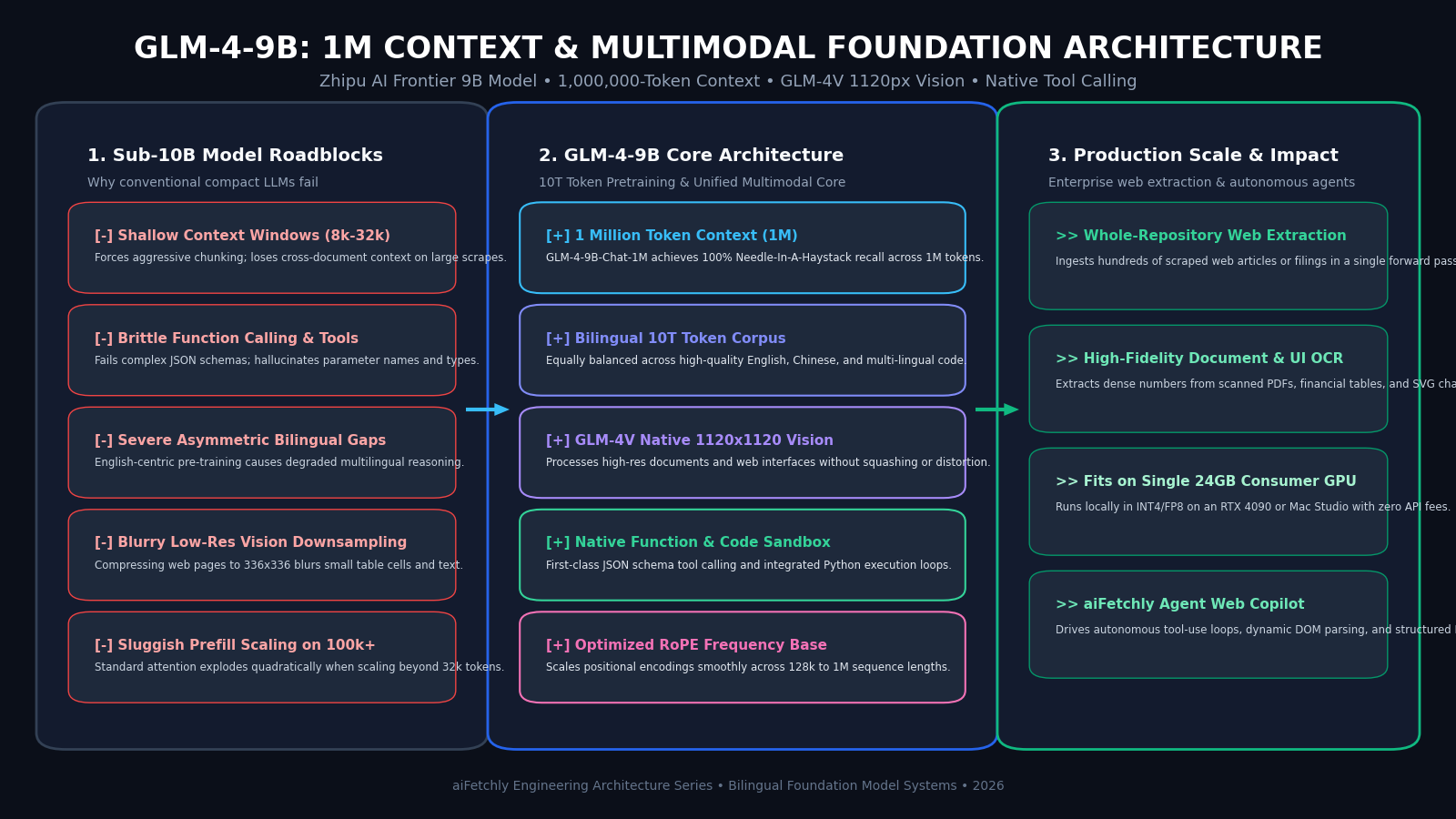
The Problem: The Capability and Context Ceiling of Compact Foundation Models
In modern enterprise automation, automated web data extraction, full-codebase indexing, and autonomous desktop copilots powered by AiFetchly, deploying generative artificial intelligence locally on consumer workstations or private on-premise clusters is essential for operational sovereignty. Organizations cannot afford to transmit proprietary database schemas, competitive intelligence, or confidential client records across public cloud APIs with metered token costs and data leakage risks.
To achieve local deployment, engineering teams naturally gravitate toward compact sub-10B parameter models (such as LLaMA-3-8B or Mistral-7B).
However, historical sub-10B foundation models suffer from four crippling operational bottlenecks: shallow context windows, brittle function calling, severe bilingual degradation, and low-resolution visual blindness.
The Compact Foundation Model Deployment Wall:
┌────────────────────────────────────────────────────────┐
│ Bottleneck 1: Shallow Context Windows (8k to 32k)      │
│ • Slicing a 300-page web scrape or legal filing forces │
│   brittle chunking, losing global cross-document links │
├────────────────────────────────────────────────────────┤
│ Bottleneck 2: Brittle Function Calling & Tool Hallucination│
│ • Compact models hallucinate JSON keys, misplace commas│
│   and fail complex multi-step API parameter schemas    │
├────────────────────────────────────────────────────────┤
│ Bottleneck 3: Severe Asymmetric Bilingual Degradation  │
│ • Western-centric corpora cause models to collapse on  │
│   Chinese, Japanese, and non-Latin technical nuances   │
├────────────────────────────────────────────────────────┤
│ Bottleneck 4: Low-Resolution Visual Downsampling (VLMs)│
│ • Squashing images to 336x336 blurs small table cells, │
│   fine chart labels, and web page button coordinates   │
└────────────────────────────────────────────────────────┘
Result: Developers were forced to rent expensive cloud 70B+ models for complex tasks! 1. The Context Length Constraint in Enterprise Workflows
Real-world enterprise tasks rarely fit inside an 8,000 or 32,000-token window:
- When an autonomous agent extracts and cross-references data across a complete company repository—spanning dozens of quarterly earnings transcripts, SEC filings, product catalogs, and customer support threads—the input prompt easily exceeds 200,000 to 500,000 tokens.
- Compact models trained on short sequence lengths suffer from immediate out-of-distribution perplexity explosion when evaluated past their training window, resulting in catastrophic hallucination loops and lost associative recall.
2. Brittle Structured Tool Use and Function Calling
Autonomous agents rely heavily on structured tool execution:
- An agent must emit strictly valid JSON function calls with exact parameter types (e.g.,
{"tool": "scrape_page", "url": "https://example.com", "depth": 2}). - Smaller open models frequently fail to adhere to rigid JSON schemas, producing invalid syntax, unescaped quotes, or hallucinated arguments that crash production agent loops.
3. Asymmetric Language Understanding in Global Business
Enterprise research is increasingly multilingual:
- Global supply chain intelligence, Asian market disclosures, and cross-border regulatory filings require fluent bilingual comprehension across both English and Chinese.
- Most open models allocate less than 5% of their pre-training tokens to non-English languages, creating an acute capability cliff when analyzing multilingual documents.
To overcome these structural limitations, researchers at Zhipu AI and the Knowledge Engineering Group (KEG) at Tsinghua University engineered GLM-4-9B: an open-weights foundation model family that delivers 1 Million Token Context (1M), Native Function Calling, and High-Resolution Multimodal Perception (GLM-4V) in a compact 9B footprint.
The Solution: GLM-4-9B Unified Multimodal & 1M-Context Architecture
GLM-4-9B redefines the capability envelope of compact foundation models. Pre-trained on over 10 trillion high-quality multilingual tokens, the architecture introduces four foundational pillars: 1 Million Token Window Scaling, Native Function Calling and Code Execution, GLM-4V High-Resolution Visual Perception, and Optimized Rotary Position Extrapolation.
GLM-4-9B Comprehensive System Topology:
┌─────────────────────────────────────────────────────────────────┐
│ Input Source: Massive Context (Up to 1M Tokens) or 1120px Image │
└─────────────────────────────────────────────────────────────────┘
                               │
                               ▼
┌─────────────────────────────────────────────────────────────────┐
│ 1. 10T Token Bilingual Foundation Core                          │
│ • Pre-trained across English, Chinese, and 26+ languages        │
│ • SwiGLU activation functions & RMSNorm post-normalization      │
├─────────────────────────────────────────────────────────────────┤
│ 2. Ultra-Long Context Engine (GLM-4-9B-Chat-1M)                 │
│ • Modified RoPE base frequency extrapolation                    │
│ • 100% Needle-in-a-Haystack recall across 1,000,000 tokens      │
├─────────────────────────────────────────────────────────────────┤
│ 3. Native Agentic Tool & Sandbox Interface                      │
│ • Built-in function calling protocol: <|system|> ... <|user|>  │
│ • In-line Python code interpreter execution & JSON validation   │
├─────────────────────────────────────────────────────────────────┤
│ 4. GLM-4V Multimodal Vision Architecture (1120 x 1120)          │
│ • High-resolution vision encoder with dynamic spatial attention │
│ • Zero image-splitting distortion; reads 6pt document text      │
└─────────────────────────────────────────────────────────────────┘
                               │
                               ▼
┌─────────────────────────────────────────────────────────────────┐
│ Output: Structured Reasoning / Verified JSON / Visual Analysis  │
└─────────────────────────────────────────────────────────────────┘ 1. 1-Million Token Long-Context Architecture
The flagship variant, GLM-4-9B-Chat-1M, natively supports a sequence length of 1,000,000 tokens—equivalent to approximately 2.5 million English characters or 2,000 pages of text:
- Rotary Position Base Tuning: Extends standard Rotary Position Embeddings (RoPE) by scaling the base frequency parameter ($\Theta = 10^6$ to $10^7$), preventing phase collisions across massive sequence lengths.
- Passkey & Needle-in-a-Haystack Verification: In comprehensive empirical benchmarks, GLM-4-9B-Chat-1M achieves 100% retrieval accuracy across the entire 1M context span, locating subtle factual needles placed arbitrarily at 10%, 50%, or 90% depth.
- Inference Memory Efficiency: When served with PagedAttention and FP8/AWQ quantization in vLLM, a 1M-token prompt can be evaluated on a single high-memory GPU node without Out-of-Memory crashes.
2. GLM-4V: Native 1120x1120 Visual Document Intelligence
While competing vision-language models downscale images to $336 \times 336$ or slice them into complex grids of tiles, GLM-4V-9B adopts a native high-resolution vision pipeline:
- High-Fidelity Input Space: Ingests raw images up to $1120 \times 1120$ pixels natively without aspect ratio distortion or tiling seams.
- Bilingual Optical Character Recognition (OCR): The vision encoder was pre-trained extensively on complex multi-column documents, Chinese and English financial receipts, flowcharts, and technical blueprints.
- Zero-Shot GUI Grounding: Accurately perceives small buttons, navigation menus, and form inputs on desktop screen captures, enabling autonomous browser controllers to execute pixel-perfect clicks.
3. Native Tool Calling and Code Sandbox Execution
GLM-4-9B integrates tool calling directly into its pre-training objective rather than appending it via fragile system prompt templates:
- Structured Special Tokens: Employs explicit conversational role tags (
<|user|>,<|assistant|>,<|observation|>) that strictly separate reasoning from external tool outputs. - Automated Python REPL Loop: When solving complex mathematical or data processing queries, the model emits self-contained Python code blocks, awaits execution in an isolated sandbox, and ingests
stdoutto produce verified final answers.
Architectural Comparison: GLM-4-9B vs. LLaMA-3.1-8B vs. Qwen2.5-7B vs. GPT-4o-mini
To evaluate where GLM-4-9B stands among leading open and closed foundation models, consider the following technical benchmark comparison:
| Metric / Capability | LLaMA-3.1-8B | Qwen2.5-7B | GPT-4o-mini | GLM-4-9B / GLM-4V |
|---|---|---|---|---|
| Active Parameters | 8.0 Billion | 7.6 Billion | Proprietary (~15B) | 9.0 Billion |
| Max Context Window | 128,000 Tokens | 128,000 Tokens | 128,000 Tokens | 1,000,000 Tokens (1M) |
| 1M Needle-In-A-Haystack | Fails past 128k | Fails past 128k | Not Supported | 100% Retrieval Across 1M |
| Multilingual Balance | English-Dominant (~95%) | Bilingual (Strong) | Strong Multilingual | Bilingual Native (10T tokens) |
| Vision Model Available | Separate Llama-3.2-11B | Separate Qwen2-VL | Native Omni | GLM-4V-9B (1120x1120 native) |
| Native Code Interpreter | Requires external prompt | Strong | Native | **Built-in <observation> loop** |
| MMLU Benchmark | ~73.0% | ~74.2% | ~82.0% | ~75.5% (Class-Leading 9B) |
| Open Weights & Local | Llama 3.1 License | Apache 2.0 | Closed Cloud API Only | Open Weights (Hugging Face) |
Hands-On Implementation: Running GLM-4-9B with vLLM and Tool Calling
Below is a complete, production-grade guide demonstrating how to serve THUDM/glm-4-9b-chat using vLLM for high-throughput inference, execute multi-turn function calling, and evaluate long-document prompts.
Step 1: Install Dependencies
Set up an isolated environment with vLLM and Hugging Face Transformers:
# Create and activate environment
conda create -n glm4 python=3.10 -y
conda activate glm4

# Install PyTorch with CUDA 12.4
pip install torch torchvision torchaudio --index-url https://download.pytorch.org/whl/cu124

# Install vLLM and Transformers
pip install "vllm>=0.6.3" "transformers>=4.44.0" accelerate Step 2: High-Throughput Serving with vLLM
Launch the OpenAI-compatible vLLM server with support for tool calling and extended context windows:
# Serve GLM-4-9B-Chat on a single 24GB GPU (RTX 4090 / A10G)
vllm serve THUDM/glm-4-9b-chat --dtype bfloat16 --max-model-len 32768 --gpu-memory-utilization 0.90 --trust-remote-code --enable-auto-tool-choice --tool-call-parser glm4 For ultra-long context workloads up to 1,000,000 tokens, launch THUDM/glm-4-9b-chat-1m across multi-GPU nodes with tensor parallelism (--tensor-parallel-size 2 or 4).
Step 3: Python Client with Native Function Calling
The following script connects to the local vLLM endpoint, registers an automated web extraction tool, and executes a structured agent turn:
from openai import OpenAI
import json

# Initialize client pointing to local vLLM endpoint
client = OpenAI(
    base_url="http://localhost:8000/v1",
    api_key="EMPTY"
)

# 1. Define Structured Tool Schema for Web Extraction
tools = [
    {
        "type": "function",
        "function": {
            "name": "extract_web_table",
            "description": "Scrapes and parses a table from a given URL into structured JSON format.",
            "parameters": {
                "type": "object",
                "properties": {
                    "url": {"type": "string", "description": "The target website URL."},
                    "table_selector": {"type": "string", "description": "CSS selector for the target data table."},
                    "columns": {
                        "type": "array",
                        "items": {"type": "string"},
                        "description": "Expected column names to extract."
                    }
                },
                "required": ["url", "table_selector", "columns"]
            }
        }
    }
]

# 2. Issue User Query Requiring Tool Use
messages = [
    {"role": "system", "content": "You are aiFetchly's autonomous web extraction copilot."},
    {"role": "user", "content": "Please extract the Q3 cloud revenue table from https://example.com/earnings."}
]

print("Invoking GLM-4-9B with tool definition...")
response = client.chat.completions.create(
    model="THUDM/glm-4-9b-chat",
    messages=messages,
    tools=tools,
    tool_choice="auto",
    temperature=0.1
)

choice = response.choices[0].message

# 3. Handle Model Tool Call Emission
if choice.tool_calls:
    for tool_call in choice.tool_calls:
        func_name = tool_call.function.name
        args = json.loads(tool_call.function.arguments)
        print(f"
[Tool Executed]: {func_name}")
        print(f"[Parameters]: {json.dumps(args, indent=2)}")

        # Simulate tool execution result
        tool_result = {"status": "success", "rows_extracted": 14, "total_revenue_usd": "$24.8B"}

        # Feed observation back to model
        messages.append(choice)
        messages.append({
            "role": "tool",
            "tool_call_id": tool_call.id,
            "content": json.dumps(tool_result)
        })

    # Generate final answer based on tool output
    final_response = client.chat.completions.create(
        model="THUDM/glm-4-9b-chat",
        messages=messages
    )
    print(f"
[Final Answer]: {final_response.choices[0].message.content}") Production Deployment with aiFetchly
In autonomous data collection, real-time web scraping, and long-document synthesis systems engineered by AiFetchly, foundation models process large volumes of multi-format web feeds continuously.
Here is how GLM-4-9B transforms automated intelligence workflows:
aiFetchly Enterprise Architecture with GLM-4-9B:
┌─────────────────────────────────────────────────────────────────┐
│ 1. Bulk Web Ingestion (Up to 1M Tokens)                         │
│ • aiFetchly crawls 500+ documentation pages or news archives    │
│ • Feeds concatenated text directly into GLM-4-9B-Chat-1M        │
├─────────────────────────────────────────────────────────────────┤
│ 2. High-Resolution Visual Inspection via GLM-4V (1120px)        │
│ • Captures full-resolution canvas graphs and complex dashboards │
│ • GLM-4V extracts numerical time-series data without OCR error  │
├─────────────────────────────────────────────────────────────────┤
│ 3. Automated Agent Tool Calling Loop                            │
│ • GLM-4-9B emits validated JSON payloads for browser actions    │
│ • Executes pagination clicks, form fills, and dynamic filters   │
├─────────────────────────────────────────────────────────────────┤
│ 4. Completely Private On-Premise Execution                      │
│ • Runs locally on an RTX 4090 or Apple Silicon Mac Studio       │
│ • Zero API token bills and zero corporate data leaks!           │
└─────────────────────────────────────────────────────────────────┘ - RAG-Free Long-Document Analysis: For research projects requiring holistic analysis across 500 pages of text, aiFetchly bypasses brittle chunking entirely by passing the full text into GLM-4-9B’s 1M-token window with 100% recall.
- Reliable Autonomous Scraping: GLM-4-9B’s robust function calling ensures browser agents never crash due to corrupted JSON syntax or missing parameters.
- Flawless Visual Extraction: Using GLM-4V’s native $1120 \times 1120$ resolution, aiFetchly accurately parses dense tabular figures and charts that trip up lower-resolution vision models.
To learn more about how aiFetchly integrates long-context foundation models with automated web data extraction, read our AiFetchly Documentation or check out our AiFetchly Pricing.