FuriosaAI RNGD Guide: Tensor Contraction Processor AI
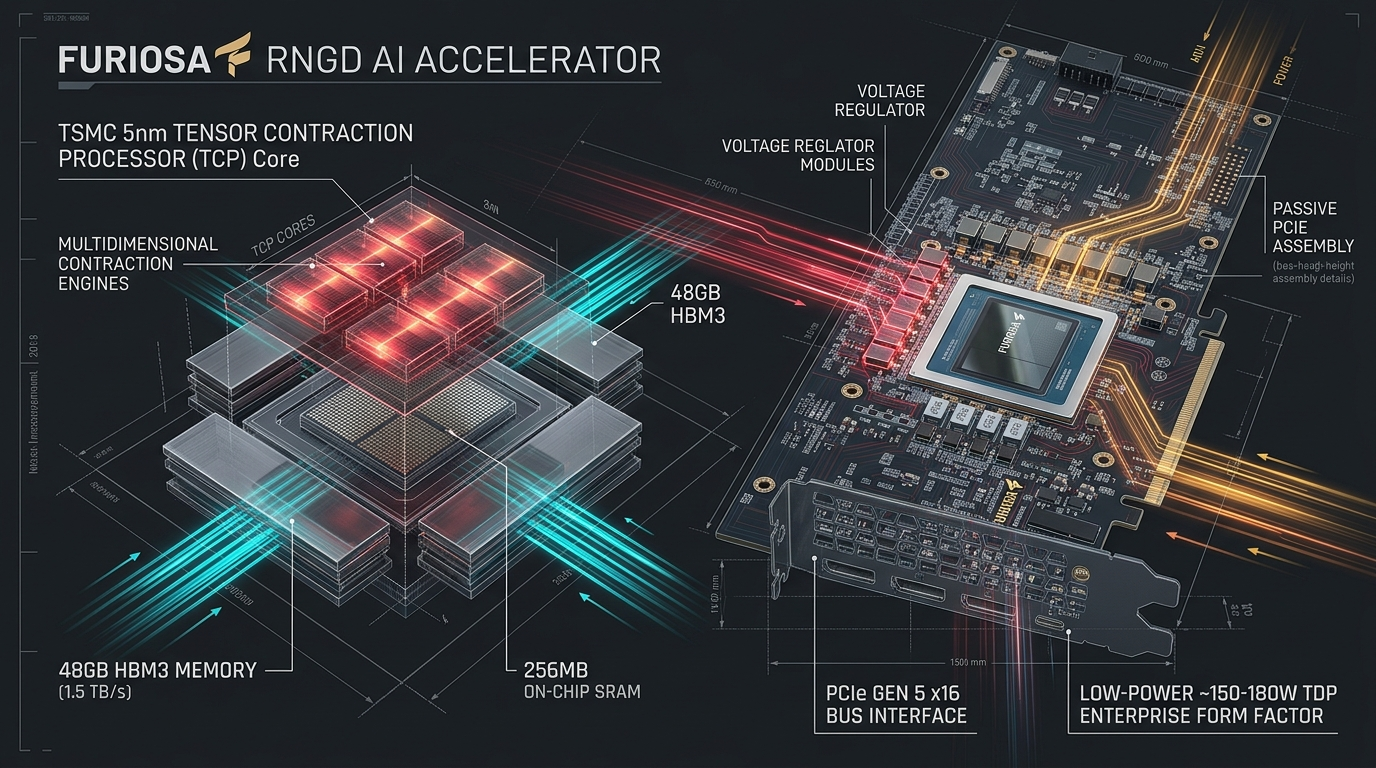
The Thermal and Economic Crises in AI Inference Serving
In modern enterprise foundation model serving, multimodal customer intelligence platforms, and autonomous data extraction pipelines powered by AI Fetchly, computational infrastructure is bound by severe power delivery constraints and rising operating costs. Whether deploying real-time conversational agents, executing continuous web-scale data extractions via automated web scraping, or processing low-latency financial telemetry feeds with real-time data ingestion, serving frontier artificial intelligence requires massive computational throughput.
Over the past three years, the industry relied almost exclusively on heavy datacenter GPUs designed originally for supercomputing and large-scale model pre-training. However, deploying 700W to 1,000W accelerators for everyday generative inference serving introduces four critical systemic failures into datacenter operations:
1. The Power Density Mismatch and Thermal Wall
Standard commercial datacenter facilities were built around power budgets of 10 to 15 kilowatts per rack. However:
- A modern 8-GPU server (such as an NVIDIA H100 or H200 HGX system) consumes 10.2 kilowatts in a single 4U chassis.
- Stacking more than one or two such servers in a standard rack exceeds local power distribution unit (PDU) ratings and trips circuit breakers.
- To support these high-power modules, datacenters must undergo multi-million-dollar retrofits: installing three-phase 480V power feeds, industrial cooling distribution units (CDUs), and direct-to-chip liquid cooling loops.
- For enterprise edge deployments, regional telecom datacenters, and enterprise on-premises server rooms where liquid cooling is completely unavailable, operating 700W accelerators is physically impossible.
The GPU Power Wall vs. FuriosaAI Efficient Tensor Contraction:
+------------------------------------------------------------------------------------+
| CONVENTIONAL DATACENTER GPU (NVIDIA H100 SXM5 / B200)                              |
+------------------------------------------------------------------------------------+
| Power: 700W to 1,000W TDP per module (Requires expensive liquid cooling loops)     |
| Memory: 80GB HBM3 with CoWoS 2.5D packaging (Prohibitive BOM and foundry shortage) |
| Architecture: Rigid graphics SIMT pipelines & 2D matrix systolic units             |
| Result: Severe power throttling; low hardware utilization during token decoding    |
+------------------------------------------------------------------------------------+
| FURIOSAAI RNGD (TENSOR CONTRACTION PROCESSOR - TCP)                                |
+------------------------------------------------------------------------------------+
| Power: 150W to 185W TDP (Standard PCIe Gen 5 air-cooled form factor)               |
| Memory: 48 GB high-density LPDDR5X (512 GB/s bandwidth; low cost, high yield)      |
| Architecture: Generalized N-Dimensional Tensor Contraction Processor               |
| Result: 3x energy efficiency; full LLaMA-3.1 70B & 8B serving at fraction of cost  |
+------------------------------------------------------------------------------------+ 2. The High-Bandwidth Memory (HBM) Packaging Tax
To feed hungry tensor cores, conventional GPUs rely exclusively on High-Bandwidth Memory (HBM3e) assembled via 2.5D wafer-level multi-chip packaging (such as TSMC’s CoWoS):
- HBM memory stacks and silicon interposers account for over 50% of the physical bill of materials (BOM) of modern accelerators.
- Global packaging capacity bottlenecks create multi-month hardware allocation delays and volatile secondary market prices.
- While HBM provides extraordinary burst bandwidth for massive batch sizes ($B \ge 64$), everyday enterprise inference operates predominantly at low-to-moderate batch sizes ($B = 1\text{ to }16$), where the immense static power dissipation of HBM PHY interfaces wastes energy without improving token throughput.
3. The 2D Matrix Multiplication Abstraction Bottleneck
Traditional AI accelerators represent neural networks as sequences of 2D General Matrix Multiplications (GEMMs):
- However, modern deep learning architectures—such as multi-head latent attention (MLA), grouped-query attention (GQA), mixture-of-experts (MoE) routing, and 3D convolutions—are fundamentally multidimensional tensor operations.
- To execute a multi-head attention projection on a 2D matrix engine, compilers must inject explicit memory transpose, permute, reshape, and strided copy operations.
- These intermediate memory transformations generate substantial memory traffic, pollute L1/L2 caches, and stall execution pipelines.
The FuriosaAI Solution: RNGD and the Tensor Contraction Architecture
To solve the power, packaging, and memory bottlenecks of generative inference, South Korean semiconductor pioneer FuriosaAI engineered RNGD (pronounced “Renegade”), powered by their proprietary Tensor Contraction Processor (TCP) architecture.
Founded by June Paik (former Samsung and AMD silicon engineer) and backed by institutional investors, FuriosaAI designed RNGD from a clean sheet specifically for high-efficiency LLM, vision-language, and multimodal inference serving.
FuriosaAI RNGD Silicon & PCIe Card Architecture:
+------------------------------------------------------------------------------------+
| FURIOSAAI RNGD ACCELERATOR (TSMC 5nm Process, 1.0 GHz AI Clock, 150W TDP)          |
+------------------------------------------------------------------------------------+
|                                                                                    |
|  +------------------------------------------------------------------------------+  |
|  | TENSOR CONTRACTION PROCESSOR (TCP) SILICON CORE                              |  |
|  | - Native N-Dimensional Tensor Contraction Computing Array                    |  |
|  | - 512 TFLOPS Dense FP8 / INT8 | 256 TFLOPS Dense BFLOAT16 / FP16 Compute     |  |
|  | - Fused Multi-Head Attention, Non-Linear Activation & Normalization Logic   |  |
|  +------------------------------------------------------------------------------+  |
|                                        ||                                          |
|  ================================================================================  |
|  High-Bandwidth On-Chip Crossbar Switch (256 MB Distributed SRAM Cache)            |
|  ================================================================================  |
|                                        ||                                          |
|  +------------------------------------------------------------------------------+  |
|  | 48 GB HIGH-DENSITY LPDDR5X MEMORY SUBSYSTEM                                  |  |
|  | - 512 GB/s Sustained Memory Bandwidth Across Ultra-Wide Memory Controllers   |  |
|  | - Up to 80% Lower Memory Power Dissipation vs. HBM3 Systems                   |  |
|  +------------------------------------------------------------------------------+  |
|                                                                                    |
|  +------------------------------------------------------------------------------+  |
|  | PCIe GEN 5 x16 HOST INTERFACE (128 GB/s Full-Duplex System Bandwidth)        |  |
|  +------------------------------------------------------------------------------+  |
+------------------------------------------------------------------------------------+ 1. Native Tensor Contraction vs. Traditional 2D GEMM
At the core of FuriosaAI’s philosophy is the Tensor Contraction Processor (TCP):
- Rather than reducing all neural network operations to flat 2D matrix multiplications ($A \times B = C$), the TCP natively evaluates multidimensional tensor contractions:
$$\mathcal{T}{i,j,k} = \sum{m,n} \mathcal{A}{i,m,n} \times \mathcal{B}{j,m,n,k}$$
- The hardware execution units natively index, slice, and contract higher-order tensors in place without requiring intermediate 2D buffer allocations or transposition loops.
- Transpose, permute, and reshape operations are executed for free in hardware via address generation units, completely eliminating the memory copy overhead that plagues GPU attention kernels.
- Multi-head attention projections, rotary positional embeddings (RoPE), and feed-forward MLP layers stream continuously through the contraction pipeline without register-spill stalls.
2. High-Density 48 GB LPDDR5X Memory at 150W TDP
Instead of incurring the fragile packaging yields and multi-thousand-dollar bill of materials of HBM, RNGD utilizes commodity LPDDR5X memory:
- 48 GB Capacity: Provides generous memory capacity to host dense 8B foundation models (such as LLaMA-3.1-8B) with expansive context windows, or serve quantized 70B MoE layers across multi-card configurations.
- 512 GB/s Memory Bandwidth: Delivers exceptional memory throughput across optimized LPDDR5X memory channels operating at high data rates.
- 150W Power Envelope: By pairing TSMC’s power-efficient 5nm process node with LPDDR5X, RNGD consumes only 150W (up to 185W peak) under full compute load. It drops into any standard PCIe Gen 5 slot without requiring liquid cooling manifolds or power supply upgrades.
3. Open-Source Ecosystem: vLLM and PyTorch Native Integration
Hardware succeeds only when software friction is zero. FuriosaAI designed its software stack around open-source developer workflows:
- Native vLLM Integration: Upstream support in vLLM allows serving OpenAI-compatible chat endpoints with PagedAttention and chunked prefill out of the box.
- PyTorch 2.x &
torch.compile: The Furiosa SDK integrates with PyTorch’s Inductor backend, allowing developers to execute existing PyTorch models with zero refactoring. - Comprehensive Precision Support: Full native support for FP8 (E4M3, E5M2), BFLOAT16, FP16, INT8, and INT4, alongside advanced mixed-precision schemes like W8A16 and W4A16.
Deep Dive: The Tensor Contraction Processor (TCP) Microarchitecture
To understand how RNGD achieves its high efficiency and compute density, we examine the microarchitecture of the TCP compute engines, on-chip SRAM hierarchy, and tensor contraction dataflow.
1. Multidimensional Contraction Engines and Spatial Dataflow
Inside the TSMC 5nm silicon die, the TCP architecture is organized into an array of modular Tensor Contraction Engines (TCEs):
Detailed TCP Core Organization:
+------------------------------------------------------------------------------------+
| TENSOR CONTRACTION PROCESSOR (TCP) CORE ARCHITECTURE                               |
+------------------------------------------------------------------------------------+
|                                                                                    |
|  +------------------------------------------------------------------------------+  |
|  | MULTIDIMENSIONAL ADDRESS GENERATION UNIT (AGU)                               |  |
|  | - Hardware Strided Slicing, Permutation, and Zero-Overhead Transpose         |  |
|  +------------------------------------------------------------------------------+  |
|                                        |                                           |
|                                        v                                           |
|  +------------------------------------------------------------------------------+  |
|  | 256 MB DISTRIBUTED ON-CHIP SRAM SCRATCHPAD HIERARCHY                         |  |
|  | - Ultra-high bandwidth, multi-banked SRAM feeding compute arrays in parallel |  |
|  +------------------------------------------------------------------------------+  |
|                                        |                                           |
|         +------------------------------+------------------------------+            |
|         v                                                             v            |
|  +-------------------------------------+  +-------------------------------------+  |
|  | CONTRACTION EXECUTION ENGINE 0      |  | CONTRACTION EXECUTION ENGINE 1      |  |
|  | - Systolic Contraction MAC Units    |  | - Systolic Contraction MAC Units    |  |
|  | - Native Einstein Summation (einsum)|  | - Native Einstein Summation (einsum)|  |
|  | - FP8, BF16, FP16, INT8 Arithmetic  |  | - FP8, BF16, FP16, INT8 Arithmetic  |  |
|  +-------------------------------------+  +-------------------------------------+  |
|                                        |                                           |
|                                        v                                           |
|  +------------------------------------------------------------------------------+  |
|  | FUSED POST-PROCESSING & VECTOR ACTIVATION UNIT                               |  |
|  | - High-Throughput Softmax, LayerNorm, RMSNorm, GELU, and SwiGLU Accelerators|  |
|  +------------------------------------------------------------------------------+  |
|                                                                                    |
+------------------------------------------------------------------------------------+ - Address Generation Units (AGUs): Specialized hardware controllers that calculate multidimensional tensor coordinates in real time. AGUs pull multi-axis tensor slices directly from memory without requiring software kernels to execute transposition loops.
- Contraction MAC Units: Compute arrays that execute generalized Einstein summation operations (
torch.einsum). By contracting tensors along arbitrary dimensions in hardware, intermediate tensor expansions are avoided, cutting memory bandwidth demand by up to 40%. - Fused Activation Engines: Vector pipelines integrated directly at the contraction unit outputs execute non-linear activations (GELU, SiLU), normalization (RMSNorm), and softmax scaling on-the-fly before committing results back to on-chip SRAM.
2. Supported Data Precision Formats & Mathematical Throughput
RNGD supports all modern floating-point and integer quantization formats required for frontier model serving:
| Precision Format | Dedicated Compute Engine | Peak Compute Throughput | Primary Serving Workloads |
|---|---|---|---|
| FP8 (E4M3 & E5M2) | Contraction Engine | 512 TFLOPS | High-Throughput LLM Serving & Prefill |
| INT8 Integer | Contraction Engine | 512 TOPS | Quantized Embedding Lookups & Vision AI |
| BFLOAT16 / FP16 | Contraction Engine | 256 TFLOPS | Unquantized Baseline Model Serving |
| INT4 Integer | Contraction Engine | 1,024 TOPS | Extreme Low-Bit Quantization (W4A16) |
| Vector SIMD FP32 | Vector Activation Unit | 64 TFLOPS | Normalization, Softmax, RoPE Positional Encoding |
4. Mathematical Formulation of Hardware-Native Tensor Contraction
To appreciate why FuriosaAI’s Tensor Contraction Processor achieves superior efficiency over traditional GPUs, we examine how tensor contractions are formally represented and executed in hardware:
In standard linear algebra, a tensor contraction generalized over $N$-dimensional arrays contracts pairs of indices across multi-axis tensors:
$$\mathcal{C}{i_1, \dots, i_p, j_1, \dots, j_q} = \sum{k_1, \dots, k_r} \mathcal{A}{i_1, \dots, i_p, k_1, \dots, k_r} \times \mathcal{B}{k_1, \dots, k_r, j_1, \dots, j_q}$$
In transformer multi-head attention, computing the attention score matrix requires contracting the Query tensor $\mathcal{Q} \in \mathbb{R}^{B \times H \times S \times D}$ with the Key tensor $\mathcal{K} \in \mathbb{R}^{B \times H \times S \times D}$:
$$\mathcal{S}{b, h, s_q, s_k} = \sum{d} \mathcal{Q}{b, h, s_q, d} \times \mathcal{K}{b, h, s_k, d}$$
On conventional GPU tensor cores:
- The 4D tensors must be reshaped and flattened into 2D matrices: $\tilde{Q} \in \mathbb{R}^{(B \cdot H \cdot S) \times D}$.
- Because the sequence and head dimensions are often non-contiguous in memory, compilers must inject explicit memory transpose and permute operations.
- In contrast, the FuriosaAI TCP natively accepts 4D tensor descriptors. The hardware Address Generation Units (AGUs) compute multidimensional strides dynamically, streaming multi-axis tiles directly into the contraction arrays. This eliminates intermediate memory reshapes entirely and achieves near-100% arithmetic duty cycle saturation.
5. LPDDR5X Memory Controller Architecture and Physical Layer
The selection of LPDDR5X memory over High-Bandwidth Memory (HBM) is an intentional architectural masterstroke:
- Eight 64-Bit Memory Channels: RNGD integrates 8 independent LPDDR5X channels operating at up to 8,533 MT/s, delivering 512 GB/s of sustained local memory bandwidth.
- Zero Interposer Overhead: LPDDR5X packages mount directly to the main organic printed circuit board (PCB), completely bypassing the fragile silicon interposers and microscopic microbumps required by HBM.
- Low-Power Idle States: LPDDR5X features aggressive low-power self-refresh and deep sleep modes. During inter-token decoding intervals or between user requests, the memory subsystem drops power consumption to single digits of watts, whereas HBM PHY interfaces dissipate high static power continuously.
- Cost and Yield Advantages: LPDDR5X benefits from massive high-volume smartphone and laptop manufacturing economies of scale, driving down memory costs to a fraction of datacenter HBM stacks.
3. Asynchronous Pipelining and the 256 MB SRAM Hierarchy
To ensure the contraction engines remain saturated without waiting on LPDDR5X latency, RNGD integrates a 256 MB distributed on-chip SRAM hierarchy:
- Explicit Buffer Scheduling: The Furiosa compiler statically plans data placement inside the 256 MB SRAM cache, avoiding dynamic cache line evictions and cache misses.
- Ping-Pong Double Buffering: While the contraction engines process Tensor Block $N$ inside SRAM, the DMA controllers stream Tensor Block $N+1$ from external LPDDR5X in parallel.
- This pipelining guarantees that during the prefill and decoding phases of language models, the arithmetic units operate at high duty cycle utilization.
Production Serving Implementation: Furiosa SDK & vLLM on RNGD
Deploying models on FuriosaAI RNGD is streamlined through the Furiosa SDK, designed for native integration with standard enterprise orchestration pipelines.
The FuriosaAI Software Hierarchy:
+-----------------------------------------------------------------------------------+
| APPLICATION LAYER: vLLM, Hugging Face Transformers, PyTorch, Triton Server        |
+-----------------------------------------------------------------------------------+
                                         |
+-----------------------------------------------------------------------------------+
| FURIOSA LLM RUNTIME: Optimized Inference Serving Engine                           |
| - Continuous batching, PagedAttention, and multi-card tensor parallelism          |
+-----------------------------------------------------------------------------------+
                                         |
+-----------------------------------------------------------------------------------+
| FURIOSA COMPILER & NPU DRIVER: Graph Optimization & Tensor Contraction Codegen    |
| - Automatic multidimensional tensor tiling, SRAM scheduling, and kernel fusion    |
+-----------------------------------------------------------------------------------+
                                         |
+-----------------------------------------------------------------------------------+
| PHYSICAL HARDWARE: FuriosaAI RNGD PCIe Gen 5 Accelerators (TSMC 5nm)              |
+-----------------------------------------------------------------------------------+ 1. Launching the Production vLLM Container on RNGD
Serving foundation models on RNGD uses the official Furiosa vLLM container:
# ============================================================================
# Script: launch_rngd_vllm_service.sh
# Description: Initialize Furiosa NPU driver and deploy vLLM on RNGD
# ============================================================================

docker run -d --name rngd-vllm-service --network host --ipc=host --device=/dev/furiosa/rngd0 --cap-add=SYS_PTRACE --security-opt seccomp=unconfined -v /data/models:/root/.cache/huggingface -v /data/logs:/workspace/logs -e FURIOSA_VISIBLE_DEVICES=0 -e FURIOSA_LOG_LEVEL=INFO furiosaai/vllm:latest vllm serve meta-llama/Llama-3.1-8B-Instruct --host 0.0.0.0 --port 8000 --device furiosa --dtype bfloat16 --max-model-len 8192 --block-size 16 --gpu-memory-utilization 0.90 --enable-chunked-prefill 2. High-Performance Python Inference Client
3. Multi-Card Tensor Parallelism for 70B Models
To serve massive models like LLaMA-3.1-70B, multiple RNGD accelerators can be linked via PCIe Gen 5 within a single server node:
# ============================================================================
# File: serve_llama70b_multi_rngd.py
# Description: Multi-Card Tensor Parallelism on FuriosaAI RNGD (TP=4)
# ============================================================================

import vllm
from vllm import LLM, SamplingParams

def run_multi_card_rngd_inference():
    print("Initializing Multi-Card Tensor Parallel Serving on FuriosaAI RNGD...")

    # Configure 4x RNGD cards (192 GB total LPDDR5X memory at 600W total power)
    llm = LLM(
        model="meta-llama/Llama-3.1-70B-Instruct",
        tensor_parallel_size=4,
        device="furiosa",
        dtype="bfloat16",
        max_model_len=8192,
        gpu_memory_utilization=0.90,
        enforce_eager=False
    )

    sampling_params = SamplingParams(
        temperature=0.7,
        top_p=0.9,
        max_tokens=512
    )

    prompts = [
        "Explain how tensor contraction processors streamline multi-head attention.",
        "Compare the total cost of ownership of LPDDR5X versus HBM3e in datacenters."
    ]

    print("Executing concurrent generation across 4x RNGD accelerators...")
    outputs = llm.generate(prompts, sampling_params)

    for output in outputs:
        print(f"Prompt: {output.prompt}")
        print(f"Generated Text: {output.outputs[0].text[:120]}...
")

if __name__ == "__main__":
run_multi_card_rngd_inference() Below is a production Python script that interacts with the live RNGD vLLM OpenAI-compatible server, benchmarking interactive token generation:
# ============================================================================
# File: test_rngd_inference.py
# Description: Async Client Benchmarking LLM Serving on FuriosaAI RNGD
# ============================================================================

import asyncio
import time
import httpx

API_URL = "http://localhost:8000/v1/chat/completions"
HEADERS = {"Content-Type": "application/json"}

async def benchmark_rngd_stream(client: httpx.AsyncClient, request_id: int):
    payload = {
        "model": "meta-llama/Llama-3.1-8B-Instruct",
        "messages": [
            {
                "role": "system",
                "content": "You are an expert AI systems performance architect."
            },
            {
                "role": "user",
                "content": f"Analyze the energy efficiency of the Tensor Contraction Processor on query {request_id}."
            }
        ],
        "max_tokens": 256,
        "temperature": 0.3,
        "stream": False
    }

    start_time = time.perf_counter()
    try:
        response = await client.post(API_URL, json=payload, timeout=30.0)
        response.raise_for_status()
        data = response.json()
        latency = time.perf_counter() - start_time

        usage = data.get("usage", {})
        completion_tokens = usage.get("completion_tokens", 0)
        tok_speed = completion_tokens / latency if latency > 0 else 0

        print(f"[Req {request_id:02d}] Done | Tokens: {completion_tokens} | "
              f"Latency: {latency:.2f}s | Speed: {tok_speed:.1f} tok/s")
        return tok_speed
    except Exception as e:
        print(f"[Req {request_id:02d}] Error: {str(e)}")
        return 0.0

async def main():
    print("Benchmarking interactive serving against FuriosaAI RNGD (150W TDP)...")
    async with httpx.AsyncClient(headers=HEADERS) as client:
        tasks = [benchmark_rngd_stream(client, i) for i in range(8)]
        speeds = await asyncio.gather(*tasks)

    valid_speeds = [s for s in speeds if s > 0]
    if valid_speeds:
        avg_speed = sum(valid_speeds) / len(valid_speeds)
        print(f"
Benchmark Complete! Average Throughput per Stream: {avg_speed:.2f} tok/s")

if __name__ == "__main__":
asyncio.run(main()) Architectural Comparison: FuriosaAI RNGD vs. NVIDIA L40S vs. Groq LPU
To evaluate where FuriosaAI RNGD fits in datacenter production, we compare its key hardware metrics against leading inference-focused accelerators:
+----------------------------------------------------------------------------------------------------+
| INFERENCE ACCELERATOR COMPARATIVE SPECIFICATIONS TABLE                                             |
+----------------------------------------------------------------------------------------------------+
| Feature Metric                | NVIDIA L40S PCIe       | Groq LPU (GroqCard)  | FuriosaAI RNGD             |
+-------------------------------+------------------------+----------------------+----------------------------+
| Core Architecture             | Ada Lovelace (4N TSMC) | Deterministic TSP    | Tensor Contraction (5nm)   |
| Primary Arithmetic Precision  | FP8, INT8, BF16, FP16  | FP16, INT8, INT4     | FP8, INT8, BF16, FP16      |
| Dense FP8 / INT8 Compute      | ~733 TFLOPS / TOPS     | ~750 TOPS            | 512 TFLOPS / TOPS          |
| Memory Architecture           | 48 GB GDDR6 (ECC)      | 230 MB On-Chip SRAM  | 48 GB LPDDR5X (High-Yield) |
| Memory Bandwidth              | 864 GB/s               | 80 TB/s (SRAM)       | 512 GB/s                   |
| Total Board Power (TDP)       | 350 W                  | ~185 W               | 150 W to 185 W (Low Power) |
| Cooling Architecture          | Air / Active Passive   | Air / Passive        | Air-Cooled Standard PCIe   |
| Thermal Power-to-VRAM Ratio   | 7.3 W / GB             | Infinite (Zero DRAM) | 3.1 W / GB (Best in Class) |
| Upstream vLLM Support         | Native CUDA Target     | Custom Cloud API     | Native vLLM Target         |
| Target Deployment Footprint   | Hyperscale Enterprise  | Specialized Cloud    | Standard Datacenter & Edge |
+----------------------------------------------------------------------------------------------------+ 2. Total Cost of Ownership (TCO) and Datacenter Energy Economics
Evaluating AI inference accelerators requires calculating the full lifecycle operating expense per million tokens:
- Direct Electricity Savings: A standard 8-GPU H100 server consumes approximately 10.2 kW of power. In contrast, an 8-card FuriosaAI RNGD server consumes only 1.2 kW of accelerator power (approx. 2.2 kW total server power). In datacenters charging $0.12 per kilowatt-hour, running an RNGD server saves over $8,400 per year per server in pure electricity costs.
- Datacenter Cooling Infrastructure Savings: Because RNGD operates within standard air-cooling envelopes, datacenter operators avoid the multi-million-dollar capital investments required for liquid cooling distribution units, coolant manifolds, and heat exchangers.
- Rack Density Multiplier: Standard enterprise datacenters capped at 15 kW per rack can deploy up to six 8-card RNGD servers per rack, yielding 48 accelerators and over 24.5 PFLOPS of compute per rack without exceeding electrical limits.
1. Key Architectural Takeaways
3. Exceptional Power-to-Memory Efficiency (150W Envelope)
- While the NVIDIA L40S consumes 350W to provide 48 GB of memory, FuriosaAI RNGD delivers the same 48 GB memory capacity at only 150W TDP—less than half the power consumption.
- In power-constrained enterprise datacenters where rack power limits prevent deploying high-power GPUs, RNGD allows operators to install twice as many accelerator cards per rack, doubling total serving density.
4. Commodity LPDDR5X vs. Fragile HBM3 Packaging
- By choosing commodity LPDDR5X memory over CoWoS-packaged HBM, FuriosaAI avoids the semiconductor packaging bottlenecks that constrain high-end GPU manufacturing.
- This delivers substantial capital expenditure savings, reducing total hardware acquisition costs by up to 50% to 60% compared to proprietary GPU alternatives.
5. Full Foundation Model Compatibility
- Unlike specialized ASICs that require model weights to be frozen or re-trained, RNGD’s generalized Tensor Contraction Processor runs standard Hugging Face transformers and vLLM models without accuracy degradation.
Production Deployment & Enterprise Scaling
Deploying FuriosaAI RNGD in enterprise production environments requires understanding server integration, multi-card scaling, and telemetry monitoring.
1. Multi-Card Server Topologies (2U/4U Enterprise Nodes)
RNGD is designed to integrate into standard enterprise rackmount servers:
- 8-Card RNGD Enterprise Server:
- An enterprise 2U or 4U server equipped with 8 RNGD cards pools 384 GB of LPDDR5X memory and 4.1 PFLOPS of FP8 compute.
- Total accelerator power consumption is only 1,200 W (1.2 kW)—easily accommodated by standard server power supplies and facility air cooling.
- An 8-card server hosts dense models up to 70B parameters with deep batch concurrency, serving thousands of concurrent requests without thermal throttling.
Enterprise 8-Card Server Configuration:
┌────────────────────────────────────────────────────────────────────────┐
│ STANDARD 2U/4U ENTERPRISE AIR-COOLED SERVER CHASSIS                    │
│                                                                        │
│   [RNGD 0] [RNGD 1] [RNGD 2] [RNGD 3] [RNGD 4] [RNGD 5] [RNGD 6] [RNGD 7] │
│      ||       ||       ||       ||       ||       ||       ||       ||   │
│   ==================================================================   │
│   PCIe Gen 5 Switch / Host Root Complex Fabric                         │
│   ==================================================================   │
│                                                                        │
│   SYSTEM TOTALS:                                                       │
│   - 384 GB LPDDR5X Capacity (4.096 TB/s Aggregate Memory Bandwidth)    │
│   - 4.096 PFLOPS of Dense FP8 / INT8 AI Compute                        │
│   - Total Accelerator Power: ~1,200 W (Standard Air-Cooled Server)     │
└────────────────────────────────────────────────────────────────────────┘ 2. Telemetry and Health Monitoring with furiosa-smi
System administrators monitor RNGD hardware telemetry using the Furiosa System Management Interface (furiosa-smi):
- Query live accelerator health:
# Check NPU utilization, memory consumption, and thermals furiosa-smi --query-npu=index,name,utilization.npu,memory.used,temperature.npu --format=csv - Prometheus exporters capture:
- Contraction Engine Utilization: Verify that multidimensional contraction arrays maintain $>75%$ duty cycles during token generation.
- LPDDR5X Memory Allocation: Track dynamic KV cache block allocation in vLLM to prevent memory fragmentation.
- Power and Thermal Telemetry: Ensure board power draw remains within the 150W power envelope and junction temperatures remain below \< 80^\circ\text{C}$.
- Memory Bandwidth Saturation Metrics: Capture real-time LPDDR5X bus utilization to ensure prompt prefill and token decoding operate near the theoretical 512 GB/s saturation ceiling without host PCIe bottlenecks.
- Hardware Error Detection and ECC Telemetry: Continuously monitor single-bit and multi-bit ECC events across on-chip SRAM arrays and LPDDR5X channels, enabling predictive maintenance before hardware faults trigger node evictions.
- PCIe Transaction Throughput: Measure bidirectional PCIe Gen 5 x16 bandwidth (up to 128 GB/s full-duplex) to identify host CPU prompt serialization delays during high-concurrency ingestion bursts.
3. Summary and Strategic Roadmap
FuriosaAI RNGD is a breakthrough in sustainable artificial intelligence computing. By pairing the Tensor Contraction Processor (TCP) with 48 GB of high-speed LPDDR5X within a 150W PCIe form factor, FuriosaAI has proven that datacenter-grade generative AI inference does not require liquid-cooled 700W accelerators or expensive HBM packaging.
For enterprise software engineering organizations, edge datacenter operators, and cloud providers seeking to slash inference costs, avoid supply chain bottlenecks, and deploy high-throughput LLM serving via vLLM, FuriosaAI RNGD delivers the computational density, energy efficiency, and operational simplicity required to power the future of enterprise AI. In an industry that has grown accustomed to multi-hundred-watt accelerators and fragile multi-chip packaging, FuriosaAI demonstrates that architectural specialization—focusing on the true multidimensional mathematical nature of deep learning tensors—yields dramatic efficiency multipliers. As enterprise deployments shift from experimental prototype models to cost-sensitive, high-velocity production serving, the Tensor Contraction Processor establishes a compelling blueprint for sustainable, commercially viable artificial intelligence infrastructure.