FP8 Mixed Precision: DeepSeek-V3 Training Architecture
The Problem: The Memory and Communication Bottlenecks of Frontier Pre-Training
In enterprise artificial intelligence, continuous domain adaptation, and high-throughput data extraction platforms like AiFetchly, scaling foundation models to hundreds of billions of parameters requires massive cluster compute budgets.
Historically, foundation models have been trained in 16-bit mixed precision (BF16 or FP16). While 16-bit formats protect training stability, they impose severe hardware bottlenecks when scaled to frontier Mixture-of-Experts (MoE) architectures (such as DeepSeek-V3’s 671 billion parameters):
1. High-Bandwidth Memory (HBM) Capacity and Bus Saturation
During distributed training, GPU memory is consumed not only by static parameters, but by dynamic intermediate activations cached for backpropagation. For a 671B model, caching activations across thousands of pipeline parallel micro-batches requires hundreds of terabytes of aggregate GPU VRAM.
Furthermore, training throughput on modern Tensor Cores (such as NVIDIA H800, H100, and Blackwell B200) is frequently bottlenecked by memory bandwidth rather than raw compute FLOPS. Streaming 16-bit tensors from High-Bandwidth Memory (HBM3) to register files leaves arithmetic units idle waiting for data transfers.
2. The MoE Inter-Node All-to-All Communication Wall
In MoE architectures, tokens are dynamically routed across hundreds of routed experts distributed over different GPU nodes.
This requires continuous All-to-All cross-node communication:
- In the forward pass, tokens must be dispatched to their assigned expert nodes across InfiniBand interconnects.
- In the backward pass, expert output gradients must be combined back across the network.
When transmitting 16-bit tensors, cross-node network bandwidth saturates, forcing GPUs into costly synchronization barriers that degrade Model Flops Utilization (MFU).
3. Why Naive FP8 Training Suffers Precision Collapse
While 8-bit floating-point (FP8) hardware support debuted with NVIDIA Hopper GPUs, early attempts to train large language models end-to-end in FP8 encountered catastrophic instability:
- Severe Dynamic Range Contraction: Standard FP8 formats allocate only 8 bits:
- E4M3 (1 sign, 4 exponent, 3 mantissa): Maximum value $\approx 448.0$. Very narrow dynamic range.
- E5M2 (1 sign, 5 exponent, 2 mantissa): Wider dynamic range, but only 2 bits of mantissa precision (causing high relative roundoff error).
- Per-Tensor Outlier Distortion: If a single activation channel experiences an outlier spike (e.g., magnitude $120.0$ while normal activations are $\approx 0.5$), per-tensor scaling divides the entire tensor by a large scaling factor. This forces 99% of normal activations into subnormal values or underflow zeros, destroying gradient signals.
- Accumulation Underflow: In standard 8-bit GEMMs, accumulating thousands of low-precision dot products directly into low-bit registers causes small gradients to vanish completely when added to running sums.
The Architecture: DeepSeek-V3’s Fine-Grained FP8 Training Framework
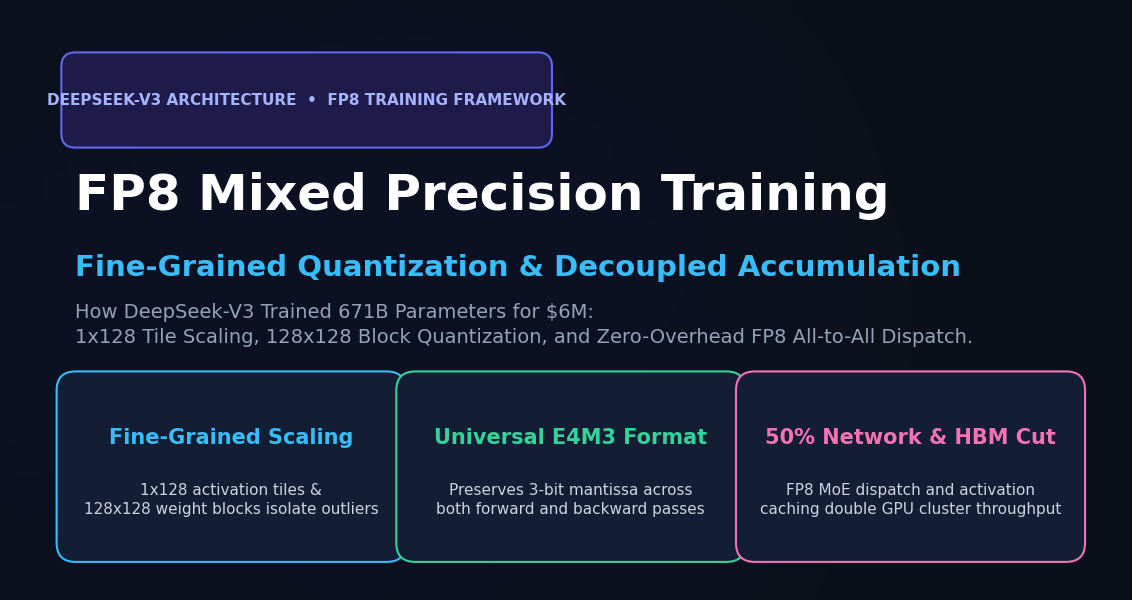
To unlock the $2\times$ compute throughput and $50%$ memory savings of FP8 without compromising numerical stability, the DeepSeek AI research team pioneered the FP8 Mixed Precision Training Framework for DeepSeek-V3.
Validated across 14.8 Trillion tokens on a 671B MoE architecture with zero loss spikes, DeepSeek-V3’s framework combines three core mathematical and architectural innovations.
1. Fine-Grained Tile and Block-Wise Scaling
Rather than computing a single scale factor across an entire tensor, DeepSeek-V3 subdivides activations and weights into compact sub-matrices:
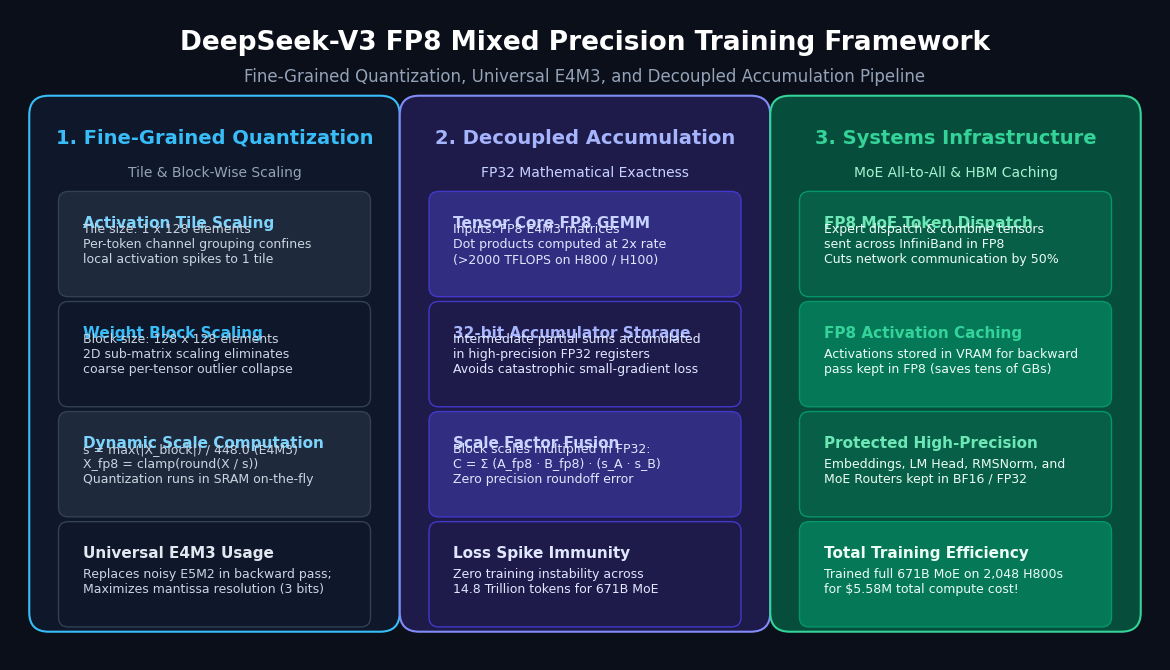
- Activation Tile Scaling ($1 \times 128$): Activations are quantized in tiles of $1 \times 128$ elements along the channel dimension for each individual token. If an activation outlier appears in channel 42, its elevated scaling factor is confined strictly to that 128-element tile, leaving the remaining channels unaffected.
- Weight Block Scaling ($128 \times 128$): Weight matrices are partitioned into 2D blocks of $128 \times 128$ parameters. Each block maintains its own independent maximum magnitude and scale factor:
$$s_{W_{i,j}} = \frac{\max(|W_{i,j}^{\text{block}}|)}{448.0}$$
$$W_{\text{FP8}} = \text{clip}\left(\left\lfloor \frac{W}{s_W} \right\rceil, -448, 448\right)$$
Operating on compact $128$-element groups guarantees that local outliers never distort the dynamic range of distant parameters, preserving sharp gradient signals throughout deep transformer layers.
2. Universal E4M3 Format across Forward and Backward Passes
Earlier industry conventions (such as NVIDIA Transformer Engine) recommended using E4M3 for forward activation passes and switching to E5M2 for backward gradient passes because gradients have a wider dynamic range.
However, DeepSeek-V3 demonstrated that E5M2’s 2-bit mantissa introduces excessive quantization noise, destabilizing optimizer updates.
By pairing the E4M3 format with fine-grained tile scaling, the effective dynamic range within each $128$-element block is narrow enough to prevent overflow. As a result, DeepSeek-V3 adopts E4M3 universally for both forward activations and backward gradients, preserving higher mantissa resolution (3 bits vs 2 bits) where mathematical accuracy matters most.
3. Decoupled Accumulation in Tensor Core GEMMs
In low-precision matrix multiplication ($C = A \cdot B$), intermediate products must be accumulated across thousands of inner-dimension steps.
DeepSeek-V3 decouples the low-precision multiplication from the high-precision accumulation:
- FP8 Input Multiplication: Tensor Cores perform dot products on 8-bit E4M3 inputs at maximum hardware speed ($>2,000$ TFLOPS on H800/H100).
- FP32 Accumulator Registers: Partial products are accumulated strictly into 32-bit floating-point (FP32) registers.
- Delayed Scale Factor Fusion: Instead of multiplying scale factors before accumulation, block scaling factors ($s_A \cdot s_B$) are multiplied into the final accumulated sum in FP32 before writing out the result:
$$C_{i,j} = \left( \sum_{k} A_{\text{FP8}}^{(i,k)} \cdot B_{\text{FP8}}^{(k,j)} \right) \times \left( s_A^{(i,k)} \cdot s_B^{(k,j)} \right)$$
This decoupled accumulation completely prevents underflow during gradient aggregation, ensuring that small updates from rare expert tokens are faithfully preserved.
4. Low-Precision Systems Co-Design: FP8 MoE Dispatch
DeepSeek-V3 extends FP8 beyond local GEMM kernels directly into distributed network infrastructure:
- FP8 Activation Caching: Forward activations retained for backward automatic differentiation are stored in GPU VRAM in FP8, cutting activation memory by 50%.
- FP8 Cross-Node MoE All-to-All: During MoE routing, token representations dispatched across InfiniBand to remote expert GPUs are quantized to FP8 on-the-fly, halving inter-node network communication bandwidth.
- Selective High-Precision Anchors: Critical sensitive modules—including the embedding layer, output
lm_head, LayerNorm / RMSNorm scales, and MoE routing gates—remain in native BF16/FP32 to anchor training dynamics.
Comparative Breakdown: Precision Frameworks
| Training Dimension | Standard BF16 / FP16 | Standard Per-Tensor FP8 | DeepSeek-V3 Fine-Grained FP8 |
|---|---|---|---|
| Quantization Scale Unit | None (16-bit unquantized) | Full Tensor ($M \times N$) | $1 \times 128$ Tiles & $128 \times 128$ Blocks |
| Forward Data Format | BF16 (8 exp, 7 mantissa) | E4M3 (4 exp, 3 mantissa) | E4M3 (Fine-grained scaled) |
| Backward Gradient Format | BF16 | E5M2 (5 exp, 2 mantissa) | E4M3 (High-resolution mantissa) |
| Accumulator Precision | FP32 | FP16 / FP32 unscaled | Decoupled FP32 Accumulation |
| MoE Inter-Node Transfer | 16-bit (Full bandwidth) | 16-bit or unscaled FP8 | Native FP8 All-to-All Dispatch |
| Activation VRAM Footprint | 100% (Baseline) | ~55% (Loss unstable) | 50% (Lossless stability) |
| Pre-Training Cost (671B) | ~$25M - $40M | Failed / Divergent | $5.58M Total Compute Cost |
Implementation: Building a Fine-Grained FP8 GEMM Engine in Python
The following standalone Python implementation demonstrates DeepSeek-V3’s fine-grained tile scaling for activations, 2D block scaling for weights, decoupled FP32 accumulation, and relative numerical error validation.
Step 1: Fine-Grained Tile and Block Quantization Functions
import numpy as np

# Constant for max absolute value representable in FP8 E4M3 format
FP8_E4M3_MAX = 448.0

def quantize_activation_tiles(X: np.ndarray, tile_size: int = 128) -> tuple:
    """
    Simulates DeepSeek-V3 1x128 fine-grained tile scaling for activations.
    X shape: (tokens, hidden_dim)
    Returns: (X_fp8, tile_scales, X_dequantized)
    """
    N, D = X.shape
    assert D % tile_size == 0, "Hidden dimension must be divisible by tile_size"
    num_tiles = D // tile_size

    # Reshape into per-token channel tiles: (N, num_tiles, tile_size)
    X_tiles = X.reshape(N, num_tiles, tile_size)

    # Compute maximum magnitude per tile
    max_vals = np.max(np.abs(X_tiles), axis=-1, keepdims=True)
    scales = np.maximum(max_vals / FP8_E4M3_MAX, 1e-12)

    # Quantize to simulated E4M3 discrete grid and clamp
    X_quant = np.clip(np.round(X_tiles / scales), -FP8_E4M3_MAX, FP8_E4M3_MAX)

    # Dequantize for mathematical simulation
    X_dequant = (X_quant * scales).reshape(N, D)
    return X_quant, scales, X_dequant

def quantize_weight_blocks(W: np.ndarray, block_size: int = 128) -> tuple:
    """
    Simulates DeepSeek-V3 128x128 fine-grained block scaling for weights.
    W shape: (d_out, d_in)
    Returns: (W_fp8, block_scales, W_dequantized)
    """
    d_out, d_in = W.shape
    assert d_out % block_size == 0 and d_in % block_size == 0
    h_blocks = d_out // block_size
    w_blocks = d_in // block_size

    # Reshape into 2D grid of blocks: (h_blocks, block_size, w_blocks, block_size)
    W_blocks = W.reshape(h_blocks, block_size, w_blocks, block_size).transpose(0, 2, 1, 3)

    # Compute maximum magnitude per 2D block
    max_vals = np.max(np.abs(W_blocks), axis=(2, 3), keepdims=True)
    scales = np.maximum(max_vals / FP8_E4M3_MAX, 1e-12)

    # Quantize to simulated E4M3 discrete grid and clamp
    W_quant = np.clip(np.round(W_blocks / scales), -FP8_E4M3_MAX, FP8_E4M3_MAX)

    W_dequant = (W_quant * scales).transpose(0, 2, 1, 3).reshape(d_out, d_in)
return W_quant, scales, W_dequant Step 2: Decoupled Accumulation GEMM and Error Comparison
def verify_fp8_training_framework():
    np.random.seed(42)
    N, D, M = 64, 512, 1024  # 64 tokens, 512 input channels, 1024 output projection channels

    # Simulate hidden activations with severe channel outliers (e.g. channel 88)
    X = np.random.randn(N, D) * 0.4
    X[:, 88] += 35.0  # Acute activation spike (80x standard deviation)

    # Simulate transformer linear projection weights
    W = np.random.randn(M, D) * 0.08

    # 1. Exact Full-Precision Reference GEMM: Y = X @ W.T
    Y_ref = X @ W.T

    # 2. Standard Per-Tensor FP8 Baseline
    scale_x_tensor = np.max(np.abs(X)) / FP8_E4M3_MAX
    X_pertensor = np.clip(np.round(X / scale_x_tensor), -FP8_E4M3_MAX, FP8_E4M3_MAX) * scale_x_tensor

    scale_w_tensor = np.max(np.abs(W)) / FP8_E4M3_MAX
    W_pertensor = np.clip(np.round(W / scale_w_tensor), -FP8_E4M3_MAX, FP8_E4M3_MAX) * scale_w_tensor

    Y_pertensor = X_pertensor @ W_pertensor.T
    err_pertensor = np.linalg.norm(Y_pertensor - Y_ref) / np.linalg.norm(Y_ref)

    # 3. DeepSeek-V3 Fine-Grained Quantization (Tile 1x128 + Block 128x128)
    _, _, X_fine = quantize_activation_tiles(X, tile_size=128)
    _, _, W_fine = quantize_weight_blocks(W, block_size=128)
    Y_fine = X_fine @ W_fine.T
    err_fine = np.linalg.norm(Y_fine - Y_ref) / np.linalg.norm(Y_ref)

    print("--- 1. FP8 GEMM Numerical Error Analysis ---")
    print(f"Per-Tensor FP8 Relative Error:    {err_pertensor * 100:.3f}%")
    print(f"DeepSeek-V3 Fine-Grained Error:   {err_fine * 100:.3f}%")
    print(f"Error Reduction Gain:             {err_pertensor / err_fine:.1f}x higher precision with fine-grained scaling!")

    print("\n--- 2. Production Memory and Network Communication Savings ---")
    # For a 671B parameter Mixture-of-Experts checkpoint
    activation_vram_bf16_gb = 240.0
    activation_vram_fp8_gb = activation_vram_bf16_gb * 0.5
    moe_all2all_bf16_gbps = 800.0
    moe_all2all_fp8_gbps = moe_all2all_bf16_gbps * 0.5

    print(f"Cached Activation Memory (BF16):  {activation_vram_bf16_gb:.1f} GB")
    print(f"Cached Activation Memory (FP8):   {activation_vram_fp8_gb:.1f} GB (50% VRAM cut)")
    print(f"MoE Dispatch Bandwidth (BF16):    {moe_all2all_bf16_gbps:.1f} GB/s")
    print(f"MoE Dispatch Bandwidth (FP8):     {moe_all2all_fp8_gbps:.1f} GB/s (50% network cut)")
    print("Fine-grained FP8 framework eliminates OOM crashes and cross-node network stalls.")

if __name__ == "__main__":
verify_fp8_training_framework() Production Advantages for Autonomous Agents and Enterprise Scraping
In automated web agents, large-scale scrapers, and data enrichment backends like AiFetchly, adopting foundation models trained with fine-grained FP8 mixed precision delivers tangible architectural benefits:
- Dramatic Reduction in Fine-Tuning Infrastructure Costs: By adopting $1 \times 128$ tile and block quantization, enterprise teams can fine-tune dense 70B models or 671B MoE checkpoints on clusters with half the GPU nodes previously required.
- MoE Serving Concurrency Boost: The same FP8 kernels used in DeepSeek-V3 training directly accelerate inference serving engines (such as vLLM and SGLang), allowing cross-expert all-to-all communication to operate at double the token throughput.
- Zero Accuracy Degradation: Unlike post-training quantization schemes that struggle with activation outliers, models trained natively in fine-grained FP8 adapt their internal weights to the discrete grid, ensuring zero reasoning degradation on complex schema extraction.
Conclusion
DeepSeek-V3’s FP8 mixed precision framework represents a landmark achievement in modern systems engineering. By rejecting coarse per-tensor scaling in favor of fine-grained tile and block quantization, universally adopting the high-precision E4M3 format, and decoupling accumulation into high-precision FP32 registers, DeepSeek proved that frontier 671B models can be pre-trained end-to-end in 8-bit precision with complete numerical stability.
For AI engineers and systems architects, fine-grained FP8 mixed precision establishes the new standard for cost-efficient foundation model pre-training and high-throughput agent serving.