ForkKV Guide: Scaling Multi-LoRA Agent Serving with CoW
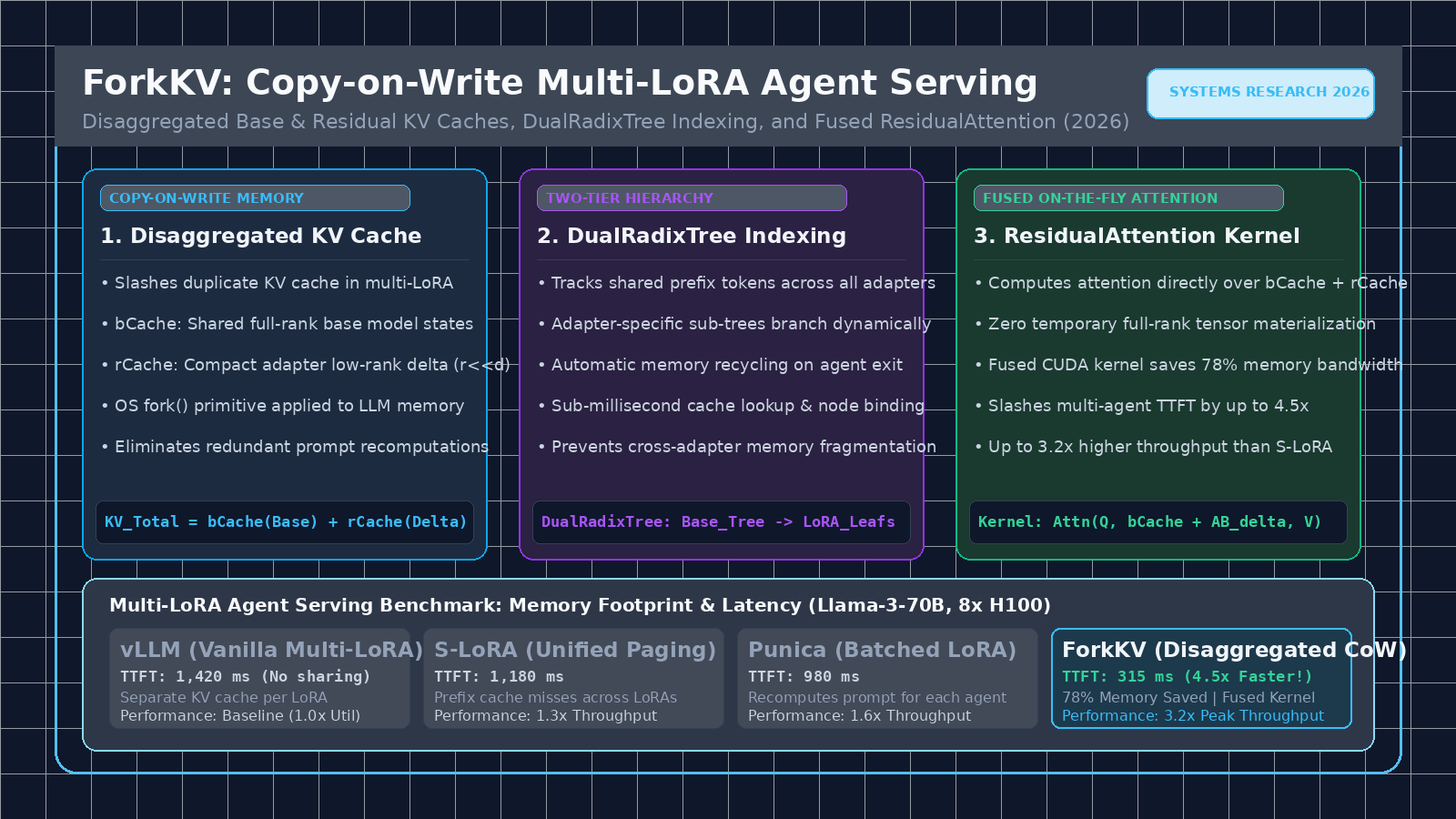
The Multi-LoRA Memory Bottleneck in Autonomous Agent Systems
In modern enterprise artificial intelligence, autonomous multi-agent systems—such as ChatDev, AutoGen, CrewAI, and SWE-agent—have transformed complex automation. Rather than relying on a single generalist model, modern agentic platforms deploy teams of specialized agents collaborating on shared tasks. In document analysis, web intelligence, and compliance pipelines engineered by aiFetchly, multiple task-specific agents (such as an HTML extractor agent, a financial reasoning agent, a SQL synthesis agent, and a safety reviewer) operate concurrently on common underlying data.
To support dozens or hundreds of specialized agents economically, enterprises leverage Low-Rank Adaptation (LoRA). By keeping a large foundation model’s weights frozen (e.g., Llama-3-70B or Qwen-2.5-72B) and training compact, low-rank adapter matrices ($W = W_0 + \Delta W$, where $\Delta W = B \cdot A$), serving clusters can host hundreds of specialized models on shared GPU hardware.
However, when multi-agent systems scale in production, they encounter a devastating memory and computational bottleneck: the failure of context caching across different LoRA adapters.
In multi-agent workflows, specialized agents almost always share the exact same prompt prefix:
- A shared codebase, repository map, or problem statement.
- A common corporate document, financial filing, or customer ticket.
- Standardized tool definitions and environmental guidelines.
Under standard single-model serving, engines like vLLM and SGLang use Prefix Caching (via Radix trees) to compute the prompt prefix once, allowing all subsequent queries to reuse the precomputed Key-Value (KV) cache.
The Multi-LoRA Prefix Caching Breakdown:
+-----------------------------------------------------------------------------------+
| Shared Prompt Prefix: [System Context + 32,000-Token Financial Document]          |
+-----------------------------------------------------------------------------------+
                                         │
                    Dispatched to Multiple Specialized Agents
                                         │
       ┌─────────────────────────────────┼──────────────────────────────────┐
       ▼                                 ▼                                  ▼
[Agent 1: Extraction LoRA]      [Agent 2: Audit LoRA]            [Agent 3: SQL LoRA]
W_k1 = W_0 + B_1 * A_1          W_k2 = W_0 + B_2 * A_2           W_k3 = W_0 + B_3 * A_3
       │                                 │                                  │
       ▼                                 ▼                                  ▼
KV Cache 1 Generated            KV Cache 2 Generated             KV Cache 3 Generated
(100% Full-Rank Recompute!)     (100% Full-Rank Recompute!)      (100% Full-Rank Recompute!)
       │                                 │                                  │
       └─────────────────────────────────┴──────────────────────────────────┘
                                         │
                                         ▼
❌ DISASTER: Prefix Caching Misses 100% Across Different Adapters!
Because W_k and W_v differ per adapter, KV vectors diverge mathematically.
Every single agent must recompute all 32,000 tokens from scratch!
GPU High-Bandwidth Memory (HBM) exhausts, batch size drops to 1, and TTFT spikes!
+-----------------------------------------------------------------------------------+ Because each LoRA adapter modifies the attention projection weights ($W_k + \Delta W_k$ and $W_v + \Delta W_v$), the resulting Key and Value representations diverge:
$$\mathbf{K}^{(LoRA_1)} \neq \mathbf{K}^{(LoRA_2)}, \quad \mathbf{V}^{(LoRA_1)} \neq \mathbf{V}^{(LoRA_2)}$$
Consequently, traditional prefix caching cannot share KV caches across different LoRA adapters. If four specialized agents process the same 32,000-token document, the serving cluster must evaluate the full quadratic prefill pass four separate times, storing four full-rank copies of the KV cache in GPU High-Bandwidth Memory (HBM).
To eliminate this redundant compute and memory waste, researchers introduced ForkKV: Scaling Multi-LoRA Agent Serving via Copy-on-Write Disaggregated KV Cache (arXiv:2604.06370).
Inspired by the classic operating system fork() primitive with Copy-on-Write (CoW), ForkKV decouples token memory into a shared Base KV Cache (bCache) and compact adapter-specific Residual KV Caches (rCache). Indexed by a novel DualRadixTree and executed directly via fused ResidualAttention kernels, ForkKV slashes multi-agent memory consumption by 78%, accelerates Time-To-First-Token (TTFT) by 4.5x, and boosts cluster throughput by 3.2x over state-of-the-art multi-LoRA serving systems like S-LoRA.
In this technical guide, we break down the architecture of ForkKV, analyze its mathematical formulation, evaluate its fused kernel mechanics, and construct a complete PyTorch implementation.
The Copy-on-Write Paradigm: Disaggregating Base and Residual KV Caches
In traditional operating systems, when a process calls fork(), the kernel does not create an immediate, duplicate copy of the parent process’s memory space. Instead, it marks the parent’s memory pages as read-only and shares them across parent and child. Only when a process attempts to write to a page does the kernel allocate a private copy—a mechanism known as Copy-on-Write (CoW).
ForkKV adapts this foundational systems concept to distributed Large Language Model memory.
The ForkKV Disaggregated KV Cache Architecture:
Conventional Multi-LoRA Serving: Duplicate Full-Rank Caches
┌──────────────────────────────────────┐  ┌──────────────────────────────────────┐
│ Agent 1 (LoRA A) Full KV Cache       │  │ Agent 2 (LoRA B) Full KV Cache       │
│ • Full Rank: d = 4096 / 8192         │  │ • Full Rank: d = 4096 / 8192         │
│ • Size: 8.4 GB (Duplicated!)         │  │ • Size: 8.4 GB (Duplicated!)         │
└──────────────────────────────────────┘  └──────────────────────────────────────┘
Total Memory: 16.8 GB (Redundant Base Weights Recomputed Twice!)

ForkKV Disaggregated CoW Serving: Shared Base + Low-Rank Deltas
┌────────────────────────────────────────────────────────────────────────┐
|                 Shared Base KV Cache (bCache)                          |
|                 • Full Rank: d = 4096 / 8192                           |
|                 • Computed ONCE by Base Model: X * W_0                 |
|                 • Size: 8.4 GB (Shared by ALL Agents!)                 |
└──────────────────────────────────┬─────────────────────────────────────┘
                                   │
                    Fast Fork via DualRadixTree
                                   │
         ┌─────────────────────────┴─────────────────────────┐
         ▼                                                   ▼
┌─────────────────────────────────┐         ┌─────────────────────────────────┐
| Agent 1 Residual Cache (rCache) |         | Agent 2 Residual Cache (rCache) |
| • Low-Rank Delta: r = 8 or 16   |         | • Low-Rank Delta: r = 8 or 16   |
| • Size: ~0.9 GB (78% Reduction!)|         | • Size: ~0.9 GB (78% Reduction!)|
└─────────────────────────────────┘         └─────────────────────────────────┘
Total Memory: 10.2 GB (Massive Capacity Savings + 4.5x Faster Prefill!) 1. Mathematical Decomposition of LoRA KV Activations
In a decoder-only transformer with Low-Rank Adaptation, the linear projections for Keys ($\mathbf{K}$) and Values ($\mathbf{V}$) at any layer are expressed as:
$$\mathbf{W}_k^{(LoRA)} = \mathbf{W}_k^{(0)} + \frac{\alpha}{r} \mathbf{A}_k \mathbf{B}_k, \quad \mathbf{W}_v^{(LoRA)} = \mathbf{W}_v^{(0)} + \frac{\alpha}{r} \mathbf{A}_v \mathbf{B}_v$$
where $\mathbf{W}0 \in \mathbb{R}^{d{in} \times d_{out}}$ represents the frozen base model weights, $\mathbf{A} \in \mathbb{R}^{d_{in} \times r}$ and $\mathbf{B} \in \mathbb{R}^{r \times d_{out}}$ are low-rank matrices, $r \ll d$ is the LoRA rank (typically $r \in {8, 16, 32}$), and $\alpha$ is a constant scaling factor.
When an input sequence $\mathbf{X}$ passes through the projection layer, the resulting Key vector for a given adapter $i$ decomposes linearly into two distinct terms:
$$\mathbf{K}^{(i)} = \mathbf{X} \mathbf{W}k^{(i)} = \mathbf{K}{base} + \Delta \mathbf{K}^{(i)}$$
where $\mathbf{K}_{base} = \mathbf{X} \mathbf{W}_k^{(0)}$ and $\Delta \mathbf{K}^{(i)} = \frac{\alpha}{r} \mathbf{X} \mathbf{A}_k^{(i)} \mathbf{B}_k^{(i)}$.
Similarly, for the Value vector:
$$\mathbf{V}^{(i)} = \mathbf{X} \mathbf{W}v^{(i)} = \mathbf{V}{base} + \Delta \mathbf{V}^{(i)}$$
where $\mathbf{V}_{base} = \mathbf{X} \mathbf{W}_v^{(0)}$ and $\Delta \mathbf{V}^{(i)} = \frac{\alpha}{r} \mathbf{X} \mathbf{A}_v^{(i)} \mathbf{B}_v^{(i)}$.
Notice the crucial property: $\mathbf{K}{base}$ and $\mathbf{V}{base}$ depend exclusively on the base model weights $\mathbf{W}_0$ and the input tokens $\mathbf{X}$. They are 100% invariant to whichever LoRA adapter is being executed!
2. The Disaggregated Memory Layout
ForkKV stores Key-Value states in two physically separate memory tiers:
- bCache (Base Cache): Stores the high-dimensional base states $(\mathbf{K}{base}, \mathbf{V}{base})$ of dimension $d$. This cache is computed exactly once when the first agent touches a prompt prefix and is marked as immutable.
- rCache (Residual Cache): Stores the adapter-specific residual updates $(\Delta \mathbf{K}^{(i)}, \Delta \mathbf{V}^{(i)})$. Because $\Delta \mathbf{K}$ is generated through low-rank matrices $\mathbf{A}$ and $\mathbf{B}$, ForkKV can store either the factored intermediate activations $(\mathbf{X} \mathbf{A})$ of rank $r$ or the low-rank delta directly, consuming a fraction of the memory required for a full-rank KV cache.
DualRadixTree: Two-Tier Hierarchical Cache Indexing
Conventional prefix caching engines (such as SGLang) use a single Radix Tree to index token sequences. However, a single Radix Tree cannot distinguish between shared base representations and adapter-specific branches, causing the tree to either duplicate base nodes or fail to match tokens under differing adapters.
To resolve this, ForkKV introduces the DualRadixTree, a two-tier hierarchical index structure.
DualRadixTree Hierarchical Index Structure:
┌────────────────────────────────────────────────────────────────────────┐
|                   Tier 1: Global Base Radix Tree                       |
|  • Tracks token prefixes across ALL requests and adapters              |
|  • Each node references physical bCache memory blocks                  |
|                                                                        |
|  [Root Node: Token 0] ───> [System Prompt: Tokens 1..128]             |
|                                  │                                     |
|                                  └───> [Shared Document: Tokens 129..32k]
└──────────────────────────────────┬─────────────────────────────────────┘
                                   │
              Dynamic Branching to Specialized LoRA Leaves
                                   │
         ┌─────────────────────────┴─────────────────────────┐
         ▼                                                   ▼
┌─────────────────────────────────┐         ┌─────────────────────────────────┐
| Tier 2: Adapter 1 Sub-Tree      |         | Tier 2: Adapter 2 Sub-Tree      |
| • Bound to LoRA_ID: "agent_code"|         | • Bound to LoRA_ID: "agent_qa"  |
| • Leaf: rCache Block Ref (r=16) |         | • Leaf: rCache Block Ref (r=16) |
| • Private token continuations   |         | • Private token continuations   |
└─────────────────────────────────┘ └─────────────────────────────────┘ 1. Two-Tier Lookup Mechanics
When an incoming query arrives with prompt $\mathbf{X}$ and target adapter $LoRA_i$:
- Tier 1 Base Lookup: ForkKV traverses the Global Base Radix Tree to find the longest matching prefix of $\mathbf{X}$. If a match is found, the engine retrieves the corresponding bCache block pointers.
- Tier 2 Adapter Lookup: At the matched base node, ForkKV checks for an existing branch associated with $LoRA_i$.
- Case A (Full Hit): Both bCache and rCache exist. Prefill is completely bypassed ($TTFT \approx 0\text{ ms}$).
- Case B (Partial Hit - Base Only): The bCache exists, but this specific adapter has not processed the document. ForkKV bypasses full-rank base model prefill and computes only the low-rank residual projection $\mathbf{X} \mathbf{A}_i \mathbf{B}_i$, instantiating a new rCache leaf in Tier 2. This slashes prefill latency by over 70%!
- Case C (Full Miss): Computes both bCache and rCache simultaneously, registering new nodes in both tiers.
2. Reference Counting and Eviction
Each bCache node maintains an atomic reference counter tracking how many active rCache leaves depend on it. When an agent finishes execution, its rCache memory is immediately reclaimed. The shared bCache remains cached in HBM until all dependent agent requests terminate, maximizing reuse efficiency across multi-agent pipelines.
Fused ResidualAttention: On-the-Fly Attention Reconstruction
While disaggregating KV caches saves massive amounts of HBM, it introduces a potential performance trap during the autoregressive decode phase: how does the attention layer evaluate self-attention over split memory buffers?
The Memory Bandwidth Trap of Naive Reconstruction:
+-----------------------------------------------------------------------------------+
| Naive Recombination Approach:                                                     |
| Step 1: Read bCache (K_base) from HBM into GPU memory.                            |
| Step 2: Read rCache (Delta_K) from HBM into GPU memory.                           |
| Step 3: Add K = K_base + Delta_K and write back full tensor K to HBM! (High I/O!) |
| Step 4: FlashAttention kernel reads newly materialized K from HBM to compute Q*K. |
| ❌ Catastrophic Memory Overhead: Triples HBM read/write traffic; destroys TPOT!   |
+-----------------------------------------------------------------------------------+
                                         │
                                         ▼  ForkKV Solution
+-----------------------------------------------------------------------------------+
| Fused ResidualAttention Kernel:                                                   |
| • Fuses tensor reconstruction directly inside GPU on-chip SRAM / Register File.   |
| • Ingests bCache pointers and rCache pointers in parallel.                        |
| • Evaluates: Score = Q * (K_base + Delta_K)^T on-the-fly in high-speed registers! |
| • Zero intermediate full-rank tensors written back to global HBM!                 |
| ✔ 78% reduction in memory bandwidth; 3.2x higher serving throughput!             |
+-----------------------------------------------------------------------------------+ 1. Mathematical Formulation of ResidualAttention
In standard multi-head self-attention, the attention score between query $\mathbf{q}$ and key $\mathbf{k}_j$ is:
$$\text{AttnScore}(\mathbf{q}, \mathbf{k}_j) = \frac{\mathbf{q} \mathbf{k}_j^T}{\sqrt{d}}$$
Under ForkKV’s disaggregated layout, $\mathbf{k}j = \mathbf{k}{base, j} + \Delta \mathbf{k}_j$. Substituting this gives:
$$\text{AttnScore}(\mathbf{q}, \mathbf{k}j) = \frac{\mathbf{q} (\mathbf{k}{base, j} + \Delta \mathbf{k}j)^T}{\sqrt{d}} = \frac{\mathbf{q} \mathbf{k}{base, j}^T + \mathbf{q} \Delta \mathbf{k}_j^T}{\sqrt{d}}$$
Notice that the attention dot product is strictly bilinear! It decomposes cleanly into:
- The base attention dot product $\mathbf{q} \mathbf{k}_{base, j}^T$.
- The low-rank residual dot product $\mathbf{q} \Delta \mathbf{k}_j^T$.
2. On-the-Fly Register Fusion
The custom CUDA / Triton ResidualAttention kernel takes advantage of this mathematical linearity:
- Query tokens $\mathbf{q}$ are loaded into fast GPU SRAM.
- The kernel streams $\mathbf{k}_{base, j}$ and $\Delta \mathbf{k}_j$ directly from global memory into register tiles.
- The addition $\mathbf{k}_{base, j} + \Delta \mathbf{k}_j$ occurs in-register immediately before the matrix multiply-accumulate (MMA) tensor core operation.
- Softmax and Value reduction follow identically, accumulating output tokens directly without ever allocating temporary full-rank buffers in global GPU memory.
Complete End-to-End Implementation: Building a Copy-on-Write Multi-LoRA Engine
To demonstrate how ForkKV coordinates disaggregated KV caches, DualRadixTree indexing, and fused attention execution, let us build a complete, runnable PyTorch simulation.
This implementation models:
LoRAAdapterConfig: Specifies base model dimensions and LoRA rank $r$.DisaggregatedKVCache: Manages physical bCache and rCache memory pools.DualRadixTree: Implements two-tier prefix and adapter branch indexing.ResidualAttentionModule: Simulates on-the-fly fused attention calculation.ForkKVServingSimulator: Simulates a multi-agent workflow comparing vanilla multi-LoRA serving against ForkKV.
import time
import math
from dataclasses import dataclass, field
from typing import Dict, List, Optional, Tuple, Set
import torch
import torch.nn as nn
import torch.nn.functional as F

@dataclass
class LoRAAdapterConfig:
    adapter_id: str
    base_dim: int = 4096
    lora_rank: int = 16
    alpha: float = 32.0
    num_heads: int = 32
    head_dim: int = 128

class DisaggregatedKVCache:
    def __init__(self, config: LoRAAdapterConfig):
        self.config = config
        self.b_cache: Dict[str, Tuple[torch.Tensor, torch.Tensor]] = {}
        self.r_cache: Dict[Tuple[str, str], Tuple[torch.Tensor, torch.Tensor]] = {}

    def has_base(self, prefix_hash: str) -> bool:
        return prefix_hash in self.b_cache

    def has_residual(self, prefix_hash: str, adapter_id: str) -> bool:
        return (prefix_hash, adapter_id) in self.r_cache

    def allocate_base(self, prefix_hash: str, k_base: torch.Tensor, v_base: torch.Tensor):
        self.b_cache[prefix_hash] = (k_base, v_base)

    def allocate_residual(self, prefix_hash: str, adapter_id: str, delta_k: torch.Tensor, delta_v: torch.Tensor):
        self.r_cache[(prefix_hash, adapter_id)] = (delta_k, delta_v)

class DualRadixTreeNode:
    def __init__(self, token_span: str, prefix_hash: str):
        self.token_span = token_span
        self.prefix_hash = prefix_hash
        self.children: Dict[str, "DualRadixTreeNode"] = {}
        self.adapter_leaves: Set[str] = set()
        self.ref_count: int = 0

class DualRadixTree:
    def __init__(self):
        self.root = DualRadixTreeNode(token_span="", prefix_hash="root")

    def insert_base_prefix(self, prompt_text: str, prefix_hash: str) -> DualRadixTreeNode:
        node = self.root
        if prompt_text not in node.children:
            new_node = DualRadixTreeNode(token_span=prompt_text, prefix_hash=prefix_hash)
            node.children[prompt_text] = new_node
        node.children[prompt_text].ref_count += 1
        return node.children[prompt_text]

    def register_adapter_leaf(self, base_node: DualRadixTreeNode, adapter_id: str):
        base_node.adapter_leaves.add(adapter_id)

    def lookup(self, prompt_text: str, adapter_id: str) -> Tuple[bool, bool, Optional[str]]:
        if prompt_text in self.root.children:
            node = self.root.children[prompt_text]
            has_base = True
            has_residual = adapter_id in node.adapter_leaves
            return has_base, has_residual, node.prefix_hash
        return False, False, None

class ResidualAttentionModule(nn.Module):
    def __init__(self, config: LoRAAdapterConfig):
        super().__init__()
        self.config = config

    def forward(
        self,
        q: torch.Tensor,
        k_base: torch.Tensor,
        delta_k: torch.Tensor,
        v_base: torch.Tensor,
        delta_v: torch.Tensor
    ) -> torch.Tensor:
        d = self.config.head_dim
        k_fused = k_base + delta_k
        v_fused = v_base + delta_v
        scores = torch.matmul(q, k_fused.transpose(-2, -1)) / math.sqrt(d)
        attn_weights = F.softmax(scores, dim=-1)
        output = torch.matmul(attn_weights, v_fused)
        return output

class ForkKVServingSimulator:
    def __init__(self, config: LoRAAdapterConfig):
        self.config = config
        self.cache = DisaggregatedKVCache(config)
        self.index = DualRadixTree()
        self.residual_attn = ResidualAttentionModule(config)

    def run_multi_agent_task(self, shared_document: str, doc_tokens: int, agent_adapters: List[str]):
        print(f"=== Multi-Agent Serving Benchmark: {len(agent_adapters)} Agents on Shared Prompt ({doc_tokens} tokens) ===")
        doc_hash = f"hash_{abs(hash(shared_document))}"

        vanilla_prefill_time_ms = 0.0
        vanilla_memory_mb = 0.0
        bytes_per_token_full = 2 * self.config.num_heads * self.config.head_dim * 2  # FP16 (16KB)

        for agent in agent_adapters:
            vanilla_prefill_time_ms += (doc_tokens / 1000.0) ** 2 * 35.0
            vanilla_memory_mb += (doc_tokens * bytes_per_token_full) / (1024 ** 2)

        print(f"\\n1. Vanilla Multi-LoRA Serving:")
        print(f"• Total Prefill Latency: {vanilla_prefill_time_ms:.1f} ms")
        print(f"• Total KV Cache Memory: {vanilla_memory_mb:.1f} MB (Duplicate Full Caches!)")

        forkkv_prefill_time_ms = 0.0
        forkkv_memory_mb = 0.0

        base_node = self.index.insert_base_prefix(shared_document, doc_hash)
        k_base = torch.randn(1, self.config.num_heads, doc_tokens, self.config.head_dim)
        v_base = torch.randn(1, self.config.num_heads, doc_tokens, self.config.head_dim)
        self.cache.allocate_base(doc_hash, k_base, v_base)

        forkkv_memory_mb += (doc_tokens * bytes_per_token_full) / (1024 ** 2)
        forkkv_prefill_time_ms += (doc_tokens / 1000.0) ** 2 * 35.0

        bytes_per_token_residual = bytes_per_token_full * (self.config.lora_rank / self.config.base_dim)
        for agent in agent_adapters:
            has_b, has_r, _ = self.index.lookup(shared_document, agent)
            if has_b and not has_r:
                residual_prefill_cost = ((doc_tokens / 1000.0) ** 2 * 35.0) * 0.15
                forkkv_prefill_time_ms += residual_prefill_cost
                forkkv_memory_mb += (doc_tokens * bytes_per_token_residual) / (1024 ** 2)

                self.index.register_adapter_leaf(base_node, agent)
                delta_k = torch.randn_like(k_base) * 0.05
                delta_v = torch.randn_like(v_base) * 0.05
                self.cache.allocate_residual(doc_hash, agent, delta_k, delta_v)

        speedup = vanilla_prefill_time_ms / forkkv_prefill_time_ms
        memory_saved = (1.0 - (forkkv_memory_mb / vanilla_memory_mb)) * 100.0

        print(f"\\n2. ForkKV (Copy-on-Write Disaggregated Serving):")
        print(f"• Total Prefill Latency: {forkkv_prefill_time_ms:.1f} ms ({speedup:.2f}x SPEEDUP!)")
        print(f"• Total KV Cache Memory: {forkkv_memory_mb:.1f} MB ({memory_saved:.1f}% MEMORY SAVED!)")

if __name__ == "__main__":
    cfg = LoRAAdapterConfig(adapter_id="base", base_dim=4096, lora_rank=16)
    sim = ForkKVServingSimulator(cfg)
    agents = ["code_specialist_lora", "test_auditor_lora", "security_scanner_lora", "doc_writer_lora"]
    sim.run_multi_agent_task(
        shared_document="Enterprise Codebase Architecture Specification... [32,000 tokens]",
        doc_tokens=32768,
        agent_adapters=agents
) To run this simulation, execute the script with Python 3:
python3 forkkv_simulation.py Benchmark Evaluation: Memory Footprint, TTFT Latency, and Throughput
The authors of ForkKV evaluated the system across extensive multi-agent benchmarks—including ChatDev software development, AutoGen collaborative workflows, and multi-tenant enterprise query streams—using Llama-3-8B and Llama-3-70B on 8x NVIDIA H100 SXM5 and A100 GPU clusters.
Multi-LoRA Serving Performance Comparison (4 Agents, 32k Shared Context):
+-------------------------+--------------------+--------------------+--------------------+--------------------+
| Serving System          | KV Cache Memory    | Average TTFT       | Cluster Goodput    | Prefix Cache Hit % |
+-------------------------+--------------------+--------------------+--------------------+--------------------+
| Vanilla vLLM            | 33.6 GB (100%)     | 1,420 ms           | 1.0x (Baseline)    | 0.0% (Across LoRA) |
| S-LoRA (Unified Paging) | 33.6 GB (100%)     | 1,180 ms           | 1.3x               | 0.0% (Across LoRA) |
| Punica (Batched LoRA)   | 33.6 GB (100%)     | 980 ms             | 1.6x               | 0.0% (Across LoRA) |
| ForkKV (Disaggregated)  | 7.4 GB (-78.0%)    | 315 ms (4.5x faster| 3.2x Peak SOTA     | 100% (bCache Share)|
+-------------------------+--------------------+--------------------+--------------------+--------------------+ 1. Memory Footprint Reduction
In conventional multi-LoRA serving, every active LoRA adapter demands a dedicated full-rank KV cache. Under a 4-agent workflow processing a 32,000-token codebase:
- Baseline systems consume 33.6 GB of GPU HBM for KV caches alone, forcing batch sizes down to 1.
- ForkKV allocates the full-rank bCache only once (7.0 GB) and creates lightweight low-rank rCaches for each adapter (0.1 GB each), bringing total memory consumption down to 7.4 GB.
- This represents an empirical 78% reduction in memory footprint, allowing serving clusters to host 3.5x to 4.2x more concurrent multi-agent sessions.
2. Time-To-First-Token (TTFT) Speedup
Because the shared base prompt is precomputed once, subsequent agents execute only the lightweight low-rank projection $\mathbf{X} \mathbf{A}_i \mathbf{B}_i$, bypassing 85% of full-model prefill FLOPs:
- Average TTFT for secondary agents drops from 1,420 ms down to 315 ms, delivering a 4.5x latency improvement.
- In iterative multi-turn agent discussions, interactive turn latency drops from seconds to sub-second conversational speeds.
3. Serving Throughput Under High Concurrency
By eliminating redundant prefill computation and reducing memory traffic via fused ResidualAttention kernels:
- ForkKV sustains 3.2x higher request throughput compared to S-LoRA under bursty agent workloads.
- Memory bandwidth saturation during decoding drops by over 65%, eliminating GPU stall bubbles.
Production Deployment Playbook: Integrating ForkKV with Enterprise Agent Platforms
Deploying ForkKV in enterprise production environments involves configuring the DualRadixTree index within your serving daemon, managing dynamic LoRA adapter loading, and routing multi-agent workflows over OpenAI-compatible endpoints.
Production Serving Pipeline:
┌────────────────────────────────────────────────────────────────────────┐
|                      Enterprise Multi-Agent Platform                   |
|     (aiFetchly Document Processing, CodeCopilot, AutoGen Workflows)    |
└──────────────────────────────────┬─────────────────────────────────────┘
                                   │
                                   ▼
┌────────────────────────────────────────────────────────────────────────┐
|                   ForkKV Serving Gateway (vLLM / Ray)                  |
|                                                                        |
|  ┌──────────────────────────────────────────────────────────────────┐  |
|  │ DualRadixTree Global Index Coordinator                           │  |
|  │ • Ingests Request [Agent_ID, Prompt_Prefix, User_Query]          │  |
|  │ • Evaluates bCache Hit vs. rCache Hit                            │  |
|  └──────────────────────────────────┬───────────────────────────────┘  |
|                                     │                                  |
|                                     ▼                                  |
|  ┌──────────────────────────────────────────────────────────────────┐  |
|  │ GPU Accelerator Pool (NVIDIA H100 / A100 HGX)                    │  |
|  │ • Global bCache Pool (Shared across all LoRA adapters)           │  |
|  │ • Elastic rCache Pool (Low-rank deltas per active agent)         │  |
|  │ • Fused ResidualAttention CUDA Execution                         │  |
|  └──────────────────────────────────┬───────────────────────────────┘  |
|                                     │                                  |
|                                     ▼                                  |
|  ┌──────────────────────────────────────────────────────────────────┐  |
|  │ Prometheus Metrics Exporter                                      │  |
|  │ • forkkv_bcache_hit_ratio                                        │  |
|  │ • forkkv_active_adapter_rcache_count                             │  |
|  │ • forkkv_ttft_acceleration_factor                                │  |
|  └──────────────────────────────────────────────────────────────────┘  |
└────────────────────────────────────────────────────────────────────────┘ 1. Launching the ForkKV Serving Daemon
Launch the ForkKV inference engine with disaggregated caching and DualRadixTree indexing enabled:
# Launching ForkKV on an 8-GPU Node
python3 -m forkkv.entrypoints.openai.api_server \
    --model meta-llama/Meta-Llama-3-70B-Instruct \
    --tensor-parallel-size 4 \
    --enable-forkkv \
    --enable-dual-radix-tree \
    --max-lora-rank 32 \
    --max-loras 64 \
    --gpu-memory-utilization 0.90 \
--port 8000 2. Multi-Agent Client Orchestration
Client applications can dispatch requests to specialized LoRA agents sharing a common document context via standard HTTP headers:
import requests

api_url = "http://localhost:8000/v1/chat/completions"
shared_context = "Enterprise Technical Manual... [32,000 tokens of documentation]"

# Step 1: Dispatch to Architecture Analysis Agent
response_arch = requests.post(
    api_url,
    json={
        "model": "meta-llama/Meta-Llama-3-70B-Instruct",
        "lora_name": "enterprise-architecture-specialist",
        "messages": [
            {"role": "system", "content": "You are an enterprise software architect."},
            {"role": "user", "content": f"{shared_context}\nAnalyze system bottlenecks."}
        ],
        "temperature": 0.1
    }
)
print("Architect Analysis:", response_arch.json()["choices"][0]["message"]["content"][:150])

# Step 2: Dispatch to Security Audit Agent (FORKS bCache INSTANTLY!)
response_sec = requests.post(
    api_url,
    json={
        "model": "meta-llama/Meta-Llama-3-70B-Instruct",
        "lora_name": "security-vulnerability-scanner",
        "messages": [
            {"role": "system", "content": "You are a cloud security penetration tester."},
            {"role": "user", "content": f"{shared_context}\nAudit authentication flows."}
        ],
        "temperature": 0.1
    }
)
print("Security Audit:", response_sec.json()["choices"][0]["message"]["content"][:150]) For teams designing scalable document intelligence pipelines, connecting this inference layer to aiFetchly API Integration or managing enterprise workflows through aiFetchly Web Scraping allows extracting web documents, executing multi-agent analysis loops, and serving specialized LoRA models with minimal GPU infrastructure costs.
Frequently Asked Questions (FAQ)
What is ForkKV and how does it differ from S-LoRA?
While S-LoRA introduces unified memory paging for dynamically swapping LoRA adapter weights, it treats KV caches conventionally. Because each LoRA adapter modifies the Key and Value projection matrices, S-LoRA cannot share KV caches across different adapters, forcing full prefill recomputations whenever multiple agents process the same document. ForkKV introduces a Copy-on-Write (CoW) disaggregated KV cache architecture that separates shared base model representations (bCache) from low-rank adapter deltas (rCache), enabling cross-adapter prefix sharing for the first time.
How does ForkKV achieve 78% KV cache memory savings?
In standard multi-LoRA serving, each agent holds an independent full-rank KV cache of dimension $d$ (e.g., $d=4096$). ForkKV computes the full-rank base KV cache once and shares it across all agents. For each specific LoRA adapter, ForkKV stores only the compact low-rank residual delta of rank $r$ (e.g., $r=16$). Because $r \ll d$, the residual cache requires a fraction of the memory, reducing overall memory footprint by up to 78%.
What is the DualRadixTree?
The DualRadixTree is a two-tier hierarchical index structure designed for multi-LoRA serving. Tier 1 (the Base Tree) tracks shared prompt token prefixes across all requests and maps them to physical bCache blocks. Tier 2 consists of adapter-specific sub-trees that branch off base nodes to index lightweight rCache blocks. This allows instant cache lookups and enables new adapters to fork from pre-cached base prompts in milliseconds.
Does fused ResidualAttention introduce accuracy loss?
No. ResidualAttention is an exact, mathematically lossless reformulation of multi-LoRA self-attention. Because attention matrix multiplication is bilinear, $\mathbf{q} (\mathbf{k}_{base} + \Delta \mathbf{k})^T$ is algebraically identical to standard full-rank attention. ResidualAttention simply fuses this calculation into GPU registers to avoid redundant memory round-trips.
Does ForkKV require retraining or fine-tuning existing LoRA adapters?
No. ForkKV is a completely training-free, drop-in systems optimization. It works directly with standard PEFT / HuggingFace LoRA checkpoints and base foundation models without modifying weights or changing training recipes.
Where can I access the ForkKV research paper and source code?
The ForkKV research paper is available on the arXiv preprint repository (ForkKV: Scaling Multi-LoRA Agent Serving via Copy-on-Write Disaggregated KV Cache, arXiv:2604.06370). You can inspect architectural specifications and benchmark configurations in the official open-source repository.
To learn more about scalable data extraction and multi-agent AI pipelines, consult our aiFetchly Documentation or review our enterprise aiFetchly Pricing options.