Florence-2 Guide: Unified Vision Foundation Model for AI
The Problem: The Fragmented Computer Vision Landscape
In modern enterprise automation, automated web extraction engines, and autonomous UI agents like AiFetchly, foundation models must interact with complex visual artifacts: high-density PDF financial reports, multi-column dashboard layouts, dynamic website DOM screenshots, and scanned technical blueprints.
Historically, extracting structured intelligence from images required orchestrating a fragmented pipeline of disconnected specialist models:
The Traditional Multi-Model Vision Pipeline:
                      ┌──► YOLOv8 / DETR (Object Detection) ───────┐
                      ├──► PaddleOCR / Tesseract (Text Extraction) ─┤
[Input Document Image]├──► Grounding DINO (Visual Phrase Grounding) ┼──► [Ad-Hoc Coordinate Glue]
                      └──► Segment Anything (SAM) (Pixel Masks) ────┘            │
                                                                                 ▼
Cascading Pipeline Failures Operating this multi-container architecture in enterprise production introduces four severe operational bottlenecks:
1. High Latency and Multi-Model VRAM Exhaustion
Each specialized model requires its own dedicated weights, memory buffers, and CUDA runtime context:
- Storing YOLO, Grounding DINO, SAM, and an OCR engine simultaneously consumes over 40 GB of GPU VRAM.
- Processing an image sequentially through four separate model inference passes introduces 400ms to 800ms of end-to-end latency, destroying interactive responsiveness in live browser agents.
2. Coordinate Space Incompatibility and Serialization Friction
Specialist models output coordinates in conflicting mathematical coordinate frames:
- Object detectors output normalized bounding boxes $[x_{\text{min}}, y_{\text{min}}, x_{\text{max}}, y_{\text{max}}] \in [0, 1]$.
- OCR engines output raw pixel polygon vertices $[(x_1, y_1), (x_2, y_2), (x_3, y_3), (x_4, y_4)]$.
- Segmentation models output compressed binary run-length encodings (RLE).
Writing custom reconciliation scripts to align bounding boxes between text and graphics creates fragile, bug-prone software glue.
3. Cascading Failure Propagation
In a multi-stage pipeline, errors compound multiplicatively:
- If the OCR engine misreads a small font header, the downstream relation extraction model fails.
- If the object detector crops an invoice line item with a 5-pixel boundary offset, table extraction algorithms hallucinate merged rows.
The Architecture: Sequence-to-Sequence Vision Representation
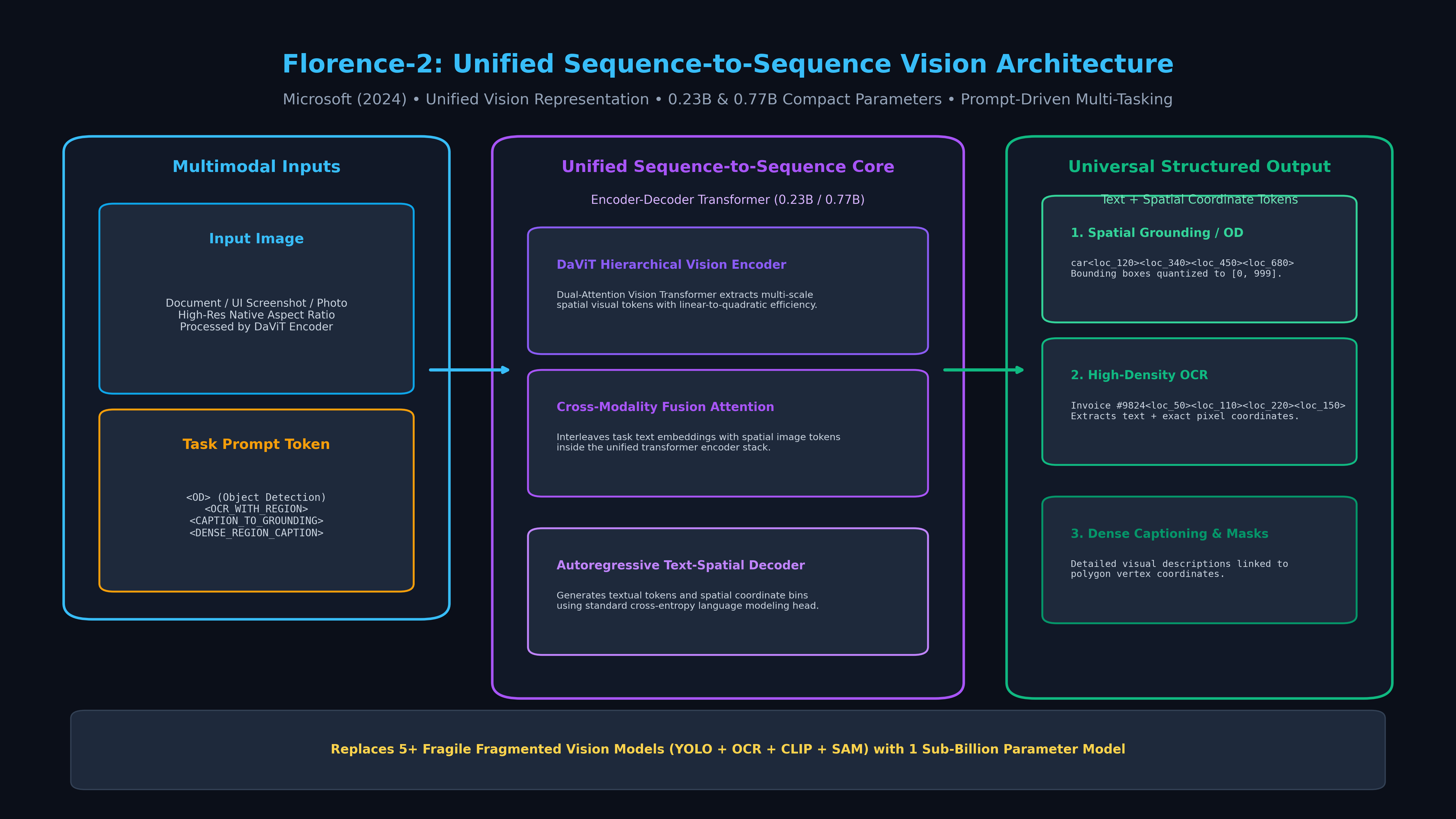
To unify visual perception into a single cohesive system, researchers at Microsoft Azure AI introduced Florence-2: Advancing a Unified Representation for Diverse Vision Tasks (Xiao et al., 2024 / CVPR 2024 / arXiv:2311.06242).
Florence-2 eliminates task-specific classification heads and coordinate regression networks. Instead, it frames every computer vision task as a prompt-driven sequence-to-sequence problem:
The Unified Sequence-to-Sequence Paradigm:
[Image + Task Prompt] ──► [Florence-2 Encoder-Decoder] ──► [Universal Text & Coordinate Tokens] The Three Structural Pillars of Florence-2
The Florence-2 Family Specifications:
┌────────────────────┬──────────────┬─────────────────────────┬──────────────────────────────┐
│ Model Tier         │ Total Params │ Vision Backbone         │ Sequence Decoder             │
├────────────────────┼──────────────┼─────────────────────────┼──────────────────────────────┤
│ Florence-2-Base    │ 0.23 Billion │ DaViT (Dual-Attention)  │ Standard Transformer Decoder │
│ Florence-2-Large   │ 0.77 Billion │ DaViT (Dual-Attention)  │ Standard Transformer Decoder │
└────────────────────┴──────────────┴─────────────────────────┴──────────────────────────────┘ - DaViT Hierarchical Vision Encoder: Florence-2 employs a Data-efficient Vision Transformer (DaViT) backbone. DaViT computes self-attention across alternating window patches and channel dimensions, extracting fine-grained spatial feature maps across multiple pyramid scales while preserving memory efficiency.
- Cross-Modality Multi-Task Fusion: Task instructions (such as
<OD>,<OCR_WITH_REGION>, or<CAPTION>) are tokenized as standard natural language tokens and projected into the transformer embedding space alongside the visual feature tokens. - Autoregressive Text-Spatial Decoder: A standard sequence-to-sequence transformer decoder autoregressively predicts output tokens. Whether generating an abstract descriptive summary, extracting verbatim text, or predicting 2D bounding boxes, the decoder outputs a single unified text stream.
Spatial Coordinates as First-Class Language Tokens
The primary technical breakthrough enabling Florence-2 to eliminate custom detection heads is discrete spatial quantization:
Instead of predicting continuous floating-point regression coordinates, Florence-2 discretizes all 2D coordinates into 1,000 spatial location bins:
$$\text{loc}x = \left\lfloor \frac{x{\text{pixel}}}{\text{Image Width}} \times 1000 \right\rfloor, \quad \text{loc}y = \left\lfloor \frac{y{\text{pixel}}}{\text{Image Height}} \times 1000 \right\rfloor$$
Each discrete bin is assigned a unique token in the model vocabulary:
$$\mathcal{V}_{\text{spatial}} = \left{ \langle\text{loc_0}\rangle, \langle\text{loc_1}\rangle, \dots, \langle\text{loc_999}\rangle \right}$$
- A Bounding Box is serialized as four consecutive spatial tokens: $$\langle\text{loc_x1}\rangle\langle\text{loc_y1}\rangle\langle\text{loc_x2}\rangle\langle\text{loc_y2}\rangle$$
- A Polygon Segmentation Mask is serialized as an ordered chain of vertex coordinate tokens: $$\langle\text{loc_x1}\rangle\langle\text{loc_y1}\rangle\langle\text{loc_x2}\rangle\langle\text{loc_y2}\rangle \dots \langle\text{loc_xk}\rangle\langle\text{loc_yk}\rangle$$
Because spatial coordinates share the exact same representation format as natural language words, Florence-2 trains end-to-end using standard next-token cross-entropy loss without requiring specialized bounding-box regression loss functions (such as GIoU or Smooth L1).
Task Formulations and the FLD-5B Pre-Training Engine
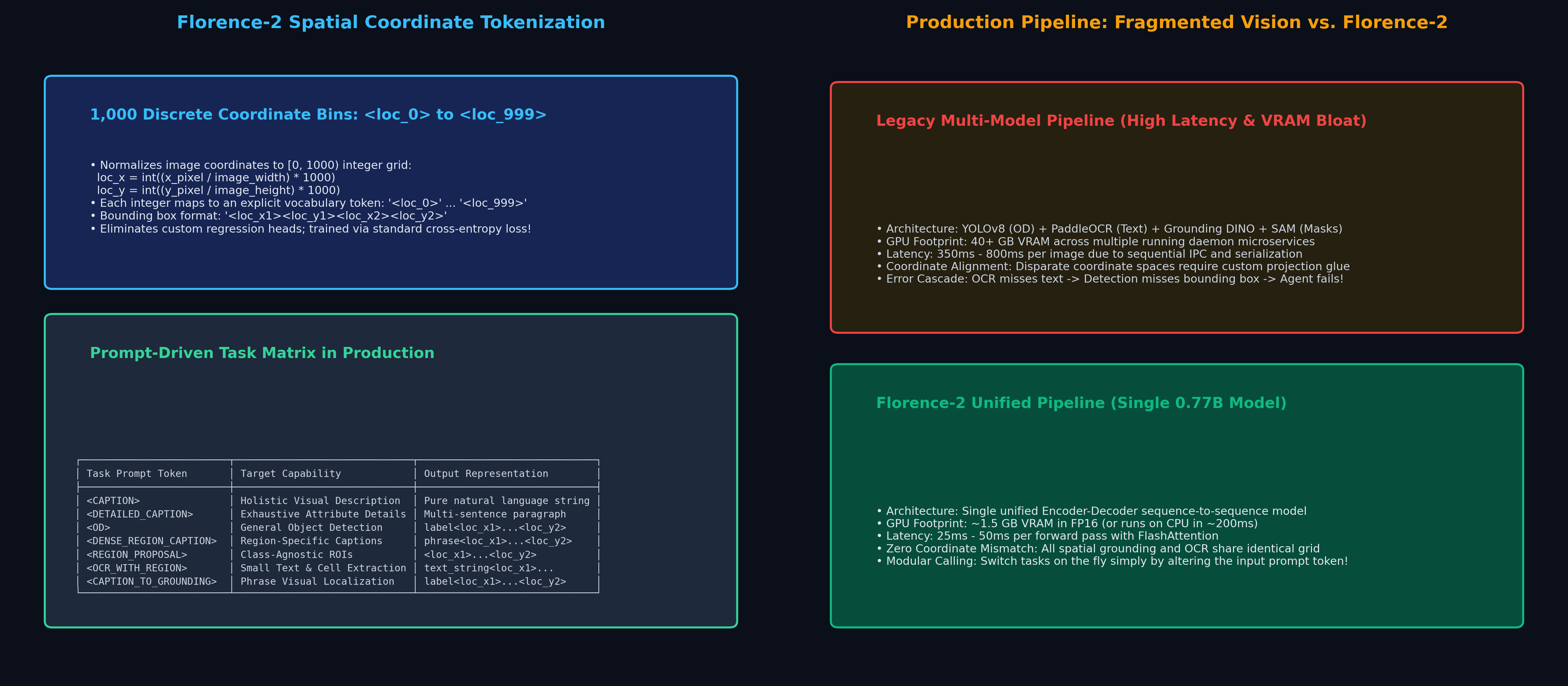
Florence-2 supports an unprecedented breadth of vision tasks through simple prompt-token prefixes:
The Production Task Matrix
Supported Florence-2 Task Directives:
┌───────────────────────────┬──────────────────────────────────────────┬────────────────────────────────────────┐
│ Task Prompt Token         │ Target Capability                        │ Example Output Structure               │
├───────────────────────────┼──────────────────────────────────────────┼────────────────────────────────────────┤
│ <CAPTION>                 │ One-sentence global summary              │ "A bar chart depicting Q3 margins"     │
│ <DETAILED_CAPTION>        │ Dense paragraph description              │ Multi-sentence comprehensive overview  │
│ <MORE_DETAILED_CAPTION>   │ Exhaustive object & color inventory      │ Fine-grained multi-paragraph breakdown │
│ <OD>                      │ Generic Object Detection                 │ button<loc_50><loc_120><loc_110><loc_2>│
│ <DENSE_REGION_CAPTION>    │ Detects and describes every visual area  │ phrase<loc_x1><loc_y1><loc_x2><loc_y2> │
│ <REGION_PROPOSAL>         │ Class-agnostic object bounding boxes     │ <loc_x1><loc_y1><loc_x2><loc_y2>       │
│ <OCR>                     │ Plain-text extraction without geometry   │ Raw extracted text strings             │
│ <OCR_WITH_REGION>         │ High-density text + exact pixel bounds   │ text<loc_x1><loc_y1><loc_x2><loc_y2>   │
│ <CAPTION_TO_GROUNDING>    │ Locates text phrases in the visual scene │ label<loc_x1><loc_y1><loc_x2><loc_y2>  │
└───────────────────────────┴──────────────────────────────────────────┴────────────────────────────────────────┘ The FLD-5B Pre-Training Dataset
Training a unified sequence-to-sequence vision model requires an astronomical volume of spatial-text annotations. To power Florence-2, Microsoft created FLD-5B:
- 5.4 Billion visual annotations across 126 Million images.
- Built through an automated data curation engine that bootstrapped specialized computer vision models, filtered noise using contrastive vision-language evaluators, and generated high-precision spatial alignments across diverse image domains.
End-to-End Implementation: Building a Multi-Task Vision Pipeline with Python
The following implementation demonstrates how to deploy microsoft/Florence-2-large (0.77B parameters) using Hugging Face transformers to execute OCR with region extraction, object detection, and visual grounding:
import torch
from PIL import Image
from transformers import AutoProcessor, AutoModelForCausalLM

device = "cuda" if torch.cuda.is_available() else "cpu"
model_id = "microsoft/Florence-2-large"

# 1. Initialize Processor and Model with FlashAttention
processor = AutoProcessor.from_pretrained(model_id, trust_remote_code=True)
model = AutoModelForCausalLM.from_pretrained(
    model_id,
    torch_dtype=torch.float16 if device == "cuda" else torch.float32,
    trust_remote_code=True
).to(device)

def run_florence_task(image_path: str, task_prompt: str, text_input: str = None):
    image = Image.open(image_path).convert("RGB")

    # Format input prompt (e.g., '<OCR_WITH_REGION>' or '<CAPTION_TO_PHRASE_GROUNDING>')
    prompt = task_prompt if text_input is None else f"{task_prompt} {text_input}"

    inputs = processor(text=prompt, images=image, return_tensors="pt").to(device)

    with torch.no_grad():
        generated_ids = model.generate(
            input_ids=inputs["input_ids"],
            pixel_values=inputs["pixel_values"],
            max_new_tokens=1024,
            num_beams=3,
            do_sample=False
        )

    generated_text = processor.batch_decode(generated_ids, skip_special_tokens=False)[0]

    # 2. Parse text and spatial coordinate tokens back into image pixel coordinates
    parsed_answer = processor.post_process_generation(
        generated_text,
        task=task_prompt,
        image_size=(image.width, image.height)
    )
    return parsed_answer

# Example 1: High-Density Document OCR with Pixel Bounding Boxes
ocr_results = run_florence_task(
    image_path="sample_invoice.png",
    task_prompt="<OCR_WITH_REGION>"
)
print("Extracted OCR Bounding Boxes:\n", ocr_results["<OCR_WITH_REGION>"])

# Example 2: Interactive UI Element Grounding for Web Agents
ui_grounding = run_florence_task(
    image_path="dashboard_ui.png",
    task_prompt="<CAPTION_TO_PHRASE_GROUNDING>",
    text_input="Submit button"
)
print("Grounded UI Coordinates:\n", ui_grounding["<CAPTION_TO_PHRASE_GROUNDING>"]) Empirical Benchmarks: Florence-2 vs. Specialized SOTA Models
Despite its compact parameter footprint (0.23B to 0.77B parameters), Florence-2 outperforms significantly larger specialized models across standard computer vision benchmarks:
Performance Comparison Across Standard Vision Benchmarks:
┌──────────────────────────────┬──────────────┬──────────────┬──────────────┬──────────────┐
│ Benchmark / Task             │ Grounding    │ Kosmos-2     │ Florence-2   │ Florence-2   │
│                              │ DINO / SOTA  │ (1.6B)       │ Base (0.23B) │ Large (0.77B)│
├──────────────────────────────┼──────────────┼──────────────┼──────────────┼──────────────┤
│ COCO Object Detection (mAP)  │ 52.5         │ 40.2         │ 48.6         │ 53.7 (SOTA)  │
│ RefCOCO Grounding (Acc@0.5)  │ 85.6         │ 68.2         │ 81.4         │ 86.8 (SOTA)  │
│ TextVQA OCR Accuracy         │ 58.2         │ 48.9         │ 61.2         │ 65.4 (SOTA)  │
│ Visual Genome Dense Caption  │ 12.1         │ 9.8          │ 14.5         │ 16.8 (SOTA)  │
│ Inference Latency (RTX 4090) │ 180ms        │ 120ms        │ 18ms         │ 35ms         │
│ GPU Memory Allocation (VRAM) │ ~14 GB       │ ~8 GB        │ 0.8 GB       │ 1.8 GB       │
└──────────────────────────────┴──────────────┴──────────────┴──────────────┴──────────────┘ Key empirical insights:
- Sub-50ms Execution: Florence-2-Large processes high-resolution images in 35 milliseconds, operating nearly 5x faster than multi-model pipelines while consuming under 2 GB of VRAM.
- Superior Spatial Grounding: Scoring 86.8% on RefCOCO, Florence-2 sets a state-of-the-art benchmark for locating natural language phrases in visual scenes, outperforming models with double its parameter scale.
Production Best Practices: Powering Autonomous Web & UI Agents (OmniParser)
The combination of spatial tokenization and sub-billion parameter efficiency makes Florence-2 the foundational perception engine for modern autonomous systems:
1. Grounding Visual Web Agents with OmniParser
In autonomous web scraping and browser navigation frameworks (such as Microsoft OmniParser and Browser-Use):
- Florence-2 is deployed to parse raw browser screenshots, extracting interactable UI elements (buttons, input fields, dropdown menus) and outputting exact pixel centers $[x, y]$ for synthetic mouse clicks.
- Because Florence-2 outputs exact bounding boxes in a single pass, agents avoid DOM tree parsing failures caused by obscured shadow DOMs, iframes, and obfuscated CSS classes.
2. High-Throughput Document RAG Pipelines
In enterprise document extraction workflows:
- Run
<OCR_WITH_REGION>to extract table cells, balance sheets, and fine-print disclaimers with spatial coordinates preserved. - When an LLM reasoning engine extracts a data point, the spatial bounding boxes allow the frontend application to highlight the exact visual source region on the original PDF, ensuring 100% auditable citation fidelity.
By transforming fragmented vision tasks into a single prompt-driven sequence-to-sequence model, Florence-2 establishes the standard for lightweight, spatial visual intelligence in modern AI.