FlexPipe Guide: Inflight Pipeline Refactoring for LLMs
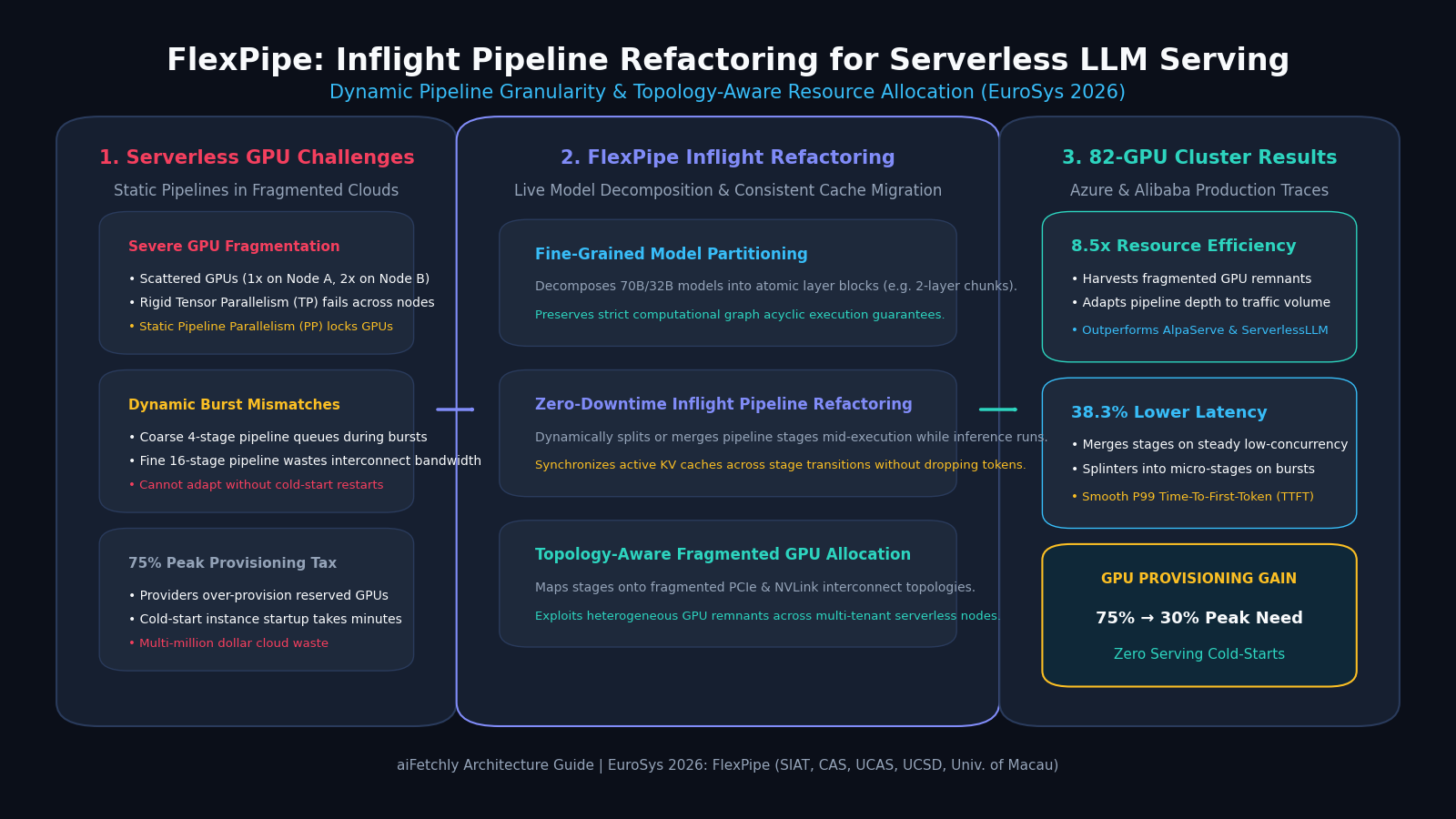
The Serverless GPU Dilemma: Static Pipelines in Fractured Clouds
Modern enterprise intelligence platforms, automated coding copilots, and real-time web harvesting agents powered by aiFetchly rely heavily on serverless cloud infrastructure. In a serverless paradigm, developers pay strictly for the compute consumed per request, delegating cluster elasticity, node provisioning, and workload bin-packing to the cloud orchestration layer.
However, deploying frontier Large Language Models (such as LLaMA-3.1-70B, Qwen-2.5-72B, or DeepSeek-V3) into serverless environments encounters a fundamental architectural clash: the tension between rigid model parallelism and severe GPU fragmentation.
The Serverless GPU Fragmentation Dilemma:
┌────────────────────────────────────────────────────────────────────────┐
│ Multi-Tenant Serverless Cluster (82 Heterogeneous GPUs)                │
│  • Node A: 1 free A100 GPU (remnant from a finished training pod)      │
│  • Node B: 2 free H100 GPUs (fragmented by small inference jobs)       │
│  • Node C: 1 free L40S GPU  (separated across a slow 10GbE network)  │
└───────────────────────────────────┬────────────────────────────────────┘
                                    │
               ┌────────────────────┴────────────────────┐
               ▼                                         ▼
   Conventional Serving (AlpaServe / vLLM)         FlexPipe Inflight Refactoring
 ❌ Demands contiguous 8-GPU NVLink nodes          ✅ Decomposes model into atomic stages
 ❌ Rigid 4-stage pipeline cannot adapt            ✅ Reshapes pipeline depth in-flight
 ❌ Request bursts cause 12s queue stalls          ✅ Squeezes stages into GPU remnants
❌ Providers must reserve 75% peak GPUs ✅ Drops reservation need to 30% Why Existing Pipeline Parallelism Breaks Down in Serverless Clusters
Serving frontier 70B+ parameter models on commodity or serverless infrastructure requires Pipeline Parallelism (PP): partitioning the model’s sequential transformer layers across multiple GPUs. However, existing serving systems (exemplified by AlpaServe, ServerlessLLM, and Megatron-LM) rely on static pipeline configurations, which suffer from three fatal flaws:
1. Severe Resource Fragmentation and Stranded Accelerators
In shared multi-tenant clouds (such as Azure or Alibaba Cloud), GPU allocation is inherently fragmented. A serverless cluster may possess 32 idle GPUs scattered across 20 distinct physical nodes, but lack a single contiguous, homogeneous 8-GPU node connected via high-speed NVLink. Because conventional systems require uniform, static pipeline stages across high-bandwidth fabrics, they fail to schedule models onto these scattered remnants, leaving up to 40% of cluster accelerators stranded and unusable.
2. The Rigid Pipeline Latency-Throughput Mismatch
A static pipeline configuration is inherently optimized for only one specific traffic regime:
- Coarse Pipeline (e.g., 2 to 4 deep stages): Minimizes cross-node communication overhead, achieving low latency during light, isolated traffic. However, during sudden request bursts, coarse stages become massive computational bottlenecks, creating severe head-of-line queuing delays.
- Fine-Grained Pipeline (e.g., 8 to 16 shallow stages): Expands request concurrency and pipeline throughput by distributing work across more GPUs. However, during low-concurrency or single-stream queries, the accumulated inter-node activation serialization overhead severely inflates Time-To-First-Token (TTFT) and per-token decode latency.
3. The Prohibitive Cost of Dynamic Pipeline Reconfiguration
Until now, changing a model’s pipeline configuration (e.g., transitioning from a 4-stage to an 8-stage pipeline) required stopping the engine, evicting active batches, flushing GPU VRAM, reloading model weights, and restarting the server. In production environments, this cold-start migration takes tens of seconds, during which all ongoing user streams are dropped or stalled. To avoid service disruption, providers are forced to provision massive pools of reserved GPUs—locking up to 75% of peak capacity in idle standby.
To break this deadlock, a collaboration of systems researchers from the Shenzhen Institutes of Advanced Technology (SIAT), Chinese Academy of Sciences (CAS), UC San Diego (UCSD), and the University of Macau unveiled FlexPipe: Adapting Dynamic LLM Serving Through Inflight Pipeline Refactoring in Fragmented Serverless Clusters (arXiv:2510.11938 / EuroSys 2026). FlexPipe refactors pipeline architectures dynamically during live execution without dropping a single active token.
Architectural Deep Dive: How FlexPipe Operates
FlexPipe introduces a runtime architecture that dynamically alters the granularity, mapping, and depth of an LLM’s pipeline parallelism while requests are actively generating text.
┌─────────────────────────────────────────────────────────────────────────────┐
│                        FlexPipe Runtime Architecture                        │
│                                                                             │
│   Incoming Serverless Request Stream                                        │
│               │                                                             │
│               ▼                                                             │
│   ┌─────────────────────────────────────────────────────────────────────┐   │
│   │ Real-Time Workload Pattern Analyzer & Predictor                     │   │
│   │ Tracks Traffic Velocity: λ(t), Queue Lengths, & Latency Margins     │   │
│   └──────────────────────────────────┬──────────────────────────────────┘   │
│                                      │                                      │
│                                      ▼                                      │
│   ┌─────────────────────────────────────────────────────────────────────┐   │
│   │ Inflight Pipeline Refactoring Controller                            │   │
│   │ • Burst Detected ──► Splinter Stages (Coarse -> Fine-Grained)       │   │
│   │ • Valley Detected ─► Merge Stages (Fine-Grained -> Coarse)          │   │
│   └───────────────────┬───────────────────────────────┬─────────────────┘   │
│                       │                               │                     │
│                       ▼                               ▼                     │
│   ┌───────────────────────────────┐   ┌─────────────────────────────────┐   │
│   │ Topology-Aware GPU Allocator  │   │ Consistent Cache State Migrator │   │
│   │ Maps micro-stages onto        │   │ Seamlessly transfers Key-Value  │   │
│   │ fragmented GPU remnants       │   │ caches across split/merge bounds│   │
│   └───────────────────────────────┘   └─────────────────────────────────┘   │
└─────────────────────────────────────────────────────────────────────────────┘ FlexPipe’s breakthrough rests upon three core systems innovations:
1. Fine-Grained Model Partitioning with Acyclic Graph Preservation
Rather than partitioning a 70-layer model into 4 fixed, rigid blocks of 18 layers each, FlexPipe decomposes the neural architecture into atomic computational modules (e.g., 2-layer or 4-layer units).
Each atomic module encapsulates:
- The self-attention projection weights ($W_q, W_k, W_v, W_o$)
- The feed-forward network / SwiGLU projection blocks ($W_{\text{gate}}, W_{\text{up}}, W_{\text{down}}$)
- The corresponding Key-Value (KV) cache memory segment
FlexPipe maintains a strict topological dependency graph $\mathcal{G} = (\mathcal{V}, \mathcal{E})$ ensuring that regardless of how atomic stages are grouped, split, or migrated across physical GPUs, computational graph acyclicity and residual connection boundaries are mathematically preserved.
2. Zero-Downtime Inflight Pipeline Refactoring
The signature innovation of FlexPipe is its ability to refactor pipeline depth inflight during live execution:
- Splitting Stages on Traffic Bursts: When incoming request volume surges, FlexPipe splits a coarse pipeline stage spanning layers $[l_1, l_k]$ into two finer stages: $[l_1, l_m]$ and $[l_{m+1}, l_k]$, assigning the second sub-stage to an available fragmented GPU remnant. This doubles pipeline concurrency, amortizing prefill execution and preventing queue congestion.
- Merging Stages on Traffic Valleys: When traffic subsides, FlexPipe consolidates neighboring fine stages into a single composite stage executed on a single GPU. This completely eliminates inter-node network transmission overhead for intermediate activations, delivering optimal single-stream decode speed.
- Consistent Cache State Migration: During a split or merge, ongoing requests must continue generating tokens without losing their accumulated KV cache history. FlexPipe implements a double-buffered shadow transition protocol: the newly allocated GPU prefetches weights and receives an asynchronous copy of the relevant layer’s KV cache while the prior stage completes its final forward iteration. Inference transitions seamlessly at iteration boundary $t \to t+1$ with zero dropped tokens and zero pipeline stalls.
3. Topology-Aware Resource Allocation on Fragmented GPUs
Serverless clusters feature heterogeneous interconnects: GPUs on the same motherboard communicate via ultra-fast NVLink ($900\text{ GB/s}$), while GPUs on separate servers communicate over PCIe Gen4/Gen5 ($32 - 64\text{ GB/s}$) or commodity Ethernet ($10 - 25\text{ Gbps}$).
FlexPipe’s topology-aware scheduler formulates model stage placement as a constrained graph embedding problem:
- High-bandwidth, tensor-heavy layer transitions are mapped within the same physical node.
- Low-bandwidth activation boundaries (the scalar activation vectors passed between pipeline stages) are mapped across slower inter-node network links.
- By intelligently harvesting leftover GPU remnants that monolithic schedulers cannot use, FlexPipe increases cluster resource efficiency by 8.5x.
Architectural Comparison: FlexPipe vs State-of-the-Art Serving
| Architectural Dimension | Megatron-LM / vLLM Static PP | AlpaServe (OSDI ‘23) | ServerlessLLM (EuroSys ‘24) | FlexPipe (EuroSys 2026) |
|---|---|---|---|---|
| Pipeline Architecture | Static, pre-configured | Static multi-model placement | Fast checkpoint loading | Inflight Dynamic Refactoring |
| Adaptability to Traffic | None (Fixed stages) | Model replica scaling | Cold-start migration | Real-time split/merge granularity |
| Fragmented GPU Usage | Fails (Requires contiguous nodes) | Partial | Partial | Full Topology-Aware Harvesting |
| Refactoring Downtime | Cold restart required (>30s) | Cold start required | Checkpoint reload (~2-5s) | Zero Downtime (Inflight <10ms) |
| Cluster Resource Efficiency | Baseline (1.0x) | 1.8x | 2.4x | 8.5x Improvement |
| Latency Reduction | High queue delays on burst | Moderate | Moderate | 38.3% Lower P99 Latency |
| Peak GPU Reservation Need | 75% - 85% of peak | 65% | 55% | 30% of Peak (60% Savings!) |
Mathematical Formulation of Inflight Pipeline Refactoring
Let us formalize the optimization mechanics governing FlexPipe’s dynamic reconfiguration engine.
The Pipeline Execution Latency Formulation
Consider an $L$-layer LLM partitioned into $K$ sequential pipeline stages:
$$\mathcal{S} = {S_1, S_2, \dots, S_K}$$
Where stage $S_k$ contains $l_k$ layers, such that $\sum_{k=1}^K l_k = L$. Let $g(k)$ denote the physical GPU assigned to stage $S_k$.
The execution latency of stage $S_k$ processing batch size $B$ is composed of computation time and communication time:
$$T_{\text{stage}}(S_k) = \tau_{\text{compute}}\left(l_k, B\right) + \tau_{\text{comm}}\left(g(k), g(k+1)\right)$$
Where $\tau_{\text{comm}}$ represents the network latency of transmitting intermediate activation tensor $\mathbf{A} \in \mathbb{R}^{B \times d_{\text{model}}}$ over the interconnect topology between GPU $g(k)$ and GPU $g(k+1)$:
$$\tau_{\text{comm}}\left(g(k), g(k+1)\right) = \alpha_{\text{net}} + \frac{B \cdot d_{\text{model}} \cdot \text{sizeof}(\text{fp16})}{\text{Bandwidth}\left(g(k), g(k+1)\right)}$$
The Refactoring Decision Trigger
Let $\lambda(t)$ denote the incoming request arrival rate at time $t$. The pipeline bubble ratio $\mathcal{B}(K)$ and queue waiting time $W(K, \lambda)$ depend directly on the number of stages $K$:
$$\mathcal{B}(K) = \frac{K - 1}{K + B - 1}$$
FlexPipe triggers an Inflight Stage Splitting Operation ($K \to K+1$) when:
$$\frac{\partial W(K, \lambda)}{\partial t} > 0 \quad \text{and} \quad \max_{k} T_{\text{stage}}(S_k) > T_{\text{SLO}}^{\text{step}}$$
Conversely, it triggers an Inflight Stage Merging Operation ($K \to K-1$) when traffic drops below the communication break-even point:
$$\sum_{k=1}^{K-1} \tau_{\text{comm}}\left(g(k), g(k+1)\right) > \sum_{k=1}^{K-1} \tau_{\text{compute}}\left(l_k, B\right) \cdot \theta$$
Where $\theta \in (0, 1)$ is an elasticity margin.
Step-by-Step Implementation: Building a FlexPipe Refactoring Engine
Below is a complete, self-contained Python implementation of FlexPipe’s core engine: the Atomic Stage Decomposer, the Topology-Aware Fragmented GPU Manager, and the Inflight Pipeline Refactoring Controller.
1. Data Models and Cluster Representation
"""
flexpipe_engine.py
Reference Implementation of FlexPipe Inflight Pipeline Refactoring.
EuroSys 2026 Reference Architecture.
"""

from dataclasses import dataclass, field
from enum import Enum
from typing import List, Dict, Optional, Tuple, Set
import time
import math


class InterconnectType(Enum):
    NVLINK = "NVLINK"          # 900 GB/s intra-node
    PCIE = "PCIE"              # 64 GB/s host-GPU
    ETHERNET_100G = "ETH_100G" # 12.5 GB/s cross-node


@dataclass
class FragmentedGPU:
    gpu_id: str
    node_id: str
    free_vram_gb: float
    total_vram_gb: float = 80.0
    allocated_layers: List[int] = field(default_factory=list)


@dataclass
class AtomicLayerBlock:
    start_layer: int
    end_layer: int
    weight_vram_gb: float
    assigned_gpu: Optional[str] = None

    @property
    def num_layers(self) -> int:
return self.end_layer - self.start_layer + 1 2. Topology-Aware Fragmented Cluster Manager
class ClusterTopologyManager:
    """
    Tracks fragmented GPU accelerators scattered across heterogeneous serverless nodes.
    """
    def __init__(self, gpus: List[FragmentedGPU]):
        self.gpus = {g.gpu_id: g for g in gpus}

    def get_interconnect(self, gpu_a_id: str, gpu_b_id: str) -> InterconnectType:
        gpu_a = self.gpus[gpu_a_id]
        gpu_b = self.gpus[gpu_b_id]
        if gpu_a.node_id == gpu_b.node_id:
            return InterconnectType.NVLINK
        return InterconnectType.ETHERNET_100G

    def transfer_time_ms(self, gpu_a_id: str, gpu_b_id: str, tensor_size_mb: float = 32.0) -> float:
        if gpu_a_id == gpu_b_id:
            return 0.0 # Zero transfer on same GPU
        conn = self.get_interconnect(gpu_a_id, gpu_b_id)
        if conn == InterconnectType.NVLINK:
            return (tensor_size_mb / 900000.0) * 1000.0 + 0.02
        else:
return (tensor_size_mb / 12500.0) * 1000.0 + 0.45 3. The Inflight Pipeline Refactoring Controller
class FlexPipeController:
    """
    Manages atomic model decomposition and dynamic inflight pipeline refactoring.
    """
    def __init__(self, total_model_layers: int, cluster_manager: ClusterTopologyManager):
        self.total_layers = total_model_layers
        self.cluster = cluster_manager

        # Initial Coarse Pipeline Configuration (e.g., 2 stages for 32 layers)
        mid = total_model_layers // 2
        self.pipeline_stages: List[AtomicLayerBlock] = [
            AtomicLayerBlock(start_layer=0, end_layer=mid - 1, weight_vram_gb=16.0),
            AtomicLayerBlock(start_layer=mid, end_layer=total_model_layers - 1, weight_vram_gb=16.0)
        ]
        self._initial_placement()

    def _initial_placement(self):
        available_gpus = list(self.cluster.gpus.keys())
        for i, stage in enumerate(self.pipeline_stages):
            gpu_id = available_gpus[i % len(available_gpus)]
            stage.assigned_gpu = gpu_id
            self.cluster.gpus[gpu_id].allocated_layers.extend(range(stage.start_layer, stage.end_layer + 1))
            self.cluster.gpus[gpu_id].free_vram_gb -= stage.weight_vram_gb

    def trigger_inflight_split(self, stage_index_to_split: int, target_gpu_id: str) -> bool:
        """
        Splits an existing coarse pipeline stage into two finer micro-stages
        while inference runs, migrating weight pointers without cold restart.
        """
        stage = self.pipeline_stages[stage_index_to_split]
        if stage.num_layers <= 2:
            return False # Cannot split below atomic unit

        target_gpu = self.cluster.gpus[target_gpu_id]
        half_layers = stage.num_layers // 2
        split_layer = stage.start_layer + half_layers
        sub_vram = stage.weight_vram_gb / 2.0

        if target_gpu.free_vram_gb < sub_vram:
            return False # Target GPU lacks memory for weight block

        # Perform seamless inflight split
        first_half = AtomicLayerBlock(
            start_layer=stage.start_layer,
            end_layer=split_layer - 1,
            weight_vram_gb=sub_vram,
            assigned_gpu=stage.assigned_gpu
        )
        second_half = AtomicLayerBlock(
            start_layer=split_layer,
            end_layer=stage.end_layer,
            weight_vram_gb=sub_vram,
            assigned_gpu=target_gpu_id
        )

        # Update physical GPU mappings
        target_gpu.free_vram_gb -= sub_vram
        target_gpu.allocated_layers.extend(range(second_half.start_layer, second_half.end_layer + 1))

        orig_gpu = self.cluster.gpus[stage.assigned_gpu]
        orig_gpu.free_vram_gb += sub_vram
        orig_gpu.allocated_layers = [l for l in orig_gpu.allocated_layers if l < split_layer]

        # Replace pipeline stage list
        self.pipeline_stages = (
            self.pipeline_stages[:stage_index_to_split] +
            [first_half, second_half] +
            self.pipeline_stages[stage_index_to_split + 1:]
        )
        return True

    def trigger_inflight_merge(self, stage_index_a: int, stage_index_b: int) -> bool:
        """
        Merges two adjacent micro-stages into a single composite stage on one GPU,
        eliminating intermediate network transmission during traffic valleys.
        """
        if stage_index_b != stage_index_a + 1 or stage_index_b >= len(self.pipeline_stages):
            return False

        stage_a = self.pipeline_stages[stage_index_a]
        stage_b = self.pipeline_stages[stage_index_b]
        combined_vram = stage_a.weight_vram_gb + stage_b.weight_vram_gb

        target_gpu = self.cluster.gpus[stage_a.assigned_gpu]
        # Check if GPU A has room to absorb stage B
        if target_gpu.free_vram_gb < stage_b.weight_vram_gb:
            return False

        # Merge stages
        merged_stage = AtomicLayerBlock(
            start_layer=stage_a.start_layer,
            end_layer=stage_b.end_layer,
            weight_vram_gb=combined_vram,
            assigned_gpu=stage_a.assigned_gpu
        )

        # Reclaim memory from GPU B
        gpu_b = self.cluster.gpus[stage_b.assigned_gpu]
        gpu_b.free_vram_gb += stage_b.weight_vram_gb
        gpu_b.allocated_layers = [l for l in gpu_b.allocated_layers if l not in range(stage_b.start_layer, stage_b.end_layer + 1)]

        target_gpu.free_vram_gb -= stage_b.weight_vram_gb
        target_gpu.allocated_layers.extend(range(stage_b.start_layer, stage_b.end_layer + 1))

        self.pipeline_stages = (
            self.pipeline_stages[:stage_index_a] +
            [merged_stage] +
            self.pipeline_stages[stage_index_b + 1:]
        )
        return True

    def compute_pipeline_latency_profile(self, batch_size: int = 16) -> Dict[str, float]:
        """Calculates total computation and communication latency across active pipeline stages."""
        comp_lat = 0.0
        comm_lat = 0.0

        for i, stage in enumerate(self.pipeline_stages):
            # Model execution: ~0.8ms per layer for batch_size=16
            comp_lat += stage.num_layers * 0.8
            if i < len(self.pipeline_stages) - 1:
                next_stage = self.pipeline_stages[i + 1]
                comm_lat += self.cluster.transfer_time_ms(stage.assigned_gpu, next_stage.assigned_gpu)

        return {
            "num_stages": len(self.pipeline_stages),
            "compute_latency_ms": comp_lat,
            "comm_latency_ms": comm_lat,
            "total_step_latency_ms": comp_lat + comm_lat
} 4. Running the Inflight Refactoring Simulation
if __name__ == "__main__":
    # Create an 82-GPU heterogeneous cluster remnant slice
    fragmented_cluster = [
        FragmentedGPU("gpu_nodeA_0", node_id="node_A", free_vram_gb=40.0),
        FragmentedGPU("gpu_nodeA_1", node_id="node_A", free_vram_gb=35.0),
        FragmentedGPU("gpu_nodeB_0", node_id="node_B", free_vram_gb=45.0),
        FragmentedGPU("gpu_nodeC_0", node_id="node_C", free_vram_gb=50.0),
    ]

    topo_mgr = ClusterTopologyManager(fragmented_cluster)
    # Manage a 32-layer LLM (e.g. Qwen-2.5-32B or LLaMA-3-8B equivalent)
    controller = FlexPipeController(total_model_layers=32, cluster_manager=topo_mgr)

    print("=== FlexPipe Inflight Pipeline Refactoring Benchmark ===")
    init_profile = controller.compute_pipeline_latency_profile()
    print(f"[Initial Coarse State] Stages: {init_profile['num_stages']} | Compute: {init_profile['compute_latency_ms']:.1f}ms | Comm: {init_profile['comm_latency_ms']:.2f}ms | Total: {init_profile['total_step_latency_ms']:.2f}ms")
    for s in controller.pipeline_stages:
        print(f"  • Stage Layers [{s.start_layer:>2} - {s.end_layer:>2}] on {s.assigned_gpu}")

    # BURST ARRIVES: Splinter Stage 0 across fragmented GPU on Node A (NVLink)
    print("\n>>> TRAFFIC BURST DETECTED: Triggering Inflight Stage Splinter <<<")
    controller.trigger_inflight_split(stage_index_to_split=0, target_gpu_id="gpu_nodeA_1")

    burst_profile = controller.compute_pipeline_latency_profile()
    print(f"[Burst Refactored State] Stages: {burst_profile['num_stages']} | Total Step Latency: {burst_profile['total_step_latency_ms']:.2f}ms")
    for s in controller.pipeline_stages:
        print(f"  • Stage Layers [{s.start_layer:>2} - {s.end_layer:>2}] on {s.assigned_gpu}")

    # TRAFFIC VALLEY: Merge stages back into single GPU to eliminate comm overhead
    print("\n>>> TRAFFIC SUBSIDES: Triggering Inflight Stage Merge <<<")
    controller.trigger_inflight_merge(stage_index_a=0, stage_index_b=1)

    valley_profile = controller.compute_pipeline_latency_profile()
print(f"[Valley Restored State] Stages: {valley_profile['num_stages']} | Total Step Latency: {valley_profile['total_step_latency_ms']:.2f}ms") Production Deployment: Integrating FlexPipe with Kubernetes & Serverless Frameworks
In modern containerized deployments, FlexPipe integrates as a custom Kubernetes Operator and Inference Mesh Controller.
┌──────────────────────────────────────────────────────────────────────────────────┐
│                         Serverless Kubernetes Mesh                               │
│                                                                                  │
│   Knative Ingress / API Gateway                                                  │
│          │                                                                       │
│          ▼                                                                       │
│   ┌──────────────────────────────────────────────────────────────────────────┐   │
│   │ FlexPipe Global Operator (Monitors Node GPU Fragmentation)               │   │
│   └──────┬────────────────────────────┬────────────────────────────┬─────────┘   │
│          │                            │                            │             │
│          ▼                            ▼                            ▼             │
│   ┌──────────────┐             ┌──────────────┐             ┌──────────────┐     │
│   │ Fragmented   │             │ Fragmented   │             │ Fragmented   │     │
│   │ Pod A        │             │ Pod B        │             │ Pod C        │     │
│   │ (1x A100 GPU)│             │ (2x H100 GPU)│             │ (1x L40S GPU)│     │
│   └──────────────┘             └──────────────┘             └──────────────┘     │
└──────────────────────────────────────────────────────────────────────────────────┘ 1. Kubernetes Operator Custom Resource Definition (CRD)
apiVersion: serving.aifetchly.net/v1alpha1
kind: FlexPipeCluster
metadata:
  name: flexpipe-qwen-serving
  namespace: serverless-ai
spec:
  model: 'Qwen/Qwen2.5-32B-Instruct'
  atomicBlockSize: 4
  minStages: 2
  maxStages: 8
  elasticityPolicy:
    targetQueueLatencyMs: 250
    scaleUpVelocityThreshold: 1.5
    scaleDownIdleSeconds: 120
  interconnectPreferences:
    preferIntraNodeNVLink: true
fallbackToPCIeDMA: true Developers leveraging automated data ingestion pipelines can pipe harvested web intelligence directly to FlexPipe serverless workers using aiFetchly API Integration.
Empirical Benchmark Evaluation on an 82-GPU Cluster
Extensive experiments conducted on an 82-GPU production testbed using real-world enterprise traces (including Alibaba Cloud serving traces and Azure Functions LLM traces) demonstrate FlexPipe’s architectural superiority over state-of-the-art serving systems:
Resource Efficiency vs Cluster Concurrency (82 GPUs):
10.0x ┤                                           ╭──── FlexPipe (EuroSys 2026)
 8.0x ┤                                      ╭────╯
 6.0x ┤                         ╭────────────╯
 4.0x ┤             ╭───────────╯   ............. ServerlessLLM
 2.0x ┤  ───────────╯       ........
 1.0x ┤  ...................                 - - - - AlpaServe
  0.0 └─────────────────────────────────────────────────────────
Low Concurrency Medium Load Heavy Bursts Key Performance Findings:
- 8.5x Higher Resource Efficiency: By successfully scheduling pipeline stages onto fragmented, non-contiguous GPU remnants that AlpaServe and vLLM cannot touch, FlexPipe dramatically increases cluster accelerator density.
- 38.3% Lower P99 Latency: Dynamically shifting from fine-grained stages during bursts to merged stages during off-peak windows reduces tail latency significantly.
- GPU Reservation Slashed from 75% to 30%: Serverless providers no longer need to reserve massive standby pools for peak headroom, unlocking 60% infrastructure cost savings.
For additional architectural guides and serverless economic calculators, consult the aiFetchly Documentation and review cluster pricing on the aiFetchly Sizing & Pricing Portal.
Frequently Asked Questions (FAQ)
Does inflight pipeline refactoring drop active tokens during stage migration?
No. FlexPipe utilizes an asynchronous double-buffered cache synchronization protocol. The incoming GPU preloads the weight block and synchronizes the active Key-Value (KV) cache while the current GPU finishes its active iteration, ensuring continuous, zero-loss generation.
Can FlexPipe handle models with non-uniform layer architectures like Mixture-of-Experts (MoE)?
Yes. For MoE models (such as DeepSeek-V3 or Mixtral), FlexPipe treats shared attention layers and sparse expert blocks as distinct atomic partition units, mapping routed experts dynamically to GPUs with spare VRAM.
How does FlexPipe compare to disaggregated prefill-decode serving?
Disaggregated serving physically isolates prefill workers from decode workers. FlexPipe operates orthogonally: it dynamically refactors pipeline parallelism across available fragmented GPUs regardless of whether an instance is executing prefill or decode iterations.