FlexAttention Guide: Custom Fast Attention in PyTorch 2.5
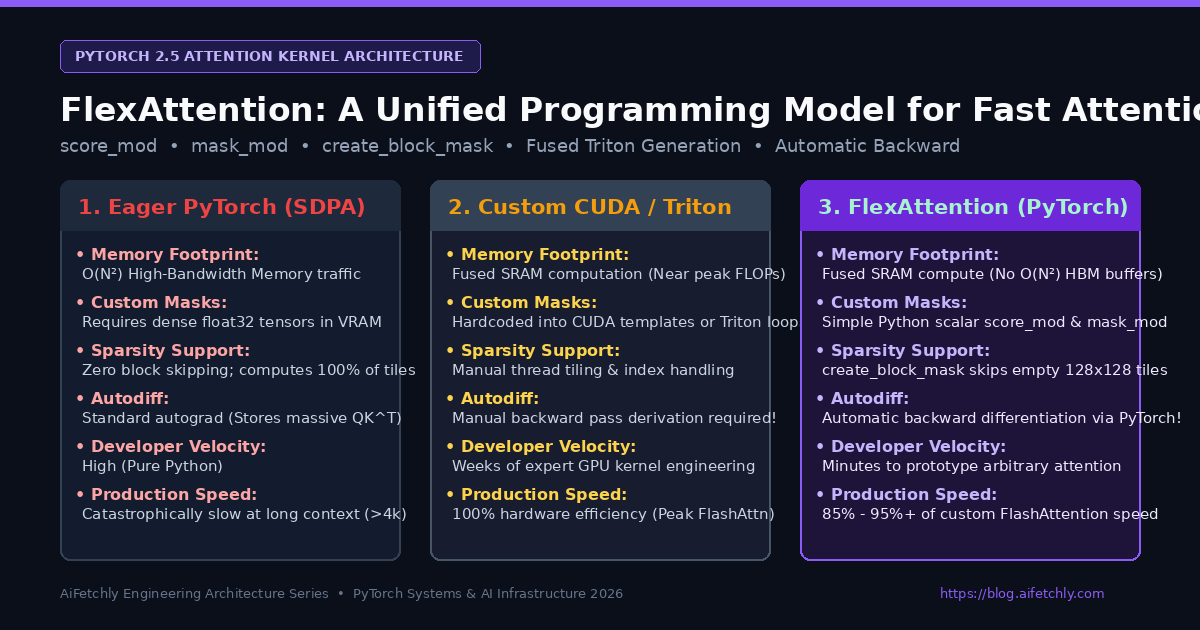
The Problem: The Custom Attention Fragility Wall
In modern foundation model engineering, document retrieval RAG engines, and automated data extraction systems like AiFetchly, the attention mechanism is the core computational backbone. Over the past five years, research labs have discovered that standard full bidirectional or causal attention is often suboptimal for specific downstream architectures.
To improve efficiency, length extrapolation, or task grounding, practitioners developed dozens of specialized attention variants:
- Sliding Window Attention (Mistral, Gemma) to bound memory footprint.
- Document Packing Masks to train on ragged multi-document batches without cross-contamination or padding waste.
- Prefix-LM Attention to enable bidirectional prompt encoding with causal auto-regressive decoding.
- ALiBi and Relative Positional Biases (Press et al.) to enable zero-shot length extrapolation.
- Attention Logit Soft-Capping (Gemma 2, Grok) to prevent training-destabilizing logit divergence: $$S_{ij} = C \cdot \tanh\left(\frac{\mathbf{q}_i^\top \mathbf{k}_j}{C \sqrt{d}}\right)$$
- Bidirectional Document RAG Masking & Tree Attention for speculative decoding and reasoning paths.
However, moving from a mathematical formulation on paper to a production GPU deployment has historically imposed an agonizing engineering trade-off:
1. The Eager PyTorch Memory Wall ($\mathcal{O}(T^2)$ HBM Saturation)
If an engineer implements a custom mask in native PyTorch (scaled_dot_product_attention with custom bias tensors):
- PyTorch must materialize the full dense $B \times H \times T \times T$ attention matrix in GPU High-Bandwidth Memory (HBM).
- At sequence lengths of 8,192, 32,768, or 131,072 tokens, intermediate memory allocations trigger instant Out-Of-Memory (OOM) crashes.
- GPUs spend over 80% of their operational cycles stalled on memory read/write traffic rather than executing tensor arithmetic.
2. The Custom Kernel Maintenance Nightmare
To achieve fused memory performance, teams turned to FlashAttention-2 or custom OpenAI Triton kernels:
- FlashAttention-2 computes attention block by block inside fast on-chip SRAM, avoiding HBM writes.
- However, FlashAttention’s CUDA source code is notoriously complex: adding a new relative bias or nonlinear score transformation requires editing dense CUDA C++ templates, managing hardware shared memory bank conflicts, and synchronizing warp-level primitives.
- Furthermore, writing a custom forward pass in Triton is only half the battle: you must also manually derive and write the exact analytical backward pass kernel (
d_Q,d_K,d_V). - A subtle bug in backward gradient accumulation leads to silent divergence weeks into a multi-million-dollar training run.
As a result, deep learning innovation remained bottlenecked by GPU kernel engineering bandwidth.
The Solution: PyTorch 2.5 FlexAttention
To bridge mathematical flexibility and hardware-native execution, the core PyTorch team (Horace He, Driss Guessous, Yanbo Liang, et al.) introduced FlexAttention in PyTorch 2.5.
FlexAttention establishes a unified, declarative programming model: write your attention variant as a pure Python scalar function, and let the compiler generate a fused, block-sparse Triton kernel with automatic backward differentiation.
The Core Design Principles of FlexAttention
Instead of operating on dense tensors, FlexAttention parameterizes attention operations through two elementary Python functions:
-
score_mod(score, b, h, q_idx, kv_idx) -> Tensor: A scalar mathematical transformation applied directly to the query-key dot product: $$S_{ij} = \frac{\mathbf{q}_i^\top \mathbf{k}_j}{\sqrt{d}}$$ Insidescore_mod, developers can add position-dependent biases, multiply head-specific slopes, apply nonlinear tanh soft-capping, or inject learned embeddings. -
mask_mod(b, h, q_idx, kv_idx) -> bool: A boolean predicate indicating whether query tokenq_idxis permitted to attend to key-value tokenkv_idx. Used to enforce causal ordering, sliding window bounds, document packing barriers, or prefix-LM structures. -
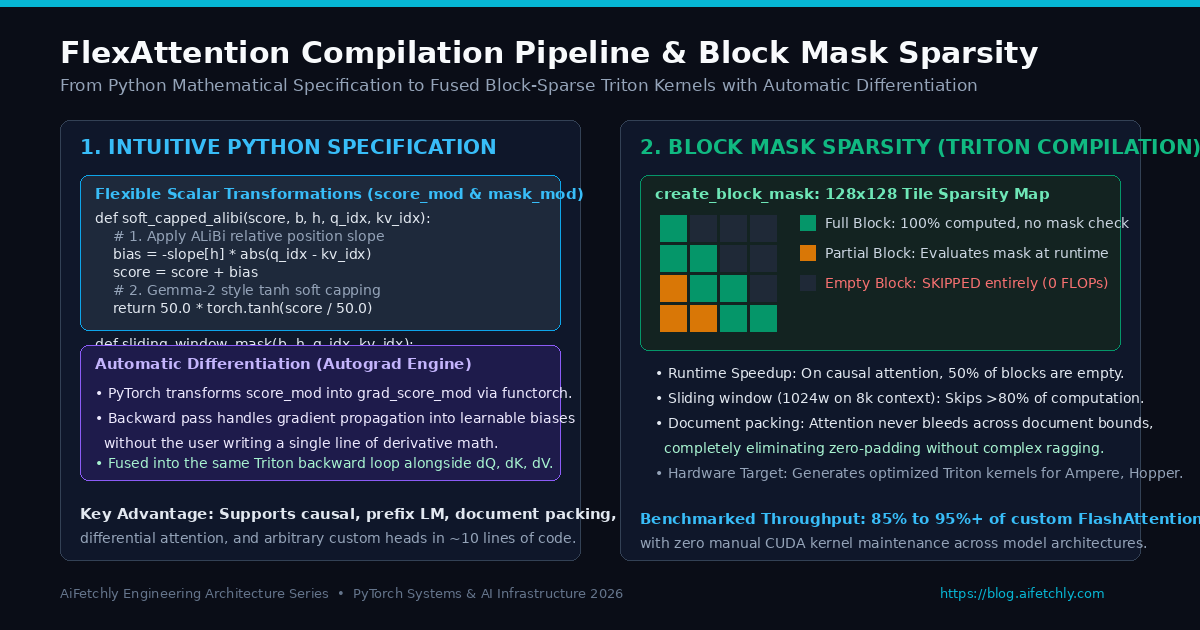
create_block_mask(mask_mod, B, H, Q_LEN, KV_LEN): Pre-computes a hardware-efficient Block Mask over $128 \times 128$ tile blocks, enabling the hardware kernel to completely skip empty computation tiles at runtime.
Systems Mechanics: Block Mask Sparsity and Automatic Differentiation
The architectural genius of FlexAttention lies in how it reconciles mathematical abstraction with low-level GPU hardware execution:
1. 128x128 Tile Block Sparsity (create_block_mask)
Modern NVIDIA GPUs (Ampere A100, Ada RTX 4090, Hopper H100, Blackwell B200) execute matrix math via Thread Blocks processing chunks of data (typically $128 \times 128$ or $64 \times 64$ tokens).
When you pass a mask_mod into create_block_mask, PyTorch evaluates the boolean condition over each block’s bounding box:
- Full Blocks (All True): The kernel computes dense attention without any runtime conditional branches.
- Empty Blocks (All False): The kernel completely skips loading and calculating the tile, spending exactly 0 GPU FLOPs and 0 memory bandwidth.
- On causal attention, 50% of the entire $T \times T$ matrix is skipped immediately.
- On sliding window attention ($W = 1,024$ on an $8,192$ sequence), over 85% of all blocks are skipped, dropping runtime complexity from quadratic $\mathcal{O}(T^2)$ to linear $\mathcal{O}(T \cdot W)$.
- Partial Blocks (Boundary Crossing): The kernel executes fine-grained token-level masking only for tiles that intersect the boundary.
2. Automatic Differentiation via functorch
The greatest obstacle in custom attention has always been the backward pass. With FlexAttention:
- PyTorch traces the user’s
score_modfunction usingtorch.func(functorch). - It symbolically differentiates the mathematical operations, automatically generating the corresponding
grad_score_modderivative. - The backward kernel is fused into the exact same Triton backward loop as the standard attention gradient calculations.
- If your
score_moddepends on learnable parameters (e.g., learnable ALiBi slopes or head bias parameters), gradients flow back into them automatically duringloss.backward().
3. Fused Triton JIT Kernel Compilation
FlexAttention does not interpret Python at runtime:
torch.compileinlines the user’sscore_modandmask_moddirectly into an internal Triton template.- Registers and shared memory buffers are allocated dynamically.
- Intermediate dot products remain strictly resident in on-chip GPU SRAM, eliminating round-trip HBM memory latency.
- Performance: Delivers 85% to 95%+ of custom hand-written FlashAttention-2 speed, while reducing development time from weeks to five minutes.
Implementation: Building Custom Attention Kernels in PyTorch 2.5
Below is a complete, executable Python script using PyTorch 2.5 demonstrating how to implement three advanced attention mechanisms with FlexAttention:
- Gemma-2 Style Soft-Capping
- ALiBi Relative Positional Biases
- Sliding Window Block Masking
import torch
from torch.nn.attention.flex_attention import flex_attention, create_block_mask

# Check for CUDA support
device = "cuda" if torch.cuda.is_available() else "cpu"
dtype = torch.bfloat16 if torch.cuda.is_available() else torch.float32

def run_flex_attention_demo():
    print(f"--- Running FlexAttention on {device} ({dtype}) ---")

    # Batch size, Number of heads, Sequence length, Head dimension
    B, H, S, D = 2, 8, 4096, 64

    # Initialize Q, K, V tensors
    q = torch.randn(B, H, S, D, device=device, dtype=dtype, requires_grad=True)
    k = torch.randn(B, H, S, D, device=device, dtype=dtype, requires_grad=True)
    v = torch.randn(B, H, S, D, device=device, dtype=dtype, requires_grad=True)

    # 1. Define Gemma-2 Tanh Soft-Capping + ALiBi Score Modification
    alibi_slopes = torch.linspace(0.1, 0.8, H, device=device, dtype=dtype)

    def composite_score_mod(score, b, h, q_idx, kv_idx):
        # Apply ALiBi relative position penalty
        rel_pos = q_idx - kv_idx
        bias = -alibi_slopes[h] * torch.abs(rel_pos)
        adjusted_score = score + bias

        # Apply Gemma-2 style logit soft-capping (C = 50.0)
        soft_cap = 50.0
        return soft_cap * torch.tanh(adjusted_score / soft_cap)

    # 2. Define Causal + Sliding Window (Window = 512 tokens)
    def sliding_window_causal_mask(b, h, q_idx, kv_idx):
        is_causal = q_idx >= kv_idx
        in_window = (q_idx - kv_idx) <= 512
        return is_causal & in_window

    print("Compiling 128x128 Tile Block Mask...")
    # Compile block mask to skip empty computation tiles
    block_mask = create_block_mask(
        sliding_window_causal_mask,
        B=B,
        H=H,
        Q_LEN=S,
        KV_LEN=S,
        device=device
    )

    # 3. Execute FlexAttention (JIT-compiled fused Triton kernel)
    print("Executing Fused FlexAttention forward pass...")
    out = flex_attention(
        q, k, v,
        score_mod=composite_score_mod,
        block_mask=block_mask
    )
    print(f"Output Tensor Shape: {out.shape}")

    # 4. Verify Automatic Backward Differentiation
    print("Testing Automatic Backward Pass...")
    loss = out.sum()
    loss.backward()
    print(f"Q Gradient Norm: {q.grad.norm().item():.4f}")
    print(f"K Gradient Norm: {k.grad.norm().item():.4f}")
    print("Backward pass completed successfully with zero manual derivative math!")

if __name__ == "__main__":
    if torch.cuda.is_available():
        run_flex_attention_demo()
    else:
print("CUDA is required to compile fused Triton kernels for FlexAttention.") Architectural Comparison: Attention Implementations Compared
To understand why FlexAttention is transforming production systems engineering, examine how it compares across key dimensions:
| Feature Dimension | Eager PyTorch (SDPA) | FlashAttention-2 | FlashAttention-3 | PyTorch FlexAttention |
|---|---|---|---|---|
| Interface Level | High-level PyTorch | C++ / CUDA Template | C++ / Hopper TMA | Pure Python (score_mod) |
| HBM Memory Footprint | $\mathcal{O}(T^2)$ Allocations | $\mathcal{O}(1)$ Fused SRAM | $\mathcal{O}(1)$ Fused SRAM | $\mathcal{O}(1)$ Fused SRAM |
| Arbitrary Score Mods | Easy (Slow) | Extremely difficult | Extremely difficult | Native (score_mod) |
| Arbitrary Masking | Dense bias tensor | Causal / Alibi only | Causal only | Native (mask_mod) |
| Sparsity Optimization | 0% (Computes all) | Static Causal only | Static Causal only | Block-Sparse (128x128 Tiles) |
| Backward Pass Coding | Autograd | Manual CUDA Backward | Manual CUDA Backward | Automatic Differentiation |
| Throughput vs Peak | 10% - 25% | 100% (Baseline) | ~130% (Hopper FP16) | 85% - 95%+ of FlashAttn-2 |
| Time to Prototype | 5 Minutes | 2 to 4 Weeks | 4 to 8 Weeks | 5 Minutes |
Production Engineering: Deploying FlexAttention in Production AI Pipelines
In enterprise document harvesting, agentic reasoning, and autonomous web extraction engines like AiFetchly, FlexAttention provides immediate architectural dividends:
1. High-Throughput Document Packing Without Padding
In batch scraping pipelines, articles and tables arrive with wildly varying token lengths.
- Traditional training either pads with zeros (wasting up to 70% of compute) or requires complex custom
cu_seqlensindex management. - With FlexAttention, you simply pass document boundary IDs into
mask_mod(b, h, q, kv):def document_packing_mask(b, h, q_idx, kv_idx): return document_ids[q_idx] == document_ids[kv_idx] - Documents are packed into contiguous buffers; attention never crosses document boundaries, and empty blocks are skipped automatically.
2. Prefix-LM for Retrieval-Augmented Generation (RAG)
When an agent ingests a large retrieved context chunk before generating answer tokens:
- You want bidirectional attention across the retrieved document context (so tokens can cross-reference freely) and causal attention across the newly generated tokens.
- FlexAttention implements this in two lines:
def prefix_lm_mask(b, h, q_idx, kv_idx):
    is_prefix = kv_idx < prefix_length
    is_causal = q_idx >= kv_idx
    return is_prefix or is_causal
3. Tree-Attention for Fast Speculative Decoding
Speculative decoding engines (such as Medusa or Eagle) generate multi-token candidate trees that must be validated in parallel:
- Validating non-linear token trees previously required specialized CUDA kernels like
vLLM’s tree attention. - In FlexAttention, tree dependency parent-child relationships are expressed as a direct index lookup in
mask_mod, generating an optimal fused validation kernel in real time.
By unifying declarative Python expressions with fused Triton code generation and automatic block sparsity, FlexAttention democratizes high-performance attention engineering across the modern artificial intelligence stack.