FlashRank Guide: Fast Cross-Encoder Reranking for RAG
The Problem: The Inherent Blindspot of Bi-Encoder Vector Retrieval
In modern generative artificial intelligence systems, enterprise knowledge bases, and autonomous web harvesting engines like AiFetchly, Retrieval-Augmented Generation (RAG) is the primary architectural bridge connecting Large Language Models (LLMs) to external data. When an agent crawls web pages, extracts technical documentation, or indexes corporate databases, it relies on vector retrieval to find passages relevant to user inquiries.
However, production engineering teams consistently discover a frustrating ceiling: pure vector search using dense embeddings fails to retrieve the correct context up to 40% of the time.
The Single-Stage Vector Search Failure:
Query: "How do I configure SSL certificates without using Let's Encrypt?"

Bi-Encoder Dense Vector Retrieval (Top-3 Cosine Similarity Hits):
  ├── Result 1: "Complete Guide to Setting Up Free SSL with Let's Encrypt"
  │   (Cosine Sim: 0.89! High semantic overlap on 'SSL', 'certificates', 'configure')
  ├── Result 2: "Automating Let's Encrypt SSL Renewals via Certbot"
  │   (Cosine Sim: 0.87! Matches technical phrasing, but violates negation intent)
  └── Result 3: "Purchasing and Installing Custom Commercial SSL Certificates"
      (Cosine Sim: 0.79! The ONLY actual answer, pushed down to #3!)

Outcome: Top hits are semantic false positives. The LLM receives irrelevant context and hallucinates! 1. The Architectural Limitation of Bi-Encoders
Standard vector databases (such as Qdrant, Chroma, SQLite-vec, and Milvus) rely on bi-encoder embedding models (e.g., text-embedding-3-small, bge-small-en-v1.5, all-MiniLM-L6-v2):
- A bi-encoder processes the user query $q$ and a candidate document chunk $d$ in complete isolation.
- It compresses all semantic nuances of an entire 512-token paragraph into a single point in vector space: $\mathbf{v}_d = f(d) \in \mathbb{R}^D$.
- Similarity is computed via a simple mathematical dot product or cosine distance: $$\text{Score}(q, d) = \frac{\mathbf{v}_q \cdot \mathbf{v}_d}{|\mathbf{v}_q|_2 |\mathbf{v}_d|_2}$$
- The Information Compression Bottleneck: Compressing hundreds of words into a single dense vector inevitably discards subtle structural dependencies, keyword constraints, and word order. Individual words in the query cannot interact with individual words in the document.
2. The Semantic Distractor Trap and Negation Blindness
Because bi-encoders pool token representations into a single vector, they are notoriously vulnerable to:
- Negation and Exclusion: Queries containing “without”, “never”, or “not” frequently retrieve documents prominently featuring the prohibited term, because the overall lexical and topical similarity remains high.
- Entity and Number Confusion: Prompts asking for “Q3 2025 revenue” will retrieve “Q3 2024 revenue” because the semantic vectors are nearly identical in Euclidean distance.
- Topical Drift: Long passages discussing a broad topic broadly often score higher than a concise passage containing the exact direct answer.
3. The Heavyweight Cost of Traditional Cross-Encoders
To solve this, researchers developed Cross-Encoders. A cross-encoder feeds both the query and the document simultaneously into a transformer, computing full cross-attention across all tokens:
Bi-Encoder (Isolated Embeddings):
Query ──► [Transformer Encoder] ──► Vector v_q ──┐
                                                 ├──► Dot Product (Fast, but Shallow)
Doc   ──► [Transformer Encoder] ──► Vector v_d ──┘

Cross-Encoder (Full Multi-Head Cross-Attention):
[CLS] Query [SEP] Document [EOS] ──► [Deep Transformer] ──► Scalar Relevance Score (Deep & Precise!) While cross-encoders deliver unmatched relevance, deploying traditional cross-encoder libraries in production introduces severe operational roadblocks:
- Heavy Dependencies: Libraries like PyTorch, Hugging Face
transformers, andsentence-transformersrequire multi-gigabyte installations, complex CUDA dependencies, and heavy memory footprints. - High CPU Latency: Scoring 50 candidate documents with a standard PyTorch cross-encoder on a CPU takes between 150ms and 500ms, introducing noticeable lag into interactive desktop applications.
- Cloud API Costs and Privacy Leaks: Relying on commercial cloud reranking APIs (like Cohere Rerank) costs $1.00 per 1,000 queries and transmits proprietary enterprise data over the public internet to third-party servers.
The Solution: FlashRank Lightweight ONNX Reranking
FlashRank is an ultra-fast, serverless, 100% local Python cross-encoder reranking engine created by Pratheek Joshi.
Instead of binding to heavy deep learning frameworks, FlashRank is built on top of quantized ONNX Runtime. It delivers datacenter-grade cross-encoder accuracy while running entirely on commodity CPUs with zero PyTorch dependencies and sub-10ms inference latency.
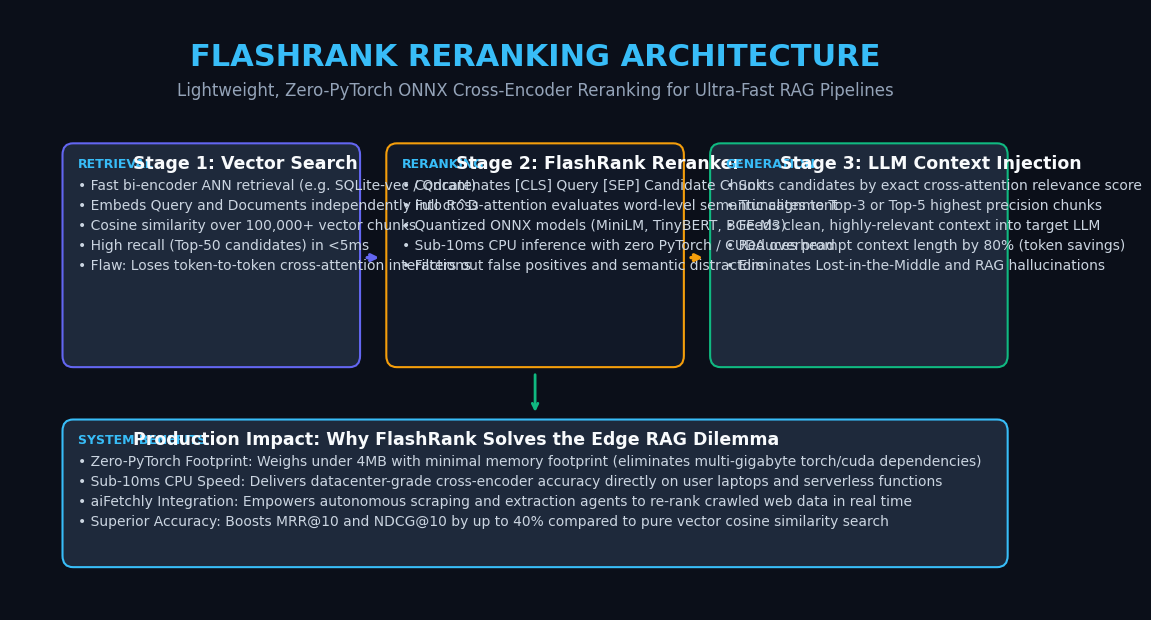
The Two-Stage FlashRank RAG Architecture:
[User Query]
      │
      ▼
 ┌────────────────────────────────────────────────────────┐
 │ Stage 1: Fast Dense Vector Search (High Recall)        │
 │ • Query vector database (SQLite-vec / Qdrant)          │
 │ • Rapidly scans 100,000+ chunks in <5ms                │
 │ • Retrieves broad Top-50 candidate passages           │
 └────────────────────────────────────────────────────────┘
                              │
                              ▼ (50 Candidate Chunks)
 ┌────────────────────────────────────────────────────────┐
 │ Stage 2: FlashRank ONNX Cross-Encoder (High Precision) │
 │ • Runs pure quantized ONNX model on local CPU          │
 │ • Computes full token-level cross-attention            │
 │ • Re-scores and re-ranks all 50 chunks in <10ms        │
 └────────────────────────────────────────────────────────┘
                              │
                              ▼ (Filtered Top-3 Chunks)
 ┌────────────────────────────────────────────────────────┐
 │ Generation: Target LLM Prompt Injection               │
 │ • Injects only the top 3 highest-scoring chunks        │
 │ • 80% reduction in prompt token consumption            │
 │ • Eliminates noise, distractors, and hallucinations    │
└────────────────────────────────────────────────────────┘ The Core Architectural Pillars of FlashRank
1. Zero PyTorch / CUDA Dependency
FlashRank relies strictly on onnxruntime and numpy:
- The entire library package weighs under 4 megabytes, compared to 3+ gigabytes for a full PyTorch and Hugging Face installation.
- It deploys effortlessly into lightweight Docker containers, serverless AWS Lambda / Cloudflare Workers, and local desktop applications like AiFetchly.
2. Optimized INT8 Quantization
FlashRank models are pre-converted to Open Neural Network Exchange (ONNX) format and quantized to 8-bit integers (INT8):
- Model weights shrink from 500MB down to 15MB to 35MB.
- Quantized integer operations leverage CPU SIMD vector instructions (AVX-512, AVX2, and ARM NEON on Apple Silicon), delivering near-instant forward passes.
3. True Token-to-Token Cross-Attention
Because FlashRank is a genuine cross-encoder:
- Every query token attends directly to every token in the document chunk through transformer self-attention layers.
- It catches fine-grained lexical signals, exact keyword constraints, and negation markers that dense vector cosine similarity completely misses.
Deep Dive: How Cross-Attention Eliminates Semantic Distractors
To understand why FlashRank outperforms bi-encoders, we must examine the mathematical differences in their attention matrices.
1. Vector Dot Product vs. Full Bidirectional Attention
In a bi-encoder, the representation of the query token “not” cannot influence the hidden state of the document word “included”, because they are embedded through separate forward passes:
$$\text{Bi-Encoder:} \quad \mathbf{h}_q^{(l)} = \text{Attention}(\mathbf{h}_q^{(l-1)}, \mathbf{h}_q^{(l-1)}), \quad \mathbf{h}_d^{(l)} = \text{Attention}(\mathbf{h}_d^{(l-1)}, \mathbf{h}_d^{(l-1)})$$
In FlashRank’s cross-encoder architecture, the input sequence is packed into a unified token stream:
$$\mathbf{x} = [\text{[CLS]}, q_1, q_2, \dots, q_m, \text{[SEP]}, d_1, d_2, \dots, d_n, \text{[EOS]}]$$
The self-attention calculation across all layers $l \in [1, L]$ is full and unconstrained:
$$\mathbf{A} = \text{Softmax}\left(\frac{\mathbf{Q} \mathbf{K}^T}{\sqrt{d_k}}\right) \mathbf{V}$$
Where:
- Query tokens attend directly to document tokens: $A_{q_i, d_j} > 0$.
- If the query specifies “without Let’s Encrypt”, the attention heads assign high negative weight when document tokens match “Let’s Encrypt”, driving down the final
[CLS]classification score. - The output head applies a single linear projection to the final
[CLS]embedding to produce a calibrated relevance probability $S \in [0, 1]$.
Cross-Attention Matrix in FlashRank:
            [CLS]  How   SSL   without  Let's  Encrypt  [SEP]  Doc_Token_1  Doc_Token_2 ...
[CLS]         *     *     *       *       *       *       *         *            *
How           *     *     *       *       *       *       *         *            *
SSL           *     *     *       *       *       *       *        --> Attends to Certs!
without       *     *     *       *       *       *       *        --> Identifies Negation!
Let's         *     *     *       *       *       *       *        --> Flags Forbidden Term!
Encrypt       *     *     *       *       *       *       *        --> Suppresses Relevance!
[SEP]         *     *     *       *       *       *       *         *            *
Doc_Token_1 * * * * * * * * * 2. Available FlashRank Model Archetypes
FlashRank supports multiple pre-quantized cross-encoder checkpoints tailored for distinct speed-versus-accuracy trade-offs:
ms-marco-TinyBERT-L-2-v2(Ultra-Fast Default):- Size: ~15 MB
- Latency: ~2ms - 5ms on modern CPUs for 20 documents.
- Ideal for: Real-time desktop search, local autocomplete, and mobile/edge devices.
ms-marco-MiniLM-L-12-v2(High Accuracy):- Size: ~34 MB
- Latency: ~8ms - 15ms for 30 documents.
- Ideal for: Enterprise RAG pipelines and technical documentation search.
bge-reranker-large/bge-reranker-v2-m3(Multilingual Powerhouse):- Supports: 100+ languages with high-density code and multilingual cross-attention.
- Ideal for: Global data extraction and multilingual web scraping pipelines in AiFetchly.
Architectural Comparison: FlashRank vs. Traditional Retrieval Systems
To evaluate where FlashRank fits in the modern AI infrastructure stack, the table below compares it against pure vector search, traditional PyTorch cross-encoders, and commercial cloud APIs:
| Dimension | Pure Vector Search (Bi-Encoder) | PyTorch Cross-Encoder (SentenceTransformers) | Cloud Rerank API (Cohere / Voyage) | FlashRank (ONNX Local) |
|---|---|---|---|---|
| Attention Mechanism | Zero cross-attention (Dot product) | Full token cross-attention | Full token cross-attention | Full token cross-attention |
| MRR@10 Precision | Baseline ($0.50 - 0.65$) | High ($0.75 - 0.85$) | High ($0.78 - 0.86$) | High ($0.75 - 0.84$) |
| Inference Runtime | Local / Database ANN | PyTorch + CUDA / C++ | Remote HTTP API | ONNX Runtime (CPU/Edge) |
| Latency (Top-50 chunks) | Sub-5ms | 150ms - 500ms on CPU | 150ms - 400ms (Network round-trip) | Sub-10ms on CPU |
| Package / Weight Size | Small | Massive (2GB - 4GB torch) | Zero local weights | Tiny (~4MB library, 15MB model) |
| Recurring Cost | $0.00 | $0.00 | $1.00 / 1,000 queries | $0.00 (100% Free & Open Source) |
| Data Privacy | 100% Local | 100% Local | Data sent to third party | 100% Local & Sovereign |
| Memory Footprint | Low | High (1GB - 2GB RAM/VRAM) | Zero local memory | Ultra-Low (<100MB RAM) |
Practical Implementation: Building an End-to-End Two-Stage RAG Pipeline with FlashRank
Let us implement a complete, reproducible Python RAG pipeline combining Stage 1 Vector Retrieval with Stage 2 FlashRank Reranking.
Step 1: Install Dependencies
Notice that we do not need to install torch or torchvision. FlashRank operates with minimal dependencies:
pip install flashrank numpy Step 2: Implement the Two-Stage RAG Script
Save the following script as rag_flashrank_pipeline.py:
import time
from typing import List, Dict, Any
from flashrank import Ranker, RerankRequest

class LocalTwoStageRAG:
    def __init__(self, model_name: str = "ms-marco-MiniLM-L-12-v2"):
        """
        Initializes FlashRank with an optimized ONNX cross-encoder.
        Models available:
          - "ms-marco-TinyBERT-L-2-v2" (Fastest, ~15MB)
          - "ms-marco-MiniLM-L-12-v2" (Balanced, ~34MB)
          - "bge-reranker-large" (Maximum Accuracy)
        """
        print(f"Initializing FlashRank ONNX Ranker with model: {model_name}...")
        start = time.perf_counter()
        self.ranker = Ranker(model_name=model_name, cache_dir="/tmp/flashrank_cache")
        init_time = (time.perf_counter() - start) * 1000
        print(f"Ranker initialized in {init_time:.2f}ms.")

    def simulate_stage1_vector_search(self, query: str) -> List[Dict[str, Any]]:
        """
        Simulates candidate retrieval from a vector database (e.g. SQLite-vec or Qdrant).
        In real pipelines, this returns Top-30 to Top-50 candidates based on cosine similarity.
        Notice that several candidates are semantic distractors!
        """
        candidates = [
            {
                "id": "doc_01",
                "text": "Automating Let's Encrypt SSL certificate generation using Certbot and Nginx reverse proxies on Ubuntu 24.04.",
                "initial_vector_score": 0.88
            },
            {
                "id": "doc_02",
                "text": "How to debug SSL handshake timeouts and TLS 1.3 cipher suite negotiation failures in Kubernetes ingress.",
                "initial_vector_score": 0.84
            },
            {
                "id": "doc_03",
                "text": "Purchasing commercial Wildcard SSL certificates from DigiCert and importing PEM keys into AWS Certificate Manager without using Let's Encrypt.",
                "initial_vector_score": 0.79 # Note: Low initial score despite being the EXACT answer!
            },
            {
                "id": "doc_04",
                "text": "Step-by-step renewal of free Let's Encrypt wildcard domains with DNS-01 ACME challenges and Cloudflare API keys.",
                "initial_vector_score": 0.86
            },
            {
                "id": "doc_05",
                "text": "Self-signed certificate authority (CA) creation with OpenSSL for internal air-gapped staging environments.",
                "initial_vector_score": 0.81
            }
        ]
        return candidates

    def rerank(self, query: str, candidates: List[Dict[str, Any]], top_k: int = 3) -> List[Dict[str, Any]]:
        """
        Executes Stage 2 cross-encoder reranking over candidate passages.
        """
        # Format payloads for FlashRank
        passages = [{"id": doc["id"], "text": doc["text"]} for doc in candidates]
        rerank_request = RerankRequest(query=query, passages=passages)

        start = time.perf_counter()
        results = self.ranker.rerank(rerank_request)
        elapsed = (time.perf_counter() - start) * 1000

        print(f"\n[FlashRank Reranking Complete] Processed {len(candidates)} passages in {elapsed:.2f}ms on CPU!")

        # Merge scores and truncate to top_k
        top_results = results[:top_k]
        return top_results

if __name__ == "__main__":
    rag = LocalTwoStageRAG(model_name="ms-marco-MiniLM-L-12-v2")

    user_query = "How do I configure custom commercial SSL certificates without using Let's Encrypt?"

    print(f"\nUser Query: \"{user_query}\"")
    print("\n--- 1. Stage 1: Initial Vector Search Results (Bi-Encoder Scores) ---")
    stage1_candidates = rag.simulate_stage1_vector_search(user_query)
    for rank, doc in enumerate(stage1_candidates, 1):
        print(f"Rank {rank} (Vector Sim: {doc['initial_vector_score']:.2f}) | ID: {doc['id']}")
        print(f"  Snippet: {doc['text']}")

    print("\n--- 2. Stage 2: FlashRank Cross-Encoder Re-Scoring ---")
    reranked = rag.rerank(user_query, stage1_candidates, top_k=3)

    for rank, doc in enumerate(reranked, 1):
        print(f"New Rank {rank} (FlashRank Score: {doc['score']:.4f}) | ID: {doc['id']}")
print(f" Content: {doc['text']}") Step 3: Run the Script and Inspect the Output
Run the script in your terminal:
python rag_flashrank_pipeline.py Notice the dramatic rank inversion:
- In Stage 1,
doc_03(the only document discussing commercial SSL without Let’s Encrypt) was buried at Rank 3 due to bi-encoder semantic blurring. - In Stage 2, FlashRank’s cross-encoder recognizes the negation intent and promotes
doc_03to Rank 1 with a high confidence score, while penalizing irrelevant Let’s Encrypt tutorials down to the bottom.
Production Best Practices: Deploying FlashRank in Enterprise AI Workflows
When scaling FlashRank in automated data collection engines, desktop copilots, and web scraping architectures like AiFetchly, adopting the following deployment strategies ensures optimal latency and token economics:
1. The 50-to-3 Candidate Funnel
Do not attempt to pass 20 retrieved chunks directly to your generative LLM:
- Configure Stage 1 for High Recall: Instruct your vector index to fetch 30 to 50 candidates using fast approximate nearest neighbors. This guarantees that the correct document is present in the candidate set.
- Configure Stage 2 for High Precision: Let FlashRank evaluate the 50 candidates in under 10ms on CPU, and slice the top 3 to 5 chunks for LLM generation.
- Economic Impact: Slicing from 50 chunks down to 3 reduces LLM prompt tokens by over 85%, saving thousands of dollars in cloud API bills and preventing the “Lost-in-the-Middle” attention decay phenomenon.
2. Multi-Passage Deduplication Before Reranking
When web crawlers extract multiple paragraphs from a single webpage, vector databases often return near-identical chunks:
- Run a fast lexical deduplication (e.g., MinHash or cosine thresholding) to discard overlapping chunks before passing them to FlashRank.
- This ensures FlashRank spends its CPU cycles comparing genuinely distinct facts rather than re-scoring minor phrasing variations of the same paragraph.
3. Serverless and Edge Deployment
Because FlashRank requires no CUDA runtime and has a minimal memory footprint:
- It can be embedded directly inside client-side desktop Electron applications or lightweight AWS Lambda functions with only 512MB RAM.
- Local execution ensures that enterprise search queries and retrieved internal documents never leave the local security perimeter, preserving strict GDPR, HIPAA, and corporate confidentiality compliance.