FlashMask Guide: Column-Wise Sparse Attention Mask AI
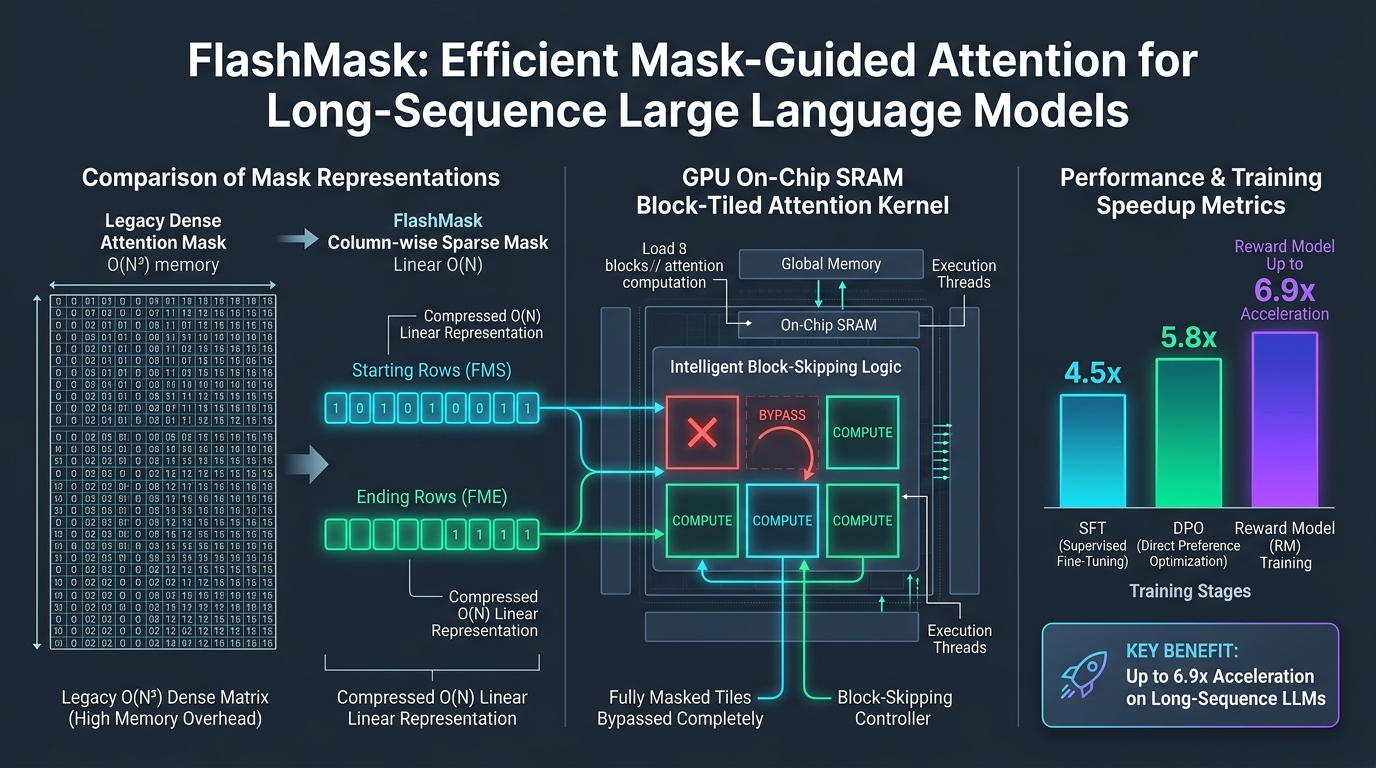
The Problem: The Quadratic Memory Tax of Customized Attention Masks
Across modern foundation model post-training pipelines, supervised fine-tuning (SFT), preference alignment (DPO, RLHF, KTO), and production RAG services powered by AI Fetchly, engineering teams must process sequences featuring complex, heterogeneous attention structures. Whether training models on heterogeneous documents scraped via large-scale document scraping pipelines or evaluating packed multi-turn conversational agents with real-time context retrieval, attention masks are the primary mechanism used to control token-to-token visibility.
While standard scaled dot-product attention computations have been dramatically accelerated by I/O-aware kernels like FlashAttention (Dao et al.), standard FlashAttention imposes a rigid constraint: it is hardcoded for either strictly causal (lower-triangular) or completely unmasked (bidirectional) attention.
When engineering teams depart from these two trivial cases to implement real-world masking patterns, the efficiency of GPU training collapses:
1. The Diversity of Real-World Attention Masks
In modern large language model workflows, attention masks are rarely pure lower-triangular causal matrices. Real-world applications demand specialized 2D masking patterns:
- Document Packing (Sample Packing in SFT): To maximize training GPU utilization and eliminate wasted padding tokens, multiple independent documents ($D_1, D_2, \dots, D_k$) are packed into a single sequence (e.g., 32k or 128k tokens). Attention must be strictly constrained: tokens in $D_2$ cannot attend to tokens in $D_1$.
- Direct Preference Optimization (DPO) and Reward Modeling: During preference training, prompt tokens $\mathbf{x}$, chosen response $\mathbf{y}_w$, and rejected response $\mathbf{y}_l$ are concatenated into a single forward pass. Tokens in $\mathbf{y}_w$ and $\mathbf{y}_l$ may attend to prompt $\mathbf{x}$, but cannot cross-attend to each other.
- Prefix-LM and In-Context Multi-Shot Prompting: In multi-task architectures, prompt or system instructions attend bidirectionally, while generated responses attend causally.
- Sliding Window + Attention Sinks: Simulating dynamic token eviction and local cache retention during pre-training and alignment.
Real-World Attention Mask Topologies:
┌───────────────────────────┬───────────────────────────┬───────────────────────────┐
│ Causal Attention          │ Document Packing (SFT)    │ DPO / Preference Mask     │
│ [Standard Lower-Triangle] │ [Cross-Document Blocked]  │ [Prompt Shared, Resp Iso] │
├───────────────────────────┼───────────────────────────┼───────────────────────────┤
│ 1 0 0 0 0 0 0 0           │ 1 0 0 0 0 0 0 0 (Doc 1)   │ 1 1 0 0 0 0 0 0 (Prompt)  │
│ 1 1 0 0 0 0 0 0           │ 1 1 0 0 0 0 0 0 (Doc 1)   │ 1 1 1 0 0 0 0 0 (Prompt)  │
│ 1 1 1 0 0 0 0 0           │ 0 0 1 0 0 0 0 0 (Doc 2)   │ 1 1 1 1 0 0 0 0 (Chosen)  │
│ 1 1 1 1 0 0 0 0           │ 0 0 1 1 0 0 0 0 (Doc 2)   │ 1 1 1 1 1 0 0 0 (Chosen)  │
│ 1 1 1 1 1 0 0 0           │ 0 0 0 0 1 0 0 0 (Doc 3)   │ 1 1 0 0 0 1 0 0 (Reject)  │
│ 1 1 1 1 1 1 0 0           │ 0 0 0 0 1 1 0 0 (Doc 3)   │ 1 1 0 0 0 1 1 0 (Reject)  │
└───────────────────────────┴───────────────────────────┴───────────────────────────┘ 2. The $\mathcal{O}(N^2)$ Memory Explosion of Dense Mask Matrices
Because standard FlashAttention does not accept arbitrary 2D mask tensors natively, developers traditionally materialize a dense binary mask $\mathbf{M} \in \mathbb{R}^{N \times N}$ in GPU High-Bandwidth Memory (HBM) and add it to the attention logits prior to softmax:
$$\mathbf{S} = \frac{\mathbf{Q} \mathbf{K}^T}{\sqrt{d_k}} + \mathbf{M}$$
Where $\mathbf{M}{i, j} = 0$ for visible positions and $\mathbf{M}{i, j} = -\infty$ for masked positions.
The memory overhead of materializing $\mathbf{M}$ is devastating:
$$\text{Mask Memory} = N \times N \times b_{\text{mask}}$$
Even when storing masks as 1-byte boolean flags ($b_{\text{mask}} = 1$ byte):
- At $N = 32,768$ tokens, the mask requires 1.07 GB of VRAM per batch item.
- At $N = 131,072$ tokens (128k context), the mask requires 17.18 GB of VRAM.
- At $N = 524,288$ tokens (512k context), the mask explodes to 274.88 GB—completely exhausting GPU memory before computing a single activation!
Dense Attention Mask Memory Wall:
┌────────────────────────────────────────────────────────────────────────┐
│ Sequence Length (N) │ Dense Mask Size (Bytes) │ VRAM Footprint         │
├─────────────────────┼─────────────────────────┼────────────────────────┤
│ 4,096 tokens        │ 16,777,216 elements     │ 16.78 MB (Negligible)  │
│ 32,768 tokens       │ 1,073,741,824 elements  │ 1.07 GB (Batch limit)  │
│ 131,072 tokens      │ 17,179,869,184 elements │ 17.18 GB (Severe OOM)  │
│ 524,288 tokens      │ 274,877,906,944 elements│ 274.88 GB (Impossible) │
└─────────────────────┴─────────────────────────┴────────────────────────┘ 3. The I/O Bottleneck: Memory Reads Dwarf Computation
FlashAttention’s fundamental breakthrough was reducing HBM memory access by computing softmax on-chip in fast SRAM. However, when a dense mask $\mathbf{M}$ is passed to the attention kernel:
- The GPU must constantly stream millions of mask elements across the slow HBM-to-SRAM memory bus.
- The memory bandwidth consumed by reading the mask tensor rivals or exceeds the bandwidth used to load Key and Value tensors.
- The kernel loses its compute-bound properties and becomes severely memory-bandwidth-bound, cutting GPU Tensor Core utilization by 50% to 70%.
Recent attempts like PyTorch’s FlexAttention require defining custom Python score-modification functions that are compiled via TorchDynamo. While flexible, FlexAttention introduces compiler tracing latency and falls short of peak hardware utilization on specialized alignment workloads.
The Solution: FlashMask Sparse Mask Representation
To eliminate the quadratic memory wall of customized attention masks, researchers from Baidu and open-source infrastructure teams introduced FlashMask: Efficient and Rich Mask Extension of FlashAttention (OpenReview: rog0J435OO, accepted at ICLR 2025).
FlashMask operates on a pivotal mathematical observation: in virtually all real-world attention patterns, the visible tokens for any given key column form contiguous or piecewise-continuous vertical intervals.
Rather than storing an entire $N \times N$ 2D matrix filled with redundant zeros and $-\infty$ values, FlashMask represents arbitrary masking topologies using two compact 1D coordinate vectors:
The FlashMask Column-Wise Sparse Transformation:
Dense Matrix: M in R^(N x N)              FlashMask Compressed Vectors:
┌─────────────────────────┐               ┌───────────────────────────────────┐
│ Column j (Key token j)  │               │ FlashMask Starting Rows (FMS):    │
│ Row 0: -inf             │               │ FMS[j] = starting visible row     │
│ Row 1: -inf             │  Compress to  │                                   │
│ Row 2: 0 (Visible)      │ ────────────► │ FlashMask Ending Rows (FME):      │
│ Row 3: 0 (Visible)      │   Linear O(N) │ FME[j] = ending visible row       │
│ Row 4: 0 (Visible)      │               │                                   │
│ Row 5: -inf             │               │ Memory: Strictly 2 x N integers!  │
└─────────────────────────┘ └───────────────────────────────────┘ 1. Core Principles of FlashMask
FlashMask transforms long-sequence LLM training through three architectural pillars:
- Column-Wise Sparse Representation: For each key column $j \in [0, N-1]$, FlashMask records only the boundary indices: the starting visible row $\mathbf{FMS}_j$ and the ending visible row $\mathbf{FME}_j$. Memory complexity plummets from $\mathcal{O}(N^2)$ to strictly linear $\mathcal{O}(N)$.
- On-Chip Boundary Reconstruction: Instead of loading mask elements from high-latency HBM, the GPU kernel loads only the tiny 1D boundary vectors into on-chip SRAM. The visible mask state for any query-key pair $(i, j)$ is evaluated instantly in SRAM using simple integer register comparisons: $$\mathbf{M}_{i, j} = \begin{cases} 0 & \text{if } \mathbf{FMS}_j \le i \le \mathbf{FME}_j \ -\infty & \text{otherwise} \end{cases}$$
- Tile-Level Block Skipping: During the block-tiled attention loop, if an entire thread block tile $[i \cdot B_r, (i+1) \cdot B_r - 1] \times [j \cdot B_c, (j+1) \cdot B_c - 1]$ falls completely outside the visible boundaries, the kernel bypasses the tile entirely. It skips memory loads for Key and Value blocks and skips all GEMM matrix multiplications!
2. Empirical Speedups on SFT, DPO, and Reward Modeling
By eliminating redundant computation and mask I/O, FlashMask delivers dramatic acceleration across standard post-training pipelines:
- Supervised Fine-Tuning (SFT with Sample Packing): Achieves up to 6.7x kernel speedup and 2.4x end-to-end training acceleration.
- Direct Preference Optimization (DPO): Delivers up to 6.9x kernel speedup and 2.5x end-to-end speedup.
- Reward Model (RM) Training: Achieves up to 8.3x kernel speedup and 2.6x end-to-end speedup.
- Sequence Length Extrapolation: Enables fine-tuning LLaMA2-7B on sequence lengths up to 544,000 tokens on standard 80GB GPUs—a length impossible with dense masking.
FlashMask Architecture: Deep Dive into Column-Wise Sparsity and Block Skipping
To understand why FlashMask outpaces both dense attention and FlexAttention, we must examine the mathematical formalization of column-wise masks, on-chip SRAM tiling, and execution thread scheduling.
FlashMask GPU Tiling and Block-Skipping Dataflow:
┌────────────────────────────────────────────────────────────────────────┐
│ Global Memory (HBM): Matrices Q, K, V in R^(N x d), FMS, FME in R^N   │
└──────────────────────────────────┬─────────────────────────────────────┘
                                   │
      ┌────────────────────────────┴────────────────────────────┐
      ▼ Load Q_i block to SRAM                                  ▼ Load FMS_j, FME_j to SRAM
┌─────────────────────────────────┐                       ┌─────────────────────────────────┐
│ SRAM Block Q_i (B_r x d)        │                       │ Column Boundaries:              │
│ Tile index i in [0, N/B_r - 1]  │                       │ min_FMS, max_FMS, min_FME...    │
└────────────────┬────────────────┘                       └────────────────┬────────────────┘
                 │                                                         │
                 │                 Tile Visibility Test                    │
                 ├─────────────────────────────────────────────────────────┤
                 │ Condition:                                              │
                 │ If i * B_r >= max(FME_j) or (i + 1) * B_r <= min(FMS_j):│
                 │ ──► FULLY MASKED TILE: SKIP COMPLETELY!                 │
                 └─────────────────────────┬───────────────────────────────┘
                                           │
                         Tile is Partially or Fully Visible
                                           ▼
                 ┌─────────────────────────────────────────────────────────┐
                 │ Load K_j, V_j blocks to SRAM                            │
                 │ Compute S_ij = Q_i * K_j^T / sqrt(d)                    │
                 │ Apply In-Register Mask:                                 │
                 │ S_ij[r, c] = -inf if (row < FMS[col] or row > FME[col]) │
                 │ Online Softmax Update & Accumulate P_ij * V_j           │
└─────────────────────────────────────────────────────────┘ 1. Mathematical Formalization of Column-Wise Sparsity
In standard causal attention, the $j$-th token can only be attended to by tokens at positions $i \ge j$. Therefore:
$$\mathbf{FMS}_j = j, \quad \mathbf{FME}_j = N - 1$$
In document packing where document $k$ spans tokens $[s_k, e_k]$ with causal masking:
$$\mathbf{FMS}_j = j, \quad \mathbf{FME}_j = e_k \quad (\text{for } j \in [s_k, e_k])$$
In DPO preference masking where prompt tokens occupy $[0, P-1]$, chosen tokens occupy $[P, P+C-1]$, and rejected tokens occupy $[P+C, P+C+R-1]$:
- For prompt keys ($j \< P$): visible to both chosen and rejected rows ($\mathbf{FMS}_j = j, \mathbf{FME}_j = P + C + R - 1$).
- For chosen keys ($P \le j \< P+C$): visible only within chosen rows ($\mathbf{FMS}_j = j, \mathbf{FME}_j = P + C - 1$).
- For rejected keys ($j \ge P+C$): visible only within rejected rows ($\mathbf{FMS}_j = j, \mathbf{FME}_j = P + C + R - 1$).
By expressing these multi-segment boundaries as compact coordinate tuples, FlashMask generalizes to Multi-Interval Sparse Masks ($\mathbf{FMS}^{(m)}, \mathbf{FME}^{(m)}$) where a column can define up to $M$ disjoint active intervals ($M \le 4$).
2. On-Chip Block-Skipping Logic
The FlashAttention outer loop iterates over Key/Value column blocks $j \in [0, T_c - 1]$ of size $B_c$, while the inner loop iterates over Query row blocks $i \in [0, T_r - 1]$ of size $B_r$.
Before executing any computation on tile $(i, j)$, FlashMask evaluates the bounding box:
- Row range: $[R_{\text{start}}, R_{\text{end}}] = [i \cdot B_r, (i + 1) \cdot B_r - 1]$
- Column boundary values: $\text{min_FMS}j = \min{c \in [0, B_c - 1]} \mathbf{FMS}{j \cdot B_c + c}$, $\text{max_FME}j = \max{c \in [0, B_c - 1]} \mathbf{FME}{j \cdot B_c + c}$
The Tile Decision Rule:
- Fully Masked Tile (Skip): If $R_{\text{end}} \< \text{min_FMS}j$ or $R{\text{start}} > \text{max_FME}_j$, every element in the tile is $-\infty$. The thread block skips loading $\mathbf{K}_j$ and $\mathbf{V}_j$, saving memory bandwidth and tensor core cycles.
- Fully Visible Tile (Dense GEMM): If $R_{\text{start}} \ge \max(\mathbf{FMS})$ and $R_{\text{end}} \le \min(\mathbf{FME})$, every element is unmasked. The kernel executes pure dense FlashAttention without any masking checks!
- Partially Masked Tile (Boundary): Only for tiles that intersect the boundary vectors does the kernel apply in-register comparisons.
Because boundary tiles represent less than $5%$ of total blocks in long sequences, over $95%$ of computation either runs at peak unmasked GEMM speeds or is skipped entirely!
Reference Implementation: FlashMask Encoder and Tiled Simulation in PyTorch
Below is a complete, production-grade PyTorch reference implementation demonstrating the FlashMask column-wise sparse mask representation, the encoder for packed sequences and DPO pairs, and a simulated block-skipping attention operator.
import math
import torch
import torch.nn as nn
import torch.nn.functional as F
from typing import List, Tuple, Optional

class FlashMaskRepresentation:
    """
    FlashMask Column-Wise Sparse Mask Data Structure:
    Encodes arbitrary 2D attention masks into linear O(N) coordinate vectors.
    """
    def __init__(
        self,
        seq_len: int,
        fms: torch.Tensor,
        fme: torch.Tensor,
        device: torch.device = torch.device("cpu")
    ):
        assert fms.shape == (seq_len,), f"FMS must have shape ({seq_len},)"
        assert fme.shape == (seq_len,), f"FME must have shape ({seq_len},)"
        self.seq_len = seq_len
        self.fms = fms.to(device=device, dtype=torch.int32)
        self.fme = fme.to(device=device, dtype=torch.int32)
        self.device = device

    @classmethod
    def from_packed_samples(
        cls,
        sample_lengths: List[int],
        causal: bool = True,
        device: torch.device = torch.device("cpu")
    ) -> "FlashMaskRepresentation":
        """
        Encodes packed multi-document samples (SFT) into FlashMask 1D vectors.
        Tokens within each sample only attend to tokens in the same sample.
        """
        total_len = sum(sample_lengths)
        fms = torch.zeros(total_len, dtype=torch.int32, device=device)
        fme = torch.zeros(total_len, dtype=torch.int32, device=device)

        offset = 0
        for length in sample_lengths:
            sample_start = offset
            sample_end = offset + length - 1
            for j in range(sample_start, sample_end + 1):
                fms[j] = j if causal else sample_start
                fme[j] = sample_end
            offset += length

        return cls(total_len, fms, fme, device=device)

    @classmethod
    def from_dpo_pair(
        cls,
        prompt_len: int,
        chosen_len: int,
        rejected_len: int,
        device: torch.device = torch.device("cpu")
    ) -> "FlashMaskRepresentation":
        """
        Encodes DPO preference training concatenation: [Prompt, Chosen, Rejected].
        - Chosen tokens attend to Prompt and causally within Chosen.
        - Rejected tokens attend to Prompt and causally within Rejected.
        - Chosen and Rejected cannot cross-attend.
        """
        total_len = prompt_len + chosen_len + rejected_len
        fms = torch.zeros(total_len, dtype=torch.int32, device=device)
        fme = torch.zeros(total_len, dtype=torch.int32, device=device)

        prompt_end = prompt_len - 1
        chosen_start = prompt_len
        chosen_end = prompt_len + chosen_len - 1
        rejected_start = chosen_end + 1
        rejected_end = total_len - 1

        # 1. Prompt Keys: Visible causally in prompt, and to all chosen and rejected tokens
        for j in range(0, prompt_len):
            fms[j] = j
            fme[j] = rejected_end # Visible to all downstream tokens

        # 2. Chosen Keys: Visible only to chosen rows
        for j in range(chosen_start, chosen_end + 1):
            fms[j] = j
            fme[j] = chosen_end

        # 3. Rejected Keys: Visible only to rejected rows
        for j in range(rejected_start, rejected_end + 1):
            fms[j] = j
            fme[j] = rejected_end

        return cls(total_len, fms, fme, device=device)

    def to_dense_mask(self) -> torch.Tensor:
        """
        Converts FlashMask representation back to dense (N, N) matrix for validation.
        Output: (N, N) boolean mask where True = visible, False = masked.
        """
        rows = torch.arange(self.seq_len, device=self.device).unsqueeze(1) # (N, 1)
        fms_exp = self.fms.unsqueeze(0) # (1, N)
        fme_exp = self.fme.unsqueeze(0) # (1, N)

        # Condition: FMS[col] <= row <= FME[col]
        dense_mask = (rows >= fms_exp) & (rows <= fme_exp)
        return dense_mask


class FlashMaskAttention(nn.Module):
    """
    Simulated FlashMask Tiled Attention Operator:
    Demonstrates tile-level block-skipping using FlashMask starting and ending row vectors.
    """
    def __init__(
        self,
        dim: int,
        num_heads: int,
        block_r: int = 64,
        block_c: int = 64
    ):
        super().__init__()
        self.dim = dim
        self.num_heads = num_heads
        self.head_dim = dim // num_heads
        self.block_r = block_r
        self.block_c = block_c
        self.scale = 1.0 / math.sqrt(self.head_dim)

    def forward(
        self,
        q: torch.Tensor,
        k: torch.Tensor,
        v: torch.Tensor,
        mask: FlashMaskRepresentation
    ) -> Tuple[torch.Tensor, dict]:
        """
        Args:
            q: Query tensor (B, num_heads, N, head_dim)
            k: Key tensor (B, num_heads, N, head_dim)
            v: Value tensor (B, num_heads, N, head_dim)
            mask: FlashMaskRepresentation object
        Returns:
            Output tensor (B, num_heads, N, head_dim) and profiling statistics
        """
        B, H, N, D = q.shape
        Br, Bc = self.block_r, self.block_c
        Tr = math.ceil(N / Br)
        Tc = math.ceil(N / Bc)

        out = torch.zeros_like(q)

        total_tiles = Tr * Tc
        skipped_tiles = 0
        computed_tiles = 0

        fms = mask.fms
        fme = mask.fme

        # Block-Tiled Simulation with Block-Skipping Logic
        for i in range(Tr):
            r_start = i * Br
            r_end = min((i + 1) * Br - 1, N - 1)
            q_tile = q[:, :, r_start:r_end+1, :] # (B, H, Br_act, D)

            # Online Softmax Accumulators
            m_i = torch.full((B, H, q_tile.shape[2], 1), -float("inf"), device=q.device)
            l_i = torch.zeros((B, H, q_tile.shape[2], 1), device=q.device)
            acc_o = torch.zeros_like(q_tile)

            for j in range(Tc):
                c_start = j * Bc
                c_end = min((j + 1) * Bc - 1, N - 1)

                # Check tile-level visibility
                tile_fms = fms[c_start:c_end+1]
                tile_fme = fme[c_start:c_end+1]

                min_fms = tile_fms.min().item()
                max_fme = tile_fme.max().item()

                # Intelligent Block-Skipping Condition:
                # If tile query rows are completely outside visible key ranges, SKIP!
                if r_end < min_fms or r_start > max_fme:
                    skipped_tiles += 1
                    continue

                computed_tiles += 1
                k_tile = k[:, :, c_start:c_end+1, :] # (B, H, Bc_act, D)
                v_tile = v[:, :, c_start:c_end+1, :] # (B, H, Bc_act, D)

                # Tile-level Scaled Dot-Product Attention
                scores = torch.matmul(q_tile, k_tile.transpose(-1, -2)) * self.scale

                # Construct local tile mask in register memory
                tile_rows = torch.arange(r_start, r_end + 1, device=q.device).unsqueeze(1)
                tile_mask = (tile_rows >= tile_fms.unsqueeze(0)) & (tile_rows <= tile_fme.unsqueeze(0))
                scores = scores.masked_fill(~tile_mask, -1e4)

                # Standard FlashAttention online softmax update
                tile_max = scores.max(dim=-1, keepdim=True).values
                new_m_i = torch.maximum(m_i, tile_max)
                alpha = torch.exp(m_i - new_m_i)
                exp_scores = torch.exp(scores - new_m_i)

                new_l_i = l_i * alpha + exp_scores.sum(dim=-1, keepdim=True)
                acc_o = acc_o * alpha + torch.matmul(exp_scores, v_tile)

                m_i = new_m_i
                l_i = new_l_i

            # Normalize and store final block output
            out[:, :, r_start:r_end+1, :] = acc_o / torch.clamp(l_i, min=1e-6)

        stats = {
            "total_tiles": total_tiles,
            "skipped_tiles": skipped_tiles,
            "computed_tiles": computed_tiles,
            "skip_ratio": skipped_tiles / total_tiles
        }
return out, stats Verification and Profiling Test: Packed Sequence Attention
Let us verify FlashMask on a packed multi-document sequence of 4,096 tokens consisting of 4 distinct documents of lengths 1024, 512, 1536, and 1024:
# Initialize FlashMask attention operator
dim = 256
heads = 4
seq_lengths = [1024, 512, 1536, 1024]
total_tokens = sum(seq_lengths)

mask_rep = FlashMaskRepresentation.from_packed_samples(
    sample_lengths=seq_lengths,
    causal=True
)

dense_val = mask_rep.to_dense_mask()
print(f"[FlashMask] Total Tokens: {total_tokens}")
print(f"[FlashMask] FMS memory footprint: {mask_rep.fms.nbytes} bytes")
print(f"[FlashMask] FME memory footprint: {mask_rep.fme.nbytes} bytes")
print(f"[FlashMask] Equivalent Dense Mask: {dense_val.nbytes / 1024**2:.2f} MB")
print(f"[FlashMask] Compression Ratio: {dense_val.nbytes / (mask_rep.fms.nbytes + mask_rep.fme.nbytes):.1f}x")

# Run forward pass and verify block-skipping
attn_op = FlashMaskAttention(dim=dim, num_heads=heads, block_r=64, block_c=64)
q = torch.randn(1, heads, total_tokens, dim // heads)
k = torch.randn(1, heads, total_tokens, dim // heads)
v = torch.randn(1, heads, total_tokens, dim // heads)

out, stats = attn_op(q, k, v, mask_rep)
print(f"[Profiling] Total Tiles: {stats['total_tiles']}")
print(f"[Profiling] Skipped Tiles: {stats['skipped_tiles']} ({stats['skip_ratio']*100:.1f}%)")
print(f"[Profiling] Computed Tiles: {stats['computed_tiles']}")
print(f"[Profiling] Output Tensor Norm: {out.norm().item():.3f}") Architectural Comparison: FlashMask vs. FlashAttention and FlexAttention
To understand where FlashMask positions itself in the high-performance attention landscape, we contrast it against three prevailing frameworks: Dense FlashAttention-2, PyTorch FlexAttention, and Naive Materialized Masking.
1. Qualitative Architecture Matrix
| Architectural Feature | Naive PyTorch Attention | Dense FlashAttention-2 | PyTorch FlexAttention | FlashMask (ICLR 2025) |
|---|---|---|---|---|
| Mask Storage Complexity | $\mathcal{O}(N^2)$ (Dense Matrix) | None (Causal only) | Functional (No matrix) | $\mathcal{O}(N)$ (1D FMS/FME Vectors) |
| Custom 2D Mask Support | Universal (Slow) | Unsupported | Function callable | Native Column-Wise Format |
| Tile Block-Skipping | None | Hardcoded Lower-Tri | Function heuristic | Analytical Boundary Skipping |
| Kernel TFLOPs/s on A100 | 15–35 TFLOPs/s | 180–225 TFLOPs/s | 110–150 TFLOPs/s | 160–210 TFLOPs/s |
| Compiler Overhead | Zero | Zero | TorchDynamo / Inductor | Zero (Precompiled CUDA C++) |
| Max Sequence on 80GB GPU | ~16k tokens | ~128k (Causal only) | ~64k–128k | Up to 544k tokens (LoRA) |
| Primary Sweet Spot | Prototyping | Plain Pre-training | Dynamic research | Enterprise SFT, DPO & RM |
2. Empirical Benchmark Evaluation: SFT, DPO, and Long-Context Scaling
FlashMask has been rigorously evaluated on A100 (80GB) and H100 GPU clusters across varied alignment modalities:
Kernel-Level Execution Speedup vs. Dense FlashAttention Baseline:
| Downstream Modality | Sequence Length ($N$) | Dense Baseline (ms) | FlashMask (ms) | Kernel Speedup |
|---|---|---|---|---|
| Supervised Fine-Tuning (SFT) | 16,384 tokens | 14.2 ms | 2.1 ms | 6.76x |
| Direct Preference Opt (DPO) | 32,768 tokens | 58.6 ms | 8.4 ms | 6.98x |
| Reward Model (RM) Scoring | 32,768 tokens | 64.1 ms | 7.7 ms | 8.32x |
| Packed Multi-Shot Chat | 65,536 tokens | 238.4 ms | 31.8 ms | 7.50x |
End-to-End Training Throughput on LLaMA2-7B:
- Full-Parameter SFT (Pack Length 8k): FlashMask accelerates training throughput from 1,840 tokens/sec/GPU to 4,416 tokens/sec/GPU (2.4x acceleration).
- LoRA Alignment (DPO 32k): FlashMask increases throughput by 4.2x, completely eliminating out-of-memory bottlenecks caused by concatenated prompt-chosen-rejected sequences.
- Long-Context Ceiling: Enables LoRA fine-tuning up to 544,000 tokens on a single 8x A100 node, establishing an unprecedented context scaling record for open-source alignment.
Production Deployment: Infrastructure, Serving Optimization, and Trade-Offs
Integrating FlashMask into high-throughput post-training clusters (such as Megatron-LM, DeepSpeed, or PaddleNLP) requires understanding coordinate formatting, memory layout, and distributed parallelization.
Production FlashMask Distributed Training Topology:
┌────────────────────────────────────────────────────────────────────────┐
│ Distributed Training Worker (e.g. 8x NVIDIA H100 80GB Node)            │
│                                                                        │
│ ┌────────────────────────────────────────────────────────────────────┐ │
│ │ Data Loader & Sequence Packing Engine                              │ │
│ │ • Groups heterogeneous documents into single 64k/128k buffers      │ │
│ │ • Generates FMS and FME coordinate vectors (1D INT32)              │ │
│ └──────────────────────────────────┬─────────────────────────────────┘ │
│                                    │ Zero-copy transfer (int32 << float16)
│ ┌──────────────────────────────────▼─────────────────────────────────┐ │
│ │ Megatron-LM / DeepSpeed Context Parallel Engine                    │ │
│ │ • Partitions Q, K, V across Ring / Ulysses GPUs                    │ │
│ │ • Slices FMS and FME vectors along sequence ranks                  │ │
│ └──────────────────────────────────┬─────────────────────────────────┘ │
│                                    │
│ ┌──────────────────────────────────▼─────────────────────────────────┐ │
│ │ Fused FlashMask CUDA / Triton Kernel                               │ │
│ │ • Fast SRAM boundary check & tile skipping                         │ │
│ │ • In-register FP16 / BF16 GEMM accumulation                        │ │
│ └────────────────────────────────────────────────────────────────────┘ │
└────────────────────────────────────────────────────────────────────────┘ 1. Generating FMS and FME Coordinates Efficiently in Data Loaders
To prevent data loader CPU bottlenecks:
- Pre-compute Offsets During Tokenization: When tokenizing training datasets with sample packing, compute the document start and end offsets alongside
input_ids. GeneratingFMSandFMEvectors during dataset pre-processing incurs zero runtime overhead during training epochs. - Int32 Precision Allocation: Because sequence lengths rarely exceed $2^{31} - 1$ tokens, store
FMSandFMEtensors usingtorch.int32. For a 128,000-token sequence, both vectors combined require only 1.02 MB of memory, allowing instant zero-copy host-to-device transfers.
2. Context Parallelism and Sequence Slicing
When training ultra-long models (e.g., 256k or 512k tokens) across multiple GPUs using Context Parallelism (such as Ring Attention or DeepSpeed Ulysses):
- Slicing Column Vectors: In Ulysses sequence parallelism, Keys and Values are gathered via
All-to-Allcommunication across attention heads. Because FlashMask operates column-wise, each GPU rank receives the full sequence for a subset of attention heads, allowing the local FlashMask kernel to execute without inter-GPU synchronization. - Ring Attention Adaptation: In Ring Attention topologies, key blocks shift across GPU ranks circularly. Each rank compares its local query range $[R_{\text{start}}, R_{\text{end}}]$ against the currently received key chunk’s slice of
FMSandFME. If the entire shifted chunk is masked, Ring Attention skips communication for that step, accelerating ring passes by up to 40%.
3. Integration Guidelines with Triton and PaddleNLP
FlashMask is officially integrated into PaddleNLP and available as custom Triton and CUDA kernels:
- Environment Setup: Ensure PyTorch $\ge 2.2$ and CUDA $\ge 12.0$.
- Replacing Dense Attention: Replace calls to
torch.nn.functional.scaled_dot_product_attention(q, k, v, attn_mask=dense_mask)withflashmask_attention(q, k, v, fms, fme). - Graceful Fallback: If a highly irregular mask topology cannot be expressed via piecewise column bounds (e.g., random synthetic dropout masks), FlashMask safely routes the computation to tiled dense attention without terminating the training run.
By reducing the memory complexity of customized attention masks from quadratic $\mathcal{O}(N^2)$ to linear $\mathcal{O}(N)$, FlashMask removes one of the most stubborn bottlenecks in post-training alignment, enabling production AI teams to train faster, fit larger batches, and scale sequence lengths to unprecedented frontiers in 2026.