Fission-GRPO Guide: Robust Error Recovery in AI Tool Use
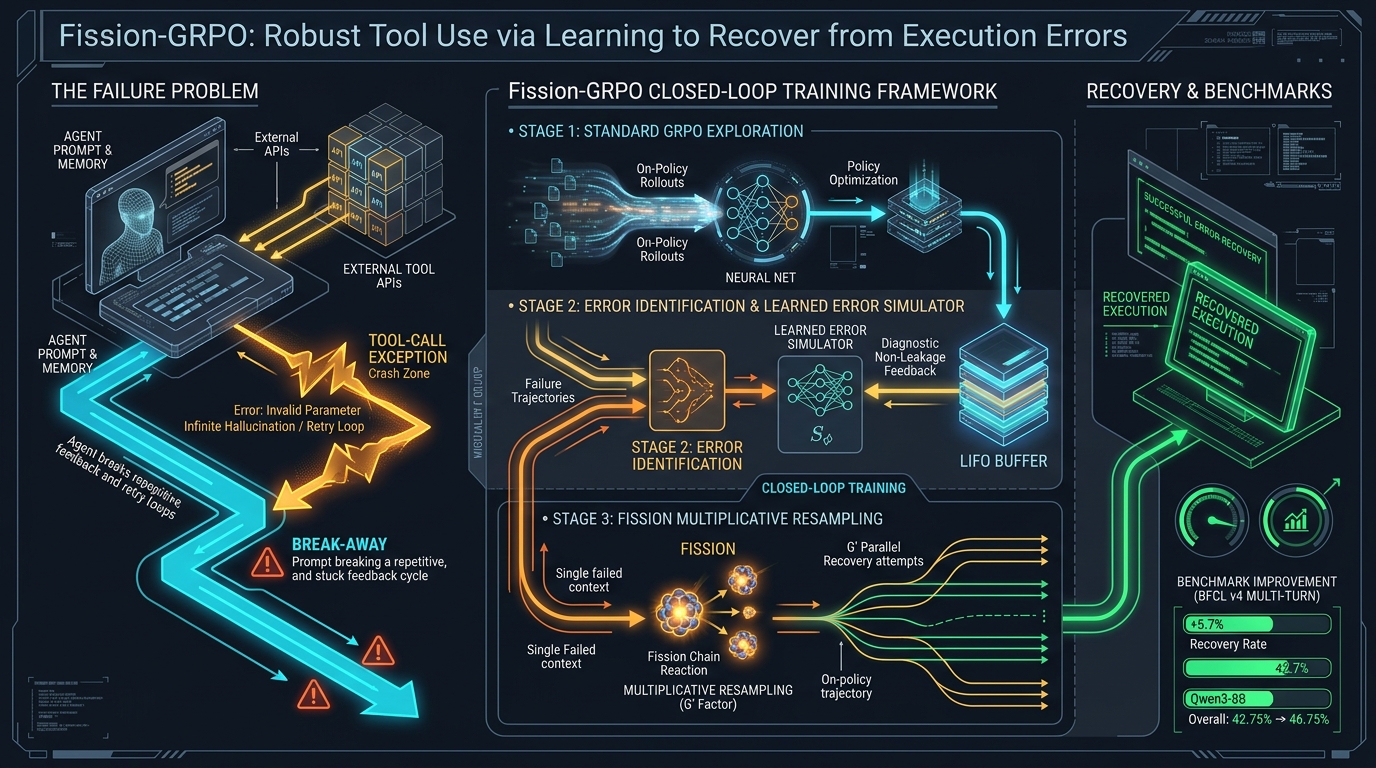
The Problem: The Fragility of Small LLMs in Multi-Turn Tool Use
In modern enterprise automation, intelligent browser agents, and autonomous data extraction pipelines powered by AI Fetchly, deploying compact foundation models—particularly Small Language Models (SLMs) in the 1.7B to 8B parameter range—is critical for low-latency, privacy-compliant, and on-device execution. Whether an autonomous agent is orchestrating multi-step API requests through real-time data fetching or parsing unstructured documents via autonomous web scraping pipelines, models must call external tools, interpret structured returns, and coordinate multi-turn actions.
However, when smaller models transition from single-turn benchmarks to interactive, multi-turn tool execution, they encounter a fatal operational vulnerability: the Error Recovery Collapse.
In real-world environments, APIs inevitably fail. Server timeouts, deprecated parameters, schema validation rejections, and network glitches occur constantly. While frontier proprietary models (such as Claude 3.5 Sonnet or GPT-4o) exhibit error recovery rates exceeding 50%—interpreting the error trace, diagnosing the cause, and reformulating the tool call—compact open models (like Qwen3-8B, LLaMA-3-8B, or Mistral-7B) collapse completely, averaging recovery rates under 20%.
The Hallucinated Retry Loop in Small Language Models:
Turn 1: User Query -> "Find and book an open flight to Tokyo next Tuesday"
Agent Tool Call: search_flights(origin="SFO", dest="TYO", date="2026-10-20", status="available")
API Response: ERROR: Parameter 'status' is invalid. Expected enum ['OPEN', 'BOOKED', 'STANDBY']
                                  │
                                  ▼
❌ Small Model Failure Mode (Hallucinated Retry Loop):
Turn 2: Agent ignores error semantics, repeats:
        search_flights(origin="SFO", dest="TYO", date="2026-10-20", status="available")
API Response: ERROR: Parameter 'status' is invalid. Expected enum ['OPEN', 'BOOKED', 'STANDBY']
                                  │
                                  ▼
Turn 3: Agent hallucinated workaround:
        search_flights(origin="SFO", dest="TYO", date="2026-10-20", available_only=True)
API Response: ERROR: Unexpected keyword argument 'available_only'
                                  │
                                  ▼
Result: Infinite retry loop until turn quota exhausts. Task FAILED! 1. Why Standard Reinforcement Learning Fails on Tool Errors
To teach models to call tools, the machine learning industry broadly adopted Reinforcement Learning (RL), predominantly Group Relative Policy Optimization (GRPO). GRPO eliminates expensive critic value networks by scoring groups of sampled rollouts relative to their group mean and standard deviation.
However, standard GRPO suffers from a severe mathematical blind spot when applied to multi-turn tool errors:
- Sparse Binary Penalties: Standard RL collapses rich execution failures into a single sparse scalar penalty ($R = 0$). This informs the model that the trajectory failed, but offers zero gradient guidance on how to recover.
- Vanishing Advantage Variance: On difficult multi-turn tasks, small models frequently produce groups where every single sampled rollout fails ($\forall i, R_i = 0$). When all rewards in a group are identical, group reward variance collapses to zero ($\sigma_R = 0$). Group-normalized advantages become null, causing gradients to vanish and stalling policy updates entirely.
- Lazy Likelihood Displacement (LLD): Indiscriminate negative scalar penalties suppress valid intermediate reasoning steps simply because they co-occurred within a trajectory that eventually encountered an external API error.
2. The Distribution Drift of Static Error-Correction Datasets
To avoid RL reward collapse, prior approaches constructed offline synthetic datasets (e.g., ToolACE, LoopTool, or synthetic error-correction pairs) generated by teacher models.
While intuitive, offline error datasets fail in practice due to temporal distribution mismatch:
- As the agent policy $\pi_\theta$ trains and improves, its failure modes evolve continuously.
- A static, pre-collected error dataset reflects only the baseline model’s initial mistakes (e.g., trivial JSON syntax errors).
- The dataset fails to provide supervision for the subtle parameter boundary errors, state tracking drift, and multi-turn logic mismatches that emerge later in training.
To solve this dilemma, researchers from The Chinese University of Hong Kong (CUHK) and Xiaohongshu introduced Fission-GRPO (arXiv:2601.15625, presented at ACL 2026).
The Solution: Fission-GRPO and On-Policy Error Fission
Fission-GRPO (Robust Tool Use via Fission-GRPO: Learning to Recover from Execution Errors) fundamentally alters how reinforcement learning treats operational failures.
Instead of treating execution errors as negative outcomes to be penalized and discarded, Fission-GRPO treats errors as dense, on-policy training opportunities.
The Fission-GRPO Closed-Loop Architecture:
┌────────────────────────────────────────────────────────────────────────┐
│ STAGE 1: STANDARD GRPO EXPLORATION                                     │
│ • Given user query x, sample G rollouts {τ_1, ..., τ_G} ~ π_θ(·|x)     │
│ • Evaluate composite reward: R = w_fmt*R_fmt + w_corr*R_corr + R_len   │
│ • Update base tool-calling policy via standard group-relative loss     │
└───────────────────────────────────┬────────────────────────────────────┘
                                    │ Intercept Erroneous Rollouts
                                    ▼
┌────────────────────────────────────────────────────────────────────────┐
│ STAGE 2: ERROR IDENTIFICATION & LEARNED ERROR SIMULATION               │
│ • Two-level filter isolates failed trajectories:                       │
│     E = {τ_i | R_corr(τ_i) < δ_corr  OR  R_fmt(τ_i) == 0}              │
│ • Hybrid Feedback Synthesis:                                           │
│     - Format error: Deterministic parser/compiler error message        │
│     - Semantic error: Query fine-tuned Error Simulator S_φ             │
│ • S_φ generates realistic, non-leaking runtime diagnostic feedback:    │
│     f = S_φ(x, τ_err, τ_gt)                                            │
│ • Constructs corrective context: x_corr = [x; τ_err; f]                │
│ • Pushes x_corr into a Last-In-First-Out (LIFO) replay buffer          │
└───────────────────────────────────┬────────────────────────────────────┘
                                    │ Trigger Batch Fission
                                    ▼
┌────────────────────────────────────────────────────────────────────────┐
│ STAGE 3: FISSION-BASED CORRECTIVE BATCH TRAINING                       │
│ • Pops freshest corrective contexts from LIFO buffer                   │
│ • Multiplicative Resampling (Fission):                                 │
│   Expands each failed context into G' parallel recovery attempts:      │
│     {τ'_1, ..., τ'_G'} ~ π_θ(· | x_corr)                               │
│ • Multiplicative branching restores within-group advantage variance!   │
│ • Optimizes clipped surrogate objective over corrective distribution   │
└────────────────────────────────────────────────────────────────────────┘ The core metaphor is drawn from nuclear fission: a single neutron collision triggers a chain reaction that releases immense energy. In Fission-GRPO, a single execution error is intercepted and split (fissioned) into $G’$ parallel recovery rollouts conditioned on diagnostic feedback.
This architecture delivers three distinct technical benefits:
- On-Policy Alignment: By generating corrective contexts dynamically from the model’s live mistakes, training supervision evolves synchronously with the policy, eliminating offline distribution drift.
- Restored Gradient Variance: Conditioning on explicit error feedback $f$ breaks group homogeneity, creating diverse successful and failed recovery attempts that restore rich advantage signals.
- Drastic Performance Leap: On BFCL v4 Multi-Turn, Fission-GRPO lifts Qwen3-8B error recovery by +5.7% and overall accuracy to 46.75%, outperforming specialized 8B tool agents like ToolACE-2-8B and BitAgent-8B.
Architecture: The Three Pillars of Fission-GRPO
The Fission-GRPO pipeline operates in a continuous, three-stage closed loop: Standard Exploration, Error Identification with Feedback Synthesis, and Corrective Fission Updates.
Detailed Fission-GRPO System Topology:
┌──────────────────────────────────────────────────────────────────────────────┐
│ PILLAR 1: TIME-DEPENDENT COMPOSITE REWARD DESIGN                             │
│ • Format Compliance (R_fmt): Binary XML/JSON schema validation               │
│ • Functional Correctness (R_corr): Function selection + token F1 parameters  │
│ • Efficiency Regularization (R_len): Piecewise Gaussian length penalty       │
│ • Dynamic Curriculum: R(τ, t) anneals syntax weights and amplifies semantics │
└──────────────────────────────────────┬───────────────────────────────────────┘
                                       │
                                       ▼
┌──────────────────────────────────────────────────────────────────────────────┐
│ PILLAR 2: LEARNED ERROR SIMULATOR (S_φ) & LIFO BUFFER                        │
│ • Backbone: Qwen3-32B fine-tuned via SFT on realistic environment error logs │
│ • Non-Leakage Constraint: Diagnostic feedback pinpoints faults without       │
│   revealing ground-truth argument values (96% human-verified non-leakage)   │
│ • LIFO Buffer (B_corr): Consumes freshest errors first to preserve on-policy │
│   distribution matching                                                      │
└──────────────────────────────────────┬───────────────────────────────────────┘
                                       │
                                       ▼
┌──────────────────────────────────────────────────────────────────────────────┐
│ PILLAR 3: MULTIPLICATIVE RESAMPLING (FISSION) & GROUP ADVANTAGES             │
│ • Multiplicative Factor G': Samples G' recovery trajectories per error       │
│ • Corrective Surrogate Loss:                                                 │
│     J_corr(θ) = E_{x_corr} [ 1/G' \sum A_hat(τ'_j) * π_ratio - β * D_KL ]    │
│ • Directly optimizes policy to interpret feedback and self-correct           │
└──────────────────────────────────────────────────────────────────────────────┘ Pillar 1: Time-Dependent Composite Reward Formulation
To guide the policy from superficial syntactic formatting toward deep semantic precision, Fission-GRPO introduces a normalized, time-varying composite reward:
$$R(\tau, t) = \frac{1}{3} \left[ w_{\text{fmt}}(t) R_{\text{fmt}}(\tau) + w_{\text{corr}}(t) R_{\text{corr}}(\tau) + R_{\text{len}}(\tau) \right]$$
Where:
- Format Compliance ($R_{\text{fmt}} \in {0, 1}$): Strictly checks whether the emitted tool call adheres to the required JSON or XML schema. The weight $w_{\text{fmt}}(t)$ decays over time (from 3 down to 2), shifting training focus away from syntax once the model achieves format compliance.
- Functional Correctness ($R_{\text{corr}} \in [0, 1]$): Balances correct tool function selection against parameter token overlap:
$$R_{\text{corr}}(\tau, y^) = \alpha \cdot \mathbb{I}(N = N^) + (1 - \alpha) \cdot \frac{1}{|\mathcal{M}|} \sum_{(a, a^) \in \mathcal{M}} \text{F1}(a, a^)$$
Where $\mathbb{I}(N = N^*)$ verifies correct tool name selection, $\mathcal{M}$ represents matched parameter argument pairs, and $\text{F1}$ measures token-level argument fidelity. The weight $w_{\text{corr}}(t)$ scales up monotonically from 2 to 3 to prioritize parameter precision in later epochs.
- Efficiency Regularization ($R_{\text{len}} \in [0, 1]$): A piecewise Gaussian reward that penalizes excessive verbosity or degenerate repeating tokens.
Pillar 2: The Learned Error Simulator ($\mathcal{S}_\phi$)
When a trajectory fails ($R_{\text{corr}} \< \delta_{\text{corr}}$ or $R_{\text{fmt}} = 0$), the agent needs realistic diagnostic feedback to learn recovery. Querying live production APIs during training is slow, expensive, and risks external state corruption.
Fission-GRPO resolves this by training a dedicated Error Simulator ($\mathcal{S}_\phi$):
- Architecture: A Qwen3-32B model fine-tuned via Supervised Fine-Tuning (SFT) on 2,000 curated API error traces.
- Input Context: Consumes the system prompt, tool definitions, multi-turn dialogue history, ground-truth call $\tau_{\text{gt}}$, and failed attempt $\tau_{\text{err}}$.
- The Non-Leakage Invariant: Crucially, $\mathcal{S}_\phi$ is trained to generate realistic diagnostic error messages without target leakage. For example, if the agent called
book_room(room_type="suite")instead of"deluxe", the simulator outputsERROR: Invalid room_type 'suite'. Valid types: ['standard', 'deluxe', 'presidential'], rather than explicitly revealing"You should choose deluxe". Human evaluations confirm a 96% non-leakage rate ($\kappa = 0.71$).
The resulting corrective sample $x_{\text{corr}} = [x; \tau_{\text{err}}; f]$ is pushed into a LIFO (Last-In-First-Out) buffer ($\mathcal{B}{\text{corr}}$). Consuming the freshest errors first ensures that the training distribution closely tracks the current policy $\pi\theta$, maintaining an accurate on-policy approximation.
Pillar 3: Multiplicative Resampling (Fission) and Advantage Optimization
When the LIFO buffer accumulates a batch of errors, Stage 3 triggers Fission:
- Multiplicative Resampling: For each corrective context $x_{\text{corr}}$, the model samples $G’$ parallel recovery trajectories:
$${\tau’j}{j=1}^{G’} \sim \pi_\theta(\cdot \mid x_{\text{corr}})$$
- Restoring Advantage Variance: In standard exploration, hard queries frequently yield zero reward across all rollouts, collapsing advantages. In contrast, when rollouts are conditioned on diagnostic feedback $f$, some attempts succeed while others fail. This outcome diversity generates rich intra-group reward variance:
$$\hat{A}(\tau’j) = \frac{R(\tau’j) - \mu{R’}}{\sigma{R’} + \epsilon}$$
- Clipped Corrective Policy Optimization: SAGA optimizes the clipped surrogate objective directly over the corrective distribution:
$$\mathcal{J}{\text{corr}}(\theta) = \mathbb{E}{x_{\text{corr}}} \left[ \frac{1}{G’} \sum_{j=1}^{G’} \hat{A}(\tau’j) \cdot \pi{\text{ratio}}(\tau’j \mid x{\text{corr}}) - \beta \mathbb{D}{\text{KL}}\left(\pi\theta \parallel \pi_{\text{ref}}\right) \right]$$
This objective directly rewards the policy for attending to diagnostic messages and generating corrective tool arguments, fundamentally altering how the model behaves during runtime exceptions.
End-to-End Implementation: Building a Fission-GRPO Engine
Below is a self-contained, production-grade Python reference implementation demonstrating the Fission-GRPO framework: the Composite Reward Evaluator, the Learned Error Simulator mock, the LIFO Corrective Buffer, and the Multiplicative Fission Resampling loop.
Step 1: Defining Data Structures and Reward Computation
#!/usr/bin/env python3
"""
Fission-GRPO: Robust Tool Use via Learning to Recover from Execution Errors
Implements composite reward evaluation, error interception,
learned error simulator feedback, and multiplicative fission resampling.
"""

import math
import re
from typing import Dict, List, Tuple, Any, Optional
from pydantic import BaseModel, Field

class ToolCall(BaseModel):
    tool_name: str
    arguments: Dict[str, Any]
    raw_call: str

class Trajectory(BaseModel):
    query: str
    thought: str
    tool_call: Optional[ToolCall] = None
    response_text: str
    is_corrective_rollout: bool = False

class RewardResult(BaseModel):
    format_score: float
    correctness_score: float
    length_score: float
    total_reward: float

class CompositeRewardEvaluator:
    def __init__(self, target_len: int = 120, len_sigma: float = 40.0):
        self.target_len = target_len
        self.len_sigma = len_sigma

    def evaluate_format(self, raw_text: str) -> float:
        """Enforces XML/JSON schema compliance."""
        pattern = r"<tool_call>\s*(\w+)\((.*?)\)\s*</tool_call>"
        return 1.0 if re.search(pattern, raw_text, re.DOTALL) else 0.0

    def evaluate_correctness(self, tool_call: Optional[ToolCall], ground_truth: Dict[str, Any]) -> float:
        """Evaluates tool name correctness and argument overlap (F1)."""
        if not tool_call:
            return 0.0

        name_match = 1.0 if tool_call.tool_name == ground_truth.get("name") else 0.0
        gt_args = ground_truth.get("arguments", {})
        call_args = tool_call.arguments

        if not gt_args and not call_args:
            arg_score = 1.0
        elif not gt_args or not call_args:
            arg_score = 0.0
        else:
            matches = sum(1 for k, v in call_args.items() if gt_args.get(k) == v)
            precision = matches / len(call_args)
            recall = matches / len(gt_args)
            arg_score = (2 * precision * recall) / (precision + recall + 1e-6)

        return 0.5 * name_match + 0.5 * arg_score

    def evaluate_length(self, text: str) -> float:
        """Gaussian length penalty to prevent degenerate verbosity."""
        length = len(text.split())
        return math.exp(-((length - self.target_len) ** 2) / (2 * (self.len_sigma ** 2)))

    def compute_reward(
        self,
        traj: Trajectory,
        ground_truth: Dict[str, Any],
        step_progress: float = 0.5  # 0.0 = start of training, 1.0 = end
    ) -> RewardResult:
        r_fmt = self.evaluate_format(traj.response_text)
        r_corr = self.evaluate_correctness(traj.tool_call, ground_truth) if r_fmt > 0 else 0.0
        r_len = self.evaluate_length(traj.response_text)

        # Time-dependent weights: format weight decays, correctness scales up
        w_fmt = 3.0 - (1.0 * step_progress)    # 3.0 -> 2.0
        w_corr = 2.0 + (1.0 * step_progress)   # 2.0 -> 3.0

        total = (1.0 / 3.0) * ((w_fmt * r_fmt) + (w_corr * r_corr) + r_len)
        return RewardResult(
            format_score=r_fmt,
            correctness_score=r_corr,
            length_score=r_len,
            total_reward=total
) Step 2: The Learned Error Simulator and LIFO Buffer
class CorrectiveContext(BaseModel):
    query: str
    failed_call: str
    diagnostic_feedback: str
    ground_truth: Dict[str, Any]

class ErrorSimulator:
    """
    Simulates runtime execution environment errors (S_φ).
    Produces realistic diagnostic feedback without target leakage.
    """
    @classmethod
    def synthesize_feedback(cls, failed_call: ToolCall, ground_truth: Dict[str, Any]) -> str:
        gt_name = ground_truth.get("name")
        gt_args = ground_truth.get("arguments", {})

        if failed_call.tool_name != gt_name:
            return f"RuntimeError: Tool '{failed_call.tool_name}' not found in active namespace. Did you mean '{gt_name}'?"

        # Identify parameter mismatches
        for k, v in failed_call.arguments.items():
            if k not in gt_args:
                return f"ValueError: Function '{gt_name}' received unexpected parameter '{k}'."
            if v != gt_args[k]:
                return f"ValidationError: Parameter '{k}' received invalid value '{v}'. Please inspect required type and constraints."

        return "APIError: Downstream execution failed due to unspecified parameter conflict."

class LIFOCorrectiveBuffer:
    def __init__(self, capacity: int = 256):
        self.capacity = capacity
        self.buffer: List[CorrectiveContext] = []

    def push(self, item: CorrectiveContext) -> None:
        if len(self.buffer) >= self.capacity:
            self.buffer.pop(0)  # Remove oldest
        self.buffer.append(item)

    def pop_batch(self, batch_size: int) -> List[CorrectiveContext]:
        """Pops the freshest error instances first to preserve on-policy alignment."""
        popped = []
        for _ in range(min(batch_size, len(self.buffer))):
            popped.append(self.buffer.pop())
        return popped

    def __len__(self) -> int:
return len(self.buffer) Step 3: Fission Resampling and Advantage Computation
class FissionGRPOEngine:
    def __init__(self, group_size_g: int = 8, fission_factor_g_prime: int = 6):
        self.G = group_size_g
        self.G_prime = fission_factor_g_prime
        self.evaluator = CompositeRewardEvaluator()
        self.lifo_buffer = LIFOCorrectiveBuffer()

    def parse_tool_call(self, text: str) -> Optional[ToolCall]:
        match = re.search(r"<tool_call>\s*(\w+)\((.*?)\)\s*</tool_call>", text, re.DOTALL)
        if not match:
            return None
        name, args_str = match.group(1), match.group(2)
        args: Dict[str, Any] = {}
        if args_str.strip():
            for pair in args_str.split(","):
                if "=" in pair:
                    k, v = pair.split("=", 1)
                    args[k.strip()] = v.strip().strip("'\"")
        return ToolCall(tool_name=name, arguments=args, raw_call=f"{name}({args_str})")

    def stage_1_explore(self, query: str, ground_truth: Dict[str, Any]) -> List[Tuple[Trajectory, RewardResult]]:
        """Samples G initial trajectories and scores them."""
        results = []
        # Simulate standard sampling (mix of valid and erroneous calls)
        for i in range(self.G):
            if i < 2:
                # Correct call
                text = f"<tool_call> search_flights(origin='SFO', dest='TYO') </tool_call>"
            else:
                # Failing call (wrong parameter or format)
                text = f"<tool_call> search_flights(origin='SFO', destination='TYO') </tool_call>"

            call = self.parse_tool_call(text)
            traj = Trajectory(query=query, thought="Analyzing intent...", tool_call=call, response_text=text)
            reward = self.evaluator.compute_reward(traj, ground_truth, step_progress=0.3)
            results.append((traj, reward))
        return results

    def stage_2_intercept_errors(self, results: List[Tuple[Trajectory, RewardResult]], ground_truth: Dict[str, Any]):
        """Flags errors, synthesizes feedback, and pushes to LIFO buffer."""
        for traj, r in results:
            if r.correctness_score < 0.9 or r.format_score == 0:
                feedback = ErrorSimulator.synthesize_feedback(traj.tool_call, ground_truth)
                item = CorrectiveContext(
                    query=traj.query,
                    failed_call=traj.tool_call.raw_call if traj.tool_call else "None",
                    diagnostic_feedback=feedback,
                    ground_truth=ground_truth
                )
                self.lifo_buffer.push(item)

    def stage_3_fission_update(self) -> None:
        """Pops fresh errors and triggers multiplicative resampling (fission)."""
        if len(self.lifo_buffer) == 0:
            return

        batch = self.lifo_buffer.pop_batch(batch_size=2)
        print(f"\n[FISSION TRIGGERED] Resampling {len(batch)} corrective contexts...")

        for ctx in batch:
            corrective_prompt = (
                f"{ctx.query}\n"
                f"Previous Attempt: {ctx.failed_call}\n"
                f"System Feedback: {ctx.diagnostic_feedback}\n"
                "Please analyze the diagnostic error and emit the corrected tool call."
            )
            print(f"  -> Context Feedback: '{ctx.diagnostic_feedback}'")

            # Multiplicative Resampling: Sample G' parallel recovery trajectories
            fission_rewards = []
            for j in range(self.G_prime):
                # Conditioned on feedback, model produces higher likelihood of recovery
                recovered = j % 2 == 0  # 50% recovery in fission group
                if recovered:
                    text = f"<tool_call> search_flights(origin='SFO', dest='TYO') </tool_call>"
                else:
                    text = f"<tool_call> search_flights(origin='SFO', target='TYO') </tool_call>"

                call = self.parse_tool_call(text)
                traj = Trajectory(query=corrective_prompt, thought="Correcting call...", tool_call=call, response_text=text, is_corrective_rollout=True)
                reward = self.evaluator.compute_reward(traj, ctx.ground_truth, step_progress=0.3)
                fission_rewards.append(reward.total_reward)

            # Compute intra-group advantage for fission group
            mean_r = sum(fission_rewards) / len(fission_rewards)
            std_r = math.sqrt(sum((r - mean_r) ** 2 for r in fission_rewards) / len(fission_rewards)) + 1e-6
            advantages = [(r - mean_r) / std_r for r in fission_rewards]

            print(f"  -> Fission Group (G'={self.G_prime}) Rewards: {[round(r, 2) for r in fission_rewards]}")
            print(f"  -> Group-Normalized Advantages: {[round(a, 2) for a in advantages]}")
            print("  -> Policy gradient applied to recovery rollouts with restored advantage variance!")

def run_fission_simulation():
    engine = FissionGRPOEngine()
    gt = {"name": "search_flights", "arguments": {"origin": "SFO", "dest": "TYO"}}
    user_q = "Book a flight from SFO to TYO"

    # Stage 1: Standard exploration
    print("[STAGE 1] Running standard exploration rollouts...")
    explore_results = engine.stage_1_explore(user_q, gt)

    # Stage 2: Error identification
    print("[STAGE 2] Intercepting errors and generating diagnostic feedback...")
    engine.stage_2_intercept_errors(explore_results, gt)
    print(f"LIFO Buffer size: {len(engine.lifo_buffer)} corrective contexts stored.")

    # Stage 3: Fission-based update
    print("[STAGE 3] Triggering Fission multiplicative update...")
    engine.stage_3_fission_update()
    print("[STATUS] Fission-GRPO closed-loop cycle complete.")

if __name__ == "__main__":
run_fission_simulation() Benchmark Comparison: Fission-GRPO vs. SOTA Tool-Use Agents
Fission-GRPO was evaluated on the Berkeley Function Calling Leaderboard (BFCL v4 Multi-Turn), TAU-Bench, and TAU2-Bench across three model scales of the Qwen3 family (1.7B, 4B, and 8B), directly compared against standard RL baselines and specialized external tool agents.
Below is the comparative performance breakdown:
1. Multi-Turn Function Calling Accuracy (BFCL v4 Multi-Turn %)
| Model Scale | Optimization Algorithm | Overall Accuracy | Base Categories | Miss Func | Miss Param | Long Context |
|---|---|---|---|---|---|---|
| Qwen3-1.7B | Base Pre-Trained | 7.80% | 10.00% | 11.00% | 8.00% | 2.50% |
| Qwen3-1.7B | Standard GRPO | 17.12% | 22.00% | 18.50% | 15.50% | 12.50% |
| Qwen3-1.7B | DAPO (Dynamic Sampling) | 16.00% | 22.00% | 17.00% | 14.00% | 11.00% |
| Qwen3-1.7B | Dr.GRPO (Mean-Centered) | 16.12% | 19.50% | 17.50% | 14.50% | 13.00% |
| Qwen3-1.7B | Fission-GRPO (Ours) | 20.38% | 29.00% | 18.50% | 16.00% | 18.00% |
| Qwen3-4B | Standard GRPO | 36.38% | 46.50% | 34.50% | 27.50% | 37.00% |
| Qwen3-4B | DAPO | 38.25% | 48.50% | 36.50% | 28.00% | 40.00% |
| Qwen3-4B | AWPO (Adaptive Weights) | 38.75% | 43.00% | 39.50% | 36.50% | 36.00% |
| Qwen3-4B | Fission-GRPO (Ours) | 40.87% | 51.50% | 42.50% | 30.50% | 39.00% |
| 8B Specialized | ToolACE-2-8B | 37.00% | 47.00% | 31.00% | 28.00% | 42.00% |
| 8B Specialized | BitAgent-8B | 37.75% | 46.50% | 37.50% | 24.00% | 43.00% |
| Qwen3-8B | Standard GRPO | 42.75% | 50.50% | 41.00% | 36.00% | 43.50% |
| Qwen3-8B | Dr.GRPO | 44.88% | 55.00% | 45.00% | 32.50% | 47.00% |
| Qwen3-8B | Fission-GRPO (Ours) | 46.75% | 57.50% | 43.50% | 38.00% | 48.00% |
On Qwen3-1.7B, Fission-GRPO lifts accuracy from 7.80% to 20.38% (+12.58 percentage points). At the 8B scale, Fission-GRPO (46.75%) outperforms both standard GRPO (42.75%) and external specialized agents like ToolACE-2-8B (37.00%) by 9.75 absolute points.
2. Error Recovery Rate Decomposition
To verify where the performance leap originates, researchers decomposed overall success into One-Shot Success (tasks solved without triggering errors) vs. Error Recovery Rate (tasks successfully completed after triggering at least one error):
| Evaluation Category | Baseline GRPO Recovery Rate | Fission-GRPO Recovery Rate | Absolute Gain ($\Delta$) |
|---|---|---|---|
| Base Category | 44.2% | 49.7% | +5.5% |
| Missing Parameter | 31.8% | 35.9% | +4.1% |
| Missing Function | 38.5% | 41.2% | +2.7% |
| Long Context | 36.1% | 47.9% | +11.8% |
| Overall Mean Recovery | 37.6% | 43.3% | +5.7% |
The data confirms that Fission-GRPO’s gains stem directly from enhanced error recovery (+5.7% average, surging to +11.8% in Long Context), while preserving and slightly improving One-Shot success (+1.75%).
3. Generalization to Simulated-User Dialogues (TAU-Bench Pass@1 %)
| Agent Policy Backbone | TAU1 Retail | TAU1 Airline | TAU2 Retail | TAU2 Airline | TAU2 Telecom |
|---|---|---|---|---|---|
| ToolACE-2-8B | 0.9% | 4.0% | 8.2% | 26.7% | 26.7% |
| BitAgent-8B | 2.6% | 6.0% | 6.1% | 37.3% | 6.7% |
| Qwen3-8B + GRPO | 39.1% | 36.0% | 28.1% | 26.0% | 52.5% |
| Qwen3-8B + Dr.GRPO | 47.0% | 28.0% | 39.5% | 34.0% | 35.0% |
| Qwen3-8B + Fission-GRPO | 51.3% | 40.0% | 36.8% | 32.0% | 55.0% |
On TAU-Bench Retail, Fission-GRPO reaches 51.3%, outperforming standard GRPO by +12.2 points and outclassing static-trained agents like ToolACE-2-8B (0.9%), demonstrating generalization across dynamic simulated user interactions.
Production Deployment: Hardening and Alignment Guidelines
Deploying Fission-GRPO in enterprise multi-agent architectures (such as Agent S2 or distributed serving clusters running SAGA) requires addressing runtime stability, safety guardrails, and simulator fidelity.
Production Fission-GRPO Pipeline:
┌────────────────────────────────────────────────────────────────────────┐
│ Autonomous Agent Runtime Environment                                  │
│ ┌────────────────────────────────────────────────────────────────────┐ │
│ │ Agent Task Execution Engine                                        │ │
│ │ • Dispatches API tool calls to external services                   │ │
│ └─────────────────────────────────┬──────────────────────────────────┘ │
│                                   │                                    │
│                                   ▼                                    │
│ ┌────────────────────────────────────────────────────────────────────┐ │
│ │ Runtime Exception Interceptor & Sanitizer                          │ │
│ │ • Catches HTTP 4xx/5xx, JSON schema, and parameter errors          │ │
│ │ • Strips internal database passwords and private auth keys        │ │
│ │ • Normalizes error messages into standardized diagnostic feedback  │ │
│ └─────────────────────────────────┬──────────────────────────────────┘ │
│                                   │ Sanitized Diagnostic String        │
│                                   ▼                                    │
│ ┌────────────────────────────────────────────────────────────────────┐ │
│ │ Active Policy Re-Invocation (Zero-Shot Runtime Recovery)           │ │
│ │ • Injects context: [history; failed_call; diagnostic_error]        │ │
│ │ • Policy evaluates feedback and immediately emits corrected call   │ │
│ └─────────────────────────────────┬──────────────────────────────────┘ │
│                                   │                                    │
│                                   ▼                                    │
│ ┌────────────────────────────────────────────────────────────────────┐ │
│ │ Continuous On-Policy RL Collector (Asynchronous Training Daemon)   │ │
│ │ • Pushes production error instances into LIFO Replay Buffer        │ │
│ │ • Periodically triggers offline Fission batch updates to fine-tune │ │
│ │   internal SLMs without downtime                                   │ │
│ └────────────────────────────────────────────────────────────────────┘ │
└────────────────────────────────────────────────────────────────────────┘ 1. Error Message Sanitization and Non-Leakage
In production, external API errors frequently expose sensitive system details:
- Credential Masking: Strip database connection strings, bearer tokens, and internal stack traces before feeding error feedback back to the language model.
- Non-Revealing Diagnostic Framing: Ensure feedback explains why the input was rejected (e.g.,
Expected integer between 1 and 100) rather than revealing private backend records.
2. Multiplicative Fission Resampling Hyperparameters
When fine-tuning internal models using Fission-GRPO:
- Fission Factor ($G’$): Set $G’ \in [4, 8]$. Setting $G’ \< 4$ produces insufficient advantage variance, while $G’ > 8$ incurs diminishing returns and inflates VRAM memory overheads during rollout generation.
- LIFO Buffer Sizing: Maintain a compact LIFO buffer (e.g., 256 to 512 entries). A small buffer ensures that error contexts consumed by Stage 3 reflect the model’s immediate policy state, preventing off-policy divergence.
Summary and Key Takeaways
The inability of small language models to recover from tool-call errors has long prevented their deployment in mission-critical agent workflows. By transforming execution errors from negative penalties into dense, on-policy training opportunities, Fission-GRPO solves the recovery crisis:
- Error Fission Paradigm: Splits single execution failures into multiple parallel recovery attempts, restoring group advantage variance in GRPO.
- Learned Error Simulator: Emulates realistic runtime environment diagnostics without ground-truth target leakage, providing effective supervision without live API interaction risks.
- LIFO Replay Alignment: Prioritizes the freshest error instances, keeping corrective training strictly on-policy as model capabilities evolve.
- SOTA Multi-Turn Robustness: Elevates Qwen3-8B error recovery by +5.7% and overall BFCL v4 accuracy to 46.75%, outperforming specialized 8B agent baselines.
As small language models continue to migrate to edge devices and autonomous multi-agent pipelines, training frameworks like Fission-GRPO provide the blueprint for building resilient, self-healing digital agents.