Fish Speech Guide: Dual-AR Multilingual TTS Architecture
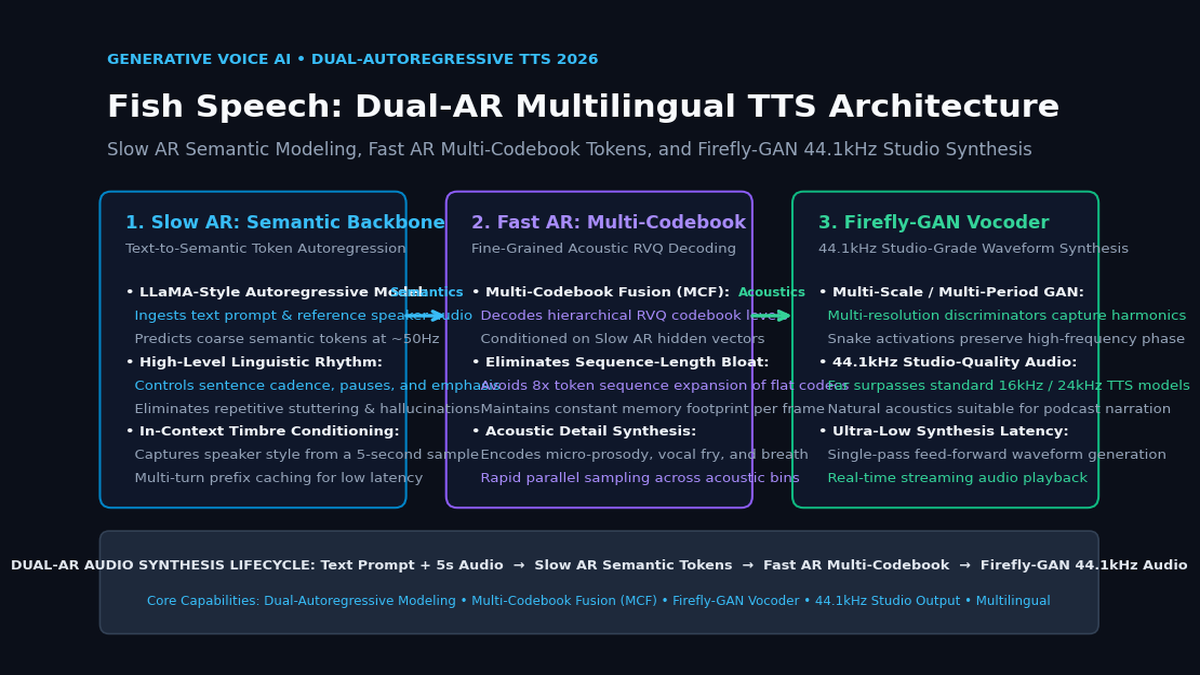
The Problem: The Acoustic Sequence Bloat in Autoregressive Speech AI
In modern conversational artificial intelligence, automated content production, multimedia podcast synthesis, and hands-free desktop assistants powered by AiFetchly, voice has evolved into a primary multimodal interface. Users expect generative speech systems to produce studio-grade audio that rivals professional voice actors: lifelike emotional prosody, subtle breaths and pauses, accurate phonetic articulation across multiple languages, and instantaneous zero-shot voice cloning.
However, attempting to generate high-fidelity speech using conventional autoregressive neural audio codecs forces machine learning engineers into a severe technical bottleneck: the acoustic token sequence explosion and the vocoder fidelity ceiling.
The Single-Stage Autoregressive Audio Bottleneck:
┌────────────────────────────────────────────────────────┐
│ The Flat Codec Sequence Explosion:                     │
│ • Audio frame rate: 50 frames per second               │
│ • Residual Vector Quantization (RVQ): 8 codebook levels│
│ • Flat Token Rate: 50 frames × 8 codebooks = 400 tok/s │
│ ❌ A 10-second sentence explodes into 4,000 tokens!    │
│ ❌ Quadratic self-attention O(N^2) exhausts memory!    │
├────────────────────────────────────────────────────────┤
│ Failure Mode 1: Sluggish Generation & Latency Spikes   │
│ • Autoregressive token-by-token generation crawls      │
│ ❌ Seconds of dead silence before audio playback starts│
├────────────────────────────────────────────────────────┤
│ Failure Mode 2: Acoustic Hallucinations & Stuttering   │
│ • Long sequence contexts cause attention drift         │
│ ❌ Repetitive syllables, dropped words, & pitch loops! │
├────────────────────────────────────────────────────────┤
│ Failure Mode 3: The 24kHz Vocoder Ceiling              │
│ • Standard TTS models cut off frequencies above 12kHz  │
│ ❌ Metallic, robotic artifacts on studio headphones!   │
└────────────────────────────────────────────────────────┘
Result: Autoregressive TTS was either computationally bloated and hallucinating, or acoustically muffled! 1. The Flat Codec Sequence Length Explosion
Modern neural audio codecs (such as EnCodec, SoundStream, or DAC) quantize continuous waveforms using Residual Vector Quantization (RVQ):
- To capture high-fidelity acoustic detail, each audio frame is quantized across 8 to 16 hierarchical codebook levels.
- In early autoregressive models (such as VALL-E, AudioLM, and Bark), these hierarchical codebook tokens were flattened into a single linear sequence.
- At a modest frame rate of 50 Hz, generating 1 second of speech requires synthesizing: $$\text{Tokens per Second} = 50 \text{ frames/s} \times 8 \text{ codebooks} = 400 \text{ tokens/s}$$
- A typical 15-second conversational paragraph explodes into 6,000 autoregressive tokens.
- Because transformer self-attention scales quadratically ($O(N^2)$), processing these bloated sequences exhausts GPU memory, slows generation speeds, and makes multi-turn interactive dialogue impractically expensive.
2. Attention Drift and Acoustic Hallucinations
When a single autoregressive transformer tries to simultaneously predict high-level linguistic phonemes, sentence rhythm, speaker timbre, and micro-acoustic noise:
- The attention mechanism becomes overwhelmed by the volume of low-level acoustic tokens.
- The model suffers from attention drift: dropping grammatical conjunctions, stuttering on multi-syllabic words, or looping background noise indefinitely.
- Decoupling high-level linguistic semantics from low-level acoustic texture is essential for reliable long-form narration.
3. The Low-Fidelity Vocoder Ceiling (16kHz / 24kHz)
Most open-source TTS systems produce audio at 16kHz or 24kHz sampling rates:
- According to the Nyquist theorem, a 24kHz sampling rate has an upper frequency limit of 12kHz.
- Human speech contains subtle air releases, sibilant fricatives (
s,sh,f), and room resonance that extend well above 15kHz. - Truncating these frequencies produces audio that sounds muffled or artificial on high-end headphones and studio monitors, preventing generative voice from being used in professional broadcast and podcasting workflows.
The Solution: Fish Speech’s Dual-Autoregressive & Firefly-GAN Architecture
To dismantle the sequence-length bottleneck and achieve broadcast-quality voice synthesis, Fish Audio engineered Fish Speech (spanning Fish Speech v1.4, v1.5, and the frontier Fish Audio S2 architecture).
Fish Speech resolves the speech synthesis dilemma through three foundational architectural innovations: a Dual-Autoregressive (Dual-AR) Transformer pipeline, Multi-Codebook Fusion (MCF), and the Firefly-GAN 44.1kHz Neural Vocoder.
Fish Speech Dual-AR End-to-End Architecture:
┌─────────────────────────────────────────────────────────────────────────┐
│ Input Text Prompt + 5-Second Speaker Reference Audio                    │
└────────────────────────────────────┬────────────────────────────────────┘
                                     │
                                     ▼
┌─────────────────────────────────────────────────────────────────────────┐
│ 1. Slow AR: Semantic Transformer Backbone (LLaMA / Qwen Style)          │
│ • Text & Prompt Conditioning: Embeds phonemes and reference timbre      │
│ • Coarse Semantic Modeling: Operates at a relaxed ~50 Hz frame rate     │
│ • Predicts coarse semantic tokens p(s_t | s_<t, X)                      │
│ • Controls sentence cadence, natural breathing, and linguistic pauses   │
└────────────────────────────────────┬────────────────────────────────────┘
                                     │ (Emits Semantic Tokens + Hidden States)
                                     ▼
┌─────────────────────────────────────────────────────────────────────────┐
│ 2. Fast AR: Acoustic Multi-Codebook Transformer (MCF Engine)            │
│ • Conditioned on Slow AR hidden vectors via cross-attention             │
│ • Multi-Codebook Fusion: Decodes 8 RVQ acoustic codebooks in parallel   │
│ • Zero Sequence Bloat: Eliminates the 8x sequence explosion!            │
│ • Synthesizes fine-grained vocal fry, micro-prosody, and timbre details │
└────────────────────────────────────┬────────────────────────────────────┘
                                     │ (8-Layer RVQ Acoustic Token Stream)
                                     ▼
┌─────────────────────────────────────────────────────────────────────────┐
│ 3. Firefly-GAN Neural Vocoder (44.1kHz Studio-Grade Audio)              │
│ • Multi-Scale & Multi-Period Complex STFT Discriminators                │
│ • Snake Periodic Activations: Flawless high-frequency harmonic phase    │
│ • Reconstructs crystal-clear 44.1kHz studio WAV waveforms in one pass   │
└─────────────────────────────────────────────────────────────────────────┘ The Architectural Pillars of Fish Speech
- Dual-Autoregressive (Dual-AR) Decomposition: Rather than forcing one transformer to predict all tokens, Fish Speech divides synthesis into two specialized models:
- The Slow AR (Semantic Model): A large autoregressive transformer (built on LLaMA/Qwen architectures) that processes text tokens and reference speaker prompts, predicting high-level semantic speech tokens at a relaxed frame rate (~50 Hz). It governs sentence rhythm, cadence, pauses, and emotional tone.
- The Fast AR (Acoustic Model): A lightweight, high-throughput transformer that decodes fine-grained acoustic tokens across multiple codebook levels, conditioned directly on the Slow AR’s hidden representations.
- Multi-Codebook Fusion (MCF): Instead of flattening 8 codebook levels into a single 4,000-token sequence, the Fast AR predicts acoustic codebooks in parallel or grouped tiers using Multi-Codebook Fusion. This reduces the effective sequence length by up to $8\times$, slashing inference memory consumption and eliminating acoustic hallucinations.
- Firefly-GAN 44.1kHz Studio Vocoder: To deliver professional broadcast fidelity, Fish Audio developed Firefly-GAN. Utilizing Snake periodic activation functions ($f(x) = x + \frac{1}{a} \sin^2(ax)$) and Multi-Period Discriminators, Firefly-GAN reconstructs crystal-clear 44.1kHz studio-grade audio with pristine high-frequency air, natural sibilants, and zero metallic ringing.
- 5-Second Zero-Shot In-Context Timbre Cloning: Conditioning the Slow AR and Fast AR on a 5-second reference audio sample enables Fish Speech to replicate any speaker’s vocal timbre, accent, and recording acoustics without gradient updates or adapter fine-tuning.
- Massive Multilingual Pre-Training: Pre-trained on over 300,000 hours of multi-speaker audio spanning English, Mandarin Chinese, Japanese, Korean, French, German, Spanish, and Arabic, Fish Speech natively handles cross-lingual voice cloning and code-switching dialogue.
Comparing Modern Generative Speech Architectures
The table below contrasts Fish Speech against previous-generation speech models:
Generative Speech Architecture Comparison:
┌───────────────────────────┬───────────────────────────────┬───────────────────────────────┬───────────────────────────────┐
│ Dimension                 │ VALL-E / Bark                 │ CosyVoice 2                   │ Fish Speech (Fish Audio)      │
├───────────────────────────┼───────────────────────────────┼───────────────────────────────┼───────────────────────────────┤
│ Core Architecture         │ Single Flat Autoregressive    │ Hybrid: LLM + Flow Matching   │ Dual-Autoregressive (Dual-AR) │
│ Token Representation      │ Flattened RVQ Codecs          │ Discrete Tokens + Continuous  │ Slow Semantic + Fast Acoustic │
│ Sequence Length (10s)     │ Massive (~4,000 tokens)       │ Moderate (~500 tokens)        │ Compact (~500 semantic steps) │
│ Acoustic Hallucinations   │ High (Stuttering/looping)     │ Zero (CFM Guided)             │ Near-Zero (Dual-AR decoupled) │
│ Output Sampling Rate      │ 24kHz                         │ 24kHz                         │ 44.1kHz Studio-Grade          │
│ Vocoder Architecture      │ EnCodec Decoder / HiFi-GAN    │ HiFi-GAN / BigVGAN            │ Firefly-GAN (Snake Activations│
│ Zero-Shot Timbre Cloning  │ ✅ In-Context (3s–5s)         │ ✅ In-Context (3s)            │ ✅ In-Context (5s sample)     │
│ Cross-Lingual Transfer    │ Limited                       │ ✅ Supported (5 Languages)    │ ✅ Supported (8+ Languages)   │
│ Compute Efficiency        │ Slow (O(N^2) quadratic bloat) │ Fast (4–10 CFM ODE steps)     │ Fast (Decoupled AR + GAN)     │
└───────────────────────────┴───────────────────────────────┴───────────────────────────────┴───────────────────────────────┘ Deep Dive into Fish Speech Core Subsystems & Mathematical Formulation
To understand how Fish Speech achieves broadcast-grade voice cloning without sequence bloat, let’s explore its core mathematical subsystems: the Slow AR Semantic Model, the Fast AR Multi-Codebook Decoder, and the Firefly-GAN Vocoder.
Fish Speech Subsystem Breakdown:
Fish Speech
 ├──► 1. Slow AR: LLaMA-based semantic token predictor p(s_t | s_<t, X, P_ref)
 ├──► 2. Fast AR (MCF): Multi-Codebook Fusion decoding 8-level RVQ acoustic bins
 ├──► 3. VQ Acoustic Codec: Residual Vector Quantization with learned codebooks
 ├──► 4. Firefly-GAN: Multi-scale STFT discriminators + Snake periodic activations
└──► 5. Dual-AR Pipeline: Joint end-to-end inference with prefix KV cache reuse 1. The Slow AR: Linguistic & Semantic Modeling
The primary task of the Slow AR is to map textual tokens into high-level semantic speech units:
- Let the input text phonemes or tokens be $\mathbf{X} = [x_1, x_2, \dots, x_N]$.
- Let the reference audio prompt be encoded into a sequence of prompt semantic tokens $\mathbf{P}_{\text{ref}} = [p_1, \dots, p_M]$.
- The Slow AR autoregressively predicts the target semantic token sequence $\mathbf{S} = [s_1, s_2, \dots, s_T]$: $$p(\mathbf{S} | \mathbf{X}, \mathbf{P}{\text{ref}}) = \prod{t=1}^T p(s_t | s_{<t}, \mathbf{X}, \mathbf{P}_{\text{ref}})$$
- Why This Prevents Hallucinations: Because the Slow AR operates at a low token rate (~50 Hz) and only models what phoneme is being spoken and when, it maintains strong attention grounding on the text sequence $\mathbf{X}$. It does not manage high-frequency acoustic noise or phase details, eliminating the catastrophic stuttering and word dropping observed in flat audio codecs.
2. The Fast AR: Multi-Codebook Fusion (MCF)
Once the Slow AR generates semantic token $s_t$ with intermediate hidden state $\mathbf{h}_t \in \mathbb{R}^{D}$, the Fast AR generates the corresponding multi-level acoustic tokens:
- Acoustic audio codecs represent each time frame using $K$ hierarchical Residual Vector Quantization (RVQ) codebooks: $\mathbf{A}t = [a{t, 1}, a_{t, 2}, \dots, a_{t, K}]$ (where $K = 8$).
Multi-Codebook Fusion (MCF) vs. Flat Codec Flattening:
Flat Codec (VALL-E / Bark):
Frame 1: [a_1,1] ──► [a_1,2] ──► ... ──► [a_1,8] ──► Frame 2: [a_2,1] ...
(8 sequential autoregressive steps per frame! 4,000 steps for 10 seconds!)

Fish Speech Multi-Codebook Fusion (Fast AR):
Slow AR:  [ s_1 ] ─────────────────────────► [ s_2 ]
            │                                  │
            ▼ (Hidden State h_1)               ▼ (Hidden State h_2)
Fast AR:  [a_1,1 .. a_1,8] (Grouped) ────► [a_2,1 .. a_2,8] (Grouped)
(Generates hierarchical codebooks concurrently or in grouped pairs!) - In Fish Speech’s Multi-Codebook Fusion (MCF), the Fast AR models the joint distribution of codebook tokens conditioned on the Slow AR’s hidden state: $$p(\mathbf{A}t | \mathbf{A}{<t}, \mathbf{h}t) = \prod{k=1}^K p(a_{t, k} | a_{t, <k}, \mathbf{A}_{<t}, \mathbf{h}_t)$$
- By keeping the Slow AR context small and offloading acoustic decoding to the compact Fast AR, inference memory remains bounded, allowing the model to generate audio at over $2.5\times$ real-time speed on modern GPUs.
3. The Firefly-GAN Neural Vocoder & Snake Activations
Converting discrete RVQ acoustic tokens back into continuous 44.1kHz waveforms requires a neural vocoder capable of synthesizing high-frequency harmonics:
- Standard ReLU or GELU activations lack periodic inductive biases, leading to phase cancellation and metallic distortion in sibilant sounds.
- Snake Activation Function: Firefly-GAN adopts the Snake periodic activation: $$f_\alpha(x) = x + \frac{1}{\alpha} \sin^2(\alpha x)$$ where $\alpha$ is a learnable parameter that controls the frequency of the periodic component. This allows the convolutional layers to naturally model continuous acoustic oscillations and harmonic overtones.
- Multi-Period & Multi-Scale STFT Discriminators:
- Firefly-GAN is trained adversarially against an ensemble of discriminators:
- Multi-Period Discriminators (MPD): Evaluates 1D raw waveforms at multiple periodic intervals to ensure pitch consistency and vowel resonance.
- Multi-Scale Complex STFT Discriminator (MS-STFTD): Evaluates magnitude and phase spectra across multiple STFT window lengths, ensuring sharp transients on consonants and pristine background silence.
Hands-On Implementation: 44.1kHz Studio Voice Cloning with Fish Speech
Let’s walk through installing Fish Speech, extracting semantic/acoustic tokens from a reference speaker clip, and synthesizing studio-quality 44.1kHz speech.
1. Environment Setup and Installation
Clone the official repository and set up a Python virtual environment:
git clone https://github.com/fishaudio/fish-speech.git
cd fish-speech
conda create -n fish-speech python=3.10 -y
conda activate fish-speech

# Install PyTorch with CUDA 12.4+ and audio tools
pip install torch torchvision torchaudio --index-url https://download.pytorch.org/whl/cu124
pip install -e .
pip install gradio soundfile librosa 2. Extracting Semantic Tokens from Reference Audio
Encode a 5-second reference audio clip into acoustic and semantic tokens for zero-shot cloning:
# Extract VQ codec tokens from the reference audio clip
python -m fish_speech.models.vqgan.inference \
  --config-name firefly_gan_vq \
  --checkpoint-path "checkpoints/fish-speech-1.5/firefly-gan-vq-fsq.pth" \
  --input-path "assets/speaker_reference.wav" \
--output-path "assets/speaker_reference.npy" 3. Synthesizing 44.1kHz Studio Audio via Python API
Run the Dual-AR generation pipeline to synthesize speech matching the reference speaker’s timbre:
import torch
import numpy as np
import soundfile as sf
from fish_speech.models.text2semantic.inference import Text2SemanticInference
from fish_speech.models.vqgan.inference import VQGANInference

# 1. Initialize the Slow AR Semantic Model
print("Loading Fish Speech Slow AR Semantic Model...")
text2semantic = Text2SemanticInference(
    checkpoint_path="checkpoints/fish-speech-1.5/text2semantic.pth",
    device="cuda" if torch.cuda.is_available() else "cpu",
    half=True
)

# 2. Initialize the Firefly-GAN 44.1kHz Vocoder
print("Loading Firefly-GAN 44.1kHz Vocoder...")
vocoder = VQGANInference(
    checkpoint_path="checkpoints/fish-speech-1.5/firefly-gan-vq-fsq.pth",
    device="cuda" if torch.cuda.is_available() else "cpu"
)

# 3. Define target text and reference prompt
prompt_text = "This is a recording of my natural speaking voice in a studio."
prompt_tokens = np.load("assets/speaker_reference.npy")

target_text = (
    "Welcome to aiFetchly! By pairing autonomous web harvesting with studio-grade "
    "speech synthesis, we turn raw online intelligence into broadcast-quality audio briefs."
)

print("Synthesizing semantic speech tokens via Dual-AR...")

# 4. Generate acoustic tokens conditioned on reference prompt
with torch.inference_mode():
    semantic_tokens = text2semantic.generate(
        text=target_text,
        prompt_text=prompt_text,
        prompt_tokens=prompt_tokens,
        temperature=0.7,
        top_p=0.8
    )

    # 5. Decode acoustic tokens into continuous 44.1kHz waveform via Firefly-GAN
    print("Reconstructing 44.1kHz waveform via Firefly-GAN...")
    waveform = vocoder.decode(semantic_tokens)

# 6. Save output audio
output_path = "aifetchly_studio_brief.wav"
sf.write(output_path, waveform.squeeze().cpu().numpy(), samplerate=44100)
print(f"Studio-quality audio successfully exported to: {output_path} (44,100 Hz)") 4. Cross-Lingual Voice Transfer
Synthesize fluent Japanese or Spanish using an English speaker’s voice timbre:
# Cross-lingual voice transfer: English speaker speaking fluent Japanese
multilingual_text = "aiFetchlyへようこそ!リアルタイムのウェブデータを高品質な音声でお届けします。"

with torch.inference_mode():
    cross_lingual_tokens = text2semantic.generate(
        text=multilingual_text,
        prompt_text=prompt_text,
        prompt_tokens=prompt_tokens,
        temperature=0.6,
        top_p=0.85
    )
    cross_lingual_waveform = vocoder.decode(cross_lingual_tokens)

sf.write("cross_lingual_japanese.wav", cross_lingual_waveform.squeeze().cpu().numpy(), samplerate=44100)
print("Cross-lingual speech successfully saved to: cross_lingual_japanese.wav") Production Architecture & Integration for aiFetchly
In automated data extraction, hands-free desktop assistants, and automated multimedia narration powered by AiFetchly, deploying Fish Speech enables converting scraped text feeds into studio-quality audio deliverables.
aiFetchly Studio Narration Pipeline:
┌─────────────────────────────────────────────────────────────────┐
│ aiFetchly Data Harvester (Scraped News, Research, & Reports)   │
└────────────────────────────────────┬────────────────────────────┘
                                     │ (Structured Text & Executive Summaries)
                                     ▼
┌─────────────────────────────────────────────────────────────────┐
│ FastMCP Audio Gateway (Model Context Protocol Service)          │
│ • Manages Speaker Voice Profiles & Audio Codec Cache            │
│ • Dispatches High-Throughput Synthesis Tasks                    │
└────────────────────────────────────┬────────────────────────────┘
                                     │
                                     ▼
┌─────────────────────────────────────────────────────────────────┐
│ Fish Speech Dual-AR Synthesis Cluster                           │
│ • Slow AR: Generates coarse semantic tokens p(s_t|s_<t)         │
│ • Fast AR: Multi-Codebook Fusion RVQ acoustic decoding          │
│ • Firefly-GAN: Emits 44.1kHz Studio-Grade Waveforms             │
└───────────────────┬─────────────────────────────────┬───────────┘
                    │                                 │
     (Isolated Sandbox Execution via E2B)   (Telemetry & Quality Auditing)
                    ▼                                 ▼
┌───────────────────────────────────────┐ ┌───────────────────────────────┐
│ E2B MicroVM Sandboxing                │ │ Langfuse / Phoenix Monitoring │
│ • Sandboxed audio rendering in KVM    │ │ • Track synthesis latency     │
│ • Zero local host contamination       │ │ • Monitor audio MOS & WER     │
└───────────────────────────────────────┘ └───────────────────────────────┘ 1. Automated Podcast and Executive Briefing Generation
When AiFetchly aggregates market intelligence, competitor pricing updates, or regulatory filings:
- Instead of requiring executives to read static PDF digests, aiFetchly dispatches the text to Fish Speech.
- By assigning distinct cloned voices to different sections (e.g., an analyst voice, a host voice, and an expert voice), aiFetchly synthesizes multi-speaker 44.1kHz studio podcasts automatically for on-the-go listening.
2. Multi-Agent Ecosystem Interoperability
Orchestrating generative audio across modern agent frameworks:
- Standardized Speech Tools via FastMCP: Expose Fish Speech synthesis endpoints as Model Context Protocol tools using FastMCP, allowing desktop assistants and IDEs to generate voice output on demand.
- Workflow Coordination with LangGraph: Use state machines in LangGraph to manage script drafting, speaker assignment, and audio post-processing pipelines.
- Isolated Audio Rendering with E2B: Run heavy PyTorch audio synthesis, pitch normalization, and ffmpeg transcoding routines inside isolated E2B Firecracker microVMs to preserve workstation responsiveness.
3. Audio Telemetry and Performance Auditing
Managing high-fidelity voice workloads in production:
- Track token generation speed, real-time factor (RTF), and GPU VRAM utilization using Langfuse and Arize Phoenix.
- Quantify Word Error Rate (WER) and speaker similarity metrics automatically using DeepEval test suites to ensure crystal-clear acoustic quality across all supported languages.
Summary: Dual-Autoregressive Modeling as the Frontier of Studio Voice AI
The evolution of neural text-to-speech has advanced from mechanical robotic concatenation to expressive, studio-grade vocal performance.
By decoupling speech synthesis into a Dual-Autoregressive architecture—pairing a Slow AR transformer for semantic cadence with a Fast AR transformer for acoustic Multi-Codebook Fusion—Fish Speech eliminates the sequence-length explosion and hallucinations that crippled early codec models. Combined with the 44.1kHz Firefly-GAN neural vocoder and robust zero-shot in-context learning, Fish Speech sets a new standard for open-source generative voice. For automated web intelligence, multimedia content creation, and conversational desktop agents built with AiFetchly, Fish Speech provides the acoustic fidelity required for professional broadcast-quality voice synthesis.