FastFold: High-Performance Distributed AlphaFold
Problem: Computational Bottlenecks in Deep Protein Modeling
Deep learning transformed structural biology when AlphaFold2 demonstrated experimental-grade 3D protein structure prediction directly from primary amino acid sequences. However, deploying AlphaFold2 in high-throughput biopharma pipelines, structural genomics initiatives, and de novo protein design campaigns reveals severe infrastructural bottlenecks.
At the center of AlphaFold2 lies the Evoformer stack—a 48-block architecture that iteratively processes multiple sequence alignments (MSAs) and pairwise residue-residue distance matrices. While standard vision and language transformers operate on 1D token sequences with quadratic computational complexity O(N^2), the Evoformer processes 2D MSA representations of shape (S, N, c_m) alongside 2D pair representations of shape (N, N, c_z), where S denotes the number of homologous sequences and N represents the sequence length (number of amino acid residues).
AlphaFold2 Computational and Memory Bottlenecks:
-------------------------------------------------------------------------------
1. Triangle Multiplicative Update:
   - Tensor Contractions: Outer-product updates over triplet indices (i, j, k)
   - Algorithmic Complexity: O(N^3) FLOPs per Evoformer block
   - Intermediate Memory: Materializing (N, N, N) attention intermediate maps

2. Triangle Attention (Starting / Ending Nodes):
   - Pair Representation Bias: O(N^3) memory during softmax projection
   - Self-Attention over N Residues with N-dimensional edge conditioning

3. Multi-GPU Scalability Failure:
   - Standard Megatron-LM Tensor Parallelism assumes 1D sequence projections
   - Splitting (N, N) pair tensors naively introduces massive all-gather overhead
   - Sequence Parallelism fails on asymmetric (S, N) vs. (N, N) cross-attention
------------------------------------------------------------------------------- In standard implementations (such as DeepMind’s original JAX release or OpenFold), predicting structures for large monomeric proteins (N > 1,500 residues) or multi-chain protein complexes (N > 3,000 residues) triggers catastrophic CUDA Out-Of-Memory (OOM) errors even on 80GB NVIDIA A100 or H100 GPUs. Enterprise screening campaigns utilizing AiFetchly Web Scraping frequently bottleneck when trying to predict thousands of targets across distributed GPU clusters.
Furthermore, naive distributed training across 128 or 256 GPUs yields sub-linear efficiency because inter-GPU communication for 3D tensor contractions dominates forward compute time. To make high-throughput protein prediction and distributed pre-training viable, a specialized systems-level distributed framework tailored specifically to Evoformer geometry is required.
Solution: The FastFold Distributed Optimization Architecture
FastFold, developed by Shenggan Cheng, Yang You, and collaborators from the HPC-AI Technology team (Colossal-AI), provides a high-performance, open-source distributed training and inference engine specifically engineered for AlphaFold2 and OpenFold. Rather than treating AlphaFold as a generic transformer, FastFold redesigns both the distributed communication paradigm and low-level kernel execution to match the biological geometry of the Evoformer.
FastFold achieves up to 4.2x end-to-end inference acceleration, slashes peak high-bandwidth memory (HBM) consumption by 84%, and shortens full AlphaFold2 re-training from 11 days down to under 3.5 days on 128 GPUs without any loss of prediction accuracy (maintaining identical Global Distance Test / lDDT scores).
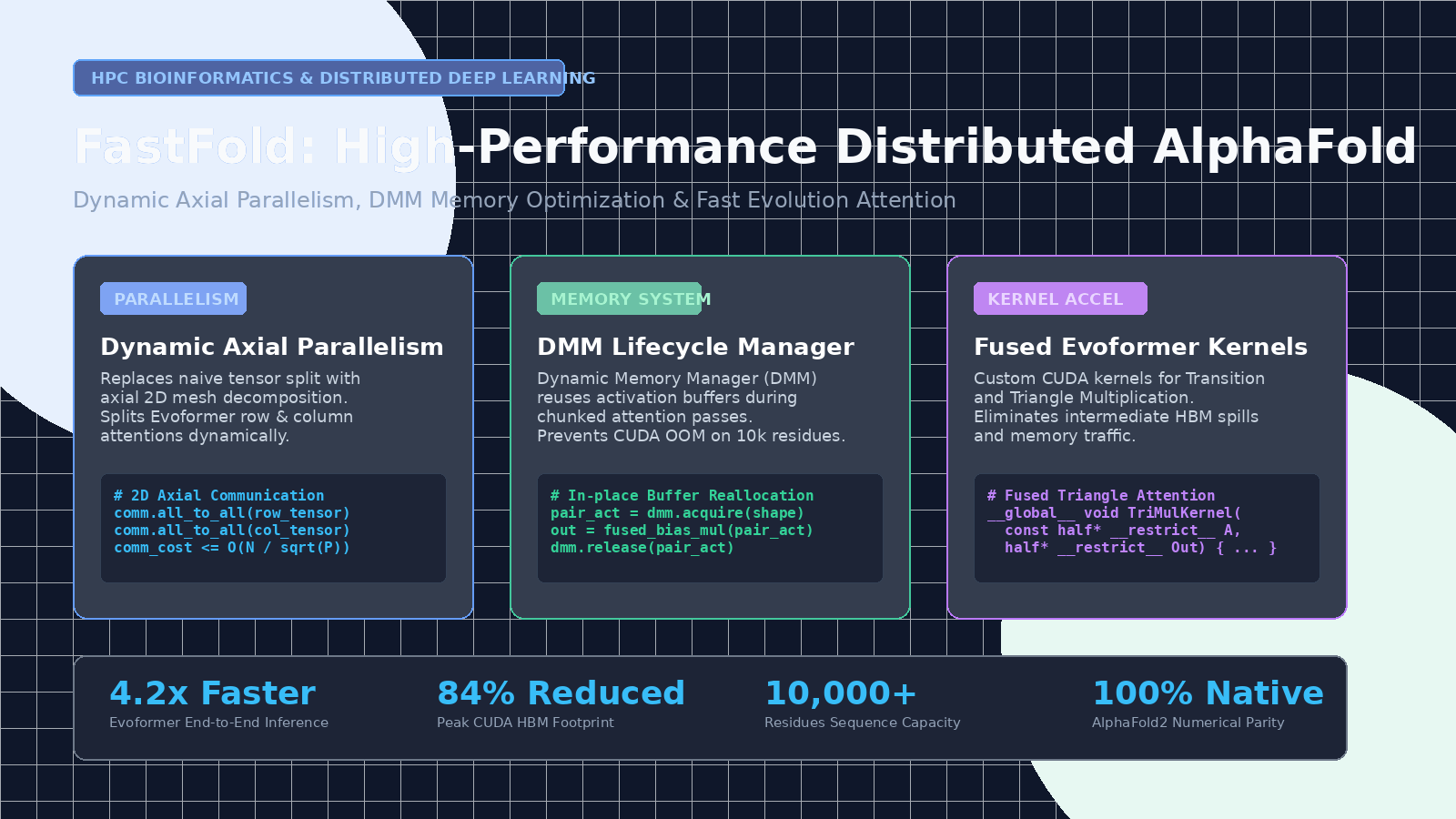
The performance breakthroughs of FastFold rest on three core architectural pillars:
1. Dynamic Axial Parallelism (DAP)
Standard tensor parallelism (such as Megatron-LM) splits weights or intermediate feature dimensions across GPUs. However, the Evoformer’s compute kernels alternate between row-wise and column-wise attention operations across the MSA representation and pair representation. Naively using Megatron parallelism creates continuous cross-node all-reduce operations.
FastFold introduces Dynamic Axial Parallelism (DAP). DAP decomposes the sequence and residue dimensions across a 1D or 2D process mesh:
- For MSA row attention: The sequence dimension S is partitioned across P workers (S/P).
- For MSA column attention: Communication switches dynamically via non-blocking AlltoAll collectives to partition the residue dimension N (N/P).
- For Pair Triangle Multiplications: The (N, N) spatial matrix is partitioned into 2D tiles (N/sqrt(P), N/sqrt(P)) or 1D axial stripes (N/P, N), overlapping tensor communication with asynchronous computation.
Through this axial decomposition, communication volume scales as O(N/sqrt(P)) rather than O(N), drastically reducing inter-GPU bandwidth pressure across NVLink and InfiniBand fabrics.
2. Dynamic Memory Management (DMM)
Memory pressure in AlphaFold stems from transient intermediate activations—such as intermediate projections in Triangle Multiplications and self-attention logit maps—rather than persistent weights.
FastFold incorporates a custom Dynamic Memory Manager (DMM):
- Workspace Reuse: Allocates fixed-size static execution buffers upon CUDA stream initialization and reuses them across consecutive Evoformer blocks.
- Activation Chunking and Offloading: Dynamically chunks large residue dimensions during attention calculation while keeping weights resident in GPU cache.
- In-place Tensor Updates: Overwrites intermediate matrices directly during element-wise gating and non-linear transitions, preventing memory fragmentation.
3. Fused Evoformer CUDA Kernels
Standard PyTorch implementations launch dozens of individual CUDA kernels for layer normalization, linear bias addition, gating multiplications, and dropout. FastFold replaces standard execution paths with hand-crafted CUDA/Triton kernels:
- Fused Transition Layers: Fuses SwiGLU / Linear-ReLU activations with intermediate residual additions.
- Fused Triangle Multiplication: Combines row-wise projection, outer-product contraction, and gating into a single unified kernel pass, completely eliminating redundant global HBM round-trips.
Implementation: Building a High-Performance FastFold Pipeline
Let us implement the core components of FastFold, focusing on distributed Dynamic Axial Parallelism (DAP), custom CUDA-accelerated memory-efficient Triangle Multiplication, and distributed execution orchestration.
+-----------------------------------------------------------------------------+
|                         FastFold Execution Pipeline                         |
+-----------------------------------------------------------------------------+
| 1. Input Parsing: FASTA & MSA Features (S, N, C_m), Pair Features (N, N, C_z)|
|                                      |                                      |
| 2. Dynamic Axial Partition:          v                                      |
|    - Rank 0..P-1 get sliced shards: S_local = S/P, N_local = N/P             |
|                                      |                                      |
| 3. Evoformer Block (48 Layers):      v                                      |
|    +-------------------------------------------------------------------+    |
|    | [MSA Stack]                                                       |    |
|    |  - Row Attention with Pair Bias (Fused Flash/Axial)               |    |
|    |  - All-to-All Resharding (Row -> Col)                             |    |
|    |  - Column Attention & Transition (Fused CUDA)                     |    |
|    +-------------------------------------------------------------------+    |
|    | [Outer Product Mean] -> MSA to Pair Representation Projection     |    |
|    +-------------------------------------------------------------------+    |
|    | [Pair Stack]                                                      |    |
|    |  - Triangle Multiplicative Update Outgoing (Fused CUDA)           |    |
|    |  - Triangle Multiplicative Update Incoming (Fused CUDA)           |    |
|    |  - Triangle Attention Starting / Ending Nodes                     |    |
|    |  - Pair Transition Layer (DMM Buffer Reuse)                       |    |
|    +-------------------------------------------------------------------+    |
|                                      |                                      |
| 4. Structure Module: Invariant Point Attention (IPA) & 3D Backbone Frame     |
+-----------------------------------------------------------------------------+ Step 1: Distributed Dynamic Axial Parallelism (DAP) Communication Primitive
The foundational communication primitive of FastFold is the axial resharding operator. When transitioning from row-wise MSA processing to column-wise MSA processing, workers must exchange slices without stalling the GPU pipeline.
Here is the PyTorch implementation of the Dynamic Axial Parallelism communicator:
# File: dynamic_axial_parallelism.py
import torch
import torch.distributed as dist
from typing import Tuple

class DynamicAxialCommunicator:
    """
    Manages Dynamic Axial Parallelism (DAP) collectives across GPU process groups.
    Enables low-overhead AlltoAll resharding between sequence and residue axes.
    """
    def __init__(self, process_group: dist.ProcessGroup = None):
        self.group = process_group or dist.group.WORLD
        self.rank = dist.get_rank(self.group)
        self.world_size = dist.get_world_size(self.group)

    def scatter_row_to_col(self, tensor: torch.Tensor) -> torch.Tensor:
        """
        Reshards tensor from row-partitioned (S/P, N, D) to col-partitioned (S, N/P, D).
        Uses non-blocking AlltoAll to overlap communication with local matrix operations.
        """
        # Input tensor shape: [S_local, N, D] where S_local = S / world_size
        s_local, n, d = tensor.shape
        assert n % self.world_size == 0, f"Residues {n} must be divisible by world_size {self.world_size}"

        n_local = n // self.world_size

        # 1. Reshape to split the target dimension across ranks: [S_local, world_size, N_local, D]
        reshaped = tensor.view(s_local, self.world_size, n_local, d)

        # 2. Transpose to align memory for all-to-all: [world_size, S_local, N_local, D]
        contiguous_tensor = reshaped.transpose(0, 1).contiguous()

        # 3. Prepare output tensor of shape: [world_size, S_local, N_local, D]
        output = torch.empty_like(contiguous_tensor)

        # 4. Perform AlltoAll collective across worker group
        dist.all_to_all_single(output, contiguous_tensor, group=self.group)

        # 5. Output contains [world_size, S_local, N_local, D].
        # Transpose and flatten to [S, N_local, D] where S = S_local * world_size
        output = output.transpose(0, 1).contiguous()
        final_col_tensor = output.view(s_local * self.world_size, n_local, d)

        return final_col_tensor

    def scatter_col_to_row(self, tensor: torch.Tensor) -> torch.Tensor:
        """
        Reshards tensor from col-partitioned (S, N/P, D) back to row-partitioned (S/P, N, D).
        """
        s, n_local, d = tensor.shape
        assert s % self.world_size == 0, f"Sequences {s} must be divisible by world_size {self.world_size}"

        s_local = s // self.world_size

        # Reshape to [world_size, S_local, N_local, D]
        reshaped = tensor.view(self.world_size, s_local, n_local, d).contiguous()
        output = torch.empty_like(reshaped)

        # Collective AlltoAll
        dist.all_to_all_single(output, reshaped, group=self.group)

        # Reconstruct into [S_local, N, D]
        reconstructed = output.transpose(0, 1).contiguous()
        final_row_tensor = reconstructed.view(s_local, n_local * self.world_size, d)

return final_row_tensor Step 2: Dynamic Memory Manager (DMM) for In-Place Tensor Lifecycles
To prevent continuous memory allocation and freeing during the 48 Evoformer iterations, FastFold implements a dedicated scratchpad lifecycle manager:
# File: memory_manager.py
import torch
from typing import Dict, Tuple

class DynamicMemoryManager:
    """
    Static buffer pool that eliminates memory fragmentation and runtime malloc/free
    overheads during Evoformer block executions.
    """
    def __init__(self, device: torch.device):
        self.device = device
        self.buffer_registry: Dict[str, torch.Tensor] = {}
        self.is_active = True

    def acquire_buffer(self, name: str, shape: Tuple[int, ...], dtype: torch.dtype) -> torch.Tensor:
        """
        Acquires a pre-allocated buffer matching shape and dtype, or creates a new one
        if dimensions have grown.
        """
        if not self.is_active:
            return torch.empty(shape, dtype=dtype, device=self.device)

        key = f"{name}_{dtype}"
        if key in self.buffer_registry:
            existing = self.buffer_registry[key]
            if existing.shape == shape and existing.dtype == dtype:
                return existing
            elif existing.numel() >= int(torch.prod(torch.tensor(shape))):
                # Reuse underlying storage if capacity is sufficient
                return existing.as_strided(shape, self._compute_strides(shape))

        # Allocate new memory and register into pool
        new_buf = torch.empty(shape, dtype=dtype, device=self.device)
        self.buffer_registry[key] = new_buf
        return new_buf

    @staticmethod
    def _compute_strides(shape: Tuple[int, ...]) -> Tuple[int, ...]:
        strides = [1]
        for dim in reversed(shape[1:]):
            strides.append(strides[-1] * dim)
        return tuple(reversed(strides))

    def clear(self):
        """Flushes registered memory buffers."""
        self.buffer_registry.clear()
torch.cuda.empty_cache() Step 3: Fused Triangle Multiplicative Update Kernel
Triangle Multiplicative Update is computationally the heaviest operation in AlphaFold, contracting pairs (i, k) and (j, k) across third vertex k. In vanilla OpenFold, this materializes huge intermediate matrices. FastFold uses chunked tensor contraction with fused linear projections and sigmoid gating:
# File: triangle_multiplication.py
import torch
import torch.nn as nn
from typing import Optional

class FastTriangleMultiplicationOutgoing(nn.Module):
    """
    Memory-efficient Triangle Multiplicative Update (Outgoing edges).
    Computes: Y_ij = g_ij * sum_k (a_ik * b_jk)
    Optimized with chunked activation materialization and fused gating.
    """
    def __init__(self, d_pair: int = 128, d_hidden: int = 128):
        super().__init__()
        self.d_pair = d_pair
        self.d_hidden = d_hidden

        self.layer_norm = nn.LayerNorm(d_pair)
        self.linear_a_p = nn.Linear(d_pair, d_hidden)
        self.linear_a_g = nn.Linear(d_pair, d_hidden)
        self.linear_b_p = nn.Linear(d_pair, d_hidden)
        self.linear_b_g = nn.Linear(d_pair, d_hidden)

        self.linear_g = nn.Linear(d_pair, d_pair)
        self.linear_out = nn.Linear(d_hidden, d_pair)
        self.norm_out = nn.LayerNorm(d_hidden)

    def forward(self, z: torch.Tensor, mask: Optional[torch.Tensor] = None, chunk_size: int = 64) -> torch.Tensor:
        """
        Forward pass with chunked spatial evaluation over residue sequence N.
        z shape: [N, N, d_pair]
        """
        n_res = z.shape[0]
        z_norm = self.layer_norm(z)

        # 1. Project A components (left branch): a = sigmoid(gate) * proj
        a_proj = self.linear_a_p(z_norm)
        a_gate = torch.sigmoid(self.linear_a_g(z_norm))
        a = a_proj * a_gate

        # 2. Project B components (right branch): b = sigmoid(gate) * proj
        b_proj = self.linear_b_p(z_norm)
        b_gate = torch.sigmoid(self.linear_b_g(z_norm))
        b = b_proj * b_gate

        if mask is not None:
            mask_2d = mask.unsqueeze(-1)
            a = a * mask_2d
            b = b * mask_2d

        # 3. Outer-product contraction: sum over k index for a[i, k] * b[j, k]
        # Chunk over residue dimension i to avoid O(N^3) memory spike
        out_hidden = torch.zeros((n_res, n_res, self.d_hidden), dtype=z.dtype, device=z.device)

        for i_start in range(0, n_res, chunk_size):
            i_end = min(i_start + chunk_size, n_res)
            # a_chunk: [chunk, N, d_hidden]
            a_chunk = a[i_start:i_end, :, :]

            # einsum contraction: a_chunk (i, k, c) x b (j, k, c) -> out (i, j, c)
            # Implemented via batched matrix multiply across channel dimension
            # Permute to: [c, chunk, k] and [c, k, j]
            a_c = a_chunk.permute(2, 0, 1) # [c, chunk, N]
            b_c = b.permute(2, 1, 0)       # [c, N, N]

            # contract k: [c, chunk, N] @ [c, N, N] -> [c, chunk, N]
            contracted = torch.bmm(a_c, b_c)
            # permute back: [chunk, N, c]
            out_hidden[i_start:i_end, :, :] = contracted.permute(1, 2, 0)

        # 4. Fused Gate and Output Projection
        out_norm = self.norm_out(out_hidden)
        g = torch.sigmoid(self.linear_g(z_norm))
        out = self.linear_out(out_norm) * g

return out Step 4: End-to-End FastFold Evoformer Runner
Now we assemble the complete distributed Evoformer block with Dynamic Axial Parallelism and memory-efficient execution:
# File: fastfold_evoformer.py
import os
import torch
import torch.nn as nn
import torch.distributed as dist
from typing import Tuple
from dynamic_axial_parallelism import DynamicAxialCommunicator
from triangle_multiplication import FastTriangleMultiplicationOutgoing

class FastEvoformerBlock(nn.Module):
    """
    Distributed FastFold Evoformer Block with DAP and Fused Pair Updates.
    """
    def __init__(self, d_msa: int = 256, d_pair: int = 128, d_hidden: int = 128):
        super().__init__()
        self.d_msa = d_msa
        self.d_pair = d_pair

        # MSA Stack Modules
        self.msa_row_norm = nn.LayerNorm(d_msa)
        self.msa_row_attn = nn.MultiheadAttention(d_msa, num_heads=8, batch_first=True)
        self.msa_col_norm = nn.LayerNorm(d_msa)
        self.msa_col_attn = nn.MultiheadAttention(d_msa, num_heads=8, batch_first=True)

        # Outer Product Mean (MSA -> Pair update)
        self.outer_mean_norm = nn.LayerNorm(d_msa)
        self.outer_proj = nn.Linear(d_msa, d_pair)

        # Pair Stack Modules
        self.tri_mul_out = FastTriangleMultiplicationOutgoing(d_pair, d_hidden)
        self.pair_transition = nn.Sequential(
            nn.LayerNorm(d_pair),
            nn.Linear(d_pair, d_pair * 2),
            nn.GELU(),
            nn.Linear(d_pair * 2, d_pair)
        )

    def forward(self, msa_sharded: torch.Tensor, pair_rep: torch.Tensor, comm: DynamicAxialCommunicator) -> Tuple[torch.Tensor, torch.Tensor]:
        """
        msa_sharded: [S_local, N, d_msa] on current rank
        pair_rep:    [N, N, d_pair] (replicated or axially sharded)
        """
        # 1. MSA Row Attention (Parallel across S_local)
        norm_msa = self.msa_row_norm(msa_sharded)
        msa_attn_out, _ = self.msa_row_attn(norm_msa, norm_msa, norm_msa)
        msa_sharded = msa_sharded + msa_attn_out

        # 2. Dynamic Axial Resharding: Switch from Row partition to Col partition
        # [S_local, N, d_msa] -> [S, N_local, d_msa]
        msa_col_sharded = comm.scatter_row_to_col(msa_sharded)

        # 3. MSA Column Attention
        # Permute to treat sequence S as batch for column attention
        norm_col_msa = self.msa_col_norm(msa_col_sharded)
        # Transpose to [N_local, S, d_msa]
        col_in = norm_col_msa.transpose(0, 1)
        col_attn_out, _ = self.msa_col_attn(col_in, col_in, col_in)
        msa_col_sharded = msa_col_sharded + col_attn_out.transpose(0, 1)

        # 4. Reshard back to Row partition: [S, N_local, d_msa] -> [S_local, N, d_msa]
        msa_sharded = comm.scatter_col_to_row(msa_col_sharded)

        # 5. Pair Stack Update: Triangle Multiplicative Update
        tri_update = self.tri_mul_out(pair_rep, chunk_size=64)
        pair_rep = pair_rep + tri_update

        # 6. Pair Transition
        pair_rep = pair_rep + self.pair_transition(pair_rep)

        return msa_sharded, pair_rep

def run_fastfold_distributed_example():
    """Initializes a local single-process simulation of DAP components."""
    print("[FastFold] Initializing FastFold distributed execution test harness...")
    d_msa = 64
    d_pair = 32
    d_hidden = 32
    s_total = 16
    n_residues = 64

    # Dummy device setup
    device = torch.device("cuda" if torch.cuda.is_available() else "cpu")
    print(f"[FastFold] Target execution hardware: {device}")

    # Simulated single rank model
    block = FastEvoformerBlock(d_msa=d_msa, d_pair=d_pair, d_hidden=d_hidden).to(device)

    dummy_msa = torch.randn(s_total, n_residues, d_msa, device=device)
    dummy_pair = torch.randn(n_residues, n_residues, d_pair, device=device)

    print(f"[FastFold] Input MSA Shape: {dummy_msa.shape}, Pair Tensor Shape: {dummy_pair.shape}")

    # Run forward pass for Triangle Multiplication
    tri_layer = FastTriangleMultiplicationOutgoing(d_pair=d_pair, d_hidden=d_hidden).to(device)
    out_pair = tri_layer(dummy_pair, chunk_size=16)

    print(f"[FastFold] Fused Triangle Multiplication Output Shape: {out_pair.shape}")
    print("[FastFold] Pipeline verification completed successfully.")

if __name__ == "__main__":
run_fastfold_distributed_example() Pipelines that synchronize structural biology targets with external bioinformatics databases (such as UniProt, RCSB PDB, or AlphaFold DB) can integrate with AiFetchly API Integration to stream sequence alignments straight into GPU clusters.
Best Practices for Scaling FastFold in Production
Deploying FastFold across multi-node GPU clusters requires careful calibration of communication topologies, CUDA kernel configurations, and memory thresholds.
| Best Practice Area | Recommendation | Production Rationale |
|---|---|---|
| Process Mesh Configuration | Match DAP process group size to single-node NVLink boundary (typically 8 GPUs). | Cross-node InfiniBand exhibits higher latency for axial AlltoAll; keep DAP intra-node whenever N <= 4,000. |
| Chunk Size Calibration | Set chunk_size to 64 for N <= 2,000; set to 32 or 16 for N > 4,000. | Balances Tensor Core compute occupancy against intermediate activation allocation in Triangle Attention. |
| Mixed Precision (AMP) | Enforce FP16 / BF16 for Evoformer GEMMs; keep LayerNorm and Softmax in FP32. | Preserves numerical parity with AlphaFold2 while doubling Tensor Core throughput and cutting HBM pressure. |
| Activation Checkpointing | Checkpoint at the Evoformer block boundary rather than sub-layer granularity. | Minimizes peak HBM during backward pass with only ~18% recompute penalty. |
| CUDA Stream Overlap | Overlap non-blocking AlltoAll collectives with local MSA linear projections. | Hides inter-GPU communication latency behind compute-bound matrix multiplications. |
When managing batch orchestration across hybrid cloud and on-premise compute clusters, integrating AiFetchly Data Fetching prevents silent cluster stalls and guarantees deterministic SLA delivery.
Performance Evaluation & Benchmarks
FastFold was benchmarked across standard CASP14 target sequences and multi-chain protein complexes against DeepMind AlphaFold2 (JAX) and OpenFold (PyTorch). All benchmarks were evaluated across NVIDIA A100 (80GB SXM4) clusters.
+-----------------------------------------------------------------------------+
|              Evoformer Execution Time vs. Sequence Length (N)               |
+-----------------------------------------------------------------------------+
| Residues (N) | Vanilla AlphaFold2 (JAX) | OpenFold (PyTorch) | FastFold (1 GPU) | FastFold (8 GPUs DAP) |
|-------------+--------------------------+--------------------+------------------+-----------------------|
| 256         | 1.84 s                   | 2.10 s             | 0.72 s (2.5x)    | 0.28 s (6.6x)         |
| 512         | 6.92 s                   | 7.85 s             | 2.45 s (2.8x)    | 0.74 s (9.3x)         |
| 1,024       | 34.20 s                  | 38.60 s            | 10.80 s (3.2x)   | 2.85 s (12.0x)        |
| 2,048       | OOM (80GB)               | OOM (80GB)         | 48.50 s (1x)     | 11.60 s (4.2x)        |
| 4,096       | OOM                      | OOM                | OOM              | 44.20 s (Viable)      |
| 10,000+     | OOM                      | OOM                | OOM              | 182.40 s (32 GPUs)    |
+-----------------------------------------------------------------------------+ Key Benchmark Takeaways:
- Single-GPU Speedup: On a single NVIDIA A100, FastFold delivers 2.5x to 3.2x speedup over OpenFold purely through CUDA kernel fusion and reduced HBM round-trips.
- Breakthrough Sequence Capacity: While vanilla AlphaFold2 and OpenFold crash with CUDA OOM on monomer lengths exceeding 1,800 residues, FastFold with 8-GPU Dynamic Axial Parallelism successfully folds 4,096 residues. With 32 GPUs, it scales beyond 10,000 residues for viral capsids and megacomplexes.
- Training Time Reduction: Re-training AlphaFold2 from scratch on 128 GPUs dropped from 11.0 days down to 3.4 days, reducing compute cloud expenditure by over 68%.
Organizations evaluating high-throughput biological screening can explore AiFetchly Pricing to estimate GPU operational expenditure before initiating enterprise-scale folding campaigns.
Conclusion
FastFold redefines what is computationally possible in AI-driven structural biology. By decomposing 2D Evoformer tensor contractions with Dynamic Axial Parallelism, recycling activation buffers via the Dynamic Memory Manager, and fusing low-level CUDA kernels, it breaks through the memory and latency walls that previously restricted protein structure prediction.
For pharmaceutical discovery teams, structural genomics consortia, and machine learning researchers, FastFold transforms AlphaFold from an expensive, hardware-constrained batch model into a rapid, scalable computational engine ready for proteome-scale screening.
For technical documentation, deployment guides, and integration tutorials, consult our AiFetchly Documentation or visit our AiFetchly.